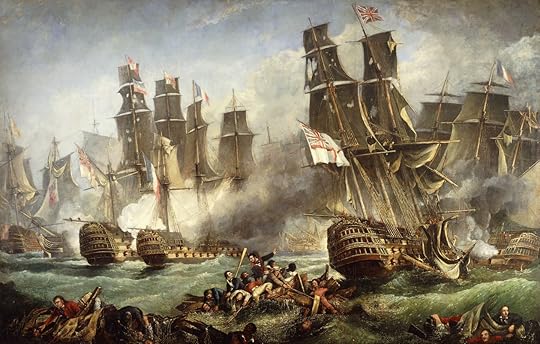
A kiváló brit hadtörténész könyvének tárgya: hogyan harcolt az ember a tengeren a sorhajók virágkorától a tengeralattjárók megjelenéséig. Elemzése négy kulcsfontosságú ütközetre koncentrál. Ezek a trafalgari, a jütlandi, a Midway-szigeteki és az atlanti-óceáni ütközet.
A mű nemcsak ismerteti a tengeri hadviselés fejlődését a vitorlás hadihajóktól a csatahajókon át a repülőgép-anyahajókig és a tengeralattjárókig, hanem mintegy élményszerűvé is teszi az olvasó számára, hogy a csata ára – akár tengeren, akár szárazföldön vívják is – emberéletekben méretik.
„A világ legkiválóbb hadtörténészének könyve.” Tom Clancy
Sir John Desmond Patrick Keegan, OBE, FRSL was a British military historian, lecturer and journalist. He published many works on the nature of combat between the 14th and 21st centuries concerning land, air, maritime and intelligence warfare as well as the psychology of battle.
Bizonyos értelemben a tengeri hadviselés története leírható úgy, mint egy út a szépségestől a monumentálison át a láthatatlanig. Keegan története a vitorlásokkal kezdődik. A vitorláshajó a korszak technikai csúcsteljesítménye, igazi műalkotás, a famegmunkálás Csomolungmája - úszó erőd, megpakolva ágyúval, sózott hússal és rummal, szelet eszik, hasítja a habot, és ha összeakad egy riválissal, oldalsortűzzel köszönti. Azonban az ipari forradalom megteremti a gőzgépet, és lehetővé teszi, hogy egy hajó ne roskadjon össze a páncélzat súlya alatt - ezek a gyönyörűségek tehát nyugdíjba mennek, és átadják helyüket a gigantikus vasszörnyeknek, a csatacirkálóknak, hogy ők uralják az óceánt. Ám az óriási acél csatahajók kora sem tart örökké. A törpék teszik őket parkolópályára - a hozzájuk képest liliputi tengeralattjárók, no és a repülők, ezek a bosszantó szúnyogok, akik egy szerencsés bombatalálattal hullámsírba küldhetik a leghatalmasabb Leviatánt is. Utóbbiak az óceán új urairól, az anyahajókról indulnak útra - de az anyahajó is kénytelen meghajolni a tengeralattjáró hatalma előtt. Mert a legerősebb az, aki lát téged, de te nem látod őt. És ez bizony a modern tengeralattjáró, a vízek Chuck Norris-a.
A szokásos Keegan: alapos, mély, megvilágító erejű. A szerző voltaképpen négy csatán keresztül vázolja fel a tengeri hadviselés evolúcióját. Először Trafalgart vesézi ki, a vitorlások eposzi egymásnak feszülését. Majd jön Jütland, meg a fém csatahajók. Ezt követi Midway értő elemzése - itt az anyahajók játsszák a főszerepet, gyakorlatilag statisztaszerepbe kényszerítve a klasszikus hadihajó-osztályokat. De a végszó a tengeralattjáróké, akik az atlanti csatában megmutatták, mire képesek. És bár ekkor még vereséget szenvedtek a szonárral és vízibombával felszerelt hadihajóktól és kísérőrepülőgépektől, de előrevetítették a jövőt: hogy a felszínt az uralja, aki a mélységet uralja.
Nyilván felmerül a kérdés, hogy hol érint minket ez. Nekünk nem cserzette arcunkat a sós szél, nekünk nem sirály jutott, legfeljebb szirti galamb. Ugyanakkor alighanem mi vagyunk az egyetlen ország Európában, ami kormányzói posztra emelt egy matrózt. Szóval valahol a lelkünk mélyén biztos akad egy hullámok verte tengeröböl.
Written in 1988, The Price of Admiralty is the Military writer John Keegan's Naval Warfare history, a companion to his great Face of Battle and Mask of Command , books about land warfare and command, control and strategy. To tell the story of modern Naval warfare, he chooses to focus on four particular good (or only) examples of fleet warfare, the classic battle off cape Trafalgar in 1806- that sealed the British Empire as full Master of the Oceans until 1914, 1916's Great clash of Imperial German High Seas Fleet and the Royal Navy's dreadnaught based Battle Fleet at Jutland, and then two of WWII's epic battles, the Carrier Clash Midway, and the more drawn out epic of the Battle of the Atlantic. Keegan uses these exemplar battles to takes us through the whole development of Wind powered combat and it's transition through Coal powered steam to Diesel and Fuel Oil based Navies. Along the way we see the Royal Navy start in a existential battle with Spanish and French Napoleonic Navies- then transition at the end of the 19th Century and the beginning of the 20th to a strategic opposition with Imperial and then Nazi Germany. The Americans come on the scene with their Spanish American war Colonial land grab- and influential author Mahan- and then to world Power status in WWI. The lightning rise of the Imperial Japanese Navy from nothing in 1870- to the Destruction of a Russian fleet with pre-dreadnaughts in 1905- and a strong dreadnaught based navy to become a Pacific Power by 1918- and then to lead the world in Carrier technology in the 20s and 30s- Keegan takes you through it at a fast but not impossible clip. He tells the story of a difficult complex place to fight, on water, and all the layers of technologies and counter technologies that these struggles called for from the nations that choose to take on the challenge.
The wooden ships of the late 1600s - to the 1850s, with their broadsides of cannon throwing more weight of shot than most land armies could dream of were massively destructive- but hard to communicate with at sea- and of course in some ways captive to the winds for their movement, did not lend themselves to decisive battle, so the Royal Navy in General and Admiral Nelson in particular tried to teach basic rules tactics- and then rely on the strength of their officers, seamanship and gunnery to carry the day. The rise of the big- gun battleships- a whole generation named after HMS Dreadnaught in the early 1900s led to a less conclusive battle at Jutland where the ships' destructive power was made clear- but how to properly use the many more types of naval ships was still unclear and in flux. Keegan adds more content on the small ships (Destroyers, Torpedo boats and submarines) fighting at Jutland- that really helps the reader understand how technology and doctrine can get out of sync as sailors often hold on to out dated ideas while their gear is taking them in another direction. Then the Aircraft Carrier and the Submarine- and Radar/Automatic Cannon for AA/DepthCharges/Torpedo improvements/Sonar and Mines - come into play for Midway and the Battle of the Atlantic. Pearl Harbour's destruction of the American battlefleet makes the Americans base their Battlegroups around Carriers - more like the IJN- and now Admirals need to understand fighting with Aircraft- and finding the enemy with aircraft as well. In the Atlantic, the U-boats try and use their "Wolfpack" gang attacks on shipping- while the US/RN/RCN/Allies use their cryptography and technological tools to fight the "U-Boat Menace". Keegan shows us how the Allies kept closing the "Air Gap" in the central Atlantic, having found the Airplane the best Anti Submarine Warfare weapon- finally adding small aircraft carriers to Convoy protection packages to drive off the Nazi Kreigsmarine. The move/countermove, technology/countertechnology in Naval warfare is as intense as any other arms race- and more intense than some others. Keegan brings it alive in a way that will content the general reader- and excite the military enthusiast for more books on the topic, the mark of a great writer.
There are some adult themes and Keegan is clear to give graphic accounts of how intense the damage from massive projectile, bomb and torpedo warfare can be , so this a book best read by the Junior reader over about 13/14. For the Gamer/Modeler/Military Enthusiast this is a strong resource- but perhaps not directly. These exact battles are refought by gamers- but the gamer will get even more from understanding the overall development of the navies of each period- and how to create other scenarios to test theories or game engines. The Modeler gets a lot of ideas for builds and dioramas, more from the prose than from the above average b/w photos that accompany the text. The Military enthusiast gets a good survey history of Naval warfare-a good base from which to learn further. Keegan even give us some good Cold War Content- discussing the NATO Navies' ASW warfare efforts and even applying his analysis to the then recent Falklands War- where the Royal Navy had to keep its Carriers out of land based Aircraft range whilst achieving the Air Superiority they needed if not the Air Supremacy they desired. At the same time their Quieter Subs could keep the Argentinian Navy with its WWII era gear outside the "Exclusion Zone" with relative ease. I think this book is a worthy addition to any Naval Library, and a good book for the Military History novice to read from one of the masters of the craft.
An early book by possibly the most famous military historian of our times. This book focuses on four major naval battles starting with Trafalgar and moving from WWI to WWII. Although sections of it are difficult to penetrate without more maps and diagrams to aid in understanding the positions of the ships involved, the majority of the analysis and quotes from various journals and publications from the time are very readable and quite interesting. There is also a helpful glossary of nautical terms which I should be more familiar with given the amount of naval books I read but here we are. Recommended reading for the Armchair Admiral.
Outstanding book that is easy to read, although not a quick read. There is so much good information that I had to slow down my pace to absorb it all! Picked this book up at a used book sale based solely upon the seeing the author... glad I did! I don't read much naval history, but this book was a welcome addition to my reading program. I've heard the term "wooden walls" in previous books, but Keegan enabled me to understand what the sailors truly mean from the days of wooden ships. Key excerpts below:
- For where Villeneuve saw difficulty, Nelson glimpsed opportunity. - … where Villeneuve shrank from action, Nelson sought by every means to bring it on. - It is a brilliantly straightforward statement of intention. “I have made up my mind…”… “ and should the enemy close I have no fears as to the result.” - Not yet constrained, as later fossil-fuel fleets would be, by the endurances imposed by the capacity of their coal bunkers or oil tankers, Britain’s wooden walls, creaking south, west or eastward at fifty or sixty miles a day, could keep the seas and cover distances without the need to touch land for periods never achieved before or since. - Naploleon’s Army of the North of 1815, that destined to give battle at Waterloo, took 366 guns… By contrast, Nelson’s Trafalgar fleet of 27 ships mounted 2232 guns. - He had grasped, in short, that the defensive was the stronger form of war between gunpowder armies… Nelson had perceived an opposite truth: that the offensive was the stronger form of warfare between gunpowder navies. - Unlike the masonry fronts of the ‘artillery trace’ fortresses on which the European dynastic states had poured out their millions in the 17th and 18th centuries, man-of-war hulls did not fracture or collapse when struck by solid shot. They rarely exploded, burnt or sank. - Japan had created a navy from nothing out of the conviction that only thus could it outface the foreigners who, in the middle of the 19th century, had intruded upon its self-imposed, long established isolation and thereby threatened its peculiar social order with disruption. - … moving inside one of those weather fronts which the Japanese were so adept at using as cover to disguise their deployments. - He thought in terms of massing an overall superiority rather than of keeping the right “mix” of aircraft types, ready for action, airborne over his own ships and heading for the enemy, which was the secret of successful carrier command.
Purpose of this book is to study challenges of naval warfare throughout last two hundred years, which Keegan claims was the period when major developments took place. For this purpose, the author provides case studies of four major actions during that period - Trafalgar illustrates apogee of man of war, Jutland does the same for Dreadnought era, Midway serves as the start of the age of aircraft carriers and finally clash between convoys HX 229/SC 122 and submarine packs of Dönitz in March 1943 brings the submarine into focus. Each of those engagements illustrates changes in technology and unique sets of challenges that those developments presented to the admirals.
Naturally, descriptions of those engagements take up major part of the book and therein lies both its strength and weakness. Keegan's selection of battles is impeccable - each of them is a milestone in history of naval warfare. Thus comparison between them is rather informative. At the same time, for those familiar with the battles, narrative of the author will probably be just a repetition of already well-known facts and the analysis/comparison provided by the author goes only skin-deep.
Keegan weaves a tale of naval doctrine evolution through a series of battles. He provides battle details, tactical context, and post mortems to explain the significance of each battle in shaping naval warfare in a concise and engaging manner.
Excellent recounting and analysis of the crucial battles he covers. His final analysis does lack an adequate analysis between the combined arms of the submarine and carrier task force, but does correctly identify the stronger platform.
I definitely enjoy John Keegan’s earlier books better than his later ones. I do not think that I have read this one since I originally read it when I purchased it back in the late eighties. Actually, it brings up some interesting questions about the current state of naval warfare.
It’s hard to slam a guy who has written what many consider to be The Single Best Book on Military History Ever (“The Face of Battle”); but I think that Keegan, like Tom Clancy, knocked out a great first book, then a couple of pretty good ones, and then just coasted. (That is of course the only thing the two have in common.)
This book, which tracks mostly the technological story of modern naval warfare from the age of fighting sail to the submarine is rendered in somewhat boring and occasionally confusing prose—Keegan is no NAM Rodger—but it is at least short. It is also a “tweener” book: perhaps dull old hat for knowledgeable readers, but something maybe a little too involved for the beginner. So I am not sure who should read it. It is old hat because it is a summary of existing scholarship, and is seemingly written almost entirely from secondary sources, some quoted at great length. At the end Keegan throws on a decidedly non-intriguing short concluding chapter. “Who knows what the future will bring to naval warfare?” (Spoiler alert, it’s awesome new submarines. Drones weren’t around yet.) But if the book is not for the advanced reader, what about the naval warfare newbie? Maybe, but Keegan also assumes a certain amount of basic knowledge in the reader which, combined with its dull prose, makes it (I would think) a tough read for the naval novice.
Anyway, the story is told through four famous naval battles: Trafalgar (the wooden warship), Jutland (the gigantic iron battleship), Midway (the aircraft carrier), and the Battle for the Atlantic (the submarine). Each of the book’s four sections has a tedious summary of the technological, military, social, political, and historical setting surrounding the battle, followed by a short, basic account of the battle, with only one or two maps, and those of such poor quality as to be almost useless. Grrrrrrrrr. One really would be better off reading a good account of each battle.
I learned the most about Jutland, about which I previously knew the least. So, ok, way to go Keegan. But I just can’t escape the notion that he is reading all the best secondary sources, digesting them, and trading on his hallowed name to sell his regurgitations. Maybe not the easiest money, but it’s hard to accept. I stopped buying his books a long time ago and punted on this one because it is one of his relatively early books and it’s been on my shelf for a long time. It’s not as bad as his later books, but I can’t recommend it. Meh.
John Keegan has turned his formidable talent to analysing some of the most famous naval battles of the last 200 years. For each, he gives an insightful look into the recent history of the times, emphasising technological aspects of ship handling and weapons. He then breaks down the battles into easy-to-comprehend chunks, followed by an analysis of the consequences (usually political) and the more immediate cost in terms of the sailors and ships involved.
While all 4 battles are famous examples, Keegan seems to waffle between choosing battles that were decisive and those that were stalemates. Trafalgar was a decisive battle, but it was unusual in the Age of Sail that one navy enjoyed such a complete victory over its enemy. Alternatively, Jutland was a large battle, but the battle itself was a tactical draw in that both sides left the battle with their proportionate strengths intact. A far more decisive ironclad battle occurred at Tsushima Bay, so why didn't Keegan choose that (admitedly less famous) battle instead?
The remaining two battles are from WWII - Midway and the Battle of the Atlantic. Midway was a clear U.S. victory, and the purest example of carrier-based naval conflict. The Battle of the Atlantic was ultimately decisive as well, but due to the seesaw of technological advancess, the outcome was very much in doubt for 4 years. Although the submarines ultimately lost the Battle of the Atlantic, Keegan concludes submarines are the ultimate naval weapon available today, and points to the success of the U.S. submarine offensive against Japan. If that is his conclusion, why not give an account of the Japan-U.S. conflict instead of the Battle of the Atlantic?
Is this nitpicking? For a book titled "the evolution of naval warfare", there is a short window of evolution. What about Salamis? Lepanto? On the other hand, the strength of the book is the masterful analysis of each individual battle. While I may question the overall theme and choice of battles, each chapter in and of itself is fantastic. Therefore, it gets 4 stars, as it is inferior to Keegan's Face of Battle and Mask of Command in maintaining an overarching theme.
This was an enjoyable read, but nothing remarkable as I recall almost 12 years later. I can't find it on my shelves, so it seems that I gave it away, probably because it just wasn't worth saving.
I have little memory of the book. When I first wrote this review, I confused it with Sea of Thunder by Evan Thomas, which I read shortly before this one and still have in my possession.
I do recall that many of John Keegan's historical opinions rub me the wrong way, but I don't know how much of that came from this book and how much came from other sources. For the subjects of history that I have studied, which have different perspectives from different historians, my view has always been different from his.
4 stars out of 5 - I re-read a hardbound that has been around here since the 1990's. It's a good combination of high level general information about the sweep of history and intense focus on the few hours or days when the effects of major revolutions in technology, attitude or tactics made themselves felt. The title is a bit misleading because the book goes beyond Midway to do a great job of describing the U-Boat vs convoy escort war that reached its turning point in 1943.
A really interesting book looking at the evolution of strategy, tactics and technology of naval warfare over the centuries. Although there are references to other periods, the focus is very much on 4 battles: Trafalgar, Jutland, Midway, and the Battle of the Atlantic. I learned a lot and enjoyed the process.
John Keegan, the excellent British historian, has given us a well written and incisive chronicle of naval warfare from Trafalgar to the battle of the Atlantic. Recommended.
Excellent, well rounded book discussing various aspects of war at sea from the Napoleonic Wars to the end of World War 2. It is a niche subject that most people wouldn't be interested in, but Keegan's writing is incredibly clear and approachable so I would recommend this to someone with even a passing interest in the topic.
The book focuses on four specific battles, but also the events surrounding them which is essential to appreciate why things happened the way they did. The specific battles are the Battle of Trafalgar, the Battle of Jutland, the Battle of Midway and the Second Battle of the Atlantic. One of the author's touches that I appreciated was that he was able to tie each battle into the last even though they took place over nearly 150 years (and over a century between the first and second ones.)
His descriptions of the various battles are excellent, and done as well or better than any fiction I've read. There is a fair bit of buildup to read through before these, but this is non-fiction so I just considered these sections more of a treat than anything.
This book provides an overview of the development of naval warfare over the last 200 years. Keegan uses four pivotal naval battles to frame this overview: the Battle of Trafalgar (Napoleonic war), the Battle of Jutland (WWI); the Battle of Midway (WWII), and the Battle of the Atlantic (WWII). This is a well researched book and will be primarily of interest to serious naval enthusiasts. The author spends considerable energy listing the commanders and their specific ships, as well as general naval design. I found this aspect of the book rather dull and "dry". The most interesting parts of the book were detailed descriptions of battle scenes and how those on ship lived or perished through the ordeal of battle. I also found the general battle strategy interesting. In the end I enjoyed the book, but I think the casual reader would find the book rather dull and overly technical.
Through the use of four seminal naval battles (Trafalger, Jutland, Midway, Atlantic), Keegan provides a very good overview of the evolution of naval warfare. He traces the development of naval warfare from the "wooden walls" through the "big guns" to the current debate about whether air or submarine is the future of naval warfare. An excellent historian and writer, Keegan manages to mix strategy, tactics, and engineering with the impact on the individual sailor. The book is a little bit dated however, in that Keegan correctly viewed the submarine as the most likely dominant factor in command of the seas, but in 1990 he appears not to have taken into account the role of the aircraft carrier as a means of projection of power in our current period of asymmetric warfare. Nevertheless, a very good history.
Typical Keegan, which is certainly not a bad thing. In particular, the first two sections covering Trafalgar and Jutland are spot-on, and his excellent (if short) concluding section is also insightful and provocative for those interested in contemporary naval strategy and strategic trends. However, while certainly worth the time, his two sections covering Midway and the Battle of the Atlantic seemed wanting. More significantly, it seems as though Keegan himself recognizes his own limitations in covering these conflicts, citing repeatedly (and at length) Samuel Elliot Morison's _Two Ocean War_ and official histories of US naval operations in the second World War. But for this shortcoming, The Price of Admiralty is still an excellent read.
Keegan's Price of Admiralty studies four naval changes in the modern world by focusing on Trafalgar (height of wooden ship action), Jutland (the Dreadnaught battleship), Midway (naval air power) and the Battle for the Atlantic (submarine warfare). Keegan's love of wooden ships and the self-sufficiency of Nelson's navy have made me read and reread O'Brian. Keegan has nothing but contempt for the Dreadnaught WWI navies - the result of an expensive arms race that always required the latest smoke-belching ships. In the future, naval contests will be decided by planes and subs and Keegan sees the latter as victorious due to their versatility. A straightforward account, but rich in analysis and background, steeped in the language of the navy but with a historian's detachment.
Another excellent read by military historian John Keegan. Narrative histories of four naval battles (Trafalgar, Jutland, Midway, and a convoy attack during the Battle of the Atlantic) that each start at the strategic level (including the causes of the wars and underlying technology) and work their way down to the details of each battle and finally on individual experiences.
The book would be superb with just the traditional battle accounts, the extra focus on how the battle affected individuals gives it a perspective often ignored. And not a comfortable perspective; naval injuries could be quite brutal. Two of the battles were decisive victories, with courage and imagination on exhibit all around. But none of them seem glorious by the time I finished reading.
John Keegan recently died. That is a great loss. I got into a stretch where I was reading a lot of him, often on audio since his books are so well written and easy to follow. Keegan combines balanced critical history with a good story telling sense and a sensitivity for critical individuals.
This book reflects his thinking on the evolution of modern naval warfare. He does so by providing four case studies on critical battles - Trafalgar, Jutland, Midway, and the Battle of the Atlantic. All of the cases are focused on interesting. His reflections on how naval warfare changed from Nelson to Nimitz are clear and memorable. I liked the battle of Jutland out of the four, although the details of all four will be familiar to anyone who does even modest reading in military history.
A solid survey of naval warfare by the always-interesting Keegan, this book suffers some from a lack of clearly-defined audience. Although the scope of the book means that it must be targeted towards the uninitiated, Keegan's natural tendency to throoughness means that its vigor is somewhat dissipated - some passages degrade to mere listing of order of battle, captain's names, tonnage, etc.
The best sections of the book are the end, a summary and look into the future, and the coverage of midway, which is both thorough but also moves quicker relative to other sections of the book.
Overall, a recommended read with these caveats in mind.
Not quite as great as Keegan's looks at ground war. Still, the chapter on Nelson, with its "world of wood" to describe the ships of the Trafalgar era, and that on Donitz, who crafted Nazi naval strategy with its emphasis on U-boats, are the best, in my opinion. Chilling ending to that last portrait, after Donitz's two sons, Klaus and Peter, are killed in World War II, the latter going to the bottom of the Atlantic on U-954. Donitz apparently didn't shiver a bit, as Keegan notes, "Over neither death did Donitz permit himself the smallest interruption of his daily routine. The hardness he so often urged on his captains had entered into his soul."
This is a reaadable account of the battles of Trafalgar, Jutland, Midway, and the Atlantic, clearly modeled on Keegan's wonderfully innovative The Face of Battle. It's an enjoyable read, and a good introduction to these battles for those unacquainted with them. However, there's little new in it for those already familiar with them. There is some attention to the actual experience of the participants, the approach that made Face such a hit, but not enough to add up to a really new treatment.
Keegan does for naval warfare what he did for land warfare. He outlines key battles that exemplified a major change in warfare based upon technology or tactics: Trafalgar (wooden capital ships and "breaking the line"); Jutland (dreadnought battleships and fleet-on-fleet precision gunnery); Midway (naval air warfare and aircraft carriers and battles between fleets beyond the horizon); and Battle for the Atlantic (unrestricted submarine warfare and the development of anti-submarine warfare). If you like military history, Keegan will keep you interested.
A little torn on how I feel. This almost four beefy articles, each well written, and then compiled into a single volume. Each interesting, but not as "evolutionarily" connected as seems like they potentially could have been.
Even if the author elected to confine himself to "modern-ish" period, I would have preferred starting with the Spanish Armada, rather than Trafalger.
Still, well written and factually well founded. But feels a little like a quality, popular author doing volume to make sales.