

What do you think?
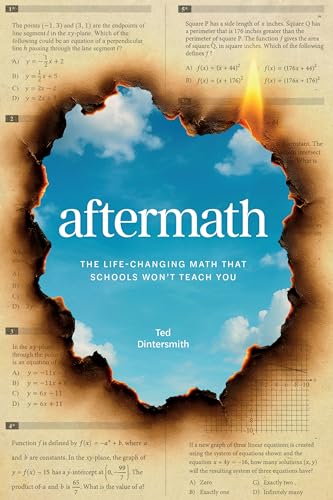
Aftermath: The Life-Changing Math That Schools Won't Teach You
Whether you loved or loathed high-school math, Aftermath will change how you think about math—and life.
Forget rote math’s dry formulas and abstract symbols. This book illuminates the fascinating math ideas that are essential to you and your loved ones—ideas totally ignored in school.
“In the age of AI and data, we badly need to rethink the way we teach math in U.S. schools. Dintersmith has joyfully illustrated how we can pull the subject out of irrelevance in the eyes of our students—a must read for teachers and parents alike.”
—Steve Levitt, Co-Author, Freakonomics and SuperFreakonomics
Forget rote math’s dry formulas and abstract symbols. This book illuminates the fascinating math ideas that are essential to you and your loved ones—ideas totally ignored in school.
“In the age of AI and data, we badly need to rethink the way we teach math in U.S. schools. Dintersmith has joyfully illustrated how we can pull the subject out of irrelevance in the eyes of our students—a must read for teachers and parents alike.”
—Steve Levitt, Co-Author, Freakonomics and SuperFreakonomics
280 pages, Paperback
First published January 1, 2026
Ratings & Reviews
Friends & Following
Create a free account to discover what your friends think of this book!
Community Reviews
Displaying 1 - 18 of 18 reviews
April 24, 2026
I found the author's life story on his experience with
math eye-opening and compelling. But had a hard time getting through the dense subsequent text. I plan to give this another read when I have more time for concentration. I suspect that other readers less cowed by math won't have my challenges with the book.
math eye-opening and compelling. But had a hard time getting through the dense subsequent text. I plan to give this another read when I have more time for concentration. I suspect that other readers less cowed by math won't have my challenges with the book.
June 9, 2026
This book is borderline awful besides the premise that math literacy is a very needed tool in everyone’s life. Yes, these specific subjects in math should be taught more frequently, absolutely.
But here’s where this book falls short. First, the math required to be able to do probability and statistics is taught in the years leading up to when a student would normally take it. You can’t just say “WE NEED TO TEACH THIS TO EVERYONE” when the majority of the people you want to teach don’t have the necessary skills to be able to learn it. Second, while this book breaks down many different subjects, most of them are all taught in one subject, statistics. A statistics class usually covers estimation, probability, optimization (and of course statistics itself).
Here’s where the book really made me mad. The author wants to try and replace the math currently being taught with these subjects. When he goes into each subject, he doesn’t actually show how it should be taught. He just wants to spew a bunch of different statistics and tidbit facts to try and prove his point. Again, this is fine if the main goal of the book is to promote mathematical literacy, but it’s not. The author wants to change the whole math curriculum. And not once did I see him actually trying to go about showing how to actually teach these skills.
There’s a reason why students go through that natural progression of math classes. It’s because the ideas and skills naturally build on top of each other. By the time a student graduates high school, they will most likely have taken pre calculus, calculus, or college algebra. These classes provide all of the necessary skills this book is trying to get across. So what’s the point of this book? The hope is that when students leave or when they are finished with their math classes, they will have the necessary critical thinking skills to be able to question and try to understand many of the things this book tries to get you to question and understand.
Out of all of this, let’s say all we do is add a mathematical literacy class. Is that class going to be mandatory? Is that class going to change how students feel towards math? Doubtful. The kids that do take it will treat it like they do most classes.
But here’s where this book falls short. First, the math required to be able to do probability and statistics is taught in the years leading up to when a student would normally take it. You can’t just say “WE NEED TO TEACH THIS TO EVERYONE” when the majority of the people you want to teach don’t have the necessary skills to be able to learn it. Second, while this book breaks down many different subjects, most of them are all taught in one subject, statistics. A statistics class usually covers estimation, probability, optimization (and of course statistics itself).
Here’s where the book really made me mad. The author wants to try and replace the math currently being taught with these subjects. When he goes into each subject, he doesn’t actually show how it should be taught. He just wants to spew a bunch of different statistics and tidbit facts to try and prove his point. Again, this is fine if the main goal of the book is to promote mathematical literacy, but it’s not. The author wants to change the whole math curriculum. And not once did I see him actually trying to go about showing how to actually teach these skills.
There’s a reason why students go through that natural progression of math classes. It’s because the ideas and skills naturally build on top of each other. By the time a student graduates high school, they will most likely have taken pre calculus, calculus, or college algebra. These classes provide all of the necessary skills this book is trying to get across. So what’s the point of this book? The hope is that when students leave or when they are finished with their math classes, they will have the necessary critical thinking skills to be able to question and try to understand many of the things this book tries to get you to question and understand.
Out of all of this, let’s say all we do is add a mathematical literacy class. Is that class going to be mandatory? Is that class going to change how students feel towards math? Doubtful. The kids that do take it will treat it like they do most classes.

September 15, 2026
In the preface of Aftermath, Ted Dintersmith argues that the math students are being taught in schools is grossly outdated - a math curriculum that adheres "to a 1893 model that expressly rewards rote skills of diminishing value - memorize content, replicate low-level procedures, follow instructions. Worse, a model expressly designed to erase the traits of ever increasing importance - creativity, curiosity, agency and audacity". He argues that the math students are taught - algebra, geometry and trigonometry, calculus - is not the math they will use in daily life; while some professions - pharmacists, nurses, carpenters, architects, chefs etc - do use math on a daily basis, most of this math (ratios, volumes, angle alignment) had to be relearned on the job and can be handled by smartphone apps. 0.1% of the labour force - the likes of physicists, econometricians, AI researchers - will use abstract and theoretical math.
Instead of "math formalism" taught in schools, Dintersmith argues that it would be far more useful for students to be taught "modern math" that defines and shapes our daily lives: estimation; statistics; probability; prediction; optimisation; algorithms, decision analysis; and game theory.
#1: Estimation: Estimation is a critical skill to assess if the numbers we are being fed on a daily basis - the unemployment rate, COVID deaths, companies' financial results to name a few - make sense or sound dodgy. Dintersmith outlines how we might go about producing an informed estimate - "after clearly defining your factor of interest, create a well conceived approach to produce an informed estimate, along with guidance about your estimate's margin of error. When an exact count is impractical or impossible, how do we make a good enough estimate? How might we estimate the lower bound and upper bound of the actual number?
#2: Statistics: Dintersmith defines a statistic as "a number synthesised from available data that captures an important aspect of an entity's performance." Statistics is about tapping on "credible, available data to create a composite number telling a story that matters." Equipped with a good understanding of statistics allows us to inform, explain and inspire, and protects us from being misled and manipulated. We need to discern whether the numbers we are fed are telling the true story of what we want to understand. For instance, does defence spending really reflect military prowess? Does the CPI really help us understand how changes in prices are affecting consumers? And do the US News and World Report rankings of universities really tell us how good a university is?
#3 Probability: An understanding of probability allows us to gauge uncertainty when faced with scarce data. Probability is the likelihood you assign to the occurrence of a precisely-specified outcome based on available information and one's prior lifetime of experience. A good understanding of probability would mean participating in lotteries as a form of entertainment rather than as a means of improving one's financial situation. It would mean being less likely to react to recent sensationalised events e.g. plane crashes.
#4: Prediction: This entails predicting the future path of a factor of interest, based on available data, estimates and prior experience, and figuring out how to "parse through complexity to make a reasonably accurate prediction". Understanding prediction helps us make sense of all the numbers thrown at us about the future - of our finances, health, climate, the economy, etc.
#5: Optimisation: This entails setting a clear objective, understanding relevant factors within and beyond one's control, recognising constraints, and pursuing a resource-efficient approach to achieve one's desired goal. Essentially, "how do we make the most of what we have to work with"? Optimisation is what airlines and logistics companies do to plan their routes and deploy drivers, what policymakers in healthcare do to find the sweet spot when trying to balance cost, access and quality. Dintersmith reminds us that before we talk about how to optimise, we must first ask ourselves whether we are optimising the right thing. Are we taking too narrow a perspective in optimising - look at narrow self interest rather than the public good? Should a railway company like Amtrak seek to optimise speed and invest in high speed rail, or should it optimise for passenger comfort and productivity? Are we taking a short term view when optimising instead of the long term view? Does capitalism and the free market lead to optimal societal outcomes when it comes to food production (think Monsanto), processed food, private equity involvement in healthcare, higher education, etc? And most importantly, what are we trying to optimise in our own lives?
#6: Algorithms: The precise set of steps designed to achieve a specific objective, whether it is a cooking recipe and the US Constitution's specifications on how congressmen are elected. Algorithms shape our daily lives in multiple ways, from the curated newsfeeds we see and Netflix offerings, to
#7: Decision Analysis: This refers to a "structured approach for making one's best choice among options with uncertain, consequential, and irreversible outcomes. It integrates our values, risk tolerance, and probability assessments to help us identify the alternative with the highest possible expected impact on our life quality. How might we make sound decisions when the choice isn't obvious and the consequences are considerable?" This ranges from (fairly straightforward) decisions like whether we should get a ride home from a drunk friend at the end of a big night out, and what risk-reducing alternatives to take up instead, to decision making about buying insurance, changing jobs, deciding whether to go to college, and whether to get a second opinion after receiving a positive diagnosis for a malignant tumour during a mammogram (this involves understanding false negatives and false positives).
#8: Game Theory: This refers to a "math based framework for making decisions in settings where the outcome depends on the actions of multiple individuals, each taking into account the thinking and anticipated actions of the others". Think the Prisoner's Dilemma, free riders and lemons in the used car market.
Dintersmith flags out the pitfalls we need to be on the lookout for to distinguish "truth from deceit, credibility from incompetence, and guidance from manipulation":
- Anecdote Anxiety: where humans tend to overweight recent, sensational events and ignore cumulative data and evidence (e.g. pp avoiding flying after a plane crash and opting to drive instead when planes are generally much safer than cars).
- Backer Bias: Being vigilant in identifying the affiliations of those producing and funding the work. While some sources are trustworthy, others have vested interests that influence conclusions. It therefore pays to identify who is backing the study.
- Causation Caution: Recognise that correlation does not mean causation. Correlation may arise from causality, but also from coincidence and shared underlying drivers. Correlation can suggest that there might be an important connection that we need to dig deeper into. Not digging deeper means we risk jumping to false conclusions.
- Credibility Checks: Informed, resource-efficient estimates that shed light on the plausibility of states results and conclusions. These rely on simplified assumptions, order-of-magnitude reasoning, and verified data sources. This helps to flag major errors and challenge assumptions.
- (In)Defensible Digits: Numbers should be presented in ways that reflect the underlying precision. So bank statements should report amounts to the cent. But global population estimates should give the upper and lower bound of the actual number. Reporting population numbers as 8,087,638,441 constitutes what Dintersmith calls "false precision with (In)Defensible Digits". Likewise how CPI is reported, when the reality is that how people experience inflation differs vastly depending on their mix of purchases, ability to substitute cheaper alternatives and their financial assets and liabilities.
- Definition Discipline: how do we define what is being counted e.g. what is the definition of an "employed person" for the purposes of calculating the employment rate? Does this definition square with what we are actually interested in measuring?
- Formidable Feedback: At times, important factors feed on each other, causing things to spin out of control. But in the absence of such formidable feedback, one should look at very large numbers with a more critical eye (e.g. Elizabeth Kolbert's prediction in The Sixth Extinction that up t0 50 percent - i.e. around 100K species lost per decade - will vanish by century's end.
- Noisy Numbers: Placing undue attention on a number associated with a phenomenon can distort the phenomenon; and
- Scenario Scope.: This entails creating a wide-ranging and well-defined set of possible future scenarios that reflect influential factors within and outside our control, accounting for unlikely turns of events.
Aftermath was a bit of a mixed bag for me. It has a very compelling thesis - that the modern math we need to navigate the world today is not the rote math taught in schools. However, the examples that Dintersmith uses to illustrate the different kinds of modern math don't necessarily help him make the point that we need this math to navigate the world. The Drake Equation and estimates of how alien civilisations arise? Sports sabermetrics? These problems might be intriguing and fascinating for some readers. But critical to understand and work through? Probably not.
I thought Dintersmith would have spent a bit more time helping the reader understand and develop the foundations of "modern math". But Aftermath was more of a manifesto arguing for the kind of math people needed to learn to navigate life, rather than the more abstract, rote math taught in schools.
Instead of "math formalism" taught in schools, Dintersmith argues that it would be far more useful for students to be taught "modern math" that defines and shapes our daily lives: estimation; statistics; probability; prediction; optimisation; algorithms, decision analysis; and game theory.
#1: Estimation: Estimation is a critical skill to assess if the numbers we are being fed on a daily basis - the unemployment rate, COVID deaths, companies' financial results to name a few - make sense or sound dodgy. Dintersmith outlines how we might go about producing an informed estimate - "after clearly defining your factor of interest, create a well conceived approach to produce an informed estimate, along with guidance about your estimate's margin of error. When an exact count is impractical or impossible, how do we make a good enough estimate? How might we estimate the lower bound and upper bound of the actual number?
#2: Statistics: Dintersmith defines a statistic as "a number synthesised from available data that captures an important aspect of an entity's performance." Statistics is about tapping on "credible, available data to create a composite number telling a story that matters." Equipped with a good understanding of statistics allows us to inform, explain and inspire, and protects us from being misled and manipulated. We need to discern whether the numbers we are fed are telling the true story of what we want to understand. For instance, does defence spending really reflect military prowess? Does the CPI really help us understand how changes in prices are affecting consumers? And do the US News and World Report rankings of universities really tell us how good a university is?
#3 Probability: An understanding of probability allows us to gauge uncertainty when faced with scarce data. Probability is the likelihood you assign to the occurrence of a precisely-specified outcome based on available information and one's prior lifetime of experience. A good understanding of probability would mean participating in lotteries as a form of entertainment rather than as a means of improving one's financial situation. It would mean being less likely to react to recent sensationalised events e.g. plane crashes.
#4: Prediction: This entails predicting the future path of a factor of interest, based on available data, estimates and prior experience, and figuring out how to "parse through complexity to make a reasonably accurate prediction". Understanding prediction helps us make sense of all the numbers thrown at us about the future - of our finances, health, climate, the economy, etc.
#5: Optimisation: This entails setting a clear objective, understanding relevant factors within and beyond one's control, recognising constraints, and pursuing a resource-efficient approach to achieve one's desired goal. Essentially, "how do we make the most of what we have to work with"? Optimisation is what airlines and logistics companies do to plan their routes and deploy drivers, what policymakers in healthcare do to find the sweet spot when trying to balance cost, access and quality. Dintersmith reminds us that before we talk about how to optimise, we must first ask ourselves whether we are optimising the right thing. Are we taking too narrow a perspective in optimising - look at narrow self interest rather than the public good? Should a railway company like Amtrak seek to optimise speed and invest in high speed rail, or should it optimise for passenger comfort and productivity? Are we taking a short term view when optimising instead of the long term view? Does capitalism and the free market lead to optimal societal outcomes when it comes to food production (think Monsanto), processed food, private equity involvement in healthcare, higher education, etc? And most importantly, what are we trying to optimise in our own lives?
#6: Algorithms: The precise set of steps designed to achieve a specific objective, whether it is a cooking recipe and the US Constitution's specifications on how congressmen are elected. Algorithms shape our daily lives in multiple ways, from the curated newsfeeds we see and Netflix offerings, to
#7: Decision Analysis: This refers to a "structured approach for making one's best choice among options with uncertain, consequential, and irreversible outcomes. It integrates our values, risk tolerance, and probability assessments to help us identify the alternative with the highest possible expected impact on our life quality. How might we make sound decisions when the choice isn't obvious and the consequences are considerable?" This ranges from (fairly straightforward) decisions like whether we should get a ride home from a drunk friend at the end of a big night out, and what risk-reducing alternatives to take up instead, to decision making about buying insurance, changing jobs, deciding whether to go to college, and whether to get a second opinion after receiving a positive diagnosis for a malignant tumour during a mammogram (this involves understanding false negatives and false positives).
#8: Game Theory: This refers to a "math based framework for making decisions in settings where the outcome depends on the actions of multiple individuals, each taking into account the thinking and anticipated actions of the others". Think the Prisoner's Dilemma, free riders and lemons in the used car market.
Dintersmith flags out the pitfalls we need to be on the lookout for to distinguish "truth from deceit, credibility from incompetence, and guidance from manipulation":
- Anecdote Anxiety: where humans tend to overweight recent, sensational events and ignore cumulative data and evidence (e.g. pp avoiding flying after a plane crash and opting to drive instead when planes are generally much safer than cars).
- Backer Bias: Being vigilant in identifying the affiliations of those producing and funding the work. While some sources are trustworthy, others have vested interests that influence conclusions. It therefore pays to identify who is backing the study.
- Causation Caution: Recognise that correlation does not mean causation. Correlation may arise from causality, but also from coincidence and shared underlying drivers. Correlation can suggest that there might be an important connection that we need to dig deeper into. Not digging deeper means we risk jumping to false conclusions.
- Credibility Checks: Informed, resource-efficient estimates that shed light on the plausibility of states results and conclusions. These rely on simplified assumptions, order-of-magnitude reasoning, and verified data sources. This helps to flag major errors and challenge assumptions.
- (In)Defensible Digits: Numbers should be presented in ways that reflect the underlying precision. So bank statements should report amounts to the cent. But global population estimates should give the upper and lower bound of the actual number. Reporting population numbers as 8,087,638,441 constitutes what Dintersmith calls "false precision with (In)Defensible Digits". Likewise how CPI is reported, when the reality is that how people experience inflation differs vastly depending on their mix of purchases, ability to substitute cheaper alternatives and their financial assets and liabilities.
- Definition Discipline: how do we define what is being counted e.g. what is the definition of an "employed person" for the purposes of calculating the employment rate? Does this definition square with what we are actually interested in measuring?
- Formidable Feedback: At times, important factors feed on each other, causing things to spin out of control. But in the absence of such formidable feedback, one should look at very large numbers with a more critical eye (e.g. Elizabeth Kolbert's prediction in The Sixth Extinction that up t0 50 percent - i.e. around 100K species lost per decade - will vanish by century's end.
- Noisy Numbers: Placing undue attention on a number associated with a phenomenon can distort the phenomenon; and
- Scenario Scope.: This entails creating a wide-ranging and well-defined set of possible future scenarios that reflect influential factors within and outside our control, accounting for unlikely turns of events.
Aftermath was a bit of a mixed bag for me. It has a very compelling thesis - that the modern math we need to navigate the world today is not the rote math taught in schools. However, the examples that Dintersmith uses to illustrate the different kinds of modern math don't necessarily help him make the point that we need this math to navigate the world. The Drake Equation and estimates of how alien civilisations arise? Sports sabermetrics? These problems might be intriguing and fascinating for some readers. But critical to understand and work through? Probably not.
I thought Dintersmith would have spent a bit more time helping the reader understand and develop the foundations of "modern math". But Aftermath was more of a manifesto arguing for the kind of math people needed to learn to navigate life, rather than the more abstract, rote math taught in schools.
This entire review has been hidden because of spoilers.

April 13, 2026
Ted is a personal friend and it is clear he actually should be in charge of our country with his ability to see where we have screwed up so many aspects from education, to politics, to voting, to defense spending, to business decisions and more. He is trying to make the point that Math has been horribly misused and miss-taught leading to massive waste, poor results, unnecessary frustrations and missed opportunity to teach children how to create, think, apply logic and solve problems. I have to say I totally agree with him and like most people had no idea what poor paths we have gone down as a nation.
I was like a fortunate few who found it relatively easy to follow the rote path and score well on standardized tests allowing access to Ivy League education. As a Math major, I took many high level esoteric classes where I learned a process and how to regurgitate it back successfully without really gaining anything of value. Once I went into a financial career it turned out I never used or needed anything beyond basic Algebra wasting lots of time and effort on Calculus and bizarre advanced math subjects. In retrospect I would have much preferred learning more about prediction, statistics, probability, game theory, optimization and decision making which were all touched on lightly but not to the depth they deserved.
I was like a fortunate few who found it relatively easy to follow the rote path and score well on standardized tests allowing access to Ivy League education. As a Math major, I took many high level esoteric classes where I learned a process and how to regurgitate it back successfully without really gaining anything of value. Once I went into a financial career it turned out I never used or needed anything beyond basic Algebra wasting lots of time and effort on Calculus and bizarre advanced math subjects. In retrospect I would have much preferred learning more about prediction, statistics, probability, game theory, optimization and decision making which were all touched on lightly but not to the depth they deserved.
March 24, 2026
Journal of a live mind. Dintersmith uses the math that we didn't necessarily learn in school to address a kaleidoscope of issues. Dry topics like statistics, optimization and game theory are given starring roles in addressing topics like covid, the fall of Lehman, and AI.
Read
August 28, 2026⭐⭐⭐⭐⭐ Aftermath by Ted Dintersmith
Aftermath by Ted Dintersmith is the kind of book that stays with you long after you finish the final page. It is thought-provoking, challenging, and surprisingly relevant to the world we live in today. Rather than simply telling us what is wrong with the systems around us, Dintersmith encourages us to question what we have been taught to accept and, more importantly, to imagine what could be possible if we chose to do things differently.
What I enjoyed most about this book was its ability to challenge conventional ideas about success, education, learning, and preparation for the future. Dintersmith makes it clear that success should not be measured only by grades, qualifications, or achievements. Real success also involves curiosity, creativity, resilience, independence, communication, and the ability to think for yourself.
The book raises an important question: Are we truly preparing people for the future, or simply preparing them to succeed within systems that already exist? This question really stood out to me. In a rapidly changing world, especially with technology, automation, and artificial intelligence transforming the way we live and work, the ability to adapt and think creatively is becoming more valuable than ever.
Dintersmith’s writing is particularly effective because he does not make these ideas feel distant or overly academic. His arguments are accessible, yet they encourage serious reflection. At several points, I found myself reconsidering assumptions I had never thought to question before. That is, in my opinion, one of the greatest strengths of the book: it does not simply give you information—it changes the way you look at familiar things.
Another aspect I appreciated was the book’s emphasis on curiosity and meaningful learning. Learning should not be about memorising information simply to pass a test and then forgetting it. It should inspire people to ask questions, explore ideas, make mistakes, solve problems, and develop their own perspectives. These are skills that remain valuable regardless of how quickly the world changes.
Aftermath can sometimes feel uncomfortable because Dintersmith does not shy away from difficult questions or inconvenient truths. However, I think that discomfort is part of what makes the book so powerful. It encourages readers not to accept the status quo simply because it is familiar. Instead, it asks us to consider whether we can create something more effective, meaningful, and human.
I also found the book especially relevant for young people. The future they are entering will not look like the world previous generations experienced. Technology will continue to evolve, careers will change, and many traditional expectations will be challenged. In that environment, being able to think independently, communicate clearly, remain curious, and adapt to uncertainty may be far more important than simply having the right answers.
Overall, Aftermath is an insightful and inspiring read that left me with plenty to think about. It is not a book that simply tells you what to believe; it encourages you to question, reflect, and form your own conclusions. Some of its ideas may be challenging, but they are precisely the kinds of ideas worth discussing.
I would highly recommend Aftermath to students, teachers, parents, and anyone interested in education, technology, personal growth, or the future of society. It is a reminder that progress begins when we become brave enough to question the things we have always taken for granted.
A powerful, intelligent, and genuinely thought-provoking read. Definitely a book I would recommend and return to.
Aftermath by Ted Dintersmith is the kind of book that stays with you long after you finish the final page. It is thought-provoking, challenging, and surprisingly relevant to the world we live in today. Rather than simply telling us what is wrong with the systems around us, Dintersmith encourages us to question what we have been taught to accept and, more importantly, to imagine what could be possible if we chose to do things differently.
What I enjoyed most about this book was its ability to challenge conventional ideas about success, education, learning, and preparation for the future. Dintersmith makes it clear that success should not be measured only by grades, qualifications, or achievements. Real success also involves curiosity, creativity, resilience, independence, communication, and the ability to think for yourself.
The book raises an important question: Are we truly preparing people for the future, or simply preparing them to succeed within systems that already exist? This question really stood out to me. In a rapidly changing world, especially with technology, automation, and artificial intelligence transforming the way we live and work, the ability to adapt and think creatively is becoming more valuable than ever.
Dintersmith’s writing is particularly effective because he does not make these ideas feel distant or overly academic. His arguments are accessible, yet they encourage serious reflection. At several points, I found myself reconsidering assumptions I had never thought to question before. That is, in my opinion, one of the greatest strengths of the book: it does not simply give you information—it changes the way you look at familiar things.
Another aspect I appreciated was the book’s emphasis on curiosity and meaningful learning. Learning should not be about memorising information simply to pass a test and then forgetting it. It should inspire people to ask questions, explore ideas, make mistakes, solve problems, and develop their own perspectives. These are skills that remain valuable regardless of how quickly the world changes.
Aftermath can sometimes feel uncomfortable because Dintersmith does not shy away from difficult questions or inconvenient truths. However, I think that discomfort is part of what makes the book so powerful. It encourages readers not to accept the status quo simply because it is familiar. Instead, it asks us to consider whether we can create something more effective, meaningful, and human.
I also found the book especially relevant for young people. The future they are entering will not look like the world previous generations experienced. Technology will continue to evolve, careers will change, and many traditional expectations will be challenged. In that environment, being able to think independently, communicate clearly, remain curious, and adapt to uncertainty may be far more important than simply having the right answers.
Overall, Aftermath is an insightful and inspiring read that left me with plenty to think about. It is not a book that simply tells you what to believe; it encourages you to question, reflect, and form your own conclusions. Some of its ideas may be challenging, but they are precisely the kinds of ideas worth discussing.
I would highly recommend Aftermath to students, teachers, parents, and anyone interested in education, technology, personal growth, or the future of society. It is a reminder that progress begins when we become brave enough to question the things we have always taken for granted.
A powerful, intelligent, and genuinely thought-provoking read. Definitely a book I would recommend and return to.
August 28, 2026
Book Review: Aftermath by Ted Dintersmith
Aftermath by Ted Dintersmith is a thought-provoking book that challenges the way mathematics is taught in schools. Of focusing mainly on formulas, symbols, memorization and repetitive calculations Dintersmith encourages readers to understand the real ideas behind mathematics and how they apply to everyday life.
One of the book’s messages is that students can spend many years studying mathematics without developing a meaningful understanding of how math can help them make decisions solve problems evaluate information and understand the world around them. In today’s age of intelligence, smartphones and data many routine mathematical calculations can easily be handled by technology. Therefore education should place emphasis on mathematical reasoning, critical thinking, interpretation of data and practical problem-solving.
I found the book especially valuable because it connects mathematics with real-life situations than treating it as a collection of abstract formulas. Dintersmith also raises a question for teachers, parents and education leaders: Are we teaching students mathematics that they will actually use and understand in real life?
Overall Aftermath is an relevant book for anyone interested in education and the future of learning. It encourages us to rethink mathematics education and focus less on memorization and more on understanding, curiosity, reasoning and practical application. It is a read, for teachers, parents, students and anyone who believes education should prepare people for real life.
Aftermath by Ted Dintersmith is a thought-provoking book that challenges the way mathematics is taught in schools. Of focusing mainly on formulas, symbols, memorization and repetitive calculations Dintersmith encourages readers to understand the real ideas behind mathematics and how they apply to everyday life.
One of the book’s messages is that students can spend many years studying mathematics without developing a meaningful understanding of how math can help them make decisions solve problems evaluate information and understand the world around them. In today’s age of intelligence, smartphones and data many routine mathematical calculations can easily be handled by technology. Therefore education should place emphasis on mathematical reasoning, critical thinking, interpretation of data and practical problem-solving.
I found the book especially valuable because it connects mathematics with real-life situations than treating it as a collection of abstract formulas. Dintersmith also raises a question for teachers, parents and education leaders: Are we teaching students mathematics that they will actually use and understand in real life?
Overall Aftermath is an relevant book for anyone interested in education and the future of learning. It encourages us to rethink mathematics education and focus less on memorization and more on understanding, curiosity, reasoning and practical application. It is a read, for teachers, parents, students and anyone who believes education should prepare people for real life.
September 8, 2026
I come to this book from two perspectives: as a data scientist and as a learning scientist and educator. From both, it gets something important right.
As a data scientist, this book teaches the kind of thinking I expect from both prospective and current employees: not just knowing the math, but being able to reason through a problem and recognize when and how to use it.
As an educator, it closely matches what and how I teach aspiring data scientists. From statistics to optimization to game theory, there is enough theory to understand what is happening, paired with GOOD examples that make the critical process of using mathematics to solve problems something learners can actually learn.
The math is meaningful because it is situated in the kinds of problems people actually encounter. This is the kind of book I would recommend to someone learning data science—and the kind I would be very happy to discover that someone I was hiring had learned from.
As a data scientist, this book teaches the kind of thinking I expect from both prospective and current employees: not just knowing the math, but being able to reason through a problem and recognize when and how to use it.
As an educator, it closely matches what and how I teach aspiring data scientists. From statistics to optimization to game theory, there is enough theory to understand what is happening, paired with GOOD examples that make the critical process of using mathematics to solve problems something learners can actually learn.
The math is meaningful because it is situated in the kinds of problems people actually encounter. This is the kind of book I would recommend to someone learning data science—and the kind I would be very happy to discover that someone I was hiring had learned from.
September 6, 2026
Aftermath by Ted Dintersmith explores how society can respond to major changes and challenges, particularly the long-term effects of decisions made during difficult times. Dintersmith encourages readers to think beyond immediate solutions and consider how our choices influence individuals, communities, education, work, and the future. A key idea is that difficult situations can also create opportunities to rethink old systems and develop better approaches. The book encourages us to question traditional ways of doing things, learn from past experiences, and focus on meaningful improvement rather than simply returning to the way things were before. Overall, Aftermath reminds us that the period after a major disruption is not only a time for recovery but also an opportunity to build something better.
This entire review has been hidden because of spoilers.
August 27, 2026
Reading Aftermath by Ted Dintersmith was a complete eye-opener for me because it shows how outdated our school math really is. I loved how the author uses real-life examples like his "Anecdote Anxiety" concept to explain why we shouldn't trust single stories over actual data, or his "Causation Caution" rule to show that two connected events don't always cause each other. Instead of forcing us to memorize useless calculus formulas or solve quadratic equations by hand—things computers do in seconds—Dintersmith explains how tools like spreadsheets, probability, game theory, and financial literacy actually help us make better daily decisions about our money and health. It completely changed my perspective, and I finally realized I was never bad at math; school just taught us the wrong kind!
Read
August 29, 2026Reading Ted Dintersmiths Aftermath felt less like opening a math book and more like opening a window to the real world. He doesn’t drown you in formulas; instead, he shows how numbers quietly shape our choices, our politics, our health, and even our future. What struck me most is how he reframes math as a language of judgment. A way to see through confusion, to question statistics and to make decisions with clarity.
I would call Aftermath a guidebook for courage. It teaches us to question, to calculate, and to trust our own reasoning. For me, it’s not just about math; it’s about reclaiming agency in a world where numbers often decide our fate.
I would call Aftermath a guidebook for courage. It teaches us to question, to calculate, and to trust our own reasoning. For me, it’s not just about math; it’s about reclaiming agency in a world where numbers often decide our fate.
August 30, 2026
I am not a math person. But it really helps me a lot. I’m really interested in reading Aftermath because it presents mathematics from a completely different perspective. Instead of focusing mainly on formulas and memorization, the book explores how math connects to real-life decision-making, problem-solving, statistics, and the world around us. I especially like the idea of learning the kind of math that can help us think critically and make better decisions in everyday life. As a student, I believe this book could change the way I see mathematics and make me more curious about its practical applications.
June 9, 2026
Went in expecting more math, but instead found a kind of common sense manifesto. I’ve read other books that covered statistics/game theory/etc in more detail and many of the real life examples are familiar from Pushkin Podcasts like Revisionist History, Cautionary Tales and Against the Rules (all recommended), but I liked how it was all put together. Also, I found it to be refreshingly blunt about some of the asinine decisions made based on bad math. Highly recommended
August 28, 2026
This book was very interesting to read. School teaches us math but in the end we just hate it and never actually use it in real life. Ted's book shows a completely different kind of math, that can actually change how you see life and the world around you. After reading that book I noticed some really eye-opening thoughts and feelings I didn't expect.
August 29, 2026
I found it super refreshing and validating. It really opened my eyes to how outdated our education system is and took away all that unnecessary pressure and stress people usually feel about not being "math people."
Would I recommend it?
Definitely. It’s a great read for students, teachers, or anyone who has ever dreaded a math test.
Would I recommend it?
Definitely. It’s a great read for students, teachers, or anyone who has ever dreaded a math test.
August 30, 2026
This book was really a unique one which teaches us that numbers are more than what school teaches us, how they can be a part of our life and how we can integrate them. The fact that it mentioned an important fact about how math ain't about memorizing like our traditional educational system told us as rather its how you cna use them to solve real world problems and make it a part of your life.
June 5, 2026
A Compelling Case for Relevance
From the moment I read the excerpt, I could not put this book down. This is about much more than math - it’s filled with relevant stories and examples of how math affects every part of life, and the failure of the US education system to teach the application of math rather than solving senseless equations.
From the moment I read the excerpt, I could not put this book down. This is about much more than math - it’s filled with relevant stories and examples of how math affects every part of life, and the failure of the US education system to teach the application of math rather than solving senseless equations.

August 15, 2026
I am not a math person - glad I read this
Math has never been my thing. This book helped me come to understand using algorithms and problem solving, etc still has foundation in math.
Math has never been my thing. This book helped me come to understand using algorithms and problem solving, etc still has foundation in math.
Displaying 1 - 18 of 18 reviews