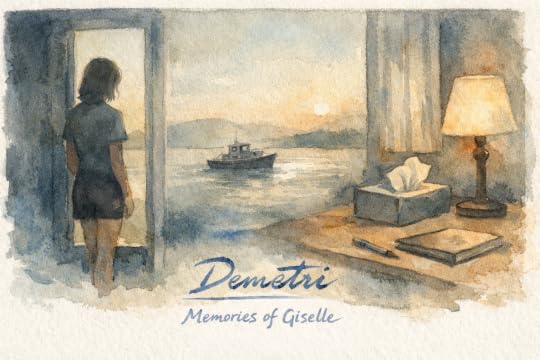
A coming-of-age, slice-of-life graphic novel that explores the psychological journey of a young woman carrying the weight of childhood trauma.
Giselle grows up haunted by the constant memories of her grandmother and a single, haunting image of a boat — a symbol of a trauma she has long buried. As adolescence brings struggles with intimacy and vulnerability, fragments of the past begin to surface, leading her to a devastating truth she had long suppressed.
Memories of Giselle is a harrowing yet deeply human coming-of-age tale about memory, trauma, and the courage it takes to reclaim one’s life.
Deeply personal part memoir graphic novel about a young woman with a traumatic past who's trying to recognise what happened to her and accept the person she now is as a result. It's not an easy read, especially after the first 30 pages or so and we see why Giselle and her brother are so guarded and depressed. I think this being in graphic novel form made this even harder to read, because you can see every emotion and bad scene played out. There's no shying away from it.
I did get slightly confused at times by the jumping around of timelines, as the woman Giselle and teen Giselle have very little to distinguish between them and there were no other markers to denote the passing or rewinding of time.
This must have taken a lot of courage to put out there in physical form for the world to see, and I hope it reaches the people who need to see it.
I feel bad even giving this book a rating due to its content, but I also feel like I have to.
First and foremost, I loved the art. Unfortunately, everything else fell flat to me. A lot of parts felt too visually graphic, nothing really made sense until the end (which you think would be the point, but, unfortunately, it was too rushed to even make much sense then,) and nothing was really cohesive.
I wanted to like this more, and I did read it in one sitting, but I wished I'd gotten more from it.
Es una historia MUY personal, yo creo que este libro va más allá de una calificación. Es una historia que trata un tema muy sensible como lo es el abuso. Creo que pudieron manejarlo de mejor manera. Visualmente el diseño de paneles tiene armonía pero creo se pueden mejorar o marcar más las diferentes etapas de la vida.
Memories of Giselle presents fragmented slices of teenage life in which the protagonist slowly confronts a trauma from her youth. Ominous memories are interspersed with the challenges of family life and warm scenes of coming-of-age friendships.
For me the pacing of the scattered memories was perfect and created a neat build up that delivered just because of its matter-of-fact conclusion. I understand some readers find fault with any (or all) of these, but for me it instantly clicked.
The sparkling style of vibrant colouring make the characters and scenery jump from the page and provides clear contrast with the faded flashbacks. I applaud the strong visual metaphors which only a drawn story can bring (and which I try not to spoil here, there are more than the sailboat on the cover).
It might have been stronger to show more of the inner life of Giselle, as some readers claim. Her experience is now mostly shared through her actions, texts and writing. Still, I’m convinced this leads to a stronger story just because it doesn’t spin an unbounded thread of inner thought and leaves the mystery intact.
4 stars, lovely graphic novel of which some panels I won’t easily forget.
This is one of the most beautifully drawn graphic novels I have ever read. The drawings were exquisite, the coloring was so incredibly well done, simply stunning. The emotions and undertones could be felt on each page, in each image.
This coming-of-age story deals with a lot of heavy topics and issues. Giselle is a young woman who is dealing with a lot of feelings and memories from her childhood she doesn’t always understand, but which keep getting in the way of her living life to the full. The story had a slow start, yet steadily you are taken deeper and deeper into Giselle’s memories and find out more about her trauma. I thought the story was very brave and authentic, and that it gave a realistic view on trauma and the trauma responses that can occur from it, both for the victim as for her loved ones. Even though the story felt very heavy at times, it was also hopeful as Giselle goes into therapy to heal and not be controlled by the past and her trauma.
Make sure to read trigger warnings for this graphic novel, especially because this deals with childhood trauma and seeing some of the story through the eyes of an innocent child can be very triggering and emotional. But these are definitely important topics that should be discussed more.
Thank you NetGalley, Katia Vecchio and Image Comics for letting me read an ARC of this graphic novel in exchange for my honest opinion.
Good graphic novel following a teen girl as she tries to go about her life while shards of childhood memories intrude. Introductory note: "Some scenes are inspired by real events."
The girl/young woman is not sure what happened but more and more things keep happening that make it clear something's not right. For example, she goes home with a cute boy and they're fooling around like teenagers do when unexpectedly she's not OK with what he's doing.
She eventually figures out what'd happened to her as a girl. I'm sure you can guess what that is. Because it's obvious, that's my main issue with why I can't rate it higher.
The reveal happens near the end. Up until that point, everything is so vague. For example, why is her brother's face always hidden in every scene? And so, ultimately, there needed to be more story, more details, in my opinion. As it is, I don't see how it could help anyone in a similar situation and, as a fictional story, everything was too obfuscated to get fully invested as a reader.
The rich, colorful artwork is a joy to view. And you can definitely feel the confusion and isolation of someone trying to process a disturbing childhood while creating happy memories as a normal girl with close friends who are all coming of age with bright futures. Those parts worked and made the book ultimately worthwhile for me. If it'd been twice as long, I suspect it would've worked even better.
This was a slow burn book where the past and the present alternate with occasionally jarring transitions. It is left to the reader to piece together the mystery of what happened to Giselle and what the picture of a boat and that of her grandmother's face all have to do with it.
Don't let the beautiful artwork and choice of colours fool you, this is a heavy read that deals with a serious topic. Check out trigger warnings before you decide to read it or pick it up for a teenager in your life.
The only true con I can see to this book is that I'm not sure who the target readership might be, if it's aimed at young people, it might need to be a bit more explicit without becoming too distressing and also spend a bit more time on processing the trauma and learning to move on from it.
Otherwise, it's an introspective read that deals with childhood SA and its aftermath.
Thank you Katia Vecchio and Netgalley for this ARC.
Thank you NetGalley for the ARC in exchange for an honest review.
The art style of this graphic novel was beautiful and I’m sure it will be even better once it’s published in full colour. I enjoyed the weaving between Giselle’s present and past and showing how triggers from CSA and CPTSD can affect day to day situations and interactions. My only criticism is that I wish it was a tad longer.
A slice of life graphic novel that explores family trauma, abuse, memory, and mental health struggles. It felt very unfinished to me as there are some plot threads that lead to nowhere. I wanted to know more about the brother and why he always wore goggles or a mask to obscure his face. I also found the passing of time to move too quickly.
In this emotional story of surviving abuse Giselle confronts her childhood trauma, finding the strength and courage to enable her to get help and move forward with her life.
"Id like to surround myself with beautiful things, and create beautiful things, and never stop committing myself to my passions." This quote stuck out to me, because really that's what I'm all about.
A beautifully drawn coming and coming of age while dealing with trauma and sexual assault of a child. This is a difficult thing to depict across paper and to tell but it was done well for this story. It hurt to read what the child in the story had went through but the author did an amazing job getting it across the page in a coming form too for that matter. It’s not easy to tell these things and to have a conversation but this book did just that. 5 stars and this story deserves to be out in the world for others and to prevent things like this from ever happening.
Thank you to NetGalley and Image Comics for providing me with an ARC in exchange for an honest review.
First of all: This comic needs clearer trigger warnings. Which is kind of hard as they'd spoil a major reveal, but especially with a theme like this I feel like everyone should have the option to make an informed decision if they should read it.
#####
TRIGGER WARNING:
#####
I enjoyed the story. Giselle felt like a realistic character to me and I definitely emphasized with her. We see her as a child, in different stages of adolescence and finally as a young adult, and I really liked how those different stages were portrayed. As a millennial, some scenes even made me a bit nostalgic. And watching her interact with her friends was nice! They felt like quite realistic (and sweet) kids and teenagers.
I also liked how her family life was portrayed. Her parents probably love both her and her brother, but at the same time they're.. not exactly great parents. Even if they're not directly abusive. They might not hit her or anything, but they seem emotionally unavailable. Her mother is dealing with her own demons, and her father seems overwhelmed and kind of uses their children as shoulders to lean on.
And then there's their grandma, whose face Giselle can't seem to get out of her head for some reason..
It's a solid comic that does a good job at portraying childhood trauma. I especially liked the fact that everything looks pretty normal for quite a while from an outsiders perspective, it shows how easy it is to overlook the signs that something's not right.
I also really enjoyed that we saw how Giselle's brother was affected by everything that happened, and that we saw him deal with his own trauma because of that.
The art style is nice but not quite my cup of tea. I did really like the colour palettes though, especially in the flashback scenes.
Wow, this was an incredibly powerful book; be prepared to be blown away by in the intense emotions this graphic novel will bring out, whether or not you can relate to the story that it tells. Do, however, mind the trigger warnings.
Memories of Giselle is the story of Giselle, told through snapshots of her past and present as she remembers the trauma in her childhood, and the effects it had on her growing up. The fractured relationships with different members of her family, and the constant flashes of an image of a boat bring pieces of the story together to keep you wondering.
This was beautifully drawn and colored, and I cannot wait to see the final product. I will be purchasing a copy when it officially releases.
I actually read this twice in a row. The second time around, I was able to see the foreshadowing in a way I didn't the first time, and I was reading with alarm and understanding. It's not a terribly long novel, but it hits all the points and does an incredible job.
The Boat, the Body, the Doorway: “Memories of Giselle” and How Graphic Fiction Makes Trauma Legible Without Explaining It Away
Watercolor Piece by Demetris Papadimitropoulos
In “Memories of Giselle,” Katia Vecchio offers a coming-of-age graphic novel that behaves less like a confession than like weather – a pressure system moving across the same landscape again and again until the reader can feel, in the bones, what the characters cannot yet say. The book’s great subject is not memory as a vault of retrievable scenes, but memory as an instrument panel: blinking lights, sudden alarms, the recurrent image that refuses to be explained away. A boat surfaces. A threshold appears. A hand pauses in a doorway. A girl learns how to smile through a roomful of laughter while her body, elsewhere, is doing something more ancient than speech: bracing.
Vecchio’s artistry is quiet, but it is not timid. “Memories of Giselle” makes its case for a particular ethics of storytelling: that some experiences are not best served by dramatic revelation, not best honored by a clean line from harm to healing, not best represented by the reader’s catharsis. The book distrusts spectacle – which, in an era that can turn trauma into content and survival into performance, feels like both an aesthetic decision and a moral one. You come away not with the satisfaction of having “learned what happened,” but with the unsettling, truer feeling of having inhabited how it happens: slowly, invisibly, in the places where family and ordinary life are supposed to be safest.
The plot, such as it is, advances by accumulation rather than propulsion. Giselle grows up with a loving, complicated family, a grandmother who is everywhere in the household’s emotional geometry, and a persistent, uninvited image: a boat that appears not as a metaphor the book wants you to decode but as a symptom the book wants you to recognize. Adolescence arrives with its usual mix of cruelty and comedy – the naming games at school, the brittle hierarchies of friends, the humiliations that feel fatal at seventeen and merely formative at thirty. There are bonfires, bikes, the talk that circles sex because it cannot yet hold intimacy. There is a boy, a room, the careful asking for permission – and then, with a suddenness that does not read as melodrama but as biology, Giselle’s body interrupts the scene from inside itself.
Vecchio is exceptionally good at drawing that kind of interruption: the moment when a face fractures into angles, when a panel’s calm is cut by an image that does not belong to the immediate present. Her line has a gentle clarity that can lull you into trusting it, and then, with one shift in composition, remind you that gentleness is not the same thing as safety. The recurring images in “Memories of Giselle” – boats, doors, windows, fans, water, hands – function like a nervous system rather than a set of symbols. They do not “stand for” something in the dutiful way of a high-school English essay. They fire when fired. They return when they must. They refuse to behave.
If the book has a single governing mood, it is vigilance learned early and practiced so long it begins to pass for personality. Giselle is often drawn half-inside spaces: at the edge of a room, behind a doorframe, framed by a window, hovering near the boundary between the social and the private. Even when she is surrounded by people – at dinner tables, in crowded school corridors, on sun-saturated beaches – she is positioned as a witness rather than a participant, the child who has learned that watching is safer than asking. The world, for other characters, appears as a series of straightforward rooms you enter and exit. For Giselle, rooms have conditions. Rooms require scanning. Rooms contain trapdoors.
The most impressive thing Vecchio does is to depict harm without converting it into a theatrical engine. Many contemporary narratives about trauma – in comics, in memoir, in the prestige novel – rely on the machinery of exposure. They proceed as if truth is something you excavate and then display. “Memories of Giselle” is more skeptical. Its deepest premise is that the mind protects itself by refusing certain kinds of knowledge until the body can bear them. The book therefore spends long stretches not on the crime, but on the climate: the aftershocks, the misfires, the uneasy intimacy, the medical searches, the fog of being certain something is wrong without having language for what. That, in turn, feels acutely of our time – not because the story is topical, but because the culture has become newly aware of how often harm is not “remembered” so much as lived around.
There is a scene in which Giselle, trying to make sense of pain and fear, searches for answers in the bright, flattening world of symptom lists and diagnoses. The relief of a name arrives with the chill of its inadequacy. One recognizes in that moment something characteristic of contemporary life: the way the internet offers language without context, information without care, explanation without witness. If earlier generations had to endure in silence, this one often endures amid a chorus of terms – “trauma-informed,” “somatic,” “boundaries,” “trigger” – that can clarify and also obscure. Vecchio’s book understands both sides of that ledger. A word is not a cure. A label can be a lantern and a blindfold.
Therapy enters “Memories of Giselle” with admirable understatement. It is not presented as the narrative’s turning point, the place where the protagonist becomes redeemed by self-knowledge. It is a door, another threshold. The sessions are drawn with the same restraint that governs the rest of the book: two chairs, measured questions, a pace that refuses to push. The therapist’s presence is not dramatic; it is infrastructural. It offers something rarer than revelation: permission to ask. “Is it a real memory?” becomes less a forensic question than a human one. How do you live with an image that returns whether or not you can prove it belongs to the past? How do you treat yourself when your mind has done its best to keep you alive by making you unsure?
This refusal to demand proof is one reason the book feels ethically aligned with the post-#MeToo landscape while also resisting its more simplistic narratives. “Memories of Giselle” doesn’t stage a public reckoning. It doesn’t offer courtroom catharsis or social-media vindication. Instead, it dramatizes something closer to how many people experience harm: privately, confusingly, with a long delay between event and recognition, with love and injury entangled in ways that make moral certainty feel too clean. Vecchio allows compassion and condemnation to coexist without canceling each other out – and that is a sophisticated, difficult stance. The book does not ask you to absolve. It asks you to look steadily at complexity without using complexity as an excuse.
One might think of “Calling Dr. Laura,” Nicole J. Georges’s graphic memoir about adult discovery and childhood sexual harm, or David Small’s “Stitches,” in which the body becomes an unwilling archive. Vecchio shares with those books a commitment to interior truth over narrative neatness, though her tone is less barbed than Small’s and less overtly investigative than Georges’s. One could also place “Memories of Giselle” in conversation with Tillie Walden’s “Spinning,” which understands the adolescent body as both instrument and prison, and with Mariko Tamaki and Jillian Tamaki’s “This One Summer,” which depicts childhood proximity to adult danger without turning that proximity into a lesson plan. Vecchio’s work belongs to that lineage of graphic storytelling that trusts the reader not to demand explanation as payment for attention.
The family dynamics in “Memories of Giselle” are drawn with particular care. Giselle’s mother appears not as a villain or saint, but as a human being living under strain – headaches, exhaustion, guilt that has no obvious outlet. The book shows the child’s instinctive turn toward caretaking: the magical thinking of trying to fix an adult’s pain, the way love becomes labor, the way responsibility begins to feel like the only proof of belonging. These scenes are among the book’s most devastating, not because anything “happens,” but because they reveal how early the child learns to swallow her own needs. If there is an intergenerational tragedy in the book, it lies partly here: adults surviving by not naming, children adapting by over-functioning, everyone meaning well, everyone missing something.
Vecchio is also attentive to the politics of the body – not in the sense of polemic, but in the sense that bodies are where culture hides its unfinished work. Menstruation appears not as a rite of passage packaged for empowerment but as a private practical emergency, something you figure out alone in a bathroom while the world carries on. This is one of the book’s virtues: it is not sentimental about girlhood. It understands that adolescence is not merely a time of discovery but a time of forced accommodation – to pain, to shame, to being watched, to the sudden awareness that your body will be read by others whether or not you consent to being read.
Water, in “Memories of Giselle,” is the most haunting example of Vecchio’s motif-work. It is a site of play, community, instruction – children holding hands, adults chatting, the bright neutrality of a beach – and also a site of private terror. A formative incident in the water returns later not as a single scene that explains everything, but as an embodied memory that shapes how Giselle moves through crowds, intimacy, and her own skin. Trauma here does not require a melodramatic villain; it can emerge from misalignment, from a moment of attention drifting, from the frightening truth that safety procedures are not guarantees. In that sense, the book speaks subtly to the wider contemporary anxiety about systems that promise protection and routinely fail – schools, families, institutions, even the scripts we inherit about what constitutes a “good” childhood.
If “Memories of Giselle” occasionally risks opacity, it is because Vecchio so thoroughly resists the familiar machinery of plot. There are stretches where a reader hungry for narrative clarification may feel held at arm’s length, asked to interpret rather than be told. The book is an uncorrected proof, and some pages are not fully colored; that provisional quality, in this case, reads less like an editorial drawback than an accidental alignment with theme. The story itself is about unfinishedness – about lives lived in drafts, memory emerging in incomplete frames, the way a person’s inner picture is often missing pieces that return, slowly, over time. Still, one can imagine a version of the book that provides slightly more connective tissue without compromising its moral restraint. The line between ethical ambiguity and readerly frustration is fine, and Vecchio walks it with impressive balance, but not without the occasional wobble.
What finally distinguishes “Memories of Giselle” is how it thinks about the endpoint of such stories. The culture is addicted to closure. We like narratives in which the survivor speaks, the perpetrator is named, the past is faced, the self is healed. Vecchio offers a different, more plausible proposition: that healing might look like boundaries rather than reconciliation, like distance rather than forgiveness, like the decision not to be a prisoner of what happened without demanding that the past be neatly defeated. In the book’s late movement, when the core truth is finally acknowledged in plain language, Vecchio refuses to sensationalize it. The moment lands with the quiet force of something recognized rather than revealed. It is less a plot twist than an exhale.
And then the book does something even rarer: it lets life continue. Work appears – not as triumph, not as hustle, but as grounding. Giselle makes things. A small studio scene, a dog asleep nearby, the modest architecture of routine. These pages matter because they resist the fashionable narrative of art as salvation. Creativity here is not redemption; it is containment. It is structure. It is a place to put what has nowhere else to go. The ending offers continuity without sentimentality, a future that is not clean but is livable. The book does not overclaim. It does not promise. It simply shows a person standing inside her own life with a little more room to breathe.
In that sense, “Memories of Giselle” feels bracingly contemporary. Not because it references our discourse, but because it shares our suspicion of grand narratives and our hunger for ethical attention. In a time when trauma stories can become content streams, Vecchio insists on privacy. In a time when audiences demand explanation, she insists on texture. In a time when the culture sells transformation, she offers maintenance. One could imagine the book being passed hand to hand, recommended not with hype but with care – the way people recommend certain books when what they mean is: this is honest, and it might help you feel less alone.
I would place it, with admiration and a measure of reservation, at 89 out of 100. The reservation belongs mostly to reach: the book’s controlled temperature and poetic refusal of narrative payoff will not satisfy every reader, and perhaps need not. The admiration is for what Vecchio accomplishes within her chosen constraints: a graphic novel that treats its subject with seriousness, that trusts the reader, and that recognizes the hardest truth about memory – that it is not always a story you retrieve, but a life you learn, slowly, to inhabit.
Memories of Giselle is a short graphic novel that explores the long shadow of childhood trauma through a quiet, slice-of-life lens. There’s an intimacy to the premise that immediately appealed to me, and the book clearly wants to approach its subject matter with softness and care. But despite the emotional weight of what it’s tackling, the story itself feels strangely distant.
The brevity of the narrative works against it at times. While there are subtle hints leading up to the final revelation, the emotional impact feels condensed rather than devastating. The reveal reframes the entire story, but the aftermath unfolds so quickly that there’s little room for Giselle’s internal processing or healing to fully breathe. Given the gravity of the trauma being explored, I found myself wanting more depth, more disorientation, and more time spent sitting with the emotional fallout instead of rushing past it.
I also think the themes could have been handled with a lighter touch. The story gestures towards interesting ideas about memory, silence, and family dynamics, but it often states them too plainly rather than allowing the reader to fully uncover them through the narrative itself. The brother, in particular, felt like a missed opportunity. He’s arguably one of the most interesting figures in the story, with hints of a much more complicated emotional role within the family, yet he remains largely absent from the narrative. In a book so concerned with what is left unsaid, his lack of presence felt less like intentional restraint and more like an underdeveloped thread.
Visually, the artwork is consistently pretty, leaning into a soft, manga-adjacent aesthetic that feels immediately accessible. Every page is polished, but the paneling itself is static and conventional. There’s very little sense of rhythm or escalation in the visual storytelling, which makes the emotional beats feel flatter than they should. For a medium that thrives on pacing and atmosphere, the layouts rarely add tension or intimacy to the narrative. Every page looks nice, but very few of them feel like anything.
Overall, Memories of Giselle has the foundations of something affecting, but it never fully settles into its own emotional depth. What stayed with me most wasn’t the trauma at the centre of the story, but the sense that there was room here for something far more resonant.
You should read this book if you like:
* Unreliable narrators 📖 * Quiet, introspective graphic novels 🌧️ * Stories about memory and family trauma 👧
I received an advance review copy for free via NetGalley. I am leaving this review voluntarily 📚.
I looked this book up before requesting it, and one venue marked it as nonfiction, which is inaccurate. If this WAS memoir, I would have better understood why parts of it were so rushed. As a novel, I wish it had included more character development, but I still found this to be an engaging slow burn, with some interesting visual and narrative choices.
I received an ARC of this copy, which included pages that had not been colored yet. (If you see other ARC reviews, you may note that some comment on the lack of color on some pages; that will not be the case in the final book.) I suspect that the timelines will be a little easier to follow once all the pages are fully colored, because as it stands now many of the true flashbacks have a sepia tint to them, which will probably make it easier for readers of the final copy to note changes. One of Giselle's friends also has hair that changes color depending on the timeframe, etc. I spent much of the book very confused about how old the characters were, because in some panels Giselle looks really small, while in others she's talking about drinking beer, relationships, etc. I cannot say whether these later timelines will be more apparent in the final version, but I did find that my confusion detracted from my appreciation of the story.
Overall, this is a pretty quiet, slow-burn book, where it feels like everything is normal and nothing is really happening, up until the point where you realize what's going on. At that point, even small conversations gain meaning and weight. While I would have appreciated some elements being more fleshed-out, the vagueness of certain aspects leaves the reader to fill in some of the less important blanks, while giving us the information we need regarding the most relevant events.
Upsetting, but good. I had a suspicion about what was going on early in the story, and that adds to the creeping tension of the narrative.
Like I said above, I read this as an ARC through NetGalley. I encourage you to read trigger warnings before picking this up, as the material is heavy, though it is handled carefully throughout. Take care of yourself! <3
⊹ ࣪ ˖ 𝒕𝒉𝒐𝒖𝒈𝒉𝒕𝒔 𝒂𝒇𝒕𝒆𝒓 𝒓𝒆𝒂𝒅𝒊𝒏𝒈 At first, when I started reading Memories of Giselle, I honestly thought it would be a melancholic coming-of-age graphic novel.
The artwork is beautiful, the colours are soft, and the overall atmosphere carries a sense of nostalgia. Giselle’s daily life at home and school feels familiar and real, as if she is just an ordinary girl going through the confusion of adolescence.
The pacing of this book is quite slow, as the reader follows Giselle’s perspective while she gradually uncovers her past. During my reading, I found myself imagining many possible explanations, but the final answer still felt unexpectedly shocking. By the end, you realise that all the emotions, reactions, and visual fragments were quietly pointing towards the same truth all along.
What impressed me most about this book is how it handles trauma. It does not present trauma as a single triggering event, but rather as a prolonged state of being, it’s something difficult to define, yet constantly affecting both the physical and emotions.
The story deals with heavy themes such as childhood trauma, bodily memory, and how these experiences shape intimacy and self-perception in adulthood. However, it does not stop at the moment of “revealing the pain”. The later healing process is also handled with restraint, without exaggeration or an overly idealised sense of complete recovery.
The author does not deliberately create dramatic conflict, nor does she offer clear moral judgement. Instead, she allows the reader to sit with confusion, hesitation, and uncertainty. In a way, this approach feels more honest and unsettling. At times, I even found myself unable to feel anger or assign blame on Giselle’s behalf.
A graphic novel perfectly capable of showing beautiful people and the beautiful life – and the colouring, including the golden hour look of a lot of it, really reinforces that – but also the sheer ugliness of life too. Giselle's family is one sort-of in the doldrums, for the parents are not having a great time of it (his electricals store is suffering with the online shopping that's coming to rival him, she's seeing disconnects across the household), her brother is isolating a lot, gran is on her last legs, and Giselle herself is struggling with the step up to being a sexualised teenager. They have a lakeside within the vicinity, trips to the coast – and even a smaller house in the countryside for retreats – but things aren't quite gelling. And whether we like it or not we're about to see why…
This was a surprise, for the source of the biggest issues seemed the most shocking. But the book shows its mastery in showing glorified people – everyone is just so attractive – in such idyllic surroundings, and yet making them believable enough for the nastiness to not completely throw us for a kilter. This is quite the genteel read, really – a sparse text allows for the calm, the silence, the constant look back to the image of a small sailing yacht. But it's not without a punch, that will unsettle quite a few.
I did have to wonder if the almost manga style of it all was the ideal choice, but I was reading a preview file that was 80% or more uncoloured. Either way, that certainly didn't prevent this from being impactful and memorable, and so four and a half stars. There's certainly a minor issue here with the conveying of time (something we see start suddenly jumps to two years down the line without any forewarning), and I still don't know if the brother was adopted or not, but generally this is a most competent production.
Content/Trigger Warnings: On page sexual assault/sexual abuse/sexual trauma, pedophilia, depictions of depression, scene of violence, bullying, grief, brief mentions loss of a loved one
This is such a powerful and emotional story of various forms of mental health and how our main character and their family members deal with their mental health struggles from a situation that happened in the past. I will say, check content and trigger warnings for this story before picking it up because everything is depicted throughout this comic. My only real issue with this comic is wanting to see more from the main character and her internal struggles with her experience instead of having her story's reveal saved for close to the very end of the comic. Overall, this comic made me cry three times at various points. I also don't want to say too much because I feel it would be spoiling the story itself. Just know if you pick this comic up, it may make you cry or feel emotional so keep a box of tissues nearby!
All thoughts, feelings, experiences, and opinions are honest and my own.
this was a quick read that was lead mostly by the dialogue and pictures. you could finish it in a sitting. this felt very like a story for girls, and that’s fine
i think this mostly went too quickly to be honest. i think things were going by so fast and giving just such lil snipe into these parts of her life. it felt like a slice of life that was going a bit fast
sometimes it was hard to tell the time was changing. we would have lil cues like martha saying “i’m 17!” or referencing going to school but i wish things were a bit more clear about when time was passing. we noticed subtle differences in outfits and the way she styled herself and that was how we could tell the passing. which felt intentional but also lazy for a story that relies so much on the passage of time
plus things just kinda felt random. what did her getting her period have to do with the lead up to finding out she was molested? what did the intentional blocking out of her brother’s face have to do with the lead up to showing his face? was it that he looked like their grandma? i don’t know
it felt very reminiscent of Speak by Laurie Halse Anderson but in a way where i’m like feeling like i’ve heard this story before. but i’m not trying to shit on that, a lot a lot a lot of people are assaulted and it happens in different ways, a million different stories and ways. and I don’t want to take that away from a person
This entire review has been hidden because of spoilers.
I went into this book completely blind. The cover immediately caught my attention because the main character's face is partially obscured by a drawing, and it made me curious enough to pick it up.
Starting with the basics: the artwork is beautiful. I especially loved how Giselle is illustrated throughout the different stages of her life. I ended up reading this in a single sitting because it was genuinely that engaging. I enjoyed Giselle's friend group, and I found myself constantly wondering what was behind her brother's behavior.
Without getting into the heavier topics or spoilers, I'll just say there was a moment where I audibly said, "Wow." I was genuinely shocked as everything began to unfold, but it also answered so many questions. By the end, I was incredibly proud of Giselle and the choices she made.
I wish the experiences explored in this story weren't a reality for so many people. At the same time, I'm grateful books like this exist—stories that give these experiences a voice and shine a light on conversations that need to be had.
I'm truly thankful I had the opportunity to read Memories of Giselle. It's a story that will stay with me long after I turned the final page.
This was a gut punch of a book. I knew it dealt with trauma based on the book blurb, but was not expecting this to be quite as heavy as it was. I would say it needs more of a trigger warning to it. I was okay, but I can't imagine what someone who had lived through a similar experience would feel reading this story. I can see why the publisher left it out, because the way Vecchio writes this is almoat like a mystery, but as someone with PTSD, I'd always rather be spoiled than unexpectedly triggered.
Outside of that, I think this is a really well written and illustrated graphic novel. As I said, Vecchio reveals Giselle's memories and trauma like a fine tuned mystery; dropping hints throughout before the final reveal. I liked the way the passage of time is shown to us through subtle character style changes instead of through dialogue or text. And the flashes of repeated images are both effective and haunting.
I also really loved how Vecchio incorporated getting help for mental health and trauma into the story. I am always happy to see the normalization of therapy in books.
Thank you to NetGalley and Image Comics for access to this eARC in exchange for my honest review.
This one stings. A brief and very emotional graphic novel about a childhood trauma that Giselle is working to unearth and heal from that has everything to do with her grandmother's abuse (who is now dead) and the sailboat that keeps flashing before her eyes. Not only is Giselle unsettled because of the trauma, though there are some healthy relationships depicted with friends while still being teenagers, Giselle's brother is struggling that readers see in snippets including the refusal of the graphic novel to show is actual face that sets the mood for the reveal and connections. Adults will instantly understand the depression and trauma, some teens will, and then by the end when it's revealed with a set of panels, it is objectively shared what occurred.
The graphic novel will not be for everyone. The trauma is on page. But it's a necessary story to tell and one Vecchio was moved to share that is part personal story.
The scenes that move from present to past are depicted in two different sets of shades for the reader. And the visual motif of the boat all play up a literary focus to move toward the uncovering of the secret Giselle and her brother share.
Don’t let the graphic novel with such a beautiful art style fool you; ‘Memories of Giselle’ is deeply devastating in the worst way possible.
The buildup caught me off guard, which perfectly depicted how childhood trauma doesn’t surface until you’re ready to address the horrifying act done to you when you’re old enough to understand. It’s unsettling in the way the novel progresses with us in the dark, just like Giselle was, having to understand the depth of the pain as she grows older. I have no more words to say because I am utterly speechless with the darkness of it all, but then again, there is always hope. This was such an intense read, but it sheds light on the struggle and pain of SA victims, which gives them the awareness that they are not alone in this.
There were some moments that confused me a bit, with the way there were time skips, as some pages immediately cut into the next life stage, though this could be because they were not yet colored.
Thank you to NetGalley and Image Comics for an advanced copy in exchange for an honest review.
This entire review has been hidden because of spoilers.
Memories of Giselle begins as a nostalgic coming-of-age story but then darkens into a haunting story of a childhood filled with grief, trauma and loneliness. Giselle has a secret and its revelation could shatter her family. So Giselle plays the perfect daughter, despite being neglected by her parents. She is the centerpeice of her family and the weight of this secret, its pervasion into all aspects of her life, creates a nearly soul-crushingly heavy atmosphere. While it can be challenging to read, Memories of Giselle also shows the possibility of moving onwards to create a future, one where you create beautiful things despite the trauma you've faced.
The artwork is exceptional. In each panel, you can feel the burden of Giselle's guilt through all the negative spaces. The way this trauma was represented, as subtext both visually and written, felt realistic. It's difficult to handle such dark topics respectfully, but I believe Memories of Giselle did an incredible job and I think would be well suited for teenagers and young adults to read.
Wow, what a comic. I personally really enjoyed this. We follow Giselle as she goes from child to adulthood, navigating a life burdened by a failing family business and the haunting, fragmented memory of an empty boat. While her trauma seems hidden, it’s actually right there in plain sight, manifesting in her struggle with intimacy and her brother’s sudden, stony silence. It’s a quiet but inevitable journey that forces her to face the slippery nature of memory as she returns to her childhood home.
This book deals with heavy subjects of sexual abuse and depression, making it a difficult but essential read. Katia Vecchio’s art is wonderfully drawn, using a soft style that creates a powerful contrast against the unsettling reality of the plot. It is deeply moving, sad, and easily one of the best books I’ve read all year. I originally thought 4.5, but I’m bumping it to a full 5 out of 5 stars.
Giselle is a teenager dealing with trauma caused by a close family member, which leads to deep emotional pain and serious mental health struggles. Only her brother knows what happened to her. At the beginning, I found the transitions a little rough, but once Giselle started opening up to the psychiatrist about her childhood trauma, everything became much more understandable.
The story is disturbing, sad and shocking. It left me wanting more, and I genuinely hope the second book comes out soon. I love how real and raw the story feels, with no inhibitions. The artwork adds another emotional layer, with gorgeous, vibrant colors that contrast beautifully with the darkness of the story, making the experience feel painfully real and unforgettable.
Thanks NetGalley and Image Comics for the digital ARC.
A touching, at times harrowing story about growing up and coming to terms with trauma. Narratively, it is perhaps a bit too direct in spaces but in the end, Giselle's journey to healing is empowering and emotional. Vecchio's cartooning is sweet, with bright colors and tender figures that bely the heft weight of its narrative arc. I like that this book sweeps from tweenage years to young adulthood with only vague signifiers and changes in how our characters look. It both compresses the time to amplify how trauma is a constant companion and flattens out Giselle's experience in her tragedy that has defined so much of her young life. It could perhaps been fleshed out a little bit more with more pages that explores a bit more of the distinct periods in her life but it's still an effective, short read and Vecchio's art work is a pleasure to look at.