“It’s a welcome surprise to read this careful look by a music historian at Graceland, Paul Simon’s 1986 By bringing both its beauty and its uglier aspects into the light, Kahn, far from ruining the album’s strange magic, lets readers appreciate its intricacies and paradoxes all the more.” —The New York Times (Editors' Choice)
In 1984, Paul Simon was at a professional and personal crossroads. His new marriage was failing and his career was in danger of stalling. He was forty-two, navigating a digital age, searching for inspiration in a scene driven by music videos, synthesizers, and drum machines.
Driving around that summer, a bootleg cassette of “township jive”—the street music of South Africa—kept him company. Lent to him by a friend, it reminded Simon of the sound and the joy of the early days of rock and roll. He began to invent his own lyrics to the groove, and became drawn to the idea of recording with the musicians on that tape. But South Africa was in the thrall of a racist apartheid system, and with economic and cultural boycotts in place, such an undertaking was risky. He grew determined to find the right conditions to allow for a collaboration.
Simon took a fateful trip to Johannesburg in 1985. It would turn out to be the first step on a musical journey that would lead him to New York, Los Angeles, Louisiana, and London, and eventually to the release of Graceland, a critical and commercial triumph, winning multiple Grammys, selling 16 million records, and spawning a five-year, worldwide tour.
Days of Miracle and Wonder is the first book to tell the full story of Graceland, offering windows into Simon’s creative process, the technical innovations that brought his songs to life, the people and places that made the album possible, the forces that helped the album achieve mainstream reach, and the controversies that the music raised—and which remain today. It sheds light on a period when America opened its doors to the sounds and styles of Africa and other faraway lands.
This is an informed, heartfelt celebration of Simon’s magnum opus, a recording forged in a tense cultural moment, but suffused with hope, change, and a sense of global connection.
Every healthy musical scene is to some degree a melting pot of influences.
This book is about the creation of the superlative and groundbreaking Paul Simon album “Graceland” which was released in 1986 – forty years ago now!
It has stood well the test of time. The author tells us the story of how the album came into being. Simon was listening to cassettes (yes, cassettes!) while commuting from Manhattan to his home in Long Island. One of them happened to be “Gumboots: Accordion Jive Hits” from South Africa. This prompted him to learn more about this music. Through his many contacts in the music business, he arranged to go and meet some South African musicians in Johannesburg. This eventually became musical history!
Page 100 Adrian Belew in the studio
I remember words about “angels in the architecture.” It gave me shivers up and down my neck. By that time I realized, “Wow, Paul Simon has made a major change in his art.”
The author goes into detail about making the music of the various tracks—Simon worked on the lyrics after. Recordings were made in Johannesburg. He took Roy Halee, his longtime recording engineer, with him. Being in apartheid South Africa was an eye-opener, with Simon witnessing first-hand the oppressive white regime.
Recordings were brought back to the U.S. and reworked. Simon also paid for the South African musicians, who were Black, to come to the studios to further polish up the music. The author goes into much detail, some of it overly technical, on the what and how of the recordings. Also, some recordings were made in London at the famous Abbey Road studio. Simon was a perfectionist, trying musical bits repeatedly and integrating these into the tracks.
When the album was finally released the individual songs did not have a great impact on the Billboard charts. It was the album that endured. As the author says, it was a long-distance runner, rather than an instant success. And endure it did!
Many South African artists, although well known in some circles, now vaulted to worldwide renown. One was Ladysmith Black Mambazo. I have seen them twice and can vouch for the beauty of their vocalizations and exuberant performance.
Page 134
Though they would feature on only two tracks on Graceland, Ladysmith Black Mambazo’s sound became one the defining elements of the album.
The author brings up some of the controversial aspects of Graceland—namely, musical appropriation and the boycott of South Africa at the time of Paul Simon’s visit. There were Black musicians on both sides of this. Simon handled the opposition politely and diplomatically.
Page 261
Ladysmith Black Mambazo gave [Paul Simon] a Zulu name: Vulindlela – He who opens the gate.”
For the most part (aside from recording jargon) this was an interesting book on a musician and album that was a startling departure for Paul Simon. It made him an even more cherished and unique lyricist, blending various musical styles to make a world-class album.
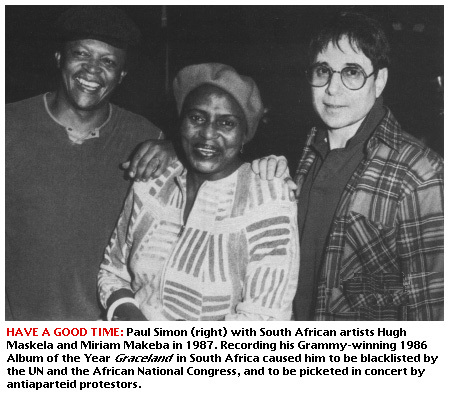
This is music historian Ashley Kahn's account of Graceland, Paul Simon's 1986 album. After a poorly selling record, Simon fell for a bootleg cassette of South African township dance music, played on long car drives. In 1985 he flew to Johannesburg, a city under apartheid, the legal system of white rule over Black citizens, and recorded with local Black musicians. The United Nations had asked artists to boycott South Africa, so protest followed. Graceland still won the 1987 Grammy for Album of the Year. The studio chapters let the musicians talk. Bakithi Kumalo, a Johannesburg bassist, was repairing cars when the call for Simon's first session came, so he rode a bus with his instrument on his lap. His cousin, the drummer Vusi Kumalo, remembers an accordion player from Lesotho, Forere Motloheloa, sitting for hours in a booth, annoyed at the word bridge, a name for a song's linking section, and picturing a literal bridge. Simon located the rhythmic feel in the bass lines, so Kahn gives the low notes top billing. The boycott chapters were the most interesting for me. The boycott was a call from the UN and the African National Congress (ANC), the Black-led movement against apartheid, to cut cultural ties with South Africa. Simon understood the ban to cover concerts. The South African musicians' union had voted to welcome him. Kahn shows the boycott's enforcers out of step with one another. A London group asked ANC headquarters in Lusaka, Zambia, whether to be flexible, and the answer came back as a refusal. About sixty protesters then stood outside Simon's London concerts, featuring two exiled South African stars, the trumpeter Hugh Masekela and the singer Miriam Makeba. The ANC's arts chief, Barbara Masekela, Hugh's sister, drafted the official response. The recording and engineering are treated here as they do on similar music books. Tape machines, reverb units and mixing consoles get named by model, and radio-consultant testimony delays the sales story. News roundups open several chapters, from Reagan's reelection to a soda recipe change, staying outside the Graceland story. I loved the framing and the context. This book is a splendid deposition paired with a modest ruling. The author lets singers, engineers, executives and critics testify at length, backs them with extensive endnotes, then rests his case. The album's lyrics stayed mostly off politics. Critics found it insufficiently direct in message. Music crosses borders at its own pace. Read for politics, the album speaks softly. Simon told Newsweek, "I'm not writing editorials," and called the project "a musical experience." His nearest approach was the a cappella song with Ladysmith Black Mambazo, built on two lines about being homeless, a moment he described as wanting "to come close to a political song." This Jewish Zionist's help for the cause was practical. Local sessions were often paid by the song recorded, so Simon offered triple American union scale per day, then carried Black South African musicians onto American television and into arenas. The touring show closed with the South African national anthem, a song sung at protests, and included a song whose "Him" was Nelson Mandela, making the anti-apartheid message plain night after night.
Days of Miracle and Wonder: Paul Simon and the Trials and Triumphs of Graceland by Ashley Kahn is a fascinating look at the creation and legacy of one of music’s most influential albums. The book provides rich historical context, behind-the-scenes stories, and thoughtful insight into the artistic collaborations that shaped Graceland. I appreciated how the author balanced the album’s creative achievements with discussions of the cultural and political complexities surrounding its production. The writing is engaging and well-researched, making it an enjoyable read for both longtime Paul Simon fans and readers interested in music history. Overall, this is an informative and compelling book that deepens appreciation for a landmark album and its enduring impact.
Liked some of the behind the scenes look at the making of the album but a little too inside music for my liking. Second half once album was already created was much better. Would give 3.5 if allowed
A number of times during my listen, I wished they had included the songs under discussion, if only to assist my memory of the tune. Realizing that since that would not be done with the regular book it certainly would not accompany this, so I just downloaded the album and reviewed the music when necessary.
Interesting tale of the development of the album, Paul Simon's creative process and the music industry, including the business side of things as well as navigating the move from analog to digital, both in the recording and editing process, as well as the the move from tape and vinyl to CDs.
The issues with the politics of dealing with apartheid as a backdrop to the performances and exposure of the South African performers to travel, perspective, etc. was also interesting.
A tip of the hat for a great album and this book that explores the complex issues associated with it. My only criticism is that the tale is quite overpopulated with people, I guess in an attempt to be fair and include anyone having anything to do with Graceland regardless of the level of their contribution.
I just finished listening to this amazing book, and I have been texting my friends to READ THIS BOOK RIGHT NOW, and waxing rhapsodic about both the album Graceland and the winding and fascinating (at least to this music and bibliophile!) tale of how this nearly singularly creatively collaborative juggernaut of an album came to be. Written by a long-time music industry insider who was in Simon's orbit during some of the Graceland era- Kahn was tour manager for Ladysmith Black Mambazo right after the album's release- this book is a fascinating and compelling deep dive into how the album was made. Kahn does an excellent job laying out the complex human and musical dynamics behind the album's creation, as well as the technical recording and production innovations used. I concede that some of the chapters about the studio recording might be a little too in the weeds on the technical side of music and the industry for many people. Some of it was over my head, but I found all but the most technical bits interesting and understandable, and I let those facts wash over me as part of the great wave that was the making of Graceland. The book gets a bit dry and technical again when going into great detail about the A&R, marketing, and publicity of the album, but Kahn does a good job of showing how much work went into the making of Graceland, and all of these parts help the reader and listener understand how and why the album became part of the musical and cultural zeitgeist, and why all that matters to the story of the album itself. Musically, Graceland was a huge turning point for Simon. I was old enough and musical enough to appreciate that. It was a great album, but I was not old enough to know any of the complexities of what went into making it or what it signified to different people, and certainly not how it was both celebrated and critiqued for borrowing and blending so many musical styles and cultures. Kahn clearly cast a wide net in looking for sources to interview and cite for this project, and carefully shows both what Paul Simon intended and how he and his work were received during the album's creation and after its release. Simon does not come off as a white savior or a shameless cultural thief, nor was he moved to be “in the struggle” of Black South Africans at the height of Apartheid. He fell in love with a bootleg of "gumboots" by the Boyobo Boys, and the whole album went from there. He was just a musical genius and curious human who wanted to work with other crazy good musicians. For better or worse, Simon did not go to South Africa with any motivation beyond the pure pursuit of incredible music.
This might be the time for a disclaimer, or maybe just a declaration: Paul Simon is one of my evergreen favorite musicians, and has been for nearly 40 years. I love nearly all of his music- but as part of Simon and Garfunkel and on his own. But Graceland is nearly singular in both Simon’s catalog and in American music. Every single track is a musical Marvel and a little bit of poetry, and one of the great albums of the 20th century. I will stake my rep on that. Also, sure, "Call Me Al" is a bop, something the record label instantly recognized, a full generation before that term became music slang, but it's far from the most brilliant song on the album. I could listen to "Under African Skies" on repeat all day.
If you loved Graceland, you will enjoy this well researched book which goes deep into the musical intricacies of recording and doesn’t ignore the controversy regarding the cultural ban.
Let’s start there. There is an economic concept called The tragedy of the Commons. It’s a simple principle; I ignore the signs to keep off the grass on the campus commons because there is arguably no damage that one set up feet will do to the grass. The issue becomes when everyone assumes that and the grass is ruined.
It’s why cultural boycotts are effective when they apply to everyone. When people start carving out exceptions, they lose their power.
The ANC was specific about prohibiting performing in South Africa. It wasn’t as clear about recording. Instead of talking to the ANC as Harry Belafonte counseled, Simon decided that no one was going to tell him what to do and proceeded. It was arrogant and he paid the price. His response was that he paid the musicians a high rate and as good as that was for those 50 musicians, it arguably undercut the boycott. The tragedy of the commons.
However.
If you believe that Graceland was also an important cultural touch point, perhaps only someone who wasn’t going to let him get his way was the only person who could have made this happen. His arrogance and wealth were keys to getting it done. Does the end justify the means? I’m not sure how to answer that.
I can say I throughly enjoyed this book, learned so much and listened to Graceland daily since I read it.
This book allows you to see Graceland in a much more nuanced way than just listening to it. You will appreciate this album on a whole new level which is well worth getting to. What went in to the making of this album is simply amazing. The last third of the book is almost a seperate book about the selling of the album and the tour. This falls in the category of very hard to put down. The only other Kahn book I have read is his book on the making of KInd of Blue which was also great. His level of detail is tremendous if at times exhausting. This book won't make you love P{aul Simon but it will make you appreciate his genuis.
I love deep dives into albums and this book was a great read. The research and detail was informative and interesting. I have only heard a few songs off of the Graceland record but now I am excited to listen to it in its entirety with all of the details I noted from the book. I also came away with so many musicians to research and I am off to make a new playlist.
I love how Ashley Kahn writes, getting out of the way of the story perfectly (despite in the afterword revealing he was tangentially involved!). A great in-depth look at a fantastic album and the complex circumstances that surround it.
I listened to the audiobook. A deep dive into the making of Graceland. It is shame that an audiobook can’t afford the rights to include the music it is describing in such detail. I switched back and forth frequently. The audiobook is very well done.
Some of the recording details went over my head, but otherwise, I found this a useful, enjoyable survey and reminder of Paul Simon’s wonderful Graceland album and the work that went into making it.
Like so many people, I've always loved this album. It was fun to learn more about its history and creation, though as a non-musician a lot of it went over my head.
This is not the fault of the author or the book -- but I picked this up solely after hearing the NPR story on the day it dropped, which focused on the politics of the production of this album. While touched on in the book, it is not the emphasis as I expected. This felt much more "inside baseball" on music production. More art than history. Not a problem, just not what I was looking for based on NPR's framing.
My thanks to NetGalley and Atria Books for an advance copy of this book that looks at an album that created not just a new sound for an act many thought had lost their way, but introduced the world to a new genre of music, giving life to old artists, new sounds, and lots of joy.
One of my favorite moments in life, one that if there is a heaven would be on repeat for me, was watching Paul Simon on Saturday Night Live in 1986. I was young, my brother was younger, and my parents were all downstairs watching the big TV. My parents enjoyed Paul Simon, my brother thrilled to be up late, and myself a pre-teen probably being moody. The first song was ok, but what was memorable was the performance of Diamonds on the Souls of Her Shoes. I was lost, the beats the music, the dancing, everything was wonderful. Amazing. I always wonder what made me care for music more than something to be played in the background. This might have been it. I know I was soon deeper in lyrics, and trying in those pre-Internet days to find out more about music not from this country. I am sure that I was not alone. Graceland was an album that started slow, but once it started moving didn't seem to stop. An album that changed lives, introduced a world to music outside their car radios, and influenced many. Days of Miracle and Wonder: Paul Simon and the Trials and Triumphs of Graceland by writer and music historian Ashley Kahn is the story of an idea, an album, its legacy and the creation of an album that still stands up, and more importantly still makes people stand up and feel good about the world.
Paul Simon has a long commute to his home in the Hamptons from his office in the Brill Building in Manhattan. Simon played music the entire trip, but one tape never seemed to leave his player. This was a compilation tape of music from South Africa featuring different bands and different styles. Music that Simon soon could not get out of his head. Soon Simon was writing lyrics to these songs, and as in began to investigate Simon found a whole genre of music he never knew about. A simple idea soon brought him to the country of South Africa. During the 1980's the country was an apartheid pariah, travel was limited, as was contact with black majority. The United Nations itself had a ban about performing with South African artists. Something Simon planned to deal with later. The music began to roll, tapes were made, and the ideas for an album were made. However there were many incidents and accidents, hints and allegations to come.
This is my first experience reading a book by Ashley Kahn, though I have seen many of his books sold in the stores I have worked at. And I can see why. This is one of the most interesting and best written books about an album I have read in quite a long time. Kahn has done incredible research, with Simon, and those involved in the creation of the album. Tracked down interviews, videos and audio, and created a real portrait of not only Simon, but the music. Kahn is a very good writer, able to explain geopolitics, song writing, life in South Africa as a black musician, and what life is like in a recording studio. The writing is very smooth and every page has either some great ideas, or factoids that are probably new. This is not a hagiography in anyway. Kahn mentions the problems, from artists like Los Lobos, the United Nations, and even fans.
One of the most complete looks at an artists creative life. There are many books about how something came about in music, this one really gets to the hearts and bones of the subject. Lyrics, musical creation, engineering, recording, reception. Even how it was brought to life in from of crowds. A really excellent book for fans of Simon, fans of the album, and for readers who enjoy books on creativity. I can't wait to read more by Ashley Kahn.
Weirdly, Graceland was not the album that got me into African music, despite the fact that it introduced millions of people around the world to South African music--aside from The Indestructible Beat of Soweto, which remains an amazement after all this time. (And I come from a family where my dad can actually pronounce mbaqanga correctly, complete with !Xhosa intonations.) It was actually the Rough Guide to Congolese Soukous CD, which S. and I listened to repeatedly as we drove around the northeast in the late summer of 2001, before the boy and, um, any other major events that may have occurred that fall. Bought at the Borders in Mount Kisco, another long-lost edifice.
Graceland is a complex cultural artifact, to be sure, but in this telling it's far more admirable and clean than I would have expected, way more in fact. Rather than the usual run of blithely carefree Boomerish appropriation of other cultures ("it's all music, man"), let's call it, Simon was appealingly conscientious and clear-eyed about the structure he was walking into--talked to Harry Belafonte for guidance before flying to South Africa at all and paid the African musicians triple scale, as well as treating them as collaborators, giving them co-writing credit and declining to take any pay when they toured the album. There's a whole lot of tech stuff here about how the songs were put together, some of it incomprehensible unless you understand what kind of sound you can get if you put the faders this way as opposed to that, and some a neat series of mini-bios about African and US session musicians who popped in at different spots, including King Sunny Ade's guitarist, who you can hear at the start of "Graceland" when Simon sings about a "National guitar." I found the TImes review irritatingly summative and worried this would avoid the thorny question of how to read this vis-a-vis the boycott of SA culture, but Kahn handles it well, to my mind, granting the complexity of the issue, noting how openly Simon listened to criticism and embraced questions on the topic (at least until he'd answered them ten times), as well as letting us in on a conversation 26 years later where he sits down with one of the leaders of the boycott and listens honestly. Kinda confirms my sense that Simon was more mensch than not, and the little details about how much knowhow and studio wizardry produced these incredibly detailed, worked-out sounds are fascinating.
Also fun: Kahn went on the road afterward with Ladysmith Black Mambazo, and his love and admiration for their moral clarity, artistic vision, and talent (he notes that Simon was initially intimidated from even considering working with them by how good they were) shine though. Apparently they loved old doo-wop (for fairly obvious reasons), but also frequently bought Merle Haggard cassettes and LOVDE them, which I did not have on my bingo card.
This is a fitting tribute to a classic that makes me want to listen to it again front to back, and I much know every song on the album.
This is what a "making of the album" book should be - thorough, well-researched, sourced with tons of direct interviews and, oh yes, so entertaining and so well-written.
Author Kahn takes you through every step of the Graceland phenomenon- from inspiration to preparation to recording to production to engineering to packaging and promotion to live performance, and to the lasting cultural footprint of this landmark album. No stone is unturned, and for an album I thought I knew everything about, now I feel like I actually know everything about it.
Sensitive areas are not downplayed - the book takes on the political sensitivities of Simon recording in the face of a UN cultural boycott at great length, not pointing fingers but not letting Paul Simon off the hook (though personally I've always been sympathetic to Simon's perspective). The book also contains a pocket history of the anti-apartheid movement, providing a critical context to consider this album.
There a lesser-known but juicy feud between Simon and Los Lobos as to the authorship of their collaboration that's covered in the book. I'd heard Los Lobos's side (via a notorious interview with band member Steve Berlin) but had never considered the other side of the story; as with most disputes, there's a large gray area and the story is not as clear as I'd always assumed it was.
While it's tempting to say that if you love Graceland the album, you'll love this book, I think it's more appropriate to say that if you enjoy deep-dives into the creative process, this book is for you.
Many thanks to Atria Books and NetGalley for the advance reviewer's copy.
Leave it to Ashley Kahn to make another of the best albums of all time seem as boring as hell. Flaccid prose, light hagiography, fake fly-on-the-wall-isms. Ho hum. That Kahn sides with Simon over the Los Lobos spat—to say nothing of the one re: Linda R—is as predictable as it is gross. Are you saying I should trust the ethics of the guy who vacations with Lorne fucking Michaels? Please, girl.
An even more sinister subtext lurks throughout. Simon revived his career not by, I don't know, writing better songs than those on Hearts and Bones (not a very strong record) and hiring appropriate musicians to deliver their tone, but by freely borrowing, cutting, and pasting grooves. There's a sense in which Graceland is an AI album; it was made by real musicians (incredible ones) in a real studio (actually a few studios), but it came about mostly as a series of aural responses to prompts like: "Give me something that sounds like X." "Ok, let's take the bridge from Y and paste it into Z." "Ok, now I'll sing a bunch of shit about being a rich but unhappy middle-aged Jew in New York City on top of this utterly unrelated African beat."
Graceland is undeniably great, but are the songs Simon's? Either way, it pointed pop in an evil direction. It doesn't matter who makes the music: "creativity" in the US can now mean nothing more than collating and post hoc warbling. All encyclopedias are imperialistic at heart, so be careful kids: sometimes the knowledge ain't worth it, even if it does move your ass.
"and sometimes when im falling, flying, or tumbling in turmoil I say, "Whoa, so this is what she means"" This was an excellent account of the creation of one of the best/controversial albums of all time. I feel that its mostly fair, but leans towards Simon not appropriating (as most media discussing Graceland tends to lean) but as someone who happens to lean towards this album being a cultural exchange over appropriation, I didnt mind that aspect. I wish media about Graceland would further discuss apartheid outside of the time Simon was making the album to give a fuller picture.
A great read that flows nicely, acknowledging every aspect of the album. I enjoyed the explanation of some of the lyrics the most, especially "she makes a sign of a teaspoon, he makes a sign of a wave" being a reference to South African traffic signals. I also enjoyed more in-depth backgrounds on the featured artists.
Here are some things that stuck out to me: Its hilarious to me that Paul was ever jealous of Elton John. digital vs analog...this was at the cusp of cutting over and they use both. analog brought warmth and digital still felt cold then the boyoyo boys were kinda already over in South Africa by the time Simon got there, which adds another layer to the discussion about appropriation. it made me sad to hear about the South African musicians who wanted to work on Graceland but didn't and the competition there. Even with the Madonna shade on how she runs her tours, this was still a really enjoyable read!
This entire review has been hidden because of spoilers.
An excellent story of Paul Simon's odyssey into South African music. This book was a total revelation to me. I remember the late '80s and wondering whether Paul Simon's collaboration with these South African musicians constituted cultural appropriation. It's amazing how we don't get the full story just from what is on TV or in the news.
I had no idea how completely Paul Simon threw in his lot with these South African musicians--how they were brothers and his love of their music enabled him to collaborate, not appropriate.
I also had no idea of the complexity of the political issues then--how the United Nations boycott of South Africa was actually unfair to South African musicians, who after all had not done anything wrong but were being deprived of their right to collaborate with Western musicians.
Luckily Simon paid them more than fairly and gave them songwriting credits, so they came out of the whole project with quite a bit of value. Plus of course the exposure they were given to the world, who until then, to quote the author, just thought South Africa was a place of "suffering." Who knew there was such joyous music coming out of there?
Mostly it was just a joy to read about their process together. Thank goodness for YouTube and Spotify; I was able to listen to the songs being described in the book.
Just a totally joyous experience, reading this book.
Graceland is an all-timer album for me (and uhh a lot of people) but it came out when I was 1 year old so I didn't know too much about how it was made. I remembered vaguely hearing something about Paul Simon being censured by the UN for breaking a South African boycott and I really appreciated learning more about the nuance of the situation. (And as a fan I appreciated learning more about how respectful/generous Simon was with the African musicians, to the extent that for the Graceland tour he didn't pay himself as an artist so he could afford to pay the full groups/bands to come on the tour.)
Some of the details about musical arrangements/technical specs etc didn't really hit for me (I don't know much about music in that sense) so I kinda skimmed those parts, but I'm sure more musically-inclined folks could get a lot out of them.
One of my fav details I learned from this was that in the song "Diamonds on the Soles of her Shoes" the "she makes the sign of a teaspoon/he makes the sign of a wave" line refers to different hand signals used to flag down minibus/shared taxis in Johannesburg.
Anyway if you ride hard for Graceland the album you would probably enjoy reading this book. If you don't...then...probably not??
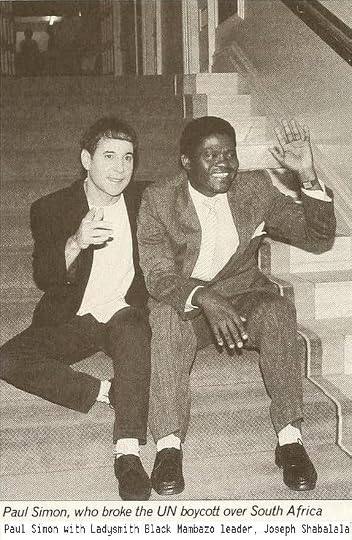
Graceland by Paul Simon has long been one of my very favorite albums. Author Kahn does a magnificent job in this chronicle of the creative process that brought together musicians from South Africa, sound engineers and producers, and Simon’s personal friends and American music legends to make a masterpiece. Among the African artists to get special mention are: Joseph Shabalala, leader of Ladysmith Black Mambazo, guitarist Ray Phiri, and Bakithi Kumalo a master on the fretless bass. Collaboration was key in giving life and structure to the songs; sound engineer Roy Hallee was instrumental and the Everly Brothers, Linda Ronstadt and noted percussionist Ralph Macdonald made contributions at Simon’s request. There are so many unexpected cameos by “greats” in the music industry that Simon looked to for advice and feedback. During the recording and release of Graceland in 1986, Kahn adds context with references to the opening of the Rock & Roll Hall of Fame, Simon’s appearances on Saturday Night Live, and the release of albums by Madonna, and New Jersey natives Jon Bon Jovi and Bruce Springsteen. In the end, Graceland moved steadily up the pop charts to secure multiple Grammys with music and lyrics that remain truly transportive.
This is an in-depth and comprehensive account of how Paul Simon’s masterpiece album, Graceland, came to be. It starts with what inspired him to bring South African musicians together to back him in a collection of songs. It covers the controversy Simon brought upon himself by going to South Africa and working with these musicians during South Africa’s apartheid period, when the rest of the world imposed a cultural boycott on that country.
Paul Simon’s career was at a nadir at this time. Having had great success in the 1970s with Simon & Garfunkel and then following that up with successful solo albums in the early 1970s, he was losing his popularity by 1985, when work on Graceland commenced. His 1983 album, Hearts and Bones, was the lowest seller of his career. Simon truly worked “outside the box” to come up with this album and it enjoyed astounding critical and popular success.
The book is incredibly detailed, a bit more than needed in how the music was created. The book also covered the production of the album, the marketing of it and the wildly successful concert tours that followed. Well done!
I intended to mostly skim this book because I could tell right away that it probably had more detail than I needed. But I ended up skimming very, very little. This book about the creation of one of my favorite albums – maybe my favorite - really hooked me quickly. I learned so much about how an artist like Simon perceives the layers of sound in a song. I was fascinated by the many-faceted effort that creates that richness, the variety of rhythms, voices and instruments, the use of synthesizers, the variety of gifted musicians, African in this case, that contributed their unique skills. I was intrigued by the qualities Simon was looking for in the musicians he chose and how he generously shared the spotlight and worked at creating a partnership, a meaningful camaraderie with all the people involved - financially, technically and creatively. So impressive. I loved being behind the scenes in a musical world where expertise and professionalism were imbued with respect and generosity. The controversies connected to the album were honestly delineated as well as its amazing success. I ended up enjoying an uplifting book that left me enriched in knowledge and spirit.
This exhaustive history of the making of Paul Simon's classic "Graceland" album covers just about every angle one could want -- Simon's musical journey that led him to explore this music, the political and humanitarian ramifications of life in 1980s South Africa, and the fallout from the creation and release of the album. There's a lot to take in here, and the author is careful to credit many of the incidental players in the saga. Simon's own hubris is touched upon, but not enough exploration is given to the accusations of, well, stealing from others. Sure, he compensated the South African musicians well, but that doesn't excuse how he used such musicians as Rockin' Dopsie, Los Lobos, or Heidi Berg, who arguably set him on a path he could afford to take when she couldn't. None of this diminishes how fresh the album was, and still is today. (advance proof supplied by NetGalley)
As previously noted, Mr. Simon and I go back decades. It has been a very enjoyable relationship. Since this was a printed book and not an audiotape, I had to dig around and find my 1987 cassette of Graceland. It stands the test of time. I really enjoyed learning how the album was pieced together and the significance of the lyrics. Liner notes on a cassette tape are incredibly small and I don't think I ever read them, even when my eyes were sharp enough to do so. The international controversy over apartheid was very real, and very strong in the UK where I had recently emigrated from. So it was illuminating to find out Simon's rationale for making the album the way he did. The book did get a bit nerdy in parts - the technical details in the recording studio for instance hence four and not five stars.
When Paul Simon's Graceland album came out, I was entranced, mesmerized. It was like nothing I had heard before. At first listen, it became one of my favorite albums. Nearly 40 years later, it still is.
Ashley Kahn's book does a remarkable job of capturing the birth of Graceland, from the first glimmer of an idea when Simon listened to a bootlegged copy of a tape of South African gumboots music, through his trip to South Africa where he met with and recorded leading South African musicians, through the year of tinkering and reworking, through the final release and live performance.
It is a story that lives up to Simon's quintessential recording. For any Paul Simon fan, music aficionado, or person interested in 20th Century pop culture, this is an ABSOLUTE MUST READ.
This was probably really a 4 but a 5 for me personally because I love this album and it was a staple of childhood car rides. I appreciated the in-depth discussion and stories of how the music of the album came together, as well as the interrogation of the wider circumstances surrounding the album, and the nuanced conversations around the boycott, cultural appropriation, and what makes something political. The book prompted me to throw the record on again yesterday evening, and I was able to listen with a new appreciation for all that went to the album's creation as well as look for little musical elements or features that had been emphasized in the stories in the book.
While I imagine one's taste may vary into just how deeply this book dives into the "trials" of the album, it certainly doesn't shy away from them. Like most of my friends, Graceland has been a part of my personal soundtrack--purchased by boomer parents, rediscovered on its own terms in college, somewhere in the background of our GenX heads for most of our lives. This book reminds why, wonderfully.