Jump to ratings and reviews
Rate this book

The History of Atlantis

Rate this book
A renowned scholar of the Atlantis myth, Lewis Spence wrote five books on the fabled land, and this is considered by many to be his best work. Replete with the magic and romance of that fantastical lost land, this replica of the first 1926 edition includes all of the original maps, photos, charts, and illustrations, and discusses: . the differences between Atlantean and other histories . why Plato's narrative of the realm was not allegorical . the numerous historical references to and proofs of the reality of Atlantis . the geography of Atlantis . the inhabitants of and early human society in Atlantis . the kings of Atlantis . corroboration of the existence of the realm in British literature . Atlantean culture, religion, and traditions . and much, much more. Scottish occultist LEWIS SPENCE (1874-1955) was a fellow of the Royal Anthropological Institute of Great Britain and Ireland, and vice president of the Scottish Anthropological and Folklore Society. He authored numerous books of mythology, folklore, and the occult, including The Occult Causes of the Present War (1940), and The Magic Arts in Celtic Britain (1945).

288 pages, Paperback

First published January 1, 1968

29 people are currently reading
296 people want to read

About the author

Lewis Spence

397 books51 followers
James Lewis Thomas Chalmers Spence was a Scottish journalist, poet, author, folklorist and student of the occult.

After graduating from Edinburgh University he pursued a career in journalism. He was an editor at The Scotsman 1899-1906, editor of The Edinburgh Magazine for a year, 1904–05, then an editor at The British Weekly, 1906-09. In this time his interest was sparked in the myth and folklore of Mexico and Central America, resulting in his popularisation of the Mayan Popul Vuh, the sacred book of the Quiché Mayas (1908). He compiled A Dictionary of Mythology (1910 and numerous additional volumes).

Spence was an ardent Scottish nationalist, He was the founder of the Scottish National Movement which later merged to form the National Party of Scotland and which in turn merged to form the Scottish National Party. He unsuccessfully contested a parliamentary seat for Midlothian and Peebles Northern at a by-election in 1929.

He also wrote poetry in English and Scots. His Collected Poems were published in 1953. He investigated Scottish folklore and wrote about Brythonic rites and traditions in Mysteries of Celtic Britain (1905). In this book, Spence theorized that the original Britons were descendants of a people that migrated from Northwest Africa and were probably related to the Berbers and the Basques.

Spence's researches into the mythology and culture of the New World, together with his examination of the cultures of western Europe and north-west Africa, led him almost inevitably to the question of Atlantis. During the 1920s he published a series of books which sought to rescue the topic from the occultists who had more or less brought it into disrepute. These works, amongst which were The Problem of Atlantis (1924) and History of Atlantis (1927), continued the line of research inaugurated by Ignatius Donnelly and looked at the lost island as a Bronze Age civilization, that formed a cultural link with the New World, which he invoked through examples he found of striking parallels between the early civilizations of the Old and New Worlds.

Spence's erudition and the width of his reading, his industry and imagination were all impressive; yet the conclusions he reached, avoiding peer-reviewed journals, have been almost universally rejected by mainstream scholarship. His popularisations met stiff criticism in professional journals, but his continued appeal among theory hobbyists is summed up by a reviewer of The Problem of Atlantis (1924) in The Geographical Journal: "Mr. Spence is an industrious writer, and, even if he fails to convince, has done service in marshalling the evidence and has produced an entertaining volume which is well worth reading." Nevertheless, he seems to have had some influence upon the ideas of controversial author Immanuel Velikovsky, and as his books have come into the public domain, they have been successfully reprinted and some have been scanned for the Internet.

Spence's 1940 book Occult Causes of the Present War seems to have been the first book in the field of Nazi occultism.

Over his long career, he published more than forty books, many of which remain in print to this day.

Ratings & Reviews

What do you think?
Rate this book

Friends & Following

Create a free account to discover what your friends think of this book!

Community Reviews

5 stars
22 (17%)
4 stars
31 (25%)
3 stars
44 (35%)
2 stars
20 (16%)
1 star
7 (5%)
Displaying 1 - 15 of 15 reviews
Profile Image for Owlseyes .
1,805 reviews305 followers
December 7, 2018
"But that Shakespeare had at least some memory of the Atlantis story at the back of his mind when he set the scene on his TEMPEST in a fantastic Atlantic isle, seems not improbable."
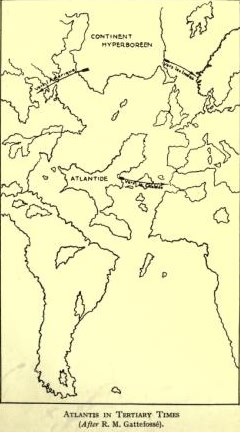
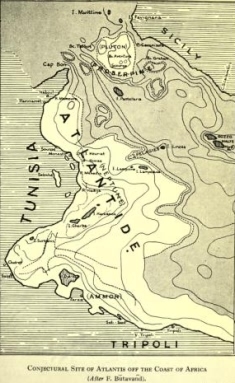
It is, no doubt, a topic that stirs anyone’s imagination: Atlantis, the lost, sunken continent.


Was it real? Why and when was it sunken? Who were the Atlanteans? Their races? Their descendants? Their kings and lineages? What was the geology and flaura and fauna of the place? What connection to Egypt and Greece (Athens foundation)…and Britain…, and Central America?


The topic is old, so the book of Lewis; a well, deeply-researched one.


Putting aside the (psychic) methodology of Edgar Cayce, what we have is a very tough point of departure: no documentary evidence, no “soil” , no “artifacts”…no “facts”, acknowledges Lewis from the very beginning. His major source are legends in several nations, but mainly the accounts of Plato (Timaeus and Critias); also the “Historical Library” by historian Diodorus Siculus.

Solon told Critias… and Critias told Socrates…

"Listen then …A TALE STRANGE THOUGH IT BE IT IS PERFECTLY TRUE".

"The gods divided the earth into portions, both great and small. and to Poseidon or Neptune, god of the sea, had been awarded the isle of Atlantis , where he begat children by a mortal woman. (...)
these princes reigned in prosperity in the island for centuries, and established a supremacy in the midst of the ocean over many other islands, as well as over those which are near Egypt and Tyrrhenia."


“…had an island… (greater than Lybia [north Africa] and Asia [minor] together)…before the Mouth of the Strait which is called …the Pillars of Hercules…but later…great earthquakes and floods there fell one day and night of destruction….sunk and vanish away”.


These are the main explanatory points from Plato’s sources; taken from Egyptian sources. It is deemed that Plato himself went to Egypt.

The major assertions of Lewis are:

(1) Attest the credibility of Plato’s narrative; neither “allegorical” nor “mythical”.

(2) Introduce this idea of an Atlantean ”invasion” of Europe; still surviving in the folklore and traditions of the United Kingdom isles. Especially in Britain, Lewis ventures on a relation between Atlas and the British Gods: Albion and Iberius :”Atlas can readily enough be associated with the gods of Britain”.


The Lyoness (of the Arthurian legend) is identified with Atlantis and most important: Avalon…with Atlantis: “Atlantis, it is needless to say, has been again and again identified with the Island of the Hesperides which contained the sacred apples”.


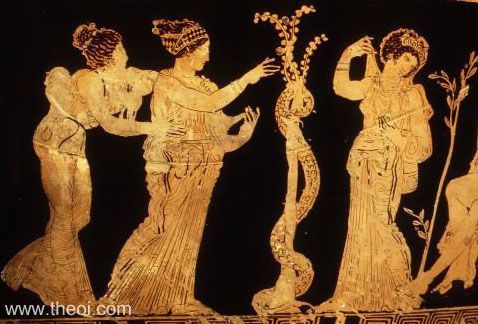
(Hesperides & the golden-apple tree, Athenian
red-figure hydria C5th B.C., British Museum)

In the legends too:"Such traditions of the submersion of cities in the lakes of the country, or of populous districts, by the intrusion of the sea, are current all over Wales."

(3) Relate Atlantis to an outpost in America: the Maya civilization.


I took special note on the Greek connection: the “submergence of a portion of the Greek peninsula” , and the 7 daughters of Atlas, the Atlantides, hypothetically related to the Greeks lineage.

Also, the account of Siculus about the warlike women (Amazons) of Hisperia. War was a current issue in Atlantis (see warfare against the Gorgons).

"The Amazons inhabited an island called Hysperia (the Hesperides, or island of Hesperus, the evening star, son of Atlas, where grew the famous golden apples or oranges, guarded by a dragon) lying to the west, near the morass named Tritonides, a fen so called from the fact that is was traversed by the river Triton. This morass borders upon Ethiopia, under mount Atlas...."

A very well accomplished book; well-answered those top questions. A starting point for the curious mind.
Profile Image for Jenn.
737 reviews42 followers
March 25, 2018
I did not finish this book. The author talked so much about Plato and Socrates and would get carried away that it felt like he veered off topic quite a few times. I know that Atlantis was in Plato's writings but the info the author put in this book was quite boring and not what I wanted. Time to look into other books that have the info I'm looking for.
Profile Image for kingshearte.
409 reviews16 followers
January 16, 2013
This book took me a very long time to slog through because it was very very dull. Dull enough that my mind would start to wander in the middle of a sentence, and therefore I started to lose track of what I was even reading. Frankly, the only reason I finished it at all was because I couldn't find a copy to borrow, and so purchased the e-book, and, having spent money on it, felt like I needed to actually read the thing. There were aspects of it that were interesting, like the very idea that it actually may have existed. And I think that's kind of where things started to fall down a bit for me. I came to the book thinking of Atlantis as that domed sunken city that's still inhabited and is still functional under the sea, so when he starts talking about how he truly believes that it existed, I was all, woah there, cowboy. What delusions are you operating with, exactly? But then I started to realize that he was not in fact talking about that version of Atlantis. He was talking about an Atlantis that actually sank due to tectonic shifting or whatever, and that is most definitely not inhabitable unless you're a fish. And while that idea is very interesting, and he makes a compelling case for it, I'm neither an anthropologist nor an archaeologist, and I was kind of more interested in that domed underwater city business, because that to me just always seemed super cool. I'm not sure how one would even go about writing a history of something that couldn't possibly exist or ever have existed, but I guess that's more what I was expecting, and this was not that. And it was dull.
899 reviews
August 2, 2022
The book has a number of very interesting stories concerning the veracity of the existence of Atlantis. The author does make a compelling argument, but I could not agree with many of the things he was writing in that he has an evolutionary perspective, discounting the truth of the Biblical account of the Flood. He does agree with the idea of a worldwide flood because it appears in most of the ancient legends and histories; however, he gives too much emphasis on the thousands of years which would have worn away islands or the volcanic action of hundreds and thousands of years that would have accounted for the rise of new islands. All and all, I did delight in reading about Plato's theories and old legends.
51 reviews
March 20, 2025
Books about Atlantis often devolve into racism and science-fiction and Lewis Spence ultimately argues that Egypt received its civilization from Europeans who come from Atlantis because he thinks Africans are too primitive, so this is ignorant and racist in parts, but he's actually not as offensive or delusional as other Atlantis hunters of the early 20th century. He sees Europeans as cousins of North Africans through Atlanteans and also with Native Americans. Unlike the godfather of Atlantis hunters Ignatius Donelly, Spence isn't arguing for an Aryan Atlantis but of a superior Atlantean stock of all non-Asiatic races. He has a beef with Theosophists and their Asia-centric origins of humanity and religion and his views are nowhere near as racist and silly as theirs. Spence suggests the Atlanteans were Native Americans who used land bridges more than ships. The science is dated but at least its reasonable. I was most impressed with his brilliant readings of Greek myths about Atlantis and knowledge of obscure British and Latin American myths. The Greek part was eye-opening and has me reconsidering the whole Atlantis myth again as more true than I thought.
54 reviews1 follower
May 3, 2021
I wanted to read this for some entertaining quackery but Spence wanted so hard to be taken seriously as a scholar that it ended being quite boring. The gist of the book is that, in Spence's opinion, Mediterranean and some American indigenous cultures have similarities. Therefore they must have come from the same vanished culture.

If you're into this stuff you're better off reading Graham Hancock. He's also a total quack and bullsh**ter but he's more entertaining to read and the science is well updated.
Profile Image for Philip Athans.
Author 55 books245 followers
November 11, 2021
The author’s passionate belief in the literal historical existence of Atlantis, and in its role as the birthplace of not only Western but Mezzo American culture is infectious. But the last almost hundred years of progress in not just archaeology and history but sciences he seemed entirely unaware of like plate tectonics and genetics have not been kind to his impassioned assertions. What I found fascinating about the book was the creativity of his worldbuilding and that’s why I’ll be writing up a more detailed recommendation for it on my blog.
Profile Image for George Eraclides.
217 reviews2 followers
April 20, 2020
A Dover Books classic reprint looking at the legend of Atlantis with some good and some fanciful arguments for its actual prehistoric existence as a large island in the Atlantic.Some quite intriguing historical allusions and artifacts which still entice the imagination. If you are looking for historical background then this book is a good place to start. If you are a science fiction writer you will also find interesting material to play with.
Profile Image for Aaron Meyer.
Author 9 books57 followers
October 23, 2025
Interesting book to say the least. His theory covers from Cro magnum upwards. There are points that I would like to research further particularly the animal migrations into the sea. The amount of similarities between the continents does also bring to mind there being a medium from which all spring so who knows in the end. Of course he wouldn't have known about the cyclopean ruins underwater in the Caribbean, if he had the book would have been longer lol
Profile Image for Victoria Adams.
Author 1 book7 followers
November 10, 2012
So, this week we are back with a bang reviewing interesting and, perhaps, rather obscure texts on subjects of interest. I have chosen to review two titles together primarily because they represent the foundation of modern thought on that mystic island in the sea, Atlantis. Each has a slightly different perspective. If you are truly interested in Atlantis and lost civilizations, these books provide much food for thought.

The “book that started it all” was entitled Atlantis, The Antediluvian World. This text was written by Ignatius Donnelly an American descended from Irish parents. He was a US Congressman and lived from 1831 to 1901. Although many modern historians and scientists consider his approach “pseudo-science,” he is the first modern researcher to take the tale from Plato’s Timaeus and put together the pieces to see whether or not it might be true. Plato’s works describing the conversations between Timaeus and Critias were written in approximately 300 BCE. Be they history or be they drama is a question that remains unanswered to this very day. They are our primary source for all things Atlantis.

The edition of Donnelly’s book that I have contains a forward by the second author mentioned in this post, Lewis Spence. In his forward he gives Donnelly credit for much basic work in the field. Beginning with fable and legend on both sides of the Atlantic as well as sources in scripture, Donnelly puts a case together that suggests many of our ancient legends do indeed carry fragments of fact. He also looks to the cultural similarities shared on both sides of the Atlantic, flora and fauna (that’s beasties and plants), and ancient tales regarding the navigational hazards of the Sargasso Sea. He also looks at art and culture as it spread through Europe during a time relevant to Plato’s chronology. It certainly goes beyond modern-day mystic interpretations of ancient spirit guides.

The book that was built on this first block-buster was The History of Atlantis by Lewis Spence. Spence was a Scotsman and lived from 1874 to 1955. He was a journalist and a literature major and authored a total of five works on Atlantis. Much of his literary work was on the history of the Celts.

He deepened the study begun by Donnelly, added information that had become available in his own time a generation after Donnelly. He also corrected a few of the observations that were developed by Donnelly. He gives full credit to his predecessor and near contemporary. This title was first published in 1926.

We have learned from experience that just about the time we think we have it all figured out, we discover something new and interesting about our distance past. We know now that islands can come and go in the sea and that cataclysms can happen which create major impacts on our globe and on civilizations great or small. If you are interested in a detailed approach to the possibility that this ancient civilization did exist, I suggest you try these volumes. They are fast and entertaining reads.
Profile Image for Cwn_annwn_13.
510 reviews84 followers
December 12, 2008
My main interest in this book was to delve into the idea of Atlantis as an ancient homeland and/or place of origin for the Aryan race. This is an overview of various ideas or theories involving the who, what, where and when of the Atlantis legends. There are a lot of theories out there that are feasable both through deciphering the legends and folklore pertaining to Atlantis as well as from the science and geology end of things. I have no doubt that Atlantis did actually exist and that it was Aryans who inhabited it but its very unlikely the specifics or details will ever be discovered.
Profile Image for Pat.
1,319 reviews
August 27, 2015
Much of this book is deadly dull. The writing style is stodgy, more like a scientific paper. Since it was written in 1929, I think a lot of the examples have been disproven, or at least tempered, by later archaeological finds and geologic theories. I did enjoy the summary of Plato and of the various myths.
Displaying 1 - 15 of 15 reviews

Can't find what you're looking for?

Get help and learn more about the design.