Szczere i żarliwe wspomnienia ikony filmu i skomplikowanego człowieka, który od ponad sześćdziesięciu lat inspiruje widzów wybitnymi rolami.
Anthony Hopkins urodził się i wychował w Port Talbot, walijskim miasteczku przemysłowym. Dorastał w czasach wojny i kryzysu, otoczony mężczyznami, którzy unikali okazywania emocjonalnej wrażliwości. Był słabym uczniem, więc koledzy, rodzice i nauczyciele mieli go za nieudacznika i nie wróżyli mu świetlanej przyszłości. Jednak pewnego sobotniego wieczoru ten lekceważony chłopiec obejrzał adaptację Hamleta z 1948 roku, a ta wzbudziła w nim niezrozumiałą jeszcze pasję i poprowadziła ścieżką, której nikt dla niego nie przewidywał.
Sir Anthony szczerze i zajmująco opisuje kolejne etapy kariery, ukazując genezę swoich najbardziej znanych ról. Dzięki monologowi Jaga z Otella dostał się na prestiżową Royal Academy of Dramatic Art, pod skrzydła samego Laurence’a Oliviera. Z Richardem Burtonem zetknął się po raz pierwszy w dzieciństwie, w domu nauczycielki rysunku, a później stanął z nim twarzą w twarz w teatralnej garderobie przed spektaklem Equus – już jako pełnoprawny aktor. Do stworzenia niezapomnianej kreacji w Królu Learze wykorzystał zaś stoicyzm ojca i dziadka.
Uczciwie przedstawia również wzloty i upadki w życiu osobistym. Uzależnienie zniszczyło jego dwa pierwsze małżeństwa i relacje z jedynym dzieckiem. Przez alkohol prawie umarł. To doświadczenie sprowadziło go ostatecznie na drogę trzeźwości, z której nie zszedł od niemal pół wieku. Podobnie jak inni mężczyźni w jego rodzinie, nieustannie zmaga się z pragnieniem samotności i unika bliższych relacji z obawy przed zranieniem. Z upływem lat coraz więcej myśli o własnej śmiertelności, przygotowując się na odkrycie tego, co jego ojciec nazywał Wielką Tajemnicą.
Przez całe życie, zarówno w momentach dotkliwej straty, jak i chwilach wyjątkowej radości, sir Anthony’emu towarzyszy jeden stały element: zdjęcie trzyletniego Tony’ego. Uchwycono na nim moment, w którym dostał drugą szansę na szczęście, cichą zapowiedź błędów, które miał popełnić, i niezliczonych możliwości, które miały się przed nim otworzyć. Dziś od tego niespokojnego dziecka dzieli go spory dystans i spoglądając na tę fotografię, z dumą mówi: Daliśmy radę, chłopaku.
Librarian Note: There is more than one author by this name in the Goodreads database.
Sir Philip Anthony Hopkins, is a Welsh actor of film, stage, and television, and a composer and painter. After graduating from the Royal Welsh College of Music & Drama in 1957, he trained at the Royal Academy of Dramatic Art in London, and was then spotted by Laurence Olivier who invited him to join the Royal National Theater. In 1968, he got his break in film in The Lion in Winter, playing Richard I. Considered to be one of the greatest living actors, Hopkins is well known for his portrayal of Hannibal Lecter in The Silence of the Lambs, for which he won the Academy Award for Best Actor, its sequel Hannibal, and the prequel Red Dragon. Other notable films include The Mask of Zorro, The Bounty, Meet Joe Black, The Elephant Man, Magic, 84 Charing Cross Road, Bram Stoker's Dracula, Legends of the Fall, Thor, The Remains of the Day, Amistad, Nixon, The World's Fastest Indian, Instinct, and Fracture.(-wiki)
So here I am today and the only advice I can offer anyone would be: Listen to music. Any music. Or read. Read anything. Books. Poems. Whatever it is.
When I was a child, at the age when I began to realize that all those colorful rectangular objects in my mom’s bookcase were books and not pretty decorations and toys, I became enchanted by a single face looking down at me from the cover of one of the books. I used to stand in front of the bookcase and look back at this calm, kind and handsome face. For obvious reasons I thought that is the face of the author of the book and I vowed that when I grew up, I will read that beautiful book.
It turned out, that the book was Tolstoy’s War and Peace and the calm face was the then young Anthony Hopkins’. The edition was the two-volume paperback box set that had been printed along the 1972 BBC television adaptation, Hopkins acting as Pierre. Needless to say, when I grew up, I read the book. I loved it. I loved the adaptation. And I loved Anthony Hopkins. I still do, for his talent, humbleness and humanness. Because of my obsession with Tolstoy and Hopkins, my mom gave the book to me. Now it's sitting on one of my bookshelves, looking at me, while I type.
In this deeply personal memoir, Hopkins reflects on his childhood and his struggles, achievements and experiences. I listened to the audiobook version narrated by Kenneth Branagh, which was excellently read. What I also loved about the book was the inclusion of family photographs and a selection of poems read by Sir Hopkins himself.
As I sobered up, I looked up at the eucalyptus trees and thanked God no one had died that night. I imagined my parents back in Wales hearing that I’d killed someone or myself. I saw their hopes smashed. I heard a voice ask me, Do you want to live or do you want to die? I want to live, a voice answered from somewhere deep inside me. Then I heard the voice say, It’s all over now. You can start living. The craving to drink left me. That was eleven o’clock on December 29, 1975.
I went into this memoir by Anthony Hopkins pretty much blind, and it ended up being a surprisingly engaging listen. We Did OK, Kid follows his journey from a lonely, struggling kid in Wales to becoming one of the most respected actors of his generation.
It’s very reflective—lots about anxiety, aging, and finding purpose later in life. The writing is smooth and there are some genuinely great quotes.
That said, it feels a bit… selective. I wanted more honesty in certain areas. Still, a solid, easy memoir if you’re in the mood for something introspective but not too heavy.
I am a huge fan of an autobiography that is self reflective and insightful…. Not just telling the stories of someone’s life. Anthony Hopkins’ book is just that. He is raw, he’s honest and he weaves this through every chapter. Not only is he an amazing actor, but he’s an engaging and entertaining storyteller, and this book is a masterpiece that will live on forever. 5 solid stars!
I've always admired Anthony Hopkins and his work. This memoir offered a wonderful glimpse into the man behind the spotlight. Throughout the book, Hopkins reflected on the roles he embraced and made his own, both on the screen and the stage. He elevated each character with the details that made them believable and memorable and that in turn made Hopkins himself impossible to forget.
I completely enjoyed the parts where he opens up about his family, his early experiences in acting, his journey to stardom, his alcoholism, and his other struggles. His success never felt like a matter of being in the right place at the right time. He clearly had the talent, discipline, and the presence to support every opportunity that came his way. He still remembered a lot of his lines from early on....and took every opportunity to share them with the reader. That wasn't always my favorite, but I have to say, I loved his tenacity.
Overall, this memoir was a heartfelt and engaging look at an extraordinary career and the person behind it. So 5 stars.
What a big hearted, touching and bittersweet memoir this is!
Written by one of our greatest living actors- Sir Hopkins' portrayal of Dr. Hannibal Lecter has been deemed the greatest villain of the American Film Institute on their best of lists. His portrayal alone in "The Silence of the Lambs" is one of the most iconic ever committed to film. Sociopathic, dangerously mercurial, and controlled- I am glad the world gets to see Sir Tony (as he has written how he likes to be referred to) in a complicated and heartfelt lens.
I first heard about Sir Anthony's memoir after having watched a segment of it on CBS Sunday Mornings. Sir Hopkins has accomplished many things: He's triumphed on stage, playing Shakespearean roles in "Othello", "Hamlet", "Macbeth", and "King Lear". He's a two time Oscar winner: for Dr. Lecter, and of “The Father”.
Here some of his other roles that he loved playing on film:
"The Lion in Winter" costarring the legendary Peter O'Toole and Katharine Hepburn as his parents- Miss Hepburn even told him that all of acting is business- acting for her was knowing how the camera worked, and even said she'd steal the film from him. What an amazing start in films to work with two of the greatest that ever was in pop culture. and in cinema!
Next he writes about "The Elephant Man" where he is the kind and patient Dr. Treves to John Hurt's devastatingly tragic John Merrick. Directed by David Lynch and costarring the legendary Anne Bancroft, he reflects on this film fondly.
As he describes “The Silence of the Lambs” being the most perfect filmmaking experience with Jonathan Demme- he writes fondly and of professional love towards Clarice Starling herself: Jodie Foster. In case you didn’t know, “The Silence of the Lambs” holds the record as one of the only three films to win the big five Oscar categories: Picture, Actress, Actor, Director, Screenplay.
Next he writes about working with the Merchant Ivory team in three films: He costarred with Vanessa Redgrave, Helena Bonham Carter and Emma Thompson in "Howards End".
Thompson and Hopkins would reunite in “The Remains of the Day". In my mind this is the film that made me love his work, it’s my personal favorite of his.
His haunting, stuttering and introverted performance of a butler unable to say what he feels- towards the woman he loves, and being complicit in turning a blind eye towards his employer who was a Nazi sympathizer will both chill you and break your heart. This, The Father and Silence are some of my favorites.
Finally Hopkins would star in Merchant/Ivory’s Surviving Picasso.
Hopkins also writes about what might have been his hardest film role: portraying President Nixon in Oliver Stone's biopic. A bundle of nerves and paranoia- I remember he embodied the role with humanity and a depth that is not found in a lot of today's biopics.
Hopkins also had a ball working with Bonham Carter and Emma Thompson's ex, Kenneth Branagh directing the Marvel film "Thor". He also enjoyed working with Steven Spielberg in “Amistad”.
Curiously, he writes about a film called "The World's Fastest Indian" which I have not seen- but it seemed to have meant to him that be a part of this role. It seems it’s the role that was the most fun he had acting, as well as his being super proud of his stunt work.
Finally, he writes of working with the great Olivia Colman in "The Father"- another gorgeous, layered performance about a man struggling with dementia.
The film world knows his surprise Oscar win over posthumous favorite Chadwick Boseman had the internet ablaze with accusations of racism.
However, if you watched "The Father" it’s a searing, intimate look at someone's pain. Sir Anthony gives it the fullest treatment. I recall I was feeling his despair of not knowing where or who he was. The journey he takes us to is somewhere so deeply painful that only someone of his acting caliber can bring genuine subtlety and pain so readily.
The book is Sir Tony telling his inner little boy that "we did ok".
The book delves into his difficult relationship with a tough father who often verbally abused him and trying to gain his attention. How his dad hurt him caused him to clam up and bottle those emotions inside of him. His alcoholism almost destroyed his career and he proudly writes that he's 50 years sober.
He honest of his cruel treatment of his first two wives, and of his estranged daughter Abigail. He writes with wistful regret that he wished they could've gotten on better- but in moving on, the door is open with a chance to reconcile.
Sir Tony minces no words of his toxic behavior, of how his cockiness got him into trouble. He writes his third wife with a lot of love and affection- and in this third act into his personal life, and career he seems to be very much at peace.
Overall, this one of the wonderful books to end 2025 with- and l do hope somehow we are all going to be ok.
Really interesting. An interesting life to read about! I really appreciated his reflections on alcoholism and on his (“failed”) relationship to his daughter. I also found it so interesting that he stayed very close with his own parents throughout his life. Given his fame and age, it was just really interesting to hear so much about his relations with his parents. Not all famous people’s autobiographies would spend this much time reflecting on their relationships with their parents. He is especially eloquent/loving in describing his father and the men of his father’s generation.
He makes passing reference to his infidelities during his 2nd marriage. That seemed odd to me, because he never said more about it before or after that. So I was surprised he mentioned the topic, if he wasn’t going to discuss it more.
At the end there is 45 minutes of him reading his favorite poems, which was just really interesting.
(Interestingly, in contrast to what I recently said about Bjorn Borg’s autobiography, Anthony Hopkins really, really makes it clear in this that he has wrestled with how he handled fatherhood and his relationship with his daughter. I think he said it’s his greatest remorse and greatest sadness (?), or something along those lines—and that he is also sure the choice he made, to leave her mother because their marriage was so dysfunctional, was the correct one. But the level of his remorse, and the admission of his own imperfection is so clear here. It’s exactly the degree of introspection that I thought seemed to be missing from Borg’s autobiography.)
Anthony Hopkins, famous actor. This memoir is not about his succesfull career, but the man behind the actor. His youth in Wales, his relationship to his parents and how a not-so-bright boy became what he became.
This is a humble biography. It is how, even to this day, he feels he shouldn't have become such a good actor and how he feels the didn't deserve it.
He doesn't talk about his achievements, but his faults. His two failed marriages, his estranged daugher and his drinking problem - the last he overcame by sheer will power.
I guess any 89 year old has some wise words for the younger generarions - Hopkins is no exception. I really liked his outlook on life. Keep going, do not brag and be thankfull.
4 🎭 🎭 🎭 🎭 (5⚝⚝⚝⚝⚝ for narration) At first I was disappointed to learn Sir Anthony did not narrate his memoir and the first 30% was a bit slow for me, but then the exceptional thespian skills of Sir Kenneth Branagh took hold and I was immersed. Hopkins later narrates some of his favorite poems in the appendix, but Branagh exudes not only the author's persona, but all the other characters portrayed. Some of the rolls he played are represented, but this is more about personal recollections looking back after 88 years of life. We've lost many great actors recently and I will miss this man's talent when he is gone, but thankfully there is more planned to come.
От години чета мемоари на известни артисти, предимно от старата генерация. Намирам го за утвърждаващо преживяване, което ми дава един по-различен поглед над изминалите десетилетия, че и над тези от времето преди да съм се родил. Почти всички от тези хора са започнали от най-ниското стъпало и са преминали къде бавно, къде стремглаво през поле от възможности, срещи с най-известните на деня и поуки отвъд лесно обозримото. Като започнеш от самия Чарли Чаплин - биографията му е като самата история на Киното, че до днешните екранни герои.
Така, стигнахме и до артиста, който ми е най-интересен на голям екран. Ако ме питат за образец на това що е то филмова игра - първото нещо, за което ще се сетя е Хопкинс в ролята на д-р. Лектър. Това е живото доказателство, че всеки може да бъде изигран, но не всеки може да го изиграе. Веднага признава и че никога не съм се ровил в личния живот на кой да е от известните, затова повечето неща в тази книга бяха нови за мен. Да кажем, всичко извън екранните превъплащения. Оказва се, че Хопкинс е бил крайно ненадеждно хлапе (по собствените му думи и тези на родителите му), подвластен на алкохола в по-голямата част от младостта и зрелостта си и достигнал до съзряване и проникновение едва в последната третина от живота си. Така усетих и книгата - наслаждавах се на последната една трета и не можех да разпозная героя си в по-голямата част от всичко преди това. Бягство от отговорност, своенравие, безцелно и безмислено отрицание, изолиране ... с една дума - страшен темерут си е бил. Мисля, че на едно място към края точно тази дума използваше и самият той.
Беше ли каквото очаквах - честно, не. През по-голямата част. Има ли уроца - има. Най-добрият актъор в съзнателния ми жовт ли е - да. Най- добрата книга от актьор - не. За мен образец за книга остава тази на Майкъл Кейн.
I'm not sure how likely it would've been that I'd have picked this up – and certainly right away — but when I saw an interview Hopkins gave to Stephen Colbert for The Late Show, I was immediately intrigued. His voice — his views — his approach to life was really interesting … and not really what you'd think. He's well-versed in Shakespeare … has had the kind of voice that makes people say "he could read me the phone book and I’d listen," but he has never really liked talking about would-be pretentious things like "craft" and "method" when it comes to acting.
His story — from early childhood in Wales and onward — was fascinating. He has exactly the thing you need in these celebrity memoirs — introspection and self-awareness … particularly the type of self-actualizing wisdom that comes from having lived for 8 decades, coming out on the other side of alcoholism, and finally coming to terms with the big regrets of his life.
I totally recommend the audiobook, which is performed by Kenneth Branagh — apart from an extended portion at the end with Anthony Hopkins — doing a little epilogue, I believe, and also he reads his favorite poems and such. That’s about an hour total from Hopkins himself. My one personal caveat is that Branagh’s Katharine Hepburn is utterly ridiculous, but his Laurence Olivier is perfection.
Как отдалечено се почувствах, когато пристъпих отначало в тези мемоари. Но колкото повече навлизах в истотията му, толкова по-трудно ми беше да се откъсна. Мемоарите на Антъни Хопкинс, изненадващо, ме накараха да се замисля за собствения ми живот и за сбъднати и несбъднати мои мечти, за надеждите и разочарованията ми, за близки, които съм изгубила завинаги. Неговата дълбока и особена чувствителност към живота и смъртта успя да извика у мен спомени и мисли, които обикновено пазим заровени на дълбоко и по-далеч от досадната практичност на всекидневието. Разчувства ме, разплака ме - не за бурния му живот, изпълнен с амбиция и грешки, дистанция откъснатост, вдъхновение и смелост, разкаяние. Устрем и красота. Разплака ме за простотата на нещата и колко трудно я постигаме, как мъчно я улавяме. Как все ни се изплъзва. Колко ни е страх. Колко дълъг е животът, когато си изгубен и самотен, и колко кратък се оказва, когато се обърнеш назад. Какви късметлии сме, че можем да надникнем зад завесата на известността на сър Антъни Хопкинс. И колко много ще ни липсва някой ден. Дано е още далеч, далеч оттук неговата Итака.
Anthony Hopkins is possibly on the spectrum of Asperger’s. Showing no interest in school, he flunked out. But he had a natural talent for memorization and delivery of Shakespeare speeches. He was awarded a scholarship to train at a prestigious school in Great Britain. He performed on stages in London and eventually moved into movies. He also played the piano well and had an interest in the arts. The biography is well delivered in the audiobook version and Hopkins reflects deeply and openly about his life and career.
Have been a huge admirer of Sir Anthony Hopkins for many years. So many amazing memories from his work. There’s so much wisdom for everyone in this memoir, in all its stark rawness often, especially for those with a creative bend. I will treasure this book. Really really enjoyed reading it and came away richer for it.
Um gigante do cinema longe do brilho de Hollywood.
Com grande honestidade, Anthony Hopkins oferece-nos o testemunho de um homem de 88 anos que ainda procura reinventar-se com serenidade. É um livro sem brilhos, luzes ou lantejoulas. Gostei da vulnerabilidade com que aborda temas sensíveis, a relação com a família, os perconceitos, a extrema ansiedade, a solidão necessária, o alcoolismo, o afastamento da sua única filha. Gostei menos do demasiado foco que é dado aos muitos arrependimentos. Ainda assim, é a humanização de um ícone, a revelação de um homem profundamente vulnerável.
O livro tem uma estrutura fragmentada, parece quase desorganizado. Não afetou a minha leitura e achei até interessante. É uma autobiografia. Anthony Hopkins é um ator, não é um escritor. Seria, para mim, estranho se fosse de outra forma. Também na escrita, correu bem, miúdo. É um livro bastante corajoso.
A solidão é algo que prezo. Não propriamente estar sozinho, mas a solidão em si.
Една от най-добре написаните актьорски биографии, които съм чел. Антъни Хопкинс разказва живота си честно, директно и без да се опитва да изглежда по-добър, отколкото е бил. Говори открито за успехите, провалите, алкохолизма, семейството и цената на славата, а книгата се чете толкова леко, че на моменти имах чувството, че чета роман. Много ми хареса и колко голямо място отделя на театъра, поезията и Шекспир – детайли, които придават още повече характер на историята. Препоръчвам я на всеки, който обича добре написани биографии, независимо дали е почитател на Антъни Хопкинс.
Not your typical film-by-film recounting of a career, this is much more the story of a troubled alcoholic (who ALSO just happens to be one of the greatest actors of our time) struggling to come to terms with his past and regain control of his future. And for that reason, is a much better book than your typical celebrity memoir. That said, it certainly contains its share of inside-the-industry gossip, ranging from what an apparent ass Paul Sorvino is, to the following (which IMHO is the best line in the book):
"It was great working with Alec and Bart the Bear, who was also in, among other movies, Legends of the Fall, The Bear, and White Fang. He could really act, that bear."
Two minor complaints with the book's production. I had waited a long time for the audiobook, only to finally get it and learn it was narrated by...Kenneth Branaugh?? I mean, I love Sir Ken (who doesn't?), but Anthony Hopkins has THE VOICE, and to hear his words coming from anyone else's mouth just seemed so wrong that I switched to the dead tree version and just heard Hopkins' voice in my head.
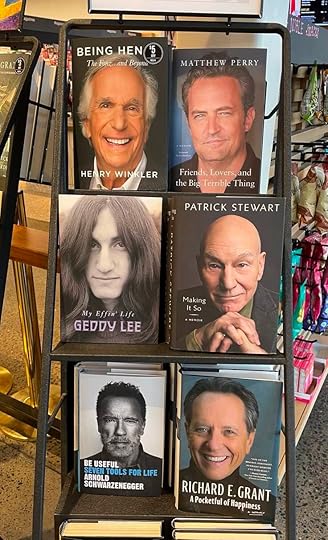
And second — what the hell is it with celebrity bios and their massive head shots these days? You’re famous — we KNOW what you look like!! Below is a recent display at our local B&N, and this book obviously continues this unfortunate trend:
But otherwise, just a fascinating and surprisingly insightful read.
DISCLAIMER: And okay, as noted in my recent review of Virginia Evans' wonderful The Correspondent, I do have a special, highly personal connection to Hopkins. From that review:
"Back in the mid-'90s, my father and I both wangled roles as extras in the film "The Road to Wellville" — one of Anthony Hopkins' few comedies — which was shot near our home in Upstate New York. Not long after, my dad had a major stroke, after which (and among so many other things) he fixated on the movie — asking when it would come out, revisiting our few days of standing in the background, wondering how he would watch it, etc. I ended up writing to Hopkins via his agent and explaining the situation, and asking if he might possibly send a brief note to my dad. Instead, he sent a beautiful long letter chatting about the film and his upcoming plans, recalling chats with my dad (probably non-existent, although he did enjoy talking to everyone — crew, extras, etc.), expressing his sympathy and wishing my dad a full recovery, even ultimately quoting MLK. That thoughtful gesture meant the world to my dad through his final days, and continues to mean the world to me — to this day, "Tony" (as he asked everyone to call him) can do no wrong."
So — endless thanks and love, Sir Tony. And miss you every day, Dad...
A fascinating story of a successful life against all the odds - his parents despaired of what he would become and he was a loner at school and then an alcoholic and only really achieved his full potential late in life. The description of SIlence of the Lambs alone is enough to make this worth reading but it is much more than that. Only how morbid and preoccupied with death it became towards the end stopped me giving this five stars.
Undeniably the most boring memoir I have ever picked up.
During my university years, I conducted several life-history interviews for my then social sciences professor, and those were of almost the same caliber as Mr. Hopkins’s memoir. By this I am not judging the respected actor himself, but rather questioning the justification for this work in its current form. I understand that in old age people enjoy reminiscing, immersing themselves in the “good old days,” and perhaps sharing a few cherished or important moments of their lives with their descendants—but as a lay reader, this book offered me absolutely nothing.
Apart from the sections dealing with alcoholism, there is nothing instructive, exemplary, or even entertaining about this memoir. It feels raw and erratic, a collection of meandering, stream-of-consciousness monologues driven by whatever happened to come to mind at the moment.
Incredibly autistic for a guy who suddenly doesn't think autism is a thing despite proudly wearing that diagnosis about 10 years ago. Still an excellent book. One of those rare celebrity memoirs that doesn't make me feel like the guy who wrote it is kinda gross by the end of it.
Спогади Ентоні Гопкінса «Ми впоралися, малий» я знайшла в застосунку «Наш формат». Переклад Олександр Михельсон і приємна начитка Костянтина Лінчевського думаю, сам автор був би задоволений.
Я рада, що Гопкінс у 87 років знайшов сили написати мемуари (хоча він знайшов сили ще й у ролі композитора свій перший музичний альбом Life is a dream випустити кілька місяців тому. І це людина, яка страждала довгий час на алкоголізм аж до провалів в памʼяті! Ось що значить валійська порода). Страшенно цікаво за ним слідувати по життю і бачити його очима світову драматургію та поезію від першої зустрічі в школі з Шекспіром, коли в душу школяра увірвалась якась незбагненна сила, до «Мовчання ягнят» та інших шедеврів:
- Фантастична гра!, - похвалив Крістофер Феттіс, викладач Академії мистецтв, свого колишнього учня за роль Ганнібала Лектера, - нарешті ви зрозуміли! А на кому ви базували свого персонажа? - на вас, - відповів Гопкінс, - коли ви давали нам зауваження на заняттях, нас ніби пронизувало крижане шило.
Захоплююче описано усю підготовку до цієї ролі. Сценарій моментально полонив актора і він відразу знав, що буде робити: «Не грай чудовиська, грай тиху, доброзичливу версію». Тривалий погляд змушує людей почуватись вкрай незручно. Тому Ганнібал буде дивитись саме так. Досконала і чітка дикція паралізує людей. Тому Ганнібал буде говорити саме так.
Коли режисер спитав: «Що ти хочеш робити перед зустріччю з Кларисою? Малювати, читати, сидіти?», Гопкінс згадав страшного павука на стіні в пекарні свого діда зі свого дитинства: «Я буду просто стояти і чекати на неї». З Джоді Фостер вони тоді не встигли познайомитись, тому, щойно вона увійшла, відразу почались проби. Всі погодились, що це було дуже страшно, панувала така тиша що чутно було б, якби впала шпилька.
Взагалі в молодості сер Ентоні трохи мені нагадує бравого вояка Швейка. І по армії він скитається туди-сюди, навіть марширувати виявляється нездатний, врешті його відправляють в штаб клацати на друкарській машинці, аж і там все йде під три чорти, начальник нетерпляче відштовхує Гопкінса (дай сюди!) і сідає клацати самотужки. А коли його викликали на килим через чергову бійку і начальство запитало: - то чому ж ви бились, Гопкінсе? Він відповів точно наче Швейк: - Не знаю. Справа в тому що я трохи недоумкуватий.
Іншим разом приятель в нього поцікавився: - ти чого не йдеш по тротуару? Тебе ж можуть збити, ти можеш загинути! - я не люблю натовпів, - пояснив Гопкінс. І справді не любив.
Його епізоди з алкоголізмом жахають. Взагалі отак слухаєш історію його життя та зйомок і дивуєшся, як деякі фільми врешті повиходили. Бо були такі, де головні актори так напивалися, що навіть не пригадували своїх сцен і діалогів, а на зйомках «Лев узимку» так залилися віскі, що Кетрін Хепберн, побачивши які всі пʼяні, люто вигукнула: «Чорт забирай, що з вами, народе англійський!». І нічого, фільм отримав купу нагород і три премії Оскари. Професіоналізм)
Тож пораджу цю книгу, якщо любите Гопкінса, як я, і закінчу його порадами: «Ти така ж людина, як і всі ми, з купою вад. Рухайся помалу, старайся отримувати задоволення від життя, поки можеш і уникай гуру та містиків»
ПС: окремо велика подяка Олександру Михельсону за переклад віршів! Особливо за Єйтса «Постарівши».