Jump to ratings and reviews
Rate this book

No Such Thing as Monday

Not yet published
Expected 16 Apr 26
Rate this book
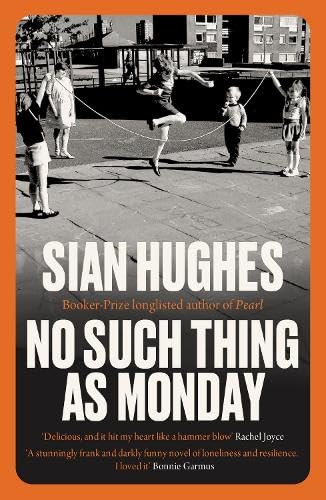
Steffie spends her days working in a dry-cleaner’s, trying to scrub the world clean one garment at a time. But no matter how spotless the clothes, she can’t rid herself of the guilt and grime she feels inside.

Haunted by what happened to her sister when they were children, large fragments of which she can’t fully remember, Steffie is stuck in a loop of self-destruction, defiance, and shame.

When her violent, bullying father dies suddenly, it sparks a reckoning that cracks open her past. What follows is an unexpectedly redemptive journey of a woman trying to piece herself together in a world that failed to make space for her.

Raw, exhilarating, and full of heart, No Such Thing As Monday confirms Siân Hughes as a masterful chronicler of life lived on the edge, and people at their most vulnerable.

240 pages, Hardcover

Expected publication April 16, 2026

31 people want to read

About the author

Siân Hughes

11 books103 followers

Ratings & Reviews

What do you think?
Rate this book

Friends & Following

Create a free account to discover what your friends think of this book!

Community Reviews

5 stars
0 (0%)
4 stars
1 (100%)
3 stars
0 (0%)
2 stars
0 (0%)
1 star
0 (0%)
Displaying 1 of 1 review
Profile Image for Gumble's Yard - Golden Reviewer.
2,188 reviews1,795 followers
October 24, 2025
I remember the shame spreading over me, the heat in my hand as I closed the door as quietly as I could and turned away.  And almost immediately I wiped it out of my head. I remember the pressure inside my head, the slippery doorknob in my hand, the urgency of closing the door. And then nothing. I don't know when I let myself remember it again. Not for years. But there it was, like a piece of broken crockery at the bottom of a stream bed, and as you lift it out you recognise the pattern from your childhood tea table in the small fragment. A tiny sliver, but you know for sure it is the same pattern. You can picture the whole plate from this one small triangle. And you think, how come 1 walked past this stream bed all these years, and it was lying there in plain sight among the pebbles and litter and weeds, and all I had to do was look down and see it there? But you didn't.

 
Siân Hughes debut novel “Pearl” was a nominatively determined unexpected treasure on the 2023 Booker Prize longlist (where it would have made my shortlist) and was later shortlisted for the Authors’ Club Best First Novel Award.
 
Like this novel it was published by the UK small press Indigo Press who “publish books to make readers see the world afresh, question their behaviour and beliefs, and imagine a better future” and whose other books I have enjoyed include “Lessons In Love and Other Crimes” by Elizabeth Chakrabarty and “Riambel” and “Tamarin” by the Mauritian Priya Hein.
 
Dealing with post-partum psychosis it drew its title from the medieval poem: (https://en.wikipedia.org/wiki/Pearl_(...) which survives in the modern day in the same Coton Nero manuscript  (written in the Middle English of Cheshire) as the better known “Gaiwan and the Green Knight” (which was also very important to the novel and even to its cover) – and was an interesting mix of the fey (partly due to the character of the narrator’s mother) and folkloric (largely due to the inclusion of a childhood rhyme or folk song at the start of each chapter) with a very harder edge (with coverage of not just PPD but also cutting and suicidal impulses – an edge matched in the choice of many of the rhymes/songs). 
 
This her second novel – not due to be published until April 2026, draws on a third of the four poems in the manuscript – Purity (or Cleanness) of which (in an afterword) the author says it is “a collection of biblical illustrations organised like a sermon, where each different story drives home the central message, in this case the Beatitude: Blessed are the pure in heart, for they shall see God. The entertaining detail of Purity, however, is much more concerned with the issue of keeping up with the laundry. It has a remarkable number of words for clothes that are old, tattered, patched, out-at-the-knees, or in need of a good pre-wash …………….. I began to wonder whether my narrator spent her lite making the laundry spotless, but never felt she could wash her soul clean.”.
 
As a novel while equally heavy hitting as its predecessor (in this case particularly around childhood abuse/neglect) its protagonist – Steffie – has a much harder poverty-affected backstory.  The blurb compares the book with some insight to Lucy Barton, but unlike Lucy, Steffie does not have the benefit of a move to a relatively comfortable new life to look back on her past.  And overall, this makes the book much rawer and gritty.
 
At the book’s opening mid-50s Steffie is working at a dry cleaners, living in a small flat, and coming to terms with the death of her father is starting to look back at her childhood, realising that there are large parts of that childhood she has deliberately blanked out – mainly relating to her one year older sister Caroline whose explicitly neglectful (to and beyond the point of abusive) treatment by their prize-fighting, domineering/bullying father was something unspoken and unacknowledged in their household even if clear to those outside it (as if – in an analogy which gives the book its title – Monday’s were simply not considered real there).
 
From there the story moves between her present (which involve her already hand-to-mouth, rather frightened existence taking a turn for the even worse as she loses her job and ends up both homeless and in a catering job), her recollections of her childhood and her recollections of the years between (which include a period being dragged into being a drug courier, a child given up for adoption, and incarceration) – and her attempts to force herself to complete the blanks in her past and to consider reaching out to a sister who fled home some 40 years ago and with who she has no contact.
 
Steffie is a superb character – not obviously or immediately sympathetic given much of her past, and hard to directly identify with for most literary fiction readers I expect given her present – but one who the reader finds themselves hugely drawn to and rooting for.
 
I would not dismiss this as a contender for a second Booker longlisting as it is every bit as good as its predecessor, and perhaps even more so as a Women’s Prize contender (albeit given dates not I think until 2027).
 
My thanks to Indigo Press for a paper ARC.
 
Displaying 1 of 1 review

Can't find what you're looking for?

Get help and learn more about the design.