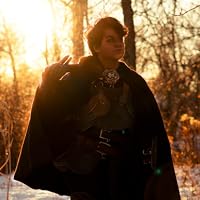
Lord Aerion Valemont is everything the court whispers; vain, venom-tongued, and untouchable in his sapphires and silk. But behind the peacock feathers lies a man raised in a cage of duty, bitterness, and the crushing weight of a dying dynasty. Better to mock the world than let it see the cracks beneath his mask.
Sir Clyde of Blackholt, the king’s most feared hound, arrives sworn to Aerion’s protection. A man of war, not words, Clyde’s silence is a shield as much as his sword. But in that quiet lies something Aerion cannot a gaze that sees too much, and a loyalty that cuts deeper than he dares admit.
What begins as venom and disdain becomes something sharper—letters passed through battlefields, glances heavy with what cannot be spoken, a devotion tested by blades, assassins, and the cruelty of court. In the gilded halls of Valemont, where heirs are bartered like coin and bloodlines weigh heavier than desire, a single oath may cost them everything.
For fans of Captive Prince and A Taste of Gold and Iron, this is a lush, slow-burn romantasy about yearning, loyalty, and love that defies crowns and cages.
Kate Butler’s Oath is a charming and enchanting queer fantasy romance about the love between a lord and his knight.
Lord Aerion Valemont is the spoiled, narcissistic son of the Archbishop. He is used to having his way, so when Sir Clyde of Blackholt, AKA “The Hound,” a war-hardened, quiet, defiant warrior, is assigned to be his protector, Aerion considers it a challenge. He insults the knight, makes demands, sneaks out, flirts openly with men and women, but he can’t get Clyde to crack. He also can’t get him out of his mind and notices that occasionally the knight gives him looks like he feels the same way. It appears these two completely opposite characters from different worlds are attracted to one another despite Clyde’s sworn oath to protect the young Lord and the scheme to get Aerion married to avoid scandal.
Oath is the type of fantasy romance that technically does nothing new. The characters are known archetypes, and the plot and setting have been seen many times. Even the fact that it’s a queer romance has been done. This book should be a disposable cliche, but there is something so delightful and endearing about this particular book that makes it work despite or actually because of the cliches.
It is determined to stick to the format so well that it offers a peace of mind like a fairy tale in which you know the characters will live happily ever after, but you are enjoying the journey anyway.
One of the reasons that this book is so entrancing is because of its protagonists, who, despite their flaws and frailties, are so lovable that you want them to get together from the moment that they lay eyes on each other.
Aerian is written as the ultimate spoiled rich kid with plenty of money and daring, but not a lot of empathy or sense. He has to be the center of attention no matter where he goes. He dresses in loud, bright colors and is often compared to a peacock. He flirts, chats, and ingratiates himself with guests, courtiers, and delegates.
He also has a mischievous streak, which he shows largely to Clyde by forcing him to answer personal questions and teasing him by giving him a ribbon and calling it a leash. He has a child’s need for attention and a penchant for emotional volatility.
Aerion portrays the spoiled rich kid almost to a cliche, but to a point. Just when the reader is about to write him off as a one-dimensional, obnoxious, petulant brat, it occurs to us that this is the point. He plays the spoiled rich kid almost too well, as though it’s an act. Clyde realizes that this is the case.
Many of the chapters where Aerion is vulnerable when alone or defending the people during a council meeting give clues to the real man wrapped inside the bright colors and performance.
While Aerion is hiding his more serious and introspective nature underneath a narcissistic and superficial shell, what you see with Clyde is what you get. He is a solid stoic force. He gives no information unless Aerion asks and then responds in terse, succinct words. (When Aerion asks if he is attracted to him, Clyde says, “Yes,” and leaves it at that for now.)
Aerion might be the vibrant ribbons dancing around the pole, but Clyde is the pole keeping him steady. He loves Aerion but does not want to compromise his duty with emotion. He has sworn an oath to protect his Lord and will do so even if it has to be from himself.
When the Lord and the knight become emotionally and physically closer together, Clyde’s softer side emerges. He protected the Lord because it was his duty to defend a faceless noble title. As their romance grows, he protects Aerion, not the Lord, the Archbishop’s son, but Aerion, the bundle of contradictions that he has grown to love.
Something changes halfway through the book. What started out as a light-hearted, fun queer romance between two opposites becomes a darker and more serious coming-of-age story during war. Clyde goes to war to protect Aerion from a rival kingdom, but also from their clandestine romance, so the path can be cleared for the young Lord to marry.
The separation causes the two to confront opposing forces and their own vulnerabilities. Clyde battles opposing armies and Aerion views with controlled courtiers and comes to terms with his father’s failing health.
They exchange letters full of love, revealing their actual thoughts and emotions while conforming to the societal standards that come with maturity and ascendency. They have to compromise who they are to each other with who they have to be to everyone else.
The darker aspect of the second half of Kate Butler’s Oath makes Aerion and Clyde’s relationship even more powerful. Where they began as archetypes in a fairy tale, they gained depth, wisdom, and insight. They move beyond a spoiled lord and stoic knight to become stronger, braver, more selfless, and more devoted characters and lovers.
Going into Oath, I wasn't sure what to expect from this book. I have an inclination towards forbidden romance, towards knighthood, towards love as the everlasting, and ever meaningful driving force of every story, but even going in, I wasn't sure if I would buy it. If I would buy the relationship between the prideful, arrogant Aerion Valemont, and his silent, stoic and somewhat unnerving oath-bound knight, Sir Clyde of Blackholt. Perhaps it's because I've seen this dynamic many times, or perhaps because I'm cynical. But I went in cautiously optimistic, having read Butler's other works, and witnessing their ability to create an interesting and compelling dynamic between unlikely parties, and had faith in their ability to do it again.
And of course, Butler delivers.
To keep this review spoiler free, I'll refrain from being particularly descriptive about Clyde and Aerion's relationship, and refrain from specifying key moments, but trust me when I say that when the slow-burn finally culminates in this novel, when it hits the peak and the glass breaks, it shatters in the best way possible. Butler takes their time establishing key motifs and themes of their relationship early on in the story, so that when they're evoked later on in the story, it's meaningful and earns its emotional punch.
While I enjoyed both character's development throughout the story, it's Clyde in the later half of the book that really gutted me - a man of stone finally FINALLY allowing the facade to break, if only for a moment. Allowing the others to see that he truly is human, and allowing himself to express how he feels (I'm also a particular sucker for this trope in general, but Clyde is handled very well by Butler - the glass shatters at just the right time, in just the right place).
While the pacing is a little iffy in certain areas - I felt certain events happened a bit too early in the novel - I understand why they had to happen in that way, and the relationship is still believable at the end of the day. The further into the novel you get, the more addictive it feels - I sat down to just read a few chapters one night, and ended up finishing the book because I couldn't stop reading because I almost couldn't stand the idea of not knowing what happened next.
Oath is an incredibly captivating story, and if you're someone like me, who enjoys these tropes, enjoys these wonderful elements of the forbidden romance, then I'm certain you'll enjoy it.
DNF 16% so repetitive. one character smirks in every sentence, the other stands quietly. and it said again and again. nothing happened, completely NOTHING, but then suddenly after knife attack they understood they can't lose each other. where did this come from? where? and why super cool and professional soldier lacks skills to stop an attack and instead takes the blow? it's single-use bodyguard? you need to hire new after every single attack? and writing tries so hard to be very dramatic. characters would be simply standing, but whiting will be: his eyes like glass knives, his words like broken arrows, like smoke, like iron, like stone, like crouching shadows. it's okay to not add dramatic descriptions to every spoken line. and where is plot? what was plot? It didn't begin in those 16%. I missed it somewhere between metaphors and stoic standing?
4.5 stars. It is a definitely a slow burn and the first quarter of the book was a bit hard to get into but after that the pace picks up and so does their romance. The letters to one another are both lovely and heartbreaking. It turned out to be a a really good read.
I received a free copy of this book via Booksprout and am voluntarily leaving a review.
First time reader of this author's work, this book started off with strength and promise. Somewhere the story wavered off and didn't seem to make any sense to me. My attention was lost and failed to reconnect.
I received a free copy of this book via Booksprout and am voluntarily leaving a review.