Both a revelatory, insight-filled playbook for doing business in China and a probing look at why the country, despite the challenges it faces, still possesses unrivaled prospects for growth and entrepreneurial opportunity—by two leaders who, over the course of decades, have taken turns helming McKinsey’s China-based management consulting.
I was in China over the winter break last year, visiting Chengdu and Guilin (previously I had been in Shanghai for work). Chengdu and Guilin are very different from Shanghai (and Beijing I'm told), this seemed like real China, and the level of sophistication in both places was impressive.
This book, written by the McKinsey consulting group argues that China remains the place to be in spite of some structural problems. They illustrate this through many examples of Chinese companies. They point out how China has embraced the Silicon Valley idea of go fast, break things and move on. My complaint with this approach is that some failures can lead to deaths, and likely we need a more hybrid approach to product development; of course the book also shows examples of how some Chinese companies created a management system that incorporates both western and eastern styles.
The Country That Outgrew Its Own Miracle In “The Next China Is Still China,” Joe Ngai and Nick Leung read China not as a fading superpower or an unstoppable machine, but as a nation learning what comes after speed, scale, and belief. By Demetris Papadimitropoulos | June 3rd, 2026
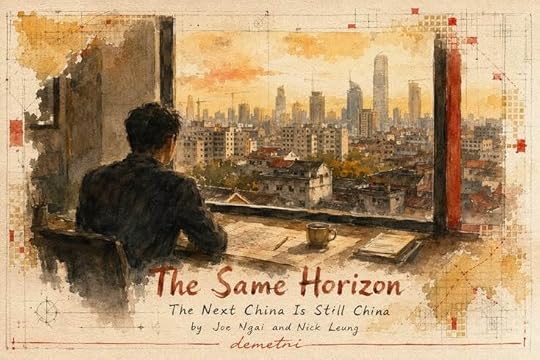
“The Same Horizon” distills “The Next China Is Still China” into a quiet room, a single observer, and a city still unfinished enough to become something else.
Despite the nerve of its title, “The Next China Is Still China” is not a lullaby for nervous boards hoping a cheaper, simpler country will appear on schedule. Its more interesting subject is what happens after a miracle has to become a management problem. Joe Ngai and Nick Leung, longtime leaders of McKinsey’s Greater China practice, begin with the question now circulating through investment committees, procurement teams, procurement desks, and anxious headquarters: if China has become harder, where is the next China? Their answer is blunt. There is not one. But the book’s sharper claim is less soothing: the next China is still China because the old China has become too large, too capable, too bruising, and too threaded through the world’s factories, ports, apps, laboratories, and anxieties to be swapped out neatly.
Each chapter presses that answer against a different seam in the machine. This is not a book about China simply resuming its old velocity. Much of it explains why that cannot happen. Growth has slowed. Property has lost its magic as a one-way bet. Consumers have become more cautious, more digitally armed, and more demanding. Debt has piled up. Margins have thinned. The habits that built China’s ascent – scale, speed, savings, infrastructure, ambition, and merciless competition – now create drag as well as lift. Ngai and Leung’s useful insight is that China’s great engines did not stop working. They started overheating.
Much of the book’s authority comes from where the authors are standing. This is not China seen from a library window. It is a book assembled from dinners, factory visits, client workshops, R&D campuses, founder conversations, strategy sessions, and years of watching executives discover that China is both less forgiving and less dispensable than they hoped. The opening contrast is telling: abroad, companies wonder whether a “China + 1” strategy can reduce exposure; inside China, teams keep finding that the “+ 1” rarely offers the same supplier depth, talent density, market size, or pace. China is no longer easy to love. It remains too dense to replace cleanly.
Even so, “The Next China Is Still China” is best when it refuses to become a brief for the defense. Its first section reconstructs how the current China was built: McKinsey’s early years in a country where consulting was so unfamiliar that the firm was mistaken for McDonald’s; the arrival of multinationals; the rise of Lenovo, Ping An, Alibaba, BYD, and mobile payments; the migration from bicycles and ration books to super-apps, EVs, and industrial robots. The history has the scale of a founding fable, but Ngai and Leung keep letting the gears grind. Phone lines are hard to get. Business vocabulary has to be invented. Analysts count bottles in nightclubs to estimate cognac demand. Nothing looks inevitable until it has already happened.
The book’s best trapdoor metaphor is China as “the world’s toughest gym,” a phrase that flatters and warns at once. The gym makes companies fitter: prices fall, products improve, supply chains sharpen, engineers iterate faster, and consumers feast. It also leaves bodies on the floor. The authors’ crucial term is involution, competition so intense that output and quality rise while returns collapse. Coffee chains sell lattes for pocket change. EV makers cut prices faster than they can digest the consequences. Solar manufacturers help cheapen the global energy transition while bleeding themselves thin. The gym builds champions, but one would not want to sleep there.
Rather than treating involution as an exotic local pathology, Ngai and Leung make it the book’s sharpest explanatory device. It shows why China can produce dazzling capability and miserable margins in the same motion. Luckin Coffee turns speed, data, supply-chain discipline, and menu churn into a machine Starbucks cannot simply imitate. BYD and its rivals transform cars into rolling software platforms while creating a consolidation problem almost too large to count. Solar companies become world-beating and money-losing at once. In this account, progress and punishment are not opposites. They share a cramped apartment and argue over the rent.
Involution also gives the book its most costly tension, though here the authors’ operator’s reflexes both clarify and limit them. They acknowledge the bill sent to actual lives: 996 work culture, youth disillusionment, delayed marriage, falling fertility, only-child pressure, and a generation wondering whether “bitter first, sweetness later” still describes a bargain worth accepting. These passages complicate the book’s confidence. Yet the analysis often moves briskly from tired bodies to productivity, from burnout to workforce adaptation, from family anxiety to market opportunity. The wound is visible. So is the consultant reaching for gauze, a framework, and three implementation steps.
Part II turns diagnosis into field manual. Multinationals can no longer rely on prestige, broad expansion, or the old rising-tide arithmetic. They must decide whether to exit, pause, or pivot, and the authors have little patience for theatrical retreat. Their preferred answer is adaptation: local autonomy, faster decision-making, deeper localization, sharper cost structures, “in China, for China,” and sometimes “in China, for global.” The old question was how to sell into China. The new one is whether a company can learn inside China quickly enough not to be outlearned by it.
As an operator’s book, “The Next China Is Still China” is crowded with corporate miniatures without becoming case-dead. McDonald’s China becomes a lesson in how ownership structure can shorten the distance between insight and action. Straumann shows localization as a full business model rather than a garnish on global strategy. KONE, once lifted by China’s property boom, must find growth elevator by elevator, district by district, service contract by service contract. ANE Global Logistic breaks its national business into forty-four micro-P&Ls. PepsiCo turns snacks into a Rubik’s Cube of city tiers, occasions, cohorts, channels, emotional meanings, and price points. “Granularity of growth” may not sound like a phrase that wants to dance, but the examples have a pulse. In the next China, the floodlight is out; the spotlight had better work.
Prose has to rescue this material from industrial sludge, and usually it does. Ngai and Leung write in the consulting-house rhythm: scene, diagnosis, quotation, lesson. At moments the cadence is so orderly that readers allergic to boardroom language may feel trapped in a very expensive meeting with unusually good snacks. Yet the book is more readable than that suggests. It has roast duck dinners, violin workshops, robot expos, baijiu survival tactics, blind-box collectors, coffee kiosks, and ski-jacket comedy. The authors know a statistic hits harder when it arrives with a person carrying it through a door.
A particular pleasure is the book’s oddity of the concrete. The global violin trade begins in Cremona and lands in Huangqiao. Luckin Coffee becomes fast fashion in beverage form. Baijiu makers lower alcohol levels and repackage banquet firewater for younger drinkers. Louis Vuitton docks a stainless-steel ship on West Nanjing Road to “seed” future customers. Robot dogs, humanoids, dancing cowboys, warehouse shuttles, and not-quite-ready mechanical creatures wander through the later chapters with a mixture of promise and comedy. The future in this book is rarely sleek. It is half-working, overfunded, underpriced, already being copied, and somehow on sale by Friday.
Design does a good deal of the book’s thinking. The three-part structure moves from origins to playbook to horizon: how China got here, how companies must compete now, and what may come next in cultural pull, AI, robotics, globalization, and succession. That arc mirrors the deeper claim. The first China rewarded speed and scale; the next China demands focus, quality, governance, brand, trust, and endurance. The architecture is more scaffold than sculpture, but the scaffolding lets the argument climb. Its weakness is repetition. Scale, speed, localization, discipline, granularity, and competition return so often that one sometimes hears the same lesson entering in a new jacket.
In Part III the book becomes most speculative and most exposed to tomorrow’s weather. The chapter on soft power smartly shifts the argument from “Made in China” to “Created in China,” using Pop Mart’s Labubu and “Black Myth: Wukong” to show Chinese companies exporting characters, aesthetics, fandom, and desire rather than only efficient goods. The claim works because the authors do not oversell the flicker as sunrise. They are not pretending Chinese games, toys, fashion, film, or luxury branding have already displaced older cultural powers. They are noticing an early, uneven glow.
More forceful are the chapters on AI and robotics, where the authors sidestep the simple question of who “leads.” They describe two different systems: a capital-rich American model pushing the frontier and a leaner Chinese machinery shaped by constraints, open-source diffusion, lower costs, and application-layer experimentation. DeepSeek becomes not just a headline but a pressure-made artifact. The robotics chapter extends the argument into hardware, where China’s supply chains, factories, deployment sites, cheap components, and engineering density create a plausible advantage in embodied AI. Intelligence may become cheaper. Acting in the physical world will not.
If the book overreaches, it does so by turning possibility into pattern a little too quickly. Chinese AI models may diffuse widely, Chinese robots may set cost benchmarks, Chinese EVs may reshape global mobility, and Chinese consumer brands may gather cultural force. The book is right to take all of this seriously. Still, its optimism sometimes assumes that China’s gifts for iteration, cost reduction, and scale will travel more smoothly than trust, politics, regulation, safety, and taste usually allow. The authors see the sand in the gears. Their instinct, however, is to turn sand into a bridge.
The globalization chapter is especially revealing because it asks Chinese firms to learn manners without losing muscle. Anta, Geely, Midea, XPENG, Haier, TikTok, SHEIN, Temu, CATL, and others populate a landscape where going abroad is no longer a glamorous side project but a profitability strategy. Yet Ngai and Leung are clear that exporting China speed can look, from the outside, like exporting a price war. Their tennis analogy is memorable: the guest who wins every set 6–0 may be technically excellent, but he may not be invited back. To become true multinationals, Chinese firms must learn legitimacy, governance, local hiring, restraint, and the art of letting someone else win a point before dinner.
Real gravity arrives in the final chapter on succession. After AI models, robot dogs, EV platforms, luxury ships, and global supply chains, the book turns to the oldest business problem wearing a family face: who takes over when the founder can no longer be the company’s central machinery? China’s private sector is full of first-generation enterprises built by people who survived scarcity, informality, policy windows, and breakneck growth. Their children are often better educated, more global, more cautious, and less hungry. The problem is not merely who gets the chair, but whether the chair can stand without the founder in it.
One quiet revelation is that the next China requires succession everywhere. Founder must give way to professional management. Land grab must give way to quality growth. Imitation must give way to innovation. Manufacturing must learn branding. Domestic dominance must learn global citizenship. Heroic stamina must learn sustainable ambition. Even the epilogue, addressed partly through the authors’ children, reframes the argument generationally. The China that built their careers is not the China the next generation will inherit. Opportunity remains, but it is narrower, more technical, more contested, and less forgiving. The frontier has become a profession.
Part of what makes “The Next China Is Still China” valuable is that it rejects two lazy comforts: triumphalism and obituary. It does not tell readers China is invincible, nor does it indulge the fantasy that China’s difficulties will move it safely to the margins. Its China is internally fragmented, geographically uneven, politically complicated, debt-burdened, aging, inventive, restless, and still capable of moving markets by sheer mass. The better image is not a rocket or a falling empire, but a supertanker in rough water, still displacing more sea than anything around it.
Of course, the book’s limitation follows from the same source as its authority. This is China seen through McKinsey’s windows: boardrooms, client sites, private dinners, R&D campuses, factory floors, and executive workshops. That access is enviable. It also means non-executive life is often converted into economic role: consumer, worker, saver, graduate, patient, parent, demographic signal. The limitation is not blindness so much as altitude. The authors descend often, but they always know where the helicopter is parked.
Under its stated topic, then, the book is really about adaptation after overperformance. It asks what happens when a country becomes too good at certain things – manufacturing, building, competing, saving, scaling, iterating, sacrificing – and then has to learn the more awkward arts of choosing, pruning, trusting, governing, branding, resting, and letting unproductive ventures die. That is a richer subject than the title alone suggests. The next China is still China, but the older habits now require adult supervision.
Like Keyu Jin’s “The New China Playbook,” Arthur R. Kroeber’s “China’s Economy,” and Chris Miller’s “Chip War,” this book tries to make a complex economic transformation legible without flattening it into slogan. Its distinguishing feature is close-range boardroom knowledge. It is less elegant as political economy than Kroeber, less pointed as technology history than Miller, and less broadly social than Jin, but it has a tremendous feel for how companies behave when the meeting starts, the competitor cuts price, the margin shrinks, and headquarters wants another memo before approving what the local team needed yesterday.
One reason readers may divide over the book is that its optimism has a spreadsheet beside it. Skeptics may find it too close to the worldview of the executives it advises. Enthusiasts may find it refreshingly unsentimental about China’s durability. I landed between those positions, admiring its breadth, access, and explanatory force while wanting more friction where business analysis meets ordinary life. My final rating is 86/100, corresponding to a 4/5 whole-star rating: a strongly argued, highly useful, occasionally repetitive book whose excellence is primarily diagnostic rather than literary.
Still, the ending works because it moves the question from the boardroom to the dinner table. The authors begin by asking where the next China is. They end by asking what kind of China their children will inherit, and what kind of work will be worthy of them there. That movement softens the book without sentimentalizing it. The next China will not arrive like a new market on a map. It will arrive as the old one after the easy shortcuts have expired: a factory trying to become a laboratory, a gym trying to become a school, a founder’s company trying, at last, to outlive the founder.
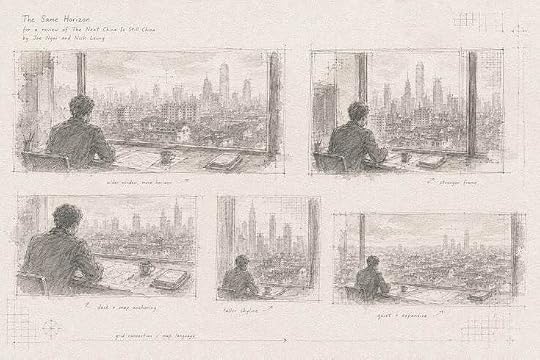
Early thumbnail studies test how solitude, skyline, desk, and horizon might hold the book’s argument before the final watercolor finds its form.
The underdrawing reveals the image’s first architecture – figure, window, city, and border lightly mapped before color begins to decide what matters.
First washes begin to stain the planning image with late-day ochre, muted shadow, and red pressure marks while much of the scene still belongs to graphite and paper.
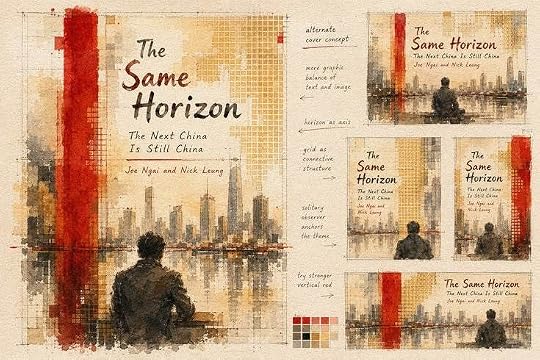
A restrained cover-derived palette of reds, ochres, creams, taupes, grays, and near-black becomes the chromatic grammar for the finished watercolor.
Border studies explore how grids, map fragments, and broken painted lines can suggest trade, measurement, and reconfiguration without turning the image into a diagram.
Figure studies search for the seated posture that will make the image human-scaled, contemplative, and quietly burdened without making the observer heroic.
Lettering studies decide how the title, book name, author line, and “demetri” signature can belong to the watercolor rather than sit on top of it.
An alternate cover concept imagines a more graphic route into the same themes – horizon, grid, observer, and the unsettled movement from what was made to what may be created.
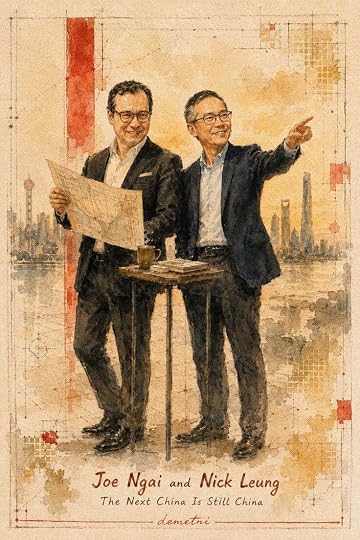
A literary watercolor portrait of Joe Ngai and Nick Leung treats the authors as measured observers of the next China: part strategists, part witnesses, and part cartographers of a country still revising its own map.
All watercolor illustrations by Demetris Papadimitropoulos. Watercolors are done on 140lb vellum and then scanned into the computer using an Epson scanner. From there, they are finalized in Procreate. All art and opinions are my own.
Revealing new perspective on China, different to what comes across in day-to-day media. Easy to follow, the breadth of examples are very compelling in bringing the messages to life.
This book was most informative despite its lack of charts to illustrate major trends. China’s economy is still growing but finding investment opportunities requires careful and cautious research. China is capitalist in the extreme. Companies compete so fiercely for market share that profits disappear, and stock prices decline. Stable cash cows to enrich investors are hard to find. The government levels the playing field by removing barriers to entry; building infrastructure, providing education and public services for employees, funding research and minimizing regulatory hurdles. Its broad goals are to improve living standards by fostering economic growth at home and abroad. It has eliminated poverty internally and provided the world with less costly goods of increasing quality. China continues to expand trade in the face of new protectionist measures. It views the world as full of customers.
Visiting often different types of factories and industries, the authors describe well the experience what I’ve also had. For a reader not as familiar with Chinese markets this book might provide more insights. I was hoping a bit more, especially in the last Part, 3. What’s next, China?