Jump to ratings and reviews
Rate this book

The Genius Bat: Understanding Our Most Mysterious Mammal

Rate this book
Step into the shadows and listen…

‘Brings the poster-species of Halloween out of the shadows, so we can better appreciate the flying mammal.’ National Geographic


Usually, you’ll hear a bat before you see it – the gentle flutter of wings, their high-pitched chatter as they dive and roll for insects. Only occasionally do you spot them, a blur against the evening sky.

With nearly 1,500 known species, bats are among the most successful mammals on earth. From the tiny bumblebee bat – which could rest comfortably on your index finger – to the giant golden-crowned flying fox with its 1.5-metre wingspan, they are evolutionary marvels, adapted to practically every environment. The only mammal that can fly, they can reach speeds of up to 100 mph, leaving cheetahs in the dust.

Yossi Yovel, an ecologist and neurobiologist, is passionate about deciphering their secrets. In The Genius Bat, he brings to life these amazing creatures as well as the obsessive and sometimes eccentric people who study them. From muddy rainforests to star-covered deserts, from guest houses in Thailand to museum drawers full of fossils in New York, this is an eye-opening account of a remarkable animal.

336 pages, Hardcover

First published October 7, 2025

Loading...
Loading...

About the author

Yossi Yovel

5 books56 followers
Yossi Yovel is an ecologist and a neurobiologist – a rare combination of disciplines. A professor at Tel-Aviv University and the head of the School of Neuroscience, he has conducted research all around the world, using an arsenal of methods and equipment. His work has been covered by major media outlets including The New York Times, The Guardian, The Financial Times, The Economist, NPR, BBC, and National Geographic. A sought-after public speaker, he is currently a visiting scholar at McGill University in Montreal.

Ratings & Reviews

What do you think?
Rate this book

Friends & Following

Create a free account to discover what your friends think of this book!

Community Reviews

5 stars
228 (26%)
4 stars
367 (42%)
3 stars
212 (24%)
2 stars
53 (6%)
1 star
10 (1%)
Displaying 1 - 30 of 270 reviews
Profile Image for Will Byrnes.
1,373 reviews122k followers
November 13, 2025
Some of the animals on the island were thrilled by our presence. The flies discovered us right away. They weren’t here when we arrived, and now they were everywhere. We dipped a cracker in jam and before it reached our mouths, five quivering flies were already wallowing in it. We usually ate it anyway. The centipedes also discovered the camp and lay in ambush everywhere; they crawled inside the tents and between the food utensils, and their claws peeked out of our books like bookmarks. One day, I shook out a carton in search of cookies and a large centipede landed on my hand. We slept with our shoes on at night and waited to see who would be the first to get bitten.
--------------------------------------
It’s not hard to become attached to these animals when you’re with them in a dark room for hours and hours. Many researchers give them individual names, and others assign them numbers. I’ve met researchers who’ve claimed to be able to identify individual bats by their scent, and researchers who’ve developed a unique whistle for each bat, with the bats landing on them one after another when summoned by their respective whistle.
In The Genius Bat, Dr Yossi Yovel, a true-life Batman, offers an encyclopedic insight into the world of our planet’s only true flying mammals. The order Chiroptera incorporates all bats from bug-sized flyers only a little over an inch long to flying foxes with a wingspan in excess of five feet. There are over 1500 species of bat. Yovel introduces us to a sample. You will learn a vast amount about the second largest mammalian order (after rodents).

description
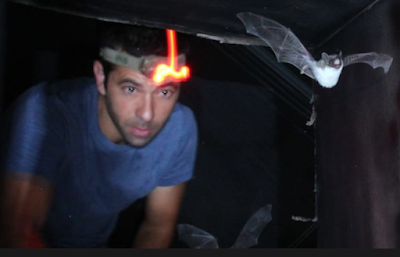
Dr. Yossi Yovel - Image from era-indianocean.org

(One of the true disadvantages of reading Advanced Readers Editions is the absence of illustrations. Note is made in the text of images on the pages, but it is necessary to google the species to get an image, and not necessarily the one the author had selected. The ones used here are not taken from the book.)

description
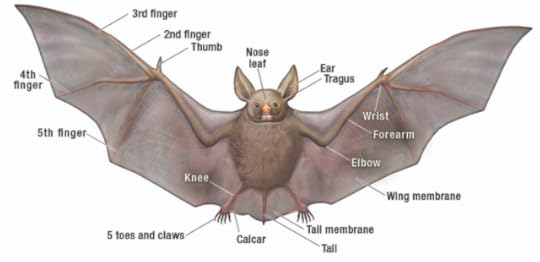
Greater sac-winged bat - image from Wikipedia

As is common in pop science books, each chapter, for the most part, focuses on one or two researchers in the field, offering details of the subjects they have explored. Many are legends in their areas of study. Yoval folds in tales of his own explorations in the far reaches of the earth. His adventures don’t always end in academic triumph, but he succeeds in providing excellent examples of what it is like to conduct field work in basic science. It’s enough to drive a person…ya know…
We tried hiking up a small gully and again had to climb over fallen trees and wade through pools of water. Everything around us was damp and rotten, and we had to check carefully before each step and before grabbing onto anything. Large tree trunks crumbled under our weight, and vines we gripped clung to our skin. During the first hours, I tried to maintain basic hygiene—mopping the sweat, wiping off the dirt, trying to keep my clothes dry—but I soon realized it was hopeless. Again and again, I wallowed in muddy water up to my knees, the sweat mixing with dirt, spider webs, and thousands of small insects. After two days in the jungle, dry socks are something you can only dream about. “Check carefully that you don’t have any leeches on you,” Boonman reminded me from time to time. “They grab hold of your shoes when you’re walking and then work their way up.”
He also offers up tales of urban bat-human interactions. A resident objects to the materials dropped on his property by bats that are drawn to a neighbor’s tree. How to resolve the conflict? A colony of bats have taken residence in a building slated for demolition. What can be done?

description
The hammer-headed fruit bat - image from iNaturalist

There are larger concerns addressed, in particular, damage from windmills (it is substantial), skyscraper glass, and white nose syndrome. Are bats perilous as a source of disease to humans?

description
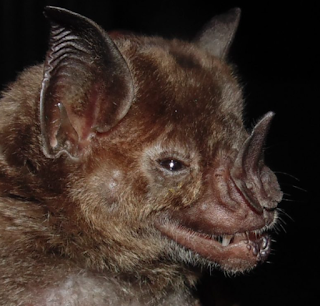
The lesser short-nosed fruit bat - image from Wikipedia

In addition to obvious items of interest, like how do bats do what they do, and do all bats use echolocation? Yovel offers up a host of surprising additions. What might be learned from studying the babble of bat pups? How do moths and bats play Darwinian leapfrog? Do bats exist in time or space? He lets us know about singing bats and bats that hunt at sea. How about bats that engage in oral sex? Wait…what? Yep. How long do bats live? Where do they live? What is social life like for bats? Do they hibernate? The author has a nice ability to put bat behavior in human terms. There are also some surprises in species with which bats interact.
Grasshoppers, for example, have ears on their front legs, and if you remove their legs, they really won’t be able to hear. There are also insects with ears on their chest, on their wings, and sometimes on their head. In general, when you think about insects, forget everything you know about mammals. If aliens ever make their way to Earth, they’ll probably look like insects

description
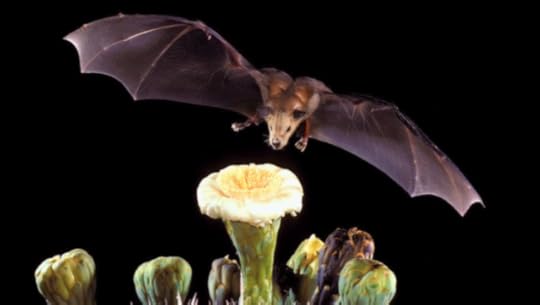
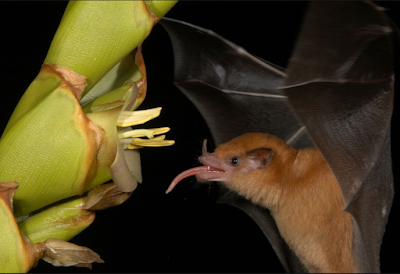
The long-tongued fruit bat - image from New Scientist - shot by Murray Cooper

While you will learn that bat echolocation was discovered before sonar was developed or the comparable capacity in dolphins was found not everything is covered. If you were hoping for some extras on Transylvanian royalty or Gotham City heroes, you will be disappointed. That said, there is a decent amount of humor in the book, particularly in relating tales from the field. There are also considerable references to the researchers who have built and are fortifying our knowledgebase about bats and their works. Dr. Yovel has given us plenty of reasons to appreciate and cheer for our flying mammal cousins, from their significance to agriculture, their impressive skill set, which offers considerable inspiration for scientific development, and their diversity of form, size, and talents. On reading The Genius Bat, you may not suddenly feel an urge to hang by your feet at bedtime, but you may find some similarities between our species that will surprise you. This is a delightful, informative read that deserves to be a blip on your sonar.
Contrary to widespread belief, there’s no evidence that the [COVID] virus came from bats. The virus found in Chinese bats is apparently unable to infect humans, but there’s solid evidence that the human coronavirus can infect bats.
Review posted – 11/14/25

Publication date – 10/07/25

I received an ARE of The Genius Bat from St. Martin’s in return for a fair review. Thanks, folks, and thanks to NetGalley for facilitating.


This review will soon be cross-posted on my site, Coot’s Reviews. Stop by and say Hi!

=============================EXTRA STUFF

Links to Yovel’s research abstracts at Tel Aviv University, Google Scholar citations, his FB page and The Bat Lab for Neuro-ecology

Profile, – National Geographic Society
Yossi Yovel is an associate professor in the School of Zoology and in the School of Neuroscience in Tel-Aviv University (TAU). He received a B.Sc. in Physics, a BSc in Biology and a M.Sc. in Neuroscience from Tel-Aviv University; and a Ph.D. in Biological cybernetics from The University of Tuebingen, Germany where he applied Machine Learning techniques for classification of Bio-sonar echoes. Before joining Tel-Aviv University as a faculty member, he was a post-doctoral fellow in the Weizmann Institute of Sciences and in the University of Chicago. Yovel leads the Bio-sonar lab in Tel-Aviv University where he studies bat bio-sonar and its application in robotics using state-of-the-art audio and video recording arrays. The lab develops miniature sensors (the smallest in the world of their kind) that can be mounted on echolocating bats in the field. The lab focuses on NeuroEcology - a combination of Neuroscience and Ecology trying to bridge the gap between these two huge disciplines by performing highly controlled experiments in the field. Yovel is the author of more than 30 peer-reviewed publications. He is a recipient of various excellence awards such as the Alon Scholarship and the Krill Prize.
Interview

-----Journal of Experimental Biology - Early career researchers: an interview with Yossi Yovel by Kathryn Knight

Items of Interest from the author
-----Interspecies Internet - From Cacophony to Order in Animal Communication with Yossi Yovel
-----The Bat Lab - The Bat Lab for Neuro-Ecology
-----ESI Frankfurt - Yossi Yovel: The bat's point of view | ESI SyNC 23 - lecture with slides
-----Defy Convention - What We Learn From Nature - Bats & Birds. Prof. Yossi Yovel & Prof. Yossi Leshem. DLD LIVE TLV 2020 - lecture with slides and video – 53:52
-----Bioengineer.org - Revolutionary Discovery: Greater Mouse-Tailed Bat’s ‘Walking Cane’ Aids Blind Navigation

Item of Interest
-----Adorable Christmas ornament - I have no commercial interest here, just think it is fabulous
-----NY Times - 9/23/26 - The Secret History of Bats: A New Study Redraws Their Family Tree - by Emily Anthes
Profile Image for Barbara.
1,899 reviews5,377 followers
December 24, 2025


Yossi Yovel, an ecologist and neurobiologist, is a professor at Tel-Aviv University. Yovel has been studying bats for decades, and shares his research - and that of other bat scientists - in this book. Lest you fear this is a dry science tome, it's not. Yovel peppers the narrative with lots of engaging anecdotes, and he has a great sense of humor.


Author Yossi Yovel

Background: Bats are the only mammals who can truly fly, their wings being a pair of hands with five extremely long fingers and a flexible skin membrane stretched between them.


The Earth harbors more than 1,500 species of bats, which range in size from the tiny bumblebee bat to the giant golden-crowned flying fox, and bats can be found everywhere, from the hottest deserts to the Arctic Circle.


Bumblebee Bat (top) and Giant Golden-Crowned Flying Fox (bottom)

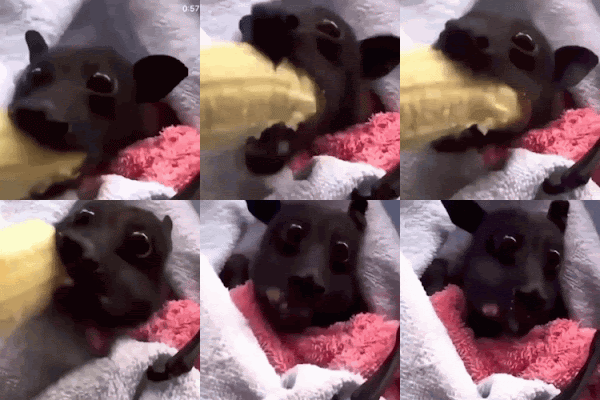
Some bats live in colonies, and others live alone. Some bats are insect eaters; some dine on fruits; some consume vertebrates like fish, frogs, birds, and other bats; and a few drink blood.


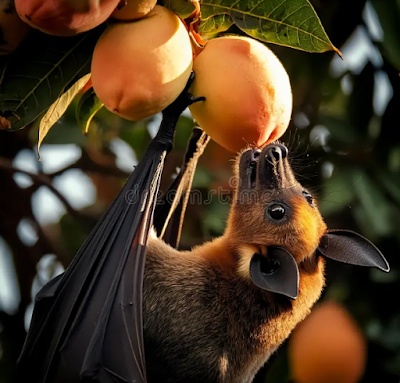
A fruit-eating bat

Bats are NOT blind, but since they hunt at night, most use echolocation (sonar) to find food and to avoid bumping into things. Bats can fly many miles each night to search for food, and some travel thousands of miles during migration.


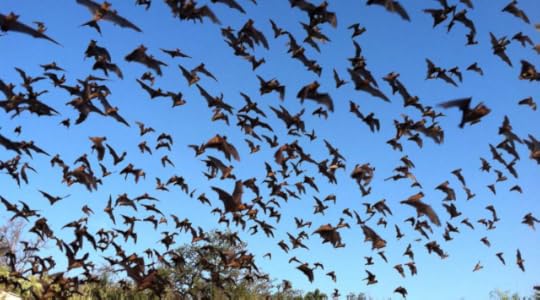
Bat Swarm Migrating

Bats have good immune systems and are among the longest-living mammals. However, human activity has endangered many species, which is VERY unfortunate from an ecological perspective. Bats eat agricultural pests; consume mosquitoes; disseminate seeds of fruits; and pollinate plants, including the agave from which tequila is made.

(No agave = No tequila).


Tequila bats pollinate agave plants

Though bats are so widespread, they remain mysterious to most people. In this book Yovel sets out to reveal the world of bats from the perspective of scientists. The narrative is divided into four broad sections: sociality, echolocation, evolution, and nature conservation.

I'll provide a brief example for each topic, and would urge interested readers to read the book.

╰┈➤ Sociality

Gerald Wilkinson was interested in studying animal sociality. When Wilkinson learned vampire bats sometimes feed other adult bats, he knew the big question was: Why would one animal help another animal?

In the 1970s-1980s, Wilkinson and a research assistant used night-vision devices to watch colonies of the common vampire bat (Desmodus rotundus) in Costa Rica. The researchers often lay on their backs peering up into hollow tree trunks to observe the bats.


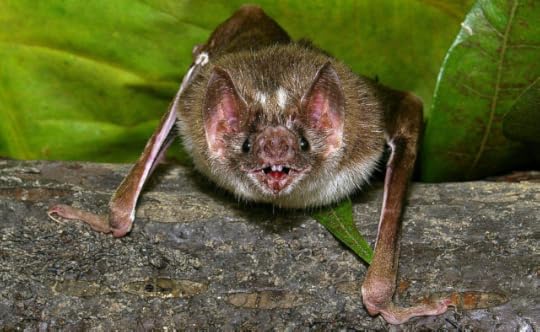
Common Vampire Bat

To feed, Desmodus crawls across the body of its prey to find a blood vessel close to the skin. The bat then injects saliva containing an anticoagulant, and drinks the animal's blood. Upon returning to the colony, mother bats feed their pups, but do they feed other adults?

Vampires have very high metabolism, and a bat that doesn't find food for three nights in a row may die of starvation. Thus food shared by a group member could save a life.

After observing vampire bats for more than 400 hours over three years, Wilkinson and his assistant documented many cases of mutual feeding, both among 'relatives' and 'bunk buddies' (bats that regularly slept close together).


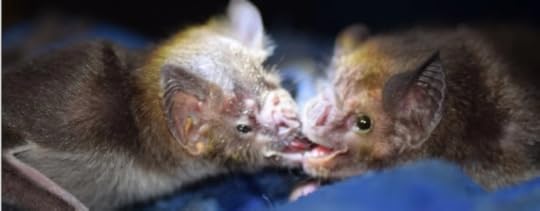
Vampire bats sharing food

Moreover, a female vampire was more likely to give blood to a fellow vampire who previously gave her blood, a phenomenon called 'reciprocal altruism.' Yovel notes, "Even today, forty years later, vampire bats are considered the best-known example of reciprocal altruism."

Fun anecdote: Scientist Jack Bradbury studied bats in their natural habitat and saw unfamiliar social behaviors. Recalling observations of greater spear-nosed bats (Phyllostomus hastatus) in Trinidad, Bradbury wrote: "Every time we visited [their cave], one male would leave his group and urinate on us." Bradbury theorized that the bats lived in a harem: a single dominant male and a group of females.


Greater Spear-Nosed Bat

╰┈➤ Echolocation

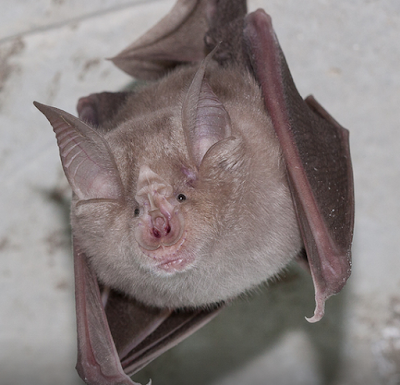
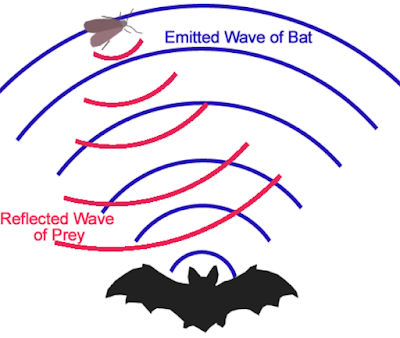
In the 1940s, Donald Griffin showed that bats emit ultrasonic sounds to navigate in complete darkness. Griffin called this bat sense 'echolocation.' Three decades later, a German student called Hans-Ulrich Schnitzler became interested in greater horseshoe bats (Rhinolophus ferrumequinum).


Greater Horseshoe Bat

Horseshoe bats use their horseshoe-shaped nose to direct the sound beam they emit from their nostrils. That is, these bats in effect "see" with their nostrils. Yovel observes, "The distance between their nostrils creates a narrow sound beam with a longer range, a sort of precise spotlight of sound....This precise frequency enables the bats to detect even the slightest movements of prey, such as the flutter of a moth's wing." In effect, bats use the Doppler effect to zero in on their prey.


Schnitzler went on to show he could use the Doppler effect to measure the bat's speed. Using food, Schnitzler trained bats to fly toward a microphone across the room. Schnitzler recorded the sound, and found that the frequency correlated with the flight speed of the bats.

Fun anecdote: Schnitzler became attached to the bats and recalled, "There was one little horseshoe bat that would sometimes fly toward me and land exactly on the tip of my nose to wait to receive food." Yovel had a similar experience. He writes, "When I was training fruit bats to perform a similar task nearly fifty years later, I had a bat...that would land on my shoulder and wait to receive a piece of banana as a prize for correctly performing the task."


The echolocation section describes many diverse experiments, including studies on how bats avoid obstacles - including arrays of thin wires - in their path. Also mentioned are other animals that use echolocation, and the evolutionary war between bats and insects. Insects evolving mechanisms to thwart bat sonar, and bats learning to compensate.

╰┈➤ Evolution

As a biology undergraduate, Yovel developed an interest in bats. This was cemented in 2001, when Canadian professor Brock Fenton - who traveled around the world teaching a bat course - came to Israel. Yovel took Fenton's class at the desert research station Sde Boker, and participated in a number of research projects.


Sde Boker

Professor Fenton was especially interested in the evolution of bat echolocation, and wondered which came first, flight or echolocation. The 'flight first' theory suggests that the earliest bats would glide between the trees and use their sense of sight to discover and hunt insects and the echolocation only evolved later.

Conversely, the 'echolocation first' theory hypothesizes that the earliest bats used a primitive form of echolocation to detect insects, and started to spring after the bugs, which eventually led to the development of wings and the ability to fly.

Fenton suggested a third idea, called the 'tandem hypothesis.' Fenton thought that since both flight and echolocation require so much energy, they had to evolve together. "To reduce the enormous energy cost of echolocation, bats synchronize their calls with their exhalation, and thus save a lot of energy. The bat's exhalation itself is synchronized with the fluttering of its wings, so that every time the wing flaps down and presses against its chest, the bat can produce a powerful echolocation call with a minimal investment of energy."

This issue is hard to resolve because while it's easy to determine whether a fossilized creature had wings, it's very difficult to know whether it used echolocation.

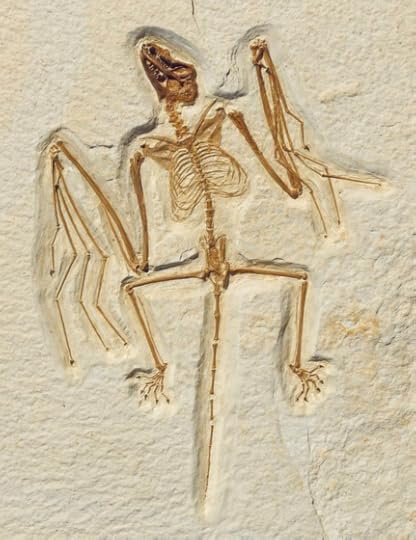
Scientist Nancy Simmons addressed the dilemma by studying the fossilized ears of bats. The ancient fossil Onychonycteris finneyi (clawed bat), from a bat that lived 52 million years ago, was discovered in 2008. Onychonycteris has a primitive wing structure, and may have alternated between flying and gliding.


Fossil of Onychonycteris finneyi (clawed bat)

Simmons and her colleagues claimed that Onychonycteris did not use echolocation because its cochlea (part of the inner ear) is small in comparison to that of bats that use echolocation, but is similar in size to the ear of fruit bats, which DON'T echolocate. Thus, in Simmons's scenario, bats flew before they echolocated.

Simmons assertion started a firestorm, with Professor Fenton publishing a contrary view. The battle raged on for years, and is not resolved yet. Despite their rivalry, Simmons and Fenton remain good friends.

Fun anecdote: When he was a doctoral student in 2007, Yovel participated in a trip to Mexico, to study cactus echoes. A wheelchair was required to move heavy recording equipment, and Mariana Melcón - a fellow doctoral student - pretended her leg was broken, to get the wheelchair to Mexico.


Mexican long-tongued bat approaching cactus

Among other things, the evolution section discusses theories about the evolution of echolocation, and whether or not all bats have a common ancestor (they do).

╰┈➤ Nature Conservation

Yovel observes that bats' number-one enemy is undoubtedly human beings. Urban development destroys bat habitats; wind turbines kill bats; and bat diseases, which can spread by humans visiting caves, kill bats.

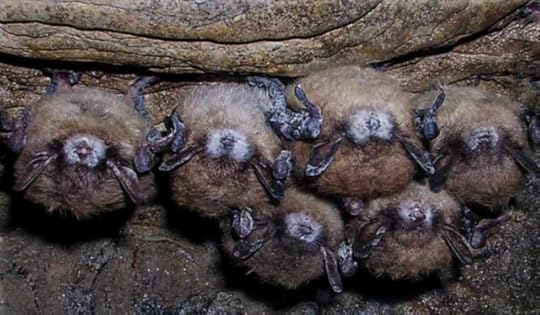
In 2006-2007, Al Hicks - a mammal specialist at New York's Endangered Species Unit - found that 'white-nose syndrome' was killing little brown bats in Howe Caverns.


Bats with white-nose syndrome

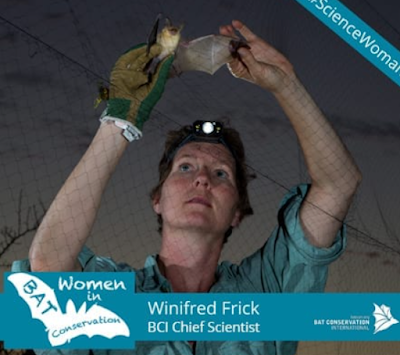
Then in 2009, bat researchers Winifred Frick and Tom Kunz traveled through New Hampshire and found that former bat colonies were empty everywhere, destroyed by white-nose syndrome. The scientists predicted that bat populations hit by the disease would shrink by about 99% in the next few decades if no remedial steps were taken.

The fungus Pseudogymnoascus destructans, which probably originated in Europe, causes white-nose syndrome. It's possible that P. destructans spores landed in the U.S. on the clothing of someone who had visited caves in Europe, and then visited Howe Caverns. Alternatively, a stowaway bat carrying the spores might have arrived in the belly of a commercial ship.

Government authorities in the U.S. have tried to stem the spread of white-nose syndrome by prohibiting people from entering some caves; having fungicides sprayed in some caves; and killing off sick bats, to prevent the spread of infection. All these measures failed, and the illness has spread all the way to Washington state and California.

Frick is now the director of conservation science at Bat Conservation International (BCI), which has a research team studying white-nose syndrome. At this time, there's no effective weapon against P. destructans. Frick thinks the most promising approach is to try to find ways to help bats survive in regions where the fungus has spread.


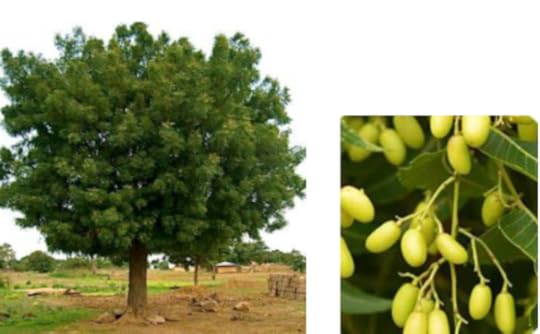
Fun anecdote: In 2015, Yovel's assistance was requested for a legal matter. An Israeli homeowner ("D") had a large neem tree, full of yellow-orange fruit. Egyptian fruit bats were visiting the tree, and pooping on the house of D's neighbor ("C"). C wanted D to cut down the tree, and filed a lawsuit. Both C and D wanted Yovel to support them in court. The neighbors eventually agreed to cut down the neem tree and plant a different species.


Neem tree and fruit

The Nature Conservation section also addresses bat destruction by people who believe bats spread rabies. The world's most famous bat conservationist, Merlin Tuttle, is working hard to correct this mistaken notion.

I found the book very interesting and informative and highly recommend it.

Thanks to Netgalley, Yossi Yovel, and St. Martin's Press for an ARC of the book.

You can follow my reviews at https://reviewsbybarbsaffer.blogspot.com
Profile Image for Ten Cats Reading.
1,482 reviews343 followers
October 12, 2025
⭐⭐⭐.5

Pre-Read Notes:

If you've spent any time with my reviews you might already know that I am an animal person. About the only trigger I cannot handle in books is gratuitous animal cruelty. I read tons of books about animals and ecology. My last was about singing fish, and now I'm into flying mammals who also happen to be disabled-- bats are blind! I'm really excited for this book. I know I will learn a lot because I don't know the first thing about these amazing creatures.🦇

"Voigt doesn’t deny that there’s a climate crisis that needs to be addressed and that green energy is part of the solution. However, he believes that other environmental problems must not be ignored when tackling climate change— such as the mass eradication of animal species, including the slaughter of bats [by wind turbines]. He calls this the “green-green dilemma.” In Voigt’s view, we’re sacrificing the environment for the sake of the climate." p231

Final Review

(thoughts & recs) I learned so much about bats and I loved it. They are extraordinary creatures with extraordinary systems of survival. They live in constant danger of predation, and yet they persist. But like many creatures, they have met their match in humans.

While I loved the subject here, I did not love the author's approach. He's a field scientist, not a conservationist, so he was interested in the bats for reasons of discovery. He experimented on the bats expressly for generating content for this book. To me, his practices felt intrusive and potentially destructive to his subjects and their environment.

I appreciate that Yovel *does* finally address the issue of conservation and the different ways human activity profoundly affects (more like obliterates) the populations of various kinds of bats. It makes me sad that reading about animals, which I've done for forty years, has changed so much.

I recommend THE GENIUS BAT to animal lovers, readers interested in bats, fans of popular science and ecology books. If you enjoy Yuval Noah Harari books, you will enjoy the style and approach here.

My Favorite Things:

✔️ "The vampires in Wilkinson’s experiments, on the other hand, were always from the same colony and selected because they had known each other for years. Carter decided to repeat the experiment with another captive vampire bat colony where the vampires were long acquainted and the full genetic relationships between them were known. “All of a sudden it was easy,” Carter says. “Everyone fed everyone.”" p20 Food altruism amidst members of bat colonies is fascinating and to me, spectacular. Science hasn't assumed that kindness and community mindedness prevailed among many species. Documenting it in bats is important.

✔️ "Our relationship with the sun was complicated: we worshipped its energy, but we also suffered greatly from its power. Shade was one of the most craved-for commodities on the island. Its value skyrocketed in the afternoon hours when we longed for a nap and the sun was at its zenith. We had to wait until it moved low enough to create a human-wide strip of shade. We knew that in any case we’d wake up in a bath of sweat, but shade was still preferable ." p36 The author went to some wild places and endured some intense conditions to do his research.

✔️ This is going to be one of those books where I highlight every page! Animal languages are so cool: "Bats have an enormous range of communication signals. Unlike the echolocation calls they use for sensing, which have to be short and stereotypical, communication calls may be long or short, whistling or chirping, ultrasonic or audible. Some bats sound like a bird or a monkey, and in Thailand, I once heard a bat that wailed like a cat. Bats use these calls for various needs : to scold a neighbor that sticks its nose into their private domain, to sound an alarm when a potential predator enters the colony, or to cry out to a mother that disappeared in the crowded cave." p45

✔️ Smut fans? Lol! "On every tree colony of greater sac- winged bats, there’s a long line of males waiting for a chance to capture a harem. If there’s enough room on the tree trunk, some of them may form a new harem immediately upon reaching maturity. However, the great majority must wait patiently in the bachelors’ section until one of the harem leaders vacates his position. Unlucky bats may have to wait many years for an opportunity to lead a harem." p46

✔️ Yep me too! "They shout at each other when someone enters their private space, when someone tries to take food from their mouth, and when someone wakes them up. Fifty shades of “get the hell out of here,” I like to call it." p49

Content Notes: bats, animal experimentation, cruelty to animals, animal harm, animal death,

Thank you to Yassi Yovel, St. Martin's Press, and NetGalley for an accessible digital arc of THE GENIUS BAT. All views are mine.
Profile Image for Erin Clemence.
1,686 reviews428 followers
September 24, 2025
Special thanks to NetGalley and the publisher for a free, electronic ARC of this novel received in exchange for an honest review.

Expected publication date: Oct. 7, 2025

Ecologist, neurobiologist and academic Yossi Yovel has penned a detailed, informative book about the world’s only flying mammal, the bat. “The Genius Bat: The Secret Life of the Only Flying Mammal” provides an educational view of the biological makeup and habits of some of the worlds over 1500 bat species.

Broken down into four sections; sociality, echolocation, evolution and nature conservation, Yovel discusses how bats socialize, communication and procreate, and what the biggest environmental threats to bats are (here’s a shocker, human beings are their biggest threat) . He doesn’t cover all bat species, for obvious reasons, but he does ensure that a wide variety of bats from various parts of the world are highlighted. Yovel’s research takes him to almost every continent although, due to the ideal bat climate and Yovel’s familiarity, the majority of bat research takes place in Israel and Egypt.

For me, I found the sections on sociality and nature conservation to be the most interesting. Obviously, I know very little about bats, and I enjoyed learning about how they formed colonies and what methods of protection are established to keep various bat species alive and thriving. The section on echolocation was a bit thick for me and very scientific, as it broke down how bats do this biologically and anatomically. There were some bits throughout that I did enjoy, especially when talking about the research undertaken with other species and discovering what, if any, of them used echolocation, but I found this section difficult to get through.

Yovel uses stories of his own adventures, interspersed with studies from other bat researchers, and goes back and forth between them. This method encouraged me to keep reading, as Yovel’s adventure started off a chapter and I had to continue reading through the research of others and their anecdotes before Yovel’s adventure was resumed.

“Genius” is definitely a book for a specific genre, geared to those with an interest in biology, ecology, or bats in general. Yovel’s story definitely taught me a lot, about bats in general but also about disease transmission, environmental threats and a little bit about insects and other small mammals. “Genius” is a unique examination of the overlooked, underappreciated and misjudged bat species and it sheds new light on the tiny cave-dwellers.
201 reviews4 followers
November 10, 2025
2.25 ⭐️s. I’ve always had an interest in bats, for many reasons. As an adult & homeowner, I’ve struggled to keep them out of my attic, with limited success at times & ultimately complete success, at least for now. During that time I have had a couple of close contacts with these creatures & have caught one that I feared may have bitten me. I don’t know if I was bitten but I caught the bat & had it tested for rabies and it tested negative, allowing me to bypass the rabies shots regimen that would have been administered as a precautionary measure had it tested positive.

Enough about that … I looked forward to learning more about these creatures & my attic nemesis when I got this book from my local library.

There are a lot of interesting facts about many different species of bats in the book. Some are:
• There are around 1,500 different species of bats. These make up over 20% of all mammalian species, including their wide range of sizes, diets (some eat insects, fruit/nectar, others fish/frogs, or blood), and their habitats.
• There is extensive discussion of echolocation, used by many (most) bats to navigate and hunt.
• The author also spends a fair amount of time discussing the social behavior of certain bats, particularly vampire bats, which engage in something called ‘reciprocal altruism,’ which is the sharing of food with those who have shared with them in the past.
• Also there’s a lot of talk about the evolution of research techniques, from early methods to modern technology like using AI to decipher communication and attaching GPS devices to track movements.
• Yovel also briefly touches on bat conservation & threats that bats face, including a fungus called white-nose syndrome, habitat destruction, and wind turbines, as well as the bat’s role in our ecosystems as pollinators and insect controllers.
• Lastly, there is detailed discussion of the history of the study of bats and the "obsessive and eccentric" people who study them.

Sounds great right? Then why the not so generous 2.25 star rating? Well there are quite a few reasons:

• This reminded me of another book I read … The Underworld by Susan Casey … where the focus is less on the topic (in this case bats) & more on the people (in this case the researchers & their methodologies). I wanted more bats & less promotion of the characters involved in the research.
• One of my common complaints about many nonfiction books is that they are good periodical articles masquerading as books. If one whittled down the ‘bat’ content in this book it would have been 50-75 pages out of what is a 300 page book.
• An annoyance (maybe just to me) is that the author often seemed to see just how many times he could get the word ‘echolocation’ onto a page. I understand it was a major part of the discussion but I simply got sick and tired of seeing & reading it.
• Rather than picking a story/setting and sticking with it, the author annoyingly and constantly jumped around between them, often to the detriment of the story and information being presented. I was waiting for a ‘oh look, a squirrel’ moment.
• A lot of what seemed to be irrelevant information thrown in for a reason I simply don’t get. Filler??

So, add that all up and it equals a difficult, laborious and very disappointing read. If I knew before I started, what I know now, after dragging myself to finish the book, I would have passed.
Profile Image for Sheila.
3,807 reviews157 followers
July 12, 2025
I received a free copy of, The Genius Bat, by Yossi Yovel, from the publisher and Netgalley in exchange for an honest review. I have never been a fan of bats, but the author Yossi is fascinated by bats. I did not realize how many different types of bats there are. This is an interesting read on bats, I learned a lot about them.
Profile Image for Stacey.
1,172 reviews157 followers
October 7, 2025
The Genius Bat immediately piqued my interest first by the title and secondly the cover art. There are more than 1500 species of bats and they have a unique way of communicating and socializing. Fitted with tracking devices, researchers are able to follow. Something that doesn’t come to mind when thinking of bats.

The organization of the book makes it easy to read. Divided in four parts with the second, Echolocation, my favorite. The book as a whole is heavy on research. If bats and research findings are of interest or wanting to learn more about these creatures then I would highly recommend. A very fascinating read!

Thanks to NetGalley and St. Martin’s Press for an early copy.
Profile Image for Moonkiszt.
3,298 reviews324 followers
November 2, 2026
Yossi Yovel has landed on our bookshelves The Genius Bat: The Secret Life of the Only Flying Mammal which as promises is full of bats of all types and from all the corners of the world (not pointing at collecting bats, but maybe?). I've never drilled this deeply into the bat world, but seeing, feeling, and paging through the bat-passion as delivered in this read - I just might be fully sated. There are certainly are no questions left dangling.

This is a stunning example of one man's obsession - how he went after, was trained to, educated in, how he took studies further and farther, and in minute detail credits all the people with which he's rubbed shoulders and bats. Opining is free-ranging and experiments with echolocation are throughout the whole of the read - a favorite side bar. Yossi Yovel, is clear: he loves bats. He worries about the earth and what humans have done to it, but isn't really concerned about them - if at the very of everything there are a few bats, all will be well.

This read is one of those that will have an enthusiastic self-selecting component to it.

*A sincere thank you to Yossi Yovel, St. Martin's Press, Macmillan Audio, and NetGalley for an ARC to read and review independently.* #TheGeniusBat #NetGalley 26|52:40d
Profile Image for Brooke.
46 reviews
October 7, 2025
I went into this book not knowing much about bats, but being a fan of a good science book. I found The Genius Bat to be absolutely fascinating. It is full of the most interesting tiny details, while still being accessible to someone with little knowledge on the topic. I thoroughly enjoyed my reading experience, and putting this book on my list of great books to gift for the holiday season. Thank you to NetGalley and the publisher for the ARC.
Profile Image for Courtney.
563 reviews39 followers
September 30, 2025
4.5 stars

I am likely the ideal demographic for this book as an ecologist and self proclaimed bat enthusiast.

I had a very big leg up on understanding much of the science in this book. I was a student of one the professors featured in this book and took his bat course in University. That being said, I found this book very interesting. I liked that the author presented all the scientific facts in an easy palatable way. Can we also take a moment to appreciate this cover art? I simply love it.

Thank you St. Martin’s Press for the complimentary copy.
Profile Image for Kayla.
202 reviews14 followers
September 23, 2025
DNF at 12%

This book was poorly organized in the extreme. I could not stand how scatterbrained the author was, or how mind-numbingly stupid some of his observations were (they let anyone get a PhD and teach university in Tel-Aviv, huh?). This guy is so cocky about his own research (who even is he?), but shows so little respect for any other scientists who aren't Israeli or American, and he's pretty gross about people from Mexico and Australia/NZ in particular. If I'd known this book was by such a moron, I wouldn't have requested it. Thanks anyway, NetGalley.
Profile Image for angel.
231 reviews
Did Not Finish
September 7, 2026
welp, this was super interesting until the author started going on about how AI is going to help us talk to animals.

Dog, AI use will destroy the habitat of these beautiful bats. Booooo
Profile Image for Kristy Johnston.
1,421 reviews69 followers
June 10, 2026
Thank you to NetGalley, St Martin’s Press, and Macmillan Audio for a free review copy.

I have mixed feelings about this book. At times, I was fascinated by the intriguing information about the bats that the scientists collected in the various studies described in the book including feeding, socialization and echolocation. Then the narrative would meander away from the bats with other information about the scientists, the methodology, and more specifics than I felt necessary about their situations that detracted from the topic and I would lose interest. It felt like a lot of filler and repetition.

I switched between the eBook and audiobook for this read. The audio was narrated by Max Meyers. This was my fourth read by this narrator and their narration assisted in my finishing since even though I really enjoyed parts, I struggled with some of the jumping around. I found the text very helpful with the structure of the book. Ultimately, I feel like I learned a lot about bats, loved the sections on altruism, but also feel like I didn’t learn enough for the time spent reading.

Limited recommendations to readers fascinated with bats, the scientists who study them, and their methods of study.
Profile Image for Amy K.
101 reviews3 followers
November 25, 2025
I was excited to learn more about bats, but this book contains only 50% bat content. The other half is about the author, his life, his experiments, and info about other scientists. His writing is not compelling enough to make any of this come alive for the reader. It is also so disorganized that it feels like we're never actually getting anywhere.
Profile Image for Katie.
358 reviews2 followers
August 31, 2025
As a self-proclaimed bat lover, I was thrilled to receive this ARC. Bats have always fascinated me, and I've always found it interesting just how each species of bat differs from the next. This book offered great insight on different species of bats, how they're researched, and ended on a note about bat conservation that left me thinking about bats I've encountered and my previous knowledge of them. However, it is very science-dense— if you do not think in-depth explanations of the mechanics behind experiments and their findings are interesting, this may not be the book for you.
Thank you to NetGalley and St. Martin's Press for the ARC in exchange for an honest review 🦇
Profile Image for Fiona.
1,375 reviews18 followers
May 11, 2026
This is the best narration of a non-fiction book I have experienced; Max Meyers brings the emotion of fiction and a distinct voice for each researcher. And there’s actual recordings of bats too! The book’s content is interesting enough (particularly if you’re a fan of bats) but the audio elevates the whole damn thing admirably.
Profile Image for MJ Barrette.
367 reviews7 followers
November 3, 2025
I suppose if I was going to read a non-fiction about animals, one about bats is on brand for me.

This was cute. I mean I know bats are cool already. I think they're neat, and although I didn't really care about the war of academics (though I do understand the need of them in order for the science to go further), the rest though, was delightful.

Could have it been organized a little differently? Sure, but it was fun enough that after I while I didn't care.

Thank you to St. Martin's Press and Macmillan Audio for an e-copy.
Profile Image for Kelly.
1,119 reviews
July 11, 2025
I always think it is interesting to learn more about the animals in the world around us, especially if little is known about them or they are misunderstood. Bats certainly fall into the latter category, so I decided to read Yossi Yovel’s The Genius Bat.

There were parts of the book that were interesting, but it felt like just as much of the book was focused on the community of people that research bats, and the various experiments that Yovel was a part of. I think it’s great that he points out that not all experiments are successful, either because they failed or because they’re inconclusive. But I go back to the fact that I picked up this book to learn about bats, not read about the adventures and anecdotes of the people who study them.

When he is focused on the bats, much of the book is heavily focused on echolocation. To be fair, this is a trait while not entirely unique to bats, is one that many of them specialize in that makes the trait stand out for the species. But, with the exception of one type of fruit bat, none of the fruit bats utilize it, putting a heavy emphasis on something throughout the course of the book that many bats don’t actually utilize. I wish that there had been more about their biological makeup, habitats, and even the history of their relationship with humans.

Yovel also has what was for me the very distracting habit of going back and forth between two storylines within a single chapter and the only thing they share in common is bats. Chapter 12 for example, which is titled ‘On Bat Diseases’ goes back and forth between people in Yovel’s home country of Israel fighting about cutting down trees that attract bats, which has nothing to do with disease, and the “white-nose syndrome” infecting little brown bats in the United States, which is absolutely on the mark with the title.

I think there are pieces of the book that are good, and parts of the last few chapters that show how humans need to think about how the way they change the environment has an impact on bats, and look for a way to positively coexist. But I don’t think it reads cohesively, it spends too much time on humans doing research, it occasionally veers off topic altogether to look too deeply into adaptations of prey, and focuses too heavily on echolocation.

Perhaps someone more knowledgeable in the field finds all of these things a great way to have a well-rounded story about bats and the people who love them, but I was looking for a more well-rounded exploration of the species itself.

A complimentary copy of this book was provided by the publisher. All thoughts and opinions are my own.
Profile Image for Mikala.
525 reviews8 followers
July 16, 2025
*The Genius Bat* left me feeling blind as a bat. The book reads like a hybrid of doctoral thesis, lab gossip and travel blog. That is so much raw material to build endlessly entertaining and engaging writing from and yet the combination ultimately falls flat. Despite the potential for a compelling narrative, it ends up as a disjointed collection of facts and events. Even the most extraordinary stories are presented in a way that fails to animate them for the reader.

The author’s expertise in the history and practice of bat research is undeniable. However, I found myself wishing for stronger editorial guidance to shape these insights into an overarching storyline. Instead, it’s like you’re the partner living with a grad student getting drips and drabs of research breakthroughs, conference highlights and scattered inside jokes. But there’s never enough to fully understand the bigger picture. I kept hoping for a cohesive thread to tie the material together, but that clarity never came.

The technical details are clearly and accessibly explained, making aspects of bat research understandable for any reader. Sadly, the galley version I received didn’t include the oft-referenced photos of adorable bat faces, which I was longing to see.
Profile Image for Bill Philibin.
991 reviews12 followers
September 19, 2025
(5.0 Stars)

Thank you #NetGalley for making this book available for reading and review.

I absolutely loved this book! For a non-fiction book, it is surprisingly narrative. You can tell the author is passionate about his work, and his words. He starts each chapter with a personal note or story, then goes off on a tangent, always relevant, always interesting, then winds his way back to his original point. But on those tangents you get history, backstory, anecdote, science, and all delivered in an enjoyable flow.

The narration is done well in the audiobook, and it all comes across like the most interesting conversation you've ever had. This was a moderately long book, but I feel like it was over too quickly.

If you like Bats, Nature, Science, or any combination... you should read this book.
Profile Image for Andy Weston.
3,468 reviews260 followers
January 8, 2026
I learnt a lot from reading this, but more often than not it had the feel of a learning experience, a text book almost. It lacked in the background, some more detail of the characters involved, and anecdotes in that regard.

It’s a hard balance to get, the appropriate level of language necessary, neither beginner nor expert, and a personal feel to the narrative.
Profile Image for Ashley Tovar.
1,062 reviews2 followers
October 1, 2025
I was able to enjoy this ARC on audio. This is such an interesting subject to read about & the structure of the book made it very easy to get invested in. I found the deeper I got the more I wanted to know. Bonus points for releasing during spooky season. The perfect non fiction read for October.

Big thanks to Netgalley & the publisher for allowing me to enjoy this ARC. 
Profile Image for Kara.
Author 1 book66 followers
June 8, 2026
If you're interested in learning practically everything there is to know about bats, or are a huge biology nerd, this is an excellent book for you. I did enjoy this, but it was REALLY long and detailed.
67 reviews
July 30, 2026
Pretty interesting book about bats. Not much else to say, honestly. Glad this guy loves his bats so much.
Profile Image for Dot526.
581 reviews3 followers
November 13, 2025
It’s clear to me that Yovel loves bats of all sorts, and finds them endlessly fascinating, and they are. BUT this is all over the place and often hard to follow. While I truly appreciate that Yovel points out the many many people involved in research and study it makes things more confusing and disjointed.
Profile Image for Kelli.
2,875 reviews41 followers
November 18, 2025
As an avid bat-lover, I suppose I’m a bit biased. I love learning more about these fascinating little creatures and so I will find something to love about any book on them, whether for children or for adults.

Here, I learned SO MUCH about how bats perceive their world and about how WE perceive the world of bats.

It was very interesting to learn what we don’t yet know or fully understand how bats communicate, socialize, or inhabit their environments. There’s even more we don’t know about their evolution.

I’m just so inspired by everything we don’t know—it makes this world feel so much bigger and more curious than we may be led to believe.

More, I love how bats—these seemingly innocuous and often unfairly maligned creatures—embody so much about us as people. They reveal both our fears and our fascinations.

After reading this book, I’m so excited for what the next fangtastic discovery may be.

Big bat love aside, I could see why the style of this book may not be for all readers.

This author has a sense of humor, let’s say.

Much like how I don’t always want a funny doctor, I don’t always want a funny scientist.

Comedy is an art and humor can be very “hit or miss”. Here, I’d say the humor is toeing the fine line between being charming or obnoxious.

Granted, this is a translated work so maybe something is being lost? But, still.

Be aware—the humor is an acquired taste.

Also, this author is Israeli and is based in the country. While the author recounts much research from around the world, much of this book takes place in Israel. He’s focused on the science and bat conservation efforts.

It’s pretty innocuous and it’s not like the bats know geopolitics?

But, just be mindful if this is a sensitive topic for you.

Otherwise, I thought this was neat. If you also like learning about bats, you probably will too~
Profile Image for delia.
60 reviews6 followers
September 9, 2025
I usually love non-fiction about niche topics but this one didn’t keep me hooked. There’s lots of interesting information presented but I found the structure disorganized and hard to keep track of. DNF around 25% as I knew at this point I knew it wasn’t my thing.

Thanks to netgalley for an ARC of this book in exchange for an honest review.
Displaying 1 - 30 of 270 reviews