"What did you do for a living, back when you used to work?" I'd overheard a nurse ask the elderly man in the room next to mine.
"IRRELEVANT!" he yelled back in fury.
I didn't want to become that man. Plus, if the nurse had asked me about my work, I'd have gone on about it for ages. It was by far the most relevant thing about me.
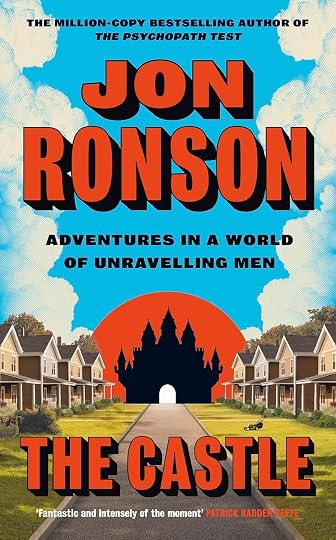
Jon Ronson is recovering from surgery, when his son tells him about how he was invited to a party and ended up at a weird castle at what was very much not a party. And that's all it took to get Ronson curious and investigating the creepy man who owns the castle to figure out what his deal is. And that leads him to a directionless wealthy man who starts out with the idea of pitching a reality show to Netflix where he has 101 young women compete to be his princess, and if you thought that sounds sketchy, it's far sketchier than you think. Like many self-involved men, he happily lets Ronson interview him, but when Ronson refuses to sign an NDA, he realizes that there may be consequences. So he starts to threaten Ronson.
His texts continued to pour in, and I continued to not respond. I had by now instigated a total communication blackout. As a consequence, he was seeing me as an inscrutable menace, whereas I was seeing myself more like a rabbit in broad daylight, reacting to danger by standing completely still. He was lashing out while I was shutting down. And mine was proving the more successful response, given how he was filling my silence with texts that would sound horrifying if read out in court.
Ronson has a talent for finding people with extreme views and getting them to speak openly, and here he turns his attention to problematic men. You'd think that this is a well-trod path, more like an interstate, and that we don't really need another look at how terrible men have been failed by society. But, refreshingly, that's not what Ronson's looking at -- he's more interested in how these flailing men harm the people around them, who are usually women and children. Women can feel directionless, too, but they tend not to inflict their feelings of inadequacy on the vulnerable. Take our castle guy. He's endlessly preying on young women, and also fully believes that he's the one in danger of gold-diggers. Ronson looks at a wide variety of problematic men; one whose retreat from society is understandable, followed by a look at Graham Linehan, who if you are familiar with his name, you're well aware of what a sad, toxic individual he has become.
One of the more interesting aspects to this book, is how AI enables and exacerbates these men as they spiral. As Ronson puts it:
There's a word for something that love bombs you, mirrors you, manipulates you into giving it all your attention, and isn't in the least bit embarrassed when caught lying. I think ChatGPT is a psychopath.
Ronson knows how structure a story and he's so curious and nonjudgmental about people, yet he doesn't avoid drawing some very strong conclusions here. In an interview I listened to with the author, he said he didn't think that falling into delusional thinking was restricted to men, but they are by far more visible and generally have a greater capacity to cause harm. It's a sobering book, but also a wildly readable one.