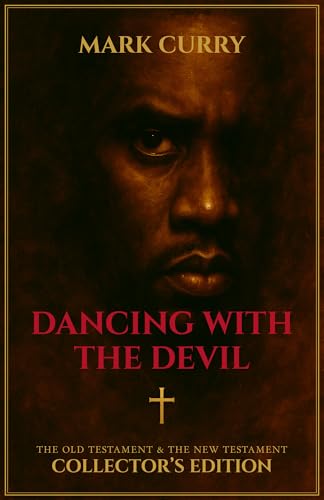
Mark Curry’s book is a raw memoir and exposé about his time as an artist under Bad Boy Records, founded by Sean “Diddy” Combs. Curry describes the glamour of 1990s hip-hop fame alongside what he claims was exploitation, manipulation, financial abuse, and emotional destruction of many Bad Boy artists. The “devil” in the title refers both to the music industry itself and to Puff, whom Curry portrays as charismatic, powerful, and deeply controlling.
⸻
Early Life & Entry Into Bad Boy
Curry begins with his upbringing in New Jersey, where music is an escape and a dream. He’s young, hungry, and eager when he gets connected to Bad Boy Records in the mid-1990s. At this time, Bad Boy is exploding—Notorious B.I.G., Faith Evans, Mase, Total, and others are becoming household names.
Curry idolizes Puff initially. Puff is presented as larger than life—visionary, demanding, and ruthless in pursuit of success. Curry believes he’s stepping into opportunity and wealth, unaware of what he describes as predatory contracts and power dynamics.
⸻
The Reality of Bad Boy Contracts (Major Spoilers)
One of the most central revelations in the book is Curry’s explanation of how Bad Boy contracts worked: • Artists were signed young and uninformed • Contracts were structured so artists owed the label for studio time, housing, food, clothing, travel, and promotion • Despite appearing on hit records, artists often made little to no money • Advances were framed as generosity but later became debt traps
Curry reveals that even while Bad Boy was earning millions, he personally struggled financially and emotionally. He claims Puff maintained control by keeping artists dependent, promising future success while delaying payments.
⸻
Life Inside the Bad Boy Machine
Curry describes Bad Boy as cult-like: • Loyalty was demanded • Questioning Puff meant exile • Artists were pitted against each other • Fear, competition, and silence ruled
He recounts lavish parties and celebrity access but contrasts them with constant stress, insecurity, and humiliation. Puff is portrayed as using public praise and private punishment to control artists.
⸻
Tupac, Biggie, and Industry Violence
Curry gives his perspective on the East Coast–West Coast feud, claiming it was fueled by ego, money, and manipulation rather than real street loyalty. He suggests that Puff benefited from chaos while others paid the price.
Regarding The Notorious B.I.G.’s death, Curry does not claim to know who killed Biggie, but he strongly implies that: • Biggie was overworked and poorly protected • Financial interests outweighed artist safety • The industry moved on quickly after his death
Curry expresses deep guilt and grief, describing Biggie’s death as a turning point where the “dream” fully collapsed.
⸻
Mental Health, Trauma & Breakdown
A major portion of the book focuses on Curry’s mental health decline: • Severe depression • Anxiety • Feelings of worthlessness • Suicidal thoughts
He reveals he eventually became homeless and mentally unstable, despite having contributed to hit records. Curry connects his breakdown directly to years of exploitation, broken promises, and emotional abuse.
This section is especially heavy, as Curry openly discusses losing his identity and sense of reality.
⸻
Religion, Recovery & Reflection
Later in the book, Curry turns toward faith and self-healing. He reframes his experiences as a spiritual battle, stating that he “danced with the devil” by chasing fame without understanding the cost.
He admits his own mistakes—trusting blindly, not educating himself, ignoring red flags—but emphasizes that the system was designed to exploit artists like him.
⸻
Final Accusations Against Puff (Major Spoilers)
By the end of the book, Curry is unapologetic in his condemnation of Puff: • He accuses Puff of systematic exploitation • Claims Puff profited enormously while artists suffered • Suggests Puff knew exactly what he was doing
The book closes with Curry urging younger artists to read contracts, value their mental health, and avoid idolizing industry figures.
This is not a balanced biography—it’s Mark Curry’s lived truth, filled with pain, resentment, and regret. Whether every claim is provable or not, the emotional devastation is unmistakable.
This entire review has been hidden because of spoilers.