Jump to ratings and reviews
Rate this book

The Savage Landscape: How We Made the Wilderness

Rate this book
A lyrical exploration of the world’s wildest, most forbiddingly remote places—and the humans who have always been there, by an award-winning and critically acclaimed writer

From the blacksand beaches of Iceland, to river crossings deep in the Amazon jungle, to the barren beauty of Antarctica, wilderness is a powerful, ancient concept, lying at the intersection of landscape, philosophy, and ecology. And for thousands of years, people have sought out uncontrolled, unknown, or uncharted nature in search of religious epiphany, self-actualization, and an escape from modern life. More recently these “pristine” places have been seen as the subject of a last effort to repair a planet imperiled by humans.

But as award-winning writer Cal Flyn traverses the most forbidding, untamed and inhospitable wild lands—the supposedly uninhabited wilds of the world—she finds that such truly untouched lands don't Nearly every wilderness has been or is actively inhabited by humans. Here we meet ascetics in search of theophany in the desert; lonely shepherds running off wolves under the stars; missionaries preaching from shacks deep in the jungle; wise lamas meditating under lofty mountain peaks. 

The Savage Landscape takes us into these breathtaking wilds—deep into dark forests, to the tops of mountains, and into the hearts of deserts—asking provocative questions about the nature of wilderness, its preservation, and its meaning.

448 pages, Hardcover

First published March 7, 2026

Loading...
Loading...

About the author

Cal Flyn

8 books234 followers

Ratings & Reviews

What do you think?
Rate this book

Friends & Following

Create a free account to discover what your friends think of this book!

Community Reviews

5 stars
81 (35%)
4 stars
97 (42%)
3 stars
38 (16%)
2 stars
9 (3%)
1 star
2 (<1%)
Displaying 1 - 30 of 45 reviews
Profile Image for Andy Weston.
3,475 reviews259 followers
June 18, 2026
With the exception of the last chapter, this is not nearly as strong as Flyn's first book, Islands of Abandonment: Life in the Post-Human Landscape. It is much more like a travel diary of her visits to various wildernesses around the world. Largely absent are the interactions with local people. She also, perhaps understandably, comes across much more as a tourist, whereas in her first book she wrote with much more authority about the islands she visited.

The last chapter is set in the Cairngorms, and much more the sort of writing that I enjoyed so much in IoA.

She remains, in my view, a young writer of great ability, and I look forward to her next project.

Wolves, bears, the wild beasts of all kinds: those that frighten us, thrill us, go bump in the night. It's what's missing, they say, from the tight-leashed land: those lamplight eyes in the dark.
Without them, without that element of fear, however faint or unformed, our relationship with the land is incomplete.
'If wildlife is removed,' the environmental historian Roderick Nash has argued, 'although everything else remains visibly the same, the intensity of the sense of wilderness is diminished!’
In other words: the fear is a part of it.
Profile Image for jeremy.
1,230 reviews335 followers
August 24, 2026
all of which is to say: the wilderness cannot be mapped, but maps, have, nevertheless, been drawn.
as she did in her fantsastic islands of abandonment, scottish writer cal flyn once more blends exquisite prose, a patient and unyielding curiosity, and a poet-philosopher's open-minded perspective to less-trod landscapes. this time visiting wilderness areas all around the globe (desert, jungle, mountain, forest, antarctic, oceanic, et al.), flyn examines different conceptions of what wilderness itself even means and the ways in which they currently exist in some of the world's remotest places. the savage landscape is utterly engrossing and flyn an amazing, thoughtful guide to the sublimity and wonder of nature, as well as the compelling questions around stewardship, conservation, and ever-encroaching rapacity.
true savages don't come dressed in skins or bearing spears. they wear fatigues, dress uniforms, blazers, dinner jackets. they carry briefcases, request progress reports, draw up plans of attack. they walk among us. in their inability to recognise the humanity of others, they reveal how their own must be lacking.
Profile Image for Socraticgadfly.
1,531 reviews499 followers
October 21, 2026
Fractional stars sure are nice, aren’t they? I had first thought of 3.25, but wound up at 2.75 for reasons explained at the bottom.

Flyn begins with looks at legal and political definitions of wilderness in the modern western world, starting with the US. Notes the pushback that many modern ecologists say noplace in the world has ever been untrammeled that way.

Wonders, along with the “Global South,” about whether this isn’t being exported as western neo-colonialism. Visits “protected areas” in Africa and South America. This part sounds like it will be good in the main body.

Notes the spiritual and outrightly religious background of wilderness, whether the Israelite wanderings, Jesus’ 40 days, Buddha’s renunciation, the Vedas telling the old to go into the rain forest wilderness, etc.

By the time I got to the first main chapter, about the area around Sinai, I was thinking this could either be eclectic, and thus generally positive, or scattershot, and thus a bit more negative. The inclusion of Antarctica, which has had no human intervention until modern times, would seem to undercut the thesis that no such thing as wilderness as untrammeled by humans exist as it wasn’t identified as a continent until the middle of the 1800s, and wasn’t landed on for exploration until the 20th century.

I don’t demand that non-fiction books outside of major history books have a thesis, but I still do halfway or more expect a central guiding principle, or a “hook,” or something similar. And, this book doesn’t totally have it.

On religious retreats into wilderness? It’s arguable that the wildness wasn’t the only, and maybe not even the primary reason, at least for Christian anchorites. It was simply to get away from people — at least in the solo eremites. That said, getting away from people unlike them was the goal of intentional monastic communities, and most people didn’t live in the desert.

The problem is increased about 30 percent in. A Mozambique game preserve is not a US or European national park, where hunting is not allowed. It’s also not a US wilderness, where hunting is allowed but without motor vehicles.

So, an overarching theme is vanishing. That’s a loss of half a star, at least.

That said, vignettes are still of value. In the African chapter, to learn George and Joy Adamson were first big-game hunters is interesting. Dian Fossey’s racism, in wanting chimps to keep hating Black Africans, is disgusting.

Linnaeus put humans and primates in the same family, not genus. Definite difference.

The Little Ice Age started long before forest began to reclaim the Amazon due to American Indian deaths. The author’s not the first to have white librul guilt, or something like that, over the actualities of what was done to and happened to American Indians to get this and other things wrong. (I stand by an early dating for the start of the Little Ice Age, based on things like increased North Atlantic ice and the demise of the Chacoan world in the US Southwest. And to the degree it may be associated with depopulation, perhaps Genghis Khan?)

One can make half an argument, I guess for Antarctica over its “dewilding” and the 1958 and beyond legal agreements, but that’s it.

The deep see chapter has the problematic issues of Antarctica in spades.

Then, we move back to the religious angle, but this time not as pilgrimage, but rather religiously tabu sites acting as a preserver of wilderness, but again, not technically untrammeled, as these sites are visited for religious reasons. On the other hand, she doesn’t get into the fact that many of them are too small and fragmented to act as refuge sites for animals of any size.

At this point, I am thinking this is a travelogue book as much or more than a “thesis” on the subtitle of her book, with it coming along for the ride.

Also, on both this and, the Ugandan refugees from the gorilla sanctuary, and wilderness areas in the U.S., Flyn leaves herself open to the interpretation that she believes more primitive people are Roussellian noble savages. I’m not saying she DOES believe that, but she leaves herself open to that. I have critiqued that idea here and here.

Between that, the biological “ladder” issue, the Little Ice age issue and the “hook” issue, I couldn’t rank this higher than 3.25. Or so I thought until the end. I went to look that up in the index? She mentions it earlier, but it’s not in the index. Plus, I was already thinking of how little new there is in this book. Add that to the disguised travelogue feel and that's why it's on my "meh" shelf.

Plus, there are no 2-star reviews. A 2.75 fractional, which is where I see this at, will actually appear under 2 stars. (I think. If not, I'll come back and tweak it to 2.5.)

And, I guess these NetGallery ARCs don’t have the equivalent of hardcover books’ front and back cover flaps? Multiple reviewers have called Ms. Flyn a man.
Profile Image for jrendocrine blunami anyone?.
780 reviews57 followers
Read
October 29, 2026
DNF. I am not rating as I struggled to get to page 70 - I looked ahead and sampled chapters, but i couldn't plumb any interest in going further. So maybe not fair to rate. And I admire the author. I see other reviewers liked it. Hmm.

I am a huge fan of the author's Islands of Abandonment, so I was looking forward to this book. C Flyn writes for the Guardian, and is on prize awarding committees, etc - perhaps that is how it got early good reviews (you scratch my back...) Maybe it would have been palatable as magazine essays rather than combined in a book purporting to examine why wilderness is wilderness. But the writing is not interesting - and no points were adequately made in the 70 pages I read. Nothing really new. Further, I couldn't say that this book delivers good nature writing - it's attempted - but it comes off as window dressing. Alas.

It's interesting that the library bought this book, and new as it is, there is no wait list. Usually the 'noteworthy' new books have a line.

Toting this up to sophomore slump. Let's see what she does next.
Profile Image for Lita.
304 reviews34 followers
August 30, 2026
Cal Flyn once again took me on a trip around the world while talking about a topic close to my heart - nature and wilderness. From the desert to the Amazonian rainforest, from the mountaintop to the deep sea, from volcanic eruptions to ice sheets in Antarctica, the author explores different facets of human understanding and concept of wilderness. It's a special skill to write a non-fiction book as a story that takes the reader on a journey of discovery. And it's refreshing to engage with an author's perspective that doesn't shy away from harsh truths in our quest to 'save' and 'protect' the wilderness. Are we truly protecting something by shutting out indigenous people who have lived in sync with local habitats for centuries? Who has better insights about a place - scientists or local people? Just because we can, should we really risk disturbing deep-sea ecosystems for the sake of progress without knowing what the consequences could be? These are some of the questions that are staying with me after reading this book. 

If I were really picky, I could point out that not all storylines had the same degree of depth or impact, but I won't do that. They still contributed to the richness of contexts and perspectives that are uniquely diverse. And it will definitely be one of the best reads of 2026.
56 reviews
November 12, 2026
Incredible book. I think the first few chapters every single sentence I thought one of:
- I completely agree with this
- I never thought this before but now it is what I think
- this makes complete sense and i'm going to tell people this

There were a few chapters/sections that felt depressing, a little hopeless, as if the author was arguing against firm beliefs of mine. But the more I read and considered what I was reading, I suppose it's better to understand more nuance of an idea that's so hard to define - or, so easy to define that everyone has their own definition.

Incredibly thought provoking, beautifully and seamlessly written. Told through personal stories that transitioned so smoothly to philosophical or historical precedent that I often didn't notice the transition until it "snapped back" to the author's experience.

Now begins the quest to make all my friends read this book, and then talk about it around a campfire.
Profile Image for Rona.
8 reviews
October 22, 2026
Slightly disappointed by this after enjoying her last book so much. I found the opening & closing sections to be the strongest - although I’m really interested in the idea of the sublime as well as conservation/rewilding, ultimately the prose wasn’t that powerful for me.
Profile Image for Kelli.
520 reviews4 followers
July 21, 2026
Thanks to NetGalley and the publisher for an advanced copy in exchange for an honest review.

This was an interesting collection of writing on the nature of wilderness and its ever-changing definition, and if you enjoy travel writing like I do then you would like this since the author visits so many remote places herself over the course of this book.

From the Antarctic, to the dense jungles of central Africa, to the Himalayas, Yellowstone, deserts, the open ocean and even deep in a submarine, she goes in search of that awe-inducing feeling that only "true wilderness" can give. What she finds is that this concept of wilderness may not really exist, and raises important questions about who exactly is allowed to exist in these remote places, with the long global history of land grabbing and the removal of indigenous communities to create national parks for tourists, and our systematic rejection of traditional methods of land management.

She also found traces of humanity everywhere, for example even the isolated cabins in the Antarctic, and of course the large tourist boat she reached this continent with always looming in the background. I liked her reflection on what this all means for our complicated definition of wilderness and how we then should address its protection.
281 reviews26 followers
May 24, 2026
A non-fiction book which explores wilderness, or the places one might see as wilderness. We follow the author to some truly magical places and the descriptions were wonderful, I could really see them in my mind and wanted to find out more. Antarctica, Iceland, the forests of Romania, Yellowstone National Park, the Amazon rainforest, the Scottish Highlands, only to name a few.

This was very educational for me. An interesting, thought provoking read that is asking questions around what is conservation of wilderness and nature, how we can achieve that. I love nature and the idea of vast wilderness, what that means and how different this can look. Some of the aspects of wilderness and nature conservation were entirely new to me and I enjoyed learning about these.

I listened to this on audio and with the author narrating it herself it felt extra special. There are also some great pictures in the physical copy.

A truly fascinating, informative and interesting non-fiction read. I highly recommend!
Profile Image for Debbie  Aiken.
223 reviews1 follower
October 14, 2026
What is wilderness? How do we identify it, protect it, and determine who can access it? Do we even have the right to? And isn’t the whole world “wilderness”? These are some of the questions I think Cal Flyn hoped to answer as she traveled the world - from mountaintop to sea floor to the South Pole.

Her beautiful, calming narration in the audiobook took me on this journey with her. I listened while on my daily walk on a wooded trail and couldn’t imagine a better outdoor companion. While I’m not sure we have answers to those questions, or at least not the ones we’re satisfied with, I learned from her curiosity and knowledge is the first step in change.
Profile Image for Keenan.
489 reviews14 followers
August 21, 2026
How is the wilderness defined? Are we destined to be forever at odds with nature? Cal Flyn explores in a sort of touristy way the various reaches of the planet, talking with tribes in Africa, submersible enthusiasts, and religious nomads at the base of Sinai. The scope is a bit wider and more diluted compared to the absolutely wonderful Islands of Abandonment but it's nonetheless an insightful and lovely read. Exciting to see what she comes out with next!
Profile Image for Kerry Pickens.
1,370 reviews46 followers
August 20, 2026
I received this book as an ARC and I liked it well enough to add another of the author’s books to my reading pile. She writes very descriptively about a range of subjects and has the knack for making the mundane interesting.
Profile Image for Cheryl.
1,463 reviews124 followers
November 14, 2026
The wilderness, a concept anchored in the physical world, nevertheless seems to express some deeper instinct: a drive to escape the bounds of ‘normality’ and connect with something larger, an urge to tear away the scrim, the petty distractions, so as to live more fully, to open oneself to the immensity of all existence, all creation, all of everything. An urge that may be, it seems, universal.

The author begins at Mount Sinai, climbing it herself, and the idea of wilderness to the writers of the bible and religious views, which was a novel approach, and there are some amazing descriptions of the landscapes the author explores. This is my first time reading this author, and I appreciated there was time spent on detailing the racist and colonial history of white men deeming something wilderness and stealing it from their original inhabitants. So overall, a decent read. It didn’t quite work for me, and it could be from my American experience of living in a country and exploring many wildernesses and wilderness adjacent places, and I reject the Eurocentric views including the title of the book.

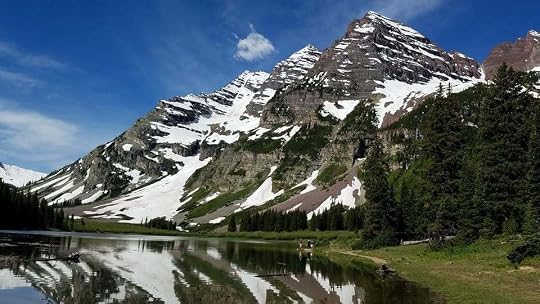
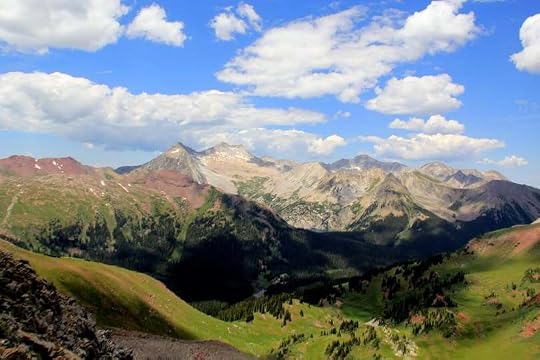
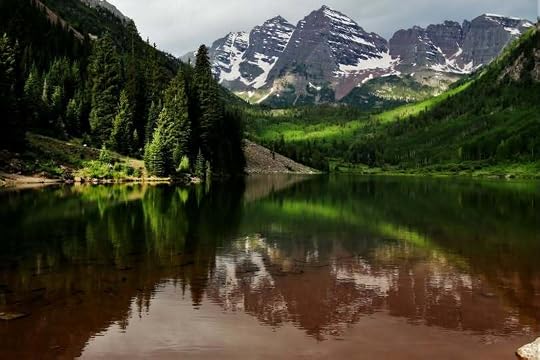
An example, which I have read in other places, is the outdated idea of the sublime meaning awe mixed with fear, and the author argues fear is necessary for a wilderness to be sublime. That is so patently false, it drives me crazy. Now, of course, fear heightens sensations and appreciation of the landscape, so it essentially can wake you up to the beauty and power around you, but it is not universal or necessary. Ask anyone who has parked a few hundred feet from Maroon Lake in front of the iconic Maroon Bells and ambled over to the reflection of the perfect, perfect glacially carved U-shape valley. It is AWE inspiring, sublime, and not far from the wilderness boundary, not even a mile, and the peaks itself are in the wilderness. Climbing the Deadly Bells is dangerous, for sure, but that is not the wilderness as we conceive of it.

A couple of photos of the Bells for perspective, Crater Lake about a mile past the wilderness boundary, and a hike deep into the Snowmass Maroon Bells Wilderness at Buckskin Pass.


I clambered hand over hand until I found myself on a high ledge overlooking a steep drop. No one was speaking, simply waiting for the light. Or something else, something more: something like visitation. But there was none, or not yet. Only the moon as it ripened, and the sweet raw flesh of the sky. The revelations had preceded us long ago. On our way to the summit, we had passed through a basin hollowed from the red-rock splendour of the mountainside where the Prophet Elijah is held to have fled in despair, and where God is said to have displayed his might in earth-shattering quakes. And it is here, at the peak, where the Bible and the Torah and the Qur’an maintain that the Lord came down in a fanfare of fumes and flames and made his commandments. A broad band of orange light spread silently along the horizon and expanded steadily upwards. Soon the firmament was ablaze, the whole sky raked with hot coals. The massif lit up in crimson and copper and violet and gold, the muscled shoulders of the peaks seeming to ripple with the effort as the rays of a rising sun played over their backs.

This very place, Mount Sinai, is one of the most widely known examples, appearing and reappearing many times in the holy texts of the Abrahamic religions. But it is far from the only wilderness of the scriptures. It was to the Wilderness of Paran that Ishmael was banished, and near there, alone in a cave, his descendant Muhammad received his first revelations; the future king David spent a decade as a fugitive in the wilderness strongholds of Engedi; John the Baptist passed most of his life preaching in the deserts of Judaea.

What lends the wilderness its symbolic power is the conflation of place and emotion: the perceived ‘mood’ of the landscape rebounding upon the human figure within it. The desolate or deserted landscape sets the tone for every story ever set there, an inversion of Ruskin’s pathetic fallacy, in which nature becomes not wild as a reflection of the person, but the person wild in reflection of the land. This works, at least in part, because our minds and bodies communicate between themselves inexactly, even allusively. External conditions, as perceived through our sensory organs, generate unintentional physical reactions – a spike in heart rate and perspiration, for example, when climbing at height. These reactions, in turn, can influence conscious thought, and sometimes in strange or surprising ways.

o read a river is an art. One you could spend your whole life mastering. I liked to watch the boat pilot surveying the surface of the water as he steered. Submerged rocks revealed themselves in the pattern of ripples across the water’s face: faint, shimmering apparitions of the contours of the riverbed below. The skiff hesitated as it passed over a glittering stretch, slowed to a crawl through a patch of tinsel, then shot away again over a clear, mirrored expanse.

Sunlight struggled through the canopy in glints. Here and there, golden shafts sliced diagonally through the water and set the silt ashimmer. There came the shrieks and shouts of unseen creatures. The ragged banks were riddled where birds and rodents burrowed. And beyond it, a darkness strident with activity. Above me, plants were clambering over other plants: competing, crowding, living, dying, reproducing, in a terrible density of life. Wood was winding itself like rope around other wood. Paradise flowers rappelled from higher levels. A bird sang a high arpeggio, and the man at the stern whistled back. At my feet, a cloud of orange butterflies were feeding or drinking, their wings rising and falling, slow as breathing. And then, at the sound of the engine sputtering into life, they lifted up and whirled around me like so many leaves. I looked up and found the men waiting for me, expectant, not yet impatient, but we had a long way to go still, and not so long until dark, and nobody wanted to be out on the water at night.

This solitude was, I came to feel, an illusion worth protecting. Or perhaps it was not an illusion at all: despite, or because of, the administrative burden, the distance between us and the nearest hiking party might be large enough to be meaningful, to reduce our impact on the land, allow shy animals their peace, and serve also some crucial psychological function. The internal event, as Ansel Adams might put it.

Though the roads of Yellowstone are jammed, and the rest stops crowded, the vast majority of the park remains relatively untouched. Fewer than 1 per cent of Yellowstone visitors will venture more than half a mile from a road. The grand majority – upwards of 95 per cent – never leave asphalt at all.
Profile Image for Richard Derus.
4,664 reviews2,402 followers
Review of advance copy received from Edelweiss+
July 27, 2026
Real Rating: 4.5* of five

The Publisher Says: A lyrical exploration of the world’s wildest, most forbiddingly remote places—and the humans who have always been there, by an award-winning and critically acclaimed writer

From the blacksand beaches of Iceland, to river crossings deep in the Amazon jungle, to the barren beauty of Antarctica, wilderness is a powerful, ancient concept, lying at the intersection of landscape, philosophy, and ecology. And for thousands of years, people have sought out uncontrolled, unknown, or uncharted nature in search of religious epiphany, self-actualization, and an escape from modern life. More recently these “pristine” places have been seen as the subject of a last effort to repair a planet imperiled by humans.

But as award-winning writer Cal Flyn traverses the most forbidding, untamed and inhospitable wild lands—the supposedly uninhabited wilds of the world—she finds that such truly untouched lands don't Nearly every wilderness has been or is actively inhabited by humans. Here we meet ascetics in search of theophany in the desert; lonely shepherds running off wolves under the stars; missionaries preaching from shacks deep in the jungle; wise lamas meditating under lofty mountain peaks.

The Savage Landscape takes us into these breathtaking wilds—deep into dark forests, to the tops of mountains, and into the hearts of deserts—asking provocative questions about the nature of wilderness, its preservation, and its meaning.

I RECEIVED A DRC FROM THE PUBLISHER VIA EDELWEISS+. THANK YOU.

My Review
: Travel writing in the poetic mode:
Wolves, bears, the wild beasts of all kinds: those that frighten us, thrill us, go bump in the night. It's what's missing, they say, from the tight-leashed land: those lamplight eyes in the dark.
Without them, without that element of fear, however faint or unformed, our relationship with the land is incomplete.

'If wildlife is removed,' the environmental historian Roderick Nash has argued, 'although everything else remains visibly the same, the intensity of the sense of wilderness is diminished!’

In other words: the fear is a part of it.
In the course of seeking out wilderness, Author Flyn makes the not-new case that "wilderness" is a societal construcy, it's about defining who gets to go where in the end..."wilderness" is reserved, apart from daily use for the great mass of people.

It's beautifully written...see quote above...but peculiarly impersonal. It's her musings, it's entirely about her responses to and thoughts about places the majority can never access. And, as the world shrinks and we humans use more and more of it for ourselves, a privileged subset of us have decided to define pieces of the world as "wild" thus off limits to the likes of you. You happen to live there? Move. This is wilderness now. I didn't see a lot of depth in her presentation of the responses to these diktats from indigenous people, but those stories are huge, deep, and outside this impressionist work's scope. I was sent off to look for the displaced's voices elsewhere—and a salutary reminder it was.

Auhor Flyn goes deep enough to present the inevitable, fundamentally irresolvable tension between the needs od humanity and the requirements of the planet's flora and animalia. It's not the first time I've read this story...Annie Dillard was my own first encounter with poetic prose telling nature's side of the story...but it is very well-made indeed.

Anyone who rethinks the relationship of human and nature has taken on an immense task, one that can't be finished, or even really grasped, in one book. Or one lifetime. We're always in need of people who look over the edges, across the horizons, under the fences, and tell us about what they saw and what they think it means. It's a perspective check...it's never possible for one person to see through all the other eyes there are looking at the world, perceiving it as we don't, even can't. It's the ultimate purpose of reading, acquiring those other perspectives in the best (albeit necessarily incomplete and skewed) way we can.

You know the lore of the woods in the 21st century, you most likely consume the stories about the denizens of the wild places on your TV. You most likely are watching vampire and werewolf media all the time. That mode of seeing these spaces has roots. Let Author Flyn show them to you, describe their planting and limn their growth for you; it will likely change how, even what, you see.

That's the point of reading, after all.
Profile Image for Shelly Fabian.
232 reviews2 followers
August 30, 2026
I received this book from a Goodreads Giveaway.

This book is non-fiction. It contains stories of adventure, different cultures, controversies, and the ups and downs of human interactions with our land/world/wildernesses.

“In cutting down my routine to its most simplistic, and my belongings to their most minimal - two nested pots, a roll mat, tent, sleeping bag, map - I have luxuriated in the basic elements of life and my capacity to use them.”

“The US Wilderness Act of 1964 codified wilderness as a region ‘untrammeled by man, where man himself is a visitor who does not remain’”

“environmental conditions compound emotional responses”

“if you live in a wild place, you live by wild rules”

“To read a river is an art.”

“‘shabono’, a huge, ring-shaped structure woven from banana leaves that served as a shared shelter for all residents.”

“His body would be burned. The ashes and bones would then be ground down and stored in a carved out gourd. When the bananas came into season, in a few months’ time, the family would pick them, mash them into a soup and then mix this together with the ashes of their dead relative. And then they would eat him.”

“True savages don’t come dressed in skins or bearing spears. They wear fatigues, dress uniforms, blazers, dinner jackets. They carry briefcases, request progress reports, draw up plan of attack. They walk among us. In their ability to recognize the humanity of others, they reveal how their own must be lacking.”

“how we should value human life: should we consider the lives of animals and plants to be equal in weight to - or potentially, in the case of endangered species, say, greater than - those of our fellow people? When push comes to shove, who gets elbowed off the ark?”

“ What I felt, I reflected, was a complex of emotions, overwhelmingly dominated by something like remorse. Or a second-hand embarrassment, on behalf of my people, my species. We had barely arrived and just look at how we were littering up the place!”

“One must be kind and respectful, thinking always of the whole. Be kind unto the animals, he said, and the animals will come to you. He meant this, literally.”

“The more we learn about the world, the universe, the species of this Earth - the ways by which they think and know the world - the more we come to realize we don’t know them at all.”
Profile Image for J.Istsfor Manity.
477 reviews
September 2, 2026
I went into the wilderness then, and at other times, because I wanted to live my life more intensely. I have found that in trading day-to-day concerns for more fundamental questions of safety, survival, navigation and supplies I could tap into a rawer, more authentic, more capable, part of myself. In cutting down my routine to its most simplistic, and my belongings to their most minimal – two nested pots, a roll mat, tent, Sleeping bag, map – I have luxuriated in the basic elements of life and my capacity to use them. In setting my own fire, chopping my own wood, making my home on the mountainside or in the forest, learning to keep myself warm and dry in all weathers — sometimes extreme — I have found a calmness and a clarity often missing from the rest of my life. In scaling high ridges or narrow precipices, in sharing a habitat with wild and sometimes dangerous animals, I have found a new flavour of fear and how to live with it. By seeking out situations in which there is no easy escape route, I have learned, sometimes with difficulty, how to cope without one.

•••

For when we talk about wilderness we are really talking about our tortured relationship with the natural world as a whole: our antagonism to it, fear of it, and - yes - our love for it too.

•••

And it seems that in this I am not alone.
Wilderness is a powerful, ancient concept, which lies at the intersection of landscape, philosophy and ecology. It is a place where the human is brought into confrontation with all that is non-human, and is challenged and changed as a result. For thousands of years people have sought out regions of uncontrolled, unknown or uncharted nature in search of religious epiphany, self-actualisation and an escape from what was to them modern life. Wilderness has been the scene of exploration, both physical and psychological, as well as a site of first contacts, privations, moral catastrophes and heroics.

•••

We are, all of us, moving through the void.
— Cal Flyn / The Savage Landscape: How We Made the Wilderness 
Profile Image for Luv2TrvlLuvBks.
1,008 reviews8 followers
Review of advance copy received from NetGalley
July 15, 2026
Reassess: to think again about something in order to decide if you should change the way you feel about it or deal with it.

The Author prods the Reader to reassess their assumptions about what is the wilderness and who defines it. From America's pre-eminent National Park, Yellowstone, to the arid jungles of the Amazon, and the juxtaposition between the animals in the Safari and the humans alongside them, this book poses quite a number of provocative questions.

The author places the Reader 'boots on the ground' as he talks to contradictions. For example, The author walks with the American hunters 'paying' to hunt Game yet that same money collected goes to conservationist efforts. Or, when the author resides with the people in the Amazon one hand acknowledging their cultural belief system (see: comingling ashes of a loved one with a food source) yet judging the same people clamoring for modern day equipment like the chainsaw.

Where the Author loses ground with this Reader was in the heavy evocation of the dead, male philosophers (see: Immanuel Kant). Knew that philosophy was to be a part of the read but felt time spent too heavily on it.

Moreover, believe that the references to preeminent (albeit, contradictory) conservationists like Teddy Roosevelt, landscape artists like Ansel Adams, will have sufficed to make his points. Then felt that the book, at times, lost focus by trying to pack in too much.

This ARC was provided by the publisher, Viking Penguin | Viking via NetGalley in exchange for an honest review.

#TheSavageLandscape #NetGalley
Profile Image for Rob Sedgwick.
510 reviews10 followers
Review of advance copy
July 17, 2026
The Savage Landscape is a thoughtful book about the nature of wilderness, what it is and where it starts and ends. Cal Flyn has been around the globe to some very remote places to sample some of today's wildernesses. Wilderness is very much a "civilised" human concept. Animals and primitive humans don't consider themselves as living in the wilderness: it just is. Very few parts of the globe are truly untouched by human hands, even if it's indirect.

Wilderness is a word which several religions have adopted and can be found in both testaments. That's where Flyn starts her book, and where it ends too: humans going into the wilderness to connect with themselves and get away from distractions. She also visits many "wildernesses" which have been constructed to meet the needs of (rich) humans, such as nature reserves. (Poor) humans have often been turfed out of their homes in order to create a wilderness, and even today's rewildings are very much still managed and have to conform to local laws.

Like her previous book Islands of Abandonment: Life in the Post-Human Landscape, also about places where few people live, it's very well written, and the author has been everywhere she writes about. Even Antarctica and remote oceans are not out of bounds. Had she been able to go into space, no doubt that would have been another chapter.
Profile Image for Ellen.
547 reviews19 followers
Review of advance copy received from NetGalley
July 26, 2026
Cal Flyn begins this book by asking a question: what is “wilderness?” Is it land untouched by humans? Land with little connection to the “civilized” world? Land where humans can connect with raw nature? To try and study this question, Flyn goes to the literal ends (and heights, and depths) of the earth, picking each destination as a way to study different ways humans have defined wilderness in different times and cultures. Wilderness as the home of wild people and animals, wilderness as protected area, wilderness as uncharted territory, wilderness as sacred ground.

Her trips to the Amazonian jungle, Antarctica, the depths of an ocean trench, the top of a mountain which housed a Buddhist lama, brought up more questions: is there any place on earth or near space that has not been touched by humans? What is our responsibility toward wilderness? Should we work actively to preserve it (with inevitable mistakes along the way) or should we just let it be (and risk natural consequences)? Can we look at wilderness as sacred space, or should we allow people to mine asteroids for rare minerals?

Flyn’s extensive research into each place she visits is impressive. Along with her personal observations and experiences, she brings in knowledge about indigenous cultures, the history of each place, and much more. She also writes with scientific knowledge but also lyrical, sometimes almost poetic awe for what she sees. It’s an amazing love song to our planet.

Many thanks to Viking and NetGalley for the opportunity to read this advance reader’s copy. All opinions are my own,
Profile Image for Elena L. .
1,286 reviews202 followers
September 5, 2026
[ 4.5/5 stars ]

There's something about nature writing that reaches deep into my heart. In THE SAVAGE LANDSCAPE, Fly invites us to venture into the wilderness, the nature that unfortunately isn't uncharted as it grieves ownership/land right disputes. From Amazonian rainforest to Antarctica (I personally loved reading parts in Ushuaia), the words transport us to the world's wildest landscapes, its rawness that embodies a sense of freedom, switching our focus from daily concerns to a matter of survival and allowing us to find calmness and clarity in the simplicity.

Yet this book doesn't solely explore the wilderness, but also dissects the relationship and boundary between human and nature, in the way wilderness preservation confronts with colonialism and ambition and furthermore, how nature conservation is anchored in local community's rites, religion and instinct. Infused with cultural and historical context, one is able to absorb the value of community and the inhabitants of wilderness while witnesses the paradox between enchanting x untouched. The journey of discovery might sound meandering, however, the wilderness narrative renders a deep thinking into environmental action and social justice.

"If wilderness does not exist, then how does it have such a hold over us?"

THE SAVAGE LANDSCAPE is a psychological exploration, an informative and enlightening non fiction that I came to appreciate and I hope people read.

[ I received a complimentary copy from the publisher - Viking books . All opinions are my own ]
Profile Image for Daniel Allen.
1,175 reviews11 followers
October 21, 2026
Author Cal Flyn travels to ten of the world's most remote locations to explore how human history, spirituality, conservation and politics have shaped nature. During her travels, Flyn asks questions about wildernesses and their continued import in the modern world.

As someone who cares deeply about the environment and nature, I enjoyed this immensely. Cal Flynn's curiosity and zeal for untrammeled wilderness and nature is evident and enthralling. The book sees the author travel extensively. Flynn reports from Iceland, Transylvania, the Amazon Rainforest and Antarctica, to name but a few locations. She explores not just the land but the people who reside there. This offers the reader interesting perspectives that lead to profound reflection.

Her descriptions of her journeys into wildernesses the world over are poetic and deeply impactful. I found myself rereading portions of the book multiple times before I progressed deeper. One in particular that stood out was her first glimpse of Antarctica from on board an Argentinian vessel. "I watched this beautiful desolation unfolding from the prow of the ship with what felt like an unclenching. After all this confusion, all this searching and second-guessing and critiquing and theorizing, it was a relief to be able to point and say, finally: This is the wilderness."

One final line that could stand as the book's central theme came from the later stages. "Whatever it takes to bring a reverence and a respect to our dealings with the natural world. Be as knowing or as credulous as you need. The point is: we give it space."
1 review
June 6, 2026
There are a few books - and it probably is only a few - that even within the first few pages you begin to understand that this is one you’ll be returning to any number of times. Nan Shepherd’s 'The Living Mountain' is one such; Cal’s previous book 'Islands of Abandonment' has already been added to my own short list; a list to which 'The Savage Landscape' will become an addition.

Invariably, on closing the book for a while, your first reflection will likely be that something has been learnt; the second will be that there will be more to come when you next pick it up. I’m thinking that many will have read Cal’s previous book 'Islands of Abandonment'; for those who haven’t I would definitely recommend adding it to your ‘what to read next’ list.

Cal is a writer who likes to confront difficult subjects (and frequently situations) both figuratively and literally. The task of following 'Islands of Abandonment' would have been a daunting one, but that high bar has been met. If I had to summarise (not an easy ask when trying to do justice to both book and author) I would probably say be prepared to have perceptions challenged, sometimes altered, and all while enjoying the originality and quality of the writing.
Profile Image for Foxx Writer.
267 reviews3 followers
Review of advance copy received from NetGalley
July 10, 2026
I'm going to start by admitting that i never finished this book. it was just too dry for me. i was expecting something that was a lot more adventure oriented, tales of the wilderness told first hand but instead i got a rather rambling dissertation on the history of various religions and their connection to the desert. and even when i skipped forward to the next chapter, it was a rambling, wordy, and dull. it read more like a textbook than a biography/memoir. if you like the clinical writing of a textbook then you will probably like this book a lot more than i did, but it really just wasn't for me. however, it was jam packed full of some really amazing research, and had some fantastic things to say about the borders between civilization and wilderness, so while i would normally give a book i didn't like 3 stars, this one is getting 4 simply because it is a fantastic book for a different audience. i'll likely pick up the Audiobook on release date and try that and see if it holds my attention more. i'm fairly sure it will depending on the narrator.

Thank you to Viking Penguin | Viking and Netgalley for this ARC
244 reviews
October 1, 2026
While a bit ponderous, many of Ms. Flyn's observations as she goes about exploring what "wilderness" really means reflect some of my own.

"How quickly I had accepted the cold towel" succinctly described my own colonial-type feelings as a traveler in what, to me, were exotic lands. I have also wondered about how to square my squeamishness about cultures who have historically engaged in ancient traditions I find abhorrent (as I celebrated Easter (and transubstantiation) at a church in Sumatra in a town known to have practiced cannibalism or when I was invited into a smoky hut in Kenya to greet a young woman on her wedding day who had just been genitally mutilated).

So, I am grateful to Ms. Flyn for giving me ideas to mull over including, but not limited to: "What is more tragic: a species existing in the world, invisible to science, or a species whose demise has been diligently, lovingly recorded?"
Profile Image for Sean Farrell.
279 reviews5 followers
Review of advance copy received from Publisher
March 19, 2026
Really loved this at first, and was well on the way to giving it a full five stars. Beautifully written, spiritual but not cloyingly so, and full of incredibly challenging ideas and revelations about the cost of conservation. The first three quarters of the book is some of the most enjoyable I've read in a while.

And then, for me at least, it just trailed off a bit. I understood the need to go to the Antarctic but found it somewhat uninteresting after the earlier chapters. The chapter Gods of the High ground just lacked focus and I can barely remember it. And the conclusion didn't bring it all together in the way it could have. It just sort of drifted away from me.

I'd still recommend it though, the failings may be mine and there's a lot of really good, thought provoking stuff here. Also - what a great idea for a book!
Profile Image for Timothy Beecroft.
1 review
May 10, 2026
A beautifully written and profound meditation on what wilderness is (does it even exist?) and what it means for both its inhabitants (and yes, they do or did exist) and for the rest of us.

Those of us who have read Cal Flyn’s previous book “Islands of Abandonment” (and if you haven’t you must) will know that with her as our guide she will take us to extraordinary places (from Mount Sinai to Antarctica via the Amazon and many other points in between) write brilliantly about what she is seeing, learning, experiencing and thinking, get herself into a variety of scrapes and help us think about things in a new light.

Even more philosophically deep, personally revealing and heartfelt that her previous book, “The Savage Landscape” is a major achievement. And a gripping read. Can’t recommend it highly
enough.”
Profile Image for Ula Tardigrade.
382 reviews41 followers
Review of advance copy received from NetGalley
July 26, 2026
A beautiful, insightful book. It was a perfect companion during my two weeks of hiking in Scotland.

What is wilderness? The author seeks the answer not only in her own journeys „to some of the world’s wildest and most invigorating landscapes” but also in philosophy, history, anthropology and psychology. She finds fascinating links to colonialism, nature conservation and cartography. I learnt a lot from it and it made me think.

The answer is not straight forward but looking for it is worthwhile - because, as the author writes, “wilderness is an enchanting delusion, a bewildering confrontation with the non-human, and ultimately a beautiful ideal whose mystical, transcendent qualities retain the power to inspire us to save our planet.”

Thanks to the publisher, Viking Penguin, and NetGalley for an advanced copy of this book.
Profile Image for Houlcroft.
349 reviews9 followers
October 7, 2026
To put it simply, this is one of the most beautiful contemplations on nature and humanities relationship with the natural world I’ve read in a while.
Flyn takes concepts from her previous book, Islands of Abandonment, and takes these further.
Her voice is clear and crisp, weaving together historical accounts of wilderness with her personal experiences:
The ongoing moments of etymology, linking language to wilderness, was my favourite part.
Here, Flyn is on par with Macfarlane, Sheppard and Baker.
Absolutely stunning.
Profile Image for Sara.
16 reviews1 follower
June 8, 2026
A deeply thoughtful exploration of the concept of wilderness that takes you on physical journey through time and across continents. The book calmly confronts uncomfortable realities and questions assumptions about wilderness, nature and the environment that have been widely accepted, even promoted, for decades. There is a clear focus on the importance of indigenous people and communities. Full of fascinating detail, for me the chapters on Romania, the Amazon and Yellowstone were highlights.
Profile Image for Lynne.
776 reviews1 follower
September 8, 2026
Travel adventure with a thoughtful look at what we mean when we say "wilderness" and how much of that is a result of colonial ideas about land and people. I definitely favored some chapters over others due to being places and landscapes I enjoyed. I was most surprised by how much I liked the chapter set in the Amazon Rainforest. I appreciated the focus on the people who live there. The book grew and grew on me as I read it.
Displaying 1 - 30 of 45 reviews