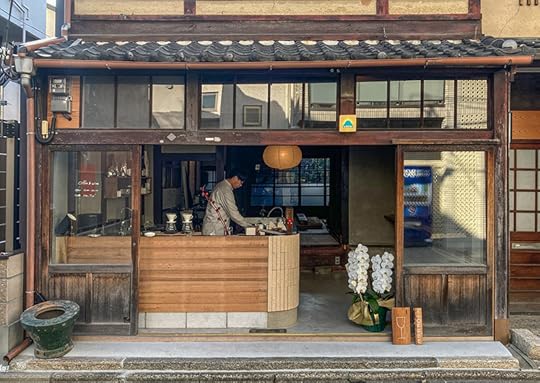
I love to do an extra yap edition when I feel like I have so much to talk about a book, so bear with me on this one as I word vomit. Frankly speaking, I don't really enjoy or fully connected with the author's more famous Morisaki Bookshop but decided to pick this almost entirely by sentiment. The cover spoke a different language, and it seems to promise something nostalgic, gentle, and deeply rooted in the Tokyo I remember. The premise of a cafe tucked away on a narrow side street instantly transported me back to my days staying in Nippori, a place filled with the exact kind of charming, hidden lanes the book describes.
Days at the Torunka Cafe is a collection of three short stories, each centered around a main character: a college student working part-time there, a man who returns after many years, and the cafe owner's daughter. In each story, the cafe becomes a quiet witness to the lives of its patrons—people who may seem ordinary at first glance but carry their own experiences, secrets, and emotional weight. I also found these stories to be filled with love as a theme, which weaves through their exploration in many complex forms. What it feels like to love without boundaries, to hold onto love in memories, and to be moved by simple kindness. Each character embodies a different philosophy of love, and through their encounters with the cafe's customers, we are invited to look back at their lives and quietly root for their futures.
Now, if you go in expecting a light, cozy read, then you might be caught off guard. I may have approached the book with the same assumption, perhaps influenced by its cover and retrospective setting. But I was actually forewarned and in hindsight, that makes sense. After all, Days at the Morisaki Bookshop was not exactly a lighthearted read either. Still, I could not help giving it the benefit of the doubt. Alas, if you were being vigilant, the book will blindside you emotionally as each chapter touched me in unexpected ways, and I found myself tearing up repeatedly, even when the stories were unassuming.
The first story, following the young part-timer Shuichi and his fascination with a mysterious older woman, Chinatsu, captures a moment of youthful hope. It is a story about the expectations and anxieties of an uncertain future, and despite the older woman/younger guy dynamic (which isn’t my personal preference), it felt oddly hopeful, even absurd and funny at times. I was rooting for them.
However, the second and third stories, while still moving, left me with a persistent feeling of unease, largely due to the narrative style. I find the prose flat, and I am unsure if that is a result of the translation or the original writing itself.
In the second chapter, which focuses on Hiroyuki Numata’s return to the café, the writing was so ambiguous that I spent a good portion confused, genuinely wondering if the author was setting up a romance between him and a daughter of a woman he once loved. The eventual revelation that it was a story about paternal love and regret was a relief, but the uncomfortable confusion lingered. And no, you might think I was in the wrong for assuming that and think differently but this did not come out in a whim. The writing really suggested that possibility, which is why I was again — questioning, if it is just a matter of getting lost in translation or the latter.
Finally, the third chapter features the owner's daughter Shizuku as she copes with the death of her older sister, which also what I found the most challenging. I loved her character in the earlier parts, but in her own story, I found her decisions annoying, even if they were rooted in understandable teenage grief. Maybe, I was just hoping for a simple, cliché romance with her childhood friend, Kōta. While I understood the story’s purpose to show how Shizuku navigates grief and personal growth—the romance subplot felt off to me, and the chapter’s overall pacing seemed stale.
Despite these issues, the book left me with a sense of gratitude. Every chapter ends on a positive note, and the author’s underlying attitude of affirming life is a gentle current throughout. It is a book that beautifully portrays how people connected to a single place reflect on their lives. I found myself placing their feelings into my own heart, following the story with a calm, steady mind. It's just a shame that the phrasing throughout just did not quite suit me. It felt like the emotional weight of the stories was slipping past without fully sinking in. Even the cover, for all its beauty, felt mismatched with the heaviness inside.
In the end, it is a book that depends heavily on the atmosphere of the day you read it. When you want to touch a warm story, it is suitable but be prepared for its bittersweet core. And while I have no regret reading it and was moved by the "miracles" it portrayed, I finished it feeling that the book I wanted to read—the one promised by the cover and my memories of Tokyo was slightly different from the one I actually held.