As society becomes more polarized around political and cultural beliefs, family estrangement has received increased attention. Going no contact with a parent, sibling, grandparent, or other extended family member is often portrayed as a sign of the further fraying of society or as a result of selfish choices that privilege the rights of the individual over the ability to compromise.
In Families We Lose, Rin Reczek takes a different view, arguing that going no contact isn’t done on a whim by selfish people or due only to specific individual circumstances. Instead she argues that contemporary family estrangement is indicative of a more fundamental culture clash in the very meaning and expectations of family in the U.S. today. Reczek shows that estrangement is sparked by a confrontation between the traditional culture, which dictates family of origin as unconditionally forever, and a rivaling idea of family that values the quality of contact, focusing on equity, accountability, personal and relationship evolution, mutual respect, and maturity.
Based on in-depth interviews with a diverse set of adults who are ‘no-contact' with family-of-origin members, Reczek reveals how these adults set new expectations about family. She shows that estrangement can be a path to healing, self-acceptance, and democratized configurations of family around the shared values of mutuality and intentional community. Shifting the focus from family reunification to family freedom, Families We Lose imagines a world where adults are empowered to choose who gets to be in their family even if it means leaving some ties behind.
Who Gets to Stay Family? In “Families We Lose,” Rin Reczek gives contemporary estrangement a lucid sociology of obligation, showing how adults can withdraw from inherited relationships without abandoning the desire for family itself. By Demetris Papadimitropoulos | August 9th, 2026
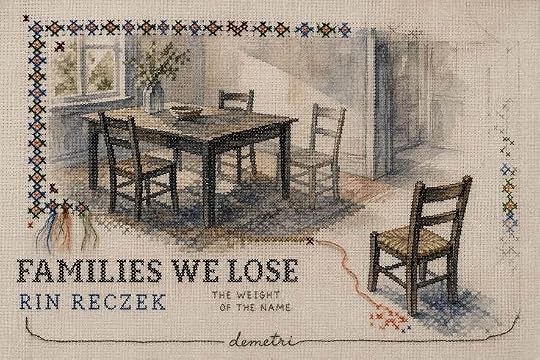
The Weight of the Name — turns the dining table, the chair pulled beyond its inherited border, and one rare loose thread into the central question of Rin Reczek’s “Families We Lose”: what remains of family obligation when belonging can no longer be guaranteed by the name alone?
Different families can be made from the same word. In Rin Reczek’s “Families We Lose: A New Explanation for Family Estrangement,” Barbara, one of 68 adults interviewed for the book, grows up amid violence, neglect and a household committed to appearing whole. She eventually leaves, losing not only her parents and sister but much of an extended kin network that treats departure as betrayal. Then comes the quieter revelation: she becomes so embedded in her husband’s family that she helps organize its reunions. Barbara has not renounced family. She has revoked one family’s monopoly on the term. Reczek begins with estrangement, but the harder question concerns what the title “family” still entitles someone to claim: contact, deference, intimacy, a permanent chair at the table.
Estrangement usually enters public discussion with a culprit already attached: an abusive parent, a new spouse, addiction, money, religion, politics, homophobia, transphobia, an old resentment with excellent recall. Reczek does not deny these circumstances. Her dissatisfaction is sociological. Many adults endure severe family strain without going no contact; others leave. Why does severing a tie become imaginable to one person and unthinkable to another? Reczek answers with two kinship cultures. “Compulsory kinship” makes family of origin inherently durable: a mother remains a mother, elders retain authority, and the tie deserves preservation even when its quality collapses. Under “democratized kinship,” continued contact depends instead on accountability and change, meaningful connection, mutual respect and safety. Family still matters. The title simply stops functioning as a lifetime access pass.
Michael asks his father for something almost aggressively modest: acknowledgment and changed behavior. He gets neither. Clarissa’s story pulls the other way. Her mother makes amends and changes, so that relationship survives; other family ties do not. Between them, the two cases prevent democratized kinship from becoming merely a theory of severance. The point is not that leaving is healthy and staying suspect. A family role simply no longer settles the question by itself. The adults who leave relatives behind often seem not less invested in family but more demanding about what the word should require of the people who use it.
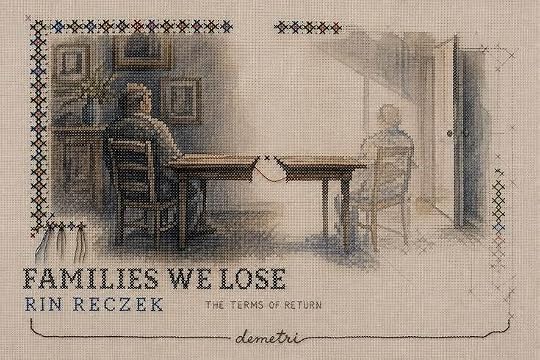
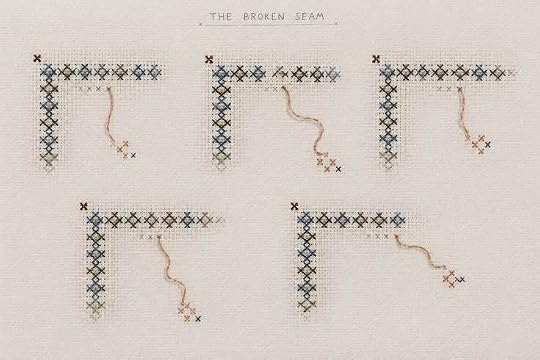
The Terms of Return — leaves a thread stretched between two sides of a broken seam without fastening it to either: contact remains imaginable in “Families We Lose,” but proximity alone cannot substitute for acknowledgment, changed behavior, or repair.
Even the word “democratized” carries an argument before Reczek has finished defining it. Drawing on Anthony Giddens’s account of transformed intimacy, she proposes that expectations familiar from modern romantic relationships – equality, autonomy, reciprocal respect, a legitimate right of exit – have migrated into some relationships between adult children and their families of origin. Parents and siblings, of course, are not lovers selected from a field of candidates. Kinship arrives burdened with childhood dependency, care, inheritance, migration, disability, religion and memory in ways that elective partnerships do not. Still, Reczek puts pressure on an assumption so ordinary it can pass for nature: that the vertical authority necessary in childhood should survive adulthood largely intact. Once the child is grown, which parental powers remain legitimate simply because they were once necessary?
The best thing Reczek does with language is name what usually hides inside familiar sentences. “Compulsory kinship” exposes the argument tucked inside “but she’s your mother.” “Democratized kinship” names the reply: perhaps a role without reciprocal conduct should not guarantee the same access forever. Reczek writes in plainspoken crossover sociology, moving between research, methodological explanation and interview narrative without much disciplinary fog. Her weakness is the obverse of her clarity. She likes to name a distinction, explain it, offer an interviewee, explain the interviewee and circle back in case anyone has misplaced the distinction. At 184 pages, the book is short; parts of the middle nevertheless feel roomier than their intellectual cargo requires. She rarely risks losing the reader. Occasionally she seems worried we might slip out during the demonstration.
Reczek has given the chapters a cleaner economy than some of the paragraphs. Chapter 2 identifies the family rules her interviewees reject; Chapter 3 gives their replacement a vocabulary; Chapter 4 asks how adults discover that another set of rules is available; Chapter 5 follows the losses and new obligations that result. By the conclusion, the subject has shifted from who leaves whom to what the legitimate possibility of leaving might do to authority inside families that never break apart. The structure earns its neatness because the argument itself changes as it moves: a binary becomes a process of cultural learning, then a question about power.
In Chapter 4, the stale argument over therapy, social media and supposedly fragile adult children becomes a question of cultural transmission. Reczek takes seriously the suspicion that therapists, self-help culture, online communities and the language of boundaries encourage people to redescribe ordinary friction as pathology. But she refuses the cartoon in which a therapist whispers “boundaries” and an adult child immediately blocks Thanksgiving. Ava encounters other models of family through friends, surrogate maternal figures, a wife, online discourse and therapy. Those encounters give names to experiences she had already been living. Reczek does not pretend therapeutic language is neutral. Her more interesting point is that culture supplies repertoires, not remote controls. New language can show someone that a door exists. It cannot, by itself, explain why that person eventually walks through it.
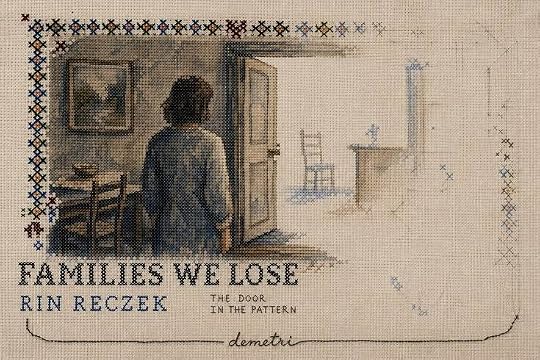
The Door in the Pattern — lets the inherited room remain denser than the pale, unfinished space beyond it: Reczek’s adults do not necessarily know what another family arrangement will become before they discover that another arrangement is possible.
Pain keeps Chapter 5 from becoming the victory lap that Reczek’s language of family freedom could easily invite. Interviewees lose siblings they still love, grandparents their children will never know, holidays, housing, tuition, inheritance, rituals, whole extended networks and sometimes the ordinary fantasy of having parents available in the ordinary way. Hannah can miss the idea of parents without wanting the parents she actually has. Julian gains distance from rejecting parents but loses financial support and leaves college. Hardev’s break with his parents effectively removes him from an enormous extended family. A decision can be necessary and still bruise. That recognition gives the book more credibility than a cleaner liberation story would.
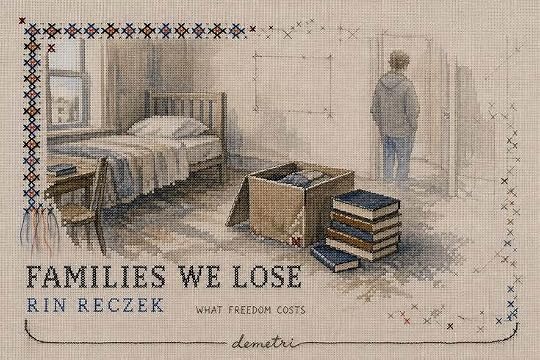
What Freedom Costs — places books, a partly dismantled room, packing forms, and an unexplained absence against mostly open cloth, giving material weight to Reczek’s reminder that a necessary departure can still take education, money, ritual, imagined futures, and people one did not mean to lose with it.
After rupture comes not emptiness but reassignment. Marriages strengthen. Some participants try to parent differently. Relatives who can change remain in the family; friends acquire duties that relatives once possessed only by title. People become part of partners’ families. Queer interviewees draw on a longer practice of chosen kinship, but the principle travels beyond queer life. Kath Weston’s “Families We Choose” sits behind this argument, while Karl Pillemer’s “Fault Lines,” with its stronger pull toward reconciliation, draws in the opposite direction. Reczek changes what counts as a successful outcome. Reunion can be one. So can a repaired relationship. So can a separation that stops damage from borrowing the moral prestige of togetherness.
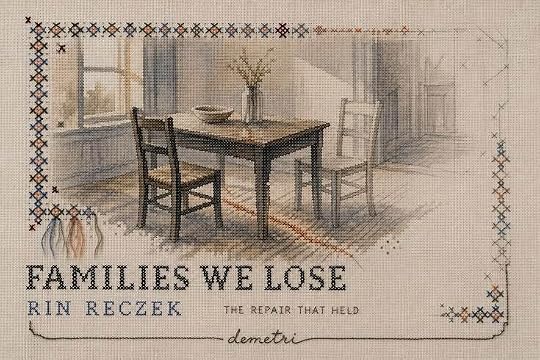
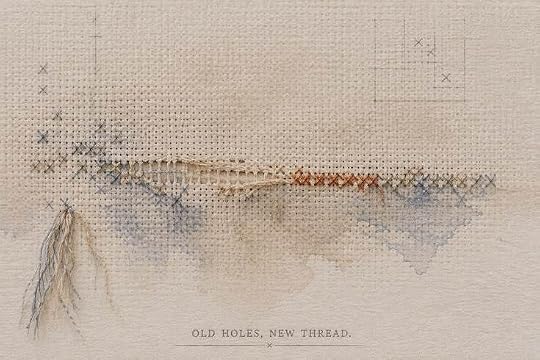
The Repair That Held — keeps the old needle holes visible beneath a seam sewn in subtly different thread, making repair legible not as a return to innocence but as the harder achievement of a relationship changed enough to hold.
Part of the trouble is already in Reczek’s names. “Compulsory kinship” receives hierarchy, coercion, image management, denial and inherited entitlement; “democratized kinship” receives accountability, growth, connection, respect and safety. One side arrives wearing handcuffs, the other carrying the refreshments. The moral contest is nearly settled by the guest list. Reczek briefly asks whether democratized expectations can become too demanding, but she mostly answers by defending adults’ right to determine the terms of their own relationships. That establishes a right to leave. It says less about whether every proposed condition for staying is wise. Can accountability become an endless admissions exam? Can “safety” stretch until ordinary discomfort begins to resemble danger? What does mutuality mean when illness, age or dependence makes reciprocity impossible for a time? The right to renegotiate family is easier to defend than every new contract.
Abuse and weary sibling disconnection eventually receive the same theoretical answer: role must no longer outrank conduct. That common question gives Reczek’s model impressive range, but it also exposes its tendency to flatten. Sexual violence, racist rejection, parental coercion, colorism, invasive boundary-breaking and the realization that one would never voluntarily befriend one’s sibling do not present the same moral problem, even if all can end in estrangement. Reczek’s interviewees usually preserve those gradations because their stories retain circumstance, embarrassment, rage and ambivalence. The categories are less discriminating. They can tell us why these relationships fail the same test without always preserving how differently they failed it.
Distinction, rather than causation, is where Reczek is hardest to resist. “Families We Lose” separates unconditional family membership from unconditional relational access. “But she’s your mother” and “you only have one brother” sound like descriptions, but each contains a theory of permanence and entitlement. Reczek’s interviewees supply the rival claim: history can create duties without creating a permanent claim on intimacy. Once named, the distinction seems almost embarrassingly obvious. That is part of its usefulness. It also explains why leaving one relative can coincide with taking other relationships, and their obligations, more seriously.
If Reczek stopped there, the book would have a narrower claim and a firmer one. Instead, she ultimately describes the clash between compulsory and democratized kinship as a fundamental or root cause of contemporary estrangement. The interviews cannot quite establish that hierarchy of causes. All 68 participants were currently estranged from at least one parent, and Reczek deliberately centers the people who left rather than pairing them with relatives or with adults who endured comparable family conflict and stayed. That choice yields rich evidence about how estranged adults understand what happened, which attempts at repair failed and how family was reconstructed afterward. It cannot tell us, on its own, what separates those adults from similarly strained people who remain in contact.
Method becomes interesting here precisely because it limits the claim without emptying it. Reczek may have written a better book than her strongest causal language permits. The interviews show adults trying to renegotiate their family relationships before abandoning them: asking for apologies, setting boundaries, requesting behavioral change, insisting that sexuality or gender be recognized, waiting for some evidence that the next encounter will not simply repeat the last. Estrangement often comes after these attempts rather than before them. The recurring drama is not quite “I chose myself.” It is closer to “the old constitution no longer governs both parties.” Reczek has persuasive evidence for that collision of rules even when she has less evidence that it is the deepest cause beneath every rupture.
In the conclusion, Reczek extends the idea one last time. If leaving a family-of-origin relationship becomes a legitimate possibility, she argues, that possibility may alter power even where nobody leaves, much as exit from other intimate relationships can constrain forms of domination that once depended on permanence. This study cannot establish that wider social change. It can, however, make the struggle over authority easier to see. The subject is no longer merely whether adults are too eager to block one another’s phone numbers. It is whether adulthood changes the terms of belonging – whether a parent’s authority, a sibling’s access or an elder’s claim can remain presumptive once continued contact becomes negotiable. The question is older than “no contact”: what do we owe people because they are family when the role and the relationship no longer agree?
The book is sturdier at human scale than at causal scale. Reczek’s prose could trust implication more often, and her preferred concepts could survive a less obliging set of names. Her evidence cannot carry every explanatory burden she places upon it. But the chapters know where they are going, the interviews refuse the fantasy that justified estrangement is painless, and the distinction between family status and family access keeps working after the argument has ended. “Families We Lose” lands at 81/100, or 4/5 stars: strong, notably uneven, and most persuasive when its claim becomes slightly smaller than Reczek wants it to be.
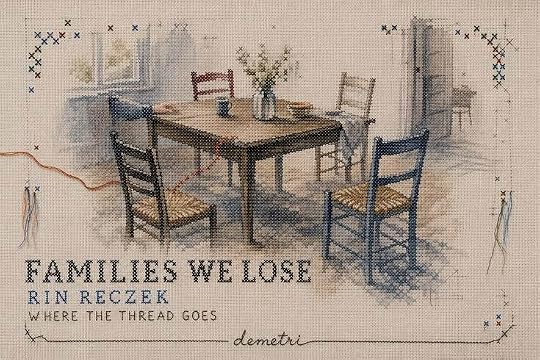
Where the Thread Goes — gathers mismatched chairs around an unfinished table and finally lets one wandering thread disappear beneath secure new stitches, answering the opening watercolor without pretending that belonging elsewhere must look tidy, complete, or permanent.
Reczek gives Barbara the book’s first durable image: the loose thread in a family blanket. It lasts because it quietly corrects some of the book’s own rhetoric of freedom. Pulling a thread free does not make it weightless. It can catch elsewhere, be knotted into another pattern, even return to an old fabric if the weave changes enough to hold it. “Families We Lose” is not finally persuasive because it makes family disposable. It is persuasive when it insists on the opposite burden: if family matters enough to structure a life, the name alone cannot be asked to carry the whole weight.
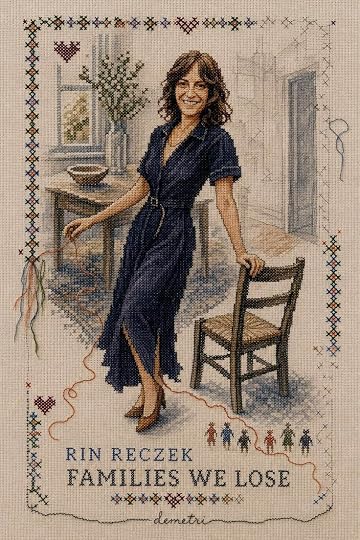
Rin Reczek enters the visual language of “Families We Lose” as a figure made from the same counted stitches as the rooms, chairs, borders, and loose threads surrounding the argument, placing the sociologist inside the pattern she has spent the book trying to make visible.
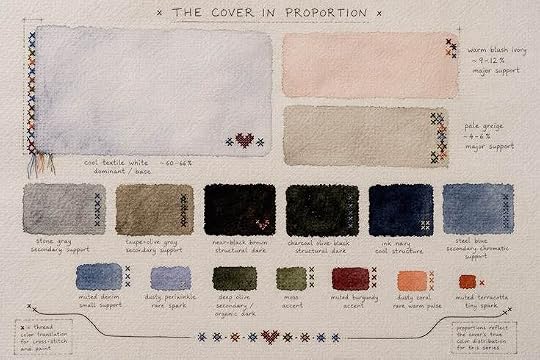
The Cover in Proportion | Watercolor Palette Study
The Broken Seam | Cross-Stitch Detail Study
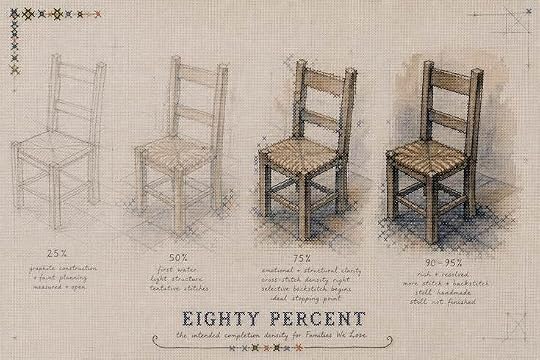
Eighty Percent | The Art of Leaving a Watercolor Unfinished
Floss and Wash | Cross-Stitch Watercolor Texture Study
Border Without Closure | Embroidery Border Study
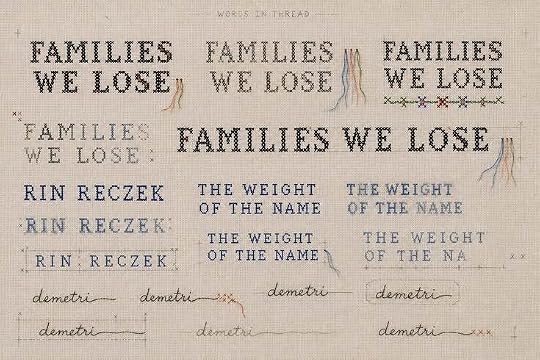
Words in Thread | Cross-Stitch Lettering
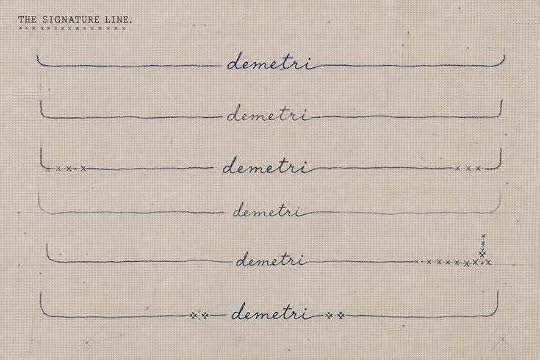
The Signature Line | Hand-Painted Thread Lettering Study
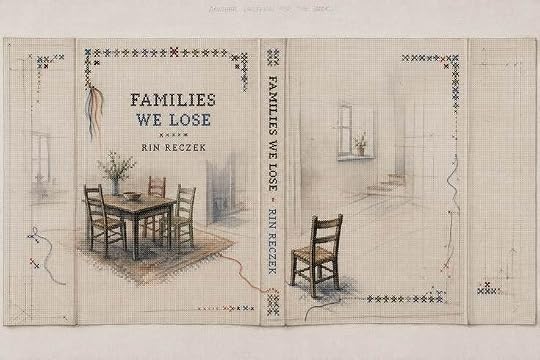
Another Pattern for the Book | Alternative Book Dust Jacket
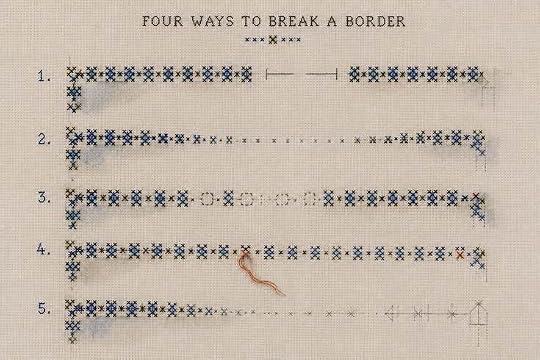
Four Ways to Break a Border | Cross-Stitch Process Study
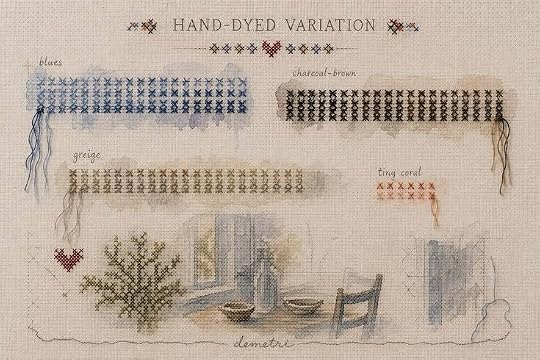
Hand-Dyed Variation | Embroidery and Watercolor Texture Study
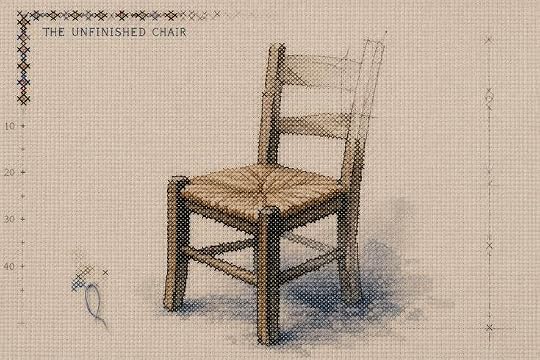
The Unfinished Chair | Cross-Stitch Object Study
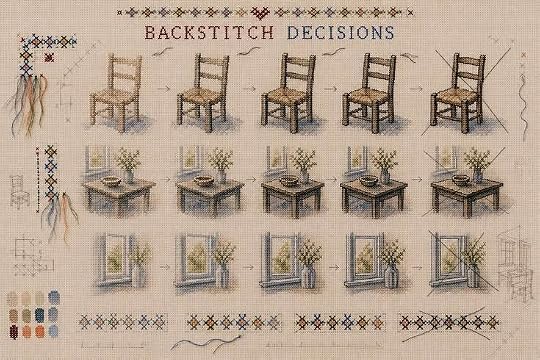
Backstitch Decisions | Cross-Stitch Technique Study
Old Holes, New Thread | Visible-Mending Study
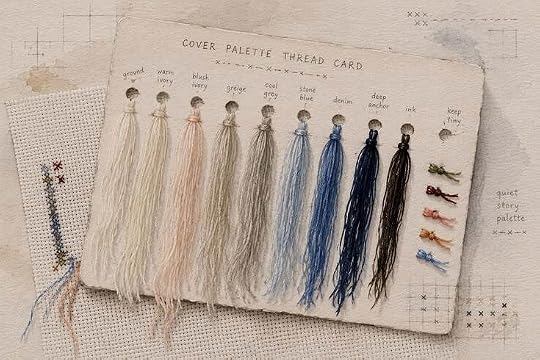
Cover Palette Thread Card | Color Study
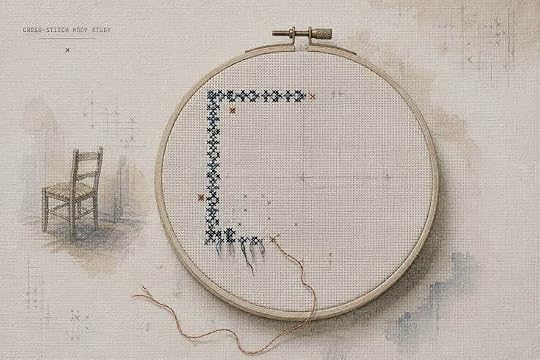
Cross-Stitch Hoop Study | Broken-Border Embroidery Study
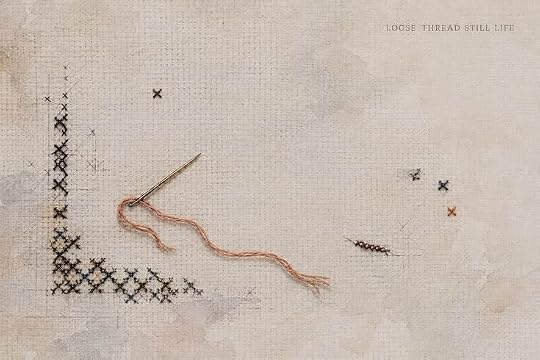
Loose Thread Still Life | Minimal Cross-Stitch Watercolor
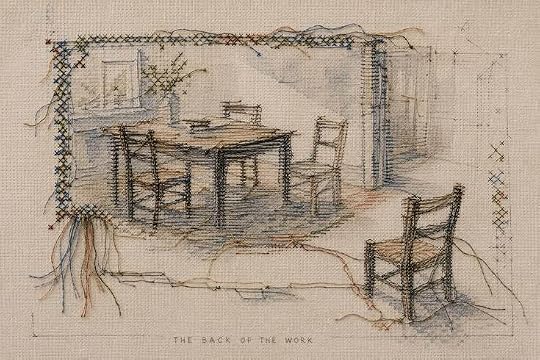
The Back of the Work | Reverse-Side Cross-Stitch Study
All watercolor illustrations by Demetris Papadimitropoulos. Watercolors are done on 140lb vellum and then scanned into the computer using an Epson scanner. From there, they are finalized in Procreate. All art and opinions are my own.
Most conversations about family estrangement begin with the person who has been cut off and the question of how the relationship might be repaired. In Families We Lose, Rin Reczek approaches estrangement from another direction: What can we learn by listening to the people who choose to leave? Drawing upon research and personal accounts, Reczek examines estrangement not simply as the breakdown of a family relationship but as a response to relationships that may already have become untenable. One of the book’s most compelling ideas is “democratized kinship,” Reczek’s term for relationships increasingly organized around values such as safety, reciprocity, and accountability rather than hierarchy, inherited roles, or the expectation that biological relationships must be maintained regardless of harm. This makes Families We Lose particularly useful for readers interested in the changing sociology of family. Reczek also considers how gender, race, sexuality, and culturally prescribed family roles can shape both estrangement and the consequences of choosing it. Estrangement rarely involves only two people; separating from one family member can affect relationships with siblings, grandparents, extended relatives, and entire family networks. Importantly, the book does not present estrangement as an uncomplicated solution. Instead, Reczek treats it as a phenomenon worthy of study in its own right. The description of estrangement as a “canary in the coal mine” (p. 26) is particularly effective: estrangement may be less the cause of a family's breakdown than a visible symptom of problems that have gone unresolved. The book is research-driven but remains connected to lived experience through personal accounts. Some of these accounts involve difficult family dynamics and may be emotionally challenging for readers with similar histories. Reczek thoughtfully includes a warning in the introduction, something I appreciated given the subject matter. As a reader who is estranged from family of origin, I found the book personally resonant without feeling that it was simply affirming a predetermined position. Its greatest strength is the additional vocabulary and context it provides for thinking about estrangement not merely as an individual family crisis, but as part of a larger negotiation over what family is, who gets to define it, and what we can reasonably expect from the people we call kin.
Families We Lose takes a thoughtful look at family estrangement and challenges the idea that there's always a single cause or a simple solution. Instead, Rin Reczek explores the many reasons relationships break down, drawing on research and personal stories to show how complicated these situations can be. I appreciated that the book made room for nuance instead of trying to fit every family into the same explanation.
This book felt personal to me because I'm estranged from my adopted father, and I was estranged from my adopted mother for five years before she died. Those experiences have taught me that every estrangement has its own history, its own pain, and its own unanswered questions. I never felt judged while reading this book, and I also never felt pressured toward one "right" outcome. Instead, I came away feeling more understood and with a better appreciation for just how many different paths families can take. My sincere thanks to the publisher and NetGalley for providing me with a free advance review copy.
Great insight into estrangement. The author has extensive experience and it was thoroughly researched. However, her writing style drove me nuts. Too much “as I explained in earlier chapters, and what this book will explain” and so on. I’m not in 4th grade, I can figure this out on my own.
This is a curiously defensive book for an academic monograph. It's in large part a rebuttal to articles in the past few years basically claiming that young-ish adults are increasingly cutting contact with family members, often parents, and that they're doing so for trivial reasons, and that this is partially the fault of influence from therapists and therapeutic culture.
I saw the author speak about this research at a conference last summer and was intrigued because family estrangement is a taboo topic. It hasn't gotten a whole lot of academic research, just therapist-authored books like Coleman's Rules of Estrangement: Why Adult Children Cut Ties and How to Heal the Conflict. So I'm very much in favor of the project, but I'm not sure the conclusions are justified.
The author theorizes two competing family cultures: a more traditional "compulsory" culture based on obligation and a newer "democratized" culture based on mutual consent. Estrangement happens when family members have opposing cultures *and* encounter a significant conflict, which they can't resolve because compulsory family culture doesn't really prioritize addressing the needs of lower status family members. Democratized culture, in contrast, offers emancipation to build families based on mutual respect.
On a topic that has had so little serious study, it's important not to expect this one study to encompass the entire topic. It's also difficult for me to separate my legitimate criticisms of the book from areas where it just doesn't reflect my individual experience on this very emotional subject. Nonetheless, I have two main criticisms.
One is sampling. Participants have diversity along gender, sexuality, and racial lines, and there's some interesting discussion of estrangement varying along these axes. I was surprised there wasn't any discussion (I don't think) of class effects in the text, although the methods appendix does report participant income levels. This is all good. However, participants were recruited from websites about family estrangement, which suggests that they're people who are spending their time actively reflecting on estrangement, and they're more likely than average steeped in online therapeutic culture. I believe that plenty of people have limited/no contact with family members but don't hang out online reading/talking about it, and that they may meaningfully differ from people who do.
Related, as the author acknowledges, it would have been good to interview not just people doing estranging, but also the people they are estranging themselves from. Given how little info there is on the subject, I don't want to say this author should have done that for this project, but I do think that the conclusions should be stated in a more restrained way.
My other complaint is how strongly the two kinship cultures are framed as positive/negative. There is discussion of negative impacts of estrangement on the person doing the estranging, but overall, compulsory kinship is definitely wrong/bad/outdated and democratized kinship is right/good/freeing.
The most magical thing about sociology is finding that someone has researched and given a name to a complex phenomenon that you've observed but never been able to describe articulately. Seeing this author speak about the two kinship cultures, I had that moment of recognition, as they put words to differences between different branches of my family, which I've never been able to articulate but would now call compulsory versus democratic approaches to kinship.
The obligatory part of the family is indeed maddening at times, as people behave in ways that don't seem to make anyone happy. There are superficial relationships between people who don't seem to actually like each other or have any desire to improve the relationship, and I can't say that's a better situation than ending those relationships would be.
And yet, the democratic part of the family is also fundamentally flawed. Believing that relationships should be based on mutual consent, while important, does not guarantee that the people involved have the relationship skills to resolve conflicts or to form deep connections. The democratic branch of my family is riddled with estrangements, mostly amongst the baby boomers, over issues both big and small. It can be lonely and unstable.
I want to say something about the similarity between the negative word "obligation" and the positive word "commitment," but I don't know exactly what and really don't want to imply that commitment is inherently good. Anyone can end a relationship for any reason, and I'd guess that overall, much more suffering arises from people being pressured to stay in bad relationships, compared to people being pressured (by straw-therapists?) to end relationships that could be salvaged. As the author says, estrangement itself is not a problem, it is a symptom of underlying problems in families of origin.
Families We Lose: A New Explanation for Family Estrangement is a thoughtful, groundbreaking, and deeply researched examination of one of the most complex and often misunderstood issues affecting modern families. In this compelling work, Rin Reczek moves beyond common assumptions about family estrangement to explore the deeper cultural, social, and emotional forces shaping how people define family relationships in the twenty-first century. Through careful research and powerful personal accounts, Reczek presents a nuanced understanding of why some individuals choose distance from family members and what those decisions reveal about changing ideas of kinship, belonging, and personal well-being.
One of the book's greatest strengths is its willingness to challenge oversimplified narratives surrounding estrangement. Rather than portraying going no contact as a sudden or selfish decision, Reczek examines the broader cultural tensions that influence these choices. Her analysis reveals how estrangement often emerges from deeper conflicts over expectations, accountability, respect, and the evolving meaning of family itself.
Particularly compelling is the author's exploration of the clash between traditional and emerging definitions of family. Reczek thoughtfully examines how older models of kinship often emphasize unconditional lifelong obligation, while newer approaches increasingly prioritize emotional safety, mutual respect, personal growth, and healthy relationships. This framework provides readers with a valuable perspective on why family relationships are changing and why these changes can create significant conflict.
Another notable strength is the book's foundation in personal experiences and in-depth interviews. By centering the voices of adults who have experienced family estrangement, Reczek brings emotional depth and authenticity to the discussion. These stories demonstrate the complexity behind decisions to separate from family members, revealing experiences shaped by pain, reflection, healing, and the search for healthier forms of connection.
The book also excels in its examination of family as an evolving social institution. Rather than treating family as a fixed structure defined only by biological ties, Reczek explores how people increasingly create meaningful relationships through shared values, care, trust, and mutual responsibility. This exploration expands conversations about belonging and encourages readers to consider how family can be intentionally shaped in ways that support individual and collective well-being.
Equally valuable is the book's balanced approach to a highly emotional subject. Reczek does not reduce estrangement to a simple issue of blame or wrongdoing but instead investigates the broader cultural forces influencing these experiences. Her sociological perspective provides readers with a deeper understanding of how personal decisions are often connected to larger shifts in society, identity, and expectations.
Despite engaging with complex topics in sociology, family studies, and cultural analysis, the writing remains clear, accessible, and engaging. Reczek combines scholarly research with compelling human stories, making the book valuable for academics, counselors, social researchers, families navigating difficult relationships, and general readers interested in understanding modern family dynamics.
Perhaps the book's most significant contribution is its reframing of estrangement as not only a story of loss but also a story of transformation. By shifting the conversation from family reunification to family freedom, Reczek invites readers to consider how individuals can build relationships that reflect dignity, respect, and emotional well-being. This perspective offers a meaningful contribution to ongoing conversations about autonomy, healing, and the future of family life.
Insightful, compassionate, and intellectually significant, Families We Lose: A New Explanation for Family Estrangement is an important contribution to sociology, family studies, and contemporary discussions about relationships and identity. Rin Reczek has created a powerful work that will resonate with researchers, educators, counselors, families, and readers seeking a deeper understanding of how society's definition of family continues to evolve.
Many thanks to the publisher, author and Netgalley for the ARC.
This academic work of literature is a must-read for today’s generation because it sheds light to the general sentiment of why it feels hard fostering an ideal family dynamics grounded on self-welfare and individual safety and explains why estrangement or cutting connections with our family of birth seems the optimal solution to this problem.
The author gave justice to this book by not just presenting her research findings theoretically backed by numerical figures, but also putting a human touch to every chapter by presenting first a story of the interviewees/ participants of the study. I also liked how the author introduced the terms compulsory kinship and democratised kinship and revolved around expounding these concepts and how the author logically presented the topics in a meaningful way. She started with laying the groundwork of explaining the current trends, stated some clarifications on the media’s claim about estrangement weakening the moral fiber of today’s society, and proceeded with presenting the cons of compulsory kinship and how democratised kinship affects the general population as a model of family life.
What I also liked is how the book unfolds to having meaningful disposition on democratised kinship and how it fosters a better navigation on the individual’s yearning for a current benchmark that goes away from the defunct mindset of preserving hierarchy, blind obedience, and reputational preservation of one’s family at birth.
I also see the value of this book’s thesis statements because these will unlock further studies on the evolving expectations about sociology, family relations, and the shifting values of today’s society. Estrangement, as rightfully explained by the author, is not the cause of problem, but rather a symptom of the failing family system. Hence, further studies should be encouraged supporting this conclusion in unraveling the shifting behaviors towards prioritising intimacy in building a more equitable and fulfilling family life.
This book has some really good points on why things have changed and how its effect the way people see what is a "family". This book does not blame sexuality nor religion for the reason of estrangement. It is overall a good study on the topic of estrangement. The book is written in a formal style, essay/report like. The language is easy to read, and the information given is set out in a very logical argument. Overall, it's a good book on family estrangement. There are some good personal stories from participants on what they have been through and experienced. Thank you to the publisher and author for allowing me to read this book as an ARC. I only read ARC's that I would personally pick to read from a store or library, and this review is of my own option.
This is hands-down one of the best books that I’ve read on family arrangement and, over the past six months, I have read many. The research is spot on, which is different than many of the self-help literature on family arrangement that is available which tend to rely more on case studies and personal opinions than actual research and data. If you want access to actual research and professional insight, this is the book for me. If you want biased opinions from an author, then look elsewhere. I received an advanced copy of this book for my research as I am currently writing a book about family estrangement.
By buying Ren Reczek's "The Families We Lose" I received much more than I bargained for. This book opened my eyes to a world of hurt that I never knew existed. As someone who hasn't read this genre since college, I came to the book with fresh eyes. While she didn't invent the term “democratized kinship,” she certainly gave meaning to it. It was an excellent read. I wonder though, why there are so few White Anglo-Saxon Protestant replies to her search for subjects?