Chronologically, the last we knew of Erlendur, the police detective of Arnaldur's series, he was (perhaps forever) searching for the remains of his younger brother. ( As young boys they got lost in a wilderness snowstorm and inadvertently separated, Erlendur has never given up the search for his lost brother.) This (chronological) last sighting of Erlendur was in Furðustrandir (Strange Shores). The next to last book in the series, The Chess Match, instead featured a young Erlendur back in the beginning of his career. This latest book goes even further back in time, to 1974. While the Chess Match is set during the Fisher-Spasski duel, Reykjavíkurnætur( Reykjavik Nights) concerns itself with missing people and anchors Erlendur's obsession, almost his reason for being: finding the missing.
Yet here is another sense in which Arnaldur, the author, has his main character search for the missing: the body of one of the persons he concerns himself with is not missing in the sense of it having disappeared; his body was quickly found. Rather, his searchlight is on after a man who most had forgotten and was too insignificant for anyone to look closely into why he drowned. Erlendur, in his free time, wonders, and discovers this homeless drunkard's fate and who he was. So along with Reykjavik in all its drunken modality (in those days it was not fashionable or for tourists) we see how the homeless, men and women, survive (or not).
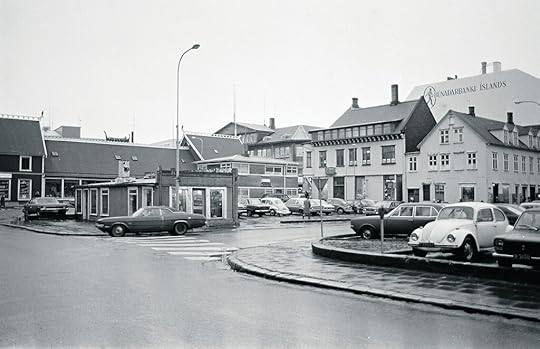
(I was a student in Reykjavik those days, how well the localities are described! The gray cement hot water tank featured in the book; I so often used to take a walks on it. Is it still there?)
We get to know Erlendur better. He gets along with his fellow cops; their nightshift cruising is often a source of hilarity (some just to the reader given the changing times and attitudes-towards such strange things as pizza), sometimes as its shows up the delusional notions of the petty criminal. But Erlendur is a loner. He saw how "it was not for him to travel with relentlessly merry people. The merriment could be oppressive." He has met the woman who we happen to know will become his wife, but she is not important to him, work is, his obsessions are. He excuses himself with his work, his schedule etc. When she tells him she is pregnant, we never see him concern himself with that. He daydreams of going to school again, then to the university, to study, guess what, Icelandic history.
Arnaldur himself studied history at the University of Iceland. Interestingly, as history weaves itself through his books, one makes these observations. Also, one current event looms, and then it is a setting: the 1974 National Celebration, in Þingvellir, of Iceland's 1100 years' birthday. Arnaldur would have been 13 at this time, but his father was the national chairman of the event (and even wrote a book about it) Surely the son would have been at Þingvellir on that 17th of June.
And now his character is there! "The command post of the police was a short distance from the tent of the directors of the festival." Later, surprising the police, were protesters against Iceland in Nato! (Ha ha, I was visiting my brother who was studying in Germany, or else we might have been there, protesting like good leftwing students. But our dad was also in an organizing committee for this event, so we'd have behaved, I hope) Wonder what Arnaldur and his dad thought of the unexpected hoo-ha, but here Erlendur does not take part in the arrests.
"Barefoot children played at the water's edge". Did Arnaldur do that, and did he then, like Erlendur, inch closer to the stage when Tómas Guðmundsson, the poet, read his commemorative poem? At any rate, the description in the book of that beautiful day is excellent; even the appearance of what his fellow policeman calls´the bloody communists´ completes the picture.
This next to last chapter really sits outside the main story line and the only connection with the oeuvre in general is that it is made the setting of Erlendur literally being tapped to join Iceland's new and tiny detective squad. I think it celebrates a special memory.
What a sweep in one book, the down and out at their most pathetic, huddling for warmth in the winter dark; the nation reveling in its survival in the bright summer glory. It is something few foreigners realize unless they live in Iceland: how happily one turns one's face to the sun in lee from the wind. Also the drunkards and the homeless relish that moment- and Arnaldur has gotten that scene too.