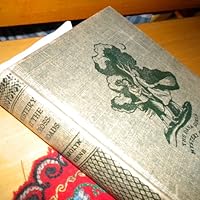
A novel for people who enjoy learning about history. As with Louis de Wohl's other novels, the text is mostly dialogue and the chapters are suspenseful, often ending in cliffhangers.
This is a novel about the life of St Thomas Aquinas through the eyes of of a fictional knight, Sir Piers Ruddle of England, and his sidekick Robin Cherrywood. (At least, I assume he's fictional.)
We first meet St Thomas when he is an Benedictine oblate at Monte Cassino. The monastery is under attack by the excommunicated Holy Roman Emperor, Frederick II, who is at war with the Pope and his allies. Sir Piers rescues St Thomas from the burning monastery, and they travel to the principal castle of the Aquinas family.
It is here that Piers falls madly in love with Theodora, the sister of St Thomas. Since they are a noble family with close connections to the Emperor, she cannot marry him. Nevertheless, he offers to make her his "lady," and she formally accepts. He enters into the service of her family.
Those who have read Cervantes may remember that Don Quixote chose Dulcinea of Toboso to be his "lady"; and although she was a homely peasant girl, he saw her as the most beautiful woman in all of Spain, boldly challenging anyone who might disagree.
Being his "lady," Piers would dedicate every victory and good deed to her honour, putting himself entirely at her disposal, and expecting nothing in return.
As the novel progresses, we follow St Thomas to school, where the other students berate him as a "dumb ox." Although Aquinas is quiet and chubby, his teacher, St Albert the Great, says, "You may call him a dumb ox, but the bellowing of his teaching will be heard throughout the world."
On another occasion, St Thomas is at a banquet thrown by St Louis, the crusader King of France. Lost in though, and oblivious to everyone around him at the dinner table, an epiphany about the nature of evil strikes, and to everyone's consternation, he slams his fist on the table, proclaiming, "And that settles the Manichees!"
While at school, Aquinas meets the Dominicans and decides to take vows with the Order of Preachers. His mother is horrified that he would join a mendicant order, choosing to live as a beggar. Her hope was that he would acquire a more illustrious position in the Church, such as Abbot of Monte Cassino. (She could not have predicted "Angelic Doctor.")
After kidnapping him, she locks him in the tower of one the their castles. His brothers send a prostitute to his room, hoping that he will somehow snap out of it. Instead, he chases her out with a firebrand. In the end, his family relents.
As the novel progresses, we follow Aquinas to the illustrious University of Paris, where he teaches alongside his Dominican brother, St Albert the Great, and the Franciscans St Bonaventure and Friar Roger Bacon, who formulated the scientific method. As the novel implies, Roger Bacon was also instrumental in the development of eyeglasses.
Aquinas' goal is to show that faith and reason are not incompatible, despite the prevailing thought of his day. Aquinas' counterpart in the Muslim world was Averroes, who believed that God established a plurality of contradictory truths, one of faith, as demonstrated in the Qur'an, and another of reason, as demonstrated by Aristotle.
Aquinas, on the other hand, believed that whenever faith and reason seem to be in conflict, either our reasoning is wrong, or our interpretation of Scripture is faulty.
Next to Aquinas, the most important historical figure in this novel is Frederick II. By the time we meet him, he has already been excommunicated multiply times, making enmity with the Popes, and toying with a multitude of heresies. He is also a brilliant megalomaniac who travels with a menagerie, dancing Arab girls, and African eunuchs.
Fearing for his safety, the Pope abandons Rome, fleeing to France, where he has Frederick II deposed. The Aquinas family must then choose between their allegiance to the Emperor and loyalty to the Church.
Ever since Michael Scotus had told the Emperor that he would die sub floris ("under the flower"), Fredrick II had refused to be in the present of flowers. He ends up dying suddenly at a castle named "Florentine."
Why focus so much on Frederick II in a novel about Aquinas? Because Frederick II was the manifestation of the problem that Aquinas set out to solve. In his hubris, the Emperor thought that he was beyond faith, which he equated with superstition. But Aquinas demonstrated that everything taught by faith could be supported by reason.
At another point in the novel, Sir Piers joins St Louis on the failed seventh crusade, where the King of France is captured, and a large ransom must be paid for his return to France. At another point, Piers is enslaved by Muslims, who try to force him to profess the sacred formula of Islam, but he slurs the words and boldy challenges a mullah who insults Our Lady. In the end, he is saved by Prince Edward Plantagenet of England, the great nephew of the crusader king, Richard the Lionheart.
(As to whether Piers ever marries his "lady," you'll have to read the novel to find out.)
Toward the end of Aquinas' life, he had a vision of God, where Jesus spoke to him from a crucifix, saying, "Thou hast written well of me, Thomas. What wouldst thou have as a reward?" His response was: "Only thyself, Lord." After this experience, he was no longer able to write, saying everything he had ever written, including the great Summa Theological, and it's five proofs for the existence of God, was like straw in comparison to what he had seen.