One hundred and six poems of self-reflection and exquisite beauty—an intoxicating blend of Seon Buddhism and French symbolism, and the first poetry collection from this essential South Korean author to appear in English
That summer I stood in the centers of storms That summer my despair burst out into crimson but still I weathered the wind and rain
Mountains, rivers, trees, flowers, the dark, a cat, a train. In the elemental forms and figures of our world, Lee Seong-bok finds repositories for thought, sounding boards against which he can test his reflections. Again and again, in sequences, he probes his subjects—five “Mountain Path” poems, three “River” poems, three commentaries on the I Ching—not to solicit answers, like Moses impatiently striking the rock for water, but to savor the muted tones that echo in response.
After one ruckus / begins another / The silent forest vibrates // Suffering was always / new suffering
The poems of That Summer’s End, though acutely conscious of the self, are free of an inhibiting self-consciousness, speaking directly of youth, love, fear, family, grief, old age, impermanence, and all that’s central to life. As enticing as they are profound, Lee Seong-bok’s poems have made him not only a poet’s poet but a favorite of RM, leader of K-pop superstars BTS, whose support of his work on social media has brought him international attention.
What Love Must Leave Unpossessed In Lee Seong-bok’s “That Summer’s End,” translated by Anton Hur, rivers, wounded trees, absent beloveds, and storm-bright flowers ask whether attention can draw close without becoming a form of capture. By Demetris Papadimitropoulos | August 4th, 2026
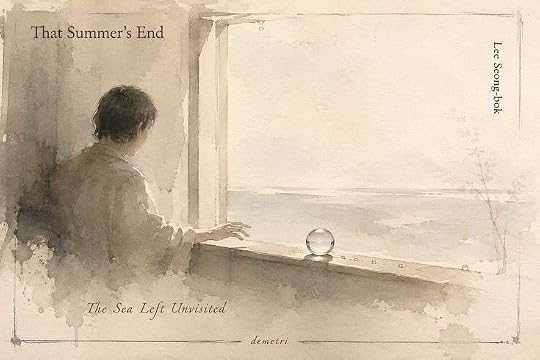
A solitary figure stops short of the droplet that holds the horizon, translating the book’s ethics of distance into a pale, cover-derived field where attention draws near without claiming what it sees.
Distance, in Lee Seong-bok’s “That Summer’s End,” sometimes does what love cannot: it leaves the beloved unpossessed. In “Western Sea,” the speaker refuses to visit a place where an absent “you” might still be; arrival would turn possibility into fact, and fact would empty the horizon. The decision is tender because it is severe. Across Lee’s first poetry collection in English, translated by Anton Hur, love keeps nearing the same dangerous threshold – the moment when naming, rescuing, or understanding another person begins to look like ownership.
Elsewhere, looking leaves bruises. A young tree is torn from rocky ground, replanted at home, watered, and still it bleeds. A cicada could be caught, but capture would silence the forest whose song drew the listener near. A lover is “claimed” and thereby imprisoned. A parent attacks what appears to be a charging boar, only to discover that the bloodied body is the child’s. Lee is less interested in kindness that fails than in kindness so certain of itself that it cannot recognize the harm done in its name.
Mountains and rivers recur, but the nonhuman world does not queue up to explain the human one. A river rejects the judgment that it looks lonely or sick: it has rushed through cities and been blackened by their exhaust. A cat ignores an offered sneaker and continues grooming itself, a small comic refusal in a book not overstocked with comedy. A familiar neighborhood mountain reveals a depth that makes familiarity seem faintly presumptuous. Lee’s natural scenes absorb projection, then decline the role prepared for them. The world keeps its own timing.
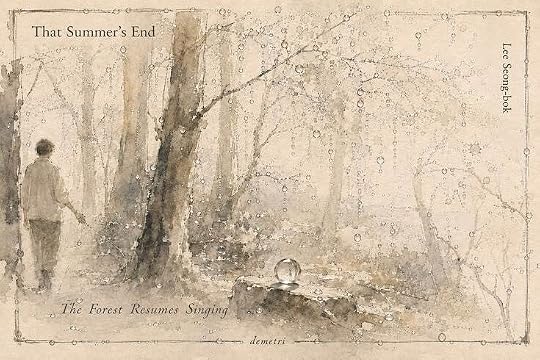
A retreating figure leaves the cicadas uncaught as droplets gather across branches like sound made visible, allowing the forest to resume its life beyond human use.
Every return alters what came before. The 106 poems move from feeling, prohibition, desire, and inward homelessness through forests, parents, children, animals, spiritual address, bodily horror, illness, and parting, ending among letters, graves, and a crape myrtle that survives repeated storms. No plot carries the book across that distance. A path stops and starts again. A river appears calm while grinding lives into sand. A beloved leaves and remains. One poem stains the next, and the sequence moves by those stains.
The English keeps a plain face while the poems grow stranger underneath it. Hur’s version leans on ordinary nouns and direct declarations: tree, hand, mother, rain, child, blood. Without the Korean beside it, the precise division of labor between poet and translator cannot be settled; the effect on the page is clear. A domestic scene opens into reincarnation. A riverbank gives way to massacre. A mother in the next room is also a mother in the grave. The floor simply drops. Sorrow takes a temporary body: a snapped root leaking clear sap, a train lingering in darkness, an old woman’s white hair becoming the beloved’s future. The plainness lets each impossible turn arrive before rhetoric can soften it. Many prose poems seem to begin in the middle of a thought, with explanation already discarded, so the reader meets the pressure before learning its source. Even beauty arrives with splinters. That economy matters: the poems can become grotesque without sounding enamored of their own darkness. When the poems falter, the order reverses: an abstract noun enters first, and the image is asked to carry a conclusion assigned in advance.
Rhythm governs the moment of estrangement. The lineated poems proceed by repetition, pause, and incremental change, borrowing prayer’s cadence without promising an answer. The prose poems are more breath-driven. Their sentences gather danger, memory, and dream logic until consciousness seems unable to stop itself. “Cliff,” for instance, accumulates rocks, waves, foam, a seagull, death, and breath in one vertiginous field. Elsewhere the syntax remains spare enough to resemble a folktale just before the tale remembers how cruel folktales can be. Line breaks postpone an object or recognition long enough for yearning to become grammar. Repeated clauses circle an emotion rather than advance an argument; Lee worries a phrase until its temperature changes. The prose poems can feel like locked rooms in which the sentence has pocketed the key.
In Louise Glück’s “The Wild Iris,” flowers and weather answer questions their speakers cannot settle alone; Lee asks similar questions, but his natural world is more bodily and less inclined to speak in orderly voices. Han Kang’s “The White Book,” translated by Deborah Smith, offers a narrower resemblance in the way grief settles into matter, though Han’s governing loss is clearer and her visual system more controlled. Lee is messier, more porous, and more willing to let a body become river, cave, tree, or road without warning. Where Glück stages a debate and Han narrows her palette, Lee lets images migrate until they have several incompatible jobs.
Pronouns keep changing who owns the pain. Lover, parent, child, dead person, divinity, and suffering can all occupy the grammar of “you.” The uncertainty is not a riddle with one biographical answer; it allows unlike attachments to cast shadows across one another. In “Parting 1,” speaker and beloved look into the mirror of separation until it becomes unclear who leaves and who remains. In “Chains,” intimacy briefly dissolves both identities before darkness restores them as strangers. In “Silk Road 2,” private suffering becomes the beloved’s punishment. One may enter deeply into another and still remain outside.
As “you” changes shape, relationships begin to bleed into one another. Romantic longing, parental fear, spiritual hunger, illness, bereavement, inherited violence, and ecological damage all pass through one lyric weather system. “Wildflower” invokes X-rays, a gun barrel, a wounded horse, and young people lined against a wall, yet offers no historical coordinates. The refusal may be deliberate, but across the collection it helps unlike griefs share the same atmosphere. Private loss and collective violence come close enough to resonate, and occasionally too close to remain distinct. A book so alert to the danger of using another life sometimes makes different sufferings do the same emotional work.
Presented without named parts, the 106 poems offer almost no broad clearing in which the reader can reset. The numbered suites show return doing more than repeating itself. “Mountain Path” is especially strong: the route becomes dead end, ordeal, wound, misguided rescue, and aftermath. “Silk Road” turns desire into arrival, punishment, capture, distance, and belated recognition. These sequences change the moral use of an image from poem to poem. Their numbering also gives the reader a rare expectation of development: the next path or river must answer the earlier one, even if the answer is another obstruction. Outside them, some standalone pieces inherit force from their neighbors rather than generating enough of their own. The suites provide what the whole sometimes lacks: a visible measure of change. Many doors appear; several open into rooms already visited.
Attention takes opposite forms in “In the Forest” and “Mountain Path 4.” In one, the speaker withdraws and lets the cicadas resume their song. In the other, the speaker removes a young tree from its difficult home, carries it somewhere safer, and discovers that safety has preserved the violence of uprooting. One scene protects by retreating; the other injures by helping. Lee’s distinction is between care that permits another life to remain beyond use and care that cannot imagine love without intervention.
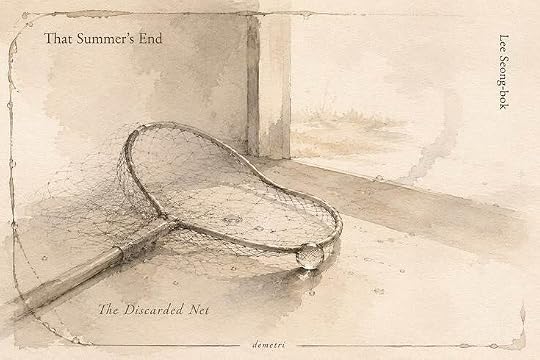
Desire makes the same mistake in more intimate clothing. “Silk Road 3” compares the speaker to a discarded butterfly net after the beloved has been claimed and exhausted. “Foot,” by contrast, turns a nearly comic gesture into a small crisis of contact: the beloved is close enough to touch, but contact might startle; refusal to touch might wound. Lee can make intimacy look faintly absurd without making it cheap. His lovers keep arriving with gardening tools for operations that require a steadier hand; the patient is right to be wary.
A collapsed net lies inside a broken orbit of droplets, turning the wish to hold beauty into a fragile architecture of exhaustion, absence, and release.
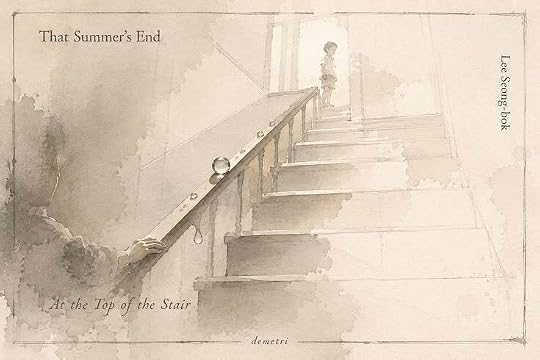
In the parent-child poems, wariness becomes terror. A child climbs a staircase and looks down with pride while the parent sees aging, blindness, and the future end of hand-holding. A mother and child lose one another on an overgrown path. Another mother sleeps in tall grass, then becomes both next door and buried. These are not characters developed through accumulated incident; they are relationships caught at the instant ordinary distance becomes irreversible. Compressed nearly to fable, the poems understand parenthood as love forced to watch separation increase under the name of growth.
Water climbs the steps and droplets measure the banister’s distance between child and parent, making ordinary growth feel tender, irreversible, and quietly terrifying.
Much of the book’s public charge is already in its polluted water. Lee never turns this into a slogan, and the poems would wilt if made to march beneath one. Still, their rivers carry detergent, soot, bodies, and memory; their animals refuse human centrality; their beloveds falter under the weight of being claimed. Again and again, a helping hand draws blood. Control borrows the language of protection in institutions as readily as in families or love affairs, but the poems make the point through consequences rather than declarations. Human history has entered the water and cannot be filtered out by lyric beauty.
Its trouble begins when every object is asked to mourn. Too many flowers arrive already bloodied. Too many paths become lament. Too many rivers carry grief before they have had the chance simply to be rivers. Lee’s abstractions are strongest when returned to matter, but words such as “sorrow,” “love,” “destiny,” and “suffering” sometimes enter bearing conclusions the image has not earned. When nearly every encounter carries the weight of death, fate, or permanent loss, the reader’s ear begins, quite sensibly, to ration its astonishment.
That is also where the book starts repeating its own discoveries. The finest poems feel irreplaceable: “Western Sea,” “Tree 3,” “Mother 2,” “Commentary on the I Ching 3,” “Silk Road 3,” “Letter 5,” and the title poem could belong only to themselves. Other poems recombine the established materials without changing their temperature enough. The book insists that suffering is always new. The reader may occasionally suspect that it has retained a few familiar lines. The difference is less between success and failure than between discovery and reiteration.
Returning to the poems sharpens distinctions that the uninterrupted sequence can blur. Red moves from wall to blood to dust to fire to blossom. Home becomes mind, absence, grave, and finally the place one cannot build for another. Water separates, contaminates, carries, receives, reflects, and dissolves. The strongest returns alter a moral relation, not merely a color or mood. The first wounded tree changes how the final flowering tree can be read. This is a book better revisited than rushed, with enough silence between poems for the images to cool before they return altered. Read in clusters, the local sequences show a precision the uninterrupted whole can briefly obscure.
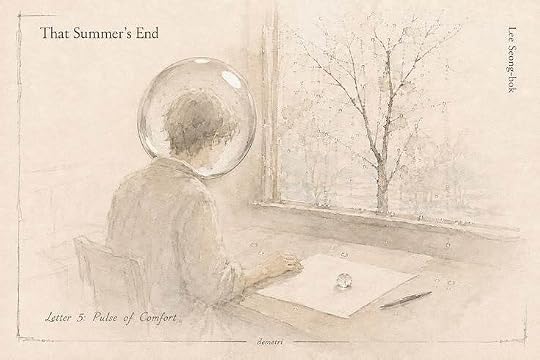
Only near the end does distance change character. In “Letter 5,” separation remains sad but becomes “a pulse of comfort,” and the speaker decides to stop writing. Beside him stands a young tree, breathing quickly in a snowless winter. It is not uprooted, claimed, translated into doctrine, or compelled to answer. It is simply there. After so many poems of pursuit, prayer, possession, and repeated address, the refusal to press closer feels almost radical.
The writer’s head is held inside a vast refracting droplet while a young tree breathes beyond the window, converting silence, distance, and the decision to stop writing into a late pulse of comfort.
Perhaps only another tree could close the book. In the title poem, a crape myrtle survives one storm and the storm after that, pouring out red flowers while the speaker’s despair bursts into crimson. The tree is not serene. It heaves and burns bright. Its blossoms retain the visual memory of blood, and the poem never suggests that the weather was useful, deserved, or secretly kind. Survival does not vindicate the storm. It refuses the storm the final word.
On its own, the declaration that despair has ended sounds more conclusive than this restless book has earned. The body making the claim complicates it. The tree is still laboring under what happened; the red has not been bleached into innocence. Lee does not restore the self that existed before injury. He imagines a life in which injury remains visible without dictating every future meaning. The wound keeps its color but loses its monopoly on the future.
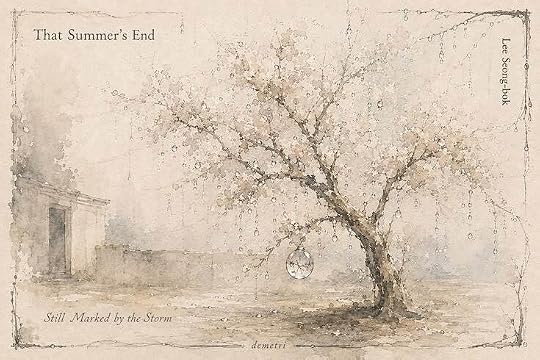
A crape myrtle flowers through the residue of storm, its blossoms formed from suspended drops and pale blooms that preserve the wound’s color without granting damage the final word.
Uneven exactly where repetition becomes reflex, “That Summer’s End” earns 85/100 and 4/5 stars. Its finest poems turn return into discovery; its weaker ones revisit the same weather with little altered but the cloud cover. The strongest images continue revising their earlier meanings after the individual poem has ended, but all 106 returns do not earn equal necessity.
Lee’s best poems know that relinquishment is not abandonment. Distance can become a form of care when it stops demanding proof of presence. What emerges is an etiquette for grief: do not confuse pursuit with devotion, do not insist that the absent answer, know when to stop writing. The poems remain sensuous, unstable, occasionally unreasonable, and wiser for refusing to pretend that wisdom arrives on schedule. Their wisdom, such as it is, lies less in enlightenment than in learning where not to place the hand.
Objects survive interpretation here. The western sea stays unvisited. The cicada stays uncaught. The dead tree stays faintly green. The mother remains both near and unreachable. The poems leave these figures partly untouched; they do not close around a lesson. In a book wary of how quickly knowing becomes owning, that reserve is not coyness. It is the form’s discipline.
Still marked by the storm, the crape myrtle flowers. It does not explain what nearly destroyed it or turn the wind into a lesson. Its red blossoms are neither compensation nor proof. They are continuation: the living tree’s quiet refusal to let damage become the only accurate name for what remains.
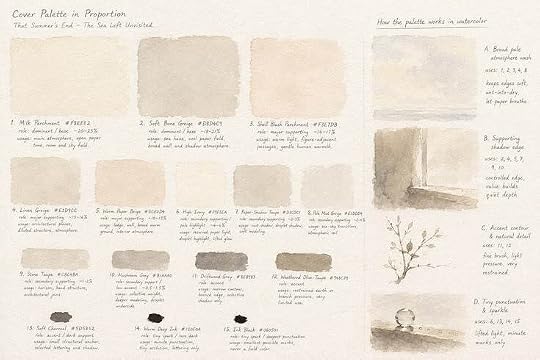
Cover Palette in Proportion
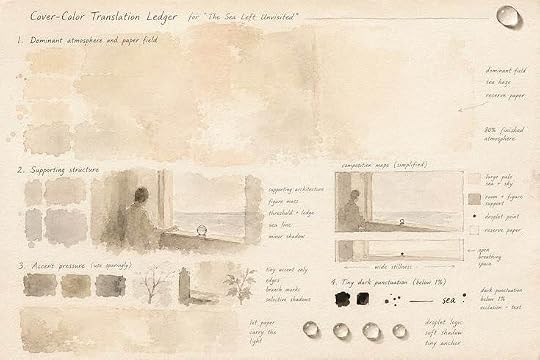
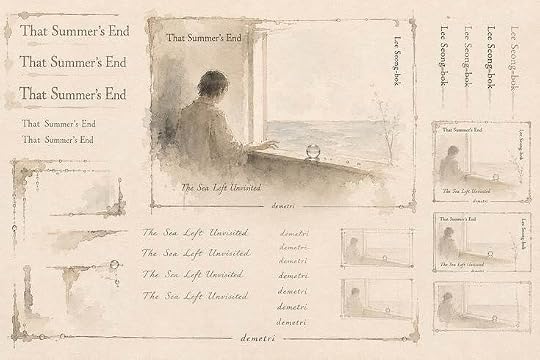
Cover-Color Translation Ledger
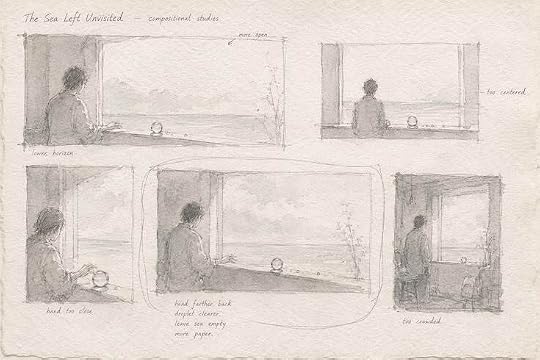
Six Ways to Leave the Sea Unvisited
Threshold, Hand, Droplet
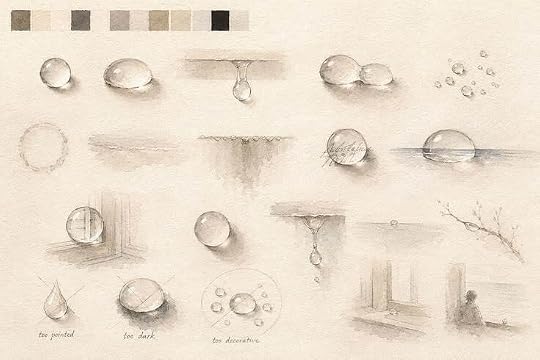
The Droplet as Lens
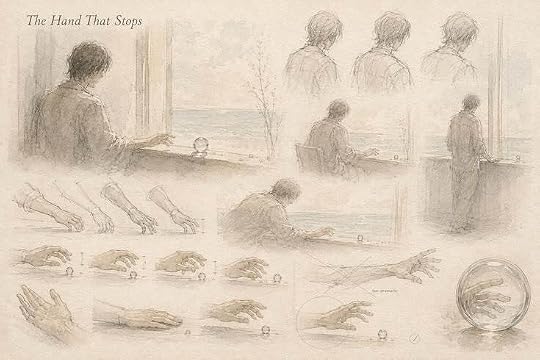
The Hand That Stops
[image error] First Parchment Wash
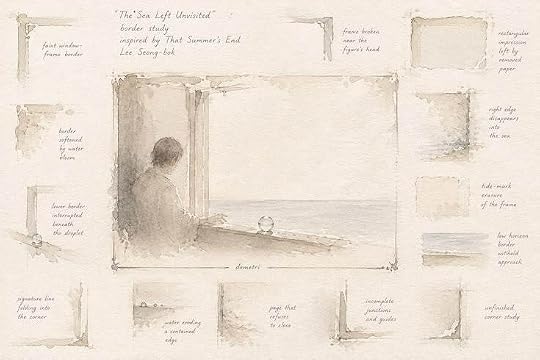
Outer Border Details
A Border That Refuses to Close
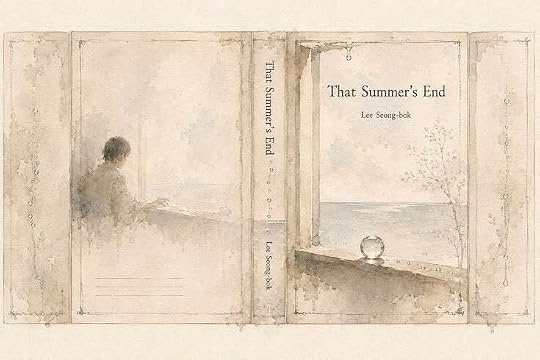
Alternative Jacket: The Sea Left Unvisited
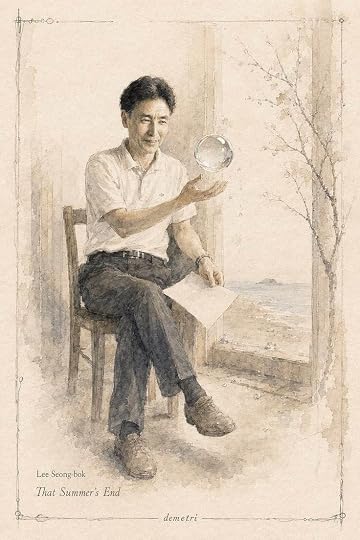
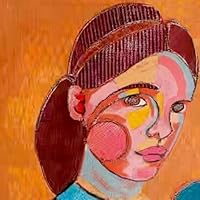
A watercolor portrait of Lee Seong-bok holding a suspended droplet above an open page, joining poet, weather, sea, and unfinished language within the restrained visual world of “That Summer’s End.”
All watercolor illustrations by Demetris Papadimitropoulos. Watercolors are done on 140lb vellum and then scanned into the computer using an Epson scanner. From there, they are finalized in Procreate. All art and opinions are my own.
Thanks to NetGalley and Knopf, Pantheon, Vintage and Anchor for providing me with an eARC.
This was a nice poetry collection but the writing wasn't really my style because the sentences felt like they would flow like prose but we're instead abrupt. Despite short phrases being the norm for poetry, something about the above feeling made it feel incomplete to me. I liked how the poems felt both calming in the presence of nature and dark and sad at the same time. The one that really spoke to me was Wall, dark and emotional at the same time. The translation was done well though, it's especially difficult to get the right emotions, meaning and tone across for poetry translations. I would recommend this to anyone into poetry collections that feel both intense and calming at once.
A beautiful poetry collection, with brilliant translation by Anton Hur. Seong-bok develops and redevelops themes within related poems such as Mountain Path I through Mountain Path 5. He deftly explores life, death, decay, and sadness - balancing heaviness with the grandeur and tranquility of nature. That Summer’s End contains a seamless intersection of nature and poetry, which might resonate with Mary Oliver fans who are looking to expand into translated poetry.
This was filled to the brim with sadness. I still enjoyed some pages. It felt somewhat disconnected to me with little hope but overall had a lasting impression.
This book was so good and breathtakingly beautiful! Like a cup of warm tea and a nice smelling candle on a brisk autumn day. I highly recommend this poetry book to each and every one of you.
Decidedly not for me! The poems were all quite over-simple, repetitive, and deeply romantically inclined (which is something I cannot relate to lol) Not terrible poetry but also not boundary pushing in any way in my own opinion! But taste in poetry does tend to be especially personal so they would most likely work for somebody else out there, just not for me.
The author’s note in the back of the book starts with the sentence, “I thought about sadness for a long time.“ he goes on to muse over the nature of emotion, its existence and the very possibility of reality over illusion. This musing undergirds many, if not all, of the poems in this beautiful book. The publisher blurb and his bio mention his background in French literature and Seon Buddhism; I found not only the symbolist movement, but also the surrealist movement to have heavily influenced this work.
Buddhist themes found in nature, the persistence of space, duality, holding multiple “realities” in tension, and the human tendency to overthink repeat. Teachings related to learning balance and emotional control are illustrated with deft descriptions of the land Seong-bok knows, especially the sea.
“Pine forest obscured my view in then sorrow hid after a moment’s wait I glimpsed it stepping forth Its back a dark blue bend and white froth in its mouth Sorrow, O sorrow rushed toward me Even as it fell and shattered, it waved” (Sea)
“ This world holds the dirtiest gutters people ever lived in and the nearest trees no human hand touches in this world both exist, but are not together and must be sought out between the two are hidden paths and time” (Mountain)
The Tree series was a particular favorite, exploring surreal space-sharing between the poet and the tree and speaking of grief, growth, pain, recovery and repairing harm.
The nature of time, the Universe and embracing change are touched upon using imagery of water movement, rivers or the ocean. Seong-bok feels the presence of the divine all around, even when lost in sorrow or confusion.
“Like a puddle after rain you shall be at the other side of my waiting A worm in the mud, or rainwater / reflecting the sky after a storm… All these insignificant things I know now as your gaze” (Silk Road 5)
Healing comes at last as the inevitable circle of life in the final, titular poem.
“That summer my / despair burst out into crimson but still weathered the wind and rain
The crape myrtle heaves but burns bright, breathing fire When its / blossoms ruffled my narrow yard with blood, my despair came to an end.”
Outstanding work. Thank you to Knopf for this work to review.
This collection of poetry is a beautiful compilation of self reflections, natural analogies, evocative symbolism and a meditative quality. The poems were deeply emotional with a focus on impermanence and the push and pull of time and memories. Whether cruel or romantic, they were an exercise in yearning and grief that was bitter sweet.
The imagery was vivid and I found the most of the poems to be at once soothing and sharp. The constant mirroring to nature created an easy connection, while the intent vacillated between tender sentiments and gut punches. I found they made me quite melancholic and contemplative though as with all poetry, the meaning may be unique to the reader.
Each poem had its own message, but there were overarching themes that connected them. Family, age, grief, fear, love and youth were all reflected on as stages of life. The words were thoughtful and easy to connect with. It made for an interesting book to pick up and put down throughout the week while the evocations ruminated in my mind.
This is the poet’s first collection translated into English by Anton Hur. Poetry is such a finely tuned language where every word holds meaning and their combination is more than just descriptions. There is a rhythm to verse where every pause holds significance. The translated prose followed a simplistic and sparse arrangement that was effective though I cannot speak to how it resembles the original Korean form.
Overall, I found this collection of 106 poems to be charged with sorrow as it evoked the transient nature of life. It looks within and uses what it clear for all to see as a parallel.
I am a huge fan of poetry books. Absolutely love finding new ones and really seeing what resonates with me with where I am at in life. Not too much of this one hit home for me, and that is okay! Nothing against the author at all. I think it’s unrealistic to go in expecting that every single poem will be loved by everyone. Each reader will find what they need to hear. And I do believe that. For that reason, I kept reading through to find that gem that I needed to hear. As we got toward the end there were 3 poems in a row that just completely brought ugly tears to my eyes. It felt like matched one of my current trials in life and that was all it took to make me pause and reflect.
3.5 stars! I love short poetry, but some of these felt like they didn’t end where they needed to and left me wanting more. This is a beautiful collection exploring sadness and I enjoyed Seong-bok’s terse writing style. My favorites in the collection were: “Western Sea”, “Sea”, “Forest 3”, “Memories of a Very Overcast Day”, “Commentary on the I Ching 1”, and “Letter 3”.
Thanks to NetGalley and the publisher for the ARC!
What an absolutely fabulous book of poetry. Deeply resonant and emotional, this collection is up there as a new favorite. The translation is beautiful, which is so important with foreign works—I usually find that the English ends up so bland and impersonal, but this was lovely. My only wish is that I could read it in the original Korean.
Thank you so much to Knopf for sending me a complimentary copy to review—this was an honor to receive and read.
This collection of 106 poems translated from Korean was a good palate cleanser. The poems mostly deal with nature and have a generally soothing,meditative vibe. If you want to escape from the world for a while and return refreshed then check this one out!
Thanks to NetGalley and the publisher for this one!
• "The world holds the dirtiest gutters people ever lived in and the neatest trees no human hand touches In this world both exist But are not together and must be sought out Between the two are hidden paths and time"
• "Birds flock by as they cover this place with graves
With the force of pushing a coffin lid I stare up at the sky"
Thank you to NetGalley and Knopf, Pantheon, Vintage, and Anchor for providing a review copy of "That Summer's End" by Lee Seong-bok.
Lee Seong-bok's poetry carries a dreamlike, surreal quality that invites readers to pause and reflect on every line. Each poem is richly layered with meaning. There is a delicate fragility to these works, as if they might disappear the moment you finish them, yet their language lingers long afterward. . Lee crafts beauty through precise, spare language, avoiding elaborate imagery while still conveying profound emotion and insight. The result is a collection that feels both intimate and timeless, transporting readers into a different way of seeing and thinking.
Thank you to NetGalley & the publisher for providing an e-ARC in exchange for an honest review.
what a tender and (bitter)sweet little collection of poems. Lee Seong-bok has a lovely ability to grip grief and sorrow and tie them together with all forms of nature.
this collection really focuses on the above themes i mentioned. grief and sorrow are a constant, and Lee Seong-bok routinely writes imagery of nature regarding mountains, (flowering) trees, the sea, forests, etc. While the imagery repetition is strong throughout this collection, each one still shared a unique message with the audience. i did not mind it whatsoever and, if anything, it made a cohesive collection that was more than enjoyable to read.
for example: i really enjoyed the poems that were explicitly packaged together, such as titles River 1, River 2, and River 3. they're already strong poems on their own, but together they tell a deeper story. River 1 describes the effect of cities on a person, River 2 leaves city imagery behind and focuses on a river metaphor of life/living (i think? this one was fun to unpack & digest, i'm still thinking about it), while River 3 ties both stories back together for a lovely ending. this was just an example of this common occurrence throughout this collection and i reallllly liked it.
Lee Seong-bok also writes about sorrow regarding various relationships. there's some about children, mothers, and lovers. of course, poetry is pretty subjective, but that's what i love about it so much: some of them were like a punch to the face to me, while others, albeit lovely, didn't hit the spot, but i was still appreciative of the opportunity to read them.
a glimpse of some of my favorite poems included in this collection: - Mountain - Memories of a Very Overcast Day - Near You 2 - Since Sickening - Future - Elegy 1
4.25/5 stars - one i'd like to add to my own personal physical poetry collection once published :)