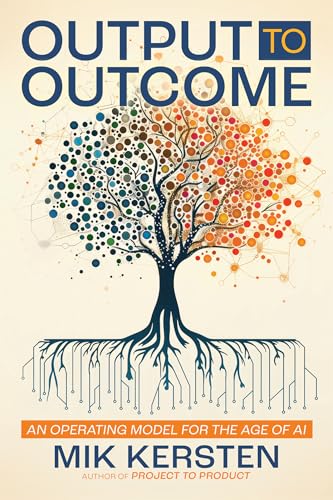
In the Age of AI, the constraint has shifted from producing outputs to delivering outcomes.
Dr. Mik Kersten, author of the bestselling Project to Product, has the data to prove it. When he and his colleagues studied more than 8,000 enterprise value streams, building accounted for just 8% of the time it took to get from an idea to running software. The rest was eaten up by planning, approvals, testing, and waiting, none of which gets faster when AI writes the code.
Output to Outcome gives executives and technology leaders an operating model for this new Outcome Management. Instead of measuring what teams and AI agents produce, Outcome Management organizes the company around the customer and business outcomes that production is supposed to deliver, and it keeps people accountable for them.
The model starts where the work gets stuck. Kersten shows readers how to use an Outcome Loop to trace a line from strategy and budget, through everything your teams and agents ship, to what customers and employees got out of it, and shows you where that line breaks. The Outcome Tree repeats this loop at every level of the company, so strategy travels down and results travel back up.
The Seven Shifts then show how to get from the organization you have to the one you need, the changes you need to make to move your organization from outputs to outcomes. These changes are practical, not theoretical, like giving every goal one accountable owner, trading a pile of planning meetings for a single rhythm, and learning to tell whether all that AI output is progress or just slop. Case studies from companies including Vanguard, Priceline, and Cognition show the model at work, and every chapter ends with a prompt you can hand to your own AI agents to start implementing the change tomorrow.
Clinging to the old organizational design is like trying to outrun a locomotive by adding more horses. It’s time to make the shift. Output to Outcome shows you the way.
No start rating (on purpose). On one hand, the model described in this book (the measure flow of work focused on outcome, not output) totally resonates with me. I use the same mental models, same metrics, I do prioritize the same things. Sometimes it felt like the author has summarized my thoughts exactly. But that made me feel like I'm going through the very obvious statements - I didn't feel I'm finding anything new, it felt like a very conservative approach. Bu well - maybe it's just because I am that familiar and in-sync with what the author describes (my personal bias).
Still, there are certain things I did NOT like about the book: - mixing too many topics (coupling cohesion) - it's writing using a very dull, corporate approach - like address only to still-necked, corporatish execs Fortunately it was short enough so I avoid getting too bored.
Anyway, I'm sorry - you'll need to evaluate for yourself. YES, I think that the background here is VERY reasonable - that's what I build upon too. But isn't it too obvious and straightforward for a book? No clue ...
Moving from Output to Outcome requires ruthless prioritization, saying "no" to cool-looking AI activities that don't drive P&L, dismantling political matrix empires, and expending the heavy mental energy to define what "value" actually means before writing a single prompt. For leaders who have championed Lean flow for years and are ready to do that hard cognitive work in the AI era, this is an essential blueprint.
Moving away from activity- and output-based management toward true value and outcomes is hardly a brand-new revelation. Product thinkers like Marty Cagan have been preaching "outcomes over outputs" and warning against "feature factories" for years, and the wider IT Revolution Press canon (Accelerate, Team Topologies, Wiring the Winning Organization, and Mik Kersten’s own 2018 Project to Product) has spent the last decade laying the groundwork for value streams and flow.
Yet history shows how stubbornly organizations cling to the easiest thing to measure. The last time outcome- and output-based management became an overnight existential necessity was during the COVID-19 lockdowns. When the world shifted instantaneously to remote work and later settled into hybrid models, traditional management by "counting hours" or physical presence became completely impossible (not that seat-time had ever been an efficient metric to begin with). You had to look at what was actually delivered. However, genuinely managing by outcomes—defining clear expectations, decoupling activity from impact, and measuring real business movement—requires vastly more reflection, strategic clarity, and mental energy from leaders. Because of that cognitive tax, once the dust settled after COVID, true outcome-based leadership never became mainstream. And today, in an age of relentless digital distraction, marshaling that deep focus is harder than ever.
Enter the Age of AI, which takes this unresolved management debt and pours rocket fuel on it.
The Lean IT Lineage: From LeanKit to Planview While going through this book, I had a personal revelation about why Kersten’s models resonate so deeply with my own management philosophy. Kersten writes extensively from his experience as CTO of Planview (which acquired his company, Tasktop, in 2022), and the book has Lean IT concepts deeply ingrained in its DNA. I have been strongly influenced by Lean IT philosophies since 2011/2012, and the biggest inspiration on my Lean journey was Jon Terry, the co-founder of LeanKit. Some of my earliest and most formative introductions to Lean were his extremely engaging presentations at the annual itSMF Estonia conferences. I remember taking photos of his slides back then and using those exact mental models to build the foundation of the Lean principles I have been professionally evangelizing ever since. LeanKit was acquired by Planview in 2017 and assimilated into its corporate portfolio, followed by Tasktop a few years later. Reading Output to Outcome feels like watching that exact lineage of visual management, WIP limits, pull systems, and flow efficiency evolve into a full-scale operating system for the AI era.
The Core Thesis: When Output is Free, Organization is the Bottleneck Grounded in Eliyahu Goldratt’s Theory of Constraints, Kersten argues that every technological revolution shatters an old constraint on production and exposes a new bottleneck. For fifty years in the Age of Software and Digital, the primary constraint was developer productivity and knowledge-worker output. Now, generative AI and agentic workflows are driving the marginal cost of creating outputs (code, documents, designs, features) toward zero.
When output capacity becomes virtually infinite, output is no longer the constraint—organizational structure and strategic alignment are. Kersten cites sobering industry telemetry from Planview’s Project to Product State of the Industry Report showing that in a typical enterprise, actual creation ("Create") accounts for only 8% of flow time, trapped between 48% spent waiting in ideation/planning bureaucracy and 44% stuck in release/deployment bottlenecks. Even worse, only 21% of delivered work is strategically aligned, while 31% is unaligned output and the remaining 48% is pure waste (excess WIP, rework, canceled items). If you take a misaligned organization and scale its output 100x with AI agents, you don't get 100x the business value—you just get buried in AI-generated "slop," technical debt, and strategic drift at breakneck speed.
Architecting the AI-Native Enterprise & The Human-Agent Orchestrator To prevent AI from managing us into chaos, Kersten proposes Outcome Management, structured around Three Foundational Models and Seven Alliterative Shifts:
• The Three Foundations: Transitioning to a true Product Operating Model (persistent capacity funding over temporary project budgets), governing every value stream via the Outcome Loop (linking Inputs → Outputs → Outcomes with dual feedback loops for Planning and Delivery), and scaling across the enterprise through the Outcome Tree—a modular, MECE hierarchy where humans report to humans and own intentionality, while hybrid teams and autonomous agentic value streams amplify execution. • The Seven Shifts: 1. Functions to Flow (Dedicated single- or dual-leader value streams over functional silos) 2. Slop to Substance (Upgrading to Flow Framework 1.1—tracking Features, Defects, Risks, and Debts across Flow Time, Velocity, Load, and Efficiency, while explicitly adding Tokens alongside Staff and Cloud as core inputs) 3. Chaos to Cadence (Replacing fragmented agile/waterfall meetings with a Unified Cadence) 4. Matrix to Modularity (Applying software architecture principles—high cohesion, low coupling, Conway's Law—to organizational design so teams have independence of action) 5. Objectives to Ownership (Ending OKR theater and diluted shared objectives in favor of single-threaded accountability) 6. Divisions to Domains (Segmenting the portfolio into Core, Platform, Incubation, and Transformation domains, each with tailored flow time targets and planning horizons) 7. Managers to Makers (Collapsing middle-management coordination overhead into "Outcome Managers" and "Outcome Architects" who design systems and govern autonomous value streams).
In this regard, Output to Outcome serves as the ultimate companion to another book I recently reviewed, The Human-Agent Orchestrator: Leading and Scaling AI-Driven Organizations. While The Human-Agent Orchestrator focuses on the tactical and operational mechanics of leading hybrid human-agent teams, Kersten provides the wider macro-economic, historical, and philosophical justification for why those orchestration approaches are mandatory. Together, they bridge the gap from individual agentic workflows to enterprise-wide portfolio governance.
Connecting the Outcome Loop to Reverse LOGFRAME Logic Where Kersten’s book really clicks on a practical strategy level is when you view his Outcome Loop (Inputs [Strategy/Budget] → Outputs [Activities/Artifacts] → Outcomes [Customer/Employee → Business]) alongside the LOGFRAME (Logical Framework / vertical logic) thought model, recently highlighted in the context of AI adoption by Estonian strategy consultant Indrek Saul.
Kersten references the widely cited MIT Sloan finding that 95% of enterprise generative AI implementations show no measurable impact on P&L. Saul’s LOGFRAME analysis explains why in razor-sharp terms: almost all common AI initiatives start from the wrong end of the chain: 1. Organizations start with Inputs & Activities ("What data and tools do we have? Let's do general AI user training and see what people can do with prompts!"). 2. This produces Outputs (new skills, automated workflows, agents, texts). 3. It may even create localized Changes ("A task takes 20% less working time"), yet Economic Benefits (P&L impact) remain zero because saving 20% of someone's time scattered across random tasks does not automatically translate into 20% lower costs or higher revenue.
As Saul points out, not every AI activity is worth doing. To get real ROI, you have to run the LOGFRAME in reverse: • 1. Benefits (Business Outcomes): Start at the top. Where are the biggest untapped growth opportunities or the largest pools of wasted expense? What specific P&L movement are we targeting? • 2. Changes (Customer & Employee Outcomes): What must change in our processes, throughput, or work organization to unlock that financial benefit? • 3. Outputs (Artifacts): What specific agents, architectural refactorings, or system integrations must be built to cause those changes? • 4. Activities & Inputs: Only now do we decide who to train, what tokens/compute to fund, and what data to acquire.
Kersten’s Outcome Loop and Saul’s Reverse LOGFRAME are two sides of the exact same coin. Kersten’s top arc (Objectives) is the reverse-engineered demand pull from Outcomes back to Inputs, while the bottom arc (Feedback) measures whether the Flow of outputs actually moved the needle on P&L.
The author is preaching Lean, but to “modernize”his approach to AI age is adding on every page that AI agents can produce unlimited outputs. The book is not covering real complexity of a big organization. Yes, a single tree organizational structure is the simplest, but it may not be possible in a real multinational company, not a SMB this author led. Some of case studies are interesting, but in most cases are presented as CTO-level propaganda. Like a CTO who deployed 3000 agents in his company…but what was the outcome? Or as the author himself writing that pre ChatGPT in his company “AI team produced research and prototypes”…sounds like functional approach to me, no?
This book is an essential playbook for the AI era, arguing that while AI collapses production costs, corporate bureaucracy remains the true bottleneck. By shifting from tracking vanity outputs ("AI slop") to managing modular Value Streams and measurable business Outcomes, Kersten provides a crisp blueprint for leaders to scale with AI speed while maintaining human intentionality.
Very informative, I learned a great deal about how the fields are changing. The amount of material available is far outstripping the ability to take it all in. The output filling the need (outcome) is far more important now that the number of items we can dig into to try to solve the problem is beyond human scope.