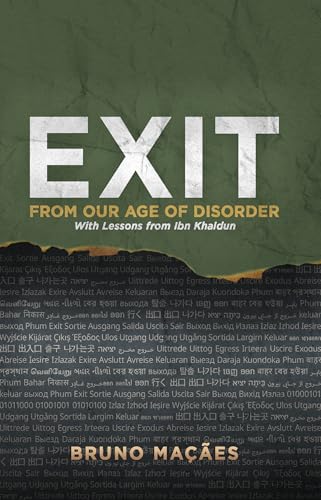
From the celebrated author and politician Bruno Maçães, Exit explores the breakdown of the existing global order. Starting from the insights of historian and philosopher Ibn Khaldun, Exit explores how that breakdown is expressed in growing conflict, destruction and intellectual confusion. It offers a guide into how to approach the transition to a new kind of order, and the hard task of building it from the ruins of the present.
Exit also serves as one of first works of the newly founded Ibn Khaldun Institute. Ibn Khaldun, (Abu Zayd Abd ar-Rahman ibn Muhammad ibn Khaldun), was one of the most prominent historians, philosophers, and scholars of the Middle Ages. He was born in May 1332, in Tunis, and passed away in March 1406, in Cairo.
Ibn Khaldun is best known for his ground-breaking work, "Muqaddimah" (also known as "The Introduction" or "Prolegomena"). With a multidisciplinary approach to the study of societies, Ibn Khaldun developed his ‘new science’ (umrān) – a positive rather than a normative study of state and society as they are, rather than as they should be. This methodology allowed him to identify and characterise sociological and economic phenomena centuries before these ideas were developed in the West. He developed the concept of ʿasabiyyah – the importance of social cohesion in avoiding civilisational decline. Above all, his elegant contributions to economics included some of the earliest known descriptions of the multiplier effect, human capital, the effect of technological improvements on growth, supply side-economics and the Laffer Curve.
Ibn Khaldun Institute is committed to preserving, promoting, and perpetuating the legacy of Ibn Khaldun, transforming his ideas into a powerful force for positive change and a source of inspiration for generations to come. Together, we strive to create a global community that values the wisdom and vision of this exceptional scholar, characterized by the defense of free trade, property rights and the rule of law.
“(…) human beings invariably regard past transitions as a good thing. They led us to the present moment, after all. But future transitions, those can mean only catastrophe.”
This slim volume addresses our current dispensation—specifically the navigation of human existence between two world orders, as we witness the collapse of an era (the “Western-led international order”) and the uncertain beginnings of another—assuredly not “Western-led.” Maçães frames this transition through the philosophy, teachings, and reflections of the Muslim scholar Ibn Khaldun (1332–1406). Commissioned by the newly formed Ibn Khaldun Institute and issued as its first book-length contribution to the intellectual dialogue, Exit thus entrusts a Western intellectual with the task of reading a global transition through a non-Western lens—an inspired, and not inconsequential, choice. The result is a work that is consistently engaging, at once fascinating and illuminating.
I must admit that, until now, Ibn Khaldun himself had escaped me—an indefensible gap in what I like to think of as a serviceable cultural education, now at least partially remedied (live and learn). I was, however, familiar with his slightly older contemporary Ibn Battuta (1304–1368/69), that extraordinary traveller—and travel writer. It is striking to recall that both men lived just after the most luminous centuries of Muslim civilisation—one of the most enlightened, gracious, and intellectually confident periods in human history—on the eve of Europe’s long cycle of conquest and ascent.
It turns out that Ibn Khaldun has much to teach us—lessons that remain enduringly relevant to our civilizational predicament—and Maçães moves through the sage’s insights with clarity and assurance.
“One argument against turning to Ibn Khaldun for guidance on the shape of the coming world order might be that he was writing before the birth of modern society and thus many of his prescriptions are now outdated. That misses the point, which is not to take his analysis literally but to look for deeper principles and insights and then adapt them to current conditions.”
“The United States remains a singularly powerful country, but it no longer has the economic and spiritual resources to represent an idea of universal order.”
“In some Western nations, even the act of considering opposing perspectives is now regarded as a mild form of treason. Attention to complex issues gives way to the simplest of narratives, where the enemy has been fashioned as a malevolent, global force.”
“The main driver of rapid development and national unity in China is the vivid sense, which was absent 20 years ago, that life is not possible under the American order.”
“(…) the dialectic is the notion that truth exists in time or in history and can only be deduced from the knowledge of the full historical process in all its moments. That also means that each individual moment, in its truth, contains all different moments, even opposites.”
“The lesson from the Cold War is that a nuclear power must be defeated by using the global system against it, but that implies that the global system is functional and effective enough to be deployed in this way and with the kind of results that were promised back in 2022. The conflict with Russia, however, revealed no such system exists. Not only does Western influence now have limited global reach, with large segments of the global economy operating autonomously, but Western economic power can no longer be exercised with the same abandon, lest its foundations be exposed as dangerously fragile. In this context, bluffs are easy to call.”
“As Lenin put it, the main sign of a revolutionary moment is the fact that the rulers are unable to rule. This can be interpreted in two different senses. If the Ukraine war represented the moment when the West was no longer able to deploy sufficient power and resources to preserve existing rules and principles, Gaza was the moment when Western rule stopped being regarded as legitimate according to those very principles. Ukraine showed us an America too weak to enforce global rules. Gaza showed us an America with contempt for global rules.”
“Asabiya means “mutual affection and willingness to fight and die for each other.” But group feeling naturally has its dark side: chauvinism or the belief in group superiority. Nor is asabiya particularly stable or enduring, according to Ibn Khaldun. Formed in battle against a common enemy, it tends to disappear in one of two ways. Either the group is defeated or it emerges victorious. In the latter case, asabiya gives way to the enjoyment of victory and the pleasures of civilisation. According to Ibn Khaldun, it is basically the emergence of luxury and comfort which leads to the disappearance of asabiya. As people grow accustomed to enjoying the fruits of civilisation, they lose their toughness and manliness: “they compete with each other in matters of food, clothing, large palaces, good weapons, and the horses in their stables.”
“Consider one such pattern mentioned by Ibn Khaldun. A state grows in power and wealth, but as the spoils become larger the collective spirit of its ruling class starts to erode and eventually dissolves. The ruling class can no longer rule as it busies itself with internal rivalry and conflict. Slowly the state starts to lose control over its provinces. The people rebel. The state shrinks until the rebels reach areas close to the centre. The state may then split in two or three. Or the end may come in some other way. These patterns can become very complicated. In fact they are quite complicated for Ibn Khaldun, who returns to the cycle of civilisations several times in his book, always adding new processes and nuances, which the reader must struggle to keep together in his or her mind. And we could and should revisit his conclusions and revise them in light of new data and new realities available in our own time. We may even come up with entirely new patterns of change. We would still be indebted to Ibn Khaldun because the basic idea that such patterns exist and can be discovered was his idea. What Ibn Khaldun is communicating is doubtless a very dangerous idea. (…)”
“History always seems to be over for those standing on top of the global hierarchy. History is not only written but seemingly completed by the winners. (…) if we have become so sophisticated as to understand the historical dynamic by which a new order replaces the previous one, might it not be possible to establish a world order on a higher plane, an order of a second order, so to speak? Instead of looking for eternal principles, how about we look for principles guiding how new principles and new orders come to be? This would imply an agreement between the great powers about the terms of their competition, determining for instance how technological progress must be allowed to happen without interference or how different powers can attempt to build their own visions of global order. The rise and fall of civilisations with their ideas of world order can be turned into a rational rather than a chaotic process. That process would seem to rest on two main pillars: globalisation and technology. The first intimates that order can never be local or regional but must encompass the world as a whole. The second rests on the truth that order must be built or organised and that process now follows from the human ability to use knowledge or technology to serve human purposes. Any idea of order, or as I argue any theory of order creation, must give free flow to these two forces. They are forces to which Ibn Khaldun would bow his head with reverence: his curiosity, which extended to the world as a whole, was ultimately a child of what he calls civilisation: the perfection and growth of human knowledge and science.”
“For Gramsci, the Marxist philosopher whose sentence on the interregnum was quoted above, hegemony is the additional power that accrues to a dominant group by virtue of its capacity to lead society in a direction that is perceived by subordinate groups as serving a more general interest. “If subordinate groups have confidence in their rulers, systems of domination can be run without resorting to coercion.” This capacity of dominant rulers to present their rule as serving the interests of subordinate groups is what Ibn Khaldun calls a larger or enlarged “group feeling.” When power is regarded as legitimate there is less need for coercion. It would be naive to argue that coercion disappears, but it may become of secondary importance. In that sense, the Trump moment may well be described as the transition from hegemony to domination. While America was never shy about using coercion, an equally indispensable foundation was its capacity to mobilise consent and cooperation internationally, by acting in such a way as to make at least plausible to others the claim that Washington was acting in the general interest, or something that at least could be presented as the general interest. More recently, the equation has changed, with domination becoming much more central. Under Trump, Adam Posen recently argued, America has switched from global insurer to extractor of profit. “Instead of the insurer securing its clients against external threats, under the new regime, the threat against which insurance is sold comes as much from the insurer as from the global environment.”
“As I regularly notice in my travels, young people in the developing world can now witness the American way of life more directly on their cell phones. Without the photoshop provided by Hollywood or corporate television, the picture lost its magnetic power. Those traveling to the United States return to their countries with stories of crumbling infrastructure and cities, not a glimpse of the future. This is where Trump comes in with an obvious response: Americans have to forget about liberal pieties and embrace the open exercise of force, with little concern for legitimacy or normative trappings. Trump won the 2024 election because his adversaries conceded his point. How should we interpret the horror of the war in Gaza if not as the wilful embrace of a form of power that no longer cares much about legitimacy, having replaced it with the use of brute force? Biden, after all, called it outrageous that the International Criminal Court would apply existing international law to Israel. Several senators threatened European countries with economic destruction, presumably through sanctions, if they dared to uphold the system of international norms they had solemnly committed themselves to. But when rules are enforced only when politically convenient, they are no longer rules. The legitimacy of the global system has been mortally wounded, hardly surprising when those upholding the rules now openly claim that rules are for the weak and that the highest form of power is exercised through unambiguous coercion, including rituals of submission akin to a tribute system.”
“Superpowers grow used to their status and tend to assume it is given by nature or natural right. Faced with an upstart, they react with righteous indignation. How can anyone purport to dispute the natural order of things, the source of everything good and just?”
As a final note, since we are on the theme of superpowers, Maçães includes a section entitled “Every country should be free to choose.” Really? Always within extraordinary constraints, certainly. Ukraine’s descent into the hell that befell it occurred, to a great extent, because it exercised a freedom that—quite evidently—in the real world it did not possess, and does not possess. The same could be said of Taiwan, or Cuba. I don’t actually believe that “every country should be free to choose”; the formula is not analytically useful. Countries choose within a straitjacket—one that must be negotiated with extreme care.
A great exploration of the current state of the global order, augmented with insights from Ibn Khaldun and others. It's written in a clear way that explains everything well even for those uninitiated. My only criticism is that the solution offered pales in comparison to the diagnosis of the problem (as is typically the case); the author settles on 2 principles that suffer from being vague statements with minimal exploration as to how they'd actually be adopted and implemented. Regardless, it's a topical work written by someone with knowledge that can be read in a single sitting, so I recommend it based on that.
The book - or rather the short essay - is a relatively disappointing and rather incoherent mish-mash of Mr Macaes X feed. Evoking Ibn Khaldun is thought-provoking and I agree with Mr Macaes that his insights remain relevant today. But the book has an excessive Western animus and fails to build on its central sections. Its final 'fundamental principles of world order' are remarkably shallow. I don't think this essay will have a long shelf life.