

What do you think?

My Year in Paris with Gertrude Stein
In contemporary Paris, a narrator and two companions explore the life and work of Gertrude a subversive imagining of a truly subversive female artist.
Our narrator has a lot going on. Her friend Eva’s cat is missing—also, she wonders, where is Eva’s husband. Their other friend Fanny is barely around, and not because of her job in finance; she is tangled up with no less than three lovers. And Gertrude Stein is ruining the narrator’s life.
She is trying to write an essay about Stein but it seems impossible. She knows too much and nothing at all about the leading avant-garde thinker of the early twentieth century. There are the Gertrude Stein studied psychology at Harvard and medicine at Johns Hopkins, then quit; curated modern art in her rented apartment that would shake the world; wrote novels, plays, poetry, and libretti that are incoherent and brilliant; felt love at first sight for her daring wife, the subject of The Autobiography of Alice B. Toklas.
But so much is out of reach. How do we put ourselves together? What do we lose to become modern? What do we find beyond the limits of language? Only a book like this, only a book by Deborah Levy, “an indelible writer [and] elliptical genius” (Dwight Garner, The New York Times Book Review), could attempt such an investigation. It crashes through genre to form something distinctively, utterly new—an imaginative, entertaining, and scholarly manifestation befitting the genius at its center. This is My Year in Paris with Gertrude Stein.
Our narrator has a lot going on. Her friend Eva’s cat is missing—also, she wonders, where is Eva’s husband. Their other friend Fanny is barely around, and not because of her job in finance; she is tangled up with no less than three lovers. And Gertrude Stein is ruining the narrator’s life.
She is trying to write an essay about Stein but it seems impossible. She knows too much and nothing at all about the leading avant-garde thinker of the early twentieth century. There are the Gertrude Stein studied psychology at Harvard and medicine at Johns Hopkins, then quit; curated modern art in her rented apartment that would shake the world; wrote novels, plays, poetry, and libretti that are incoherent and brilliant; felt love at first sight for her daring wife, the subject of The Autobiography of Alice B. Toklas.
But so much is out of reach. How do we put ourselves together? What do we lose to become modern? What do we find beyond the limits of language? Only a book like this, only a book by Deborah Levy, “an indelible writer [and] elliptical genius” (Dwight Garner, The New York Times Book Review), could attempt such an investigation. It crashes through genre to form something distinctively, utterly new—an imaginative, entertaining, and scholarly manifestation befitting the genius at its center. This is My Year in Paris with Gertrude Stein.
240 pages, Hardcover
First published April 16, 2026
About the author
Deborah Levy
60 books4,143 followersDeborah Levy trained at Dartington College of Arts leaving in 1981 to write a number of plays, highly acclaimed for their "intellectual rigour, poetic fantasy and visual imagination", including PAX, HERESIES for the Royal Shakespeare Company, CLAM, CALL BLUE JANE, SHINY NYLON, HONEY BABY MIDDLE ENGLAND, PUSHING THE PRINCE INTO DENMARK and MACBETH-FALSE MEMORIES, some of which are published in LEVY: PLAYS 1 (Methuen)
Deborah wrote and published her first novel BEAUTIFUL MUTANTS (Vintage), when she was 27 years old. The experience of not having to give her words to a director, actors and designer to interpret, was so exhilarating, she wrote a few more. These include, SWALLOWING GEOGRAPHY, THE UNLOVED (Vintage) and BILLY and GIRL (Bloomsbury). She has always written across a number of art forms (see Bookworks and Collaborations with visual artists) and was Fellow in Creative Arts at Trinity College, Cambridge from 1989-1991.
Deborah wrote and published her first novel BEAUTIFUL MUTANTS (Vintage), when she was 27 years old. The experience of not having to give her words to a director, actors and designer to interpret, was so exhilarating, she wrote a few more. These include, SWALLOWING GEOGRAPHY, THE UNLOVED (Vintage) and BILLY and GIRL (Bloomsbury). She has always written across a number of art forms (see Bookworks and Collaborations with visual artists) and was Fellow in Creative Arts at Trinity College, Cambridge from 1989-1991.
Ratings & Reviews
Friends & Following
Create a free account to discover what your friends think of this book!
Community Reviews
Displaying 1 - 30 of 385 reviews

April 16, 2026
Deborah Levy moved to Paris to produce a biography of Gertrude Stein, its working title Mama of Dada. But instead, she developed this fluid, compelling novel about trying and failing to finish it. Although queer author, art collector and thinker Stein’s experiences dominate the narrative, it also becomes an entry point into a broader meditation on women writers and creators, about identity, about modernity, about war and loss. It’s steeped in French culture from the very start, even the opening centred on the search for a lost cat eccentrically named ‘it’ echoes Cédric Klapisch’s classic movie Chacun cherche son chat. It’s Paris, November 2024, the novel’s narrator’s caught up with friend Eva’s desperate quest to find her beloved cat. It’s a welcome distraction from the narrator’s stalled essay about Gertrude Stein. So far all she has is a series of images and associations running through her mind : the wars happening now versus the wars Stein lived through; Paris scenes including the iconic Père Lachaise Cemetery Stein’s final resting place; the artists also buried there whose existence was irrevocably marked by war from Chaim Soutine to Georges Braque.
The quest for ‘it’ the cat becomes enmeshed with the narrator’s semi-philosophical quest for other lost ‘its’, symbol of the narrator’s uncertainties, her desire to make sense of her rapidly-changing world. A world the narrator thinks of in stark terms, “Gertrude Stein wanted to kill the nineteenth century. The twenty-first century seems to be killing itself.” Stein represents many things but among them is the shift from the Victorian to the modern. Was it a moment of gradual change or a moment of rupture? Stein was known too for taking realism to task, dismantling it bit by bit, a true iconoclast who devoted herself to producing work that defied ease of interpretation. In this, another of her self-proclaimed novels of ideas, Levy too is playing with realities. Her novel presents arguments, deals with artifice, with stand-ins, avatars, perhaps doppelgangers. The narrator is clearly another of Levy’s versions of herself, her Paris bolthole with its Kelim rugs and low beams explicitly replicates the place Levy inhabited in real life.
The narrator’s formed a trio with Eva and Fanny. Eva is another drawn to France, Fanny has always lived there. Three seems to hold special significance for Levy. Here the friends bring to mind Stein’s famous Three Lives but equally Levy’s assertion that she often reflects on, at least, three contradictory ways of thinking, embracing enigmas and ambiguities in her fiction. Not unlike Stein. The friends overlap yet remain distinct, Fanny’s polyamorous, juggling a number of women at any one time, some more important to her than others. She works in a resolutely capitalist industry but her personal life borders on old-school bohemian. Eva’s working on a graphic novel, her affections, her security gained from her bond with ‘it’ whose disappearance prompts a myriad of anxieties. Stein’s thoughts intermingle with the narrator's, particularly certain aphoristic statements. One seems particularly important, “Others are secret because they are other.” A saying that applies not only to the narrator’s writing block but to the very concept of biography, its fundamental impossibility, its mutability. Equally it comments on the narrator’s personal relationships especially with Eva whose subsequent choices reveal her to be quite different from the individual the narrator believed she knew.
Meanwhile the hunt for the elusive ‘it’ – the many elusive ‘its’ – continues. Cats have always been special to Levy. But this phantom cat is the catalyst for unexpected encounters. An older man on a park bench somehow becomes part of the trio’s everyday. His strange interest in the narrator’s knees, his shock of white hair, his cane, his name Jean-Luc, suggest a composite of Rohmer, Derrida, and Godard – one of Levy’s favourite directors who famously stated, “All you need for a movie is a gun and a cat.” Levy’s narrative is haunted by the guns firing in Ukraine, distant Gaza and her cat is curiously absent both there and not there. Just as the narrator’s attempts to accurately represent Stein are both progressing and frustratingly blocked. But Jean-Luc, who may or may not have been robbed of a similar cat, also seems to represent a culture of ideas and creativity dominated by masculine energies and perspectives. One that’s been very much visible throughout recent French history from philosophy to New Wave cinema and beyond. Levy’s narrator and Fanny suggest a turning away from this heritage, acknowledging its strengths but – again like Stein - refusing to follow in its footsteps. Fanny, in a sense, through her profession negotiates her role within male-dominated spheres. However, Eva, it seems, ultimately capitulates. I didn’t learn much about Stein I didn’t already know but I relished the ways in which the narrator’s notions about Stein opened up a dialogue about gender, about freedom and responsibility, about being in a current moment in an increasingly unpredictable, ravaged world. It’s a markedly feminist piece, albeit a rather rarefied bourgeois feminism, thoughtful, insightful and incredibly engaging. I’m not a huge fan of Levy’s novels but loved her memoirs and this offers similar pleasures.
Thanks to Netgalley and publisher Hamish Hamilton for an ARC
The quest for ‘it’ the cat becomes enmeshed with the narrator’s semi-philosophical quest for other lost ‘its’, symbol of the narrator’s uncertainties, her desire to make sense of her rapidly-changing world. A world the narrator thinks of in stark terms, “Gertrude Stein wanted to kill the nineteenth century. The twenty-first century seems to be killing itself.” Stein represents many things but among them is the shift from the Victorian to the modern. Was it a moment of gradual change or a moment of rupture? Stein was known too for taking realism to task, dismantling it bit by bit, a true iconoclast who devoted herself to producing work that defied ease of interpretation. In this, another of her self-proclaimed novels of ideas, Levy too is playing with realities. Her novel presents arguments, deals with artifice, with stand-ins, avatars, perhaps doppelgangers. The narrator is clearly another of Levy’s versions of herself, her Paris bolthole with its Kelim rugs and low beams explicitly replicates the place Levy inhabited in real life.
The narrator’s formed a trio with Eva and Fanny. Eva is another drawn to France, Fanny has always lived there. Three seems to hold special significance for Levy. Here the friends bring to mind Stein’s famous Three Lives but equally Levy’s assertion that she often reflects on, at least, three contradictory ways of thinking, embracing enigmas and ambiguities in her fiction. Not unlike Stein. The friends overlap yet remain distinct, Fanny’s polyamorous, juggling a number of women at any one time, some more important to her than others. She works in a resolutely capitalist industry but her personal life borders on old-school bohemian. Eva’s working on a graphic novel, her affections, her security gained from her bond with ‘it’ whose disappearance prompts a myriad of anxieties. Stein’s thoughts intermingle with the narrator's, particularly certain aphoristic statements. One seems particularly important, “Others are secret because they are other.” A saying that applies not only to the narrator’s writing block but to the very concept of biography, its fundamental impossibility, its mutability. Equally it comments on the narrator’s personal relationships especially with Eva whose subsequent choices reveal her to be quite different from the individual the narrator believed she knew.
Meanwhile the hunt for the elusive ‘it’ – the many elusive ‘its’ – continues. Cats have always been special to Levy. But this phantom cat is the catalyst for unexpected encounters. An older man on a park bench somehow becomes part of the trio’s everyday. His strange interest in the narrator’s knees, his shock of white hair, his cane, his name Jean-Luc, suggest a composite of Rohmer, Derrida, and Godard – one of Levy’s favourite directors who famously stated, “All you need for a movie is a gun and a cat.” Levy’s narrative is haunted by the guns firing in Ukraine, distant Gaza and her cat is curiously absent both there and not there. Just as the narrator’s attempts to accurately represent Stein are both progressing and frustratingly blocked. But Jean-Luc, who may or may not have been robbed of a similar cat, also seems to represent a culture of ideas and creativity dominated by masculine energies and perspectives. One that’s been very much visible throughout recent French history from philosophy to New Wave cinema and beyond. Levy’s narrator and Fanny suggest a turning away from this heritage, acknowledging its strengths but – again like Stein - refusing to follow in its footsteps. Fanny, in a sense, through her profession negotiates her role within male-dominated spheres. However, Eva, it seems, ultimately capitulates. I didn’t learn much about Stein I didn’t already know but I relished the ways in which the narrator’s notions about Stein opened up a dialogue about gender, about freedom and responsibility, about being in a current moment in an increasingly unpredictable, ravaged world. It’s a markedly feminist piece, albeit a rather rarefied bourgeois feminism, thoughtful, insightful and incredibly engaging. I’m not a huge fan of Levy’s novels but loved her memoirs and this offers similar pleasures.
Thanks to Netgalley and publisher Hamish Hamilton for an ARC

May 1, 2026
The title plainly tells almost all. Set in 2024, Deborah Levy’s My Year in Paris with Gertrude Stein (2026) follows a writer temporarily staying in Paris, working on an essay about Gertrude Stein. It's definitely not a year of rest and relaxation, as she is struggling with writer's block. The narrative moves back and forth between present-day anxieties and the world of 1920s Paris, unfolding in a stream-of-consciousness form.
Alongside the unnamed narrator, we get acquainted with two of her friends: Eva, a graphic novelist obsessed with finding her missing cat, and Fanny, a financier who strongly dislikes Stein's writing style (those repetitions!) and leads an active love life. Unfortunately, neither of these characters resonated with me.
To be brutally honest, I found myself far more invested in the fate of "It" (the cat’s wonderfully peculiar name) than in Fanny’s sexual appetites or the narrator's creative throes. The contemporary characters felt oddly flat, almost as though they had been forced into the narrative to make the book more appealing. In my case, that strategy did not work. A tempting idea was to sieve out the modern-day elements, but it wasn't feasible, as the plots were entwined like roots of trees growing close to each other.
Gertrude Stein was such a remarkable and talented figure, with a brilliant mind and eccentric personality, that she hardly needed this kind of embellishment. I found myself wishing Levy had focused exclusively on her, although I realize that novels tend to attract a wider readership than biographies or essays. Everything connected to Gertrude Stein in Deborah Levy's book was utterly fascinating! I loved the anecdotes, the quotations, and the biographical details scattered throughout the text. Before reading this novel, my knowledge of Stein was rather limited, and I got to know her better with delight.
A few quotes to give you a glimpse:
She [Gertrude] longed for readers to find her, yet there was a part of her that could not bear to be found. She was even ashamed of her bestselling autobiography because it was so easy to understand.
Stein herself on being a genius in Everybody’s Autobiography:
It takes a lot of time to be a genius, you have to sit around so much doing nothing, really doing nothing.
And Levy on Alice B. Toklas—Gertrude Stein’s devoted partner, who described their erotic life as “gathering wild violets”:
Originally from San Francisco, a chain-smoker with a taste for expensive gloves, she would stuff lettuce leaves with sweetbreads and truffles cooked in sherry for her beloved, edit her work, help Gertrude self-publish, and still find time to sauté one hundred frog legs in butter and cream.
Finally, Levy on poodles, sentences and paragraphs:
Gertrude and Alice loved their two giant white poodles, Basket I and his successor, Basket II, as well as their little dog, Pepe. Gertrude would listen to the rhythm of Basket’s tongue lapping water from a bowl and claim it helped her understand the difference between writing sentences and writing paragraphs. She considered paragraphs to be much more emotional than sentences.
Let's face it, the narrator, Fanny and Eva didn't stand a chance against the amazing Gertrude, who completely stole the spotlight. It was a contest they were destined to lose from the very beginning. No wonder I finished the book far less interested in the fictional characters, who evaporated from my mind the moment I closed the book, than in the extraordinary woman at its centre. Her memory (the poodles included!) will be keeping me company for a long time to come.
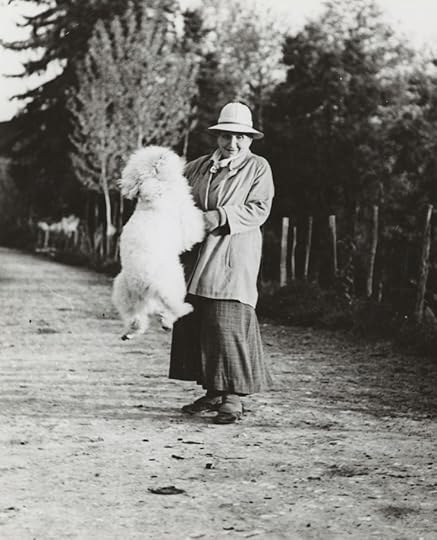
Gertrude Stein and Basket.
Alongside the unnamed narrator, we get acquainted with two of her friends: Eva, a graphic novelist obsessed with finding her missing cat, and Fanny, a financier who strongly dislikes Stein's writing style (those repetitions!) and leads an active love life. Unfortunately, neither of these characters resonated with me.
To be brutally honest, I found myself far more invested in the fate of "It" (the cat’s wonderfully peculiar name) than in Fanny’s sexual appetites or the narrator's creative throes. The contemporary characters felt oddly flat, almost as though they had been forced into the narrative to make the book more appealing. In my case, that strategy did not work. A tempting idea was to sieve out the modern-day elements, but it wasn't feasible, as the plots were entwined like roots of trees growing close to each other.
Gertrude Stein was such a remarkable and talented figure, with a brilliant mind and eccentric personality, that she hardly needed this kind of embellishment. I found myself wishing Levy had focused exclusively on her, although I realize that novels tend to attract a wider readership than biographies or essays. Everything connected to Gertrude Stein in Deborah Levy's book was utterly fascinating! I loved the anecdotes, the quotations, and the biographical details scattered throughout the text. Before reading this novel, my knowledge of Stein was rather limited, and I got to know her better with delight.
A few quotes to give you a glimpse:
She [Gertrude] longed for readers to find her, yet there was a part of her that could not bear to be found. She was even ashamed of her bestselling autobiography because it was so easy to understand.
Stein herself on being a genius in Everybody’s Autobiography:
It takes a lot of time to be a genius, you have to sit around so much doing nothing, really doing nothing.
And Levy on Alice B. Toklas—Gertrude Stein’s devoted partner, who described their erotic life as “gathering wild violets”:
Originally from San Francisco, a chain-smoker with a taste for expensive gloves, she would stuff lettuce leaves with sweetbreads and truffles cooked in sherry for her beloved, edit her work, help Gertrude self-publish, and still find time to sauté one hundred frog legs in butter and cream.
Finally, Levy on poodles, sentences and paragraphs:
Gertrude and Alice loved their two giant white poodles, Basket I and his successor, Basket II, as well as their little dog, Pepe. Gertrude would listen to the rhythm of Basket’s tongue lapping water from a bowl and claim it helped her understand the difference between writing sentences and writing paragraphs. She considered paragraphs to be much more emotional than sentences.
Let's face it, the narrator, Fanny and Eva didn't stand a chance against the amazing Gertrude, who completely stole the spotlight. It was a contest they were destined to lose from the very beginning. No wonder I finished the book far less interested in the fictional characters, who evaporated from my mind the moment I closed the book, than in the extraordinary woman at its centre. Her memory (the poodles included!) will be keeping me company for a long time to come.
Gertrude Stein and Basket.

June 20, 2026
4 Stars (Based on the experience alone!)
This was my first work by this author and man, was it a wildly unique experience. Part fiction, part Gertrude Stein biography, part something else entirely—the story follows a narrator in Paris attempting to write an essay on Stein, alongside characters Fanny and Eva. But there really is so much more going on.
There is immense beauty, depth, and structural play to unpack here. The author weaves together different writing styles and history with current events, frequently leaving you lingering in the unknown, reflecting on the uncertainty of what you just took in.
Deborah Levy clearly has her own very distinct style of writing. And I kind of dig it! I’ll be checking out more of her work for sure.
This was my first work by this author and man, was it a wildly unique experience. Part fiction, part Gertrude Stein biography, part something else entirely—the story follows a narrator in Paris attempting to write an essay on Stein, alongside characters Fanny and Eva. But there really is so much more going on.
There is immense beauty, depth, and structural play to unpack here. The author weaves together different writing styles and history with current events, frequently leaving you lingering in the unknown, reflecting on the uncertainty of what you just took in.
Deborah Levy clearly has her own very distinct style of writing. And I kind of dig it! I’ll be checking out more of her work for sure.
April 21, 2026
this book just went triple platinum in my mind

July 28, 2026
Yes to more Deborah Levy, but not this, which feels painfully self-conscious, affected and deliberately artful.
If there’s to be a forthcoming essay on Gertrude Stein, please let there be one and I’ll happily read it.
If there’s to be a forthcoming essay on Gertrude Stein, please let there be one and I’ll happily read it.

January 28, 2026
“Meanwhile, bombs are falling through the twenty-first century upon the living and the soon-to-be dead.”
Deborah Levy seems to be the only intellectual cosmically qualified for the job of interrogating the life of Gertrude Stein from her current place in history decades upstream. As with all of her books, in My Year in Paris with Gertrude Stein, Deborah Levy creates a separate realm that exists in both body and mind, the real and the surreal. She drags her hand (and pen) across the border where realism ends, where otherworldly wisdom is waiting to break through and to be channeled by the right writer. Along with Deborah Levy's unique writing and sharp perception, she delivers a thorough biography of Gertrude Stein despite her opaqueness. Only Deborah Levy could do it.
Deborah Levy seems to be the only intellectual cosmically qualified for the job of interrogating the life of Gertrude Stein from her current place in history decades upstream. As with all of her books, in My Year in Paris with Gertrude Stein, Deborah Levy creates a separate realm that exists in both body and mind, the real and the surreal. She drags her hand (and pen) across the border where realism ends, where otherworldly wisdom is waiting to break through and to be channeled by the right writer. Along with Deborah Levy's unique writing and sharp perception, she delivers a thorough biography of Gertrude Stein despite her opaqueness. Only Deborah Levy could do it.
August 4, 2026
The narrator of this book, a Brit living in Paris, is trying to write an essay about Gertrude Stein. The book alternates between reflections on Stein and the things going on in the narrator’s life, a format I really loved. I like when novels are able to blend in smart nonfiction. I have never read Stein and now very much want to!

June 21, 2026
This is a brilliant book, blurring the lines between fiction, memoir, biography and literary analysis. Levy’s prose shines as always, completely brilliant and illuminating, and her writings about Stein celebrate the more incomprehensible aspects of Stein’s oeuvre.
Some brilliant quotes:
I could be at home reflecting on all of this, or being a genius and doing nothing at all
Gertrude Stein wanted to kill the nineteenth century. The twenty-first century seems to be killing itself
Stein collected modern art. She wanted to excavate the future. She was so forward looking she never learned to reverse her Ford Model T
All writing is about walking ghosts. Or perhaps the ghosts walk the writer.
Some brilliant quotes:
I could be at home reflecting on all of this, or being a genius and doing nothing at all
Gertrude Stein wanted to kill the nineteenth century. The twenty-first century seems to be killing itself
Stein collected modern art. She wanted to excavate the future. She was so forward looking she never learned to reverse her Ford Model T
All writing is about walking ghosts. Or perhaps the ghosts walk the writer.

June 8, 2026
i know nothing about gertrude stein but i was still engrossed in this book enough to finish it in one day! deborah levy is one of my most read authors (only after annie ernaux and rachel cusk) but her last 2 releases weren’t my favorite, so i’m glad to have enjoyed this one a bit more. there isn’t much in the way of plot, which follows our narrator and 2 of her friends in paris, but learning about gertrude stein’s life gave this enough substance to be compelling. stopped a few times to look things up that i was curious about but levy provides sufficient context. i liked how the question of how we put ourselves together kept overlapping between the narrator’s life and stein’s life. levy employs her sparse prose that i always love, and this was a quick read!
thank you to fsg and netgalley for the advanced copy!
thank you to fsg and netgalley for the advanced copy!

February 26, 2026
love my girl deb lev

May 10, 2026
I’m levinating

June 18, 2026
What's not to like - Gertrude Stein plus Deborah Levy? The narrator, presumably Levy alter ego, goes to Paris to write an "essay" about Stein, has two women friends there and one punishing date with a Frenchman, has an annoying leitmotif about a cat named It (or Bob, take your pick, either is annoying).
I had moments in the beginning where I thought maybe I didn't get it, that I was missing something Levy was brilliantly doing (in her brilliant way) to emulate Stein - but then I just settled down into the enjoyable pattern of hearing words directly from the Great Lady herself, and then some daily occurrences in the narrator's life as she ruminated about Stein. Stein is endlessly entertaining - certainly Levy thinks so. Most of what is related is easily found in Janet Malcolm's (entertaining) "Two Lives".
It's a short book, not sure it made much of an impression on me: it was an idyll, a Levy/Stein dream. But, it was over before I wanted it to be over.
I had moments in the beginning where I thought maybe I didn't get it, that I was missing something Levy was brilliantly doing (in her brilliant way) to emulate Stein - but then I just settled down into the enjoyable pattern of hearing words directly from the Great Lady herself, and then some daily occurrences in the narrator's life as she ruminated about Stein. Stein is endlessly entertaining - certainly Levy thinks so. Most of what is related is easily found in Janet Malcolm's (entertaining) "Two Lives".
It's a short book, not sure it made much of an impression on me: it was an idyll, a Levy/Stein dream. But, it was over before I wanted it to be over.
July 15, 2026
I've finally clicked with the precursor to enjoying Levy's fiction - that problems in characters' lives are not meant to be solved; they exist to be lived through. With that, it became easy to be entertained by this novel - new city, new friends, no lover, mice in the apartment, a friend's missing pet, and an essay that is yet to have a single page written. Yet the act of making and unmaking onself persists among changes.
A nitpick, I started off not knowing much about Gertrude Stein. I learnt some things but I'm not convinced about her genius in any which way. The act of "waging a war" against commas and question marks, whether done within the last century by Ms. Stein or by some writers in present day, comes across as silliness cloaked in the language of progressive transgression. But that's on Stein and not Levy.
My favourite quote: "When I told Fanny I like reading books I don't understand, she said, 'Why not have some sex you don't understand?'"
A nitpick, I started off not knowing much about Gertrude Stein. I learnt some things but I'm not convinced about her genius in any which way. The act of "waging a war" against commas and question marks, whether done within the last century by Ms. Stein or by some writers in present day, comes across as silliness cloaked in the language of progressive transgression. But that's on Stein and not Levy.
My favourite quote: "When I told Fanny I like reading books I don't understand, she said, 'Why not have some sex you don't understand?'"


May 27, 2026
Deborah Levy is exceptional!
read this one because of Paris and Gertrude Stein but also to enjoy Levy's playful experiments with her thinking and writing.
somehow, there's joy in Levy's writing even when she touches on some very hard topics. that's a talent in itself.
read this one because of Paris and Gertrude Stein but also to enjoy Levy's playful experiments with her thinking and writing.
somehow, there's joy in Levy's writing even when she touches on some very hard topics. that's a talent in itself.
March 12, 2026
she’s so bloody good

April 18, 2026
This was my first Levy and definitely not my last. This was absolutely everything I could possibly want in a novel. I’m just upset it took me so long to read any of her work.

July 8, 2026
Set in November 2024, an unnamed British writer travels to Paris to write an essay on Gertrude Stein. The storyline is slim: she struggles to make progress on the essay while helping search for her friend Eva's missing cat. She grows close to Eva, a Danish graphic novelist, and to Fanny, a free spirit with an active sex life. The book draws on the lives of Stein and her wife, Alice B. Toklas, both directly and metaphorically, and I suspect I'd have enjoyed it more if I'd come to it knowing them better. I liked the prose and the wordplay, but I'm not sure it will stay with me.

July 16, 2026
It may be difficult to categorize this work by genre, but fortunately, original and compelling should suffice. Part romance, part procrastination for writing an essay, and a great deal of literary history involving Gertrude Stein and Alice B. Toklas, My Year in Paris with Gertrude Stein is both fun and illuminating.
Deborah Levy's frequent posing of the question "What is it?" is an elliptically perfect comment on Gertrude Stein's writing style. I'm not sure how I heard about this book, but I'm glad I read it!
Deborah Levy's frequent posing of the question "What is it?" is an elliptically perfect comment on Gertrude Stein's writing style. I'm not sure how I heard about this book, but I'm glad I read it!
April 30, 2026
Reading about art, artists and writers isn’t my favourite thing to do, and so a lot of this went over my head - i prefer to read/ digest and appreciate artwork firsthand.
But there were moments that struck me in this book, and I always like how Levy’s writing can swing so quickly between being deeply profound (intentionally or unintentionally) and being wry and to the point.
I’m probably not the target audience of this book but I appreciated little moments in it nonetheless. Also learnt a lot about Stein and her philosophies which I found interesting, though I think I’d struggle with her actual work.
‘I unwrapped the oozing baguette and devoured it there and then amongst the dead. The living have appetites. Desires. To drive us mad. To make us joyful. To make us cry. To lead us up the wrong path and down the right path. The dead have done all that. The dead who can no longer feel the rain had spent a lifetime creating themselves.’
‘When I told Fanny I like reading books I don't understand, she said, 'Why not have some sex you don't understand?’’
‘Meanwhile, rain was falling gently on Paris, including on all its trees and statues and on every caress at a bus stop and on every kiss by a fountain.’
But there were moments that struck me in this book, and I always like how Levy’s writing can swing so quickly between being deeply profound (intentionally or unintentionally) and being wry and to the point.
I’m probably not the target audience of this book but I appreciated little moments in it nonetheless. Also learnt a lot about Stein and her philosophies which I found interesting, though I think I’d struggle with her actual work.
‘I unwrapped the oozing baguette and devoured it there and then amongst the dead. The living have appetites. Desires. To drive us mad. To make us joyful. To make us cry. To lead us up the wrong path and down the right path. The dead have done all that. The dead who can no longer feel the rain had spent a lifetime creating themselves.’
‘When I told Fanny I like reading books I don't understand, she said, 'Why not have some sex you don't understand?’’
‘Meanwhile, rain was falling gently on Paris, including on all its trees and statues and on every caress at a bus stop and on every kiss by a fountain.’

September 1, 2026
***(*)
Zeker niet slecht, maar ik las andere dingen van Deborah Levy liever ...
Zeker niet slecht, maar ik las andere dingen van Deborah Levy liever ...
July 3, 2026
the queen of the tiny summer intellectual novel. loved it

May 28, 2026
'Why are you wearing stiletto heels for this
walk, Fanny?'
'For my mental health.'
walk, Fanny?'
'For my mental health.'
June 30, 2026
I think this was two books I loved trapped inside of a book I only kind of liked.
I want a full book from Deborah Levy on Gertrude Stein and a want a full book on Eva, Fanny and It.
I want a full book from Deborah Levy on Gertrude Stein and a want a full book on Eva, Fanny and It.

April 17, 2026
"Gertrude Stein wanted to kill the nineteenth century. The twenty first century seems to be killing itself."
..& how perfectly the unnamed narrator of this Genre Defying, witty novel imbibes her inspiration "Gertrude Stein" when she kills the expectations of her past to live in the shadow of a literary giant like Stein but then also finds that the very idea of a future seems to be killing itself in the messy reality of her 21st century friendships & relationships
She has moved to Paris & is spending time with her 2 friends Eva (a Danish artist in a long distance marriage) & Fanny ( an adventurous French financier who believes in polyamory). Here she is trying to write an essay on Stein. While it has been constantly reiterated throughout the book that Stein (a formidable American writer & art collector) doesn't like to be understood, the irony of the concept lies right here coz the protagonist absolutely reveres Stein & is also trying to understand her so as to write this essay about her
But she also finds the task nearly impossible, feeling both captivated and frustrated by Stein’s baffling prose
"(Gertrude Stein) removed all question marks from her work because she said it was obvious when something is a question. She found them revolting. And she thought commas were servile. Readers should be free to take a breath whenever they feel like it. Her main aim was for a sentence to push onwards"
The narrative starts with the sentence
"Eva called to say she had lost it"
It's only when you read the next sentence that you come to know that the 'it' in the sentence is a Cat. But then I guess that's the mastery of Levy's work, even if for a second she lets your mind travel a whole lot of dimensions trying to figure out what that 'it' can be - is 'it' mind, is 'it' identity, is 'it' goals
"While Picasso was painting her portrait, he couldn't paint her head. Perhaps he was transmitting Stein shaped sentences to his paint brush. A Stein shaped sentence is a very bespoke thing."
Levy isn't shy of name dropping, finding connections or even creating them
"I am walking through the hundred and ten acres of Père Lachaise Cemetery in the 20th arrondissement to find the grave of Gertrude Stein. Here in the wind and rain I see the dead buried in my mind, lit up, lit up with life, vanity, suffering and fame. I know what a few of them looked like from photographs and paintings, the various attitudes in their eyes and their various talents. Oscar Wilde, Edith Piaf, Chopin, Proust, Apollinaire, Georges Perec, Colette, Modigliani, are all buried here"
This only further amplifies narrator's chaotic mind which finds more clarity in the cemetery than she does in the chaotic lives of her friends, Fanny and Eva
This book is something special. I don't even know how to pitch it to you. I can gauge that my review is chaotic, much like my mind after reading this book which is chaotic riot but yet so good, so cerebral, so funny and so engaging. I have highlighted every next paragraph. There are many quotes but then there are many sentences which don't have the traits of a quote yet I want to read them again & again
This one became all the more special to me with its mention of elite dancers like Merce Cunningham & Isadora Duncan in it, who have had a great impact on my career as a dancer -choreographer
This is my 1st book by Levy. While people may say it's not the best place to start the Levy journey but I had super fun with it & won't have it any other way. I have so much to say but for now will rest my case with these brilliant words of Levy
"What else are wars for except wounding? What else are words for except to press on a wound?"
Let Levy's words press on yours
Read it & still have the best fun with the most special writing
Thank you Netgalley and Hamish Hamilton for advance review arc
..& how perfectly the unnamed narrator of this Genre Defying, witty novel imbibes her inspiration "Gertrude Stein" when she kills the expectations of her past to live in the shadow of a literary giant like Stein but then also finds that the very idea of a future seems to be killing itself in the messy reality of her 21st century friendships & relationships
She has moved to Paris & is spending time with her 2 friends Eva (a Danish artist in a long distance marriage) & Fanny ( an adventurous French financier who believes in polyamory). Here she is trying to write an essay on Stein. While it has been constantly reiterated throughout the book that Stein (a formidable American writer & art collector) doesn't like to be understood, the irony of the concept lies right here coz the protagonist absolutely reveres Stein & is also trying to understand her so as to write this essay about her
But she also finds the task nearly impossible, feeling both captivated and frustrated by Stein’s baffling prose
"(Gertrude Stein) removed all question marks from her work because she said it was obvious when something is a question. She found them revolting. And she thought commas were servile. Readers should be free to take a breath whenever they feel like it. Her main aim was for a sentence to push onwards"
The narrative starts with the sentence
"Eva called to say she had lost it"
It's only when you read the next sentence that you come to know that the 'it' in the sentence is a Cat. But then I guess that's the mastery of Levy's work, even if for a second she lets your mind travel a whole lot of dimensions trying to figure out what that 'it' can be - is 'it' mind, is 'it' identity, is 'it' goals
"While Picasso was painting her portrait, he couldn't paint her head. Perhaps he was transmitting Stein shaped sentences to his paint brush. A Stein shaped sentence is a very bespoke thing."
Levy isn't shy of name dropping, finding connections or even creating them
"I am walking through the hundred and ten acres of Père Lachaise Cemetery in the 20th arrondissement to find the grave of Gertrude Stein. Here in the wind and rain I see the dead buried in my mind, lit up, lit up with life, vanity, suffering and fame. I know what a few of them looked like from photographs and paintings, the various attitudes in their eyes and their various talents. Oscar Wilde, Edith Piaf, Chopin, Proust, Apollinaire, Georges Perec, Colette, Modigliani, are all buried here"
This only further amplifies narrator's chaotic mind which finds more clarity in the cemetery than she does in the chaotic lives of her friends, Fanny and Eva
This book is something special. I don't even know how to pitch it to you. I can gauge that my review is chaotic, much like my mind after reading this book which is chaotic riot but yet so good, so cerebral, so funny and so engaging. I have highlighted every next paragraph. There are many quotes but then there are many sentences which don't have the traits of a quote yet I want to read them again & again
This one became all the more special to me with its mention of elite dancers like Merce Cunningham & Isadora Duncan in it, who have had a great impact on my career as a dancer -choreographer
This is my 1st book by Levy. While people may say it's not the best place to start the Levy journey but I had super fun with it & won't have it any other way. I have so much to say but for now will rest my case with these brilliant words of Levy
"What else are wars for except wounding? What else are words for except to press on a wound?"
Let Levy's words press on yours
Read it & still have the best fun with the most special writing
Thank you Netgalley and Hamish Hamilton for advance review arc
June 9, 2026
Worked often in threes: Gertrude, Alice, Picasso; our narrator, Fanny, Eva; three loose apartment mice; even in its own questions to itself: “Is that a desirable way to live? Or is it the only way to live? How do we put ourselves together?” Very readable, perfect for the uncanny parallel drawers of the world, those who often unconsciously connect their life to all of the art they come across and vice versa, as does our narrator in her excavations of Gertrude Stein and of herself. Essentially a quiet and tasteful literary mind map common to women in GLAM and their current fixations. (Galleries, Libraries, Archives, and Museums)

May 18, 2026
I keep coming back to Levy for the tedious yet minute fluency of her Hot Milk and The Man Who Saw Everything, but every recent book of hers has only seemed lazier and lazier. The only interesting bits of this fanfic-cum-novel were Stein's words, sprawled around the insipid prose that for some reason, unbeknowst to the gods of creative writing college classes, obsessed over drowning and running a cat over again and again every few pages. The narrator knew there would be no way to breach Stein's 'genius,' but this TikTokification of her life and ideas might be in poor taste even for the lesbian mistress-master of modernist satire herself.

June 28, 2026
Bookclub soon, review later :)
3.5 🥁
3.5 🥁

May 27, 2026
“If we create ourselves with and through language, it seems to me that Gertrude Stein’s project was to dismantle herself and a whole century through language, to uncreate herself as she had been created by her father, by her sneering professor at John Hopkins, by her brother, to undo the manner of the nineteenth century. Get rid of commas. Get rid of question marks. She did not want to be told when to take a breath and when something was a question or who to love or how to dress. Get rid of clichés. Break through the conventions of genre. Stein was going to step out of the frame, away from the life of her mother and aunts, away from the uncomfortable femininities that had been societally constructed to keep her in her place.”
If there was ever a city in which to deconstruct your identity and step out of the frame of your own self-perception, it would be Paris.
Picasso, Hemingway, Chagall, Fitzgerald, Baldwin, Modigliani, Kundera, Wilde, Dali and Joyce. They all journeyed to the banks of the river Seine to shed a few skins and dip their feet into the streams of consciousness of past and future centuries. Unmoored and hungry for a revolution.
So did the enigma that is Gertrude Stein.
If there was ever a perfect writer to explore the nooks and crannies of modernism, it would be Deborah Levy. She came to Paris looking for Stein, armed with two soaked London raincoats, unmoored and hungry for a fight.
What she gives us is a novel/treatise/meditation that is as slippery, visually striking and intellectually delightful as a film by Jean-Luc Godard or Éric Rohmer, punctured by shards of texts, philosophical questions, the daily conversations between three women friends on the hunt for a lost cat named It.
By exploding the linearity of traditional literary criticism, Levy creates a living tableau that is anything but still, always in motion, always rearranging itself in space, in perpetual dialogue.
There is a painting of Levy by Paul-Hebert Percy in the National Portait Gallery in London that encapsulates her genius: her face, but split in three, kaleidoscopic, a third eye unmoored and hungry for expression.
Cherchez la femme.
If there was ever a city in which to deconstruct your identity and step out of the frame of your own self-perception, it would be Paris.
Picasso, Hemingway, Chagall, Fitzgerald, Baldwin, Modigliani, Kundera, Wilde, Dali and Joyce. They all journeyed to the banks of the river Seine to shed a few skins and dip their feet into the streams of consciousness of past and future centuries. Unmoored and hungry for a revolution.
So did the enigma that is Gertrude Stein.
If there was ever a perfect writer to explore the nooks and crannies of modernism, it would be Deborah Levy. She came to Paris looking for Stein, armed with two soaked London raincoats, unmoored and hungry for a fight.
What she gives us is a novel/treatise/meditation that is as slippery, visually striking and intellectually delightful as a film by Jean-Luc Godard or Éric Rohmer, punctured by shards of texts, philosophical questions, the daily conversations between three women friends on the hunt for a lost cat named It.
By exploding the linearity of traditional literary criticism, Levy creates a living tableau that is anything but still, always in motion, always rearranging itself in space, in perpetual dialogue.
There is a painting of Levy by Paul-Hebert Percy in the National Portait Gallery in London that encapsulates her genius: her face, but split in three, kaleidoscopic, a third eye unmoored and hungry for expression.
Cherchez la femme.
Displaying 1 - 30 of 385 reviews