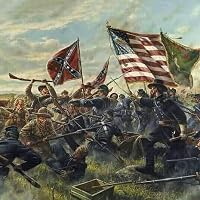
Baptized by Fire, the first installment in a trilogy on this storied regiment, chronicles the near-daily exploits of the 14th New York State Militia recruited from Brooklyn. Known as chasseurs or Red Legs for their distinctive uniforms, the men of the 14th N.Y.S.M. endured grueling marches, brutal weather, and fierce battles from April 1861 to August 1862.
During these first 15 months of war, the regiment earned praise from both allies and adversaries. In January 1862, a Union soldier encamped near the chasseurs wrote to his hometown newspaper that the “Brooklyn Boys” were “respected for their courage and prowess at the Battle of Bull Run,” adding that the Red Legs were also admired for their “mischief and practical jokes.” Confederate General P. G. T. Beauregard acknowledged that the 14th N.Y.S.M. “did more harm and caused greater trouble” to his forces than any other unit.
In August 1862, the 14th N.Y.S.M. faced a grueling campaign marked by night marches, scant rations, and relentless skirmishes, culminating in three harrowing days of combat at the Second Battle of Bull Run, where the regiment served with distinction.
Jim McLean’s first volume of the regiment’s history draws on his decades of research, including nearly 200 visits to the National Archives, the examination of documents at the New York State Archives, and the exploration of collections at the Brooklyn Historical Society. Letters, diaries, and images shared by descendants and collectors further enrich this study. The 14th N.Y.S.M. did not fight in isolation, so records of allied and opposing regiments provide critical insights into the Brooklyn soldiers and their experiences. The result is a vivid examination of the regiment’s initial 15 months of service through the eyes of the common their reasons for enlisting, their reactions to the challenges of military life, the evolution of their attitudes toward combat, and the lasting impact of wounds and illnesses into the postwar years.
After the war, the 14th N.Y.S.M. faded into obscurity. Only three battle reports by its officers appear in the Official Records, two of which describe but minor engagements. Unlike many regiments, the chasseurs did not contribute to the postwar proliferation of Civil War literature, and their honorable record gradually dimmed. This volume seeks to restore the reputation of a regiment too often overlooked by modern historians and students alike.
Literally just finished, and it's late so I may edit this review down the road. For now, however, I can say that this was an excellent study of a renowned regiment of the War Between the States. This was my first regimental study, and it certainly won't be my last. Unit histories are the last bastion of Civil War military historiography for me to break into, and this was a perfect Vanguard into this realm of the historical lore. Written by a master of the field, already well known for works on Union units, Mr. McClean turned his pen to the 14th NYSM, also known as the Brooklyn Chaussers (their uniform was mostly a copy of Napoleon III's Imperial infantry, or Chausser, uniform). The first in a proposed trilogy, this book takes the reader alongside the men from the New York City area, and some from elsewhere, from their enlistments, all the way through their heartbreaking retreat, as a much small regiment, from the defeat at Second Manassas. At 424 pages of text (not the 1270 listed on Goodreads for some bizarre reason), and over a hundred pages for appendices, and index, this is a hefty tome. However Mr. McLean's writing is erudite, and incredibly engaging and he often quotes the words of the participants themselves. When he does so, though, he never loses sight of the all important context, analysis, and of keeping a flowing narrative. He doesn't do what many British historians do and block quote page after page, thankfully. As per standard with Savas Beattie titles this one is filled with footnotes, and I often found myself pausing to read them, as I typically do, and there's plentiful photographs, period illustrations, and maps. What makes this title unique is the thick, glossy paper, the oversized scale of the book (not quite a coffee table sized, but slightly larger than standard hardback), and full color maps and illustrations, and colorized photos if they were colorized during the period. It makes for an intensely attractive reading experience. The trials and travails of the men are well captured. Whether the boredom of camp and sentry duty, drilling, marching, horsing around (the 14th were notorious pranksters, mischief makers, and occasional brawlers, all of which made them more endearing), or the thrilling terror of combat, all of it is well penned from an author who clearly adores his subject. All in all this is a fine book, one of my favorites of 2026, and I wholeheartedly recommend this one to anyone who wants a fantastic regimental study.