"Téa Mutonji writes sharply about the subtle ruptures endemic to formative friendships." —Raven Leilani, bestselling author of Luster
Intimate and sharply funny, My Person is a bold debut novel following two lifelong friends who suddenly find themselves in an emotional deadlock when one abruptly proposes to break up after years of subtle betrayals, from Téa Mutonji, author of Shut Up You're Pretty and one of Canada’s most exciting writers.
Best friends of over twenty years, Tania and Margot are preparing to host their monthly Sunday Loaf dinner party, when Tania tells Margot this isn’t working for her anymore—they’ve been entangled for too long, she wants to "unknow" her. But how do you extricate yourself from someone whose family owns the apartment you live in, who has taken you in as their own, even claims you as their "person”?
As Tania attempts to live her life loudly on the outskirts of Margot’s bubble, Margot’s past betrayals become increasingly clear. But she means well, doesn’t she? They had felt like sisters from the start. Or had Tania just been blind to Margot’s antics? Set in the framework of a tense will-they-won’t-they break-up, Tania and Margot’s once delicate dance escalates toward an astonishing finale that neither person sees coming.
A taut, piercing exploration of race and privilege, codependency, and the ways in which world-defining friendships can be both beautifully and excruciatingly life altering, My Person is an addicting, astutely observed novel from a major talent.
Téa Mutonji is a Canadian author. She was born in the Democratic Republic of the Congo but came to Canada at a young age. She grew up in in Scarborough and Oshawa. She studied media studies and creative writing at the University of Toronto Scarborough.
i wanted to read this book (in spite of the corny title) because i was under the impression that it was about a friendship breakup.
any woman over the age of 25 can tell you that there is no event in life as painful and traumatic as a friendship breakup. the memory of my ex friend haunts me every day.
the reason i was under this impression is because of the synopsis, and the beginning of the book, and the marketing materials, and what this novel obviously considers itself to be about.
our subject in reality is "a cruel and selfish person has a complete and total mental breakdown and acts for several hundred pages like someone who should probably be receiving inpatient behavioral health treatment for the foreseeable future." which is fine. but i'd like to have known that going in.
beyond that, i have never read a book that tells, not shows like this. 90% of the book is written in sweeping declarations about Who People Are and What They Do and Why They Do It, which means a) we never get a sense of what these people actually mean to each other, b) there is no depth, character development, or narrative arc of any kind, and c) it's so, so boring.
the most laughable part is that these broad statements come in so hot and heavy that they contradict each other over and over again, sometimes within the same paragraph. someone will be called a good person and then immediately referred to as pure evil. and we just have to go along.
this book made me cringe so hard for so long that eventually i just got angry.
the ending was so dumb and thoughtless it made me laugh out loud.
4/5 Such a great book about friendship! Pick this book up only if you love to just follow along the lives of characters and you’re not looking for a specific plot. Love how the main character was messy and unreliable. Felt so real to life and made me enjoy the book even more.
This book explores, best friends, Tania and Margot. Tania wants to end the friendship since she feels too enmeshed with Margot. It is supposed to explore privilege, race, class, and long-term friendship.
Tania is messed up. She feels constricted and controlled by her best friend. Margot may be too dependent on Tania, but feel for her more. Margot has reason to worry since Tania does many reckless things. She doesn’t take responsibility, but instead blames Margot for much of her problems. Margot does come across as naive, superficial, and entitled at times. For Example: Margot advocates for her friend when she is completely drunk and decides to be with two strange men in their thirties on a Cliff and then does not know where Tania is. Margot calls the police. Tania, is furious she did this since she says she wanted to behave this way. Sure, fine if you are sober, but she definitely was not. I don’t really know how to respond to that. Friends are supposed to look out for friends and very intoxicated ones even more.
Tania, at first seems reasonable. She needs to find her unique self. She has always lived and been around white people, so there is that issue. She also feels that she needs to be an “I” and not always a “we”. Things were made pretty easy for her by moving in with Margot and paying very little for rent so, it’s hard to grasp that only Margot gets easy breaks in life. If you want to carry on about your privileged friend, the time to do it is probably not when you are still in her apartment, paying way below renting value. It, seems logical that instead of having a dramatic set of conversations with Margot and also going nuts at their last dinner party, she would just tell Margot she needs time by herself to really grow up and figure out who she is. I would think she would have looked for an apartment first. Then move and yes, take some more time to step into being your own person.
Hard to read this book since I just couldn’t connect to Tania and really understand her decisions many times.
Thank you NetGalley and Putnam Books for a copy of this book. I always leave reviews of books I read.
My Person isn’t just about friendship — it’s about what happens when a friendship becomes your identity. Watching Tania slowly realize she wanted to “unknow” Margot was uncomfortable in the best way, because it felt so real. The tension wasn’t loud or dramatic — it was quiet, layered, and emotional.
What I learned from this book is that not all deep connections are healthy just because they’ve lasted a long time. Time doesn’t equal alignment. History doesn’t equal safety. And love doesn’t cancel out harm.
It also taught me that choosing yourself can feel selfish when you’ve been codependent for years — but sometimes it’s the bravest thing you can do.
The way the book explores race, privilege, blurred boundaries, and silent betrayals made the story even more powerful. It felt honest. Raw. And painfully relatable.
This isn’t a romance breakup story — it’s a friendship breakup story, and somehow that hurt more.
This is meant to be a story about complex, morally grey characters navigating the nuances of lifelong friendship—the audience is supposed to grapple with rooting for Tania and Margot despite their flaws. But the characters are so unlikable, they fail to evoke sympathy in the reader.
Also, at times, the writing is trying so hard to be shocking and taboo that it comes off as juvenile.
Thank you Random House Canada for the gifted copy 💕
I love a story set in Toronto. Most things in the book captured how it is to live in Toronto and reminds me of my days living downtown…
We follow childhood friends, Tania and Margot. They’ve always been together….. and now, Tania feels the friendship has run its course and needs to end. We follow Tania as her and Margot deal with this friendship breakup throughout the book.
I liked the friend group and Rita and her wallahi’s lol reminded me of my friend group as well and was a perfect fit for Toronto life 😋
While I liked the writing and thought the premise was really interesting, I don't think the story resonated with me as much as I expected. Since everything is told through Tania's perspective, we only see her side of the friendship. Much of her narration focuses on the privileged life Margot has had, and she often places the blame for her unhappiness on Margot even when many of the choices she's making herself are reckless or ultimately not good for her.
That said, I could understand why Tania felt stuck. She's trying to figure out who she is, questioning the life she's accepted, and wondering if she wants something more for herself. Those moments felt relatable.
A few conversations being fully open with Margot may have helped the breakup go a bit more smoothly.
I also couldn't help but think that if Tania and Margot had been more open and honest with each other, a few difficult conversations might have made their friendship breakup a little less painful.
Overall, I enjoyed the writing, the Toronto setting and the realistic portrayal of a friendship falling apart…..a thoughtful exploration of growing apart and figuring out who you are.
Could not put it down. Toxic friendship, bad decisions, sex and drugs and Toronto at night, a sharply seen and rendered reflection on being an artist and a woman and a woman of color and a woman of color among rich white people who love you and hate you and use you in equal measure. This is a bold book and Mutonji is an exceptional talent.
The premise of two long-time friends “breaking up” sounded like a great book to me. Unfortunately, the execution went sideways somewhere. Tania never seemed to know who she was or what she wanted in any area of her life. I didn’t understand any more about why she didn’t want to be friends with Margot at the end of this book than I did at the beginning. Overall, the entire book made very little sense. Tania was a very unlikable main character. I would not recommend.
My Person is stressful and absolutely nuts. The micro aggression, self sabotage, and codependency are nails on a chalkboard…but your brain is the chalkboard and the nails are these women.
2.75-3⭐️ I’ll admit the synopsis of this book did not impress me but the authors note did. I was a huge Grey’s Anatomy fan so when she referenced Meredith and Cristina’s relationship as a premise for this story I was immediately intrigued. Needless to say I just could not with the FMC Tania and her reasons or lack there of for wanting to “unknow” her “best friend “ of 20+ years.
"I was desperate for material that spoke directly to the great romance that is the friendship between little girls."
This book is, on its surface, about a friendship breakup. But it's really about the pain we inflict on those closest to us when we're depressed or dissatisfied with our life. When those we love the most become the target for all the self-hatred we feel.
Sometimes, being tethered to someone who has known every version of you holds you back. You need to let go to shed your past and become the truest version of yourself.
I was excited to read this novel about a lifelong female friendship coming to an end. I was expecting more of a literary fiction feel with more serious exploration of themes of trust, love, race, privilege, etc…
Unfortunately, I found the characters very immature and I had to wade through an abundance of raunchy & vulgar behavior to get to those themes I wanted to read about.
I think I’m supposed to have mixed feelings about these morally grey friends, but honestly, both of them are so annoying and shitty I just didn’t care about them. I got over 50% of the way through and decided I didn’t care enough about either to continue with the trajectory of the story.
Didnt love. Maybe because I couldn't relate but I didnt love the way the storey telling was written. Bounced around alot and felt like I was missing peices of the storey.
3.5 ✨️ This book had such an interesting premise. Tania wakes up one day and decides to break up with her best friend of 20 years, Margot. Which… valid, I guess? 😂 But also, I found it surprisingly difficult to fully grasp.
The story dives into some really interesting and complicated themes; race, power imbalances, codependency, control, and what happens when a friendship no longer feels healthy. Margot is understandably caught completely off guard, and from there, they both spiral as they try to find their footing outside of a friendship that has shaped so much of their lives.
The entire story is told from Tania’s POV, and honestly, that left me feeling a little unsatisfied. I would have loved to get Margot’s perspective and understand what was going through her mind. Because 20 years is a LONG time. How do you even begin to undo something that has been such an integral part of your life for that long?
That said, I’m not suggesting that the length of a relationship should determine whether you stay or leave. If you’re unhappy, you have every right to choose the exit, whether it’s been 20 years or 20 days. 🧡 I think what made this story so fascinating was exploring the messy, uncomfortable space between knowing you need to leave and actually dealing with the aftermath.
I also really enjoyed the Grey’s Anatomy references because, as a Grey’s stan myself, I was absolutely seated. 😂
Overall, I’d recommend this one. It’s thought-provoking, uncomfortable in the best way, and definitely the kind of book that makes you pause and reflect on your own friendships and what happens when a relationship that once felt like home no longer does. 🧡
I am wrecked. I think this book helped me to heal from a past friendship breakup that I just never… healed from. A friendship is a relationship that can be wonderful … but also if you lose it.. especially those you literally saw them in your future… can be absolutely devastate you. I fucking loved this. It was raw, real, and had me in a chokehold. Loved this.
I’m usually “Death before DNF” but if it’s wrong to abandon this book now, let god strike me down…and/or the town of Pickering make me officially unwelcome.
What Happens When ‘Chosen Family’ Becomes a Cage: My Review of Téa Mutonji’s “My Person” and the Cost of Being Somebody’s Everything
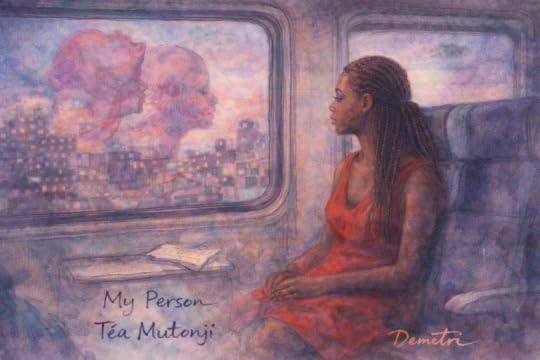
Watercolor Piece by Demetris Papadimitropoulos
Téa Mutonji’s debut novel, “My Person,” opens with a proposition that sounds like a rom-com tagline until it starts behaving like a prophecy: your best friend can be your great love story. Not “like” a love story – not “almost” a romance – but the full, blood-warm thing, complete with yearning, exclusivity, rivalry, betrayal, a shared mythology, and the specific violence of being known too well by someone who insists they own the knowing.
The book’s title, borrowed from the devotional language of “Grey’s Anatomy,” is deceptively cute. Mutonji treats that phrase the way a surgeon treats a scalpel: she tests its sharpness, its utility, its capacity to heal and to cut. “My person” is what you say when you want closeness to sound fated. It’s also what you say when you want possession to sound like care.
At the center is Tania, a Black woman, a writer, and – in the way that matters most here – a narrator with a gift for making her own life feel like a scene she’s watching from the corner of the room. She has been best friends with Margot since childhood, the kind of friendship that accumulates lore: formative humiliations, sleepovers, shared outfits, shared enemies, shared language. When we meet them in earnest, they’re adults, cohabiting, braided together in the mundanity of a shared apartment and the high drama of shared social circles. In the early rupture, which Mutonji stages like a breakup you can’t believe is happening until you’re already living in the “after,” Tania coolly tells Margot she wants out. There’s no clean explanation, no cinematic monologue, no single betrayal that can be framed and hung on a wall. There is only the exhausted sentence a lot of people – especially women – have been trained to feel guilty for saying: I don’t want this anymore.
What follows is a novel that understands something unflattering and true about modern intimacy: we are surrounded by language, and language does not necessarily save us. Therapy vocabulary can become a shield. “Boundaries” can become a performance. “Family” can be a corporate euphemism. “Love” can be the most elegant lie you tell yourself about control.
Mutonji’s plot motor is simple and cruel. The friendship ends, but the infrastructure of the friendship – the social ecosystem, the habits, the shared dependencies, the mutual surveillance – keeps running. Tania cannot simply “move on,” because the life she lived with Margot has colonized her sense of self. When she tries to detach, she doesn’t float free; she falls.
One of the book’s key set pieces is Eli’s engagement party, held at a waterfront restaurant in Pickering, a venue calibrated for a certain kind of Canadian prosperity: yacht club adjacency, hydrangeas, polished service, the aesthetic of good taste that tries to pass itself off as goodness. Eli, Margot’s cousin, is a significant figure in Tania’s emotional life – a man who has always hovered at the edge of the friendship as both temptation and tether. The party becomes a stage for everything the novel wants to expose: class performance as morality, whiteness as default, Blackness as visibility, and the way “family” functions as both invitation and cage.
Mutonji is exceptionally good at rendering rooms. You can feel the air change when someone enters. You can feel the choreography of people pretending not to see what they see. You can feel the disciplinary posture of a friend angling her body away from yours. And at this engagement party, you can feel the dread of an event designed to celebrate stability while your interior life is actively collapsing.
Margot, in her role as the perfect host, delivers a speech that feels – to Tania, and to us – like a small act of theft. Then she does something worse: she reads a poem written by Tania, a poem about her country, about the place where homes are built inside people. Margot reads it badly, carelessly, like a menu, flattening its enjambment and, in doing so, flattening its soul. It is a brilliant choice, because it’s petty in the way real betrayals often are. The injury isn’t only that Margot uses Tania’s work without permission. It’s that she reveals she doesn’t actually know how to hold it. The poem becomes another accessory in Margot’s narrative about herself.
And that is when Mutonji detonates the scene with a gesture both primitive and inevitable: Tania slaps Margot in the middle of the dance floor. The slap is not catharsis. It’s not empowerment. It’s not a “moment.” It is an eruption – the body expressing what the language has failed to make legible. The room freezes. The social order shudders. And Tania, as quickly as she becomes monstrous, becomes familiar again: a woman alone on the GO train, mascara running, drinking vodka out of plastic, unsure where she’ll get off. Grief, in Mutonji’s hands, is not always noble. Sometimes it’s tacky. Sometimes it’s embarrassing. Sometimes it’s a red dress you keep putting back on because it’s the only thing that still feels like a self.
The chapters that follow track a spiral that is both hyper-specific and uncomfortably recognizably of-the-moment. Tania disappears into Toronto nightlife – after-hours clubs, bathroom stalls, neon lighting, house music as theology. She does drugs with strangers who briefly become “concrete buildings,” tall and reflective, a hallucination of stability she can lean against. She checks into the Drake and lives there like a woman trying to outspend her own collapse. She cycles through Tinder men and nameless sex that becomes less about pleasure than about anesthesia, the body used as a place to put what cannot be carried in the mind.
Mutonji writes these sequences with a striking blend of comedy and horror. A street hot dog becomes an “exorcism.” Vomit becomes metaphor – Margot exiting the system. A bouncer becomes a dealer becomes a transactional intimacy. A list of solo activities (“pet dolphins,” “wine tour,” “sad movie at TIFF”) reads like a parody of self-care culture and a genuine attempt at building a life that isn’t structured around one person. A Google search for “family” becomes an existential inquiry. Reddit threads become a temporary church.
It’s in these passages that Mutonji’s style announces itself as more than voice. The narration has a Shondaland velocity – fast, confessional, sometimes grandiose, always aware of itself as story – but it’s anchored by an exacting observational intelligence. Mutonji can make you laugh and then, mid-laugh, make you realize you’ve been laughing at a wound.
The novel is also, quietly but insistently, about money – not as an abstract theme, but as an active force shaping what is possible. The publishing advance that evaporates. The contract that gets canceled. The humiliating logic of debt. The predatory proximity of payday loan stores. The collector calls. The way art becomes both identity and liability in a world that pretends to admire creatives while providing them no structural mercy. In this sense, “My Person” feels in conversation with the very current, very grim discourse around the creative economy: who gets to risk making art, who gets to “take a break,” who gets to be messy without being destroyed by it.
When Tania is finally forced home – back to Pickering, back to her Congolese parents – the book becomes something else: not a redemption arc, not a tidy healing narrative, but a reintroduction to the possibility that care can exist without possession. The parents are drawn with a tenderness that never turns them into saints. Tshili, especially, is rendered with the kind of specificity that makes her feel lived-in: her bluntness, her humor, her political obsession and insistence on correct language (“It is not a conflict… it is a genocide”), her practical mothering that is not always soft but is often exact. Tania’s father hums Bob Marley, calls her baby, transfers money with quiet gravity. Their home becomes a strange refuge: the place Tania fled and the only place that can hold her when she is un-holding herself.
Mutonji’s handling of family is one of the book’s smartest reversals. In the broader culture, “found family” is often romanticized as a morally superior alternative to blood. “My Person” complicates that. It doesn’t dismiss chosen family – Tania’s friendships matter, and the novel takes them seriously – but it refuses the notion that the family you choose is automatically healthier than the one you were born into. Chosen family can be a lifeline. It can also be a cult with good lighting.
As Tania stabilizes, the book allows itself to become quieter, stranger. Depression is named as “an episode,” joked about at the dinner table, a way of domestically holding something that otherwise would feel like an endless weather system. Rituals return: walks, home-cooked meals, church steps. Tania does not suddenly become “fixed.” She becomes, instead, a person who can sit still long enough to feel her own thoughts again.
In the background, the novel keeps its most damning argument humming: that intimacy without an honest accounting of power is not intimacy, it’s fantasy. Race sits at the center of this – not as a didactic “issue,” but as a lived asymmetry that Margot can afford to treat as optional. Tania’s late-summer notes about the friendship – about Margot’s obsession with sameness, her tendency to flatten difference, to “humble my experiences and exaggerate yours so that it feels like we’re the same” – are among the book’s most devastating pages. Mutonji refuses the comforting conclusion that love makes you equal. She suggests the opposite: love is the place where inequality can be most easily smuggled in, because you want so badly to believe you’re safe.
This is one reason “My Person” feels so relevant right now, in a culture that oscillates between over-sharing and avoidance, between the language of accountability and the terror of direct confrontation. The novel understands how often we try to outsource hard conversations to vibes. It understands how “we’ve known each other forever” becomes an argument against growth. It understands how people can do real harm while genuinely believing they are good.
If the book has a formal signature beyond voice, it is its devotion to scenes of social performance – dinners, parties, weddings, therapy sessions – where what cannot be spoken is communicated through posture, through who looks at whom, through who is allowed to narrate the room. Mutonji’s social critique is precise without being programmatic. She isn’t writing a thesis. She is writing a life.
Readers will inevitably reach for comp titles, not because “My Person” is derivative, but because it participates in a lineage of books that treat female friendship as a major literary event. You can feel the ancestral pressure of “Sula” – the way love between women can be both sanctuary and harm. You can hear an echo of Elena Ferrante’s “My Brilliant Friend” cycle in the novel’s insistence that a girlhood bond can become a lifelong architecture of self. There are contemporary kinships, too: the sharp social acuity of “Such a Fun Age,” the erotic and financial unease of “Luster,” the messy confessionals of “Acts of Desperation,” the friend-group politics of “Conversations with Friends,” the self-mythologizing drift of “My Year of Rest and Relaxation.” And in its willingness to let a narrator be difficult – unlikable, hilarious, self-aware, and still deserving of our attention – the book shares DNA with works like “The Idiot” and even the tonal logic of “Fleabag,” where pain and punchline often arrive in the same breath. (Mutonji’s own explicit tether to “Grey’s Anatomy” makes this televisual kinship part of the point: our emotional education is, increasingly, pop-cultural.)
What distinguishes Mutonji, though, is the particular moral temperature of her writing. She is not interested in punishing Tania for her worst impulses, nor in absolving her. She lets the consequences stand. She lets the shame remain shameful. She lets tenderness show up in odd places – in a mother applying Vicks to a daughter’s back, in hair being taken down, in the quiet logistics of feeding someone who cannot feed herself.
And then the book performs its final, risky magic trick: it stages a late encounter between Tania and Margot that refuses melodrama. They meet on a street like any other street, under bright sun that feels almost rude in its ordinariness. Margot is pregnant. Time has passed. The scene is built, not around fireworks, but around the absence of them: no butterflies, no cinematic rush, no instant reconciliation. Just two people, briefly, facing the fact that their lives were once fused and are now separate. The exchange is both mundane and spiritually enormous. When Tania asks, “Are you happy?” it is not a trap. It is the genuine question at the end of a long obsession: what did all of this buy you? What did all of this cost?
The novel’s greatest strength – and, occasionally, its limitation – is the intensity of its narration. Mutonji writes from inside a mind that does not easily leave itself. The voice is so vivid, so commanding, so stylistically assured that it can sometimes feel like the book is daring you to take a breath. There are moments in the most frenetic chapters when the escalation risks repetition: another night, another chemical theology, another attempt to outrun the same ache. But even that can be read as formal integrity. This is what spirals do. They do not innovate. They repeat, louder, until something breaks or something changes.
“My Person” is, among other things, a novel about the danger of being readable. Tania wants to be understood, but she also fears what it means to be seen accurately by the wrong person. Margot’s version of knowing is invasive. Diane’s “mothering” is proprietary. Publishing’s “we’re a family” rhetoric is manipulative. Even friendship, the most cherished refuge, can become a regime. Against all of this, Mutonji offers a different model of care: the kind that doesn’t require you to be owned in order to be held.
There is a particular bleak humor in the way our era sells intimacy as a brand – tracking someone’s location, curating your grief, proving your belonging via story views, turning every rupture into content. Mutonji doesn’t preach about this. She dramatizes it, and the effect is more damning. In “My Person,” the ultimate horror is not that you can lose your person. It’s that you can lose them and still be haunted by the infrastructure of them – the habits, the language, the reflex to narrate everything through their eyes.
Mutonji’s debut is not perfect – very few first novels this ambitious are – but it is startlingly accomplished, emotionally exact, and formally confident. It treats female friendship with the seriousness literature has often reserved for marriage. It is frequently funny, often brutal, and, at its best, almost unbearably tender about the ways people try to survive love when love has been confused with control.
I’d rate “My Person” an 89 out of 100 – a fierce, stylish, psychologically sharp novel that understands the modern hunger for intimacy and the modern terror of it, and that insists, without sentimentality, that leaving can be both the most violent act and the first honest one.
I’ve been loving the trend of novels focused on the interpersonal relationships between two women, especially Black women, so I was super excited to read My Person by Téa Mutonji. I’m also a big Grey’s Anatomy fan, Christina and Meredith being one of my favorite fictional friendship duos, so the inspiration from the title did not pass me by. Unfortunately this book was a let down in that category.
Our main character Tania (Black) decides that her decades long friendship with bestie, Margot (white), is over. The book follows the journey to dissolve this relationship while both being incredibly codependent on each other and having so much of their lives interwoven together. They share an apartment, friend group, often share a bed (platonically) and have been each others “person” since the 3rd grade. It’s described as a will they won’t they as much as Tania tries to break away, she can’t seem to let go.
My problem is I had no reason to ever be invested in their friendship. When we meet them, narrator Tania has already decided their friendship is over. We follow her as she spirals and realizes the friendship she’s spent years in have been one sided, and isolating as she is the only Black girl in her friend group. The book is more of an exploration of her spiral than it is about a crumbing friendship. With a title like MY PERSON I expected to be actually let into this friendship and watch it unravel. Lots of what Tania said was never actually explored so it left me like of in the wind on how to even feel about this breakup. I literally did not care.
I did like the writing and I’ll be sure to check out future work for this author even though this book didn’t work for me.
I wolfed this down in less than a day; the drama is so addicting.
‘My Person’ is the term of endearment Meredith Grey and Cristina Yang use to describe their deep, platonic sisterhood…friendship…soulmates…on Grey’s Anatomy. It’s the kind of relationship so many women develop / aspire to, in their 20’s. What Téa Mutonji does so brilliantly in this novel is peel back the reality for Tania and Margot, whose once ‘My Person’ level bond has gone sour, and they are in the throws of a breakup.
Téa brilliantly explores the impact on each person in light of their racial and class differences; from financial safety nets to community, dating and hypersexualisation of Black women (aka mysogynoir). It’s raw and gripping in a self-sabotaging millennial/Gen-Z way that other generations may struggle to relate to. Thoroughly enjoyed this.
Wow wow wow! This book is layered, reflective, and a beautiful exploration of friendship, love, loss, patience, and tolerance and so much more! I went expecting commentary on friendships and friendship break ups. Ana was uncomfortably and pleasantly surprised by the depth.
Questions that I held the more I read: Could I walk away from a friendship of decades? What's the responsibility of each party in a friendship breakup? How honest is too honest? What lengths would I go through to save a friendship, even when I don't care to save it?
I am sitting with so much from this book, the power of unspoken needs and expectations. The intersectionality of race and experience within friendships. The importance of accountability and communication early and often.
The exploration of growing up together while growing apart for a multitude of reasons and experiences, felt realistic, painful, and understandable.
Tea knocked this out of the park! Thank you at #NetGalley and #Putnam #PutnamSons for this eArc!
My Person is a smart and moving novel about the way adulthood complicates friendships from youth—which don’t always grow with us—with a sharp eye to subtle dynamics around race, privilege, and sex. Fans of Fleabag, Luster, and Emma Cline will devour this book as eagerly as I did, and think about it long after.
every black girl has had (or has) a margot .. téa mutonji did an excellent job of teasing out the emotional stakes and reminding us that no one in the novel is perfect, including the protagonist. i see a lot of myself in tania (mentally unstable african-canadian writer living in toronto !!) i do wish parts of it had been more concrete than metaphorical but still a good read!
My Person is about a friendship breakup told from the point of view of Tania, the person breaking up said friendship. It’s messy, raw, honest, layered, and to me, a true depiction of the complexity of friendship.. I mean, you may not relate to some of the choices made in this novel, but at its core, the experience is the same. Your friends are people you choose to have in your life and when you’ve invested time in a friendship, how do then you rid yourself of it? how do you separate yourself from someone you chose (or who chose you) in the first place? 😩
This was a 5-star read for me, and let me tell you why: 1) the single pov was genius. I know there are readers who want Margot’s side, but I actually think writing this only in Tania’s perspective really strengthened how deluded and one-sided a person can be in a breakup like this. Her pov succeeds in villainizing Margot, but also in empathizing with the protagonist. But then by the end, you wonder how reliable Tania really was.. such delicious, skillful writing! 2) Téa wrote a diverse cast of characters without the assumption of whiteness, but rather ‘other’-ness as its assumptive background. I LOVED this. To identify whiteness in a book is so rare these days, and the intention showed! 3) I got what I wanted out of the book, and that was that I wanted a book about how messy and complex it is to decidedly break up with a person in your life. IT IS HARD. The easy thing would be to just slowly drift apart.. but to announce it and go through it and be petty as the breakup is happening and have regrets, those are the real and raw emotions of deciding someone no longer gets access to you. I know some of the choices made, I can’t relate to, but the self-sabotage of it all, I can.
I absolutely loved this book and cannot recommend it enough! I was lucky enough to hybrid-read this one, thank you Penguin Random House Canada for the ARC and Libro fm for the ALC!! 🫶🏽
The book's premise sounded fascinating; however, as I read, it never seemed to take off or gain momentum. I felt like the introduction kept going instead of evolving.
This was painful to get through—like the friend breakup that took 30 years and dragged the reader along for every miserable second. I have never been so annoyed by a character in any of my reading😅
I requested this book from #NetGalley to review an #ARC because the title reference lead to the term "My Person" frequently being used in Grey's Anatomy. Lead character Meredith refers to her collegue, roommate and friend Christina as "my person". This tv-series is my guilty pleasure. I've been watching since episode 1 and haven't missed one. So I was intrigued by the book. But I didn't get untill page 60 or so, skimmed the book a bit. It tells the story of Tania an african-american woman, a writer, living to getter with her childhood friend Margot who is white. Margot basically let's Tania live rentfree, and takes their friendship, living together, sometimes sleeping together in a bed for the company, bringing eachother food and coffe, as a given. Because they always have been friends. Tania at one point, doesn't feel the same, and she wants to "break-up". Move out, distance herself from her friend. She's annoyed by Margot. I was annoyed by her, the whole play of Tania not deciding to make a clean cut. And thinking what's her problem? And their friendship, it never seemd that they were the besties like the besties are besties in Grey's Anatomy. They have fun, they cry, they help eachother. Margot and Tania are never fun, they don't help eachother. I thought the book would funny, loving, but it's not. Instead Tania seems depressed, makes stupid decisions like hooking up Margot's cousin while he's engaged... or doing weird stuff with their friends. Nope..this book was just not for me.. I couldn't finish.