

What do you think?

Scrapper
Kelly scavenges for scrap metal from the hundred thousand abandoned buildings in a part of Detroit known as “the zone,” an increasingly wild landscape where one day he finds something far more valuable than the copper he’s come to steal: a kidnapped boy, crying out for rescue. Briefly celebrated as a hero, Kelly secretly takes on the responsibility of avenging the boy’s unsolved kidnapping, a task that will take him deeper into the zone and into a confrontation with his own past, his long-buried trauma, memories made dangerous again.
Scrapper is a devastating reimagining of one of America’s greatest cities, its beautiful architecture, Its lost houses and its shuttered factories, its boxing gyms and storefront churches, anywhere hope lingers. With precise and powerful prose, it asks: What transgressions would we allow if we believed they would ensure the safety of the people we loved? What do we owe for our crimes, even those committed to protect our charges from harm?
From the Hardcover edition.
Scrapper is a devastating reimagining of one of America’s greatest cities, its beautiful architecture, Its lost houses and its shuttered factories, its boxing gyms and storefront churches, anywhere hope lingers. With precise and powerful prose, it asks: What transgressions would we allow if we believed they would ensure the safety of the people we loved? What do we owe for our crimes, even those committed to protect our charges from harm?
From the Hardcover edition.
320 pages, Hardcover
First published September 15, 2015
About the author
Matt Bell
39 books1,696 followersMatt Bell’s next novel, Appleseed, was published by Custom House in July 2021. His craft book Refuse to Be Done, a guide to novel writing, rewriting, & revision, will follow in early 2022 from Soho Press. He is also the author of the novels Scrapper and In the House upon the Dirt between the Lake and the Woods, as well as the short story collection A Tree or a Person or a Wall, a non-fiction book about the classic video game Baldur's Gate II, and several other titles. His writing has appeared in The New York Times, Esquire, Orion, Tin House, Conjunctions, Fairy Tale Review, American Short Fiction, and many other publications. A native of Michigan, he teaches creative writing at Arizona State University.
Ratings & Reviews
Friends & Following
Create a free account to discover what your friends think of this book!
Community Reviews
Displaying 1 - 30 of 112 reviews

September 30, 2015
Hmmm. The writing is excellent, as usual with Bell. But this novel felt like it needed to be much longer to accommodate the various narrative ambitions. There were three sort of sidebars, pulled from current (ish) events, that I struggled to make sense of. Kelly was a thoroughly absorbing character--so burdened and troubled and trying to be a better man. The boxing sequence was particularly well done as was the portrayal of Kelly's relationship with "the girl with the limp." This is a novel set in Detroit, or the ruins of Detroit and I was willing to go along with that but the narrative style mostly elides the issue of race, which cannot be ignored in a Detroit story. I am not finding the words for what I want to say here. But this is a novel that will stay with me for a while. Lots to chew on here.

April 17, 2017
This novel consumed me, chewed me up and spat me out. It changed me. A reviewer in the New York Times described it as "equal parts dystopian novel, psychological thriller and literary fiction." I could not say it better, although the dystopian aspect is so close to where we already are and have been in some areas of the world, that it was more like a summary of the kinds of places you would tell your kids or loved ones to avoid.
Set in Detroit, a city I have been in or around for most of my life, deep in the ruins of the automobile industry there, it features a legendary type of hero/fallen man named Kelly. He is a "scrapper," someone who scavenges scrap metal from the deserted factories and homes in the black hole section of modern Detroit and sells it for cash. He also fits the original meaning of the word: a fighter, a pugilist. Kelly's abusive father was a wrestling coach who taught him the ways of pugilism in his formative years. This rejected but absorbed aggressive stance has brought him trouble and a load of guilt.
So when he meets a chronically ill woman with a limp and when he rescues a kidnapped boy, all his demons and sorrow coalesce into a desperate determination to make some things right.
Not a pretty story but dark, gritty and violent, yet filled with meanings, with understandings, about love, self-defense, duty, vengeance and atonement. Somehow Matt Bell takes this microcosm of all that is wrong in the world and makes it hauntingly beautiful.
I truly do not know how he did that. Scrapper is part of the story of civilization as it appears to us now. The ways that progress/greed and power/oppression and hopes/losses work in life, in society, in politics and government and wars. Also the ways that whatever divine spark lives in any human being can bring about transformation even in the midst of violence and decay.
Thanks again to the Nervous Breakdown Book Club for sending to my mailbox a book I otherwise may have missed. I would say that if you feel frightened by the world the way it is today, this novel could give you courage.

August 5, 2023
"You couldn’t escape the past but he hoped you could choose what to restore, what to keep gleaming. This was the progress Kelly had seen, not the replacing of the old city with the new but the building of smarter exits and bypasses."
-- Matt Bell, Scrapper
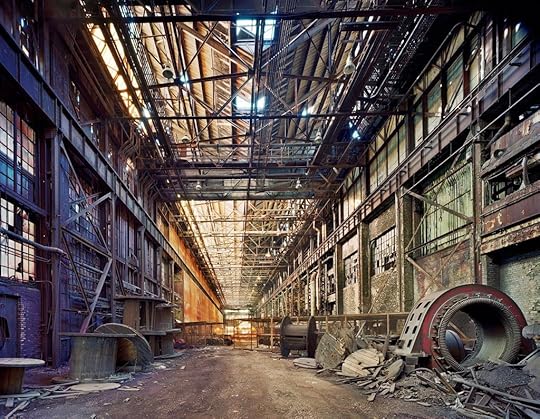
Matt Bell's 2015 novel Scrapper is the second of Matt's novels I've read. When I read him, I get elements of Cormac McCarthy, Brian Evenson, Don DeLillo, Vollmann, and (it took me awhile to put my finger on it) Gertrude Stein?
Scrapper centers on a man, Kelly, trapped between the things that haunt him in the past and his crumbling, decaying present. This felt very Dystopian to me, but the further I waded into Bell's story, the more I had the feeling that not recognizing a landscape doesn't mean the zone doesn't exist, doesn't mean the disaster isn't inevitable even for the privileged, even for those currently at the top of the heap. The clock ticks for us all and, sooner or later, it stops ticking forever.
There is a physicality to the book, both in setting and characters. The story starts in Detroit and a crumpling Detroit is the centerpiece of the novel. The character is bouncing between redemption and destruction. Interspersed are two separate short-stories that seem in the beginning not related to the narrative structure of the book, but once the veil of the story lifts a bit, you realize these two stories are keys that unlock the theme a bit more. Two twisted, rusted I-beams that give a distinct shape to the broken concrete and the web of rebar that give it all shape and direction. They are two foreign bodies that don't seem to belong, but once we pan back, we see the broken car located in the house is part of a greater entropy from an explosion or wreck.
All damage has a beginning. All narratives begin with a blank slate.
Tracking not exactly directly backwards in Matt's fiction, it appears from the two points I know (Scrapper and Appleseed), there are threads running through Matt's fiction. Environmental disaster, decay, loneliness and redemption are all there.
A warning, and I'll end this with the warning -- This book is not for the faint-hearted. It reminded me a bit of The Road, Immobility, and the prose rang like DeLillo and Stein. It is hard. It is horror, both in landscape and intent. There are no superheroes in this story. No medals. But there is a payoff.
-- Matt Bell, Scrapper
Matt Bell's 2015 novel Scrapper is the second of Matt's novels I've read. When I read him, I get elements of Cormac McCarthy, Brian Evenson, Don DeLillo, Vollmann, and (it took me awhile to put my finger on it) Gertrude Stein?
Scrapper centers on a man, Kelly, trapped between the things that haunt him in the past and his crumbling, decaying present. This felt very Dystopian to me, but the further I waded into Bell's story, the more I had the feeling that not recognizing a landscape doesn't mean the zone doesn't exist, doesn't mean the disaster isn't inevitable even for the privileged, even for those currently at the top of the heap. The clock ticks for us all and, sooner or later, it stops ticking forever.
There is a physicality to the book, both in setting and characters. The story starts in Detroit and a crumpling Detroit is the centerpiece of the novel. The character is bouncing between redemption and destruction. Interspersed are two separate short-stories that seem in the beginning not related to the narrative structure of the book, but once the veil of the story lifts a bit, you realize these two stories are keys that unlock the theme a bit more. Two twisted, rusted I-beams that give a distinct shape to the broken concrete and the web of rebar that give it all shape and direction. They are two foreign bodies that don't seem to belong, but once we pan back, we see the broken car located in the house is part of a greater entropy from an explosion or wreck.
All damage has a beginning. All narratives begin with a blank slate.
Tracking not exactly directly backwards in Matt's fiction, it appears from the two points I know (Scrapper and Appleseed), there are threads running through Matt's fiction. Environmental disaster, decay, loneliness and redemption are all there.
A warning, and I'll end this with the warning -- This book is not for the faint-hearted. It reminded me a bit of The Road, Immobility, and the prose rang like DeLillo and Stein. It is hard. It is horror, both in landscape and intent. There are no superheroes in this story. No medals. But there is a payoff.

August 6, 2015
Scrapper refers to Kelly, a young man who forages for scrap metal and salvageable parts of abandoned buildings in an area of Detroit known as the zone. He removes and sells the parts by the pound. In this dystopian future, “The remainder of a city within the city…A century of reinforced concrete and red brick and steel crossbeams…their torn and opened fences made an invitation to the gutting,” the landscape is an urban area of waste and disuse described as “destruction porn.” A few people still live here, but most have moved to more habitable areas. Kelly, however, is running away from his past, and punishing himself for crimes later revealed. Working in the zone is a way to wrestle with his conscience. He left his lover and her son in the South (unnamed place) and lives as a loner, until he meets a woman, Jackie, a police dispatcher with a noticeable limp due to degenerative disease. However, her crippled body houses a guardian spirit, an irony not lost on the reckless, hollowed out anti-hero.
This fabled tale is about redemption--of the darkest parts of the soul, and the bleakest aspects of society. Bell’s harrowing landscape symbolizes the collapsed morality buckling under end-stage hope. Kelly believes in two parts of the self—the violent scrapper and the righteous salver, and it is these two halves he tries to reconcile, to undo the damage in a world fraught with pain. When he finds a kidnapped boy chained in a basement in one of the zone’s abandoned houses, Kelly is determined to find and confront the person who did this, and, in a twisted way, redeem his own errors and those of his father, and his father’s father before him.
This is where the story breaks down for me. The prose, while sometimes piercing and filled with metaphors of devastation and misery, is just as often reworked clichés written in declarative sentences, and leans toward self-conscious.
“There were no space spaces except those you made yourself. Safety could not be granted. Safety was the absence of anyone stronger or weaker. And always there was someone stronger or weaker, someone greater than, less than. The only true safety was the deepest kind of loneliness and for a time Kelly had chosen it.”
“…and the man who cried said the suffering of the individual had been eclipsed by the suffering of the masses. Eartquakes in Haiti, tsunamis and nuclear devastation in Japan. Genocides in Africa…” etc, “All I’m saying, the man who never cried said, is that there are whole cities falling into the ocean, whole species going extinct…We’re here wailing about a single human life. He said, I love my wife but she’s the equivalent of a thousand starving children…”
The text labors on these prosaisms where it isn’t necessary, but is murky where it needs to be more transparent. The narrative breadth reached its limit way before the author intended it to. In other words, the furnishings and philosophies are repeatedly expounded upon, the author hammering home a point that was already obvious. But the manifestation of actual events is inevitably banal, however padded, and the author gluts the reader with yet another extraneous meditation on doom. I get the sense that Bell was aiming to stretch out a thin story with a grand theme, but I became weary. He was trying too hard for effect, and the prose, which echoed Cormac McCarthy but lacked the master’s immaculate precision, was used as compensation for a strained story. And, sometimes, the overuse of non-specific pronouns, such as “he,” or descriptors, such as “the girl with the limp,” “the man who cried,” etc. seems superfluous, as if the redundancy is supposed to imply additional weightiness.
Moreover, Bell’s plot unfolds evasively, even confusedly, with provocative but intended complementary events concerning the music rapper Mos Def and his visit to a detainee in Guantánamo; a scene with Michael Zimmerman in Florida, and a scene near Chernobyl in Russia. But it came off as overreaching, or gratuitous, almost like filler standing in for fullness. When the story does reach its apex, and Kelly decides on a specific act, it is an act that, to me, contorted the rest of the story, made it nearly insensate.
The story searches for atonement in an inhumane world, a place where base desires and lawless atrocities have eclipsed hope and kindness, where corruption and evil have subjugated decency and rectitude. I felt that the author led us there, to reparation, but then it inevitably became pointless. Occasionally I felt inside of the zone where justice is weighed at a cost, but at other times, it seemed I was just standing there with scraps.
This fabled tale is about redemption--of the darkest parts of the soul, and the bleakest aspects of society. Bell’s harrowing landscape symbolizes the collapsed morality buckling under end-stage hope. Kelly believes in two parts of the self—the violent scrapper and the righteous salver, and it is these two halves he tries to reconcile, to undo the damage in a world fraught with pain. When he finds a kidnapped boy chained in a basement in one of the zone’s abandoned houses, Kelly is determined to find and confront the person who did this, and, in a twisted way, redeem his own errors and those of his father, and his father’s father before him.
This is where the story breaks down for me. The prose, while sometimes piercing and filled with metaphors of devastation and misery, is just as often reworked clichés written in declarative sentences, and leans toward self-conscious.
“There were no space spaces except those you made yourself. Safety could not be granted. Safety was the absence of anyone stronger or weaker. And always there was someone stronger or weaker, someone greater than, less than. The only true safety was the deepest kind of loneliness and for a time Kelly had chosen it.”
“…and the man who cried said the suffering of the individual had been eclipsed by the suffering of the masses. Eartquakes in Haiti, tsunamis and nuclear devastation in Japan. Genocides in Africa…” etc, “All I’m saying, the man who never cried said, is that there are whole cities falling into the ocean, whole species going extinct…We’re here wailing about a single human life. He said, I love my wife but she’s the equivalent of a thousand starving children…”
The text labors on these prosaisms where it isn’t necessary, but is murky where it needs to be more transparent. The narrative breadth reached its limit way before the author intended it to. In other words, the furnishings and philosophies are repeatedly expounded upon, the author hammering home a point that was already obvious. But the manifestation of actual events is inevitably banal, however padded, and the author gluts the reader with yet another extraneous meditation on doom. I get the sense that Bell was aiming to stretch out a thin story with a grand theme, but I became weary. He was trying too hard for effect, and the prose, which echoed Cormac McCarthy but lacked the master’s immaculate precision, was used as compensation for a strained story. And, sometimes, the overuse of non-specific pronouns, such as “he,” or descriptors, such as “the girl with the limp,” “the man who cried,” etc. seems superfluous, as if the redundancy is supposed to imply additional weightiness.
Moreover, Bell’s plot unfolds evasively, even confusedly, with provocative but intended complementary events concerning the music rapper Mos Def and his visit to a detainee in Guantánamo; a scene with Michael Zimmerman in Florida, and a scene near Chernobyl in Russia. But it came off as overreaching, or gratuitous, almost like filler standing in for fullness. When the story does reach its apex, and Kelly decides on a specific act, it is an act that, to me, contorted the rest of the story, made it nearly insensate.
The story searches for atonement in an inhumane world, a place where base desires and lawless atrocities have eclipsed hope and kindness, where corruption and evil have subjugated decency and rectitude. I felt that the author led us there, to reparation, but then it inevitably became pointless. Occasionally I felt inside of the zone where justice is weighed at a cost, but at other times, it seemed I was just standing there with scraps.

September 20, 2015
Note: The edition I read is marked as "Advance Uncopyedited Edition" and obtained from an online bookseller.
Because one day there would be no one living who remembered the form of your face or the sound of your voice and on that day it would be as if you had never existed. This was the final death of the unremarkable.
I don’t do plots very well in my reviews.
Mostly I blockquote.
This review requires a skeletal synopsis however.
This novel is set in Detroit …sometime in the near future.
Like maybe next month.
Or the one after.
The protagonist is a scrapper.
A scrapper is a person who goes into the vacant buildings and abandoned homes found in abundance in the ghost town that Detroit has become.
A series of old, once prosperous and well populated neighborhoods now abandoned by former residents who lost their livelihoods after the automobile industry pulled out for other countries.
This lone scrapper is living a day-to-day existence, pulling out what metal and copper he can find from the interiors of abandoned houses and buildings and selling them to salvage yards.
A series of bad things happened to him a long, long time ago and he has immersed himself in his job –dangerous at times- in an attempt to forget his history.
His bad days.
His dark hours.
He said, I saw a child hollering in a front yard yesterday, in a block I thought was vacant. A boy, eleven or twelve. The child alone, shirtless, his skin glistened with sweat, sunshine. It was fall but the year had a few warm days left.
He told her this but what he told her wasn’t a story. It was something he’d seen, not something he’d done. He was merely a spectator, didn’t want to paint the image tainted by his action or inaction, didn’t want the responsibility of cause and effect.
There’s this creeping kind fatigue, he said.
If he thought harder about what he heard and saw from his apartment he didn’t think he could live there.
The vast turnover of the people with loud voices, louder problems, the small miseries and the daily cruelties.
Better to focus on external anxieties, on more crises far-flung, the news. On what he read in books or saw in documentaries. It was easier if he could pretend the tragedy was somewhere else.
She touched his hand until he calmed.
She said, You think the world is a bad place but you want to be a good man in it.
One day he finds a boy shackled to a filthy bed, held in captivity in the sound-proofed basement of an abandoned house.
He rescues the boy but is outraged that the boy's captor or captors have escaped.
He seeks vengeance for the boy's ordeal.
That desire for vengeance becomes an obsession.
And with that obsession the scrapper's life is forever changed.
What is the responsibility of the good man in the zone?
Is the detective a role or an action. Is the good man an action too.
Can I take on the role of the detective and carry it to its completion.
Can pretending to be a good man one day make me a good man
This is a powerful novel.
It moves at its own slow pace, graceful and beautifully written.
It fills the reader with a kind of grim dread, a feeling of encroaching horror and an ultimate sense of helplessness.
Don't want to reveal too much about the resolution of conflict in this novel but I can’t imagine finding another novel this year that will be as emotionally staggering.
Now the scrapper. Now the salvor. Until the duty was done.
Now the deep winter. Now the blue air and the slow cracking of concrete against the frozen and immovable earth. Now the streets ever more vacant in the zone, all Kelly’s knowledge of the topography blurred by constant snowfall. Now the unbroken clouds hiding the pale and heatless heart of the sun.

July 8, 2015
The premise of Matt Bell's latest novel, Scrapper, is fantastic. This psychological tale of post-fall Detroit centers around a scavenger who guts homes and businesses for scrap metal. In the book's opening chapters, the scavenger, Kelly, finds a boy who has been kidnapped. The rest of the novel focuses largely on Kelly's turmoil regarding his own tragic past and the trauma of the kidnapped boy.
What works extraordinarily well in this novel is the casting of Detroit as a character. Bell paints the city in such a manner that I found myself repeatedly looking up information about Detroit to better understand this city. He handles the city with affection and trepidation. I was scared of Detroit, but I understood why it was to be feared—it had been abused, abandoned, and forgotten. It's Bell's treatment of the setting that makes this city alive.
And yet, while the setting is so detailed, the time was never quite clear to me. Initially, I thought I was reading a story set twenty or thirty years in the future, but the more I read, the less sure I was about when I was. It's okay. Time isn't necessary to enjoy this novel, and perhaps it's better not to know; but I did find myself wondering to the point of distraction.
Scrapper has a wonderful set-up and is certainly written well. As the book proceeds, it does become largely psychological and I think it could've done with more solid story telling to back up what was going on in the mind of Kelly. Nevertheless, I was greatly impressed with Bell's writing and I look forward to reading more of his work in the future.
What works extraordinarily well in this novel is the casting of Detroit as a character. Bell paints the city in such a manner that I found myself repeatedly looking up information about Detroit to better understand this city. He handles the city with affection and trepidation. I was scared of Detroit, but I understood why it was to be feared—it had been abused, abandoned, and forgotten. It's Bell's treatment of the setting that makes this city alive.
And yet, while the setting is so detailed, the time was never quite clear to me. Initially, I thought I was reading a story set twenty or thirty years in the future, but the more I read, the less sure I was about when I was. It's okay. Time isn't necessary to enjoy this novel, and perhaps it's better not to know; but I did find myself wondering to the point of distraction.
Scrapper has a wonderful set-up and is certainly written well. As the book proceeds, it does become largely psychological and I think it could've done with more solid story telling to back up what was going on in the mind of Kelly. Nevertheless, I was greatly impressed with Bell's writing and I look forward to reading more of his work in the future.

March 27, 2016
Nobody writes books like Matt Bell. Language-driven, often allegorical or fantastic, world-encompassing but claustrophobic, deeply flawed protagonists caught in the web of their poor decisions and circumstance - and Scrapper is no exception. It's a wonderful, strange, moving book that merges fairy tale with gritty realism, and inhabits the space of true mystery - not mystery as in genre, but Mystery with a capital 'M' - the kind of cosmic questioning that makes a book stay with you long long after the last page has been turned. I loved it.

September 15, 2015
Beautifully written-- Bell's protagonist is painstakingly rendered, and his slow, panic-driven inner decay is depressingly realistic. We're asked to consider some of the larger, most important, most unanswerable questions about trauma, both personal and geographical, and healing (or the lack there of). A must read.

August 22, 2018
This story started out strong for me, but about half way through started to lose me, and he strong dystopian theme become lost in moral preaching, and trying to do too much too fast.

December 3, 2015
'Scrapper' by Matt Bell
This story is set in the near future. One that has stagnated. It's a story of Urban decay & the human cost. It could be next week, next year or 20-30 years from now. But if so, it's a future where humans & their future has stagnated & is in decline. Where there are no innovations, only the breaking down of existing technologies.
At one point, early in the story, it's main protagonist, Kelly, reflects:
"He didn't think his was the final generation, but perhaps the last might already be born."
The Plot:
Kelly is a 'Scrapper'. He collects scrap metal & anything else he can salvage from a large section of
Detroit, which has been abandoned, due to the collapse of a once thriving car industry & the
subsequent unemployment this has caused.
"Saturn, Mercury... they named a car after a god, but only after they had killed the god."
"Whenever Kelly entered an uninhabited house he understood he entered some life he might have lived, how the emptiness of every room pulled him inside out. A furnishing of the self."
In order to survive his bleak existence, Kelly has drawn into himself. Shutting himself off from all but purely essential contact with other human beings.
One day, while scavenging in the ruins, Kelly finds a young boy chained to a bed. Kelly rescues the boy & is briefly hailed a hero.
After finding the boy Kelly begins to question his existence; his past, his future. He decides to track down the boy's abductor & in doing so, he begins to 'awaken' again.
"His teeth were still firmly seated but he worried other connections in his head were loosening."
"If Kelly had been watching anyone else, he would have been happier than watching himself."
One night Kelly meets a woman with whom he forms a relationship. The woman has a degenerative neurological disease & Kelly takes on the role of protector & provider, while searching for the boy's abductor.
There is one aspect of this novel that jarred somewhat. There are two instances of this, in fact,
where there are short vignettes, only a few pages each, which appear to bear no relation to the rest of the story. When i came to the first instance, i actually thought my copy must be corrupted. But on further investigation, this proved not to be the case. Still puzzling over this first instance, i read on. Eventually i arrived at the second example, which is a fellow living in the radioactive wastes of Chernobyl. He's had no human contact for eight years, following the loss of his family & at one point muses:
"Once he'd had sins to confess but now he thought, If there are no people, are there sins? Who was left to sin against?"
Which reminded me of that philosophical question;
"If a tree falls in a forest and no one is around to hear it, does it make a sound?"
So, what's this book about, i thought? It's about urban decay, some of which is taking place now, the author seems to be saying. And where will it end? It's about man's alienation from his fellow man & poses the question; Can a good man remain a good man in the face of extreme adversity? Can he choose to be a good man?
So there is a philosophical side to this novel. At least that was my experience. If this book were merely a recital of a bleak, dystopian near-future, it would still be good reading. Told in the author's beautifully evocative prose, it becomes something more.
"Concrete everywhere, cement everywhere else. Grey clouds & grey snow & grey earth."
Indeed. I look forward to Matt Bell's next novel with avid interest.
4 stars from me. I'm tempted to give it 5, but am anticipating something even better from this young author in the future.
This story is set in the near future. One that has stagnated. It's a story of Urban decay & the human cost. It could be next week, next year or 20-30 years from now. But if so, it's a future where humans & their future has stagnated & is in decline. Where there are no innovations, only the breaking down of existing technologies.
At one point, early in the story, it's main protagonist, Kelly, reflects:
"He didn't think his was the final generation, but perhaps the last might already be born."
The Plot:
Kelly is a 'Scrapper'. He collects scrap metal & anything else he can salvage from a large section of
Detroit, which has been abandoned, due to the collapse of a once thriving car industry & the
subsequent unemployment this has caused.
"Saturn, Mercury... they named a car after a god, but only after they had killed the god."
"Whenever Kelly entered an uninhabited house he understood he entered some life he might have lived, how the emptiness of every room pulled him inside out. A furnishing of the self."
In order to survive his bleak existence, Kelly has drawn into himself. Shutting himself off from all but purely essential contact with other human beings.
One day, while scavenging in the ruins, Kelly finds a young boy chained to a bed. Kelly rescues the boy & is briefly hailed a hero.
After finding the boy Kelly begins to question his existence; his past, his future. He decides to track down the boy's abductor & in doing so, he begins to 'awaken' again.
"His teeth were still firmly seated but he worried other connections in his head were loosening."
"If Kelly had been watching anyone else, he would have been happier than watching himself."
One night Kelly meets a woman with whom he forms a relationship. The woman has a degenerative neurological disease & Kelly takes on the role of protector & provider, while searching for the boy's abductor.
There is one aspect of this novel that jarred somewhat. There are two instances of this, in fact,
where there are short vignettes, only a few pages each, which appear to bear no relation to the rest of the story. When i came to the first instance, i actually thought my copy must be corrupted. But on further investigation, this proved not to be the case. Still puzzling over this first instance, i read on. Eventually i arrived at the second example, which is a fellow living in the radioactive wastes of Chernobyl. He's had no human contact for eight years, following the loss of his family & at one point muses:
"Once he'd had sins to confess but now he thought, If there are no people, are there sins? Who was left to sin against?"
Which reminded me of that philosophical question;
"If a tree falls in a forest and no one is around to hear it, does it make a sound?"
So, what's this book about, i thought? It's about urban decay, some of which is taking place now, the author seems to be saying. And where will it end? It's about man's alienation from his fellow man & poses the question; Can a good man remain a good man in the face of extreme adversity? Can he choose to be a good man?
So there is a philosophical side to this novel. At least that was my experience. If this book were merely a recital of a bleak, dystopian near-future, it would still be good reading. Told in the author's beautifully evocative prose, it becomes something more.
"Concrete everywhere, cement everywhere else. Grey clouds & grey snow & grey earth."
Indeed. I look forward to Matt Bell's next novel with avid interest.
4 stars from me. I'm tempted to give it 5, but am anticipating something even better from this young author in the future.

November 30, 2016
Scrapper is a interesting novel. I discovered it from an ad on Geek's Guide to the Galaxy podcast and it sounded interesting. A end of the world novel that takes place in a post apocalyptic city that is surrounded by the rest of the world going forward as normal. As a concept I thought was super interesting. Kelly the main character is a scrapper who goes on short trips into the abandoned future Detroit. He is salvaging metal and supplies from the the city left behind for dead.
Bell is clearly a talented writer who choose to employee as experimental prose form that reminded me of Cormac Macarthy's Blood Meridian. No grammar rules. Look not everyone can do this and I think the novel suffered for this. This was interesting concept but the story was a hard to follow at time and it greatly slowed down my reading experience.
I feel Bell might be a much better writer than me, but I felt sometimes the prose was just too experimental at the cost of the story. That might be on me. I spent alot of time slowing down and re-reading sections because the no grammar rules made for a confusing lack of narrative drive. That said Kelly is a interesting character and the setting is fascinating.
The concept of a isolated end of the world is a interesting one that I think Bell missed a chance to explore. None the less there are plenty of interesting story points. The novel is very bleak and haunting through out. This Detroit is one that could serve as a cautionary tale, but the novel is never preachy. It paints a vivid picture of a place no one would want to go. We get the sense that Kelly is doing something dangerous and the novel works quite well on that level.
That is one reason that the lack of grammar rules annoyed me. I started to become more interested in the process of the prose than the story. How is Bell conveying aspects of the story without quotations for example. When I was not doing that and just trying to flow with the story I would often get lost. I would have to re-read parts. Thus this was not easy or fun read for me. Also it is broken up with chapters about Guantanamo Bay, and Chernobyl that are both excellent but totally out of place. The Chernobyl one was more connected at least in theme.
So I think I liked the idea of the book more than the execution. I think there is plenty of awesome things going on here. I would say if the idea of the experimental prose doesn't turn you off then you are more likely to dig than me. I still think it is 3/5 stars more positive than negative and overall I glad I checked it out.
Bell is clearly a talented writer who choose to employee as experimental prose form that reminded me of Cormac Macarthy's Blood Meridian. No grammar rules. Look not everyone can do this and I think the novel suffered for this. This was interesting concept but the story was a hard to follow at time and it greatly slowed down my reading experience.
I feel Bell might be a much better writer than me, but I felt sometimes the prose was just too experimental at the cost of the story. That might be on me. I spent alot of time slowing down and re-reading sections because the no grammar rules made for a confusing lack of narrative drive. That said Kelly is a interesting character and the setting is fascinating.
The concept of a isolated end of the world is a interesting one that I think Bell missed a chance to explore. None the less there are plenty of interesting story points. The novel is very bleak and haunting through out. This Detroit is one that could serve as a cautionary tale, but the novel is never preachy. It paints a vivid picture of a place no one would want to go. We get the sense that Kelly is doing something dangerous and the novel works quite well on that level.
That is one reason that the lack of grammar rules annoyed me. I started to become more interested in the process of the prose than the story. How is Bell conveying aspects of the story without quotations for example. When I was not doing that and just trying to flow with the story I would often get lost. I would have to re-read parts. Thus this was not easy or fun read for me. Also it is broken up with chapters about Guantanamo Bay, and Chernobyl that are both excellent but totally out of place. The Chernobyl one was more connected at least in theme.
So I think I liked the idea of the book more than the execution. I think there is plenty of awesome things going on here. I would say if the idea of the experimental prose doesn't turn you off then you are more likely to dig than me. I still think it is 3/5 stars more positive than negative and overall I glad I checked it out.

November 6, 2015
If an extremely talented yet depressed and alcoholic writer decided to channel his or her emotions into an incomprehensible story with random scenes from Cuba and Russia thrown in, this is what it would look like.

March 28, 2016
This is the strangest book I have read. Nothing is told straight, the reader must figure out which character is speaking. I found it tiring. There is too much unsaid. Kelly is an illegal scrapper in Detroit. He has a girl with a limp and a disease that will end her life (We don't get to know what the disease is.) While scraping, Kelly finds a boy in a basement who has been kidnapped. Kelly becomes a hero. He begins boxing and throws himself at opponents. Slowly, we find out Kelly's dad watched him at night and had him watch him. (This is never clearly explained, but the reader can assume sex was involved.) The boy saved is being abused, so Kelly seems to beat and kill him. It took me a week to bother reading the last 15 pages because I didn't care anymore. I didn't like that everything was a secret. It was difficult to figure out who was talking and the actions they were taking. Also although this is supposed to take place in Detroit, the only thing that makes it Detroit are the Red Wings, although even there the author talks about the wings, but never the Red Wings. Scrapping takes place everywhere.

December 22, 2015
Redemption in an ugly world. The disturbing look at a decaying city and the people who live there. A novel that turns you inside out with the vivid descriptions and makes you question the time and place, never letting you feel comfortable.

August 3, 2015
Sometimes when I was reading this I had to remind myself to breathe.
January 2, 2026
Dark. I expected a book about the “zone” in Detroit to be sad, possibly violent, and be filled with abandoned houses and businesses. The scrapper reported many times about the abandoned homes’ conditions and what he found there. I found those descriptions to be interesting, even if heartbreaking. The scrapper had a dark mindset from early treatment by his father and the hard knocks of life. Some of those bad life experiences were his own making. He did save a young boy from a kidnapping situation, while scrapping. The scrapper went through many changes as he tried to solve the crime of the kidnapped boy. He established a relationship with a dying woman. She provided some redemption for him at the end.

September 19, 2026
"Scrapper" had promise, but Matt Bell just kept stuffing more and more into it until it lost it center and just petered out. "Scrapper" takes place in a near future. Much is the same except much of Detroit has been abandoned and collapsed. This area is known as the Zone and the protagonist Kelly makes his living by traveling the zone salvaging copper pipe and other things from abandoned buildings. In the zone he has a run in. This run in uncovers a troubled past where Kelly has done terrible things. From here things go off the rails. Kelly becomes obsessed with finding a criminal. He gets deeply involved in working out and boxing to the point of self-destruction. There are also these one off chapters that don't directly have anything to do with the larger story. In one of these someone is interviewing a detainee at Guantanamo with the hopes of making a documentary. Another seeminly tells the murder of Trayvon Martin from the perspective of George Zimmerman, and another is an old man wandering around modern day Chernobyl remembering when he was sent there after the meltdown as part of a cleanup crew.

January 14, 2026
Bell does it again with poetically brutal prose. A novel that is so firmly grounded in place, yet evades the conception of place by the end, because it's not ultimately about "the zone" - it's about Kelly and his heart.

January 20, 2020
Spectacularly written and deeply fascinating, I actually slowed my usual reading pace to savor this book.

January 14, 2021
Man, I was so prepared to like this. I did like it until, like, the beginning of part three, and then the whole thing fell apart. I had this cool, sophisticated reading, and actually started to write it out so I wouldn't forget it (which I never do), but then everything good this novel had going for it was thrown out the window. The third part of this ruined the first two for me. I am so, so, SO sick of narratives that handle trauma the way this one does. I am sick of trauma being the reason someone becomes completely unhinged and violent and blind to boundaries altogether. It's so cheap. Kelly doesn't overtly blame his violent nature on the people who hurt him, but his motivations all come from that pain. I think that this book is all about morality, and the blurry nature of it -- looking at this explains the pretty random rapper section -- but oh my god, the last section was so lazy that I don't think it earns this. I have so, so many issues with this.
Anyway: This book is like if someone crossed Cormac McCarthy with Lindsey Drager (and maybe more specifically, "The Road" and "The Sorrow Proper," though I liked both of those better than this). Not sure how to feel about the complete absence of question marks. Was totally fine with the first two sections, though admittedly, it is hard to get through because it remains largely stagnant. Overall, it just came out cheap and cliché.
Anyway: This book is like if someone crossed Cormac McCarthy with Lindsey Drager (and maybe more specifically, "The Road" and "The Sorrow Proper," though I liked both of those better than this). Not sure how to feel about the complete absence of question marks. Was totally fine with the first two sections, though admittedly, it is hard to get through because it remains largely stagnant. Overall, it just came out cheap and cliché.

September 27, 2015
I love Matt Bell's writing, so I went into SCRAPPER expecting to love it. For the most part, I wasn't disappointed, nor was this the book I expected it to be (another reason I love Bell's writing). Here are some randomish thoughts:
Bell rarely uses a question mark where conventional grammar would demand one. I love that.
Very few characters in the novel are named, and even when they have a name (like Daniel), the narrator rarely uses it. Sometimes this is annoying, but often it makes sense as it gives the novel the mythological mood Bell is known for.
Many readers have complaints about the "digression" chapters. Here's my take. One way to view these is that they portray other versions of scrappers (yes, even George Zimmerman), which puts Kelly, the protagonist, on a kind of scrapper spectrum. A worse way to look at the chapters is the author trying too hard to make the novel more important than it is by dramatizing global social problems. Since I respect Bell as an author, I don't want to focus on this latter interpretation. Though tenuous, the connection between these complicated chapters and Kelly's story is there, somewhere.
I read SCRAPPER as Bell's attempt at a crime novel. I think this is as close to plot as he dares go.
While I don't read with "stars" in mind, I was going to give this five stars until the last two pages. I wonder what other endings he had drafted. I fear he threw out a better one.
Still, Matt Bell is one of the few who tries to write the novel no one else has written. For that reason alone, I eagerly await his next one.
Bell rarely uses a question mark where conventional grammar would demand one. I love that.
Very few characters in the novel are named, and even when they have a name (like Daniel), the narrator rarely uses it. Sometimes this is annoying, but often it makes sense as it gives the novel the mythological mood Bell is known for.
Many readers have complaints about the "digression" chapters. Here's my take. One way to view these is that they portray other versions of scrappers (yes, even George Zimmerman), which puts Kelly, the protagonist, on a kind of scrapper spectrum. A worse way to look at the chapters is the author trying too hard to make the novel more important than it is by dramatizing global social problems. Since I respect Bell as an author, I don't want to focus on this latter interpretation. Though tenuous, the connection between these complicated chapters and Kelly's story is there, somewhere.
I read SCRAPPER as Bell's attempt at a crime novel. I think this is as close to plot as he dares go.
While I don't read with "stars" in mind, I was going to give this five stars until the last two pages. I wonder what other endings he had drafted. I fear he threw out a better one.
Still, Matt Bell is one of the few who tries to write the novel no one else has written. For that reason alone, I eagerly await his next one.
June 2, 2016
I really did not like this book. It was a required reading in my Literature course at SVSU. I liked most of the books we read, but this was my least favorite of the course. Bell's style of writing just didn't work for me. I hated that he never used quotation marks, and felt like he tried too hard to use elaborate language when it wasn't necessary. The actually story was way too strange for me as well. I had to stop reading on multiple occasions just because I was so weirded out by the story. Then, there were other short stories thrown into random spots in the book between parts. It interrupted the flow of the book, and the stories weren't even related to the story in any way. The story is about some weird, child molesting scrapper living in Detroit that saves a kidnapped boy yet one of the "short story" parts of the book was about a journalist visiting Guantanamo bay to talk to a prisoner. It didn't tie into the book at all, and made no sense. This was the first Matt Bell book I've read, and my last.

Read
October 19, 2016This is a formidable work of art, with more emotional pull than his debut. Few writers can write in a high style without succumbing to pretentiousness—Matt Bell remains one of those few. The protagonist’s complicated morality and relationships with “the boy” and “the girl with the limp” all resonate deeply.
It might seem a less ambitious book than “In the House…”—there are less paragraphs about rooms, to be certain. I can’t help thinking Bell tried to compensate for this through the Guantanamo, Zimmerman and Pripyat scenes. There’s a “rule” in writing that all subplots must intersect the main story. Good writing usually requires breaking rules, but I wish this one had been heeded: Kelly’s story is enough on its own, hence the subplots end up distracting instead of illuminating. They might have ruined a lesser book.
It might seem a less ambitious book than “In the House…”—there are less paragraphs about rooms, to be certain. I can’t help thinking Bell tried to compensate for this through the Guantanamo, Zimmerman and Pripyat scenes. There’s a “rule” in writing that all subplots must intersect the main story. Good writing usually requires breaking rules, but I wish this one had been heeded: Kelly’s story is enough on its own, hence the subplots end up distracting instead of illuminating. They might have ruined a lesser book.

February 23, 2019
Decidedly NOT for fans of The Dog Stars nor Station Eleven per the suggestion of one of the blurbs. And despite Publisher Weekly's assertion, other than a man and a boy being involved, I didn't sense McCarthy's The Road in this at all. This book is neither post-apocalyptic nor particularly dystopian. It is, however, a painfully unrewarding slog through an excessively tedious exploration of the minutia of a wounded man's aggressively passive interactions with the small handful of other walking wounded that make up his world. I would say it's all style over substance but it's arguable if it merits "style" being attributed to it. I made it halfway through.

October 16, 2015
This was different from Bell's other work I've read, slipperier than normal at least. That's saying something too. There are definite touches of darkness, though that isn't new. Far from pleasant, which is no reason to judge a book negatively anyway, this one gave a great deal to think on-though much of that as I saw it was not stated directly.

August 25, 2015
Bleak & haunting, with a terrific sense of place. Something of a continuation of Bell's preferred themes, albeit in a more realistic setting.

November 1, 2015
A beautiful, powerful, and important novel

November 4, 2016
A bleak setting and powerful prose reminiscent of Cormac McCarthy, but not that much actually happens.

May 22, 2021
SCRAPPER is a novel by Matt Bell that takes place in “the zone” in Detroit, an area that has been created by the city as an attempt to close off certain areas by the removal of utilities to force residents to move to more populated areas thereby making it unnecessary for the police force and other municipal operations to concentrate on the dying neighborhoods in the city.
Kelly is a “scrapper”, who has become a loner and lives a meager lifestyle but works hard at his craft which is identifying newly vacated homes and commercial buildings that still have valuable metals that can be sold as scrap metals, and the removal of them is often difficult but allows Kelly to live the life he’s chosen and to be left alone by society for the most part.
Jackie is an unusual woman that Kelly meets when he goes to a bar one night, and he is immediately attracted to her, and although he knows she’s not beautiful in a way that would appeal to everyone, he follows her home and is immediately aware of a noticeable limp as she walks the streets ahead of him.
“The Southern Woman” is the name he uses to describe a woman he’s loved from the past, and it’s obvious that there is a lot of pain associated with the end of the relationship with her and her son, which causes him to try to avoid thoughts of her whenever possible.
Kelly unexpectedly comes upon someone in need of rescue purely by accident on one of his scrapping excursions, and becomes somewhat of a local hero as a result of a feature on him by an attractive reporter, and this leads to an employment opportunity that forces him to decide on whether or not to continue his chosen profession or accept the position offered as a result of his heroism.
Can Kelly find happiness with Jackie with concerns about her long term health, and will he ever be able to get over what troubles him from the past with his previous relationship?
I really enjoyed this book and was able to picture many of the things described as my employment previously placed me in many of the neighborhoods and vacant homes in the areas described.
Many thanks to my youngest son who gifted me with a hard copy of this book after he read it himself and knew I’d appreciate it.
Recommended for those familiar or interested in the forgotten neighborhoods in the affected areas of Detroit (and other large cities), or in novels that focus on what places someone like Kelly in the situation he finds himself in.
4 stars.
Kelly is a “scrapper”, who has become a loner and lives a meager lifestyle but works hard at his craft which is identifying newly vacated homes and commercial buildings that still have valuable metals that can be sold as scrap metals, and the removal of them is often difficult but allows Kelly to live the life he’s chosen and to be left alone by society for the most part.
Jackie is an unusual woman that Kelly meets when he goes to a bar one night, and he is immediately attracted to her, and although he knows she’s not beautiful in a way that would appeal to everyone, he follows her home and is immediately aware of a noticeable limp as she walks the streets ahead of him.
“The Southern Woman” is the name he uses to describe a woman he’s loved from the past, and it’s obvious that there is a lot of pain associated with the end of the relationship with her and her son, which causes him to try to avoid thoughts of her whenever possible.
Kelly unexpectedly comes upon someone in need of rescue purely by accident on one of his scrapping excursions, and becomes somewhat of a local hero as a result of a feature on him by an attractive reporter, and this leads to an employment opportunity that forces him to decide on whether or not to continue his chosen profession or accept the position offered as a result of his heroism.
Can Kelly find happiness with Jackie with concerns about her long term health, and will he ever be able to get over what troubles him from the past with his previous relationship?
I really enjoyed this book and was able to picture many of the things described as my employment previously placed me in many of the neighborhoods and vacant homes in the areas described.
Many thanks to my youngest son who gifted me with a hard copy of this book after he read it himself and knew I’d appreciate it.
Recommended for those familiar or interested in the forgotten neighborhoods in the affected areas of Detroit (and other large cities), or in novels that focus on what places someone like Kelly in the situation he finds himself in.
4 stars.
November 25, 2024
In the dystopian wasteland of Detroit, Michigan, comes the story of Kelly, a man burdened by his past and his sins and trying to live day by day. Through the randomness of life, he stumbles across an elusive crime which racks his brain as he is forced to confront his hidden demons.
The story, in my mind, is ultimately about finding something in the ruin. The scenes in Detroit paint an almost post-apocalyptic tale, as the once glinting city slowly decays away. This theme of seeking something among the trash, among the horrors of human nature, is reflected in the vignettes interspersed across the novel. While each explores their own themes and issues, somewhat parallel to whatever most recently happened to Kelly in Detroit, I think every scene in this book is unified in its hunt for a light in the darkness. In sum, I believe that Bell does a very good job exploring this issue, by balancing the light with the darkness of humanity, using Kelly as a sort of foil for both sides. I would also argue that the way Bell ultimately concludes the tale allows the reader themselves to come up with an idea of whether or not Kelly succeeded or failed, in the end, with this task.
I found the writing very straight to the point while also filled with thematic questions and ideas, akin to the works of Cormac McCarthy - I would even venture to say that this book is heavily inspired by McCarthy. While I did enjoy the narrative voice overall, at times it seemed that there was too much telling of what was going on and not enough showing. I also just had a general sense that, while I did enjoy this book, there is just something about it that makes it not something greater than three stars. Looking at some of the other reviews for it, I agree with some that it boils down to this book trying to pack a lot more than it can handle on its pages and, at times, being rather preachy in its declarations.
This is certainly not a bad book and it is one that I think others who like the genre will enjoy, but at the same time, I cannot really find in myself the desire to recommend it to anyone, not even any group of readers in particular. Perhaps it does not have something which helps it stand out from amongst the rest? Even so, it is a good read and leaves me with good questions on morality and the human spirit to consider.
The story, in my mind, is ultimately about finding something in the ruin. The scenes in Detroit paint an almost post-apocalyptic tale, as the once glinting city slowly decays away. This theme of seeking something among the trash, among the horrors of human nature, is reflected in the vignettes interspersed across the novel. While each explores their own themes and issues, somewhat parallel to whatever most recently happened to Kelly in Detroit, I think every scene in this book is unified in its hunt for a light in the darkness. In sum, I believe that Bell does a very good job exploring this issue, by balancing the light with the darkness of humanity, using Kelly as a sort of foil for both sides. I would also argue that the way Bell ultimately concludes the tale allows the reader themselves to come up with an idea of whether or not Kelly succeeded or failed, in the end, with this task.
I found the writing very straight to the point while also filled with thematic questions and ideas, akin to the works of Cormac McCarthy - I would even venture to say that this book is heavily inspired by McCarthy. While I did enjoy the narrative voice overall, at times it seemed that there was too much telling of what was going on and not enough showing. I also just had a general sense that, while I did enjoy this book, there is just something about it that makes it not something greater than three stars. Looking at some of the other reviews for it, I agree with some that it boils down to this book trying to pack a lot more than it can handle on its pages and, at times, being rather preachy in its declarations.
This is certainly not a bad book and it is one that I think others who like the genre will enjoy, but at the same time, I cannot really find in myself the desire to recommend it to anyone, not even any group of readers in particular. Perhaps it does not have something which helps it stand out from amongst the rest? Even so, it is a good read and leaves me with good questions on morality and the human spirit to consider.
Displaying 1 - 30 of 112 reviews