What do you think?
Rate this book


160 pages, Kindle Edition
First published April 7, 2026
I don’t understand how you permit them. That she sat in my house, my granddaughter, a little Hungerkünstler, head bowed over her so-called tablet. That she cannot lift her eyes to mine. Even if the light is blue it is a black hole for the eyes. You know that I do not suffer from nostalgia. I am a partisan of the new, but only when it admits distance. Head bowed as if in prayer, this tiny creature. I do not criticize you. These are very powerful, yes, I barely escaped them. I am lucky to be, as you say, too late for them.
Then I reached for my phone, which I’d set in the small steel tray attached to the mirror. I somehow knocked the phone into the water.
For the duration of this sentence, it was submerged. I tried to dry it with a towel but my screen was cracked in places and the liquid had seeped in; I watched it spread, like the solution across a rapid antigen test. The screen wouldn’t respond to my touch except to blur a little where I pressed it.
I kept seeing the flowers as organic one instant and as artificial the next, a kind of duck–rabbit effect, not between things the object might represent, but between nature and culture, the given and the constructed. And I carried this new way of looking, or this new hinge in my looking, outside the museum: when my sister dragged me camping, for instance, I was typically unmoved by “unspoiled” mountain views; after the glass flowers, I would see cracks in the rock face as penciled, as a history of small decisions, and then experience the view as beautiful. I could will myself to see the rose and pink of a sunset as applied in touches or stains and then revert to seeing it as natural; and so on. It was with Anisa that I first became conscious of this quiet but crucial technique, somewhere between a child’s game, a CBT exercise, and a religion. Eventually I’d call this “fiction.”
I was having an unusual experience of presence—more aware of silicates glittering in the asphalt, the little plumes of vapor that were my breath, the articulation of branches and their shadows on the sidewalk—but I was also walking into my past, because this was a landscape so dense with formative memories and events, and because only in the past would I be deviceless …. But it wasn’t just people: the light arriving from the stars was younger, too, the birds dreaming in the tree cavities were the birds of the past, growth rings had vanished from the trees in which they slept—and this time travel depended on my being prevented from checking on Eva or Googling “songbird life expectancy” or “Caroline Sharpe” as I walked uphill.
I wanted to hurt him. Once—only once—did I tell him about my concern with Emmie’s eating, and before the word ‘Hungerkünstler’ was fully out of his mouth, before he could quote his beloved Kafka at me, or launch into some discourse about the history of pre-Christian asceticism, I snapped at him in German: This is not … theater, Dad, this isn’t art or literature, Emmie isn’t a character in a fiction, she’s my .. daughter.
I kept seeing the flowers as organic one instant and as artificial the next, a kind of duck–rabbit effect, not between things the object might represent, but between nature and culture, the given and the constructed. And I carried this new way of looking, or this new hinge in my looking, outside the museum: when my sister dragged me camping, for instance, I was typically unmoved by “unspoiled” mountain views; after the glass flowers, I would see cracks in the rock face as penciled, as a history of small decisions, and then experience the view as beautiful. I could will myself to see the rose and pink of a sunset as applied in touches or stains and then revert to seeing it as natural; and so on. It was with Anisa that I first became conscious of this quiet but crucial technique, somewhere between a child’s game, a CBT exercise, and a religion. Eventually I’d call this “fiction.”
Who's the one author or what's the one book you'll never understand, despite the praise?
The list is long and I have sufficient enemies. I will say, I struggled to get through the first section of Ben Lerner's novel "Transcription." In the end, I read the parts in reverse to endeavour to understand the hype. Read backward or in reverse, it improved. I never would have gotten there without my topsy-turvy approach.
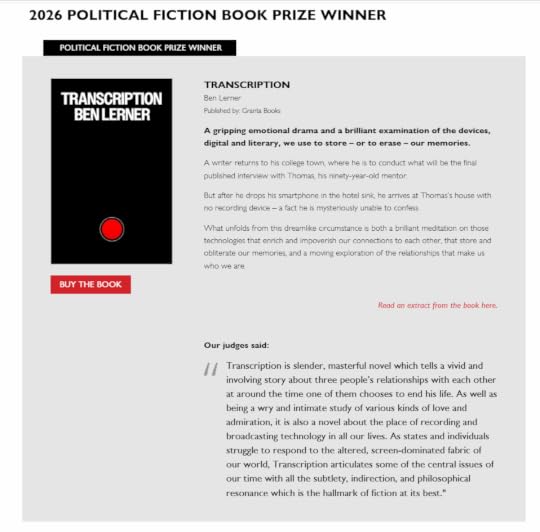
mementoize
məˈmenˌtōˈīz/
verb / neologism
Definitions:
• 1. to tell a story in reverse order, as in the film Memento (2000) by director Christopher Nolan.
“Christopher Nolan didn’t invent reverse chronology story telling, but his film title Memento is the easiest to make into a verb: mementoize."
• 2. to read a book in reverse order to finish it, especially when reading it in forward order is not very interesting or compelling.
“The book was so dull I had to mementoize it in order to get through it."
• 3. a fictitious word invented for use in book reviews by The Lone Librarian™.