

What do you think?

The 25th Hour: How to Thrive (And Gain Ridiculous Amounts of Time) by Getting Out of Your Own Way
Are you craving not just extra time but the wisdom and self-awareness to use it joyfully and effectively? An elite executive coach brings us his proprietary approach to finding at least another hour in our day to do anything we want—all by learning to manage our fears and other emotions better.
We often equate saving time with working smarter. If only we could cut unnecessary meetings, streamline emails, and collaborate more strategically, we could claw back all the stolen hours in our day. While these tactical adjustments help, they only skim the surface. The real problem isn’t external, but internal. In The 25th Hour, Neal Schore reveals how our emotional reactions quietly eat away not just at our time but also our energy. It’s the unproductive worrying, the anxiety that blooms and spirals, the decisions we make based on fear, the obsession over other people’s actions and behaviors—all those complicated emotional dynamics that we so rarely address at work. More than anything else, we get in our own way.
In three parts, The 25th Hour offers a simple, practical, paradigm-shifting approach to professional development, moving the focus beyond strategies for greater efficiency to what really costs us so much time and our uncontrolled emotional responses.
Part I starts us off with some simple tools that can help you handle yourself better in any professional exchange, including the one question you should always ask yourself.
Part II introduces a series of strategies for maneuvering when life isn’t going as you’d hoped, including a failsafe way for resetting after a distracting or tough experience leaves you in a miasma of self-doubt.
Part III helps you reach new levels of achievement and efficiency by firing your fears, breaking with your automatic responses, and fighting back against impostor’s syndrome, with creative tools that will make you smile as you put them to work.
Drawing on Schore’s personal experiences and his successful work with some of today’s most consequential business leaders, The 25th Hour will show you how to manage yourself in order to manage your professional life. With proven guidance and tools for becoming more self-aware, reigning in unruly feelings, and preventing needless drama, this book will equip everyone from CEOs to students with the skills to focus in on what matters to work more productively and efficiently while also having more fun along the way. The counterintuitive surprise? Your colleagues will love that you don’t waste their time either!
We often equate saving time with working smarter. If only we could cut unnecessary meetings, streamline emails, and collaborate more strategically, we could claw back all the stolen hours in our day. While these tactical adjustments help, they only skim the surface. The real problem isn’t external, but internal. In The 25th Hour, Neal Schore reveals how our emotional reactions quietly eat away not just at our time but also our energy. It’s the unproductive worrying, the anxiety that blooms and spirals, the decisions we make based on fear, the obsession over other people’s actions and behaviors—all those complicated emotional dynamics that we so rarely address at work. More than anything else, we get in our own way.
In three parts, The 25th Hour offers a simple, practical, paradigm-shifting approach to professional development, moving the focus beyond strategies for greater efficiency to what really costs us so much time and our uncontrolled emotional responses.
Part I starts us off with some simple tools that can help you handle yourself better in any professional exchange, including the one question you should always ask yourself.
Part II introduces a series of strategies for maneuvering when life isn’t going as you’d hoped, including a failsafe way for resetting after a distracting or tough experience leaves you in a miasma of self-doubt.
Part III helps you reach new levels of achievement and efficiency by firing your fears, breaking with your automatic responses, and fighting back against impostor’s syndrome, with creative tools that will make you smile as you put them to work.
Drawing on Schore’s personal experiences and his successful work with some of today’s most consequential business leaders, The 25th Hour will show you how to manage yourself in order to manage your professional life. With proven guidance and tools for becoming more self-aware, reigning in unruly feelings, and preventing needless drama, this book will equip everyone from CEOs to students with the skills to focus in on what matters to work more productively and efficiently while also having more fun along the way. The counterintuitive surprise? Your colleagues will love that you don’t waste their time either!
- GenresNonfictionSelf Help
272 pages, Kindle Edition
Published August 13, 2026
Ratings & Reviews
Friends & Following
Create a free account to discover what your friends think of this book!
Community Reviews
Displaying 1 - 13 of 13 reviews

August 11, 2026
"The 25th Hour" takes an interesting approach to productivity, focusing on the time and energy we lose to worry, emotional reactions, assumptions, and workplace frustrations. Neal Schore draws on his experience as a business leader and executive coach to offer practical strategies for getting out of our own way and focusing on what matters.
While many of the concepts were familiar to me, I appreciated the reminder that managing our reactions is also a way of managing our time. This book may be especially helpful for newer employees and professionals developing their self-management skills.
Thank you to NetGalley, Avid Reader Press/Simon & Schuster, and Neal Schore for the digital ARC.
While many of the concepts were familiar to me, I appreciated the reminder that managing our reactions is also a way of managing our time. This book may be especially helpful for newer employees and professionals developing their self-management skills.
Thank you to NetGalley, Avid Reader Press/Simon & Schuster, and Neal Schore for the digital ARC.

Review of advance copy received from NetGalley
The Hour Fear Keeps for Itself
Neal Schore’s “The 25th Hour” is strongest when it treats time not as a scheduling problem, but as the story panic tells before work begins.
By Demetris Papadimitropoulos | July 24th, 2026
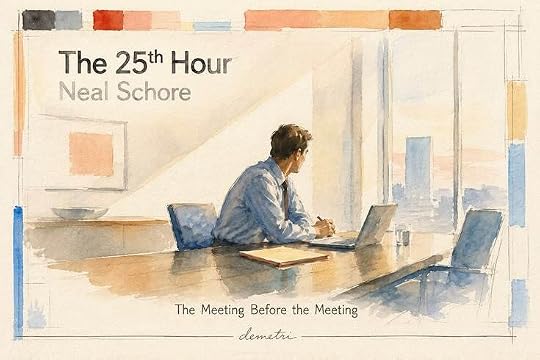
The Meeting Before the Meeting – In a room washed in the pale peach, butter-yellow, sky-blue, and gray quiet of “The 25th Hour,” dread arrives before the agenda does, and the missing hour begins as a private story told under professional light.
Don’t blame the calendar too quickly. That is the best trick in Neal Schore’s “The 25th Hour: How to Thrive (And Gain Ridiculous Amounts of Time) by Getting Out of Your Own Way.” The book arrives with the pitch of a manual for rescuing the day, then spends its pages finding dread under the conference table. The missing hour, Schore argues, is not always trapped in the inbox, the recurring meeting, the notification mist, or the agenda tyranny of the workday. More often, we hand it to the private courtroom: the invented slight, the defensive email, the conversation postponed until it curdles, the mistake promoted into catastrophe. Time is not merely scheduled here. It is narrated.
Even the title’s extra hour is less a clock trick than a dare. Schore, an executive coach and former entrepreneur, wants to move time management away from its usual shelf of hacks, inbox systems, calendar rules, and meeting housekeeping. Those things matter, but they are not where the deepest loss begins. The more expensive drain, he says, is dread: worry, resentment, self-doubt, hunger for reassurance, fear-based delay, and the habit of treating an ambiguous signal as a verdict. His book proposes that if people learn to manage those responses, they recover not only minutes but ease. The claim is simple enough to sound obvious and sharp enough to keep needling: the workday is full partly because fear keeps accepting invitations.
Most chapters start small, with an office snag and a bruise beginning under the surface. Ken’s failed product test becomes ten days of catastrophic forecast. Cara, a young CEO, mistakes an employee’s need for reassurance for a strategic emergency requiring her intervention. Stephen loses a weekend to the “Ucks,” then has to repay the forty-hour debt through sharper self-management. A hard question in a room of executives threatens to trigger defensiveness until a clarifying question offers escape. Again and again, Schore finds the click where an event becomes a story. The meeting is not just a meeting; it is proof that I am not respected. The mistake is not just a mistake; it is a prelude to ruin. The delay is not just delay; it is cowardice in a clean shirt.
Early on, Schore gives the book its grammar of interruption. “What’s the Intent?” asks readers to pause and consider what another person is really seeking before reacting. “Pose a Clarifying Question” buys time, defuses tension, and transfers some conversational labor back to the person who created the fog. “Credits and Debits” turns wasted feeling into a ledger of hours lost and saved. “What’s the Worst Thing That Can Happen?” forces dread to stop waving its arms and start doing math. Later come “the Ucks,” “Pity Party,” “cookies,” “the robot,” “Ten Minutes a Day,” and the “Line of Mediocrity.” The names can wobble. Sometimes the wobble helps. They are built to be grabbed under pressure, when one’s best intentions have stepped out for coffee.
The book is most useful when it shows how a feeling that seems private becomes a shared expense. A manager’s insecurity becomes a needless half-hour conversation. A leader’s resentment becomes a message nobody needed. A worker’s fear of looking ignorant becomes overtalking. A colleague’s insult becomes three days of mental rehearsal. “The 25th Hour” is less about saving my hour than about refusing to turn my panic into the team’s meeting. That is where it becomes more serious than its sales hook. The extra hour is the time spared when one person declines to export an overreaction.
Read straight through, however, the chapter pattern begins to clack. The usual sequence is anecdote, diagnosis, tool, application, payoff, exercise. Someone spirals; Schore names the pattern; the right tool makes its entrance; the person regains proportion, repairs a relationship, saves time, or grows into a more confident version of themselves. The sequence works, then starts to announce itself. At times the stories feel pre-arranged for conversion, as if every messy professional knot has been waiting politely for its coaching label. The book’s hammer is well made; it simply begins to admire the nail-like qualities of too many objects in the room.
In fairness, the prose knows its assignment. It is not trying to make sentences glow. It is brisk, emphatic, colloquial, and built for recall. Its units of value are the phrase one remembers before replying to a maddening email, the comic tag that lowers shame, the direct question that interrupts defensiveness. “The Ucks” is not Henry James, but Henry James would have been of limited use before a Monday budget meeting in which everyone is pretending not to be irritated. Schore’s diction lives in the executive-coaching room: blunt, encouraging, sometimes profane, sometimes goofily earnest, usually efficient. When it works, the informality makes self-command feel less like moral purification and more like noticing the banana peel on the carpet before one steps on it.
Perhaps the most revealing stylistic habit is the way the book turns inner states into props. The fearful voice becomes the Devil; the wiser self becomes the Angel; automatic behavior becomes the robot; praise becomes cookies; disappointment gets a scheduled party; mediocrity is plotted on a line. These metaphors are not atmospheric. They are handles on slippery moods. Their charm is also their limitation. The reader who likes tools will underline. The reader allergic to packaged self-awareness may feel held hostage at an off-site where the muffins are suspiciously excellent and the facilitator has one laminated card too many.
As structure, this is not accidental. The book has a clearer movement than its chapter-by-chapter drill first admits. Part I teaches readers to interrupt their own reactions in ordinary professional exchanges. Part II turns to adversity, insult, disappointment, gratitude, and reset. Part III becomes more ambitious, asking what it means to take risks, trust oneself, praise others, confront mediocrity, and practice vulnerability. The progression matters. The book begins with efficiency and ends nearer self-possession. It moves from “How do I avoid wasting this afternoon?” toward “What kind of person am I becoming when I stop letting fear direct so much of my conduct?”
Pressed beyond the mechanics, the later chapters become more affecting because the tools begin to ask larger questions. Schore’s discussion of mediocrity is his boldest wager. He redefines mediocrity not as incompetence but as cowardice: the idea not offered, the difficult conversation postponed, the risk dodged under cover of competence. The language is severe, and not every hesitation deserves such sentencing. Yet the chapter has bite because it touches something familiar in professional life: the quiet respectability of avoidance. Most workplaces contain people skilled enough to see what should be said and careful enough not to say it. Schore is at his best when he names that bargain without dressing it up as prudence.
A more tender enlargement comes near the end, when the book’s tools leave the meeting room and enter grief. Ellie, whose relationship with a difficult colleague has improved through the tools, faces her husband’s cancer diagnosis and death. The book does not pretend that self-management solves grief, which would be grotesque. Instead, it shows the tools helping her speak plainly, set boundaries, and refuse needless spirals when time has become brutally finite. Then the Epilogue offers Drew, Schore’s youngest son, arriving at a parents’ weekend dinner in dirty clothes and an old flannel pajama top, to his parents’ alarm. At the later gathering, the room turns toward him. He is not performing polish, managing impressions, or begging ordinary approval. Schore sees in him a natural version of the “Exceptional” mindset the book has been teaching.
Despite those late human turns, “The 25th Hour” has a hard ceiling. Its best claim survives repetition, but repetition still dulls it. Dread explains a great deal in the book, sometimes too much. Not every delay is cowardice. Not every difficult workplace dynamic is best understood as a failure of self-command. Not every anxious response is distortion; sometimes it is accurate weather detection. Bad bosses, unequal power, perverse incentives, burnout, precarity, and institutional dysfunction sit awkwardly inside a system so eager to hand the reader a tool and return them to agency. The book acknowledges that some crises require care no checklist can supply, but its broader confidence can still make bad conditions look too much like poorly managed reactions.
It also leans heavily on examples that arrive already buffed. Schore’s clients tend to improve, repair, advance, clarify, profit, delegate, reset, or become happier once the right tool enters the scene. Of course one understands why: this is a coaching book, not a tragedy, and it sells practice by making practice seem possible. Still, the smoothness has a cost. The reader may wish for more resistant cases, more failures, more moments in which a tool fails, stalls, or only partly helps. A little more friction would have made the victories feel more earned. The book is refreshingly willing to call out avoidance, but less willing to sit with situations where avoidance has reasons.
Measured against what it attempts, the book lands at 76/100, which translates to 3/5 stars on a Goodreads-compatible whole-star scale. That number is not a shrug; it is respect with the lights on. “The 25th Hour” is portable, sharp in places, and easy to remember under pressure, with a reframing worth keeping: the day does not vanish only because work is busy; it vanishes because fear adds tasks no one assigned. But the book is too repetitive, too anecdotal in its evidence, and too hungry to diagnose fear to feel fully distinguished. Its neighbors are books that turn the inner work of performance into practical advice: “The Power of Full Engagement” by Jim Loehr and Tony Schwartz, “Emotional Agility” by Susan David, “Deep Work” by Cal Newport, and, at a farther practical remove, “Getting Things Done” by David Allen. Schore’s contribution is narrower and more desk manual than doctrine, but usefully so: he gives the professional class a desk-side field guide to its own self-generated storms.
If the rating sounds restrained, the book’s afterlife in the next email may be stronger than the number suggests. Its best tools are already halfway into tomorrow. “What’s the Intent?” is a question one can imagine using before the next prickly message. So is “What’s the Worst Thing That Can Happen?” So is the quiet pause before answering the person who has just irritated you with theatrical efficiency. The book is not delicate, but delicacy is not always what saves the hour. Sometimes what saves it is a phrase plain enough to reach for before the Devil, the robot, or the Ucks has taken the chair at the head of the table.
That portability also explains why the book may divide readers. Those who like practical coaching, named frameworks, and quick behavioral handles will find it generous. Those allergic to motivational packaging may find it too tidy, too confident, too eager to turn ordinary self-awareness into a system. Schore’s warmth helps. So does his willingness to look silly. The best jokes in the book are not jokes exactly; they are shame reducers. “Cookies” is a ridiculous name for praise, but it makes praise easier to give and easier to receive. The silliness has a function. It lets the reader practice without feeling summoned before a tribunal.
Real workplace recognition enters without needing to be dragged in by the collar. Anyone who has watched a five-minute email become a half-day mood, or a small meeting slight become a week of private evidence-gathering, will know Schore’s territory. The office is already crowded with meetings, messages, tone-reading, and the pressure to appear steady while privately conducting a three-act opera of insecurity. Schore’s best insight is not that work is busy. We know. The sharper point is that work becomes psychologically expensive when every ambiguous signal is treated as a verdict.
One comparison clarifies both the value and the limit of the project. “Deep Work” by Cal Newport teaches readers to protect attention from distraction; “The 25th Hour” teaches them to protect attention from interpretation gone feral. “Emotional Agility” by Susan David offers a deeper psychological vocabulary for relating to emotion without being ruled by it; Schore offers a more corporate, more portable toolkit. “Getting Things Done” by David Allen asks readers to capture obligations so the mind can stop holding them. Schore asks readers to capture the fearful story before it starts rearranging the afternoon. It lacks Allen’s system, David’s psychological depth, and Newport’s austerity. It is livelier, messier, and eager enough to show you the laminated card.
Part of its appeal lies in that eagerness. Schore writes like someone who wants to grab the reader by the lapels, then offer a snack. There is a humane impulse beneath the executive patter: stop tormenting yourself; stop making everyone else attend the torment; ask the question; take the pause; give the cookie; apologize faster; tell the Devil to pack for vacation. The tone can become too pleased with its own labels, but it is rarely cold. For a book about high performers and leaders, it is notably interested in embarrassment, insecurity, wounded pride, and the small humiliations that make adults behave like cornered interns.
Of all its claims, the most durable is that the self is often the first meeting one needs to manage. That is not as glamorous as gaining a hidden hour, but it is more honest. Before the calendar fills, before the email is sent, before the difficult conversation is postponed, there is usually a flash of interpretation: They are excluding me. I am failing. I will look foolish. I cannot risk it. Schore’s tools are small interruptions placed at that flashpoint. They do not make the reader wise. They make the reader pause long enough to avoid becoming theatrically unwise.
Under the subtitle’s wink, then, “The 25th Hour” is least persuasive as a miracle of productivity and most persuasive as a manual of interruption. It interrupts fear before fear becomes prose. It interrupts resentment before resentment becomes culture. It interrupts the respectable little evasions that call themselves caution. It also interrupts the managerial fantasy that every hard day needs a better app, cleaner workflow, or more disciplined morning routine. Sometimes the day needs a calmer interpreter of events. Sometimes the hour is not lost. It is being held hostage by a story.
Looked at as a book built for use, its bluntness begins to look less like excess than design. A more elegant book might produce a finer theory of emotion and work; this one produces phrases that can survive contact with annoyance. There is value in advice sturdy enough to remain legible while the pulse is up. A person in mid-spiral does not need a sonata. A kazoo, if blown at the correct second, may do.
One leaves the book wishing it trusted difficulty more, but also admitting that several of its questions travel well. What is the intent? What is the worst thing that can happen? What am I making this mean? What am I avoiding while congratulating myself on being careful? Timing is the tool. Asked before the defensive reply, before the extra meeting, before the three days of private prosecution, the questions become small levers. Schore’s book is full of such levers. A few bend in the hand; a few pry open more than their plastic brightness promises.
Schore leaves us not with a dashboard, a calendar, or a workflow, but with Drew on the rooftop, badly dressed and entirely at home. That is the image that quietly improves the argument. The recovered hour is not finally for squeezing one more task into the day. It is for living with less defensive choreography. It is for entering the room without first consulting the tribunal in one’s head. It is for discovering, with some embarrassment and relief, that when fear stops arranging the schedule, there may be a little more life left in the day than expected.
Neal Schore’s “The 25th Hour” is strongest when it treats time not as a scheduling problem, but as the story panic tells before work begins.
By Demetris Papadimitropoulos | July 24th, 2026
The Meeting Before the Meeting – In a room washed in the pale peach, butter-yellow, sky-blue, and gray quiet of “The 25th Hour,” dread arrives before the agenda does, and the missing hour begins as a private story told under professional light.
Don’t blame the calendar too quickly. That is the best trick in Neal Schore’s “The 25th Hour: How to Thrive (And Gain Ridiculous Amounts of Time) by Getting Out of Your Own Way.” The book arrives with the pitch of a manual for rescuing the day, then spends its pages finding dread under the conference table. The missing hour, Schore argues, is not always trapped in the inbox, the recurring meeting, the notification mist, or the agenda tyranny of the workday. More often, we hand it to the private courtroom: the invented slight, the defensive email, the conversation postponed until it curdles, the mistake promoted into catastrophe. Time is not merely scheduled here. It is narrated.
Even the title’s extra hour is less a clock trick than a dare. Schore, an executive coach and former entrepreneur, wants to move time management away from its usual shelf of hacks, inbox systems, calendar rules, and meeting housekeeping. Those things matter, but they are not where the deepest loss begins. The more expensive drain, he says, is dread: worry, resentment, self-doubt, hunger for reassurance, fear-based delay, and the habit of treating an ambiguous signal as a verdict. His book proposes that if people learn to manage those responses, they recover not only minutes but ease. The claim is simple enough to sound obvious and sharp enough to keep needling: the workday is full partly because fear keeps accepting invitations.
Most chapters start small, with an office snag and a bruise beginning under the surface. Ken’s failed product test becomes ten days of catastrophic forecast. Cara, a young CEO, mistakes an employee’s need for reassurance for a strategic emergency requiring her intervention. Stephen loses a weekend to the “Ucks,” then has to repay the forty-hour debt through sharper self-management. A hard question in a room of executives threatens to trigger defensiveness until a clarifying question offers escape. Again and again, Schore finds the click where an event becomes a story. The meeting is not just a meeting; it is proof that I am not respected. The mistake is not just a mistake; it is a prelude to ruin. The delay is not just delay; it is cowardice in a clean shirt.
Early on, Schore gives the book its grammar of interruption. “What’s the Intent?” asks readers to pause and consider what another person is really seeking before reacting. “Pose a Clarifying Question” buys time, defuses tension, and transfers some conversational labor back to the person who created the fog. “Credits and Debits” turns wasted feeling into a ledger of hours lost and saved. “What’s the Worst Thing That Can Happen?” forces dread to stop waving its arms and start doing math. Later come “the Ucks,” “Pity Party,” “cookies,” “the robot,” “Ten Minutes a Day,” and the “Line of Mediocrity.” The names can wobble. Sometimes the wobble helps. They are built to be grabbed under pressure, when one’s best intentions have stepped out for coffee.
The book is most useful when it shows how a feeling that seems private becomes a shared expense. A manager’s insecurity becomes a needless half-hour conversation. A leader’s resentment becomes a message nobody needed. A worker’s fear of looking ignorant becomes overtalking. A colleague’s insult becomes three days of mental rehearsal. “The 25th Hour” is less about saving my hour than about refusing to turn my panic into the team’s meeting. That is where it becomes more serious than its sales hook. The extra hour is the time spared when one person declines to export an overreaction.
Read straight through, however, the chapter pattern begins to clack. The usual sequence is anecdote, diagnosis, tool, application, payoff, exercise. Someone spirals; Schore names the pattern; the right tool makes its entrance; the person regains proportion, repairs a relationship, saves time, or grows into a more confident version of themselves. The sequence works, then starts to announce itself. At times the stories feel pre-arranged for conversion, as if every messy professional knot has been waiting politely for its coaching label. The book’s hammer is well made; it simply begins to admire the nail-like qualities of too many objects in the room.
In fairness, the prose knows its assignment. It is not trying to make sentences glow. It is brisk, emphatic, colloquial, and built for recall. Its units of value are the phrase one remembers before replying to a maddening email, the comic tag that lowers shame, the direct question that interrupts defensiveness. “The Ucks” is not Henry James, but Henry James would have been of limited use before a Monday budget meeting in which everyone is pretending not to be irritated. Schore’s diction lives in the executive-coaching room: blunt, encouraging, sometimes profane, sometimes goofily earnest, usually efficient. When it works, the informality makes self-command feel less like moral purification and more like noticing the banana peel on the carpet before one steps on it.
Perhaps the most revealing stylistic habit is the way the book turns inner states into props. The fearful voice becomes the Devil; the wiser self becomes the Angel; automatic behavior becomes the robot; praise becomes cookies; disappointment gets a scheduled party; mediocrity is plotted on a line. These metaphors are not atmospheric. They are handles on slippery moods. Their charm is also their limitation. The reader who likes tools will underline. The reader allergic to packaged self-awareness may feel held hostage at an off-site where the muffins are suspiciously excellent and the facilitator has one laminated card too many.
As structure, this is not accidental. The book has a clearer movement than its chapter-by-chapter drill first admits. Part I teaches readers to interrupt their own reactions in ordinary professional exchanges. Part II turns to adversity, insult, disappointment, gratitude, and reset. Part III becomes more ambitious, asking what it means to take risks, trust oneself, praise others, confront mediocrity, and practice vulnerability. The progression matters. The book begins with efficiency and ends nearer self-possession. It moves from “How do I avoid wasting this afternoon?” toward “What kind of person am I becoming when I stop letting fear direct so much of my conduct?”
Pressed beyond the mechanics, the later chapters become more affecting because the tools begin to ask larger questions. Schore’s discussion of mediocrity is his boldest wager. He redefines mediocrity not as incompetence but as cowardice: the idea not offered, the difficult conversation postponed, the risk dodged under cover of competence. The language is severe, and not every hesitation deserves such sentencing. Yet the chapter has bite because it touches something familiar in professional life: the quiet respectability of avoidance. Most workplaces contain people skilled enough to see what should be said and careful enough not to say it. Schore is at his best when he names that bargain without dressing it up as prudence.
A more tender enlargement comes near the end, when the book’s tools leave the meeting room and enter grief. Ellie, whose relationship with a difficult colleague has improved through the tools, faces her husband’s cancer diagnosis and death. The book does not pretend that self-management solves grief, which would be grotesque. Instead, it shows the tools helping her speak plainly, set boundaries, and refuse needless spirals when time has become brutally finite. Then the Epilogue offers Drew, Schore’s youngest son, arriving at a parents’ weekend dinner in dirty clothes and an old flannel pajama top, to his parents’ alarm. At the later gathering, the room turns toward him. He is not performing polish, managing impressions, or begging ordinary approval. Schore sees in him a natural version of the “Exceptional” mindset the book has been teaching.
Despite those late human turns, “The 25th Hour” has a hard ceiling. Its best claim survives repetition, but repetition still dulls it. Dread explains a great deal in the book, sometimes too much. Not every delay is cowardice. Not every difficult workplace dynamic is best understood as a failure of self-command. Not every anxious response is distortion; sometimes it is accurate weather detection. Bad bosses, unequal power, perverse incentives, burnout, precarity, and institutional dysfunction sit awkwardly inside a system so eager to hand the reader a tool and return them to agency. The book acknowledges that some crises require care no checklist can supply, but its broader confidence can still make bad conditions look too much like poorly managed reactions.
It also leans heavily on examples that arrive already buffed. Schore’s clients tend to improve, repair, advance, clarify, profit, delegate, reset, or become happier once the right tool enters the scene. Of course one understands why: this is a coaching book, not a tragedy, and it sells practice by making practice seem possible. Still, the smoothness has a cost. The reader may wish for more resistant cases, more failures, more moments in which a tool fails, stalls, or only partly helps. A little more friction would have made the victories feel more earned. The book is refreshingly willing to call out avoidance, but less willing to sit with situations where avoidance has reasons.
Measured against what it attempts, the book lands at 76/100, which translates to 3/5 stars on a Goodreads-compatible whole-star scale. That number is not a shrug; it is respect with the lights on. “The 25th Hour” is portable, sharp in places, and easy to remember under pressure, with a reframing worth keeping: the day does not vanish only because work is busy; it vanishes because fear adds tasks no one assigned. But the book is too repetitive, too anecdotal in its evidence, and too hungry to diagnose fear to feel fully distinguished. Its neighbors are books that turn the inner work of performance into practical advice: “The Power of Full Engagement” by Jim Loehr and Tony Schwartz, “Emotional Agility” by Susan David, “Deep Work” by Cal Newport, and, at a farther practical remove, “Getting Things Done” by David Allen. Schore’s contribution is narrower and more desk manual than doctrine, but usefully so: he gives the professional class a desk-side field guide to its own self-generated storms.
If the rating sounds restrained, the book’s afterlife in the next email may be stronger than the number suggests. Its best tools are already halfway into tomorrow. “What’s the Intent?” is a question one can imagine using before the next prickly message. So is “What’s the Worst Thing That Can Happen?” So is the quiet pause before answering the person who has just irritated you with theatrical efficiency. The book is not delicate, but delicacy is not always what saves the hour. Sometimes what saves it is a phrase plain enough to reach for before the Devil, the robot, or the Ucks has taken the chair at the head of the table.
That portability also explains why the book may divide readers. Those who like practical coaching, named frameworks, and quick behavioral handles will find it generous. Those allergic to motivational packaging may find it too tidy, too confident, too eager to turn ordinary self-awareness into a system. Schore’s warmth helps. So does his willingness to look silly. The best jokes in the book are not jokes exactly; they are shame reducers. “Cookies” is a ridiculous name for praise, but it makes praise easier to give and easier to receive. The silliness has a function. It lets the reader practice without feeling summoned before a tribunal.
Real workplace recognition enters without needing to be dragged in by the collar. Anyone who has watched a five-minute email become a half-day mood, or a small meeting slight become a week of private evidence-gathering, will know Schore’s territory. The office is already crowded with meetings, messages, tone-reading, and the pressure to appear steady while privately conducting a three-act opera of insecurity. Schore’s best insight is not that work is busy. We know. The sharper point is that work becomes psychologically expensive when every ambiguous signal is treated as a verdict.
One comparison clarifies both the value and the limit of the project. “Deep Work” by Cal Newport teaches readers to protect attention from distraction; “The 25th Hour” teaches them to protect attention from interpretation gone feral. “Emotional Agility” by Susan David offers a deeper psychological vocabulary for relating to emotion without being ruled by it; Schore offers a more corporate, more portable toolkit. “Getting Things Done” by David Allen asks readers to capture obligations so the mind can stop holding them. Schore asks readers to capture the fearful story before it starts rearranging the afternoon. It lacks Allen’s system, David’s psychological depth, and Newport’s austerity. It is livelier, messier, and eager enough to show you the laminated card.
Part of its appeal lies in that eagerness. Schore writes like someone who wants to grab the reader by the lapels, then offer a snack. There is a humane impulse beneath the executive patter: stop tormenting yourself; stop making everyone else attend the torment; ask the question; take the pause; give the cookie; apologize faster; tell the Devil to pack for vacation. The tone can become too pleased with its own labels, but it is rarely cold. For a book about high performers and leaders, it is notably interested in embarrassment, insecurity, wounded pride, and the small humiliations that make adults behave like cornered interns.
Of all its claims, the most durable is that the self is often the first meeting one needs to manage. That is not as glamorous as gaining a hidden hour, but it is more honest. Before the calendar fills, before the email is sent, before the difficult conversation is postponed, there is usually a flash of interpretation: They are excluding me. I am failing. I will look foolish. I cannot risk it. Schore’s tools are small interruptions placed at that flashpoint. They do not make the reader wise. They make the reader pause long enough to avoid becoming theatrically unwise.
Under the subtitle’s wink, then, “The 25th Hour” is least persuasive as a miracle of productivity and most persuasive as a manual of interruption. It interrupts fear before fear becomes prose. It interrupts resentment before resentment becomes culture. It interrupts the respectable little evasions that call themselves caution. It also interrupts the managerial fantasy that every hard day needs a better app, cleaner workflow, or more disciplined morning routine. Sometimes the day needs a calmer interpreter of events. Sometimes the hour is not lost. It is being held hostage by a story.
Looked at as a book built for use, its bluntness begins to look less like excess than design. A more elegant book might produce a finer theory of emotion and work; this one produces phrases that can survive contact with annoyance. There is value in advice sturdy enough to remain legible while the pulse is up. A person in mid-spiral does not need a sonata. A kazoo, if blown at the correct second, may do.
One leaves the book wishing it trusted difficulty more, but also admitting that several of its questions travel well. What is the intent? What is the worst thing that can happen? What am I making this mean? What am I avoiding while congratulating myself on being careful? Timing is the tool. Asked before the defensive reply, before the extra meeting, before the three days of private prosecution, the questions become small levers. Schore’s book is full of such levers. A few bend in the hand; a few pry open more than their plastic brightness promises.
Schore leaves us not with a dashboard, a calendar, or a workflow, but with Drew on the rooftop, badly dressed and entirely at home. That is the image that quietly improves the argument. The recovered hour is not finally for squeezing one more task into the day. It is for living with less defensive choreography. It is for entering the room without first consulting the tribunal in one’s head. It is for discovering, with some embarrassment and relief, that when fear stops arranging the schedule, there may be a little more life left in the day than expected.

September 14, 2026
I got my copy from the library.
I enjoyed this book and thought it had valuable information. Although it sometimes dragged on.
I enjoyed this book and thought it had valuable information. Although it sometimes dragged on.

August 12, 2026
I enjoyed reading this book. I have done some work on improving myself and this book gave me more ideas on how to keep working on that. Several parts of the book resonated with me. A few were about letting yourself be miserable and working through how you feel or having a short pity party for yourself. I have thought this to be very beneficial. I think this is work that we are all continuing to work on. I think the authors conversations about the worst case scenario were great to understand that sometimes the worst case scenario isn’t that big of a deal. I will be revisiting this book.
Updated: I have been thinking about the tools from this book more often than I realized. A few of them resonated with me so I’m going to change my star rating.
Thank you to Neal Schore, NetGalley and Avid Reader Press for the advanced copy of this book in exchange for an honest review.
Publication Date: August 11, 2026
Updated: I have been thinking about the tools from this book more often than I realized. A few of them resonated with me so I’m going to change my star rating.
Thank you to Neal Schore, NetGalley and Avid Reader Press for the advanced copy of this book in exchange for an honest review.
Publication Date: August 11, 2026
September 9, 2026
Ah yes, another rich white man telling us that the real problem isn't the unreasonable expectations of our bosses or the financial worries created by those bosses refusing to pay us fairly or the numerous forms of bigotry faced by workers who are not the gender and race of the author. No, the real problem is..."YOU HAVE HUMAN EMOTIONS AND YOUR BOSS WANTS YOU TO BE A ROBOT. STOP FEELING AND START ON THE TO-DO LIST."

August 28, 2026
"We don't lose time to tasks—we lose it to our reactions. By learning to manage the emotions that drive our behavior, we can reclaim focus, improve our relationships, and ultimately get more out of every day."
— Nir Eyal (Author of Indistractable, reviewing the core thesis)
— Nir Eyal (Author of Indistractable, reviewing the core thesis)

August 23, 2026
I have selected this book as Stevo's Business Book of the Week for the week of 8/23, as it stands heads above other recently published books on this topic.
September 6, 2026
Excellent, will reread.

September 16, 2026
lots of good advice in here on how to find more time - mainly by taming your own thoughts.

September 20, 2026
some nice ideas and concepts, but not into his overall plan

Review of advance copy received from Netgalley
Thank you to NetGalley for the ARC in exchange for an honest review.
4 stars.
This book was unfortunately predictable and therefore mildly disappointing. I really wanted to like this book. I'm a fan of productivity, however, think Marie Forleo, Amy Porterfield and Danielle Laporte. If you're a fan of Gary Keller, Phil Knight and Tony Robbins, this will be your jam.
The book discusses the typical productivity advice. Some of it is worth listening to, however I nearly DNFed when the author gives the suggestion of "asking a clarifying question" that's really just answering a question with a question. If you don't know the meaning of something, ask what it means. A little humility goes a long way, but books like these tend to rest on the fact that the reader is pretty privileged and is given the benefit of the doubt in job interviews.
This book glosses over parenthood, specifically motherhood, a major oversight (and I'm not a mom!). This book is for a 20-early 40 year old with few familial ties or with someone that can take over for them. Time is not always transactional, sometimes it's about nurturing those around you, rather than creating “debits and credits”. Time transforms, it’s not always a transactional. The book sees time in a very black-and-white format, when time tends to be on a spectrum. Again, if you liked Phil Knight, Tony Robbins, Gary Keller, this is your book.
4 stars.
This book was unfortunately predictable and therefore mildly disappointing. I really wanted to like this book. I'm a fan of productivity, however, think Marie Forleo, Amy Porterfield and Danielle Laporte. If you're a fan of Gary Keller, Phil Knight and Tony Robbins, this will be your jam.
The book discusses the typical productivity advice. Some of it is worth listening to, however I nearly DNFed when the author gives the suggestion of "asking a clarifying question" that's really just answering a question with a question. If you don't know the meaning of something, ask what it means. A little humility goes a long way, but books like these tend to rest on the fact that the reader is pretty privileged and is given the benefit of the doubt in job interviews.
This book glosses over parenthood, specifically motherhood, a major oversight (and I'm not a mom!). This book is for a 20-early 40 year old with few familial ties or with someone that can take over for them. Time is not always transactional, sometimes it's about nurturing those around you, rather than creating “debits and credits”. Time transforms, it’s not always a transactional. The book sees time in a very black-and-white format, when time tends to be on a spectrum. Again, if you liked Phil Knight, Tony Robbins, Gary Keller, this is your book.
This entire review has been hidden because of spoilers.

Review of advance copy received from Netgalley
Many thanks to NetGalley for the eARC of this book.
Anytime I go into a business/time management/self help book like this, I try to imagine I am reading this type of book for the first time. There are a lot of great management and personal suggestions and tips in this book, shortcuts that Schore refers to as his "tools" to help in all sorts of relationships and situations.
That said, I didn't really feel like this book followed through on the thesis of giving someone that vaunted 25th hour. The "debits and credits" tool is probably the closest tool to that overall theme, but the others are really just generally good ideas, not necessarily tangible time savers.
This book is certainly good if you're looking for a general guide to management, but not necessarily one that will shave minutes off your day to find elusive hidden productivity.
Anytime I go into a business/time management/self help book like this, I try to imagine I am reading this type of book for the first time. There are a lot of great management and personal suggestions and tips in this book, shortcuts that Schore refers to as his "tools" to help in all sorts of relationships and situations.
That said, I didn't really feel like this book followed through on the thesis of giving someone that vaunted 25th hour. The "debits and credits" tool is probably the closest tool to that overall theme, but the others are really just generally good ideas, not necessarily tangible time savers.
This book is certainly good if you're looking for a general guide to management, but not necessarily one that will shave minutes off your day to find elusive hidden productivity.
Review of advance copy received from Netgalley
A solid book for any leader or team member feeling that every day is the same. While the tools and strategies are not groundbreaking or revolutionary in their delivery, the book is a guide on fighting back against becoming just ordinary in a workplace. When we start a job, we quickly adapt to the prevailing culture, the default communication systems, and avoid being direct. This often, while easy, gets in the way of letting you stand out and be extraordinary. This book was a good reminder for me to restart some things that I had let slide over time and has given me a package of new tools I'm excited to try. If you are a leader or a team member, and you feel your job has become ordinary, give this book a read.
Displaying 1 - 13 of 13 reviews