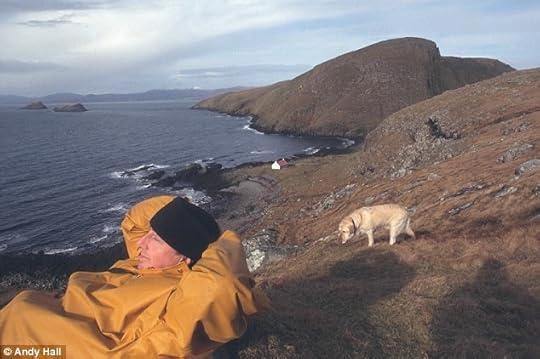
This was a beautifully written biography of a place, not quite like any I have read before. Entirely devoted to three Scottish islands known as the Shiants (“one definite, softened syllable, ‘the Shant Isles’, like a sea shanty but with the ‘y’ trimmed away”), they are an archipelago of three islands in the Hebrides, about 550 acres in size, about four miles off the coast of Lewis, located in a body of water called the Minch, their names Garbh Eilean, Eilean an Tighe, and Eilean Mhuire. The author intended in the book to immerse himself in the islands in an attempt to tell their whole story “in as many dimensions as possible: geologically, spiritually, botanically, historically, culturally, aesthetically, ornithologically, etymologically, emotionally, politically, socially, archaeologically, and personally.”
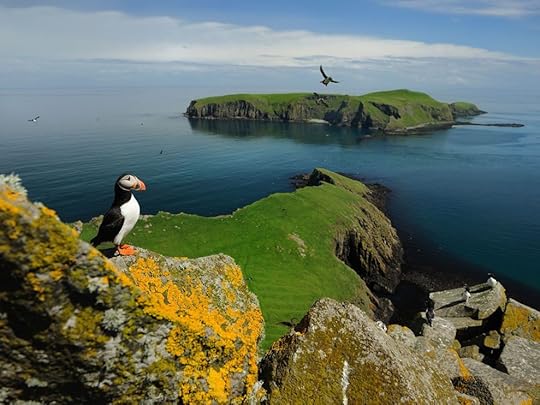
Right away in a very early paragraph you can tell the author loves these islands, lands “with black cliffs five hundred feet tall dropping into a cold, dark, peppermint sea, with seals lounging at their feet, the lobsters picking their way between the boulders and kelp and thousands upon thousands of sea birds wheeling above the rocks.” Again and again he describes the feel of being on the islands any time of day or night, all year long, of being in the waters around them, climbing the rocks, being among the wildlife and the sheep, of spending time with the locals who have made either a living there fishing and shepherding or with scientists have studied the island’s geology, biology, and archaeology, all described with a novelist’s eye and amply illustrated with photographs and maps.
Geology fairly early on is very well discussed, with the author noting that the Shiants are the “most northerly extension of the British volcanic landscape” and the “most northerly example” of columnar dolerite, the author vividly describing the geological origins of these and other rocks in the Shiants, what they look like, and the sometimes deadly dangers of climbing them. The columnar rocks were fascinating, as from time to time entire columns collapse into the sea as the base of each column gets eaten away by the ocean, as “the columns of which the islands are made are scarcely more bound to each other than pencils in a box and once the base has gone, knocked out by a winter storm, there is nothing to withstand the force of gravity.” Said to be similar in some ways to a glacier calving, where the splits occur “the remaining edges are as sharp as knives,” while the “bare unlichened stone smells of iron or even blood, because blood smells of iron too.”
Though not getting a lot into botany per se, Nicolson never failed to note the surprising number of flowers that bloom in the archipelago, noting early in the book for instance that in summer “the grass on the cliff-tops is thick with flowers: bog asphodel and bog pimpernel; branched orchids, the stars of tormentil and milkwort,” with other plants including wild thyme, purple knapweed, hart’s tongue ferns, forget-me-nots, meadowsweet, yellow flags, and watermint. Of all the natural history subjects covered in the book this was probably the one he spent the least amount of time on, though he was far from “plant blind” and always noted wildflowers and other plants wherever they occurred (and not just through dull listings but describing what they looked like and sometimes what they meant to him or in the past to the previous inhabitants).
Birds more than any other wildlife were described again and again in truly well written prose, everything from snipe (“fluting at night over their territories” in the marsh) to short-eared owls (cruising “low over the rushes for the voles that are its only prey”) to white-tailed sea eagles (with a “leonine presence,” “the only truly imperial creature in the British Isles”), to ravens (which gleefully harass the eagles playing “like Messerschmitts around” them). Most of the all the seabirds are well discussed, as the Shiants are “one of the great bird places in the world,” boasting between 15,000-18,000 guillemots, 8,000 to 11,000 razorbills, between 4,000 and 6,000 fulmars, about 2000 kittiwakes, about 1500 shags, a few hundred gulls of various species, 26 great skuas, and 240,000 puffins (“about one in eight of the British total and two per cent of all the puffins in the world”). The seabirds are especially well detailed, the author vividly portraying what they look and sound like, what is it is like to see them in such dense numbers in the breeding season (and perhaps not see them at all outside of that season), of how they subdivide the various ecological niches around the island, with for instance noting how gulls and kittiwakes dabble at the surface while puffins dive to depths of 30 to 40 feet, while the guillemots plunge “much deeper, often to a hundred and fifty feet, and going much further afield.” My favorite descriptions were of the shags, as nothing “can prepare you for the reality of the shag experience. It is an all-power meeting with an extraordinary, ancient, corrupt, imperial, angry, dirty, green-eyed, yellow-gaped, oil-skinned, iridescent, rancid, rock-hole glory that is Phalacrocorax aristotelis,” a creature that lives in a “stinking slum,” which if one approaches, “hawks and spits at you, its gizzard shaking in anger and fear, its whole head prodding and prodding towards you, like an angry finger.”
Additionally, it was interesting to read accounts of when the birds used to be trapped and eaten (or the eggs collected and eaten), with the author reproducing a chart compiled by Cambridge zoologist HB Cott in the early 1950s in which he rated the various how the eggs of the various seabird species tasted when scrambled, which ranged from “very good” for the lesser black-backed gull and kittiwake to “unpleasant” and “off” for the shag.
Rather late in the book he delved into a subject that is around the edges the entire time one reads this work, scurrying in the walls of the single house still fit for human occupation on the island (in that it has walls and a roof), of the sounds heard at night as he slept next to the fire, evidence of their nocturnal excursions obvious the next day; rats. Possibly as many as three thousand rats call the Shiants home. No one knows how they got there originally or how long they have been there, but it was interesting that they weren’t “the rats you find at home in the barn or the sewer,” the brown rat (Rattus norvegicus), but instead now a rare rat in the UK, the ship, black, or plague rat (Rattus rattus). One might have thought they would have denuded the islands of their numerous seabirds, but Nicolson went to offer theories as to why there may actually be some sort of equilibrium between nesting birds and the rats.
I really liked how the author made the waters around the islands come alive, describing them as dynamic places with almost a personality, of how the water, far from being a static thing, moved and pulsed in response to the winds, tides, currents, and often most of all the undersea topography, of how the water could be very unpleasant for instance where it was squeezed between islands in narrow channels, perhaps further agitated as it was “forced to run over a knotted and fractured sea-bed.” He learned to be wary of the many underwater rocks around the Shiants, that though dangerous became familiar to him like an “ill-tempered dog,” mindful of some rocks that looked “black and bitter, the knobbled spine of a half-submerged creature.” It wasn’t just the author who saw creatures and animate beings in the often chaotic waters around the islands, as the “Sound of Shiant is also known as the Sruth na Fear Gorm, the Stream of the Blue Men, or more exactly the Blue-green Men,” as the “adjective in Gaelic describes that dark half-colour which is the colour of deep sea water at the foot of a black cliff” but also that according to folklore and tall tales, describes the Blue-Green Men, who “are strange, dripping, semi-human creatures who come aboard and sit alongside you in the sternsheets, sing a verse or two of a complex sign and, if you are unable to continue in the same metre and with the same rhyme, sink your boat and drown your crew.”
Though the islands, uninhabited for well over a century, are regarded as wild, remote, and nearly wilderness, Nicolson never lets the reader forget this is very much a human landscape. Much of that history is told through accounts of personal triumph and more often tragedy, either recorded at the time or what he can be discerned from what archaeologists and he himself found on the island showing the lives of inhabitants from before the Middle Ages all the way up into the 20th century, everything from a very rare and valuable golden torc to a “hermit’s pillow stone, the medieval brooch, the decorated craggenware, the stone stools, the scrimshawed plate, the kelp irons, the boat nails from the house roof,” to a fragment of a lovingly crafted wooden toy boat, each item vividly described, often illustrated with photographs or sketches, each one opening up to a reader a lost history, one very rarely written down or with any named individuals attached to it.
Again and again in the book, Nicolson shares his thoughts on what islands mean to the human spirit and day-to-day life and how this changed through time for the inhabitants and visitors of the Shiants. Over the centuries the islands went from being rich places, able to provide a living to their inhabitants and part of the wider world around them, the inhabitants benefitting from the local markets as much as they benefitted from them, of the islanders being part of local churches or clan conflicts or even rarely larger tides of history, that “to be on the Shiants was to have the benefits of good soils, the riches of the birds and fish…[i]t was not to be deprived of anything the mainland could offer…a sea room with sea room, a place enlarged by its circumstances, not confined by them” to eventually with the coming of modernity in the eighteenth century being felt even by the those who loved the place as a realm that was cut off and just too isolated for people to remain, a place that was forgotten and unneeded. When the islands emptied, they became seen as awful places for a time as illustrated by the views of Robinson Crusoe, the author writing the Shiants were seen, just as Crusoe viewed islands, “in some ways a prison, a symbol of…suffering, divorced from the company of men.”
Still later the islands after they emptied of families who had lived increasingly hard lives (even facing at times starvation) they began again to be seen as wonderful places, such as viewed by authors as Jean-Jacques Rousseau (not specifically writing about the Shiants), as places where the solitary self could flower, a place where “dreamy-eyed travelers from the south were coming to see…as a vision of earthly beauty” (or derisively by authors such as DH Lawrence who according to Nicolson islands are “not so much islands as I-lands, where the inflated self smothers and obliterates all other forms of life”), a decidedly modern and romantic view.
Either because of his love for history and to immerse himself in the islands, or perhaps conscious of his own at times romanization of the Shiants, Nicolson notes that one, in appreciating the island’s modern, wild, isolated nature, should never forget the human cost behind such a thing. The author described at length what life was like on the Shiants for centuries, of how at one point there were originally five family farms located there, but with the changing markets due to globalization, demands of distant landlords that the inhabitants couldn’t meet and also produce enough food to eat, and perhaps the desire of the island’s owners to squeeze more money from the islands, profiting much less from resident farmers and shepherds and much more from seasonal kelpers and shepherds, the islands began to die by the 1720s. Instead of being rich places or at least decent places to live the Shiants became at the very least a place where “[i]nsularity was now a symptom of backwardness and isolation a kind of failure” to at worst “a kind of hell,” the islanders either left of their own accord because they couldn’t make a living there or were (somewhat less likely in the case of the Shiants) forced out. Nicolson wrote that because of the “continuing resonance of the Clearances” that there are those who strongly hold beliefs that the empty, uninhabited lands of Scotland “are an insult to society,” with some even going so far as to call for an end to private land ownership, a subject the author address again and again towards the end of the book, of hard feelings about how “southerners with southern money came to entertain themselves in a romantic and deserted island,” islands that once had families and where people fished and collected seaweed and took care of sheep and were born and died. I think Nicolson tried to walk a razor’s edge between noting that the islands were once very much homes to people for centuries, places abandoned either under the duress of poverty and starvation or the greed of distant landlords, while at the same time loving, treasuring, and working hard to preserve their modern beauty of windswept wildflowers, dark sea cliffs, wheeling, screeching seabirds, and Viking-era ruins.
The author’s own views of the islands, what the idea of islands mean to him, as owner of the islands (having inherited them from his father and not long after he published the book said he would hand them off to his son), were that being on the islands excited him, that the island’s “wonderful sea room, the surge of freedom which a moated island provides” enlarged him, a feeling that he carried with him even when far from the Shiants. Again and again Nicolson came back to what the islands meant to him. Far from finding this boring or self-indulgent, I enjoyed reading this as it was an exploration in a sense of what the Shiants meant to previous generations and what islands in general mean to people who love them.