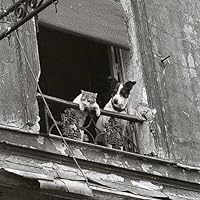
Used to the regularity of home life, orphaned Emma goes to live with a bohemian aunt in Edinburgh who keeps unusual hours, has strange friends, leaves the dishes, which helps Emma develop a sense of responsibility and maturity.
Honor Arundel was a novelist for children and young adults, critic, playwright, poet, editor, and journalist.
Arundel's novels for young people have earned her a reputation as an author sensitive to the conflict between responsibility to oneself and responsibility to others that many adolescent girls find difficult to resolve. She began writing novels for teenagers when her daughter complained about the lack of stories about "ordinary children … with real problems" with whom they could identify. Many critics and readers have appreciated Arundel's honesty in describing predicaments that have no easy resolution in life, but she has been criticized for portraying young women who are so closely tied to their families that they lack realistic aspirations outside of family life as well as the confidence necessary to achieve them.
The strong sense of place in Arundel's books, most of which are set in Edinburgh or in the south country of Scotland, testifies to her knowledge and love of the two places she called home.
Her last book, The Blanket Word, which tells of a teenaged daughter's response to her mother's fatal illness, was written while she herself was dying of cancer.
A dearly beloved book of my childhood. I was a lonely only child when I read this book for the 1st time and I identified with the main character (Emma) very much. I have loved this book ever since. I read The High House many times as a child but never owned it. I was lucky enough to find a US 1st edition copy to keep as my own and read it for the 1st time with adult eyes in 2009.
A rereading of a book I read long ago as a child. Oh the joys of a public library that I was able to walk to. I devoured many a book and this one came to mind the other day when reading a Rumer Godden book. I enjoyed it way back when and again over the last day or so. The best of stories doesn't date.
I read this book as a teenager, in the 1970s, it was way ahead of it's time then and i thought it was brilliant. Would like to read it again as an adult to see if it's still as good, or maybee it's dated now.
In the 1970s, there seemed to be a lot of books about orphaned or motherless girls who had to take on adult responsibilities and in so doing learned that love is more important than a clean house. I recall reading that book at least twice as Reeney by Molly Cone and another one about some orphan girl named Ellen. If Judy Blume hasn't already written that book then she probably will at some point.
A couple of weeks ago, I passed by my neighborhood Little Free Library and there was that book again, this time as The High House. Siblings Emma and Richard are sent to live with different aunts after their parents are killed in an accident. Budding musician Richard's aunt is orderly and believes in routine; judgmental killjoy Emma's is an artist and therefore doesn't believe in clocks or doing dishes. Long story short: Emma discovers that love is more important than a clean house.
I can see where if someone read this book as a kid, they would look back on it fondly, but reading it for the first time as an adult, I just wanted to flick Emma in the forehead every time she disapproved of something.
This is a charming getting-over-grief novel about a girl named Emma. Before the book starts, her parents die in an accident and two aunts split up Emma and her brother Richard. Emma, a serious by-the-book person, gets Aunt Patsy, who is just the opposite of her and, worst of all, never does the dishes after eating.
Both characters learn to appreciate each other and Emma begins to enjoy living in Edinburg. Then, she has a chance to live somewhere else. What should she do?
This is one of those books that has been moved from classroom to classroom to classroom and I’ve never picked it up because of its painfully dated cover, etc. But, when I was paring down my book hoard recently, I picked it up and something about it interested me. While it was written in 1967, it was way ahead of its time and really a delightful book! It’s impossible not to wonder what happens to Emma next!
At 12 I loved this book - a 13 year old protagonist who loses her parents and is uprooted to an aunt in Edinburgh whilst her brother is with another aunt. All about new beginnings and growing up. This book and its sequels were so frequently read and I have re-read now as am off sick and needed something easy. Still love it and it still makes me want to live in Scotland!
Another re-read of a childhood favourite. I clearly had excellent taste as this is really well written and she paints an excellent picture of adjusting to life with her artist aunt in Edinburgh after the death of her parents.
This story gives an incite into the human psyche, and the resilience, adaptability and boundless courage of a child. I can't imagine anything worse than losing both parents while still only a teenager, but to then be forced to live with an eccentric and little known aunt, would be, at best, terrifying, and at worst, catastrophic. The aunt is the exact opposite of the child's mother, and that kind of trauma could have easily given birth to a rebellion resulting in more difficulties for the young girl. Emma is amazing; she soon learns to adapt to her Aunt's way of living and eventually discovers that there are more ways to peel an egg (metaphorically speaking) without her life descending into chaos because of it. She grows to love her aunt, who, to my mind, sounds like a much more alternative and fascinating person than her straight-laced mother (no offence to fictional mum). Anyway, this is a charming and much-loved tale from my childhood and well worth a read from all you 21st century teenagers, with ne'er a mobile phone, xbox or pc in sight!
First in the Emma series. Emma and her brother are separated when their parents die in a car crash. Thirteen year old Emma is sent to Edinburgh to live with an aunt who is an artist. Missing her mother dreadfully, Emma tries to adjust to a new life without rules and structure.
Although I read a number of books by this author, I don't think my library had this one. It was fun to read it, knowing I am going to Edinburgh in a month! While I liked this, it seemed insubstantial compared to Pauline which has a similar theme and which I read and reread many times.