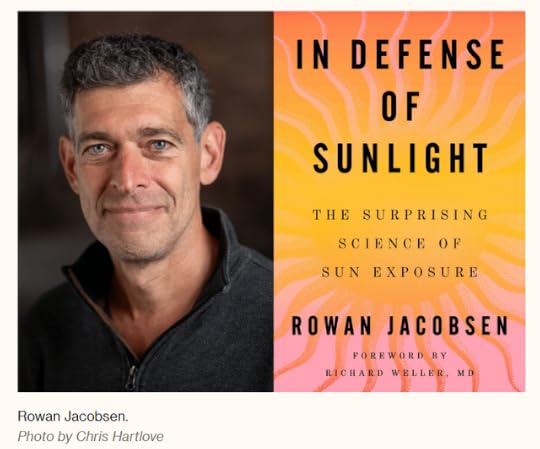
Upending everything we thought we knew about sun exposure, this trenchant investigation into the “zero-sun policy” sounds the call on the many health benefits of the sun, and what we risk when we minimize our exposure.
A quiet revolution is transforming our understanding of sunlight’s effects on human health. For decades, a “zero-sun” policy has characterized our approach to sun protection, advising us to stay out of the sun whenever possible and apply sunscreen daily to any skin that might be exposed, rain or shine, summer or winter, indoors or out. But recent studies have proved that this policy is thoroughly mistaken and that this prolific misunderstanding is causing us to miss out on many of the health benefits of sun exposure.
In this incisive work, acclaimed journalist Rowan Jacobsen presents the growing case for the importance of modest sun exposure for our health and well-being. Aided by the most up-to-date studies on the effects of sunlight on human health, Jacobsen presents a much-needed, lucid assessment of not only what the sun can do for us, but how a lack of sun could actively be harming us.
In Defense of Sunlight sounds the call on what researchers have been sure of for years, and what health care providers and media outlets have been slow to take that sunlight is one of the simplest, and most equitable, treatments for a variety of health issues, from diabetes to dementia to multiple sclerosis. Laying out the new science of sunlight in a straightforward and responsible manner for mainstream readers, this book is an eye-opening story of scientific discovery, outlining not only best practices for sun exposure, but the story of how current recommendations became misguided, how a few inquisitive scientists glimpsed the truth and deciphered the mechanisms responsible, and how everyone can safely incorporate this new knowledge into their daily lives. It also exposes the implicit injustice underlying current approaches, which benefit the whitest people on earth (who are the most susceptible to skin cancer) at the expense of those with darker skin (who suffer extremely low rates of skin cancer and have the most to gain from sun exposure).
A call for a return to common sense in our relationship with our local star, In Defense of Sunlight offers its own seven words of Get sun. Not too much. Go outside.
Rowan Jacobsen is the James Beard Award-winning author of A Geography of Oysters: The Connoisseur’s Guide to Oyster Eating in North America, Fruitless Fall: The Collapse of the Honey Bee and the Coming Agricultural Crisis, and The Living Shore, about our ancient connection to estuaries and their potential to heal the oceans. He has written for the New York Times, Newsweek, Harper’s, Outside, Eating Well, Forbes, Popular Science, and others, and his work has been anthologized in The Best American Science and Nature Writing and Best Food Writing collections. Whether visiting endangered oystermen in Louisiana or cacao-gathering tribes in the Bolivian Amazon, his subject is how to maintain a sense of place in a world of increasing placelessness. His 2010 book, American Terroir, was named one of the Top Ten Books of the Year by Library Journal. His newest, Shadows on the Gulf: A Journey Through Our Last Great Wetland, was released in 2011. His Outside Magazine piece “Heart of Dark Chocolate” received the 2011 Lowell Thomas Award from the Society of American Travel Writers for best adventure story of the year. He is a 2012 Alicia Patterson Foundation fellow, writing about endangered diversity on the borderlands between India, Myanmar, and China.
This is really well argued book with easy to follow science. I liked the read and it made me revisit much of my thinking around sun exposure. Persuasive. Straightforward.
When asked what's the source of all life on Earth, one could do much worse than point a confident finger at the Sun. During our daily grind, we don't give nearly enough credit to the sun, and often fail to recognize how deeply entrenched and intricate that star is in our very being. It not just gives life, but does wonders for sustaining it, protecting it, nurturing it, and when almost everything else fails - repairing it.
To say that the Sun finally as its day in the sun, would be a little too on the nose, but it is true that humanity's understanding of the ways in which our sun impacts and influences our lives has grown by leaps and bounds in the recent decades. Taking a brief trip into the prehistoric appearances of the sun, the book quickly begins to lay down facts, often ably propped up by scientific research or scientifically driven studies. We begin auspiciously enough, with the original halcyon days of field of heliotherapy, when the sun was indeed considered a certified treatment for such dreaded diseases like tuberculosis and pneumonia. This is where the book lays a strong foundation into the social stances that gave rise to the field, and that also subsequently supported those approaches. Of course, unlike other medical studies, the problem with studies to do with the medical or medicinal properties of the sun is that you can't tweak it from one round to another, and it is very difficult to isolate what in the sun's rays is harmful and what is beneficial. State sponsorship for such studies has always been rather weak, but there are some recent leader nations, who have been quick to realize possible benefits, and how to provide suitable scientific guidance to an open-minded, and educated populace.
A little before the middle of the book, sunscreen makes an appearance, with the best of intentions - the book is quick to point out, but soon creates an oversimplified and rather myopic view of the benefits of sunscreen, that coupled with the supposed benefits of UV in specific and sunlight in general, made a whole generation literally forget what the sun had come to mean to centuries of mankind history before it.
The author cites study after study that has provided incremental but concrete evidence that the sun's rays contain elements that benefit most of mankind, on most days, in the most ways. While sunburn is acknowledged as being harmful, the book makes an impassioned plea to consider changing that messaging to a more nuanced one, that even while highlighting the benefits of sunscreen also reminds that sunlight itself is not harmful. Life on Earth has evolved over billions of years, and it has had all that time to refine and re-refine how to make the best use of the single biggest source of heat and light on this planet, that is literally endless and absolutely free.
The last couple of chapters are about an experiment the author subjected himself to, and - in my opinion, that is an absolute delight. This is where this science treatise becomes a science memoir, and manages to demonstrate beyond much doubt the absolute dependency our human body has on natural sunlight, and how our circadian rhythm must have developed and first recognized for what it truly is - our body's response to best utilize the most abundant natural resource available to it - pure, unadulterated sunlight.
A fantastic, immensely erudite and well researched book into the life giving benefits of the biggest and brightest star in our terran sky.
My thanks to Netgalley, Scribner and the author for providing an eARC. The review is wholly mine.
This was a VERY interesting book. Exposure to sunlight has been demonized. We are told that we should avoid direct sunlight wherever possible or face terrible medical consequences over time. This is a total overreaction but it’s very effective for marketing purposes. There is big money in selling sunscreens and clothing that blocks sunlight and since the sun does not have a marketing agency, the sun has become a villain.
The author is NOT suggesting that we expose ourselves to many hours of sunlight, avoid sunscreen, or avoid sun blocking clothing. But avoiding the sun, staying inside in artificial light all the time is not healthy. Exposure to sunlight in moderation, has some significant health benefits.
A couple of examples: Sunlight hitting the skin produces Vitamin D, a hormone which regulates calcium in the body and is essential for strong bones and a number of basic biological processes. People with higher blood levels of Vitamin D have lower rates of diabetes, obesity, osteoporosis, heart attack, stroke, depression, cognitive impairment, autoimmune diseases, colorectal cancer and respiratory infections. Popping a Vitamin D pill is not even close to being as effective as exposure to sunlight.
The main molecules in the body that successfully absorb the near infrared light from the sun are found in the mitochondria, the site of cellular respiration which produces energy for the cell. Infrared light penetrates the skin (and clothing) and energizes our mitochondria. Every activity of our bodies requires energy, including but not limited to motion, cognition and healing. If the mitochondria wear out, our bodies wear out. Infrared light comprises 53% of the solar spectrum, more than all other visible light combined. The LED lights that are the norm in most office buildings have much less infrared light than sunlight. Photobiomodulation (also called red-light therapy) is used in thousands of clinics around the world to treat wound healing, hair loss, and cognitive disorders such as Parkinson’s disease. Dentists use red light therapy (red laser) on our gums during some dental procedures because gums heal faster when exposed to red light. Anytime we are outside in daylight, photons of infrared light are pouring into us, energizing our mitochondria, even through our clothing. Years ago, that used to happen a lot every day but now that we spend most of our time indoors, it happens a LOT less which is not good.
There is SO much interesting science in this book that made So much sense. Again, the author is not saying to sit out and sunbathe all day. The author is an award winning science writer whose work has appeared in MIT Technology Review, The Best American Science and Nature Writing and many others.
Short Yet Thoroughly Documented Clarion Call Inspired By Pollan's In Defense Of Food. In this text, Jacobsen explicitly sets out to do for sunlight what Michael Pollan once did for "real food" several years ago... and largely nails it. The writing here is engaging and explains the science at a level that most will be able to understand it yet doesn't shy away from the more complex areas of the science either. At just under 300 pages with just over a quarter of even that being documentation, this is an easy one day read for many people... and yet will also be one that many readers will want to sip and savor and perhaps spread out over a much longer reading period.
Perhaps, even, via reading it for a few minutes per day as the sun rises or sets... which is a particular period Jacobsen shows does quite a bit for the human body.
In all honesty, I read this book when I did - days before the dreaded "Spring Forward" of "Daylight Saving Time" - hoping for a much stronger anti-DST argument here, which isn't as present as I had hoped... but that actually points to the actual strengths of the text, as Jacobsen is more concerned that you get outside at all than *when* you get outside, though he does indeed go into detail about what the sun's light at different times of the day can do for you and does in fact make at least some case for the earlier sunrises of so-called "Standard" time, while also pointing out the science of living on the eastern vs western edges of a time zone, among many other topics.
Overall a very thorough text covering all aspects of the science of the interaction of the sun and the human body, this is absolutely one book everyone needs to read and make their own calls about... and perhaps even recommend it to your medical providers. I know I'll be recommending my own docs read this.
"In Defense of Sunlight" discussed scientific studies on the benefits and dangers of sunlight to human health using a historical framework. In the 1800s, scientists realized that lack of sunlight in badly polluted cities was causing rickets in children. Doctors started treating diseases like tuberculosis with sunlight, and the recommendations moved toward nude sunbathing for your health. Scientists discovered vitamin D. So, of course, people made vitamin D pills and UV lamps as health products but discovered neither quite lived up to hopes (though a narrow wavelength UV light can be used to treat multiple sclerosis!).
The author covered the skin cancer scare that lead to the current recommendations as well as the history of sunscreen, its variable effectiveness at blocking UV, and research into if it really does stop skin cancer. He also showed why the actual science is much more nuanced than 'everyone should always wear sunscreen.' You can get many health benefits from the sun while most sun-exposure cancers won't kill you, so informed sun exposure (especially for darker-skinned people) is desirable. After covering recent scientific studies on why getting sun on your skin provides various health benefits, he covered the latest science-based recommendations for how much sun your skin type should get and when is the best times to get it.
Though there is a lot of good scientific information in this book (thank you!), it's an easy read and the science is explained in terms a high schooler could understand. I knew I enjoyed the joint-deep warmth of the sun, and now I better understand why I'm drawn to sun exposure, especially in the morning. It helps your body in a multitude of ways. Overall, I'd highly recommend this informative and interesting book.
I received a free ebook review copy of this book from the publisher through NetGalley.
In Defense of Sunlight is a fascinating and eye-opening book about something most of us take for granted: sunlight. Instead of just warning about sun exposure, the author looks at the many ways sunlight supports our health and well-being.
What I loved most about this book is how clearly it explains the science. The author breaks down complex topics in a way that is easy to understand while still feeling well researched and thoughtful. It explores how sunlight affects sleep, mood, and overall health, and it really made me rethink how much time I spend outside during the day.
The book is packed with information but still very readable. It’s the kind of book you could read quickly, but it’s also one that makes you pause and reflect on small daily habits. By the end, I found myself appreciating sunlight in a whole new way.
Overall, this was an engaging and informative read that makes a strong case for the importance of getting outside and connecting with natural light.
Thank you to NetGalley and the publisher for the ARC in exchange for my honest review.
A quiet revolution is challenging the long-held “zero-sun” policy, revealing that moderate sun exposure offers significant health benefits. This book presents scientific evidence that modest sun exposure is crucial for overall well-being and to avoid harm.
This engaging and easy-to-read book is a wonderful corrective to the common understanding about sunscreen use. I was shocked to learn that sunscreen is not proven to reduce melanoma—only the less deadly forms of skin cancer.
As a fair-skinned person living in the tropics, I won’t change my behavior regarding sunscreen use as a result of reading this book—though I will make more of an effort to get sun every day. Darker-skinned people, however, might want to discuss their personal sunscreen regimen with their dermatologist.
Thanks, NetGalley, for the ARC I received. This is my honest and voluntary review.
No, but seriously, Rowan Jacobsen’s In Defense of Sunlight is a sharp, well written challenge to decades of standard public health advice.
Jacobsen argues that our collective "zero-sun policy" has created a massive, unseen health crisis, moving far beyond Vitamin D to show how moderate solar exposure lowers blood pressure, regulates sleep, and combats depression.
Crucially, the book rejects lazy "one-size-fits-all" messaging, explaining how blanket anti-sun warnings accidentally harm people with darker skin tones, who face minimal melanoma risks but suffer heavily from sunlight deprivation.
Written with deep scientific literacy and wit, this eye-opening book replaces fear-mongering with a brilliant seven-word rule of thumb:
Absolutely fascinating! This book delivers the nitty gritty science in a way that is readable, accessible, and interesting. Everyone should read this, especially since it takes public policy and health so long to adapt to new evidence and discoveries.
The key take aways: the sun is not something to be feared, but an essential source of health and vitality. We need a more nuanced approach than “avoid the sun and wear sunscreen every day.” Depending on skin tone, location, and life circumstances, your sun exposure might need some radical changes in order to gain all the benefits to your heart, metabolism, and more.
I would highly recommend this book to anyone interested in optimizing their health.
So there’s been some stirrings about the benefits of sun (versus all that we’ve heard since the 80s about using sunscreen)...so I was intrigued to read this book diving deeper into the concept with some scientific data.
It is a short read, and I’d recommend the audio and print if you are interested in reading more about the topic.
It does spend quite a bit of time walking you the reader through the timeline of “sunscreen” and “sun benefits”....so that might be helpful (or redundant if you already know it).
Jacobsen does dwell on the idea of sleep- including a dark sky sleep study he does- I found that interesting!
I would like to still continue reading more on this consent.
In Defense of Sunlight is a really thoughtful exploration of how sunlight shapes life, health, and the natural world. I live in a very sunny area and sometimes I just don't want to go out and soak up the sunshine. However this book changed my perspective and I think the public need to learn more on how important it is for our health to get more sunshine! Highly recommended and I can't wait for the audiobook.
4.5/5. This was a great listen (audiobook, read by Rowan himself). The content - the surprising benefits of sunlight - could easily veer into sketchy wellness territory but I was confident Rowan could pull it off, having read several of his other books. A good nonfiction summer read!
Well-researched and written. Really interesting to think about the power of sunlight overall. I found a lot of things that made perfect sense within these pages.
This book completely rewired how I look at my own potential. It takes concepts you think you know and flips them upside down. Prepare for a major paradigm shift.