THE FIRST R. CRUMB COMIC BOOK IN 23 YEARS! The seminal cartoonist who single-handedly invented the alternative comics format of the one-person anthology in 1967 with ZAP returns at age 81, still raging at the world and himself, still drawing like a master, and still funny... mostly. In his latest comics excursion, Crumb dives down internet and newspaper rabbit-holes, and comes up asking questions. Why don't we know the real background of deep state careerists? And is Crumb himself just as paranoid as everyone else tells him he is? Or is that just what THEY want you to think?
Mixing memoir, essay, polemic, neurosis, and conspiracy across 12 short comics — including the final Dirty Laundry story, drawn by Crumb with a script written with Aline Kominsky-Crumb before her death in 2022 — Tales Of Paranoia shows there's still plenty of life in both the artist and the classic underground comics format.
Robert Dennis Crumb (born August 30, 1943)— is an American artist, illustrator, and musician recognized for the distinctive style of his drawings and his critical, satirical, subversive view of the American mainstream.
Crumb was a founder of the underground comix movement and is regarded as its most prominent figure. Though one of the most celebrated of comic book artists, Crumb's entire career has unfolded outside the mainstream comic book publishing industry. One of his most recognized works is the "Keep on Truckin'" comic, which became a widely distributed fixture of pop culture in the 1970s. Others are the characters "Devil Girl", "Fritz the Cat", and "Mr. Natural".
He was inducted into the comic book industry's Will Eisner Comic Book Hall of Fame in 1991.
a lot of it is just very dense and sometimes not very interesting ramblings but the bit where he finishes a comic he was supposed to make with Aline and ending it with 2 panels of his current life alone and making dinner for one in his apartment hit me very hard. A book supposed to poke fun at Crumb’s neurotic self reveals lots of vulnerability and loneliness more than anything
Flojisimo, de lo peor de Crumb. Pensamientos y reflexiones paranoicas del autor acrecentados por la crisis del Covid y sus experiencias con Lsd en la juventud. Demasiado rollero y diferente a su material de los 60.
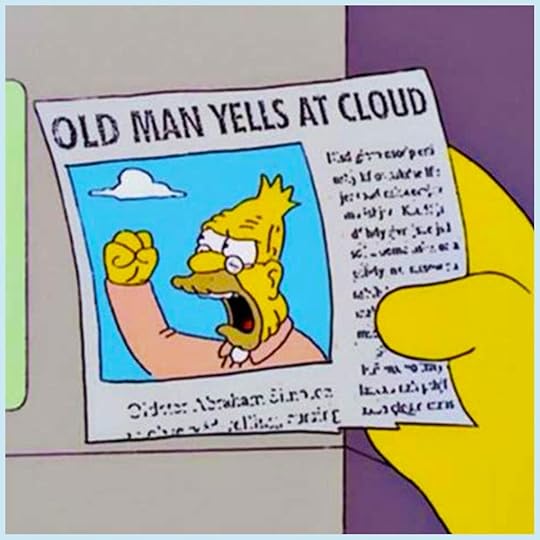
just kept thinking of this old man yells at sky meme
refusing to engage with how information works today strips healthy skepticism of its purpose and turns it into defensive posturing. You’re not part of some intelligentsia because you know how to get to the third page of google.
it’s tough because there are some real world breaks in how we understand what’s “true” today. if you told me twenty years ago that there were microplastics in everyone’s balls and that there really WERE billionaires running competitive pedophile rings, I would’ve told you to get the fuck outta here. but now that enough improbable things really have turned out to be real, we’ve lowered the bar of plausibility so low that every unhinged thing is being treated as possible. it’s fun n all to point out but i really wish crumb in all his lived experience offered anything even close to wisdom rather than just drinking from his rabbit hole. whatEVER
"Harhaisia tarinoita" ainakin havainnollisti itselleni sitä, kuinka ei ole mikään ihme että liikkeellä on paljon salaliittoteorioita ja paranoiaa, etenkin Yhdysvalloissa. Elämme niin kummallisessa maailman tilassa, kaikki alkaa tuntua epäilyttävältä kun vähänkin pureutuu johonkin aiheeseen. Sarjakuvassa on omintakeinen mustavalkoinen piirrosjälki.
Siempre es un placer poder disfrutar de un nuevo trabajo de Robert Crumb tras décadas sin publicar. Sin embargo, una parte importante del libro consiste en primeros planos del autor desvariando —y si de joven ya era excéntrico, con más de ochenta años está completamente desconectado de la realidad.
Aun así, incluye un par de historias inéditas en las que su talento brilla con la intensidad de siempre (me encantan, en particular, sus páginas junto a Aline Kominsky)
Recomendable, aunque para un primer contacto con su obra, quizá sea mejor empezar por sus trabajos más tempranos.
I have always loved and admired the style of Crumb's illustration, though I admittedly never really connected with a lot of the content of what is often considered his classics--save for the adaptations of other people's writing or his illustrating for Pekar, etc. I attribute this to how of-the-time a majority of the Crumb-authored work is. I'm sure if I was living then, it would have smashed my head open the way it did for many of the authors/artists whose work exists in his shadow (and whose work I do connect with).
That being said, I think this is the closest thing to a genuine immediate connection that I have ever experienced with his subject matter. As a thirty-something, Tales of Paranoia feels like a reaction to what is now MY world and I can now more easily feel what someone my age might have felt fifty years ago seeing the first of his first Underground Comix emerging into the world rather than just understanding it in a purely intellectual or historical way. Of course, this is not to say I AGREE with all of what he is exploring or insinuating but I definitely think we should be talking about it more than the current socio-cultural-political environment deigns to be acceptable.
Crumb comes across as bright, thoughtful, anxious, self-aware, paranoid (duh), and lonely. He is voicing an alternative perspective to the mainstream informed by his research into the questionable science, politics, and bureaucracy of this century of American humiliation. And, for the most part, it works really well. Some of it is funny, much of it isn't, all of it is beautifully illustrated. There are A LOT of words in this slim comic and some of the pieces are a little samey. You do walk away feeling a little bad for the old coot and more-so, if you are a thoughtful person with a mordant intellect, you walk away worrying that in fifty years you might fade into the same shaky paranoid shell that Crumb so brilliant self-portrays in his illustrations.
Regardless, even if you pick up this book for no other reason than to gawk at the amazing line and shadow work, or the grotesque faces and bodies, or the brilliant page layouts, there is still something to appreciate and learn. After all, genius is still genius even if you don't always get it or agree with it. We can only hope there's more to come and that it doesn't take a quarter century to arrive (if we have that long).
Read in the first printing of the beautiful Fantagraphics single issue.
This is Crumb, now an octogenarian, presenting his first published solo work in more than twenty years. His artwork remains technically excellent and dark. Unfortunately, too much of the art here consists of his face, as he rants on, literal old man yelling at the clouds (I'm not the first to make this comparison. I won't be the last), but at least acknowledging that's what he's doing. Seriously, much of the comic resembles a screencapped YouTube vlog or illustrated Reddit post. Although Crumb has time for other conspiracies and his own history of paranoia, he directs most of his rant at the Covid pandemic and Big Pharma. He both questions and defends his own conspiratorial leanings, while dismissing others. In all fairness, the ones he dismisses are pretty dumb and dismal. He at least tries to be informed, even while bemoaning his inability to be certain of anything.
The comic becomes something far better whenever Crumb decides to do something else. His final story with and about his late wife, Aline Kominsky-Crumb, is genuinely touching. He also gives us a disturbing account of his worst LSD trip (if it even was LSD in this instance; he's not certain), which did little to diminish his paranoic tendences. Read it for these tales. If you're into comic art, buy it, for no other reason, than Crumb's creepy cover.
Crumb has always been able to engage and fascinate readers or, perhaps, a certain kind of reader, even when we disagree with or are even outraged by what he says and draws. Tales of Paranoia is more sad than outrageous. Crumb completists will buy it, but I wouldn't recommend it as an entry point to his work.
Tales of Paranoia is Robert Crumb’s first book of new comics in 23 years. At 82, Crumb remains a master draftsman able to imbue existential drama even in stories whose outward actions consist only of depictions of Crumb in bed worrying over anxious thoughts. His paranoid musings cover COVID-19, the vaccines developed to counter it, the “deep state,” bad “LSD” trips, and pleas to what may be an imaginary god.
A problem common to believers in conspiracy theories is that otherwise healthy skepticism toward any assertion of fact or truth is not balanced by a distinction between possible and probably or a foundation upon which facticity or truth can be established—it’s just radical doubt all the way down. Although I find fault with some of his reasoning, Crumb is as articulate and expressive in his with his writing as he is his drawing, given to entertaining points of view contrary to his own. He may be old but he hasn’t mellowed and shows every sign of refusing to go gentle into that good night.
Although some of the ranting is difficult to get through, the comic he co-wrote with his late wife and illustrates here is a standout, along with the one about his struggle to recall a traumatic LSD trip in the 60s that he mentally blocked immediately after the experience and has never been able to fully remember, despite years of trying. I am also fond of his one-page conversations with God. There was one moment when reading, though, that did make me sigh deeply before continuing -- about halfway through, you turn the page, and it's basically all a block of text hitting you in the face from both pages. The "Deep State Woman" part also didn't really go anywhere. But it's good to see Crumb's work again, even if it isn't always as interesting as Self-Loathing Comics or Mystic Funnies, which I was lucky enough to pick up back when I first started getting into comics some twenty years ago or so. Despite disagreeing with him on much of what he says in this issue, I think it's valuable to understand why he, and so many others, feel paranoid about the modern world. Radical doubt might be as much of a problem as blind belief, it turns out.
This was an interesting read to say the least... Like the cover warns us, this isn't popular entertainment. Even though it's just a bit over 30 pages, it's an extremely dense read, filled with overwhelming amounts of text. I didn't see this as an issue, the issue is that most of these texts are just Crumb's rumblings about conspiracies and about how he distrusts the covid vaccines. I wouldn't say that I agree with that, but at least he raises some more interesting arguments, regarding other topics, even though he renders himself as an untrustworthy writer, when his sources are Joe Rogan's podcast and RFK Jr... Some shorter stories, that don't feature his paranoia are certainly the highlights of the comic, but to be fair, even in the more paranoid segments, his incredible artwork always shines. Even though large parts of this comic consist of him just sitting down and talking to the reader, his beautiful shading and artstyle are always able to capture and hold the reader's attention. 7/10
O único que se salva é o estilo de Crumb e o cómic que recolle e que estaba feito a medias con Aline. O resto, é Crumb amosándose como imbécil que, de tan antiautoritario dá a volta e acaba sendo un fascista anticiencia que compra todo o discurso ao poder que pretende atacar. Coñezo os suficientes como para sorprenderme, pero no caso de Crumb dá mágoa, aínda que nunca fose un cerebro perfecto. Na fin, serve como escusa para branquexar sesgadamente a xente da ultradereita ianki, e pretender que fai unha investigación cando só é cherry picking no mellor dos casos, buscando confirmación. Se aínda deixase pé á ironía, ou á posibilidade de estar no erro, ok. Pero até iso está desaparecido neste Crumb octaxenario e que confirma outro caso de cabeza ácrata, con drogas dentro, que acaba patinando pola paranoia do individuo libre que o capitalismo lle vendeu.
Crumb remains one of the great illustrators and funny book makers and Paranoia is excellent in that respect. I think it could also be subtitled "Confirmation Bias: The Comic." The basis for Crumb's skepticism around vaccines seems to be purely emotional however he goes to great lengths to demonstrate research and cite his sources. Of course, he looks only for evidence that supports his thesis without ever presenting a rationale for the thesis in the first place. He also makes statements that seem sinister but can be resolved with a few minutes of looking. While the conspiracy theorists often urge people to "do their own research" it's clear that Crumb's assertions are the result of pretty amateur sleuthing.
A collection of shorts that mainly consists of the same character/characters in slightly different poses, no backgrounds and pages packed full of text.
In an artistic sense, it's rather lazy. Can't say the ramblings are lazy, but they do feel like top of the head thoughts about various topics. They are coherent enough, and he sure wants to tell the world his thoughts on things. They are just not insightful or interesting enough to fill page after page with, making the whole thing feel rather pretentious. Given Robert's age, it's still an impressive feat, and there's not a lack of skill in the drawing department. That's why I have to give it 2 stars instead of 1. Can't recommend this to anyone though
The first significant Crumb work I read was The Book of Genesis and it remained that way for more than a decade. Save for some forgettable shorts of Crumb, I haven't had a Crumb book since.
Until Tales of Paranoia arrived late 2025, which became my latest Crumb read. The art doesn't disappoint, delivering what one would expect from Crumb the drawer, meticulous pen and ink drawings of grotesque and exaggerated human forms.
As for the stories, I couldn't finish the main story. It was exhausting keeping up with Crumb's ranting. The rest, however, were accessible and I enjoyed those.
no surprise that Crumb has become a facebook conspiracy theory grandpa—it’s not like he was thinking clearly before. but still a sad experience reading this work of amorphous ranting, which contains virtually no visual pleasures. most of this is dedicated to repeated drawings of Robert, with the frame devoted to unspooling his enervating, infuriating monologues. it reminds me of the direction Charles Crumb’s work took as he became increasingly isolated from society, the hermetic repetitive dialogue eventually completely overwhelming the figures in the frame
it's Crumb after Crumb - always susceptible to conspiratorial thinking, being a child of the 60s ("question everything") and whatnot - has spent a few years inhaling RFK-adjacent tweets like so much spraypaint huffed from a bag. still good, because his work is good (his graphic-novel rants are always enjoyable even when one disagrees with him) and because he's got the self-awareness to say what is going on here (it's also not new to this volume, as his misremembered/hard-to-remember anecdote about his bad LSD trip and his largely laudatory Philip K. Dick bio-comic (not included, but worth googling) make clear). Highly recommended if you've consumed as much of this strange old man's content as I have.
Crumb’s first publication since Genesis and first floppy comic in over 20 years.
He’s still a fantastic artist, even at 80 his drawing is great.
But what made him come back? Apparently he wanted to talk about Covid and vaccines and deep state conspiracy theories. Argh. I don’t really think he adds anything new to these arguments. And I did not think I’d ever read a crumb comic that quotes an alt. scientist on the Joe Rogan Experience.
Best part was his recollection of a bad acid trip in 1966. He blocked out the memory of the trip. But he thinks it’s some grand experience when I’m thinking it’s just drug induced psychosis.