Péter Nádas is one of the most renowned contemporary Hungarian authors. A Lovely Tale of Photography displays his essentially experimental orientation. It is a hallucinatory novella about a female photographer who is suffering from an undetermined illness. Confined to a sanatorium, where she is surrounded by a cast of stock characters speaking various languages, she is made to confront a reality other than that framed by her camera. The novel takes the form of short scenes, as if a film sequence, and this structure lends the text a fairy-tale, poetic quality similar to many surrealist works.
Nominated for the 2001 International IMPAC Dublin Literary Award
Hungarian novelist, essayist, and dramatist, a major central European literary figure. Nádas made his international breakthrough with the monumental novel A Book of Memories (1986), a psychological novel following the tradition of Proust, Thomas Mann, and magic realism.
Péter Nádas was born in Budapest, as the son of a high-ranking party functionary. Nádas's grandfather, Moritz Grünfeld, changed his name into Hungarian, which was considered a scandal in the family. Nádas's youth was shadowed by the loss of his parents. Nádas's mother died of cancer when he was young and his father committed suicide. At the age of 16 his uncle gave him a camera, and after dropping out of school Nádas turned to photojournalism. During the late 1960s and early 1970s, he worked as an editor, reader, and drama consultant. After the Soviet-led invasion of Czechoslovakia in 1968, Nádas quit his job as a journalist and devoted himself to literature. "I resigned, walked out, and turned my back on the system to save my soul," he later said.
Fragmentarisk, poetisk, nästan lite sagolikt, läggs pusslet till en berättelse om en kvinnlig fotograf som tas in på sanatorium för ja, vadå, ett psykiskt sammanbrott av något slag. Pusslet är inte fullständigt. Det finns ett intressant yttre berättarperspektiv som ibland blir lite synligt. Kornelia ses utifrån, och också genom en slags kameralins eller genom levande fotografier, om man kan uttrycka det så. Det finns ett slags triangeldrama med en baron eller furste som hon är förlovad med, men en annan man, Carl eller Karoly, som mer verkar vara hennes tvillingsjäl? Jag känner mig inte särskilt klok efter läsningen, men det är också det jag tycker om, som att det bildas lite nya banor i hjärnan varje gång man läser en bok med oväntat, ovanligt narrativ. Det är därför jag älskar sådana böcker. Intressant i sammanhanget då jag nyss läst boken om Sigrid Hjertén och att hon slutade sina dagar på Beckomberga. Typisk trop för kvinnliga konstnärer. Men bilden av Kornelias obsession med kameran, som att fotograferandet var den enda sanningen, jag gillar den. Metaforiskt djup. Och väldigt tjusig utgåva i tjockt papper med välgjord bindning, ryser av välbehag varje gång jag vänder blad.
Life is too short I decided when I stopped reading on page 48 although the novel is very short. However, it is called 'a film novella' and seems far too avant-garde for me - very confusing.
There are several ways that this novella could be read, the most obvious being as a psychoanalytic meditation on repression and well-being – but in some ways that is too obvious for what it is. My preferred reading is as a piece of ‘conceptual art’ in that it is most certainly about big ideas – about making sense of one’s place in the world, about desire and attachment (hence the obvious psychoanalytic reading). I suspect, however, that it is as much about mediating existence, about technology and control as it is about anything else – so a more nuanced and demanding set of psychoanalytic ideas.
This technological reading is shaped by several aspects of the novel. At its heart is a woman (Kornélia) who is in a sanatorium being treated for an unspecified disease that seems to induce seizures (but that may be at times also fainting fits, in late 19th/early 20th century medicine the distinction for women was often obfuscated) that may be epileptic but it is not clear; what is clear is that the treatment involves rest, discipline, surgery of some form but centres on the removal of her photographic equipment, it seems so she can be treated for a psychosis of some form that means she only sees the world and believes in the existence of that which can be photographed. It is the removal of the camera equipment that makes this, to my mind, more complex than a piece about repression and more about technology and mediation. There are others involved in her treatment and incarceration – Henrietta (a maid), the baron (her fiancé) and Karol/Karoly/Carl (it is not entirely clear whether Carl is Karol(y) or not but probably not) who is the object of her desires.
This sense of the technological is enhanced by the structure of the novel, hinted at by its subtitle (a film novella). It reads as if it is a script for a film with short scenes that cut abruptly to the next, which may or may not be obviously obviously related – enhancing the surreal moments. The opening sequence, centred on a helicopter flight reminiscent in part of the opening sequence of La Dolce Vita ends abruptly as we swing back to the late Imperial era of Austro-Hungary and a balloon flight, possibly with one of the men spied in the opening sequence, that seems to bring on Kornélia’s illness, or at least is the moment of its first manifestation. This film script character means that we, as readers, must pay careful attention the form and sense of the novel – it is not always clear who is speaking (although as the film it might be clearer if we could see them) and along with the third person narrator there is also a seemingly disembodied voice that narrates, speaks to Kornélia, speaks about Kornélia and directs the action through both its ‘real’ and surreal moments.
This voice suggests a fairly straightforward psychoanalytic aspect, as do the moments of the surreal and of sexual excess – but the filmic character of the text and the emphasis on Kornélia’s obsession with mediating the world as a photographer means that the novel explores issues of the real (and in a Lacanian sense the Real), technological mediation and the role of language in getting access to the real/Real and what Louis Armand calls literate technologies (see http://www.goodreads.com/book/show/12...). This is a long way from an easy read, mainly because we need to concentrate to the form as well as the voices to follow the narrative through its real and surreal moments as well as manage Kornélia’s repeated attempts to thwart those who want to treat and control her. Once again, the excellent Twisted Spoon Press (http://www.twistedspoon.com/) has given us a quality piece of contemporary East/Central European fiction.
Honestly not quite sure what to make of this strange little text. It feels incomplete, like it's only one part of a multi-media presentation. Before he wrote novels Nádas had a whole career as a photo-journalist. So he knows a thing or two about surfaces and light. This feels like the script for a never to be produced art house film - Bergman at his most experimental, if not necessarily his best. More the Silence than Persona, I'm afraid.
I wouldn't necessarily recommend it to any but the most die-hard Nádas fans (and do such people even exist, or am I essentially a tribe of one?). Nonetheless this feels like as good an opportunity as any to reiterate the basic point : Péter Nádas is GOD. Read A Book of Memories and Parallel Stories.
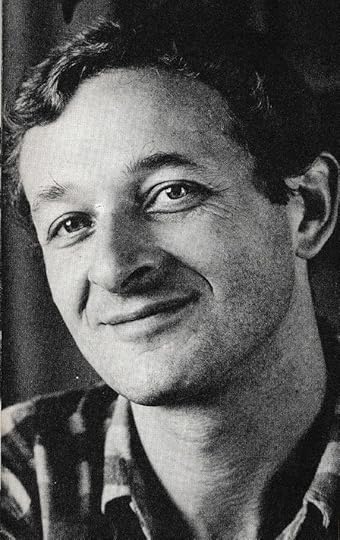
total dreamboat
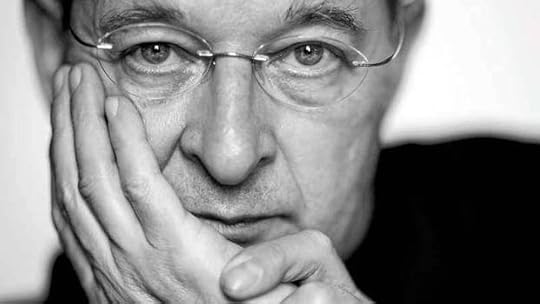
(and still handsome in old age, with a certain severe dignity)
Za vikend san putova u Mađarsku, pa rekoh da posudim nekog mađarskog autora za put. Libar je pari taman dimenzija za put busom, naslov je fotografu u meni obećava zanimljivo štivo. Na kraju sam libar dovrsi samo zato jer u busu ne mores ga zaminit za drugi, a jedini dio mene ki je bi zadovoljan je onaj koji uživa u bizarnim sličicama. Svoj dojam na kraju mogu svest na jednu besedu - pretenciozno.