"Fascinating . . . Jardine's attention to the material side of things is an important explanatory complement to the many histories of the period that have dwelt on the sublime works of art . . . Real history is in the details, the small stories, of which WORLDLY GOODS is a treasure house." Richard Bernstein, The New York Times
Lisa Anne Bronowski (Jardine) was a British historian of the early modern period. From 1990 to 2011 she was Centenary Professor of Renaissance Studies and Director of the Centre for Editing Lives and Letters at Queen Mary, University of London. Since 2008 she was Chair of the Human Fertilisation and Embryology Authority (HFEA)] She was a Member of Council of the Royal Institution, but resigned from that post in September 2009. On 1 September 2012, She relocated with her research centre and its staff to University College London (UCL) to become the first director of its Centre for Interdisciplinary Research in the Humanities.
This is a good, readable book on the renaissance, but I was disappointed with it, I had expected something more from Professor Jardine.The thesis that desire for worldly goods was a driving force in the renaissance didn't seem radical to me at the time of reading - surely that idea is implicit whenever patronage and commissioning are involved. On reflection my reaction was simply a product of my environment.
I came to Worldly Goods after reading bits of Fernand Braudel. So the thesis of the desire to acquire material objects as a driving force of the Renaissance seemed not new but self-evident. Collecting beautiful objects and the increasing wealth of material things provided a useful means for demonstrating conspicuous consumption for the wealthy of this world. Consciously or unconsciously the spirit of Thorstein Veblen moves over the pages of this book. New frontiers in space and skill gave new opportunities to demonstrate wealth and success.
On the other hand if you are coming to this book from a background of appreciating art then the approach of this book may strike you entirely differently. It has a focus on the artistic and artisan production of the Renaissance as being objects of desire. It has the Renaissance as the triumph of patronage, not so much as the appreciation of style and talent as ends in themselves but as a means of acquiring fabulous worldly goods.
An economic history written by a cultural specialist. The book's thesis is hardly new and really doesn't hold up in the direction that Jardine takes it. Plenty of very smart people have already pointed out that a capitalist economy existed in Europe well before the spread of humanism, and the economy was actually in a state of serious decline by the time the new culture started to take hold, so it's hard to argue that economics trumps culture in the case of the Renaissance. Something more than capitalism took place in Europe during that period. Kind of a silly book, and not a very interesting read.
(Eventually... the point long ago made, the cataloguing of vanities got a bit wearying... Hence, the four stars. Also, I can't be sure that her central thesis is correct. Nonetheless, worth a couple of days of reading.)
According to Jardine, in this fascinating book, the explosion of the arts in the 15th century (not only the fine arts - but prints, tapestries, gems, silver works, book-making, credit instruments... etc.) was essentially the result of an enormous acquisitive drive that appeared at this time of burgeoning wealth -- and that led (rather than followed from) to an expansion of trade, globalization, discovery, and empire... that was an attempt to satisfy this drive for a conspicuous consumption that announced that the men and cities involved had attained to pinnacles of worldly success and power. -- Hence, the extraordinary attention given in the paintings of that period to the clothes, cloths, tapestries, hats, turbans, damasks, silks, chalices, gems, embroideries, architecture, books, mirrors, bronzes, velvets, and so forth... in paintings commissioned by wealthy patrons from what were (at that time) essentially craftsmen (i.e., the painters of this period) -- all marks of a bursting forth of material (and of a quite materialistic) culture.
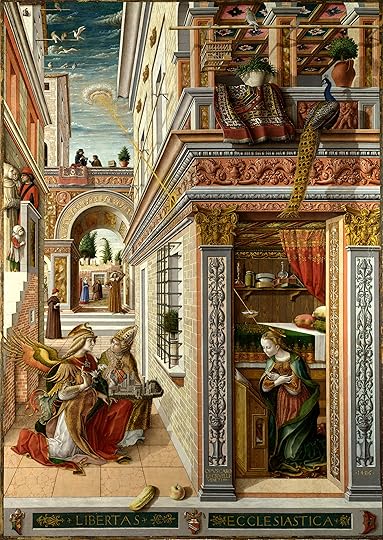
Here is an example of what Jardine is getting at. Look at the extraordinarily detailed portrayal of the material culture contained in the work by Carlo Crivelli
Annciation with St. Emidius. 1486. National Gallery, London.
The woman inside the window is the Virgin Mary. Outside, the angel Gabriel greets the Virgin while conversing with St. Emidius, the patron saint of Ascoli Piceno (Crevelli's hometown, which had commissioned the panel), who is holding a "meticulously detailed model of the town he guides. "The client discusses his ambitious town-planning project with his architect -- or so it appears."
Here is a portrait of the Doge Leonardo Loredan (of Venice) celebrating the new threaded damask and velvet outfit that Loredan had introduced as the Doge's costume as part of a deliberate program of advertising Venice's new-found prominece as a center of high-quality silks.
The men who commissioned or bought these paintings understood the language that these types of material expressions were speaking… the vocabulary and syntax of "worldly goods"…
Here is an excerpt from Jardine's commentary on these two paintings:
Robert Campin, Portrait of a Man. 1425-30. National Gallery, London
[image error] Jan van Eyck, Portrait of a Man in a Turban. 1433. National Gallery, London
"In Robert Campin's A Man and Jan van Eyck's Portrait of a Man in a Red Turban the sitters wear virtually identical costumes. The fur-lined robe of sober, heavy-duty cloth suggests a merchant. So too does the exotic turban, oth for its form and, especially, for its colour. The intense crimson dye 'in the grain' of the cloth is that achieved with Indian lac - a dye made from ground-up cochineal beetles, or from the bark of the trees within which the beetles lay their eggs. Such crimson cloth might be acquired in Venice or Amsterdam, but because the dye which produced its coveted colour had to be imported it was inevitably costly. The red turban advertised the individual's status as a cosmopolitan man of means with access to an international trading center as clearly as Doge Loredan's own distinctive headgear advertised his prominent civic role." (31f.)
"Admiration -- the aesthetic sense of wonder with which the beholder gazes upon the work of art -- becomes here a mental representation in which sensual delight is strenuously linked with an appreciation of the market value of the goods and the urge to acquire. In the mid-fifteenth century the social rise of the merchant brought with it an aesthetic of expenditure -- a visual mode which gave delight through the intrinsic desirability of endlessly varied and exquisitely manufactured belongings, available for purchase. The eye of the onlooker responded with pleasurable longing to the fantasy of possession.... The art of Flanders like the art of Venice celebrated the triumph of worldly goods" (124).
Let the record show I perused this work to support my thesis which isn't actually about the European Renaissance, which colors my review of this book. Overall, I would say this is an okay book. The history itself was not something I cared about because it wasn't what I was reading it for, it was quite dry and didn't have a compelling through line. I think it'll serve the purpose I need it for but I probably won't read it again otherwise.
In Scholar Lisa Jardine’s book, Worldly Goods: A New History of the Renaissance, she accomplishes just that, a new history. Jardine guides her readers on a virtual tour through Renaissance Europe with a dominant emphasis on mercantilism and consumerism. Her main focus is the way the expansion of commerce fueled the expansion of thought and culture. Jardine claims the ideas of material culture blossomed during the Renaissance. She investigates the urge-to-own mentality that was born to the wealthy class, which included princes, clergyman, and nobles. Jardine, further, examines the way that the “entrepreneurial spirit” became a seed for our own “exuberant multiculturalism and bravura consumerism.” Her book focuses on the way those seeds were planted in the European Renaissance.
The European Renaissance, Jardine claims, was a golden era “bathed in Mediterranean sunlight.” It was a period of rebirth reaching back to a time of political and cultural supremacy of the Greeks and Romans. However, there was new spirit that blossomed during this period. The spirit was the celebration of belongings—tangible evidence per se. The wealthy class began to accumulate realistic material objects not only represented by art but also an evidence of ready money. These patrons, which Jardine explains, began to have “a competitive urge to acquire,” which led to “a precondition for the growth in production of lavishly expensive works of art.” These patrons began a celebration of ownership that still survives today.
One of many important aspects that she focuses on is the transition of not only the ruling class’s ability to harness the wealth but the rising level of aristocracy among the major financial investors of the time period. Investment families like the Medici and the Fuggers were becoming patrons, as well as, the courts of Charles the V, Henry the VIII, and the various Popes of the era. She claims the Renaissance was an era of the wealthy class. A wealthy class that was advertising their power and wealth, through the lavish sculptures, cameos, paintings, tapestries, maps, and books. She states these were “sources of aesthetic delight and properties in commercial transactions.” As all of wealthy Europe began to engage in the developing worldwide market of commodities, the wealthy class began to depend on the financial backing of investors; the artisans begin to flourish because they became a sought after commodity. Jardine adds the patrons of the era looked for skilled craftsmen to build, sculpt, construct, and engineer the physical evidence of their wealth. Leonardo Da Vinci, Michelangelo, Donatello, Botticelli, Holbein and a score of others were to profit.
In closing Lisa Jardine writes an all-encompassing survey of the economic stage during the Renaissance. Jardine’s book includes many images of the era in relation to her thesis. She blends the art and economic stasis of this period in such a way that readers can draw comparisons to the world they live in now. The fierce pride that went with mercantilism still survives today. She reveals ultimately how art has become a commodity that has a place in the bank vault as well as the museum. She closes her book by taking a closer look at Holbein’s painting The Ambassadors, which reveals the “infinite care on the surface of the desirable objects – objects which are of great price, are things of beauty in themselves and are also masterpieces of technological skill.” She supplies a new way of looking at the period providing a different lens that readers can view the European Renaissance through.
In the end, I wasn't as impressed by this book as I had anticipated. The author was highly recommended to me by a professor I respect. However, Jardine's thesis is interesting and compelling, but she spends a long time and many, many, stories, pictures, and pages, fleshing out an idea that could have been communicated more succinctly. In short, Jardine argues that we should look for the roots of our modern consumer culture in the Renaissance. This is the time period in which we see the modern beginnings of conspicuous consumption, accumulating to show status, etc. While she makes a strong positive case for the existence of the things she's discussing, she mostly ignores the negative case of showing it wasn't there before. However, The book is interesting, if occasionally hard to follow as it jumps from character to character, and it is filled with useful and informative tidbits of information. She does a good job of showing connections and comparisons between varous people.
Jardine’s book begins and ends in London’s National Gallery, and her close readings of works of art including Holbein’s The Ambassadors are a valuable contribution to Early Modern history. In between, chapters call attention to the importance of material objects: cloth, spices, precious metals and gems, and books. She shows how maps and globes represent the expansion of knowledge but also the value of secrets, with key trade routes deliberately omitted from printed maps so that only the original map’s owners could profit. My only complaint about this absorbing book is that the black and white illustrations in the paperback edition are often too small and indistinct to support the text. If the hardcover edition has color plates, it would be worth the extra cost, a worldly good itself.
Jardine's view is that the growth of wealth and the desire of wealthy men to show off their wealth and possessions was a major cause of the flowering of art in the Renaissance. She does not successfully prove this point in my opinion or even give many extra insights into the period.
I liked it. it was very interesting, it did provide much new insight in the Renaissance but, to be honest, it didn't grab me the way I'd hoped it would. I ended feeling 'so what' about so much of it.
Data rich--a graduate education in a book. Comparable to James Burke's alternative-view-of-history titles, but much more erudite. Artwork seen as a key to the Renaissance passion for acquisition.
The story of the Renaissance is simple: In the latter half of the 15th century, there was a sudden rediscovery of the classic Greek and Roman works of philosophy, science, mathematics and literature, starting first in Italy and then, as the 16th century got underway, spreading to northern Europe, right? It was all done by monks and some secular intellectuals, such as Erasmus in the Netherlands, correct? The higher minds of the era just miraculously had a collective brain explosion and all the treasured knowledge of the classical era was, within a few decades, alive again. That’s the narrative of the Renaissance that held for a long time and is still common today. But Lisa Jardine largely blows it away in her brilliant Worldly Goods. Jardine’s thesis, fabulously laid out in this great book, is that the murky world of commerce played a far greater role in the rediscovery of classical learning in Europe in the 15th and 16th centuries than many previous historians acknowledge. The super-rich merchant families of Italy, such as the Medici in Florence and various Venetian families, funded expeditions, building programmes and trade in general, ploughing much of the profits of their activities into being patrons of learning. The advent of the printing press around the turn of the 16th century was the spark that lit the fire of learning on the continent – and it was a strictly commercial activity, with wealthy scions first ordering expensive individualised copies of the classic works for their own collections, then financing print runs of cheaper versions of the classics for less wealthy readers - and thus getting the whole industry going. Governments and higher learning institutes got in on the game and the publishing world just grew and grew. Money is at the heart of this book: if you think the Medici et al were wealthy, wait til you read about the Fuggers, Germany’s ultra-rich merchant family and bankers to European monarchs. Jardine pays tribute the various characters who played pivotal roles in the Renaissance but whose contribution has been downplayed because of their association with trade and commerce. She explains the era’s bills of exchange, double entry bookkeeping and the various ways loans were made and called in, in a way that could be dry in lesser hands but is always fascinating in hers. Throw in the Lutheran reformation and it was truly a turbulent era – Jardine weaves all the religious turmoil into the commercially-driven Renaissance world very well. The co-opetition between Latin Europe and the Ottoman Empire is well explained, too – despite some of Europe’s empires being at war with the Turks on and off throughout the era, trade and diplomacy between the two worlds continued. As a sweeping narrative of the Renaissance, with a focus on just how much the conscious accumulation of wealth through trade ultimately played in the rediscovery of classical learning, and the development of the mass-produced book, Worldly Goods is a five-star read.
Author Jardine sums up the best description of her rich history of the Renaissance, and her main objective in authoring this volume, in her closing sentences: "It was the Renaissance which opened these international and cosmopolitan horizons, the Renaissance which kindled the desire to purchase the rare and the beautiful as a sign of individual (or family) success. The world we inhabit today, with its ruthless competitiveness, fierce consumerism, restless desire for ever wider horizons, for travel, discovery and innovation, a world hemmed in by the small-mindedness of petty nationalism and religious bigotry but refusing to bow to it, is a world which was made in the Renaissance." (p. 436)
The richness of the world during the 15-17th centuries is captured meticulously in this page-turner chronicle of the period's family quarrels, achievements, marriages, divorces, discoveries, artists, architectural projects, bankers, debtors, collectors, brokers ... in short, Worldly Goods chronicles an age in which access to wealth and goods combined with tremendous advances in science and mathematics, and fueled by the geographic discoveries of the age led by Portugal and Spain, laid the groundwork for the world we live in today.
On the positive side, it is richly illustrated, but deserved to be in hardback with full-size, rich 4C photographs (rather than paperback!); on the other hand, there is a full index of the illustrations' sources so readers can search for many in more detail online. As an educator, I missed footnotes that lead one to the original sources of some of the lesser-known details, but paging through the 15-page bibliography would serve as a good starting point for those wishing to delve deeper into some of the subjects covered. My own list of such topics from this fascinating book is a long one filled with such fascinating trivia as how the Columbus brothers (Christopher and Bartholomeo) copied a number of "Portuguese maps from the secret archives [of King Manuel of Portugal], . . . including the large world map (which he transferred on to eleven sheets of paper, because paper was lighter, and easier to conceal, than parchment" (p 300) before taking them to Italy to sell there to allay their finances, then reconstructing the large world map to show to the monarchs of Spain to win Columbus' support for his expedition that won Spain the Americas. There is a blockbuster movie of such historical espionage, trickery and adventure waiting to be made.
In short, highly recommended to anyone interested in the state of the world in the 15-17th centuries and how it together helped form the world we live in today. A 5-star read for those who love world history.
This was mostly a fun book to read. I read parts of it in a state of exhaustion while on a very long flight and those parts of the book are a bit fuzzy. Jardine writes well when discussing art history, the history of art collecting and, for me, the segments discussing the German financing (the Fuggers) of much of the economic activity of western Europe during the 15th and 16th century. These parts of the book were fascinating and new to me. The role the Fuggers played in financing the Portuguese and Spanish voyages of discovery; the role they played in financing the Austrian resistance to Ottoman advance; and the role they played in financing publishing and scientific advancement and investment. Very interesting and under reported in history books generally. If you had asked me to name the principal banking family of the European renaissance I would have said the Medici. But no longer!
Other parts of the book drag a bit and seem less focused. In fact, the book works as a collection of stories about scientific instruments, tapestries, printed books, etc. But as a big-picture cultural history, it doesn't quite come together. I think Jardine needed an extra chapter or two to connect the dots.
This book is an interesting survey of Renaissance history from the perspective of the super-rich (the likes of the Habsburgs, Borgias, Medicis, Kings, and Sultans) and to a lesser extent, the experts that served them. As such, it shows huge blind spots, like describing the lives of ordinary people, but it still has some great history in it. I especially liked the chapters on the spread of printing and on navigation and astronomy. It's interesting to think of the Reformation being catalyzed by the disruptive technology of the printing press. Papal Indulgences were mass produced via printing, and Martin Luther's sermons were likewise widely distributed via the technology. The many, many detailed descriptions of the wealth of the Renaissance super-rich can become monotonous, but do make Jardine's point, and also are a great resource for treasure items to use in a Dungeons and Dragons game.
A Christmas present from my brother Mike some years ago, I recall talking to him and asking why this book, as its subject matter is distant from my usual. He said it looked interesting and he just had it sent to me. I'm happy he did. Ms Jardine introduces the reader to Europe, and Italy in particular, as it begins its great reawakening -- largely through its expanding trade and easier access to the world beyond itself. The outreach of the city-states, and their avarice brings goods which were not previously available in the quantities their trade produces. Trade brings a greater need for exchange, which brings efficiencies in banking, and the spread of the new ideas. The demand expands knowledge and wealth, which is suddenly threatened by the rise and expansion of the Ottomans. This, in turn, sends Portuguese, Spanish and Italian explorers out into the unknown, looking for a way around this inimicible foe. And on. A very worthwhile read.
I salute to author's splendid knowledge in arts and research she has made to write "Worldy Goods", but by explaining in so much depth every artwork (which author thought was worth looking at), I had a feeling that author got carried away from time to time and should have spent more time on researching the logistics and financial aspects of international trade of "worldy goods" and how the traders&buyers overcame the obstacles which were presented in time of Renaissance.
A bit dissapointed, but for someone else who has background in art history, this book - I truly believe, could be the perfect read.
While I appreciated Jardine's approach to the Renaissance from a perspective outside of just art and intellectual development or renewal of the classics, it also neglected a lot of other elements that do make the Renaissance what it was. The material consumption that she describes wasn't only about consumption, but also about religious and philosophical ideals, which she overlooks. Her argument could have been much more nuanced.
This was on a bibliography for an upcoming trip: Journey into Antiquities. It was interesting at first, included trade route maps and illustrations of Renaissance art pointed out details of luxuries of the day. References to ancient cultures (Roman and Greek) paralleled some of Vergil’s Aeneid and Dante’s Purgatorio, also rereads from this list. The publishing and book trade, and its influence on cross-cultural exchange wasn’t new to me, but so much detail here.
Jardine argues that the Renaissance was driven by wealthy people wanting to show off (remind you of anybody?). That's not exactly a new idea, but she tells the story in a compelling way. For the record: My hardbound copy of Worldly Goods is the most beautiful book I own. The paper is rich, the type is elegant and the plates are stunning. Holding the book is worth its cost.
Think this book does not offer much new insight. Main thesis being creation/chasing of wealth drives the development of culture, and I think this concept is already common in current day's knowledge.
I enjoyed the book but it was like reading a patchwork quilt. There are lot of fascinating stories that are stitched together. The author tries to sum it all up neatly in the epilogue, but it is too little too and too late.
Almost 30 years after publication, the book remains relevant and convincing. Its depiction of the Renaissance complexity and interdependence of commercial, financial, aspirational, educational and ideological aspects makes the period easier to understand to the 21st century reader.
Engagingly written and replete with the kind of details that can fill in some of the gaps in more general histories. Uncovers the first sprouts of our current possession-obsessed age.
A fascinating book that describes the Renaissance by means of the material objects it produced and the ways in which trade and commerce drove the scientific and intellectual advances of the period. Includes descriptions of the book trade, early banking, voyages of discovery that changed trading relationships, the ways in which political power was bolstered by displays of conspicuous consumption, developments in clocks and scientific instruments.
Originally posted on my blog here in September 2000.
An interesting idea, Worldly Goods looks at the Renaissance through its attitude to possessions. Two particular objects stand out in Jardine's analysis, the collection of carved gems belonging to a Gonzaga Cardinal, which eventually became stuck in the vaults of the Medici bank, as part of a complex system of pledges on loans; and Holbein's painting The Ambassadors, discussed at some length in the epilogue and clearly bringing together many threads from a wide ranging history.
There is an immense amount of ground to be covered, as Jardine looks at goods not just as works of art but trade items (so that topics such as exploration become relevant), intangibles such as learning, and books as goods (a major theme with the immense opening up of new avenues for the distribution of information which followed the introduction of printing). Most histories of the Renaissance don't connect the art with the idea of commodities, because it has become considered vulgar to think of art except for its own sake; the Renaissance happened before this shift in perception, and so these histories are not really giving a complete picture. One area which is missing from Worldly Goods is any interest in the less well off, though that is partly because the Renaissance was a phenomenon affecting the upper and middle classes, which made hardly any difference to the lives of the peasants in the fields and the urban poor.
The influence of the author's father is clear, both on the subject matter and the style, but Lisa Jardine is not as brilliant an integrator as Jacob Bronowski; sometimes her writing seems a little bitty and repetitive. Nevertheless, Worldly Goods is very interesting to read, and made me feel that I understood this brilliant period in history a little better than I had done beforehand.
I am rather indifferent when it comes to this particular book. I had to read it for my Renaissance and Reformation class and it was a fairly easy read which is always nice. But I imagine it won't be a book I look back on with fond memories. It centers around the economics of the Renaissance time period. Talks a lot about the beginning of banking and of course the infamous Medici's. Mostly though it is about currency and what was monetarily valuable at this point in time. There is an entire section on books/printing press and how they became more than just valuable manuscripts for very high end clients, but an item for the masses that allowed knowledge and ideas to spread and gain acceptance. The book centers around the same bunch of characters; the Medici's, Gonzagas, d'Estes, the Holy Roman Emperors, the Pope, Henry VIII, Francois I, the Fuggers, Erasmus, etc. So sometimes it got a little dull hearing about these folks because at this point in time they were the only ones with any money or of high enough rank to be allowed credit. The book discusses all of the really great works of art and even little things like medals and cameos that were so valuable to everyone. I think it is safe to say the Renaissance begin the worlds preoccupation with material objects. That without having the newest and nicest of everything you were below everyone who had them. I think it is crazy how these elites would put themselves millions of ducats in debt just procure these items that generally won't last the test of time. At least now-a-day the rich and famous actually have to have the money to get what they want most of the time. They don't just call up the Bank of America and ask for a 4 million dollar loan and are immediatly obliged with said money. Even if the book isn't entirely memorable it was still packed with a lot of good information and some really great pictures as well.
A rather different take on the Renaissance, focusing on the flowering of financial institutions, and the accumulation of material goods, not only for their aesthetic value, but as investments. While I wouldn't argue that this period wasn't seminal for the development of capitalist society, or that Burckhardt and his successors have said everything that there is to say, I found it a rather soulless reading of the Renaissance. For me it was an exciting period of history because of the intellectual and cultural achievements,and its contribution to the way we think about politics and society today. But good, and illuminating, to have this alternative view, and the book is fabuously illustrated.
I like Jardine's books, this is my third, they are always nicely presented, lavishly illustrated, well written and so best in hardback! I am not sure she does justice to the whole set of drivers to the Renaissance, and I am not sure she meant to. Nevertheless, this book is about the commecial thrust, the emergance of printing, commerce, exploration and the new humanism and the new drive for aquisition, which she says is the foundation for modern capitalism, aquisitiveness and consumerism.
The books begin and ends with wonder, detailed descriptions of two great Renaissance pieces of art...