

What do you think?

The 12 Levers: The Complete Psychological Toolkit For Improving Your Life
A clinical psychologist and an applied math psychology entrepreneur distill the collective wisdom of self-help into 12 core principles for self-improvement that are as simple to activate as switching a lever
The number of self-help books and psychological therapies out there is overwhelming. But, at their core, are all these books and therapies really teaching different things? That is, are there really that many self-help strategies out there? After spending years analyzing more than a hundred self-help books (from Tony Robbins to Tim Ferriss) and more than a dozen therapies (from CBT to EFT), Spencer Greenberg and Jeremy Stevenson propose that the answer is no.
Ultimately, it all boils down to just twelve effective strategies that underlie basically all of self-improvement. The 12 Levers offers to readers something they won’t find a single source to learn these twelve core strategies underpinning self-improvement and how to apply them, step-by-step. These 12 levers are situated in four successive Clarify Act Overcome Cultivate Thoughtfully assembled from their extensive analysis of the field and interwoven with fascinating stories about the originators and popularizers of these techniques, The 12 Levers will not only be simple and intuitive to implement, but compelling and thought provoking to read.
The number of self-help books and psychological therapies out there is overwhelming. But, at their core, are all these books and therapies really teaching different things? That is, are there really that many self-help strategies out there? After spending years analyzing more than a hundred self-help books (from Tony Robbins to Tim Ferriss) and more than a dozen therapies (from CBT to EFT), Spencer Greenberg and Jeremy Stevenson propose that the answer is no.
Ultimately, it all boils down to just twelve effective strategies that underlie basically all of self-improvement. The 12 Levers offers to readers something they won’t find a single source to learn these twelve core strategies underpinning self-improvement and how to apply them, step-by-step. These 12 levers are situated in four successive Clarify Act Overcome Cultivate Thoughtfully assembled from their extensive analysis of the field and interwoven with fascinating stories about the originators and popularizers of these techniques, The 12 Levers will not only be simple and intuitive to implement, but compelling and thought provoking to read.
368 pages, Hardcover
Published July 28, 2026
Ratings & Reviews
Friends & Following
Create a free account to discover what your friends think of this book!
Community Reviews
Displaying 1 - 23 of 23 reviews

August 24, 2026
Summary:
Spencer Greenberg and Jeremy Stevenson’s The 12 Levers is the end product of an extensive research project aimed at identifying the best psychological tools for improving human life. The book distills a massive amount of information from self-help and psychotherapy into “12 Levers” that we can pull to cope, heal, learn, grow, and reduce suffering.
For each Lever, Greenberg and Stevenson present a series of evidence-based techniques to give readers the most effective and reliable routes to self-improvement. The 12 Levers is one of the best psychology books I have ever read, and surely the “One Ring To Rule Them All” of self-help books. It cuts through the noise of a messy, inconsistent genre and delivers a clear and powerful signal that anyone can understand and benefit from.
Key Concepts and Notes:
––This book is the perfect answer to a problem I encountered while studying Counseling Psychology in graduate school. The more I learned about the various approaches to psychotherapy, the more I suspected that most modalities are constructed using the same (or very similar) concepts and practices, but deploy fancy terms and marketing language to differentiate themselves. I did notice some genuine and important distinctions, to be sure, but my overall impression was that most modalities are not nearly as unique as their creators and devotees would have us believe. Jeremy Stevenson appears to have had a similar experience: “While doing his PhD, [Jeremy] noticed that advocates of various therapies often claimed their approaches were revolutionary. But as he dove deeper into the techniques of each therapy, he once again found patterns. The techniques, while effective, were often repackaged, even if the terminology differed” (4). The 12 Levers solves this problem by identifying the perspectives and techniques that work across modalities, sharing them in plain language, and paving the way for improvement without overpromising. “We did the digging, sorting, and synthesizing so that you don’t have to,” they write. “You get the big picture of self-improvement strategies and the specifics of how to use them” (7).
––Greenberg and Stevenson did their homework. In their own words: “We analyzed 106 books, twenty-three therapies, and numerous journal articles, videos, manuals, and other materials…Every time we encountered a technique, we extracted it to a spreadsheet. That spreadsheet grew to nearly five hundred techniques…After two years of research, we hit a saturation point––we stopped finding meaningfully new techniques, only variations of ones we’d already captured. From there, we began to synthesize, carefully reviewing each technique and grouping them based on their similarities. This is where we made the discovery that forms the foundation of this book: all 459 techniques fell into just twelve distinct categories. We called these categories Levers because they reflect the broad strategies for improving your life. By contrast, techniques are the specific ways to implement each Lever” (6). It’s possible that similar projects have been undertaken and I’m just not aware of them, but The 12 Levers is by far the most comprehensive and systematic examination of this topic that I’ve encountered.
––Greenberg and Stevenson carefully limit their scope to non-pharmacological and non-medical psychological tools. They provide a general overview of the psychological benefits of exercise and some specific movement and breathing techniques, but they scrupulously avoid any commentary on medications, supplements, or nutrition.
––They also assume that readers are ready and willing to consider making some changes to their lives; strictly speaking, this isn’t a “motivational” text.
––While Greenberg and Stevenson don’t deny the impact of past events, including trauma, their focus is on how readers can improve their lives in the present and going forward. “Too much digging up the past has a risk,” they write. “You can get stuck there. You can wind up ruminating over memories without improving your life today” (14). This attitude resonates deeply with my stance as a psychotherapist, which is unsurprising given that we share mutual influences from mindfulness and Stoicism.
––I love how The 12 Levers is anchored in values development and alignment. Greenberg and Stevenson emphasize that humans crave an ethical framework to inform our thoughts, feelings, and behaviors. When we can clearly articulate what we care most about and live in purposeful harmony with our values, we are on the path to the good life. I also appreciate their definition of “productivity” as “the measure of how much value your actions create per unit of time (per day, week, or year), according to whatever you fundamentally value” (152).
––It was rewarding to see the basic principles of exposure therapy featured so prominently in this book. We know this is the gold standard for certain conditions such as specific phobias and social anxiety, but I have found that exposure can be one of the most helpful directions for almost any therapeutic journey. Greenberg and Stevenson’s framing of “Approaching the Monster” generalizes exposure practices in a way that can help people overcome any kind of irrational fear.
––I have no reservations about the Levers themselves, but it bears noting that some readers may not connect with the specific techniques the book recommends. One thing I’ve learned from my clinical experience is that there are many doors that lead to the same destinations of healing and well-being. One door might be the perfect portal for one person but completely inaccessible to another. So if you find yourself drawn to working on a particular Lever, start with Greenberg and Stevenson’s recommendations, but if those don’t click it may be worthwhile to engage with the broader literature.
––Greenberg and Stevenson end with an unassailable reminder that while we do know a lot about how to improve human life, there are no shortcuts. “Knowing the Levers isn’t enough,” they insist. “There is one more essential ingredient: action. This is the most important thing. Without action, the Levers are useless” (297). I see this every week with clients. Those willing to take action improve, and those who don’t either stay stuck or get worse.
––This book deserves to become a nonfiction classic, one that will hopefully be read and adopted by people around the world. It’s an essential text for anyone searching for practical and effective ways to make life better.
Favorite Quotes:
Ultimately, we analyzed 106 books, twenty-three therapies, and numerous journal articles, videos, manuals, and other materials. These resources covered a wide range of topics, such as productivity, habit formation, mental health, and communication skills. Every time we encountered a technique, we extracted it to a spreadsheet. That spreadsheet grew to nearly five hundred techniques, ranging from reciting mantras to writing trauma accounts to gamifying your goals.
After two years of research, we hit a saturation point––we stopped finding meaningfully new techniques, only variations of ones we’d already captured. From there, we began to synthesize, carefully reviewing each technique and grouping them based on their similarities. This is where we made the discovery that forms the foundation of this book: all 459 techniques fell into just twelve distinct categories.
We called these categories Levers because they reflect the broad strategies for improving your life. By contrast, techniques are the specific ways to implement each Lever. For example, take Lever 6: Shift your Body to Shift your Mind––that’s the broad strategy. Then, one specific technique within this Lever is progressive muscle relaxation. To use an analogy: In weight training, think of lifting free weights as a Lever, and a barbell bench press as one technique within that Lever. Levers are the macro. Techniques are the micro.
Each Lever has many possible techniques. So once we uncovered the 12 Levers, we selected what we believe are the best techniques for each one. Our selections were based on a combination of current scientific research, Jeremy’s clinical experience (treating hundreds of clients over thousands of sessions), and Spencer’s work and research (creating self-improvement-related modules used by hundreds of thousands of people, and conducting numerous psychological studies on relevant topics).
One reason why we believe this book is valuable is that it’s both comprehensive and selective. It’s comprehensive because the 12 Levers cover all psychological approaches to improving your life, based on a massive analysis of self-help techniques. But it’s also selective because we’ve tried to curate the best techniques for each Lever. We did the digging, sorting, and synthesizing so that you don’t have to. You get the big picture of self-improvement strategies and the specifics of how to use them. (6-7)
Too much digging up the past has a risk: You can get stuck there. You can wind up ruminating over memories without improving your life today. (14)
Guiding foundations are like a lighthouse. Most of the time, we’re at sea just focusing on rowing. But once in a while, we need to look up at the lighthouse and see where to go. We might already be perfectly on track, though often we need to make course corrections, whether small or large. (26)
Even without an anxiety disorder, fear can stand between us and the type of life we actually want to live. It can prevent us from leaving bad relationships, forming closer friendships, starting fulfilling projects, and exploring new hobbies and experiences. Sometimes fear itself––not the thing being feared––is the problem. That’s why learning to “approach the monster” is so important. Of course, if the monster is a man with a knife beckoning you over, don’t approach him. The monster to approach is the one created by fear alone, not by actual danger. (72)
Your mind and body are deeply connected. Shifts in your physiology can shift your psychology, and vice versa. (88)
If you change your exaggerated and distorted thoughts to make them more realistic, you tend to feel better.
In CBT, cognitive restructuring is the technique for reframing negative thoughts. The goal, however, is not “positive thinking.” If you didn’t get that job you really wanted, you wouldn’t use cognitive restructuring to eliminate any initial feelings of disappointment. Those feelings are a natural and healthy response to not getting something you wanted.
But if you feel hopeless and depressed and those feelings persisted, that’s when cognitive restructuring can help. You can use it to target the extreme thoughts that often underlie disproportionate, lingering negative emotions. To put it simply, cognitive restructuring is not about pretending a bad thing is good––it’s about having the most helpful (but still accurate) view of the world possible. (110)
Of course, we don’t literally have other beings inside us, and each part is not a specific region of the brain. “Parts” is a useful metaphor because it can simplify things. You can use a single label to bundle together recurring patterns of beliefs, emotions, and behaviors (this is essentially the definition of a part).
More than that, parts work can change your relationship to internal experiences. Similar to mindfulness, thinking in terms of parts can create a healthy distance between you and your painful emotions, which can make them less overwhelming. Saying “part of me is anxious” can feel different from saying “I am anxious.” It can also shield your identity, in a healthy way. Difficult experiences like depression don’t need to define you as a person. Likewise, just because a part of you sometimes can be selfish doesn’t mean you are inherently a selfish person.
When you imagine a part of yourself as a person (particularly a child), it can activate all your pro-social machinery––empathy, compassion, understanding––in a way that imagining an abstract concept like an emotion does not. This is the biggest promise of parts work: It can transform your inner dialogue. In doing so, it can soothe anxiety, lift depression, or even help heal trauma. (128)
Postponing a thought won’t necessarily make the thought disappear. You can’t control every thought that enters your mind. But just because a negative thought keeps appearing, it doesn’t mean you have to think about it more or pay attention to it. You can briefly acknowledge the thought, postpone it until later, and then return your attention to something more useful or interesting. (145)
Productivity isn’t just about working harder or longer or producing “output” for its own sake. Defined in the healthiest way, productivity is the measure of how much value your actions create per unit of time (per day, week, or year), according to whatever you fundamentally value. If you create more of what you value, then you’ve increased your productivity. (151-2)
The true path to sustainable and meaningful productivity is accepting our limits. We are limited––by time, energy, and focus––limited in how much we can realistically achieve in a lifetime. This means making hard choices and letting some things go, maybe many things. But once we accept these limitations, we can also let go of the doomed endeavor of trying to do everything, and just focus on the few things that matter to us most. (163)
The most important principle to keep in mind if you’re underactive is: Action often proceeds motivation. In other words, don’t wait until you’re motivated. Motivation will come later, once you get started. Especially if you’re depressed, you likely won’t want to do whatever you’ve scheduled. Your mind will try to convince you it’s not worth it. But as Jeremy tells clients, a key driver of recovery is simply a willingness to do things that you don’t want to do. If you can tolerate that––temporarily––you’re much more likely to get the change you seek. (179)
Follow a plan, not a mood. After you act, the good feelings tend to follow. (180)
The connection between relationship quality and happiness is well established across genders and cultures. What is less well established, however, is how to build better relationships.
There are many ways to improve social connections, such as planning fun activities to do with people you like. But there’s one social activity that humans do more than any other, and it shapes nearly every relationship we have: talking…
No matter where you’re from or how old you are, conversations are key to forming and deepening relationships of all types. Better conversations create closer friendships and stronger romantic bonds. (184-5)
While assertiveness has its own drawbacks (it can be intimidating and others may still react negatively), it’s the option most likely to achieve the outcomes you want, like fair treatment, valuable opportunities, and healthier relationships. Assertiveness is the best default communication style for everyday situations because it balances your needs with the needs of others. (199)
There’s always one opportunity hardship provides: training in resilience. You can strive to endure this adversity with poise and steadiness. So the next time your car breaks down, your waiter is rude, or your partner is late, try telling yourself: “This is training.” The more resilience you can bring to this adversity, the more prepared you’ll be for the adversity to come. (239)
Given that excessive self-focused attention can cause negative emotions, an explicit goal in several types of therapy is to shift people away from the internal and toward the external. When you focus away from body sensations and thoughts, and toward external sights and sounds, you can reduce your distress. (273)
This radical shift––changing your relationship to experience––is fundamentally what mindfulness is about.
Mindfulness is a type of attention that involves changing your relationship to experience such that you’re (1) accepting whatever arises, while (2) knowing you’re having an experience. (278-9)
Remember: Knowing the Levers isn’t enough. There is one more essential ingredient: action. This is the most important thing. Without action, the Levers are useless. (297)
This review was originally published on my blog, Words&Dirt.
Spencer Greenberg and Jeremy Stevenson’s The 12 Levers is the end product of an extensive research project aimed at identifying the best psychological tools for improving human life. The book distills a massive amount of information from self-help and psychotherapy into “12 Levers” that we can pull to cope, heal, learn, grow, and reduce suffering.
For each Lever, Greenberg and Stevenson present a series of evidence-based techniques to give readers the most effective and reliable routes to self-improvement. The 12 Levers is one of the best psychology books I have ever read, and surely the “One Ring To Rule Them All” of self-help books. It cuts through the noise of a messy, inconsistent genre and delivers a clear and powerful signal that anyone can understand and benefit from.
Key Concepts and Notes:
––This book is the perfect answer to a problem I encountered while studying Counseling Psychology in graduate school. The more I learned about the various approaches to psychotherapy, the more I suspected that most modalities are constructed using the same (or very similar) concepts and practices, but deploy fancy terms and marketing language to differentiate themselves. I did notice some genuine and important distinctions, to be sure, but my overall impression was that most modalities are not nearly as unique as their creators and devotees would have us believe. Jeremy Stevenson appears to have had a similar experience: “While doing his PhD, [Jeremy] noticed that advocates of various therapies often claimed their approaches were revolutionary. But as he dove deeper into the techniques of each therapy, he once again found patterns. The techniques, while effective, were often repackaged, even if the terminology differed” (4). The 12 Levers solves this problem by identifying the perspectives and techniques that work across modalities, sharing them in plain language, and paving the way for improvement without overpromising. “We did the digging, sorting, and synthesizing so that you don’t have to,” they write. “You get the big picture of self-improvement strategies and the specifics of how to use them” (7).
––Greenberg and Stevenson did their homework. In their own words: “We analyzed 106 books, twenty-three therapies, and numerous journal articles, videos, manuals, and other materials…Every time we encountered a technique, we extracted it to a spreadsheet. That spreadsheet grew to nearly five hundred techniques…After two years of research, we hit a saturation point––we stopped finding meaningfully new techniques, only variations of ones we’d already captured. From there, we began to synthesize, carefully reviewing each technique and grouping them based on their similarities. This is where we made the discovery that forms the foundation of this book: all 459 techniques fell into just twelve distinct categories. We called these categories Levers because they reflect the broad strategies for improving your life. By contrast, techniques are the specific ways to implement each Lever” (6). It’s possible that similar projects have been undertaken and I’m just not aware of them, but The 12 Levers is by far the most comprehensive and systematic examination of this topic that I’ve encountered.
––Greenberg and Stevenson carefully limit their scope to non-pharmacological and non-medical psychological tools. They provide a general overview of the psychological benefits of exercise and some specific movement and breathing techniques, but they scrupulously avoid any commentary on medications, supplements, or nutrition.
––They also assume that readers are ready and willing to consider making some changes to their lives; strictly speaking, this isn’t a “motivational” text.
––While Greenberg and Stevenson don’t deny the impact of past events, including trauma, their focus is on how readers can improve their lives in the present and going forward. “Too much digging up the past has a risk,” they write. “You can get stuck there. You can wind up ruminating over memories without improving your life today” (14). This attitude resonates deeply with my stance as a psychotherapist, which is unsurprising given that we share mutual influences from mindfulness and Stoicism.
––I love how The 12 Levers is anchored in values development and alignment. Greenberg and Stevenson emphasize that humans crave an ethical framework to inform our thoughts, feelings, and behaviors. When we can clearly articulate what we care most about and live in purposeful harmony with our values, we are on the path to the good life. I also appreciate their definition of “productivity” as “the measure of how much value your actions create per unit of time (per day, week, or year), according to whatever you fundamentally value” (152).
––It was rewarding to see the basic principles of exposure therapy featured so prominently in this book. We know this is the gold standard for certain conditions such as specific phobias and social anxiety, but I have found that exposure can be one of the most helpful directions for almost any therapeutic journey. Greenberg and Stevenson’s framing of “Approaching the Monster” generalizes exposure practices in a way that can help people overcome any kind of irrational fear.
––I have no reservations about the Levers themselves, but it bears noting that some readers may not connect with the specific techniques the book recommends. One thing I’ve learned from my clinical experience is that there are many doors that lead to the same destinations of healing and well-being. One door might be the perfect portal for one person but completely inaccessible to another. So if you find yourself drawn to working on a particular Lever, start with Greenberg and Stevenson’s recommendations, but if those don’t click it may be worthwhile to engage with the broader literature.
––Greenberg and Stevenson end with an unassailable reminder that while we do know a lot about how to improve human life, there are no shortcuts. “Knowing the Levers isn’t enough,” they insist. “There is one more essential ingredient: action. This is the most important thing. Without action, the Levers are useless” (297). I see this every week with clients. Those willing to take action improve, and those who don’t either stay stuck or get worse.
––This book deserves to become a nonfiction classic, one that will hopefully be read and adopted by people around the world. It’s an essential text for anyone searching for practical and effective ways to make life better.
Favorite Quotes:
Ultimately, we analyzed 106 books, twenty-three therapies, and numerous journal articles, videos, manuals, and other materials. These resources covered a wide range of topics, such as productivity, habit formation, mental health, and communication skills. Every time we encountered a technique, we extracted it to a spreadsheet. That spreadsheet grew to nearly five hundred techniques, ranging from reciting mantras to writing trauma accounts to gamifying your goals.
After two years of research, we hit a saturation point––we stopped finding meaningfully new techniques, only variations of ones we’d already captured. From there, we began to synthesize, carefully reviewing each technique and grouping them based on their similarities. This is where we made the discovery that forms the foundation of this book: all 459 techniques fell into just twelve distinct categories.
We called these categories Levers because they reflect the broad strategies for improving your life. By contrast, techniques are the specific ways to implement each Lever. For example, take Lever 6: Shift your Body to Shift your Mind––that’s the broad strategy. Then, one specific technique within this Lever is progressive muscle relaxation. To use an analogy: In weight training, think of lifting free weights as a Lever, and a barbell bench press as one technique within that Lever. Levers are the macro. Techniques are the micro.
Each Lever has many possible techniques. So once we uncovered the 12 Levers, we selected what we believe are the best techniques for each one. Our selections were based on a combination of current scientific research, Jeremy’s clinical experience (treating hundreds of clients over thousands of sessions), and Spencer’s work and research (creating self-improvement-related modules used by hundreds of thousands of people, and conducting numerous psychological studies on relevant topics).
One reason why we believe this book is valuable is that it’s both comprehensive and selective. It’s comprehensive because the 12 Levers cover all psychological approaches to improving your life, based on a massive analysis of self-help techniques. But it’s also selective because we’ve tried to curate the best techniques for each Lever. We did the digging, sorting, and synthesizing so that you don’t have to. You get the big picture of self-improvement strategies and the specifics of how to use them. (6-7)
Too much digging up the past has a risk: You can get stuck there. You can wind up ruminating over memories without improving your life today. (14)
Guiding foundations are like a lighthouse. Most of the time, we’re at sea just focusing on rowing. But once in a while, we need to look up at the lighthouse and see where to go. We might already be perfectly on track, though often we need to make course corrections, whether small or large. (26)
Even without an anxiety disorder, fear can stand between us and the type of life we actually want to live. It can prevent us from leaving bad relationships, forming closer friendships, starting fulfilling projects, and exploring new hobbies and experiences. Sometimes fear itself––not the thing being feared––is the problem. That’s why learning to “approach the monster” is so important. Of course, if the monster is a man with a knife beckoning you over, don’t approach him. The monster to approach is the one created by fear alone, not by actual danger. (72)
Your mind and body are deeply connected. Shifts in your physiology can shift your psychology, and vice versa. (88)
If you change your exaggerated and distorted thoughts to make them more realistic, you tend to feel better.
In CBT, cognitive restructuring is the technique for reframing negative thoughts. The goal, however, is not “positive thinking.” If you didn’t get that job you really wanted, you wouldn’t use cognitive restructuring to eliminate any initial feelings of disappointment. Those feelings are a natural and healthy response to not getting something you wanted.
But if you feel hopeless and depressed and those feelings persisted, that’s when cognitive restructuring can help. You can use it to target the extreme thoughts that often underlie disproportionate, lingering negative emotions. To put it simply, cognitive restructuring is not about pretending a bad thing is good––it’s about having the most helpful (but still accurate) view of the world possible. (110)
Of course, we don’t literally have other beings inside us, and each part is not a specific region of the brain. “Parts” is a useful metaphor because it can simplify things. You can use a single label to bundle together recurring patterns of beliefs, emotions, and behaviors (this is essentially the definition of a part).
More than that, parts work can change your relationship to internal experiences. Similar to mindfulness, thinking in terms of parts can create a healthy distance between you and your painful emotions, which can make them less overwhelming. Saying “part of me is anxious” can feel different from saying “I am anxious.” It can also shield your identity, in a healthy way. Difficult experiences like depression don’t need to define you as a person. Likewise, just because a part of you sometimes can be selfish doesn’t mean you are inherently a selfish person.
When you imagine a part of yourself as a person (particularly a child), it can activate all your pro-social machinery––empathy, compassion, understanding––in a way that imagining an abstract concept like an emotion does not. This is the biggest promise of parts work: It can transform your inner dialogue. In doing so, it can soothe anxiety, lift depression, or even help heal trauma. (128)
Postponing a thought won’t necessarily make the thought disappear. You can’t control every thought that enters your mind. But just because a negative thought keeps appearing, it doesn’t mean you have to think about it more or pay attention to it. You can briefly acknowledge the thought, postpone it until later, and then return your attention to something more useful or interesting. (145)
Productivity isn’t just about working harder or longer or producing “output” for its own sake. Defined in the healthiest way, productivity is the measure of how much value your actions create per unit of time (per day, week, or year), according to whatever you fundamentally value. If you create more of what you value, then you’ve increased your productivity. (151-2)
The true path to sustainable and meaningful productivity is accepting our limits. We are limited––by time, energy, and focus––limited in how much we can realistically achieve in a lifetime. This means making hard choices and letting some things go, maybe many things. But once we accept these limitations, we can also let go of the doomed endeavor of trying to do everything, and just focus on the few things that matter to us most. (163)
The most important principle to keep in mind if you’re underactive is: Action often proceeds motivation. In other words, don’t wait until you’re motivated. Motivation will come later, once you get started. Especially if you’re depressed, you likely won’t want to do whatever you’ve scheduled. Your mind will try to convince you it’s not worth it. But as Jeremy tells clients, a key driver of recovery is simply a willingness to do things that you don’t want to do. If you can tolerate that––temporarily––you’re much more likely to get the change you seek. (179)
Follow a plan, not a mood. After you act, the good feelings tend to follow. (180)
The connection between relationship quality and happiness is well established across genders and cultures. What is less well established, however, is how to build better relationships.
There are many ways to improve social connections, such as planning fun activities to do with people you like. But there’s one social activity that humans do more than any other, and it shapes nearly every relationship we have: talking…
No matter where you’re from or how old you are, conversations are key to forming and deepening relationships of all types. Better conversations create closer friendships and stronger romantic bonds. (184-5)
While assertiveness has its own drawbacks (it can be intimidating and others may still react negatively), it’s the option most likely to achieve the outcomes you want, like fair treatment, valuable opportunities, and healthier relationships. Assertiveness is the best default communication style for everyday situations because it balances your needs with the needs of others. (199)
There’s always one opportunity hardship provides: training in resilience. You can strive to endure this adversity with poise and steadiness. So the next time your car breaks down, your waiter is rude, or your partner is late, try telling yourself: “This is training.” The more resilience you can bring to this adversity, the more prepared you’ll be for the adversity to come. (239)
Given that excessive self-focused attention can cause negative emotions, an explicit goal in several types of therapy is to shift people away from the internal and toward the external. When you focus away from body sensations and thoughts, and toward external sights and sounds, you can reduce your distress. (273)
This radical shift––changing your relationship to experience––is fundamentally what mindfulness is about.
Mindfulness is a type of attention that involves changing your relationship to experience such that you’re (1) accepting whatever arises, while (2) knowing you’re having an experience. (278-9)
Remember: Knowing the Levers isn’t enough. There is one more essential ingredient: action. This is the most important thing. Without action, the Levers are useless. (297)
This review was originally published on my blog, Words&Dirt.

July 23, 2026
Now and then, I come across a book that makes me stop and think, I wish everyone would read this. The 12 Levers by Spencer Greenberg and Jeremy Stevenson is one of those books.
What the authors have accomplished here is genuinely remarkable.
After two years of research, they compiled hundreds of evidence-based psychological techniques from disciplines such as CBT, ACT, DBT, and more. They discovered that every meaningful technique could be grouped into just 12 strategies for creating positive change. Those strategies became the 12 Levers.
It’s such a simple idea, yet the work behind it is anything but simple.
Rather than leaving you to sift through hundreds of disconnected techniques, they’ve done the hard work of organizing a framework that actually makes sense. Even better, they explain not only what each Lever is, but which techniques are most useful, what kinds of struggles they’re best suited for, and how to begin applying them. It turns an enormous body of psychological research into something that feels approachable instead of overwhelming.
I also loved how many stories are woven throughout the book. The authors share both personal experiences and patient examples, which makes the techniques feel human rather than clinical. They don’t just explain the ideas—they show you what they look like in real life.
Every chapter ends with Key Takeaways and Key Actions, something I found incredibly helpful. And for those moments when you’re struggling but aren’t quite sure where to begin, there’s a table in the back that points you toward the Levers most applicable to the challenge you’re facing. It’s such a thoughtful addition.
As I was reading, I kept thinking how extraordinary it is to hold so much wisdom in one book. Not because it has all the answers, but because it gathers together such a rich collection of evidence-based tools that you can return to again and again as life changes.
I already know I’ll be reading this one a second time. The first read gave me a broad understanding of the Levers; next time, I want to approach it differently, turning to the specific Lever that fits whatever season or challenge I’m experiencing.
And perhaps my favorite takeaway comes from the authors’ final exhortation: knowing the Levers isn’t enough. The essential ingredient is action.
That felt like the perfect ending because it’s true. We can collect knowledge forever, but our lives don’t change because we know something. They change because we do something.
I cannot recommend this book highly enough. It’s fascinating, deeply practical, easy to understand, and one of the most valuable books on personal growth I’ve read. I have a feeling this is one I’ll be returning to for years to come.
Special thanks to the authors, Grand Central Publishing, and NetGalley for the gifted copy.
What the authors have accomplished here is genuinely remarkable.
After two years of research, they compiled hundreds of evidence-based psychological techniques from disciplines such as CBT, ACT, DBT, and more. They discovered that every meaningful technique could be grouped into just 12 strategies for creating positive change. Those strategies became the 12 Levers.
It’s such a simple idea, yet the work behind it is anything but simple.
Rather than leaving you to sift through hundreds of disconnected techniques, they’ve done the hard work of organizing a framework that actually makes sense. Even better, they explain not only what each Lever is, but which techniques are most useful, what kinds of struggles they’re best suited for, and how to begin applying them. It turns an enormous body of psychological research into something that feels approachable instead of overwhelming.
I also loved how many stories are woven throughout the book. The authors share both personal experiences and patient examples, which makes the techniques feel human rather than clinical. They don’t just explain the ideas—they show you what they look like in real life.
Every chapter ends with Key Takeaways and Key Actions, something I found incredibly helpful. And for those moments when you’re struggling but aren’t quite sure where to begin, there’s a table in the back that points you toward the Levers most applicable to the challenge you’re facing. It’s such a thoughtful addition.
As I was reading, I kept thinking how extraordinary it is to hold so much wisdom in one book. Not because it has all the answers, but because it gathers together such a rich collection of evidence-based tools that you can return to again and again as life changes.
I already know I’ll be reading this one a second time. The first read gave me a broad understanding of the Levers; next time, I want to approach it differently, turning to the specific Lever that fits whatever season or challenge I’m experiencing.
And perhaps my favorite takeaway comes from the authors’ final exhortation: knowing the Levers isn’t enough. The essential ingredient is action.
That felt like the perfect ending because it’s true. We can collect knowledge forever, but our lives don’t change because we know something. They change because we do something.
I cannot recommend this book highly enough. It’s fascinating, deeply practical, easy to understand, and one of the most valuable books on personal growth I’ve read. I have a feeling this is one I’ll be returning to for years to come.
Special thanks to the authors, Grand Central Publishing, and NetGalley for the gifted copy.
August 14, 2026
For many years now, I've listened to podcasts in which I've heard self-help authors describe how our lives could be better if we were to follow their methods. Often, the authors focused on what made them stand out compared to other authors in the field. However, with time, what I started to notice is that the authors seem to have a lot more in common than they thought. Hence, I was pretty excited when I heard that the host of the Clearer Thinking podcast and his co-author noticed something similar and wrote a book about it!
The 12 Levers is about 12 categories that regroup most of the techniques available in the self-help industry. The book is also quite heavily evidence-driven, which I really appreciated. It was well written, with a focus on techniques instead than on stories in order to be relatively concise. I learned many things while reading the book despite already being familiar with the domain.
The book tries hard to convince the reader to take action, which makes a lot of sense: just reading the book is unlikely to change somebody's life, but using one of the many techniques available could. That being said, on my side, I didn't start reading the book with the intent of taking action right away. My goal was to discover the tools available to me before I really need them. Well, that, and satisfy my curiosity! Now that the book is closed, I can confirm that both goals have been achieved.
The 12 Levers is about 12 categories that regroup most of the techniques available in the self-help industry. The book is also quite heavily evidence-driven, which I really appreciated. It was well written, with a focus on techniques instead than on stories in order to be relatively concise. I learned many things while reading the book despite already being familiar with the domain.
The book tries hard to convince the reader to take action, which makes a lot of sense: just reading the book is unlikely to change somebody's life, but using one of the many techniques available could. That being said, on my side, I didn't start reading the book with the intent of taking action right away. My goal was to discover the tools available to me before I really need them. Well, that, and satisfy my curiosity! Now that the book is closed, I can confirm that both goals have been achieved.

Review of advance copy received from NetGalley
A Map for the Over-Advised
In “The 12 Levers,” self-improvement becomes less a promise of transformation than a disciplined art of choosing the right next move
By Demetris Papadimitropoulos | June 11th, 2026
Depending on one’s mood, the contemporary self-help shelf can look like a pharmacy, a gym, a chapel, a startup accelerator, or a lost-and-found for people who have misplaced the afternoon. There are cures, little gospels, protocols, journeys, hacks, habits, values, nervous-system resets, Stoic maxims, shadow parts, gratitude lists. There are breathing methods, exposure ladders, dopamine warnings, and apps eager to become your substitute frontal lobe. Spencer Greenberg and Jeremy Stevenson’s “The 12 Levers” enters this overfurnished room with a politely audacious promise: not one more miracle, but a way to sort the miracles already making claims on the reader. The question is not whether some advice survives contact with actual life. It is whether anyone can still hear the workable part through the fog of pitch, promise, and protocol.
Even that description gives the book more sparkle than it seeks. “The 12 Levers” is not a book of revelation. It is a manual of distinctions under pressure: this pain, not that tool; this thought, not that remedy; this species of trouble, not that laminated mountain wisdom. Its best act is triage before encouragement. Which problem calls for analysis? Which for values clarification? Which for acceptance? Which for exposure? Which for a difficult conversation? Which for the disciplined refusal to keep thinking about the same misery before lunch? The book’s intelligence lies less in discovering new techniques than in asking what form of agency a given moment permits.
Much of the claim rests on distillation with a spreadsheet’s patience. Greenberg, an entrepreneur and mathematician behind ClearerThinking.org, and Stevenson, a clinical psychologist, say they examined 106 self-help books, 23 therapies, and hundreds of techniques, then sorted them into twelve handles for recurring trouble. The handles cover causes, values, action, fear, body, thought, time, talk, attitude, and attention. First come diagnosis and direction; later come storms, monsters, bodies, conversations, and the strange little theater of attention. It is a table of contents with the air of a very determined emergency kit – one with a bibliography tucked beside the bandages.
Each Lever follows the familiar routine of applied popular psychology: arresting case, principle, moves, warnings, takeaways, actions. Panic, suicide safety planning, fear conditioning, sleep restriction, cognitive restructuring, parts work, postponement, behavioral activation, assertiveness, gratitude, loving-kindness, mindfulness – all are placed in the same cabinet of labeled drawers, though not every drawer is equally sturdy. Its design is so legible that summary risks becoming inventory: understand, clarify, act, prepare, confront, regulate, rethink, schedule, speak, frame, appreciate, attend. This is less a maze than a training hallway: long, bright, and labeled within an inch of its life.
The sentences know their job. Greenberg and Stevenson write in clear, mid-length units, favoring sequence over shimmer. Their language carries the marks of therapy culture, but it does not seal itself inside them. Clinical terms arrive translated, not merely acronymed; “metacognitive beliefs,” for instance, becomes a way to understand worrying about worry itself. The metaphors are plainly made to be remembered under stress: storms for recurring trouble, monsters for safe fears, smoke alarms for emotional signals, spotlights for attention. They do not shimmer; they orient. A person caught in a spiral may well remember the “smoke alarm” of natural versus manufactured emotions more readily than a more elegant phrase. This is prose that would rather be used than admired, and it has chosen its priorities honestly.
Repetition is the price of that usability. The chapters proceed with brisk competence: here is the human pressure; here is the underlying principle; here are the steps; here is the warning label; here is the assignment. As teaching, the repetition helps; as reading, it flattens. The manual is easy to consult and slightly less enlivening to read straight through. One begins to anticipate the moment when the anecdote will give way to the numbered list, like watching a magician kind enough to label the false bottom.
Inside that orderly design is a real risk: unlike traditions are made to share one frame. The opening Levers create orientation: causes, values, goals, habits, choice points. The middle Levers handle what interrupts intention: crisis, fear, physiology, difficult thoughts. The later Levers widen into the daily weather of work, talk, rest, resentment, attention. The book refuses to treat self-improvement as a single mood. Sometimes one should investigate. Sometimes one should stop investigating and take the walk.
Particularly strong is the handling of thought. Lever 7, “Steward Your Thoughts,” refuses the common self-help error of treating the mind as if it had one master key. Cognitive restructuring asks whether a distressing belief is accurate. Parts work asks whether an inner critic, procrastinator, or frightened part needs compassion and boundaries. Postponement asks whether the entire thought spiral can be given a fifteen-minute appointment later in the day. That triad is more sophisticated than its clipboard manner suggests. A thought may need evidence, comfort, or a calendar invite.
A similar discrimination appears in Lever 5, “Approach the Monster,” where the authors explain exposure therapy through fear conditioning, gradual fear hierarchies, behavioral experiments, and safety behaviors. The sharpest lesson is not merely that one should face fears, but that the brain can learn the wrong lesson if one faces a fear while secretly clinging to protective rituals. Courage performed with one hand on the escape hatch may reinforce the very fear it means to disprove. At its best, “The 12 Levers” notices such traps: the brave-looking behavior that keeps the old terror in business.
Plans, in this book, are not bureaucratic decorations. Lever 4 begins with Kimberly Zapata’s suicide safety plan, a high-stakes example that could easily have been mishandled. The authors use it to argue for written plans made before the mind is least able to improvise: risk factors, early warning signs, coping strategies, people to call, reasons to live. That logic then travels to recurring arguments, procrastination, panic, work anxiety, and sleep problems. The tonal drop from suicide prevention to ordinary self-management is real. Still, the underlying point holds: the self in crisis should not be asked to draft its rescue manual from scratch.
As the book expands into productivity, it tilts from manual into argument. Lever 8 opens in the spirit of Oliver Burkeman’s “Four Thousand Weeks,” refusing the fantasy that one can ever be permanently on top of everything. Productivity is defined as value created per unit of time, according to what one actually values. The formula – Productivity = Time x Efficiency x Importance – is airless, but clarifying. The best way to become more productive may not be to work faster or longer, but to stop working efficiently on the wrong thing. The PlayPump example, borrowed through William MacAskill’s “Doing Good Better,” gives this point a dry little sting: nothing wastes time like diligent labor on a bad idea.
Downtime, too, gets rescued from vagueness. Lever 9’s phrase “glad-you-did-it activities” has tote-bag peril, but it is one of the book’s distinctions small enough to carry. The authors separate activities that give instant relief and leave regret from those that may require effort but leave satisfaction. Scrolling may relieve without restoring; effort may leave a better aftertaste than ease. That distinction lets behavioral activation serve both the underactive, who need more energizing or meaningful activity, and the overactive, who need rest that actually restores. Its behavioral commandment – “follow a plan, not a mood” – has the glamour of a refrigerator magnet and the advantage of being right.
In the relationship chapters, the book turns outward without losing its methodical pulse. “Cultivate Deeper Conversations” argues for complete, genuine, interested attention, for questions that move beyond facts into interests, opinions, highlights, lowlights, and vulnerability. “Improve Assertiveness” distinguishes passivity, aggression, passive-aggression, and assertiveness with admirable clarity. The advice – remember your rights, use “I” statements, speak concretely, use politeness skillfully, amplify when necessary – will not astonish anyone versed in communication books, but it is levelheaded and less sugary than much writing about connection. The authors do not pretend that all relationships are healed by disclosure. They understand that vulnerability requires a trustworthy receiver, not merely a brave speaker.
Much of the final third concerns attitude: optimism, acceptance, Stoic resilience, appreciation, kindness. Here the book walks nearest the scented-candle aisle, though its warning labels keep the incense under control. Its optimism chapter, with Shackleton and Seligman, warns against toxic positivity. The acceptance chapter, built around Paul Pritchard’s catastrophic climbing accident, insists that acceptance is not passivity but a reset of one’s psychological baseline to reality. The Stoic chapter, through James Stockdale and Epictetus, distinguishes brief preparation for hardship from rumination. Gratitude and kindness risk uplift drift, but often steady themselves by staying near difficulty: shame, anger, grief, mortality, the stubborn need to practice tenderness when one does not feel especially tender.
In Lever 12, “Pay Attention,” the book reaches widest. Attention is selective, the authors argue, and what we attend to largely constructs subjective reality. Grounding, attention training, mindfulness, expansion, defusion, and finally nondual mindfulness all appear. The section is strongest when practical: the warning that body-focused grounding can worsen panic or health anxiety is exactly the sort of nuance that earns trust. When nondual mindfulness arrives, the empirical air thins. The authors are candid that this practice is difficult, abstract, and barely supported by randomized trials. That candor does not make the section fully cohere with the book’s sturdier methods, but it keeps it from floating entirely off the evidence table.
The appendices matter more than appendices are usually allowed to matter. They sort the receipts after the pitch. Again and again, Greenberg and Stevenson distinguish between strong support, indirect support, limited support, mixed findings, and anecdote. CBT, exposure, behavioral activation, sleep, exercise, mindfulness, and ACT-related practices stand on firmer ground. Energetic breathing, cold exposure, Stoic techniques, premortems, IFS in particular, and nondual mindfulness are thinner, more mixed, or more speculative. Those pages do not merely support the main text; they correct its confidence. They make the authors more trustworthy while confirming that “complete psychological toolkit” is a wrapper the evidence cannot quite fill.
Rating the book fairly means separating what a reader may actually return to from literary distinction. I would place “The 12 Levers” at 79/100, which corresponds under my rubric to a 3/5 Goodreads rating – a very high three, almost but not quite a four. It misses the higher category because its sentences are functional rather than memorable, its strongest techniques are often well-handled elsewhere, and its breadth sometimes becomes organized sprawl. It earns the score because the design is genuinely helpful, the qualifications are unusually responsible, and the book’s matching intelligence is stronger than its wrapper.
One comparison shelf is enough. “The Happiness Trap” by Russ Harris also turns therapy-derived ideas into humane popular instruction; Harris’s book is narrower and more unified because ACT supplies its spine. “Atomic Habits” by James Clear shares the faith in repeatable systems, though Greenberg and Stevenson are more clinically various and less brand-polished. “Four Thousand Weeks” by Oliver Burkeman haunts the productivity chapter as the wiser uncle in the room, politely suggesting that perhaps the inbox is not the soul’s final frontier. Together these comparisons locate the book between therapy manual, habit system, and anti-productivity essay: broader than a single-method guide, less elegant than the best reflective self-help, more evidence-conscious than much of the wellness market.
Precisely because it does not need to chase the moment, the book feels current. We live amid too many answers and too little discernment: therapy language in casual speech, productivity systems in the workplace, attention capture on every device, loneliness treated as both private sorrow and public health concern, apps offering guided calm in exchange for monthly billing. “The 12 Levers” does not need to mention every contemporary anxiety to speak to them. Its deeper subject is the difficulty of choosing a next move when one has already heard too much advice.
Overclaim remains the cost of the design. By giving every technique a place in the same system, the book sometimes makes grief, panic, burnout, and fear look more sortable than they feel from inside. Grief rarely arrives asking which chapter applies. Poverty, illness, unsafe relationships, discrimination, and contingency do not necessarily yield to better worksheets, braver conversations, or five minutes of attention training. To their credit, the authors often say so. They warn readers to seek professional help, consider medical causes, leave dangerous situations, and recognize environmental constraints. But the book’s form – its lists, tools, actions, and clean chapter endings – keeps shepherding suffering back toward procedure.
Underneath the self-help premise, though, the book’s best idea is simple and stubborn: agency under constraint. You cannot directly choose your emotions, undo your history, command your body, make others kinder, exempt yourself from mortality, or arrange life so that no storm arrives. But you may be able to write a plan, name a value, approach a safe fear, go to bed earlier, breathe more slowly, postpone a worry, ask a better question, say no, schedule the walk, thank the friend. You may notice the sound of traffic without becoming the thought that accompanies it.
Looked at this way, “The 12 Levers” is not built for afterglow, and it is not wholly original. It is something rarer in its category: a labeled instrument that admits which settings have been tested and which still hum with theory. It cannot tell you what your life should mean. It cannot abolish illness, grief, danger, or other people.
Only a smaller claim finally persuades: not that this is the complete toolkit, but that it is a useful way to stop mistaking every trouble for the same kind of trouble. A fear may need exposure. A thought may need postponement. A body may need sleep. A conversation may need courage. A grief may need to be left unlevered.
Still, help is not nothing. “The 12 Levers” can help you stand in the noisy aisle, lower the volume, and notice the one handle solid enough to pull.
In “The 12 Levers,” self-improvement becomes less a promise of transformation than a disciplined art of choosing the right next move
By Demetris Papadimitropoulos | June 11th, 2026
Depending on one’s mood, the contemporary self-help shelf can look like a pharmacy, a gym, a chapel, a startup accelerator, or a lost-and-found for people who have misplaced the afternoon. There are cures, little gospels, protocols, journeys, hacks, habits, values, nervous-system resets, Stoic maxims, shadow parts, gratitude lists. There are breathing methods, exposure ladders, dopamine warnings, and apps eager to become your substitute frontal lobe. Spencer Greenberg and Jeremy Stevenson’s “The 12 Levers” enters this overfurnished room with a politely audacious promise: not one more miracle, but a way to sort the miracles already making claims on the reader. The question is not whether some advice survives contact with actual life. It is whether anyone can still hear the workable part through the fog of pitch, promise, and protocol.
Even that description gives the book more sparkle than it seeks. “The 12 Levers” is not a book of revelation. It is a manual of distinctions under pressure: this pain, not that tool; this thought, not that remedy; this species of trouble, not that laminated mountain wisdom. Its best act is triage before encouragement. Which problem calls for analysis? Which for values clarification? Which for acceptance? Which for exposure? Which for a difficult conversation? Which for the disciplined refusal to keep thinking about the same misery before lunch? The book’s intelligence lies less in discovering new techniques than in asking what form of agency a given moment permits.
Much of the claim rests on distillation with a spreadsheet’s patience. Greenberg, an entrepreneur and mathematician behind ClearerThinking.org, and Stevenson, a clinical psychologist, say they examined 106 self-help books, 23 therapies, and hundreds of techniques, then sorted them into twelve handles for recurring trouble. The handles cover causes, values, action, fear, body, thought, time, talk, attitude, and attention. First come diagnosis and direction; later come storms, monsters, bodies, conversations, and the strange little theater of attention. It is a table of contents with the air of a very determined emergency kit – one with a bibliography tucked beside the bandages.
Each Lever follows the familiar routine of applied popular psychology: arresting case, principle, moves, warnings, takeaways, actions. Panic, suicide safety planning, fear conditioning, sleep restriction, cognitive restructuring, parts work, postponement, behavioral activation, assertiveness, gratitude, loving-kindness, mindfulness – all are placed in the same cabinet of labeled drawers, though not every drawer is equally sturdy. Its design is so legible that summary risks becoming inventory: understand, clarify, act, prepare, confront, regulate, rethink, schedule, speak, frame, appreciate, attend. This is less a maze than a training hallway: long, bright, and labeled within an inch of its life.
The sentences know their job. Greenberg and Stevenson write in clear, mid-length units, favoring sequence over shimmer. Their language carries the marks of therapy culture, but it does not seal itself inside them. Clinical terms arrive translated, not merely acronymed; “metacognitive beliefs,” for instance, becomes a way to understand worrying about worry itself. The metaphors are plainly made to be remembered under stress: storms for recurring trouble, monsters for safe fears, smoke alarms for emotional signals, spotlights for attention. They do not shimmer; they orient. A person caught in a spiral may well remember the “smoke alarm” of natural versus manufactured emotions more readily than a more elegant phrase. This is prose that would rather be used than admired, and it has chosen its priorities honestly.
Repetition is the price of that usability. The chapters proceed with brisk competence: here is the human pressure; here is the underlying principle; here are the steps; here is the warning label; here is the assignment. As teaching, the repetition helps; as reading, it flattens. The manual is easy to consult and slightly less enlivening to read straight through. One begins to anticipate the moment when the anecdote will give way to the numbered list, like watching a magician kind enough to label the false bottom.
Inside that orderly design is a real risk: unlike traditions are made to share one frame. The opening Levers create orientation: causes, values, goals, habits, choice points. The middle Levers handle what interrupts intention: crisis, fear, physiology, difficult thoughts. The later Levers widen into the daily weather of work, talk, rest, resentment, attention. The book refuses to treat self-improvement as a single mood. Sometimes one should investigate. Sometimes one should stop investigating and take the walk.
Particularly strong is the handling of thought. Lever 7, “Steward Your Thoughts,” refuses the common self-help error of treating the mind as if it had one master key. Cognitive restructuring asks whether a distressing belief is accurate. Parts work asks whether an inner critic, procrastinator, or frightened part needs compassion and boundaries. Postponement asks whether the entire thought spiral can be given a fifteen-minute appointment later in the day. That triad is more sophisticated than its clipboard manner suggests. A thought may need evidence, comfort, or a calendar invite.
A similar discrimination appears in Lever 5, “Approach the Monster,” where the authors explain exposure therapy through fear conditioning, gradual fear hierarchies, behavioral experiments, and safety behaviors. The sharpest lesson is not merely that one should face fears, but that the brain can learn the wrong lesson if one faces a fear while secretly clinging to protective rituals. Courage performed with one hand on the escape hatch may reinforce the very fear it means to disprove. At its best, “The 12 Levers” notices such traps: the brave-looking behavior that keeps the old terror in business.
Plans, in this book, are not bureaucratic decorations. Lever 4 begins with Kimberly Zapata’s suicide safety plan, a high-stakes example that could easily have been mishandled. The authors use it to argue for written plans made before the mind is least able to improvise: risk factors, early warning signs, coping strategies, people to call, reasons to live. That logic then travels to recurring arguments, procrastination, panic, work anxiety, and sleep problems. The tonal drop from suicide prevention to ordinary self-management is real. Still, the underlying point holds: the self in crisis should not be asked to draft its rescue manual from scratch.
As the book expands into productivity, it tilts from manual into argument. Lever 8 opens in the spirit of Oliver Burkeman’s “Four Thousand Weeks,” refusing the fantasy that one can ever be permanently on top of everything. Productivity is defined as value created per unit of time, according to what one actually values. The formula – Productivity = Time x Efficiency x Importance – is airless, but clarifying. The best way to become more productive may not be to work faster or longer, but to stop working efficiently on the wrong thing. The PlayPump example, borrowed through William MacAskill’s “Doing Good Better,” gives this point a dry little sting: nothing wastes time like diligent labor on a bad idea.
Downtime, too, gets rescued from vagueness. Lever 9’s phrase “glad-you-did-it activities” has tote-bag peril, but it is one of the book’s distinctions small enough to carry. The authors separate activities that give instant relief and leave regret from those that may require effort but leave satisfaction. Scrolling may relieve without restoring; effort may leave a better aftertaste than ease. That distinction lets behavioral activation serve both the underactive, who need more energizing or meaningful activity, and the overactive, who need rest that actually restores. Its behavioral commandment – “follow a plan, not a mood” – has the glamour of a refrigerator magnet and the advantage of being right.
In the relationship chapters, the book turns outward without losing its methodical pulse. “Cultivate Deeper Conversations” argues for complete, genuine, interested attention, for questions that move beyond facts into interests, opinions, highlights, lowlights, and vulnerability. “Improve Assertiveness” distinguishes passivity, aggression, passive-aggression, and assertiveness with admirable clarity. The advice – remember your rights, use “I” statements, speak concretely, use politeness skillfully, amplify when necessary – will not astonish anyone versed in communication books, but it is levelheaded and less sugary than much writing about connection. The authors do not pretend that all relationships are healed by disclosure. They understand that vulnerability requires a trustworthy receiver, not merely a brave speaker.
Much of the final third concerns attitude: optimism, acceptance, Stoic resilience, appreciation, kindness. Here the book walks nearest the scented-candle aisle, though its warning labels keep the incense under control. Its optimism chapter, with Shackleton and Seligman, warns against toxic positivity. The acceptance chapter, built around Paul Pritchard’s catastrophic climbing accident, insists that acceptance is not passivity but a reset of one’s psychological baseline to reality. The Stoic chapter, through James Stockdale and Epictetus, distinguishes brief preparation for hardship from rumination. Gratitude and kindness risk uplift drift, but often steady themselves by staying near difficulty: shame, anger, grief, mortality, the stubborn need to practice tenderness when one does not feel especially tender.
In Lever 12, “Pay Attention,” the book reaches widest. Attention is selective, the authors argue, and what we attend to largely constructs subjective reality. Grounding, attention training, mindfulness, expansion, defusion, and finally nondual mindfulness all appear. The section is strongest when practical: the warning that body-focused grounding can worsen panic or health anxiety is exactly the sort of nuance that earns trust. When nondual mindfulness arrives, the empirical air thins. The authors are candid that this practice is difficult, abstract, and barely supported by randomized trials. That candor does not make the section fully cohere with the book’s sturdier methods, but it keeps it from floating entirely off the evidence table.
The appendices matter more than appendices are usually allowed to matter. They sort the receipts after the pitch. Again and again, Greenberg and Stevenson distinguish between strong support, indirect support, limited support, mixed findings, and anecdote. CBT, exposure, behavioral activation, sleep, exercise, mindfulness, and ACT-related practices stand on firmer ground. Energetic breathing, cold exposure, Stoic techniques, premortems, IFS in particular, and nondual mindfulness are thinner, more mixed, or more speculative. Those pages do not merely support the main text; they correct its confidence. They make the authors more trustworthy while confirming that “complete psychological toolkit” is a wrapper the evidence cannot quite fill.
Rating the book fairly means separating what a reader may actually return to from literary distinction. I would place “The 12 Levers” at 79/100, which corresponds under my rubric to a 3/5 Goodreads rating – a very high three, almost but not quite a four. It misses the higher category because its sentences are functional rather than memorable, its strongest techniques are often well-handled elsewhere, and its breadth sometimes becomes organized sprawl. It earns the score because the design is genuinely helpful, the qualifications are unusually responsible, and the book’s matching intelligence is stronger than its wrapper.
One comparison shelf is enough. “The Happiness Trap” by Russ Harris also turns therapy-derived ideas into humane popular instruction; Harris’s book is narrower and more unified because ACT supplies its spine. “Atomic Habits” by James Clear shares the faith in repeatable systems, though Greenberg and Stevenson are more clinically various and less brand-polished. “Four Thousand Weeks” by Oliver Burkeman haunts the productivity chapter as the wiser uncle in the room, politely suggesting that perhaps the inbox is not the soul’s final frontier. Together these comparisons locate the book between therapy manual, habit system, and anti-productivity essay: broader than a single-method guide, less elegant than the best reflective self-help, more evidence-conscious than much of the wellness market.
Precisely because it does not need to chase the moment, the book feels current. We live amid too many answers and too little discernment: therapy language in casual speech, productivity systems in the workplace, attention capture on every device, loneliness treated as both private sorrow and public health concern, apps offering guided calm in exchange for monthly billing. “The 12 Levers” does not need to mention every contemporary anxiety to speak to them. Its deeper subject is the difficulty of choosing a next move when one has already heard too much advice.
Overclaim remains the cost of the design. By giving every technique a place in the same system, the book sometimes makes grief, panic, burnout, and fear look more sortable than they feel from inside. Grief rarely arrives asking which chapter applies. Poverty, illness, unsafe relationships, discrimination, and contingency do not necessarily yield to better worksheets, braver conversations, or five minutes of attention training. To their credit, the authors often say so. They warn readers to seek professional help, consider medical causes, leave dangerous situations, and recognize environmental constraints. But the book’s form – its lists, tools, actions, and clean chapter endings – keeps shepherding suffering back toward procedure.
Underneath the self-help premise, though, the book’s best idea is simple and stubborn: agency under constraint. You cannot directly choose your emotions, undo your history, command your body, make others kinder, exempt yourself from mortality, or arrange life so that no storm arrives. But you may be able to write a plan, name a value, approach a safe fear, go to bed earlier, breathe more slowly, postpone a worry, ask a better question, say no, schedule the walk, thank the friend. You may notice the sound of traffic without becoming the thought that accompanies it.
Looked at this way, “The 12 Levers” is not built for afterglow, and it is not wholly original. It is something rarer in its category: a labeled instrument that admits which settings have been tested and which still hum with theory. It cannot tell you what your life should mean. It cannot abolish illness, grief, danger, or other people.
Only a smaller claim finally persuades: not that this is the complete toolkit, but that it is a useful way to stop mistaking every trouble for the same kind of trouble. A fear may need exposure. A thought may need postponement. A body may need sleep. A conversation may need courage. A grief may need to be left unlevered.
Still, help is not nothing. “The 12 Levers” can help you stand in the noisy aisle, lower the volume, and notice the one handle solid enough to pull.

August 17, 2026
This book is a self-improvement cheat sheet! It is a treasure trove for those committed to personal growth.
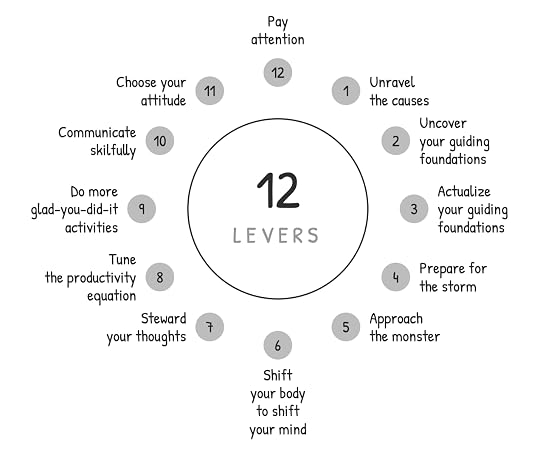
The authors took 2 years to analyze 106 books, 23 therapies, and numerous journal articles, videos, manuals, and other materials. Their conclusion was that the 459 techniques they extracted fell into the following 12 categories:
LEVER 1: Unravel the Causes.
Understand what’s causing your problems by breaking them down into smaller parts, like activating events, beliefs, consequences, and background vulnerability factors.
LEVER 2: Uncover Your Guiding Foundations.
Clarify what matters most to you — your intrinsic values, principles, and priorities — to give your life direction.
LEVER 3: Actualize Your Guiding Foundations.
Align your actions with your values through goals, habits, choice points, and reviews.
LEVER 4: Prepare for the Storm.
Create preparation plans to prevent problems from happening or better manage them if they do.
LEVER 5: Approach the Monster.
Use gradual exposure to face your fears (assuming they’re not dangerous) until your fear fades.
LEVER 6: Shift Your Body to Shift Your Mind.
Regulate your physiology through sleep, relaxation, energization, and healthy stress, and in doing so, regulate your mind.
LEVER 7: Steward Your Thoughts.
Cultivate helpful thinking by reframing your beliefs, working with internal parts, and postponing unhelpful worry and rumination.
LEVER 8: Tune the Productivity Equation.
Increase your productivity by working more hours, more efficiently, or on more important things.
LEVER 9: Do More Glad-You-Did-It Activities.
Identify whether you’re under or overactive and proactively schedule activities that reliably and sustainably improve your mood.
LEVER 10: Communicate Skillfully.
Improve your conversations by steering them into deeper topics, and improve your assertiveness by finding the balance between passivity and aggression.
LEVER 11: Choose Your Attitude.
Frame your experiences using helpful perspectives, such as optimism, acceptance, Stoic resilience, appreciation, and kindness.
LEVER 12: Pay Attention.
Cultivate helpful attention by redirecting your focus or practicing mindfulness.
These Levers can help if you
- feel stuck or trapped, have unexplained negative emotions, or don’t understand what’s causing your problems
- lack meaning or direction, don’t know what’s important to you, or struggle with big life decisions
- feel unmotivated, have unhealthy habits, struggle to take action, or aren’t living by your values
- experience the same problems repeatedly, face challenges you feel like you can’t handle, or keep making the same mistakes
- frequently feel anxious or are blocked by fear from doing things that are important to you
- often feel agitated/angry/stressed, dull/bored/depressed, or sleep poorly
- struggle with self-criticism, often get stuck in negative emotions that may be disproportionate to the situation, or spend a lot of time worrying or ruminating
- want to be more productive, frequently procrastinate, or don’t progress on goals or projects despite working a lot
- have chronic low mood, find downtime unfulfilling, or feel burned out
- feel lonely or socially disconnected, get stuck in shallow conversations, struggle with assertiveness, or get taken advantage of
- are stuck in difficult circumstances you can’t change, feel easily stressed or pessimistic, or struggle to appreciate the good things you have
- are typically distracted rather than present, get caught in loops of negative thinking, want moment-to-moment existence to feel better, or often try to avoid difficult thoughts and feelings
Each chapter ends with a "Key Takeaways" summary and a practical "Key Actions" section. This is always a win for me in a self-help book.
There also a ton of tools and resources on their website: https://www.clearerthinking.org/
The authors took 2 years to analyze 106 books, 23 therapies, and numerous journal articles, videos, manuals, and other materials. Their conclusion was that the 459 techniques they extracted fell into the following 12 categories:
LEVER 1: Unravel the Causes.
Understand what’s causing your problems by breaking them down into smaller parts, like activating events, beliefs, consequences, and background vulnerability factors.
LEVER 2: Uncover Your Guiding Foundations.
Clarify what matters most to you — your intrinsic values, principles, and priorities — to give your life direction.
LEVER 3: Actualize Your Guiding Foundations.
Align your actions with your values through goals, habits, choice points, and reviews.
LEVER 4: Prepare for the Storm.
Create preparation plans to prevent problems from happening or better manage them if they do.
LEVER 5: Approach the Monster.
Use gradual exposure to face your fears (assuming they’re not dangerous) until your fear fades.
LEVER 6: Shift Your Body to Shift Your Mind.
Regulate your physiology through sleep, relaxation, energization, and healthy stress, and in doing so, regulate your mind.
LEVER 7: Steward Your Thoughts.
Cultivate helpful thinking by reframing your beliefs, working with internal parts, and postponing unhelpful worry and rumination.
LEVER 8: Tune the Productivity Equation.
Increase your productivity by working more hours, more efficiently, or on more important things.
LEVER 9: Do More Glad-You-Did-It Activities.
Identify whether you’re under or overactive and proactively schedule activities that reliably and sustainably improve your mood.
LEVER 10: Communicate Skillfully.
Improve your conversations by steering them into deeper topics, and improve your assertiveness by finding the balance between passivity and aggression.
LEVER 11: Choose Your Attitude.
Frame your experiences using helpful perspectives, such as optimism, acceptance, Stoic resilience, appreciation, and kindness.
LEVER 12: Pay Attention.
Cultivate helpful attention by redirecting your focus or practicing mindfulness.
These Levers can help if you
- feel stuck or trapped, have unexplained negative emotions, or don’t understand what’s causing your problems
- lack meaning or direction, don’t know what’s important to you, or struggle with big life decisions
- feel unmotivated, have unhealthy habits, struggle to take action, or aren’t living by your values
- experience the same problems repeatedly, face challenges you feel like you can’t handle, or keep making the same mistakes
- frequently feel anxious or are blocked by fear from doing things that are important to you
- often feel agitated/angry/stressed, dull/bored/depressed, or sleep poorly
- struggle with self-criticism, often get stuck in negative emotions that may be disproportionate to the situation, or spend a lot of time worrying or ruminating
- want to be more productive, frequently procrastinate, or don’t progress on goals or projects despite working a lot
- have chronic low mood, find downtime unfulfilling, or feel burned out
- feel lonely or socially disconnected, get stuck in shallow conversations, struggle with assertiveness, or get taken advantage of
- are stuck in difficult circumstances you can’t change, feel easily stressed or pessimistic, or struggle to appreciate the good things you have
- are typically distracted rather than present, get caught in loops of negative thinking, want moment-to-moment existence to feel better, or often try to avoid difficult thoughts and feelings
Each chapter ends with a "Key Takeaways" summary and a practical "Key Actions" section. This is always a win for me in a self-help book.
There also a ton of tools and resources on their website: https://www.clearerthinking.org/
August 4, 2026
Greenberg and Stevenson went through more than a hundred self-help books and 20+ of therapy, built a database of around 500 techniques, and found that the whole pile collapses into twelve underlying psychological strategies. That's the book. You can see the research behind every chapter, but it never reads like a literature review.
I've read the usual suspects. The 7 Habits of Highly Effective People, Atomic Habits, The Subtle Art of Not Giving a F*ck, How to Win Friends and Influence People, Mindset. Some of them are good, and I don't regret the time. But each one is essentially a single author's angle, sold hard for three hundred pages. The 12 Levers is better than all of them by a wide margin, and it's better for a structural reason rather than a stylistic one: it's the only one that starts by reading the others and asking what actually holds up.
Structurally it's the most carefully built book of its kind I've come across. Each chapter says what it needs to say and then stops, which sounds like a small compliment until you remember how many authors stretch one decent idea across a whole book. The stories are chosen well, and every chapter closes with a summary of the key points, so it works just as well as a reference you flip back into later as it does read front to back.
The writing keeps you moving, which is not something I say often about this category. No pumped-up motivational tone, no filler, just clear explanations of things you can actually do.
I have also listened to the audio book, which has a beautiful voice and the accompanying materials turned out to be far more useful than I expected. They cover much of the book and they pair beautifully with the free surveys and tools over at Clearer Thinking, Greenberg's platform. Running a relevant assessment after finishing a chapter turns an idea you merely agreed with into something you've actually applied to yourself. ClearerThinking.org is worth poking around in regardless of whether you read the book, but together they're much better than either alone.
If you're only going to read one book on self-improvement or personal growth, make it this one. And if you're the type who reads twenty, start here anyway. It'll save you most of the other nineteen 😊
I've read the usual suspects. The 7 Habits of Highly Effective People, Atomic Habits, The Subtle Art of Not Giving a F*ck, How to Win Friends and Influence People, Mindset. Some of them are good, and I don't regret the time. But each one is essentially a single author's angle, sold hard for three hundred pages. The 12 Levers is better than all of them by a wide margin, and it's better for a structural reason rather than a stylistic one: it's the only one that starts by reading the others and asking what actually holds up.
Structurally it's the most carefully built book of its kind I've come across. Each chapter says what it needs to say and then stops, which sounds like a small compliment until you remember how many authors stretch one decent idea across a whole book. The stories are chosen well, and every chapter closes with a summary of the key points, so it works just as well as a reference you flip back into later as it does read front to back.
The writing keeps you moving, which is not something I say often about this category. No pumped-up motivational tone, no filler, just clear explanations of things you can actually do.
I have also listened to the audio book, which has a beautiful voice and the accompanying materials turned out to be far more useful than I expected. They cover much of the book and they pair beautifully with the free surveys and tools over at Clearer Thinking, Greenberg's platform. Running a relevant assessment after finishing a chapter turns an idea you merely agreed with into something you've actually applied to yourself. ClearerThinking.org is worth poking around in regardless of whether you read the book, but together they're much better than either alone.
If you're only going to read one book on self-improvement or personal growth, make it this one. And if you're the type who reads twenty, start here anyway. It'll save you most of the other nineteen 😊
August 18, 2026
Comprehensive psychological advice. The proof is in the pudding: I find myself repeatedly drawing on Greenberg's advice. Postponement, mindfulness and distancing yourself from thoughts, opposite action, the ABC technique and exposure therapy are all extremely useful in everyday experience.
For additional recommendations, the book is also excellent: new therapy kinds (dialectical behaviour therapy, metacognitive therapy), podcasts (Invisibilia) and many memoirs and self-help books (Eric Topol's Super-Agers looks particularly valuable.)
For me the book falls short in a few ways, which relate to its marketing:
1. 12- there are many more than 12 levers in the book! When you get into "sub-levers", the book gets much more comprehensive but also much more difficult to engage with and a slog in later chapters.
Paradoxically, because it's got so many levers and techniques, I assume there are many more useful techniques which they haven't considered, which makes it less of a one-stop shop than they originally intended.
2. Evidence: if you read the appendix, the actual evidence base is often for the overall therapy kinds rather than specific techniques, which is fine but weakens my trust slightly.
3. Self-help: my inclination is the books relies more on "what are the best evidence-based therapy techniques" than "which self-help books are the most useful". I like the book on that basis but it jars with the marketing around "we read hundreds of self-help books", which felt very secondary to the content.
Overall, it is good! I would still recommend reading good psychological techniques which help improve your life.
For additional recommendations, the book is also excellent: new therapy kinds (dialectical behaviour therapy, metacognitive therapy), podcasts (Invisibilia) and many memoirs and self-help books (Eric Topol's Super-Agers looks particularly valuable.)
For me the book falls short in a few ways, which relate to its marketing:
1. 12- there are many more than 12 levers in the book! When you get into "sub-levers", the book gets much more comprehensive but also much more difficult to engage with and a slog in later chapters.
Paradoxically, because it's got so many levers and techniques, I assume there are many more useful techniques which they haven't considered, which makes it less of a one-stop shop than they originally intended.
2. Evidence: if you read the appendix, the actual evidence base is often for the overall therapy kinds rather than specific techniques, which is fine but weakens my trust slightly.
3. Self-help: my inclination is the books relies more on "what are the best evidence-based therapy techniques" than "which self-help books are the most useful". I like the book on that basis but it jars with the marketing around "we read hundreds of self-help books", which felt very secondary to the content.
Overall, it is good! I would still recommend reading good psychological techniques which help improve your life.

September 7, 2026
The Ultimate Guide to Self-Help. Highly actionable and easy to read.
As someone who has read a lot in the personal development space, I found The 12 Levers remarkably comprehensive while also being refreshingly practical.
Spencer Greenberg and Jeremy Stevenson undertook an enormous research project, analyzing 106 self-help books, 23 different therapies, and a wide range of journal articles, videos, manuals, and other materials. From that research, they identified 459 self-help techniques and ultimately distilled them into 12 distinct categories.
What I especially appreciate is their decision to focus on techniques: the things we can actually do. We can’t always choose our circumstances or how we feel, but we can choose to try a technique. And ultimately, it’s what we do differently that gives us the opportunity to create different outcomes.
The result is what feels like a complete psychological toolkit for improving your life. It’s comprehensive without being overwhelming and rigorous without being academic or difficult to read.
I found myself highlighting something on nearly every page. The book is fluff-free, simple yet potent, and genuinely enjoyable to read, with a great blend of stories, research, and practical ideas you can immediately apply to your life.
There is so much gold here. I highly recommend The 12 Levers to anyone who cares about personal growth and wants practical, thoughtful tools for living a better life.
As someone who has read a lot in the personal development space, I found The 12 Levers remarkably comprehensive while also being refreshingly practical.
Spencer Greenberg and Jeremy Stevenson undertook an enormous research project, analyzing 106 self-help books, 23 different therapies, and a wide range of journal articles, videos, manuals, and other materials. From that research, they identified 459 self-help techniques and ultimately distilled them into 12 distinct categories.
What I especially appreciate is their decision to focus on techniques: the things we can actually do. We can’t always choose our circumstances or how we feel, but we can choose to try a technique. And ultimately, it’s what we do differently that gives us the opportunity to create different outcomes.
The result is what feels like a complete psychological toolkit for improving your life. It’s comprehensive without being overwhelming and rigorous without being academic or difficult to read.
I found myself highlighting something on nearly every page. The book is fluff-free, simple yet potent, and genuinely enjoyable to read, with a great blend of stories, research, and practical ideas you can immediately apply to your life.
There is so much gold here. I highly recommend The 12 Levers to anyone who cares about personal growth and wants practical, thoughtful tools for living a better life.

Review of advance copy received from NetGalley
4.5 rounded up
One of the biggest challenges with self-help books is that they often leave you with plenty of ideas but very little guidance on what to actually do. The 12 Levers stands out by organizing decades of psychological research, therapies, and self-improvement strategies into a practical, easy-to-follow framework. Rather than presenting entirely new concepts, it thoughtfully curates and synthesizes proven tools from across the self-help landscape into one accessible resource. I especially appreciated how actionable the book is, with exercises, reflection prompts, and techniques that encourage real application rather than passive reading. This is the kind of book worth keeping on your shelf, revisiting during different seasons of life, and working through again whenever you need a reset or a fresh perspective. Highly recommended for anyone looking for a practical toolkit to improve their well-being and navigate life's challenges with greater intention.
Thank you Netgalley and Grand Central Publishing for the ARC!
One of the biggest challenges with self-help books is that they often leave you with plenty of ideas but very little guidance on what to actually do. The 12 Levers stands out by organizing decades of psychological research, therapies, and self-improvement strategies into a practical, easy-to-follow framework. Rather than presenting entirely new concepts, it thoughtfully curates and synthesizes proven tools from across the self-help landscape into one accessible resource. I especially appreciated how actionable the book is, with exercises, reflection prompts, and techniques that encourage real application rather than passive reading. This is the kind of book worth keeping on your shelf, revisiting during different seasons of life, and working through again whenever you need a reset or a fresh perspective. Highly recommended for anyone looking for a practical toolkit to improve their well-being and navigate life's challenges with greater intention.
Thank you Netgalley and Grand Central Publishing for the ARC!

August 1, 2026
The book has too much varied content stuffed in. 12 levels should have been simplified to 3-5 levers.
Unless you are bringing this book along with you, you won't remember half of what the book is about. There is a summary after each chapter, but I believe this book is trying to be too comprehensive about ways to improve your life.
Personally, I liked the pay attention and communicate skillfully chapters. Some chapters spent too much time providing research, but lacked details on how to apply the principles/ideas to the reader's life.
Look for other self-help books since this one is too spread out and tries to cover too many topics.
Unless you are bringing this book along with you, you won't remember half of what the book is about. There is a summary after each chapter, but I believe this book is trying to be too comprehensive about ways to improve your life.
Personally, I liked the pay attention and communicate skillfully chapters. Some chapters spent too much time providing research, but lacked details on how to apply the principles/ideas to the reader's life.
Look for other self-help books since this one is too spread out and tries to cover too many topics.

August 2, 2026
Based on extensive research, this book distills self-help into 12 core strategies, or "Levers." This toolkit helps readers clarify values, conquer fear, improve sleep, enrich downtime, increase productivity, and manage self-consciousness, providing a comprehensive approach to life improvement.
This easy-to-read book provides a clear map for developing productive habits while overcoming destructive thoughts and behaviors. Sometimes it seemed a bit facile to me, ignoring the role of trauma. Still, this is a good guide for resetting daily routines in order to live a happier, healthier life.
Thanks, NetGalley, for the ARC I received. This is my honest and voluntary review.
This easy-to-read book provides a clear map for developing productive habits while overcoming destructive thoughts and behaviors. Sometimes it seemed a bit facile to me, ignoring the role of trauma. Still, this is a good guide for resetting daily routines in order to live a happier, healthier life.
Thanks, NetGalley, for the ARC I received. This is my honest and voluntary review.

August 6, 2026
Thank you to NetGalley and Grand Central Publishing/Balance for the ARC in exchange for an honest review.
This is not the kind of book you sit and binge. It fills a gap in self help literature that has always driven me crazy- too much analysis and discussion and not enough actionable steps to take. Having a toolkit of actions is incredibly helpful. However, that makes this book dense, not in the way off too difficult but in the way of too much packed in. It could be really helpful to pull out and skip around and play with on occasion but as a cohesive book it just feels thick.
This is not the kind of book you sit and binge. It fills a gap in self help literature that has always driven me crazy- too much analysis and discussion and not enough actionable steps to take. Having a toolkit of actions is incredibly helpful. However, that makes this book dense, not in the way off too difficult but in the way of too much packed in. It could be really helpful to pull out and skip around and play with on occasion but as a cohesive book it just feels thick.

Did Not Finish
September 19, 2026Like any male in their early 20’s looking to make their mark - I was heavily attracted to self help books. Tony Robbins, Tim Ferris, Phil Knight’s bio, The seven habits etc.
I’ve wandered far from those books in the last 3-4 years, but thought I would give this one a go. I’m a bit of a fanboy of Spencer Greenberg you see. But for everything there is a season - and a self help book with lists is winter, and the sun in shining.
If I was 25, I’d have eaten this up. But I’m not, so I’m putting it down.
Spencer, I’m still a huge fan.
I’ve wandered far from those books in the last 3-4 years, but thought I would give this one a go. I’m a bit of a fanboy of Spencer Greenberg you see. But for everything there is a season - and a self help book with lists is winter, and the sun in shining.
If I was 25, I’d have eaten this up. But I’m not, so I’m putting it down.
Spencer, I’m still a huge fan.

August 27, 2026
This book effectively condenses dozens of other books into actionable techniques to improve your life. Each lever has step-by-step instructions on how to implement the tool, as well as examples of how it helped people in real life.
For anyone with mental health challenges I think this is a must read. For people just trying to better themselves but no significant mental health issues, I would still recommend this book.
I will be coming back to it for sure.
For anyone with mental health challenges I think this is a must read. For people just trying to better themselves but no significant mental health issues, I would still recommend this book.
I will be coming back to it for sure.

Review of advance copy received from NetGalley
I really loved this book. It’s a great ‘life bible’ with everything you need to know to get greater satisfaction out of life. For me there was nothing entirely new in there but it was well written and well evidenced. Definitely something I would refer to if I needed an overhaul. I would definitely recommend it. Thanks to NetGalley and Balance for the ARC.

August 29, 2026
I love the idea for this book - a meta-analysis of self-help and life improvement interventions. Its breadth provides a no-stone-left-unturned approach to becoming familiar with the most proven techniques to dealing with what ails. It’s a strong and well-researched overview. You can further pursue specific areas that resonate, though the book will get you started in applying many of the tools.
August 28, 2026
This may be the best book to gift someone that I've ever come across. But maybe it's because it's one of the most helpful books I've ever read and had in my possession. And it has a strong chance to eventually be first on that list.

August 28, 2026
I've read a lot of self-help books, but this one is by far the best. There is no padding or BS; just clear instructions on how to implement evidence-based techniques that will improve your life. I'll keep coming back to this book time and again over the years to come.

September 30, 2026
Audiobook. This was so absolutely phenomenal I can’t even begin. All of the information was so easy to understand and the stories and research made so much sense. I truly believe everyone could benefit from this book. The narrator was great as well.
August 11, 2026
A carefully compiled synthesis of the self improvement literature with an uncommonly firm evidentiary basis and a judicial, sparing use of anecdotes.

September 7, 2026
Standard self help stuff (which is the point really)! Good if you have a normal brain

September 14, 2026
A comprehensive review of applied psychology and decision science with a ridiculous amount of strategies that can be implemented immediately. A very cool concept well executed.

September 15, 2026
I don’t particularly enjoy self help, but this is the exception. This book is the distillation of over 100 other self help books into truly actionable steps. Would recommend.
Displaying 1 - 23 of 23 reviews