

What do you think?

Said the Dead
From the author of
A Ghost in the Throat
, an unforgettable book - both history and ghost story - that will leave you gasping by its final page.
In the city of Cork, a derelict Victorian mental hospital is being converted into modern apartments. One passerby has always flinched as she passes the place. Had her birth occurred in another decade, she too might have lived within those walls. Now, she notices a FOR SALE. It is the first of many signs. Following them, she finds herself drawn into an irresistible river of forgotten voices, those of the women who knew this place insistent, vivid and true. They murmur from archives and old records; they whisper from stairwells and walls. Among them - and in one figure in particular -- she may find meaning, solace, rage; her own salvation, perhaps, or her own vanishing?
A work of sublime intensity and tenderness, Said the Dead breaks the boundaries between worlds -- past and present, imagined and real -- to make something lasting and an experience full of danger, full of love and full of truth.
In the city of Cork, a derelict Victorian mental hospital is being converted into modern apartments. One passerby has always flinched as she passes the place. Had her birth occurred in another decade, she too might have lived within those walls. Now, she notices a FOR SALE. It is the first of many signs. Following them, she finds herself drawn into an irresistible river of forgotten voices, those of the women who knew this place insistent, vivid and true. They murmur from archives and old records; they whisper from stairwells and walls. Among them - and in one figure in particular -- she may find meaning, solace, rage; her own salvation, perhaps, or her own vanishing?
A work of sublime intensity and tenderness, Said the Dead breaks the boundaries between worlds -- past and present, imagined and real -- to make something lasting and an experience full of danger, full of love and full of truth.
332 pages, Hardcover
First published May 21, 2026
About the author
Doireann Ní Ghríofa
21 books536 followersDoireann Ní Ghríofa is a bilingual writer, devoted to exploring how the past makes itself felt within the present. A Ghost in the Throat finds an 18th century poet haunting a young mother, leading her through visions of blood, milk, lust, and murder. Written on the roof of a multi-storey car park in Ireland, it went on to be described as “powerful” (New York Times), “captivatingly original” (The Guardian), and a “masterpiece” (Sunday Business Post). A Ghost in the Throat won the James Tait Black Prize and was voted overall Book of the Year at the Irish Book Awards, while the US edition was a finalist for the National Book Critics Circle Award and a New York Times Notable Book of 2021. It is to appear in 15 further languages worldwide.
Doireann is also the author of six critically-acclaimed books of poetry, each a deepening exploration of birth, death, desire, and domesticity. Awards for her writing include a Lannan Literary Fellowship (USA), the Ostana Prize (Italy), the James Tait Black Prize (Scotland), a Seamus Heaney Fellowship, and the Rooney Prize for Irish Literature, among others.
Doireann is also the author of six critically-acclaimed books of poetry, each a deepening exploration of birth, death, desire, and domesticity. Awards for her writing include a Lannan Literary Fellowship (USA), the Ostana Prize (Italy), the James Tait Black Prize (Scotland), a Seamus Heaney Fellowship, and the Rooney Prize for Irish Literature, among others.
Ratings & Reviews
Friends & Following
Create a free account to discover what your friends think of this book!
Community Reviews
Displaying 1 - 30 of 252 reviews

May 12, 2026
Absolutely sensational… there are streams of tears running down my cheeks as I write this. What a transformative and monumental book. Tentatively adding this to my favourites of all time. I miss it already.

January 6, 2026
In November 2025 I lived in Cork City thanks to a booksellers’ exchange programme. The bedroom of my apartment had a window overlooking Fitzgerald Park and the hill beyond the River Lee. Every morning, as I woke up, I wondered what that large red-brick building stretching out before me might be: I could see the collapsed roof, windows opening onto an empty sky, trees growing inside. Only a few weeks later did I discover that it was the Good Shepherd’s Convent, a former Magdalene laundry, purchased by Cork City Council and slated for conversion into student accommodation. I know it is a mistake to think this way, but somehow the derelict convent transformed itself in my mind into the asylum that Doireann Ní Ghríofa chose to write about in her new book, a place that seems to share the same past and the same future. And it was there that the author took me, on one of my last days in Cork, allowing me to look at it through a gate and through her voice.
Because of a mix-up in the mail, the Reader — both protagonist and narrative device of the book — begins to receive letters not addressed to her. Her stubborn search leads her to consult the old records of the local asylum, where she repeatedly encounters the name of Dr Lucia Strongman, the only woman physician. Through her, the voices of the patients are released and take possession of the book, passing through the reader with memories, pain, and healing. For this is a book about healing: the only cure made possible when the past returns and makes itself present again. It is a book written by someone who believes that ghosts can be glitches in time, presences we can still encounter in the places they once inhabited.
Said the Dead is a sublime book, permeated by its author’s sensitivity and extraordinary empathy. It is also a nocturnal book, of births and deaths, and, as in A Ghost in the Throat, these pages too are a “female text”: the eyes of its women look back at us from Victorian photographs, made hazy and fantastical by the slow decay of paper.
Because of a mix-up in the mail, the Reader — both protagonist and narrative device of the book — begins to receive letters not addressed to her. Her stubborn search leads her to consult the old records of the local asylum, where she repeatedly encounters the name of Dr Lucia Strongman, the only woman physician. Through her, the voices of the patients are released and take possession of the book, passing through the reader with memories, pain, and healing. For this is a book about healing: the only cure made possible when the past returns and makes itself present again. It is a book written by someone who believes that ghosts can be glitches in time, presences we can still encounter in the places they once inhabited.
Said the Dead is a sublime book, permeated by its author’s sensitivity and extraordinary empathy. It is also a nocturnal book, of births and deaths, and, as in A Ghost in the Throat, these pages too are a “female text”: the eyes of its women look back at us from Victorian photographs, made hazy and fantastical by the slow decay of paper.

Review of advance copy received from Publisher
There were many pages left to read, but the archive clock never slowed its ticking, her allocated hours dwindling to minutes with brutal speed. The children would soon be emerging from school in raincoats and scuffed shoes, and her afternoon would fill with chores and homework and errands. Soon. But for a little longer, it could be just her and this book. She pressed onwards through the crowd, reading each person she met in the particularity of their sorrows, their enmities, their own cherished rage. If she recognised their distress, it was because she, too, had known the lure of the river's dark silks and the horror of being dragged back from her ending, but when she recognised wisps of herself in their lives, she understood that her pain was hers, and their pain was theirs.
I first came across Doireann Ni Ghriofa’s brilliant and unique “Ghost in the Throat” – part memoir, part historical biography, part autofiction, part essay about a 21st Century narrator searching for the woman behind a 18th Century poem - due its longlisting (on behalf of Tramp Press) for the 2021 Republic of Consciousness Prize for risk-taking small-press Fiction. Its genre-bending nature was shown by its listing for other awards for Fiction (e.g. longlisted for the 2021 Desmond Elliott Prize for debut fiction) and two genres of non-fiction – winner of the 2021 James Tait Black Prize for Biography and then Finalist for the US National Book Critics Circle Award for Autobiography (having also nominations for the 2021 cross-genre Folio Prize and won the overall and non-Fiction categories at the 2020 Irish Book of the Year awards).
And this – the bilingual poet and essayists first novel since then fits perhaps even more strongly with her self-description on her website as being an Irish writer “devoted to exploring how the past makes itself felt within the present” and is just as genre-defying (if I think more clearly starting with the outwards trappings of fiction) with its 21st century third-party narrator (“The Reader”) in communication with the lives of the patients and doctor in an Cork Victorian mental hospital via extensive and in the end almost life-consuming archival research - research carried out by the author herself for who “the reader” is a clear avatar.
The book opens with a chance call from an estate agent – simply to say that library notices have been going to the narrator’s old address – which then prompts the narrator to call back as she recognises the estate agent as one selling new built flat conversions in the old asylum, which she uses as an excuse to visit it. From there she finds herself drawn to the local archives to trace the history of the asylum and comes across a casebook on the treatment of female patients written by the lead doctor (and including descriptions of their condition – albeit with an all too common “no change” – and sometimes photos) – and is even more drawn in when she discovers that one of the doctors – Lucia – is female.
And from there she is drawn into the lives of many of those who were in the asylum, with the narrative blurring alongside the genre.
At times we are more reading of the Reader’s researches: her debates with the archivists over what she can both access (there is for example a 100 year rule) and what she can use (for some time she is told she has to anonymise names but feels strongly this is dishonouring the memory of the dead); her further investigations which might take her into board minutes, birth death and marriage registers, newspaper articles and more.
At other times we are much more in the lives of the women themselves.
Alongside this is an intriguing occasional interjection from another voice who is following the Reader’s investigations and concerned about the Reader’s own mental health (and perhaps displacement of care for that into the lives of the long dead patients).
As the story develops – additional strands start to weave in, both Irish history (the Independence struggles and Civil War) and the use of mesmerism to treat mental illness.
And there is an excellent end to the novel – where the identity of the Reader is acknowledged by name, the identity of the second voice becomes clearer and the reader of the novel ourselves (particularly perhaps if the reader is female).
Really an outstanding piece of work – as deserving of multiple and varying literary accolades as its predecessor – with perhaps the Goldsmith Prize for mould-breaking fiction where I would most like to see it featuring (a prize which is now overdue an Irish winner after their early dominance).
Until now, she has spoken only of the past, relying - at least in part - on fact.
But tonight, she collides with the present, a threshold I'd hoped might lead us into the treatment phase. But she isn't ready. Departing
from the facts of the past, she skips the present, and begins to tell the future, in past tense.
My thanks to Faber for an ARC

June 5, 2026
Doireann Ní Ghríofa's debut novel A Ghost in the Throat was published in 2020 by Tramp Press, founded by Lisa Coen and Sarah Davis-Goff in 2014 to “find, nurture and publish exceptional literary talent”.
It initially came to me attention via its shortlisting for the Republic of Consciousness Prize for innovative fiction from small presses, and went on to considerable literary prize success, but interestingly in a variety of categories - fiction; non-fiction; biography - the novel a distinctive blend of lyrical essay and autofiction, as the author told of her search for the woman, Eibhlín Dubh Ní Chonaill, behind an 18th century poem and lament, Caoineadh Airt Uí Laoghaire.
Said the Dead, the author's second work, is in a similarly hybrid vein and another book I hope and expect to see earn prize success.
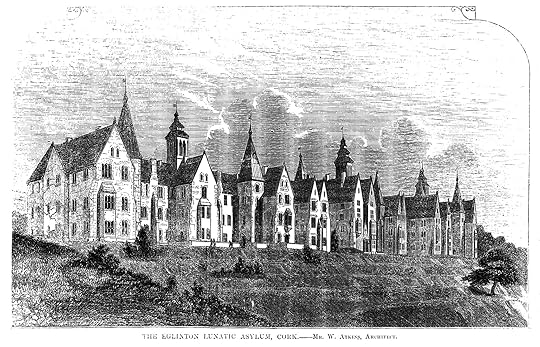
The novel is based around Our Lady's Hospital, Cork, which opened in 1852 as the Eglinton Lunatic Asylum, and became a mental and then a psychiatric hospital until it's closure in 1992.
The architect's drawing of the Eglington Lunatic Asylum:
It was subsequently converted to residential accomodation, and its seeing a For Sale sign (although the actual place is not named) that leads the author/narrator/subject to investigate further, aware of her own history, starting with a visit via her estate agent:
On a hill over the city, a derelict mental hospital had been partly converted into apartments, and now the hospital chapel was being advertised as a development opportunity too. She counted herself among the many who flinched as they passed that old institution. Had her birth occurred in another decade, she - whose distress had twice sent her clambering river railings seeking her ending - might have lived within those walls.
She called it a whim, the force that lifted the phone and made her thumb ask a favour: if the agent was arranging viewings of the chapel, might he allow her to pop in afterwards, just for a quick look? It all happened quite quickly then, the phone began to ring in her hand, and within fifteen minutes, she was watching him unlock the gate.
I hedge with the author/narrator/subject qualifier as the investigation into the asylum is conducted by a character referred to, in the third person, as the Reader. And another, unnamed narrator, provides their own commentary on her investigations, treating her obsession with the history of the mental hospital, as a form of psychiatry for the Reader.
The Reader soon exhausts her physical investigation into the part-refurbished part-derelict site but discovers a richer source in Cork's archives - detailed case notes (she focuses on the female side of the institution) of those incarcarated and treated there. Initially they are largely written by Dr William Scanlan, the Assistant Medical Officer, but then she spots another name:
What were they tor? Who were they for? Other doctors, she supposed, who might skim a patient's history before plotting treatments. Many entries were initialled W. S., matching the opening page: William Scanlan. Towards the end of November 1895, he was writing of a woman who said 'that she can stop the Sun from dancing, that her husband sold her to the clergy because he did not want her to be looking so well as she had too much money... She heard a man speaking to her during the night, while in bed. He said, "We'll meet again," but she does not know who he is? Later entries only shrugged 'No change since the last report, 'No change'. 'No change', 'No change'.
Years were lost to such repetition, while precious minutes were passing in the archive. Scanlan's signature was replaced by new squiggles - LS or GH or LFG or JF - but no one ever clarified whether the man in the night made good on his promise: 'We'll meet again.' Instead, one doctor observed that this patient fancies she is in a grand place and is very happy. LS! Three years later, the same hand found her 'elated and cheerful, fancies this is a lovely place and that she is wonderfully happy'. Even after a bout of influenza, she was 'still cheerful, although she now tells everyone that she is dead'. To this doctor, the patient appeared neat, clean and healthy, if 'very pale in complexion', and when the patient spoke from that blue page to address her doctor, ‘she says my name is Miss Justice.’
The Reader was taken aback. Was she looking at another woman?
And examining the minutes of the institution's Board she soon discovers that they appointed, unusually for the time, a female doctor, Lucia Strangman.
The obituary for Lucia Strangman Fitzgerald from the British Medical Journal in 1958:
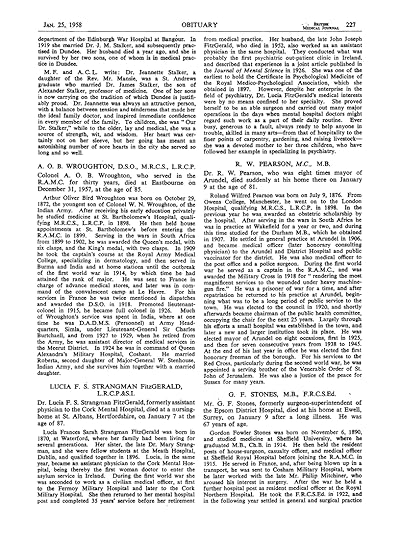
The novel then consists of the Reader followng the history of the institution, and of Lucia, through the case notes, which she in part transcribes but in part brings to life in her fictionalised imaginings. We also see Lucia and her husband, another doctor at the institution, establishing the first psychiatric outpatient clinic in Ireland. And all the time the narrative voice concerns itself with the Reader's own present-day mental wellbeing.
Generally, the story told is of what comes across, particularly under Lucia's stewardship, as a caring institution, albeit one limited my the medical techniques of the time (indeed Lucia is required to act as a general surgeon as well as a psychiatrist) and prone to epidemics of TB and cholera. The main concern perhaps being the refrain of 'no change' and 'content' as many of the patients show no real improvement, or perhaps even desire to improve. But then the Reader comes across a letter from a relative of a patient, which makes her realise she is reading history through a one-sided lens:
Following polite enquiries about relatives and neighbours, Mary wrote of her stepsister, 'I saw Annie just once... she looks fairly well but her mental condition is no better, although she recognised me after a little while. She does not seem to feel the privation of these dismal walls. I know the outside world would seem foreign to her now. Have you got any idea of what kind of a place this is — well I must tell you, it is not a very good place and the treatment of the patients here is horrifying.'
The Reader's pencil rolled onto the archive floor. Her eye darted back to her question - 'Have you got any idea of what kind of a place this is' - No. She had been looking through the doctors' eyes for too long. If Lucia had written 'content here' about this stepsister, the Reader would have taken her words as fact. Scraping back her chair, she stumbled through the archive vestibule and locked herself into the bathroom.
She'd let the casebooks lull her into thinking of them as truth, and she was angry with herself for that, and angry that she couldn't put the doctors' books aside altogether in favour of letters composed by the patients themselves.
A coda to the novel provides an interpretation of the Reader's identity - or identities? - and most strikingly the identity of the psychiatrist-narrator.
Beautifully done. Perhaps my only hesitation the sheer volume of case studies, and the feeling the author wanted to do all the (anonymised) women she encountered in the archives justice, 4.5 stars.
It initially came to me attention via its shortlisting for the Republic of Consciousness Prize for innovative fiction from small presses, and went on to considerable literary prize success, but interestingly in a variety of categories - fiction; non-fiction; biography - the novel a distinctive blend of lyrical essay and autofiction, as the author told of her search for the woman, Eibhlín Dubh Ní Chonaill, behind an 18th century poem and lament, Caoineadh Airt Uí Laoghaire.
Said the Dead, the author's second work, is in a similarly hybrid vein and another book I hope and expect to see earn prize success.
The novel is based around Our Lady's Hospital, Cork, which opened in 1852 as the Eglinton Lunatic Asylum, and became a mental and then a psychiatric hospital until it's closure in 1992.
The architect's drawing of the Eglington Lunatic Asylum:
It was subsequently converted to residential accomodation, and its seeing a For Sale sign (although the actual place is not named) that leads the author/narrator/subject to investigate further, aware of her own history, starting with a visit via her estate agent:
On a hill over the city, a derelict mental hospital had been partly converted into apartments, and now the hospital chapel was being advertised as a development opportunity too. She counted herself among the many who flinched as they passed that old institution. Had her birth occurred in another decade, she - whose distress had twice sent her clambering river railings seeking her ending - might have lived within those walls.
She called it a whim, the force that lifted the phone and made her thumb ask a favour: if the agent was arranging viewings of the chapel, might he allow her to pop in afterwards, just for a quick look? It all happened quite quickly then, the phone began to ring in her hand, and within fifteen minutes, she was watching him unlock the gate.
I hedge with the author/narrator/subject qualifier as the investigation into the asylum is conducted by a character referred to, in the third person, as the Reader. And another, unnamed narrator, provides their own commentary on her investigations, treating her obsession with the history of the mental hospital, as a form of psychiatry for the Reader.
The Reader soon exhausts her physical investigation into the part-refurbished part-derelict site but discovers a richer source in Cork's archives - detailed case notes (she focuses on the female side of the institution) of those incarcarated and treated there. Initially they are largely written by Dr William Scanlan, the Assistant Medical Officer, but then she spots another name:
What were they tor? Who were they for? Other doctors, she supposed, who might skim a patient's history before plotting treatments. Many entries were initialled W. S., matching the opening page: William Scanlan. Towards the end of November 1895, he was writing of a woman who said 'that she can stop the Sun from dancing, that her husband sold her to the clergy because he did not want her to be looking so well as she had too much money... She heard a man speaking to her during the night, while in bed. He said, "We'll meet again," but she does not know who he is? Later entries only shrugged 'No change since the last report, 'No change'. 'No change', 'No change'.
Years were lost to such repetition, while precious minutes were passing in the archive. Scanlan's signature was replaced by new squiggles - LS or GH or LFG or JF - but no one ever clarified whether the man in the night made good on his promise: 'We'll meet again.' Instead, one doctor observed that this patient fancies she is in a grand place and is very happy. LS! Three years later, the same hand found her 'elated and cheerful, fancies this is a lovely place and that she is wonderfully happy'. Even after a bout of influenza, she was 'still cheerful, although she now tells everyone that she is dead'. To this doctor, the patient appeared neat, clean and healthy, if 'very pale in complexion', and when the patient spoke from that blue page to address her doctor, ‘she says my name is Miss Justice.’
The Reader was taken aback. Was she looking at another woman?
And examining the minutes of the institution's Board she soon discovers that they appointed, unusually for the time, a female doctor, Lucia Strangman.
The obituary for Lucia Strangman Fitzgerald from the British Medical Journal in 1958:
The novel then consists of the Reader followng the history of the institution, and of Lucia, through the case notes, which she in part transcribes but in part brings to life in her fictionalised imaginings. We also see Lucia and her husband, another doctor at the institution, establishing the first psychiatric outpatient clinic in Ireland. And all the time the narrative voice concerns itself with the Reader's own present-day mental wellbeing.
Generally, the story told is of what comes across, particularly under Lucia's stewardship, as a caring institution, albeit one limited my the medical techniques of the time (indeed Lucia is required to act as a general surgeon as well as a psychiatrist) and prone to epidemics of TB and cholera. The main concern perhaps being the refrain of 'no change' and 'content' as many of the patients show no real improvement, or perhaps even desire to improve. But then the Reader comes across a letter from a relative of a patient, which makes her realise she is reading history through a one-sided lens:
Following polite enquiries about relatives and neighbours, Mary wrote of her stepsister, 'I saw Annie just once... she looks fairly well but her mental condition is no better, although she recognised me after a little while. She does not seem to feel the privation of these dismal walls. I know the outside world would seem foreign to her now. Have you got any idea of what kind of a place this is — well I must tell you, it is not a very good place and the treatment of the patients here is horrifying.'
The Reader's pencil rolled onto the archive floor. Her eye darted back to her question - 'Have you got any idea of what kind of a place this is' - No. She had been looking through the doctors' eyes for too long. If Lucia had written 'content here' about this stepsister, the Reader would have taken her words as fact. Scraping back her chair, she stumbled through the archive vestibule and locked herself into the bathroom.
She'd let the casebooks lull her into thinking of them as truth, and she was angry with herself for that, and angry that she couldn't put the doctors' books aside altogether in favour of letters composed by the patients themselves.
A coda to the novel provides an interpretation of the Reader's identity - or identities? - and most strikingly the identity of the psychiatrist-narrator.
Beautifully done. Perhaps my only hesitation the sheer volume of case studies, and the feeling the author wanted to do all the (anonymised) women she encountered in the archives justice, 4.5 stars.

June 22, 2026
Archives, names, and historical traces are incredibly powerful, but they are not yet a world.
I’m pretty bummed about not liking Doireann Ni Ghriofa’s Said the Dead more because I adored A Ghost in the Throat and loved her poetry collections. Here, she does a similar thing as in A Ghost in the Throat: archival pursuit, historical women, the narrator’s own life, motherhood, language, translation, hunger. However, instead of turning obsession into propulsion and openness, the book loses its poetic grip halfway through its woman-reading-archives plot. I don’t mind vibes and poetic fragments, but I’m supposed to feel something, and I simply can’t help drifting away. I still have the archive and the atmosphere, but the ghosts are no longer pulling me into the book.
I’m pretty bummed about not liking Doireann Ni Ghriofa’s Said the Dead more because I adored A Ghost in the Throat and loved her poetry collections. Here, she does a similar thing as in A Ghost in the Throat: archival pursuit, historical women, the narrator’s own life, motherhood, language, translation, hunger. However, instead of turning obsession into propulsion and openness, the book loses its poetic grip halfway through its woman-reading-archives plot. I don’t mind vibes and poetic fragments, but I’m supposed to feel something, and I simply can’t help drifting away. I still have the archive and the atmosphere, but the ghosts are no longer pulling me into the book.

Read
January 21, 2026'She read and read, because she had woken these voices, and to stop reading would silence them.'
Original, a novel no one could've written but this incredible author. Yet my fascination didn't always trump my impatience and at times I had to force myself ahead when I wished to be simply compelled.
Original, a novel no one could've written but this incredible author. Yet my fascination didn't always trump my impatience and at times I had to force myself ahead when I wished to be simply compelled.

September 12, 2026
Een bijzonder en intens boek dat me op een heel andere manier raakte dan ik vooraf had verwacht. Doireann Ní Ghríofa schrijft prachtig over moederschap, verlies, verlangen en de sporen die vrouwen door de generaties heen met zich meedragen.
De combinatie van het persoonlijke verhaal en de historische laag vond ik indrukwekkend en soms zelfs confronterend. Het is geen boek dat je zomaar even uitleest; sommige passages vragen tijd om te laten bezinken. Juist die poëtische en soms rauwe manier van vertellen maakte dat het verhaal in mijn hoofd bleef nazinderen.
Een kwetsbaar, origineel en mooi boek.
De combinatie van het persoonlijke verhaal en de historische laag vond ik indrukwekkend en soms zelfs confronterend. Het is geen boek dat je zomaar even uitleest; sommige passages vragen tijd om te laten bezinken. Juist die poëtische en soms rauwe manier van vertellen maakte dat het verhaal in mijn hoofd bleef nazinderen.
Een kwetsbaar, origineel en mooi boek.

June 14, 2026
this was deeply deeply not for me, but it's going to really work for a lot of people.
i'll briefly talk about what it is, because it sounds super fascinating and it's why i picked it up. ní ghríofa takes a large old building in cork, which used to be a psychiatric hospital and only closed down in the 90s for ever. it's been abandoned and parts of it are now private apartments. the narrator in this book, who is the author but distanced, wanders through this place both physically (in the derelict parts) and also psychically. she reads over records of the women who stayed there. she immerses herself in their stories and tries to tell them, while also discussing what brought her there. it's clear she's struggled significantly with her own mental health and a prevailing concern appears to be that her own mental health would have likely seen her in similar places a hundred years ago.
this is an emotional creative exercise, using the bones of nonfiction. the author is writing using public records, reconstructing stories of the women who have been in this hospital, along with a pretty interesting story about one of the staff, lucia strangman -- a woman herself, who went to medical school, who become one of the first psychiatric fellows, who then went and opened her own clinic after.
i want to be upfront and say that some of this is very beautifully written, that it is obviously hugely emotionally impactful to the author, that it even feels like an interesting thing to do. it's a huge undertaking and it is compassionate. but, for me, i just didn't get on with the odd intersection between fact and fiction and the blurring of the lines. the distancing between the author and the "Reader" she creates to not use "I" over and over is a stylistic choice that i didn't like. the creativity she explores in diving into these womens lives and trying to bring them to life might be interesting but it made me very very aware of the distance, too. she's obviously trying to erode that but i just didn't find it convincing. if you're using these accounts and records to recreate these women, i ended up thinking that it wasn't enough of either. i didn't think it worked as a nonfiction and it's clearly not fiction although it's certainly creative. i didn't like the fundamental choice in the creation of this book so it made me feel odd and strange as i listened to it. i just didn't like it.
but it isn't bad. it's just not for me. a really interesting concept, for sure, but i think you know within the first part if you'll get on with this. i do recommend giving it a go because i think a lot of people will get on with this.
i'll briefly talk about what it is, because it sounds super fascinating and it's why i picked it up. ní ghríofa takes a large old building in cork, which used to be a psychiatric hospital and only closed down in the 90s for ever. it's been abandoned and parts of it are now private apartments. the narrator in this book, who is the author but distanced, wanders through this place both physically (in the derelict parts) and also psychically. she reads over records of the women who stayed there. she immerses herself in their stories and tries to tell them, while also discussing what brought her there. it's clear she's struggled significantly with her own mental health and a prevailing concern appears to be that her own mental health would have likely seen her in similar places a hundred years ago.
this is an emotional creative exercise, using the bones of nonfiction. the author is writing using public records, reconstructing stories of the women who have been in this hospital, along with a pretty interesting story about one of the staff, lucia strangman -- a woman herself, who went to medical school, who become one of the first psychiatric fellows, who then went and opened her own clinic after.
i want to be upfront and say that some of this is very beautifully written, that it is obviously hugely emotionally impactful to the author, that it even feels like an interesting thing to do. it's a huge undertaking and it is compassionate. but, for me, i just didn't get on with the odd intersection between fact and fiction and the blurring of the lines. the distancing between the author and the "Reader" she creates to not use "I" over and over is a stylistic choice that i didn't like. the creativity she explores in diving into these womens lives and trying to bring them to life might be interesting but it made me very very aware of the distance, too. she's obviously trying to erode that but i just didn't find it convincing. if you're using these accounts and records to recreate these women, i ended up thinking that it wasn't enough of either. i didn't think it worked as a nonfiction and it's clearly not fiction although it's certainly creative. i didn't like the fundamental choice in the creation of this book so it made me feel odd and strange as i listened to it. i just didn't like it.
but it isn't bad. it's just not for me. a really interesting concept, for sure, but i think you know within the first part if you'll get on with this. i do recommend giving it a go because i think a lot of people will get on with this.

June 7, 2026
3.5
UPDATE: I don’t know if my rating is accurate because I can’t stop thinking about the book now that its covers are closed and it’s back on my shelf. I think I wanted it to be like A Ghost in the Throat, which is unfair and like comparing two children. Possibly a 4… I loved learning about Lucia & her patients, but I didn’t always love the storytelling surrounding them. It’s a hard one to rate. Worth a read for the history alone.
UPDATE: I don’t know if my rating is accurate because I can’t stop thinking about the book now that its covers are closed and it’s back on my shelf. I think I wanted it to be like A Ghost in the Throat, which is unfair and like comparing two children. Possibly a 4… I loved learning about Lucia & her patients, but I didn’t always love the storytelling surrounding them. It’s a hard one to rate. Worth a read for the history alone.

August 14, 2026
Said the Dead follows an obsessive narrator known as the Reader, who uncovers the 19th and early 20th century casebooks of the derelict Cork District Lunatic Asylum. She works through the records entry by entry, and most of what she finds is standard institutional language. The phrase "no change" repeats until it starts reading like a verdict handed down. She arrives at the building already knowing what it is to be in the kind of distress the casebooks record and develops a connection with the women committed there and with Dr. Lucia Strangman, the asylum's (real) first female psychiatrist. The connection turns psychic, almost surreal.
The book blends archival research, fiction, and memoir. It moves fluidly between the asylum's history and the narrator's present. It reveals how little agency these women had and how little of them survived in writing. Ní Ghríofa's prose is intimate and atmospheric, and the accumulation of small entries becomes mesmerizing. It is also the book's one drawback. There are more case reports than the narrative strictly requires, but I could feel the author wanting to honor every woman she found.
Said the Dead is a tribute to women erased by history. It is the type of book I expect to see on literary prize lists. Recommended to readers who want exceptional prose and unconventional storytelling. I haven't read Ní Ghríofa’s A Ghost in the Throat, but I will now.
4.5
Many thanks to the publisher, author, and NetGalley for providing me with an advance reader’s copy.
The book blends archival research, fiction, and memoir. It moves fluidly between the asylum's history and the narrator's present. It reveals how little agency these women had and how little of them survived in writing. Ní Ghríofa's prose is intimate and atmospheric, and the accumulation of small entries becomes mesmerizing. It is also the book's one drawback. There are more case reports than the narrative strictly requires, but I could feel the author wanting to honor every woman she found.
Said the Dead is a tribute to women erased by history. It is the type of book I expect to see on literary prize lists. Recommended to readers who want exceptional prose and unconventional storytelling. I haven't read Ní Ghríofa’s A Ghost in the Throat, but I will now.
4.5
Many thanks to the publisher, author, and NetGalley for providing me with an advance reader’s copy.

June 8, 2026
This centres around the actual records female patients in Cork District Lunatic Asylum at the turn of the 20th century. It is a blend of fact and fiction. Despite an interesting premise the plot is difficult to follow. It is informative, written in an appealing style of prose, but lacks an edge that could have come from developing more of a fictional balance.
It will be to the liking of many, and it serves as a tribute to those who suffered such horrors. But I had hoped for something darker. Ultimately, it’s neither one thing nor another, not a historical account, and not a haunting novel based around actual records.
It will be to the liking of many, and it serves as a tribute to those who suffered such horrors. But I had hoped for something darker. Ultimately, it’s neither one thing nor another, not a historical account, and not a haunting novel based around actual records.

September 13, 2026
Doireann Ní Ghríofa maakte weer zo'n indringende mix van feit, (auto)fictie en poëzie. 'The Reader' in Said The Dead duikelt de archieven op van de vroegere psychiatrische instelling in Cork. Via dr. Lucia Strongman, de enige vrouwelijke arts, komen de stemmen van de patiënten tot leven.
Net als A Ghost in the Throat is dit een 'female text': dit boek eist ruimte op voor de vergeten stemmen van vrouwen. Vrouwen die vaker het slachtoffer waren van maatschappelijke onderdrukking dan van een echte psychische kwestbaarheden. Ní Ghríofa creëert een eigen genre en ik vind het subliem.
PS: zoek zeker foto's op van die instelling in Cork!
Net als A Ghost in the Throat is dit een 'female text': dit boek eist ruimte op voor de vergeten stemmen van vrouwen. Vrouwen die vaker het slachtoffer waren van maatschappelijke onderdrukking dan van een echte psychische kwestbaarheden. Ní Ghríofa creëert een eigen genre en ik vind het subliem.
PS: zoek zeker foto's op van die instelling in Cork!

July 25, 2026
Video review https://youtu.be/jlbS6JwzOYc
Such beautiful writing conjuring up the ghosts of an asylum
Such beautiful writing conjuring up the ghosts of an asylum

September 7, 2026
Title: Said The Dead
Author: Doireann Ní Ghríofa
Genre: A mashup of narrative non-fiction, memoir, poetry, historical fiction, and historical research
Format: Audio 🎧
Rating: ⭐️⭐️⭐️
This novel is set in Cork, Ireland. It centers around a derelict Victorian mental hospital (the former Cork District Lunatic Asylum) that is undergoing conversion into modern apartments.
The narrator, referred to as “The Reader”steps away from her domestic life to submerge herself in old casebooks from the asylum. She unearths the forgotten names and the stories of female patients that were confined to the asylum. The Reader reconstructs the stories of individual women and feels a deep connection to them.
This book blurs the line between the living and the dead. We are left to question whether the researcher is haunting the past or being haunted by it.
The writing in this book was very poetic and atmospheric. I listened to this book on audio and the author narrated it herself. She did an excellent job with the narration. Her voice was almost hypnotic. However, I think this is a book that I would have done better with if I had read a physical copy. This book is very ambitious. There are a lot of timeline shifts and perspective shifts throughout the book that were hard to keep up with on audio.
Thank you to NetGalley and Macmillan Audio for the advance copy of this audiobook. All opinions are my own.
Author: Doireann Ní Ghríofa
Genre: A mashup of narrative non-fiction, memoir, poetry, historical fiction, and historical research
Format: Audio 🎧
Rating: ⭐️⭐️⭐️
This novel is set in Cork, Ireland. It centers around a derelict Victorian mental hospital (the former Cork District Lunatic Asylum) that is undergoing conversion into modern apartments.
The narrator, referred to as “The Reader”steps away from her domestic life to submerge herself in old casebooks from the asylum. She unearths the forgotten names and the stories of female patients that were confined to the asylum. The Reader reconstructs the stories of individual women and feels a deep connection to them.
This book blurs the line between the living and the dead. We are left to question whether the researcher is haunting the past or being haunted by it.
The writing in this book was very poetic and atmospheric. I listened to this book on audio and the author narrated it herself. She did an excellent job with the narration. Her voice was almost hypnotic. However, I think this is a book that I would have done better with if I had read a physical copy. This book is very ambitious. There are a lot of timeline shifts and perspective shifts throughout the book that were hard to keep up with on audio.
Thank you to NetGalley and Macmillan Audio for the advance copy of this audiobook. All opinions are my own.

July 30, 2026
Prepare to be haunted and maybe to haunt, too

August 5, 2026
One of the more highly anticipated novels of the year for me and what a novel. Quite unlike A Ghost in the Throat, and yet it feels like only Doireann Ni Ghriofa could have written this hallucinatory, captivating, honouring of troubled women, the Doctor who cared for them and recorded their conditions and imagined some other way of meeting their needs that might preclude their ever needing admission to the asylum in the first place.
A woman visits an archive and requests to see a casebook from the mid 1800's for the Cork Asylum. Sat on a cushion, she is forbidden to name names or take too many notes. She has been called there by a presence, L. She follows the intuitive nudges and occasional voices and begins to read - of epidemics, of typhus, of suicidal tendencies, of women in distress. And then in her world, in her timeline, a pandemic happens. The desire to return to the books increases.
She visits the site of the asylum, it is scheduled for demolition. She can't keep away.
Eventually, it is possible to return. She follows a young woman Lucia Fitzgerald, medical assistant, Doctor, in her interactions and assessments and treatments of these women, who continue to be present on the page and often make themselves heard in her mind, her imagination, her everyday life, while she tends to the mundane of family life.
A fragmented style that includes poetic prose, case notes, though it takes a while to get into the rhythm of the style, once you tune in, there's no letting go, I was swept away by the cascade of entries and acknowledgment of each of these women and the thread (s) that held them together, Lucia and the Reader.
It is a novel that reveals itself, in the same way that it did to the author, you are compelled onwards, as she was, and will understand the further you progress, as she does, the I, the Reader, those who invite you in, able to have their stories shared, to be understood with compassion, finally.
It all starts with a knock at the door.
A stunning, unforgettable work of originality and remembrance.
Highly Recommended.
A woman visits an archive and requests to see a casebook from the mid 1800's for the Cork Asylum. Sat on a cushion, she is forbidden to name names or take too many notes. She has been called there by a presence, L. She follows the intuitive nudges and occasional voices and begins to read - of epidemics, of typhus, of suicidal tendencies, of women in distress. And then in her world, in her timeline, a pandemic happens. The desire to return to the books increases.
She visits the site of the asylum, it is scheduled for demolition. She can't keep away.
Eventually, it is possible to return. She follows a young woman Lucia Fitzgerald, medical assistant, Doctor, in her interactions and assessments and treatments of these women, who continue to be present on the page and often make themselves heard in her mind, her imagination, her everyday life, while she tends to the mundane of family life.
A fragmented style that includes poetic prose, case notes, though it takes a while to get into the rhythm of the style, once you tune in, there's no letting go, I was swept away by the cascade of entries and acknowledgment of each of these women and the thread (s) that held them together, Lucia and the Reader.
It is a novel that reveals itself, in the same way that it did to the author, you are compelled onwards, as she was, and will understand the further you progress, as she does, the I, the Reader, those who invite you in, able to have their stories shared, to be understood with compassion, finally.
It all starts with a knock at the door.
A stunning, unforgettable work of originality and remembrance.
Highly Recommended.

August 17, 2026
Sort of unrateable but I’m still giving it 5 stars? Loved this!! Calling it fiction is… a stretch lol Doireann girl we know this is all you we’ve read your other work. A feat of research hidden in a fiction book somehow packaged up as something ooky and spooky when in fact it’s really soft and gentle and loving. I feel like marketing this as a horror is going to land it in the wrong people’s laps and I hope that doesn’t affect its ratings or reviews!! Because it is truly fantastic and fascinating

June 15, 2026
Said the Dead is one of those books that's nearly impossible to categorize. Is it fiction? Is it memoir? History? Fantasy? All of the above? The person telling the story (at times described using the first person and at times called simply "the Reader") comes across a former mental hospital being redeveloped into condos. Exploring some of the grounds and buildings, she feels a strange connection, which leads her to seek out the archives of the institution. There she comes across the unusual history of Lucia Strangman, one of the first female doctors to work with the mentally ill, and becomes obsessed with her case notes. The Reader becomes so immersed in the stories of the women who Lucia treated -- so often committed to the hospital not because they were truly ill but because they were at the mercy of men in their life or because they didn't fit in with the society of the time or simply due to extreme poverty -- that she often neglects her own life and family. The narrative is interspersed with haunting images of Lucia, her family, and some of her patients, and throughout there is a mysterious commentary to one side that suggests that as the Reader is somehow watching the lives of these patients unfold, someone is watching her. There is a dreamlike quality to the book, and there's never a clear sense of what is real and what is fiction, but overall there's an immense respect for the many women whose names and lives were utterly forgotten in time. As soon as I finished the book, I wanted to go back to the beginning and read it again, certain there was so much I missed.
Thank you to NetGalley and Farrar, Straus and Giroux for providing me with a digital ARC of this book in return for an honest review. This book will be published September 22, 2026.
Thank you to NetGalley and Farrar, Straus and Giroux for providing me with a digital ARC of this book in return for an honest review. This book will be published September 22, 2026.
June 9, 2026
I’ve genuinely never read anything like this before. It’s part memoir, part historical investigation, part ghost story, yet it doesnt fit into any one genre. The way Doireann Ní Ghríofa blends archival records, imagination and personal reflection creates something that feels completely unique.
What struck me most was how the novel explores the lives of women confined to a psychiatric institution through the eyes of a reader trying to piece together their stories. The book constantly questions what we can really know about people from the fragments they leave behind, and the result is both haunting and deeply moving. As the Reader becomes increasingly absorbed in the records, the line between history and imagination begins to blur, creating an unsettling but fascinating reading experience. At times I wasn’t entirely sure where reality ended and imagination began, but that felt like the point.
The last line in the book gave me goosebumps, a novel I will 100% be rereading.
What struck me most was how the novel explores the lives of women confined to a psychiatric institution through the eyes of a reader trying to piece together their stories. The book constantly questions what we can really know about people from the fragments they leave behind, and the result is both haunting and deeply moving. As the Reader becomes increasingly absorbed in the records, the line between history and imagination begins to blur, creating an unsettling but fascinating reading experience. At times I wasn’t entirely sure where reality ended and imagination began, but that felt like the point.
The last line in the book gave me goosebumps, a novel I will 100% be rereading.

June 6, 2026
Was hoping for so much more due to the interesting premise- but this was too poetic/lyrical and incoherent for me. The format was difficult to get into, and I wish there was less jumping around and back and forth.

July 17, 2026
The idea of ghosts in literature is an interesting one, although sometimes used as a technique to scare (I would check out Roald Dahl’s anthology) it can be a symbolic way for a character to get a glimpse into the past: to view our mistakes and losses. You can see this in Susan Hill’s The Woman in Black, Charles Dickens A Christmas Carol and Doireann Ní Ghríofa’s second novel, Said the Dead.
Doireann Ní Ghírofa is no stranger to writing about how the past can affect the present day, her debut A Ghost in the Throat was about birth and motherhood. Said the Dead does this as well but in a more expansive way.
The book’s main protagonist or known as the reader, is exploring a disused mental asylum in Cork which is going to be converted into flats. There she discovers a shard of glass with L written on it. Through research she discovers that the glass belonged to one of the first woman doctors Lucia.
As she researches more about Lucia, the ghosts of her patients start to appear until both living and dead worlds are combined.
Each patient represents the struggles women have gone through from the 1900s onwards. There’s victims of abuse, women with unwanted pregnancies , women who had relationships with other women, a woman who liked reading but was beaten for doing so : most victims of a patriarchal society which asks the question who the real mad people are. Lucia’s struggle to become a doctor also is included with the suffering of her patients.
Doireann Ní Ghírofa, as in her debut, likes to mix styles. Once again it’s here in Said the Dead. There’s a mixture of that gorgeous prose, poetry, research - Lucia and her patients did exist and mixed media. All which bring out the message even more.
Said the Dead does have one flaw, for me and that is the over abundance of patient descriptions. At times it does drag a narrative a bit but this definitely not a book to miss out on. Highly recommended.
Doireann Ní Ghírofa is no stranger to writing about how the past can affect the present day, her debut A Ghost in the Throat was about birth and motherhood. Said the Dead does this as well but in a more expansive way.
The book’s main protagonist or known as the reader, is exploring a disused mental asylum in Cork which is going to be converted into flats. There she discovers a shard of glass with L written on it. Through research she discovers that the glass belonged to one of the first woman doctors Lucia.
As she researches more about Lucia, the ghosts of her patients start to appear until both living and dead worlds are combined.
Each patient represents the struggles women have gone through from the 1900s onwards. There’s victims of abuse, women with unwanted pregnancies , women who had relationships with other women, a woman who liked reading but was beaten for doing so : most victims of a patriarchal society which asks the question who the real mad people are. Lucia’s struggle to become a doctor also is included with the suffering of her patients.
Doireann Ní Ghírofa, as in her debut, likes to mix styles. Once again it’s here in Said the Dead. There’s a mixture of that gorgeous prose, poetry, research - Lucia and her patients did exist and mixed media. All which bring out the message even more.
Said the Dead does have one flaw, for me and that is the over abundance of patient descriptions. At times it does drag a narrative a bit but this definitely not a book to miss out on. Highly recommended.

June 1, 2026
so offensively one of a kind, she’s in a league of her own!
June 9, 2026
She’s writing these just for me

July 27, 2026
Uitmuntend.

August 20, 2026
“An echo of the mythic rippled inside the archivist's ultimatum: to enter the Book of Lives, she must vow never to name the women inside. But in myth, whenever a woman was fleeing a tunnel with daylight almost in sight, almost meant not quite. Eurydice could only escape the Underworld if Orpheus promised not to look back at her as they fled. Every time her story was told, she had to run again, feet fast with hope, until Orpheus slowed, his face turning towards her. Every time, in every telling, he always looked back, as though he couldn't help it. The Reader found she could no longer hold this against him; she now knew that in such a scenario, she'd fuck up too.
Even if she changed all the names, as the archivist insisted, some blunder or other would eventually tug her tongue, she'd let a true name slip, and they'd all vanish back into darkness.
So she delayed the chore, telling herself that she wasn't breaking her word, she'd get around to the renaming... someday.”
I actually finished reading Said the Dead a few weeks ago but I’ve been waiting to review because I was wondering how my feelings about it might mature. And I’m glad I gave it that space, because it really did start to settle into me.
I am definitely one for being sucked into a rabbit hole of research, although I have never felt the same level of inescapable passion for a topic as the Reader did for her work in the archives. I loved the framing of this book, which lets it not only tell the story of the lone female doctor at a Victorian-era mental hospital in Cork and of her patients, who often suffered more from medical and societal misogyny than any illness, but also contemplates what we owe the past and its people, what we owe their stories.
It’s a story about the things that haunt us, and the ways we live with ghosts in our art and our minds.
Naturally, Doireann Ní Ghríofa’s writing is incredible. Every sentence sings. Although Said the Dead does not rise to the heights of her incomparable first novel, like A Ghost in the Throat this, too, is a female text. And it’s a book that nobody but she could have written, both in the singularity of her writing style and in the depth of her passion.

July 28, 2026
Ní Ghríofa has completely blend the boundaries between fiction & non-fiction in this absolute favourite book of mine. It will send you down the rabbit hole to figure out how much of this is a memoir or shear imagination of author's mind.
The book is a perfect example of mosaic writing.
Author has very smartly narrated the whole plot through a character simply known as "The Reader". By fluke she comes across an asylum which is currently in dire state & is up for sale. Slowly The Reader gets obsessed with finding out more about this asylum where abandoned women were institutionalized. She starts going through the medical records of hundreds of these women, which have been written by Dr. Lucia, who forms the anchor between these long forgotten women & the reader of today
letting the voices of the deceased fill her thoughts
Stories like that of Anna Martha (who is institutionalized as she is suffering from severe postpartum depression) or that of Dora (who is institutionalized coz she is fiercely independent woman & refuses to conform to societal norms) though set in 1850's still feel relevant to today's tome
The fragmented narrative about hospital records never feels dry. There are many many deeply personal stories in here which didn't overwhelm me but felt like prose poetry. This one reminded me so much of Han Kang's The White Book
Ní Ghríofa is a master storyteller. Both her works aim to undo the historical erasure of women & I love her for that. Don't miss this one
The book is a perfect example of mosaic writing.
Author has very smartly narrated the whole plot through a character simply known as "The Reader". By fluke she comes across an asylum which is currently in dire state & is up for sale. Slowly The Reader gets obsessed with finding out more about this asylum where abandoned women were institutionalized. She starts going through the medical records of hundreds of these women, which have been written by Dr. Lucia, who forms the anchor between these long forgotten women & the reader of today
letting the voices of the deceased fill her thoughts
Stories like that of Anna Martha (who is institutionalized as she is suffering from severe postpartum depression) or that of Dora (who is institutionalized coz she is fiercely independent woman & refuses to conform to societal norms) though set in 1850's still feel relevant to today's tome
The fragmented narrative about hospital records never feels dry. There are many many deeply personal stories in here which didn't overwhelm me but felt like prose poetry. This one reminded me so much of Han Kang's The White Book
Ní Ghríofa is a master storyteller. Both her works aim to undo the historical erasure of women & I love her for that. Don't miss this one
August 16, 2026
Uitzonderlijk, rijk en meesterlijk!

June 10, 2026
The author of this book is gifted at writing, descriptive and tender, a poet, but a storyteller I’m not so sure? Despite being well worded - some sentences honestly were so powerful and beautiful as standalone pieces of work - the repetitive nature of this book was such a slog to get through. Halfway through I felt like giving up and having finished it I don’t feel there was any payoff for having stuck with it.
Although, having slogged through it all the way to the end, maybe I did so as an act of solidarity to those female patients, the same as the reader. Maybe that was the point of it?
“She read and read, because she had woken these voices, and to stop reading would silence them.”
Although, having slogged through it all the way to the end, maybe I did so as an act of solidarity to those female patients, the same as the reader. Maybe that was the point of it?
“She read and read, because she had woken these voices, and to stop reading would silence them.”

June 4, 2026
FULL BODY CHILLS


September 21, 2026
Doireann Ní Ghríofa‘s Said the Dead defies classification: ”The book you have been reading draws on elements both lived and dreamt. The events described here – remembered, felt, and written to the best of my ability – are subject to the fallibility of memory and imagination.“ Said the Dead is neither history nor memoir nor fiction, yet it’s all three together. Said the Dead‘s form reminds me of Patrick Modiano and especially his Dora Bruder (also published as The Search Warrant), but with more embellishments of facts and more of the author in the narrative. It’s at once a history of late 19th century and early 20th century Irish psychiatric care, an abbreviated biography of a pioneering woman physician, a recounting of case files from over one hundred years ago, and the story of the author’s increasingly personal engagement with the women in the case files and with the long-dead physician.
”On a hill over the city, a derelict mental hospital had been partly converted into apartments, and now the hospital chapel was being advertised as a development opportunity too. She counted herself among the many who flinched as they passed that old institution. Had her birth occurred in another decade, she – whose distress had twice sent her clambering river railings seeking her ending – might have lived within those walls. / She called it a whim, the force that lifted the phone and made her thumb ask a favour: if the agent was arranging viewings of the chapel, might he allow her to pop in afterwards, just for a quick look?” And so it begins. We learn that the author (AKA “the Reader”) gains access to the Cork District Lunatic Asylum’s archives and begins her initially casual, and then obsessive, reading of the ”Female Case Book —Chronic Cases written by Dr. William T. A. Scanlan, Assistant Medical Officer in November 1895. In December 1897, Dr. Lucia F. S. Strangman, later FitzGerald, started her own case books, also accessed by the Reader.
Said the Dead features the Reader, Dr. Strangman, and women in the case files as its main characters. As Said the Dead proceeds, the Reader’s emotions, identity, and even present day seem to merge with both those of Dr. Strangman and those of several institutionalized women. Ní Ghríofa beautifully describes the Reader’s depression: ”All her life she’d wanted to die. She didn’t know why. Now her bones felt so heavy that when she dragged herself upstairs, she had to use her palms against the steps. Once the children were washed, pyjamaed and tucked into their beds, she drew the blankets over her head and sank into the dreams of the dead.” Dr. Strangman‘s depression and those of her patients (especially see Dora’s case history) become the Reader’s as well.
Ní Ghríofa easily could have converted her sections devoted to Dr. Strangman’s eventful, productive, and pioneering life into a separate and rewarding biography. What a life she had! Earning her medical degree in 1896, joining Dr. Scanlan as medical staff at the Asylum in 1897, marrying Dr. John FitzGerald in 1903, serving at the Cork and Fermoy Military Hospitals in 1917 and treating those traumatized and injured by their service, living through the depredations of the Black and Tans and English soldiers in Cork from 1919 into 1922, and founding Mile House as a free clinic. Out of interest and affection, Ní Ghríofa follows Lucia Fitzgerald through her retirement in 1934, the death of her husband in 1952, her years as matriarch, and eventually her death in 1958 at the age of 87 in Hertfordshire nursing home.
Both in her earlier A Ghost in the Throat and in Said the Dead, Ní Ghríofa writes with remarkably raw emotional power. Whether memoir, history, novel, or all three, Said the Dead is a fine and memorable book.
4.5 stars
I would like to thank NetGalley and Farrar, Straus and Giroux for providing me with an advanced reader’s copy of this excellent book.
”On a hill over the city, a derelict mental hospital had been partly converted into apartments, and now the hospital chapel was being advertised as a development opportunity too. She counted herself among the many who flinched as they passed that old institution. Had her birth occurred in another decade, she – whose distress had twice sent her clambering river railings seeking her ending – might have lived within those walls. / She called it a whim, the force that lifted the phone and made her thumb ask a favour: if the agent was arranging viewings of the chapel, might he allow her to pop in afterwards, just for a quick look?” And so it begins. We learn that the author (AKA “the Reader”) gains access to the Cork District Lunatic Asylum’s archives and begins her initially casual, and then obsessive, reading of the ”Female Case Book —Chronic Cases written by Dr. William T. A. Scanlan, Assistant Medical Officer in November 1895. In December 1897, Dr. Lucia F. S. Strangman, later FitzGerald, started her own case books, also accessed by the Reader.
Said the Dead features the Reader, Dr. Strangman, and women in the case files as its main characters. As Said the Dead proceeds, the Reader’s emotions, identity, and even present day seem to merge with both those of Dr. Strangman and those of several institutionalized women. Ní Ghríofa beautifully describes the Reader’s depression: ”All her life she’d wanted to die. She didn’t know why. Now her bones felt so heavy that when she dragged herself upstairs, she had to use her palms against the steps. Once the children were washed, pyjamaed and tucked into their beds, she drew the blankets over her head and sank into the dreams of the dead.” Dr. Strangman‘s depression and those of her patients (especially see Dora’s case history) become the Reader’s as well.
Ní Ghríofa easily could have converted her sections devoted to Dr. Strangman’s eventful, productive, and pioneering life into a separate and rewarding biography. What a life she had! Earning her medical degree in 1896, joining Dr. Scanlan as medical staff at the Asylum in 1897, marrying Dr. John FitzGerald in 1903, serving at the Cork and Fermoy Military Hospitals in 1917 and treating those traumatized and injured by their service, living through the depredations of the Black and Tans and English soldiers in Cork from 1919 into 1922, and founding Mile House as a free clinic. Out of interest and affection, Ní Ghríofa follows Lucia Fitzgerald through her retirement in 1934, the death of her husband in 1952, her years as matriarch, and eventually her death in 1958 at the age of 87 in Hertfordshire nursing home.
Both in her earlier A Ghost in the Throat and in Said the Dead, Ní Ghríofa writes with remarkably raw emotional power. Whether memoir, history, novel, or all three, Said the Dead is a fine and memorable book.
4.5 stars
I would like to thank NetGalley and Farrar, Straus and Giroux for providing me with an advanced reader’s copy of this excellent book.
Displaying 1 - 30 of 252 reviews