

What do you think?

Win a free print copy of this book!
5 days and 16:50:37
25 copies available
U.S. only
Dèy
Win a free print copy of this book!
5 days and 16:50:37
25 copies available
U.S. only
FINALIST FOR THE NATIONAL BOOK AWARD • From the bestselling author of Everything Inside comes a vivid, timely story, moving from Haiti to Brooklyn to Miami, of a woman whose sense of self and family are called into question when she gets caught in a random act of violence one sunny Florida day.
“Is home the place where we are born? Or is it the place where we die?” These questions haunt Magnolia, a successful Haitian American real estate agent in Miami. When she hears gunfire while at a shopping mall, she takes shelter in a nearby restaurant, cowering with fellow shoppers and diners. Once she’s safely home, Magnolia keeps this traumatic event from everyone. But given her life back, she begins to see everything her extraordinary bond with her daughter, Zoë; her nearly broken relationship with Zoë’s father; the challenges of her mentally troubled mother, whose unraveling patterns Magnolia worries she’s spiraling toward herself; and her father’s affair with a woman who has borne him a child. While struggling through the labyrinth of her past, Magnolia must also come to terms with the losses sustained that life-altering day, and nearly every day by her parents and sibling in Haiti.
Can love or family protect us from harm? Does optimism or fear win out in one’s heart? Which side will prevail for Magnolia? Pulled between these questions, each of which involves a high-stakes choice—Miami or Haiti, single or married, mortal or ghost, before or after—Magnolia is a narrator who is “yon pati koukouy, part firefly”: flitting and shimmering between different worlds.
Taking as its title a Haitian Kreyòl word for mourning, Dèy is a profoundly warm and moving novel about the importance not only of sharing grief but also of inseverable family ties. Brave and striking, Dèy is one of Danticat’s most powerful and deeply affecting works yet, told with her signature “unfaltering voice and evocative beauty” (The Boston Globe).
“Is home the place where we are born? Or is it the place where we die?” These questions haunt Magnolia, a successful Haitian American real estate agent in Miami. When she hears gunfire while at a shopping mall, she takes shelter in a nearby restaurant, cowering with fellow shoppers and diners. Once she’s safely home, Magnolia keeps this traumatic event from everyone. But given her life back, she begins to see everything her extraordinary bond with her daughter, Zoë; her nearly broken relationship with Zoë’s father; the challenges of her mentally troubled mother, whose unraveling patterns Magnolia worries she’s spiraling toward herself; and her father’s affair with a woman who has borne him a child. While struggling through the labyrinth of her past, Magnolia must also come to terms with the losses sustained that life-altering day, and nearly every day by her parents and sibling in Haiti.
Can love or family protect us from harm? Does optimism or fear win out in one’s heart? Which side will prevail for Magnolia? Pulled between these questions, each of which involves a high-stakes choice—Miami or Haiti, single or married, mortal or ghost, before or after—Magnolia is a narrator who is “yon pati koukouy, part firefly”: flitting and shimmering between different worlds.
Taking as its title a Haitian Kreyòl word for mourning, Dèy is a profoundly warm and moving novel about the importance not only of sharing grief but also of inseverable family ties. Brave and striking, Dèy is one of Danticat’s most powerful and deeply affecting works yet, told with her signature “unfaltering voice and evocative beauty” (The Boston Globe).
256 pages, Hardcover
First published August 25, 2026
About the author
Edwidge Danticat
135 books2,961 followersEdwidge Danticat is a Haitian American novelist and short story writer. Her first novel, Breath, Eyes, Memory, was published in 1994 and went on to become an Oprah's Book Club selection. Danticat has since written or edited several books and has been the recipient of many awards and honors. Her work has dealt with themes of national identity, mother-daughter relationships, and diasporic politics. In 2023, she was named the Wun Tsun Tam Mellon Professor of the Humanities in the department of African American and African Diaspora Studies at Columbia University.
Ratings & Reviews
Friends & Following
Create a free account to discover what your friends think of this book!
Community Reviews
Displaying 1 - 30 of 191 reviews

August 25, 2026
While I read Edwidge Danticat’s new novel about gun violence, six members of a family died by gunfire in Winfield, Kansas; another five were massacred near Lake City, Michigan.
It’s unlikely you heard much about these shootings. Held captive by the Supreme Court’s misreading of the Constitution and the deadly influence of the gun lobby, Americans routinely suffer such carnage. While thoughts and prayers are exchanged for campaign donations, politicians admonish mourners not to politicize the latest gun tragedy.
Indeed, so successful has that campaign been that even this mention of recent attacks and my brief characterization of our political impotence feel slightly hysterical, almost in bad taste. Enough with your editorial — get to the book!
Danticat must feel the same fury at this daily slaughter, but her novel Dèy is a gracious exercise in restraint, a story fueled by the tempered outrage that runs through so much of her fiction and nonfiction. She bears witness and, by the extraordinary empathy of her prose, makes us witnesses, too.
The first three of Dèy’s four sections are titled “Run,” “Hide,” and “F(l)ight,” a grim allusion to the advice American schoolchildren receive during active-shooter drills. The novel opens in early 2018, mid-rampage: “I dive to the restaurant floor as gunfire rips the air outside.” The narrator, a real estate agent named Magnolia, is shopping for her daughter’s birthday present at a mall when blasts echo through the building.
“Is this a mass grave?” asks a man sobbing next to her on the floor.
“Where else is left to run to now?” Magnolia wonders — a question that refers as much to the top floor of the Miami shopping mall as to this trapped nation.
But then sirens approach....
You can read the rest of this review for free on Substack:
https://roncharles.substack.com/p/the...
It’s unlikely you heard much about these shootings. Held captive by the Supreme Court’s misreading of the Constitution and the deadly influence of the gun lobby, Americans routinely suffer such carnage. While thoughts and prayers are exchanged for campaign donations, politicians admonish mourners not to politicize the latest gun tragedy.
Indeed, so successful has that campaign been that even this mention of recent attacks and my brief characterization of our political impotence feel slightly hysterical, almost in bad taste. Enough with your editorial — get to the book!
Danticat must feel the same fury at this daily slaughter, but her novel Dèy is a gracious exercise in restraint, a story fueled by the tempered outrage that runs through so much of her fiction and nonfiction. She bears witness and, by the extraordinary empathy of her prose, makes us witnesses, too.
The first three of Dèy’s four sections are titled “Run,” “Hide,” and “F(l)ight,” a grim allusion to the advice American schoolchildren receive during active-shooter drills. The novel opens in early 2018, mid-rampage: “I dive to the restaurant floor as gunfire rips the air outside.” The narrator, a real estate agent named Magnolia, is shopping for her daughter’s birthday present at a mall when blasts echo through the building.
“Is this a mass grave?” asks a man sobbing next to her on the floor.
“Where else is left to run to now?” Magnolia wonders — a question that refers as much to the top floor of the Miami shopping mall as to this trapped nation.
But then sirens approach....
You can read the rest of this review for free on Substack:
https://roncharles.substack.com/p/the...

October 4, 2026
Magnolia, a Haitian-American real estate agent who lives with her daughter Zoe and until recently her boyfriend Harrison.. all living in Miami.
One day while shopping at the mall trying to get a cell phone for her young daughter’s birthday, she is caught up in a mall shooting, taking cover inside a restaurant in the food court.
Some people died but she comes out ok… physically that is.
She does not tell her partner Harrison or anyone else that she was in the mall when this happened …but the effects on her mentally, she can’t shake.. and then days later to top it off, there is a shooting at a school nearby.
It’s a story about shock, resilience, and survival.
Very good.
Thank you to NetGalley and Knopf for the free ebook in exchange for my honest review.
One day while shopping at the mall trying to get a cell phone for her young daughter’s birthday, she is caught up in a mall shooting, taking cover inside a restaurant in the food court.
Some people died but she comes out ok… physically that is.
She does not tell her partner Harrison or anyone else that she was in the mall when this happened …but the effects on her mentally, she can’t shake.. and then days later to top it off, there is a shooting at a school nearby.
It’s a story about shock, resilience, and survival.
Very good.
Thank you to NetGalley and Knopf for the free ebook in exchange for my honest review.

September 27, 2026
"I feel like a bit like myself again, whatever that is now: mother, daughter, partner? Real estate agent, woman determined to no longer give this event at the mall any space in my life, human refusing to die" (23)
"Some masks are meant to hide the faces of the dead as they move among the living, creating a barrier to keep them apart" (157)
In having read all of Professor Edwidge Danticat's oeuvre, "Dey" is Professor Danticat at her most personal, and it is her most uplifting novel. Being one of America's foremost Haitian American authors and professors, she has now reached legendary status to all those who read her work. She is often compared to Toni Morrison, Maya Angelou, Paule Marshall, and Jamaica Kincaid.
To me, simply, because of her awesome, beautiful language and captivating storytelling, she is one of the best out there, period.
"Are We Simply to Walk Away?" (12):
Like much of Danticat's work, "Dey" begins in violence. Our protagonist and narrator, Magnolia has survived a mass shooting at the fictional Hibiscus Mall in Miami, Florida. On the way to the phone store to purchase her daughter Zoe a smartphone for her birthday, she is trapped with hundreds inside the mall where a deranged gunman aims fire at innocent shoppers and bystanders.
She is trapped at the Oasis Restaurant where she leaves behind her sandals and her pocketbook- and manages to flee. Danticat with acute detail describes what it'd be like barefoot on hot Florida concrete as she makes a break for it in her car, "the pavement is lava, as in a game of skipping and hopping. I run to my car and don't look back" (12)
The rest of the novel is Magnolia's attempt to process of having survived being murdered in a situation of mass shooting. She tries to suppress her trauma by quickly spending time with her daughter Zoe, her separated partner Harrison, her family friend Caroline and rebuilds her life as a successful real estate agent. She manages and sells property in Miami neighborhoods such as Brickell, Homestead, Little Haiti, Little Havana just to name a few.
This is a true Florida book- a novel that I can relate to, having spent part of my own coming of age in South Florida. Danticat writes about North Miami Beach, Ft. Lauderdale, and areas in between that I am familiar with.
You can feel the imagery of bright colors, delicious fruit, and the hotness of the pavement. Images of violence, of gunfire, and of death are juxtaposed with images of both joy and grief.
"Sharing Our Troubles Only Leads to More Trouble”(23)
Magnolia is also navigating the reality that she shares with her brother Victor, that their parents may have to stay in exile in Miami. They need to be away from the rival gangs that are invading properties in Haiti where it is a country that is lawless and bult on senseless violence. Their parents Daniel and Louise are exiled. They have to navigate that Daniel's mistress, Beatrice, is Victor's mother.
As siblings, they have to come to terms with raising aging parents whose idea of their own American Dream, and piece of the good life has quickly disappeared. Her Tante Odile also is part of the family, the one woman who helps raise her.
"Our family has not yet been in this country for generations, but our son was born in this country, and he was an American" (66):
Professor Danticat also uses the novel as an act of political resistance against oppression: She incorporates the stories of those who are also in dictatorships and governments where its communities are innocent civilians victimized: Afghanistan, Yemen, Venezuela, Nigeria, Syria, Brazil, and of course Palestine.
The fictional casualties of the Hibiscus Mall Shooting are given names, and lives. Finally, she mentions the tragic events of Margery Stoneman High School, where an actual school shooting took place, with students and staff members who perished in cold blood as a result of senseless gun violence.
In spite of all the difficult themes and events that Magnolia has to navigate internally- the book is about love.
Magnolia loves her daughter Zoe to pieces. She and Harrison have a complicated relationship where they co parent, bicker and argue. But it always finds its way into a love that is defined for them. It mirrors much of today's non traditional families that often make it work, and the chosen families that remain because they are just as tied to them as their blood relatives are.
In In Haitian Creole, "dèy" means "mourning" or a period of grief, often associated with loss or bereavement.
There are times Magnolia misses family, mourns the loss of loved ones, mourns the loss of those who died at the Hibiscus Mall, those who are suffering geopolitically, and those who have survived school shootings. But ironically, the novel is not all about mourning.
Magnolia has beautiful memories of her mother: a particular favorite is when they used to dance to Soul Train when it was on TV. Or the times she would visit her family in Flatbush, Brooklyn- (another place I am so familiar with) and are a part of New York's concrete jungle.
The novel is a generous, loving, and even at times, dryly humorous- a slice of life that is imperfect but perfect to me.
I think Magnolia is Danticat's most human, most relatable protagonist yet- and I absolutely adore her.
"Some masks are meant to hide the faces of the dead as they move among the living, creating a barrier to keep them apart" (157)
In having read all of Professor Edwidge Danticat's oeuvre, "Dey" is Professor Danticat at her most personal, and it is her most uplifting novel. Being one of America's foremost Haitian American authors and professors, she has now reached legendary status to all those who read her work. She is often compared to Toni Morrison, Maya Angelou, Paule Marshall, and Jamaica Kincaid.
To me, simply, because of her awesome, beautiful language and captivating storytelling, she is one of the best out there, period.
"Are We Simply to Walk Away?" (12):
Like much of Danticat's work, "Dey" begins in violence. Our protagonist and narrator, Magnolia has survived a mass shooting at the fictional Hibiscus Mall in Miami, Florida. On the way to the phone store to purchase her daughter Zoe a smartphone for her birthday, she is trapped with hundreds inside the mall where a deranged gunman aims fire at innocent shoppers and bystanders.
She is trapped at the Oasis Restaurant where she leaves behind her sandals and her pocketbook- and manages to flee. Danticat with acute detail describes what it'd be like barefoot on hot Florida concrete as she makes a break for it in her car, "the pavement is lava, as in a game of skipping and hopping. I run to my car and don't look back" (12)
The rest of the novel is Magnolia's attempt to process of having survived being murdered in a situation of mass shooting. She tries to suppress her trauma by quickly spending time with her daughter Zoe, her separated partner Harrison, her family friend Caroline and rebuilds her life as a successful real estate agent. She manages and sells property in Miami neighborhoods such as Brickell, Homestead, Little Haiti, Little Havana just to name a few.
This is a true Florida book- a novel that I can relate to, having spent part of my own coming of age in South Florida. Danticat writes about North Miami Beach, Ft. Lauderdale, and areas in between that I am familiar with.
You can feel the imagery of bright colors, delicious fruit, and the hotness of the pavement. Images of violence, of gunfire, and of death are juxtaposed with images of both joy and grief.
"Sharing Our Troubles Only Leads to More Trouble”(23)
Magnolia is also navigating the reality that she shares with her brother Victor, that their parents may have to stay in exile in Miami. They need to be away from the rival gangs that are invading properties in Haiti where it is a country that is lawless and bult on senseless violence. Their parents Daniel and Louise are exiled. They have to navigate that Daniel's mistress, Beatrice, is Victor's mother.
As siblings, they have to come to terms with raising aging parents whose idea of their own American Dream, and piece of the good life has quickly disappeared. Her Tante Odile also is part of the family, the one woman who helps raise her.
"Our family has not yet been in this country for generations, but our son was born in this country, and he was an American" (66):
Professor Danticat also uses the novel as an act of political resistance against oppression: She incorporates the stories of those who are also in dictatorships and governments where its communities are innocent civilians victimized: Afghanistan, Yemen, Venezuela, Nigeria, Syria, Brazil, and of course Palestine.
The fictional casualties of the Hibiscus Mall Shooting are given names, and lives. Finally, she mentions the tragic events of Margery Stoneman High School, where an actual school shooting took place, with students and staff members who perished in cold blood as a result of senseless gun violence.
In spite of all the difficult themes and events that Magnolia has to navigate internally- the book is about love.
Magnolia loves her daughter Zoe to pieces. She and Harrison have a complicated relationship where they co parent, bicker and argue. But it always finds its way into a love that is defined for them. It mirrors much of today's non traditional families that often make it work, and the chosen families that remain because they are just as tied to them as their blood relatives are.
In In Haitian Creole, "dèy" means "mourning" or a period of grief, often associated with loss or bereavement.
There are times Magnolia misses family, mourns the loss of loved ones, mourns the loss of those who died at the Hibiscus Mall, those who are suffering geopolitically, and those who have survived school shootings. But ironically, the novel is not all about mourning.
Magnolia has beautiful memories of her mother: a particular favorite is when they used to dance to Soul Train when it was on TV. Or the times she would visit her family in Flatbush, Brooklyn- (another place I am so familiar with) and are a part of New York's concrete jungle.
The novel is a generous, loving, and even at times, dryly humorous- a slice of life that is imperfect but perfect to me.
I think Magnolia is Danticat's most human, most relatable protagonist yet- and I absolutely adore her.

Review of advance copy received from Edelweiss+
Finaliat for the 2026 National Book Award
I first came across this book – when Bookstagram’s brilliant couple, Bernie Lombardi and Christopher Metts delighted each other by both independently making it one of their first Booker longlist predictions – a prediction which did not come true but with their enthusiasm nevertheless infectious.
The Haitian-American author – unknown to me I have to say – has a great record in two of the largest American literary prizes and across a variety of genres.
This is her fifth novel but she has also written two short story collections – the first of which “Krik? Krak!” was a 1995 US National Book Award Finalist, as in 2007 was the second “Brother I’m Dying” which went on to win the National Book Critics Circle Award (from a Finalist List including Ben Lerner, Colson Whitehead and Valeria Luiselli). Her third novel (a connected set of short stories) “The Dew Breaker” won the 2005 Anisfield-Wolf Book Award and her fourth “Claire of the Sea Light” was shortlisted for the Andrew Carnegie Medal for Excellent in Fiction. And her Family Memoir “Brother, I’m Dying” won the National Book Critics Circle Award for Non-Fiction and was a National Book Award finalist.
The novel opens in the midst of a shooting in a Miami shopping mall – as Magnolia (a first generation Haitian American real estate agent) shelters in a diner thinking about the “run, hide, fight” active shooter mantra (which with the third changed to f(l)ight gives the novel its first three sections before the titular fourth (the creole word for mourning).
Magnolia survives and walks out of the mall without challenge – taking a quick decision to keep her involvement in the incident from those closest to her: which include: her young daughter Zoë; Zoë’s father Harrison (from whom she is having something of a trial separation); her mother who has suffered for years with mental health and who is now suffering with suspected appendicitis; her father who having worked as a bus driver when he first moved to America is now back in Haiti having sold the family farm to build a large home, but who is increasingly conscious of the gang warfare racking his country; her stepbrother – from an affair of her father, now looking after her mother; Caroline her boss and Harrison’s cousin.
And the novel really concentrates on three elements: Magnolia’s re-evaluation of each of those relationships in light of her near death; a clear analogy between the violence in Haiti which the dispora fled to escape and the violence they have found in America; Magnolia’s increasing PTSD from the event and her following of the stories of the victims.
All told in lively language (further embellished with a generous sprinkling of creole) but with a cast (particularly of colleagues and extended families) I must admit I found a little bewildering, particularly when combined with some unfamiliar American cultural references. And further its two main integrated themes are American mass shooting culture (something which to readers in almost every other country is entirely alien) and the Haitian diaspora in US (not really a prominent immigrant culture in the UK).
So I have to say that while I enjoyed this novel well enough I did feel that it would not really have been a suitable Booker longlistee (especially this year where the judges seemed not to have succumbed to the US-centricity of many recent UK prize lists) but will I think be a contender for the two US prizes again.
My thanks to Qercus Books for an ARC via NetGalley
The pall, a replacement for a baptismal garment, is, in this case, the red-and-blue flag of the country that Jonathan, like so many here, have fled. “He was driven away by fear of death, only to meet death head-on,” one of the Haitian-American politicians declares. She ends her speech by saying, “Li devan,” meaning that Jonathan Augustin had simply traveled ahead. My parents and Tante Odile would say this whenever they heard that someone had died. Li devan. Nou dèyè. He went ahead. We’re right behind.
I first came across this book – when Bookstagram’s brilliant couple, Bernie Lombardi and Christopher Metts delighted each other by both independently making it one of their first Booker longlist predictions – a prediction which did not come true but with their enthusiasm nevertheless infectious.
The Haitian-American author – unknown to me I have to say – has a great record in two of the largest American literary prizes and across a variety of genres.
This is her fifth novel but she has also written two short story collections – the first of which “Krik? Krak!” was a 1995 US National Book Award Finalist, as in 2007 was the second “Brother I’m Dying” which went on to win the National Book Critics Circle Award (from a Finalist List including Ben Lerner, Colson Whitehead and Valeria Luiselli). Her third novel (a connected set of short stories) “The Dew Breaker” won the 2005 Anisfield-Wolf Book Award and her fourth “Claire of the Sea Light” was shortlisted for the Andrew Carnegie Medal for Excellent in Fiction. And her Family Memoir “Brother, I’m Dying” won the National Book Critics Circle Award for Non-Fiction and was a National Book Award finalist.
The novel opens in the midst of a shooting in a Miami shopping mall – as Magnolia (a first generation Haitian American real estate agent) shelters in a diner thinking about the “run, hide, fight” active shooter mantra (which with the third changed to f(l)ight gives the novel its first three sections before the titular fourth (the creole word for mourning).
Magnolia survives and walks out of the mall without challenge – taking a quick decision to keep her involvement in the incident from those closest to her: which include: her young daughter Zoë; Zoë’s father Harrison (from whom she is having something of a trial separation); her mother who has suffered for years with mental health and who is now suffering with suspected appendicitis; her father who having worked as a bus driver when he first moved to America is now back in Haiti having sold the family farm to build a large home, but who is increasingly conscious of the gang warfare racking his country; her stepbrother – from an affair of her father, now looking after her mother; Caroline her boss and Harrison’s cousin.
And the novel really concentrates on three elements: Magnolia’s re-evaluation of each of those relationships in light of her near death; a clear analogy between the violence in Haiti which the dispora fled to escape and the violence they have found in America; Magnolia’s increasing PTSD from the event and her following of the stories of the victims.
All told in lively language (further embellished with a generous sprinkling of creole) but with a cast (particularly of colleagues and extended families) I must admit I found a little bewildering, particularly when combined with some unfamiliar American cultural references. And further its two main integrated themes are American mass shooting culture (something which to readers in almost every other country is entirely alien) and the Haitian diaspora in US (not really a prominent immigrant culture in the UK).
So I have to say that while I enjoyed this novel well enough I did feel that it would not really have been a suitable Booker longlistee (especially this year where the judges seemed not to have succumbed to the US-centricity of many recent UK prize lists) but will I think be a contender for the two US prizes again.
My thanks to Qercus Books for an ARC via NetGalley

September 8, 2026
Although Dèy starts with Magnolia witnessing a mass shooting at a mall, it is a reflective novel about the impact of the violence that surrounds her family in Miami and Haiti. And all of us. Danticat writes beautifully, capturing Magnolia's interior life, her family life, and life in this violent era.

September 2, 2026
This beautifully poignant story is as timely as it is quietly powerful. I loved the author’s writing style that allows the reader to get thrust into the action alongside our MC on page one, and then remain beside her through the entirety of the book as she processes turbulence and trauma, both in the past and present. A fantastic read and terrific on audio.

September 27, 2026
This book is on the recently announced National Book Award for fiction which has been published by an American publisher. The longlist of 10 will be reduced to a 5 book shortlist on Oct 6, and the winner wiłl be announced on Nov. 18 . It will be live streamed along with the 4 other categories and with the winner earning $10k.
DEH, written BY Edwidge Danticat portrays Magnolia, a Haitian American woman who has built a successful career as a real estate agent in Miami. A traumatic event that happens early in the book is in my opinion the most interesting and well-written part of the book.
It is not a spoiler to share that she becomes a very close onlooker to a shooting incident in a shopping mall. The description of the different actions by the shooter, law enforcement and other shoppers is so well drawn that I almost felt part of it! Who would think there would distinctive smells that would take her back to the situation for years!
The rest of the book appears to present decisions she makes afterward in her life that result from the early shooting experience that concern her family and other loved ones in both America and Haiti and didn't seem as realistic and interesting to me as the shooting incident.
This is the first book on the longlist that I have read so am not prepared to announce my choices for the next round, though I hope to read them all!
DEH, written BY Edwidge Danticat portrays Magnolia, a Haitian American woman who has built a successful career as a real estate agent in Miami. A traumatic event that happens early in the book is in my opinion the most interesting and well-written part of the book.
It is not a spoiler to share that she becomes a very close onlooker to a shooting incident in a shopping mall. The description of the different actions by the shooter, law enforcement and other shoppers is so well drawn that I almost felt part of it! Who would think there would distinctive smells that would take her back to the situation for years!
The rest of the book appears to present decisions she makes afterward in her life that result from the early shooting experience that concern her family and other loved ones in both America and Haiti and didn't seem as realistic and interesting to me as the shooting incident.
This is the first book on the longlist that I have read so am not prepared to announce my choices for the next round, though I hope to read them all!

August 26, 2026
There is the before and then there is the after, but the audience never truly sits in the depth of the after when it is not theirs to endure. In Dèy by Edwidge Danticat, we watch the before and after merge as Magnolia finds herself at the center of a mall shooting, crouched inside the restaurant Oasis with survival training tampered by fear and the unknown lingering. Magnolia survives, but something in her does not leave that mall untouched. Grief and suppression follow as she keeps the shooting a secret and carries on being a mother, daughter, sister, employee, and spouse, although separated.
Dèy is at its own pace as Magnolia eventually faces all that she has bottled up, but it is not just mourning the lives lost or how close to death she was. It is the stages of grief she endures without guidance or support because pretending all is fine seems easier. While selling real estate and navigating coparenting, she is also on edge as her aging parents remain in Haiti, her mother is deteriorating, and violence threatens everything they have built. Magnolia is surviving something in America while worrying about whether her family will survive something else in Haiti. Violence looks different in both places, but the fear of how quickly life can change remains the same.
While immersed in her day-to-day life, Magnolia retells moments that show the intertwining relationships of the important people in her life. We hear about gentrification, another shooting, immigration, displacement, motherhood, family, and what it means to call somewhere home when safety is never guaranteed. Even Magnolia’s career in real estate carries its own irony as she sells others the idea of home while trying to understand what home means for herself.
Magnolia is so human that it’s 70% in when she realizes the weight of the shooting, the real effects it has had on her, and begins to question, why not her? How is she alive when, during her encounter with the shooter, he lets her be, and right after comes chaos, shots, screams, and a stampede? Survival leaves questions, guilt, and the realization that being spared does not mean walking away unaffected.
For a while, I was so immersed in Magnolia’s life that I forgot about the shooting, almost as if I were reading two different books. But that is how deeply she suppressed it. Suppression is the act of stopping, holding back, or preventing something from being seen. This is Magnolia. She works, parents, worries about her family, navigates separation, remembers, distracts herself, and continues. Yet underneath it all is something she refuses to give language to until her mind and body begin remembering what she tries to bury.
That is where the title Dèy, meaning mourning, carries even more weight. Magnolia’s grief is not attached to one death or event. She mourns the lives lost, her sense of safety, the possibility of losing her parents, pieces of her relationship with her spouse, and the version of herself that existed before she crouched inside Oasis wondering if she would survive. The sections Run?, Hide, F(l)ight, and Dèy reflect this as she runs from what happened, hides it from those closest to her, fights to maintain her life, and eventually has to mourn.
Danticat does not make grief exist in isolation. Dèy shows how life continues right beside devastation. Children still need their parents. Aging parents still need their children. Relationships remain complicated. Work continues. The world does not stop because something inside of you did. Magnolia’s silence allows her to function, but functioning and healing are not the same. Sometimes the after does not announce itself immediately. Sometimes it quietly follows you until you can no longer pretend you are still living in the before.
Dèy is at its own pace as Magnolia eventually faces all that she has bottled up, but it is not just mourning the lives lost or how close to death she was. It is the stages of grief she endures without guidance or support because pretending all is fine seems easier. While selling real estate and navigating coparenting, she is also on edge as her aging parents remain in Haiti, her mother is deteriorating, and violence threatens everything they have built. Magnolia is surviving something in America while worrying about whether her family will survive something else in Haiti. Violence looks different in both places, but the fear of how quickly life can change remains the same.
While immersed in her day-to-day life, Magnolia retells moments that show the intertwining relationships of the important people in her life. We hear about gentrification, another shooting, immigration, displacement, motherhood, family, and what it means to call somewhere home when safety is never guaranteed. Even Magnolia’s career in real estate carries its own irony as she sells others the idea of home while trying to understand what home means for herself.
Magnolia is so human that it’s 70% in when she realizes the weight of the shooting, the real effects it has had on her, and begins to question, why not her? How is she alive when, during her encounter with the shooter, he lets her be, and right after comes chaos, shots, screams, and a stampede? Survival leaves questions, guilt, and the realization that being spared does not mean walking away unaffected.
For a while, I was so immersed in Magnolia’s life that I forgot about the shooting, almost as if I were reading two different books. But that is how deeply she suppressed it. Suppression is the act of stopping, holding back, or preventing something from being seen. This is Magnolia. She works, parents, worries about her family, navigates separation, remembers, distracts herself, and continues. Yet underneath it all is something she refuses to give language to until her mind and body begin remembering what she tries to bury.
That is where the title Dèy, meaning mourning, carries even more weight. Magnolia’s grief is not attached to one death or event. She mourns the lives lost, her sense of safety, the possibility of losing her parents, pieces of her relationship with her spouse, and the version of herself that existed before she crouched inside Oasis wondering if she would survive. The sections Run?, Hide, F(l)ight, and Dèy reflect this as she runs from what happened, hides it from those closest to her, fights to maintain her life, and eventually has to mourn.
Danticat does not make grief exist in isolation. Dèy shows how life continues right beside devastation. Children still need their parents. Aging parents still need their children. Relationships remain complicated. Work continues. The world does not stop because something inside of you did. Magnolia’s silence allows her to function, but functioning and healing are not the same. Sometimes the after does not announce itself immediately. Sometimes it quietly follows you until you can no longer pretend you are still living in the before.

Review of advance copy received from NetGalley
I LOVE this book! I want to call everyone I know and sing its praises, but this review seems like the best place to start.
The first page is stunning and draws you in immediately. It introduces you to the main character, Magnolia, at a shopping mall in Miami, Florida. Magnolia is of Haitian descent, and much of the book takes place in the Little Haiti neighborhood there. Her mall experience kept me turning the pages, as it could happen to any of us here in America.
The first chapter is gripping, and the rest of the story unfolds around it as Magnolia returns home and attempts to keep her mall experience a secret. We meet her extended family throughout. They did not feel like characters in a book to me; they felt like people I know. Her 10-year-old daughter Zoe and her partner Harrison ground her while she struggles to cope with what happened. Slowly, Magnolia’s secret comes out and her family’s responses help her process her own and other community members’ experiences in the mall that day.
The author makes brilliantly incisive observations about the parallels between modern American and Haitian events and culture. However, these take a backseat to the warmth of her family and the poignance of their origin stories and immigration experiences.
I hope Oprah chooses this novel for her book club: it deserves not only a wide and diverse exposure, but several book awards, perhaps a Pulitzer. Yes, it’s THAT good.
Many, many thanks to NetGalley for the arc!
The first page is stunning and draws you in immediately. It introduces you to the main character, Magnolia, at a shopping mall in Miami, Florida. Magnolia is of Haitian descent, and much of the book takes place in the Little Haiti neighborhood there. Her mall experience kept me turning the pages, as it could happen to any of us here in America.
The first chapter is gripping, and the rest of the story unfolds around it as Magnolia returns home and attempts to keep her mall experience a secret. We meet her extended family throughout. They did not feel like characters in a book to me; they felt like people I know. Her 10-year-old daughter Zoe and her partner Harrison ground her while she struggles to cope with what happened. Slowly, Magnolia’s secret comes out and her family’s responses help her process her own and other community members’ experiences in the mall that day.
The author makes brilliantly incisive observations about the parallels between modern American and Haitian events and culture. However, these take a backseat to the warmth of her family and the poignance of their origin stories and immigration experiences.
I hope Oprah chooses this novel for her book club: it deserves not only a wide and diverse exposure, but several book awards, perhaps a Pulitzer. Yes, it’s THAT good.
Many, many thanks to NetGalley for the arc!

October 1, 2026
I am not sure what I expected when I opened this book but it certainly wasn’t being plunged into the middle of a Florida mass shooting in a shopping mall. There is no slow build to the emotional intensity here; it was quick and, honestly, a little terrifying. And I wasn’t prepared. I wasn’t sure I wanted to stay with it through the first part, but I am so glad I did.
In Haitian Creole, "dèy" means "mourning" or a period of grief and bereavement and that is certainly where the book’s narrator lives. Marigold was a slow burn for me as author Edwidge Danticat resists the urge to make her sweet or simple. What she is is utterly human and struggling with loss and fear and insecurity. Slowly, she won me over and by the last 100 pages, I couldn’t put this book down.
This book isn’t easy and it’s not happy; it is, ultimately, beautiful and honest and really, really interesting.
In Haitian Creole, "dèy" means "mourning" or a period of grief and bereavement and that is certainly where the book’s narrator lives. Marigold was a slow burn for me as author Edwidge Danticat resists the urge to make her sweet or simple. What she is is utterly human and struggling with loss and fear and insecurity. Slowly, she won me over and by the last 100 pages, I couldn’t put this book down.
"Is home the place where you were born? Or is it the place where we die? ...
We are seeds in one soil. And weeds in another. ...
We don't always choose where we call home. Sometimes it's others who decide. ...
What if there's no such thing as home?"
This book isn’t easy and it’s not happy; it is, ultimately, beautiful and honest and really, really interesting.

September 11, 2026
Danticat’s writing is elegant and restrained as she shows her protagonist working through the aftermath of a random shooting at a Miami—area mall. I’m happy to see this thoughtful book is a finalist for the 2026 National Book Award.

September 27, 2026
What happens when random gun violence becomes part of your everyday life? When you visit the mall to buy a birthday present for your daughter and a mass shooting occurs? When, days later, the mass shooting at a nearby school happens? When your elderly parents fear an emergency trip to their local hospital because they may get shot or kidnapped? When they know that their home may be taken over by gun-toting gangs? How do you react? How do you explain the horror to your daughter? Where do you seek and find comfort? How do try to live a normal life?
A lesser novelist would have written a grim, didactic novel addressing these questions. But in Dèy, Edwidge Danticat has written a novel in which such questions are wrapped in family, love, and trust. Magnolia (confusingly for herself and for us called Ma by her parents) lives in Miami, her parents in Haiti, and it’s 2018. She’s about celebrate her 33th birthday, her Jesus year. Her daughter, Zoë, is about to celebrate her 10th birthday. Ma drives to the Hibiscus mall to buy Zoe her first cell phone for her birthday. But before she buys it, ”I dive to the restaurant floor as gunfire rips the air outside. The concrete is warm an sticky, the kind of gluey surface that would slow your step even if you were wearing rubber-soled boots, let alone flip-flops, what my mother calls sandals Jezi Kri, Jesus Christ sandals.” She wonders, ”how will [Zoë] feel if I’m killed while trying to by her this thing she’s been begging Harrison and me for all year? How will she celebrate her birthday in a few days if I die?” Fleeing the mall unhurt, Ma ”feared that [she] was a ghost, that [she] had died and that [her] mind couldn’t accept it. . .”. Soon after, the slaughter at nearby Marjory Stoneman Douglas High School in Parkland occurs. In the midst of the Florida random gun murders, her mother suffers an health crisis in Haiti and braves kidnaping and random shooting to get to the hospital.
What makes Dèy a special novel is Danticat’s faith in her characters. Neither Magnolia, nor her partner Harrison, nor her mother or her aunt minimize or trivialize the quotidian gun violence that they live with in Miami and Haiti. Perhaps the saddest episode in Dèy is a politician’s eulogy for a twenty-nine year old security guard who died in the mass shooting at the Hibiscus Mall: ”He was driven away [from Haiti] by fear of death, only to meet death head-on.” But despite the reality of random killings, Danticat’s characters find believable means to move forward, to enjoy each other and their lives. Danticat portrays a tight and self-consciously loving family: ”I don’t move, waiting for them to turn around and face me, first my mother, then Tante Odile, encasing me like a protective shroud. . . ‘We are with you, Ma,’ she says. ‘M konn sa,’ I say. I know. ‘We will always be,’ Tante Odile says. I know."
Despite its grim and violent foreground, in Dèy Edwidge Danticat has written a novel filled with warmth and hope.
4.5 stars
I would like to thank NetGalley and Alfred A. Knopf for providing me with accesss to this advanced reader’s copy.
A lesser novelist would have written a grim, didactic novel addressing these questions. But in Dèy, Edwidge Danticat has written a novel in which such questions are wrapped in family, love, and trust. Magnolia (confusingly for herself and for us called Ma by her parents) lives in Miami, her parents in Haiti, and it’s 2018. She’s about celebrate her 33th birthday, her Jesus year. Her daughter, Zoë, is about to celebrate her 10th birthday. Ma drives to the Hibiscus mall to buy Zoe her first cell phone for her birthday. But before she buys it, ”I dive to the restaurant floor as gunfire rips the air outside. The concrete is warm an sticky, the kind of gluey surface that would slow your step even if you were wearing rubber-soled boots, let alone flip-flops, what my mother calls sandals Jezi Kri, Jesus Christ sandals.” She wonders, ”how will [Zoë] feel if I’m killed while trying to by her this thing she’s been begging Harrison and me for all year? How will she celebrate her birthday in a few days if I die?” Fleeing the mall unhurt, Ma ”feared that [she] was a ghost, that [she] had died and that [her] mind couldn’t accept it. . .”. Soon after, the slaughter at nearby Marjory Stoneman Douglas High School in Parkland occurs. In the midst of the Florida random gun murders, her mother suffers an health crisis in Haiti and braves kidnaping and random shooting to get to the hospital.
What makes Dèy a special novel is Danticat’s faith in her characters. Neither Magnolia, nor her partner Harrison, nor her mother or her aunt minimize or trivialize the quotidian gun violence that they live with in Miami and Haiti. Perhaps the saddest episode in Dèy is a politician’s eulogy for a twenty-nine year old security guard who died in the mass shooting at the Hibiscus Mall: ”He was driven away [from Haiti] by fear of death, only to meet death head-on.” But despite the reality of random killings, Danticat’s characters find believable means to move forward, to enjoy each other and their lives. Danticat portrays a tight and self-consciously loving family: ”I don’t move, waiting for them to turn around and face me, first my mother, then Tante Odile, encasing me like a protective shroud. . . ‘We are with you, Ma,’ she says. ‘M konn sa,’ I say. I know. ‘We will always be,’ Tante Odile says. I know."
Despite its grim and violent foreground, in Dèy Edwidge Danticat has written a novel filled with warmth and hope.
4.5 stars
I would like to thank NetGalley and Alfred A. Knopf for providing me with accesss to this advanced reader’s copy.

October 2, 2026
4 ⭐️
Beautiful descriptive writing and well written characters bring this story of Magnolia “Ma” and her Haitian family to life! Ma is a real estate agent, married but separated from her husband Harrison, mother to a preteen daughter, Zoe, and daughter to aging parents at risk in Haiti.
The opening is set in Miami in 2018 as Ma, present at a mall shooting, hides under a table in a restaurant and survives. Initially she tries to keep it from her family but as she struggles with PTSD from the mall shooting, she begins to reevaluate her life and the meaning of love and family.
I could feel Magnolia’s mental struggles and triumphs, and loved the bits of Haitian culture and language throughout. Great background stories about her parents and Harrison’s parents lives in Haiti. Interesting the three sections are titled “Run”, “Hide”, “ F(l)ight”.
Thanks to NetGalley and Knopf Publishers for the eArc in exchange for my honest review.
Beautiful descriptive writing and well written characters bring this story of Magnolia “Ma” and her Haitian family to life! Ma is a real estate agent, married but separated from her husband Harrison, mother to a preteen daughter, Zoe, and daughter to aging parents at risk in Haiti.
The opening is set in Miami in 2018 as Ma, present at a mall shooting, hides under a table in a restaurant and survives. Initially she tries to keep it from her family but as she struggles with PTSD from the mall shooting, she begins to reevaluate her life and the meaning of love and family.
I could feel Magnolia’s mental struggles and triumphs, and loved the bits of Haitian culture and language throughout. Great background stories about her parents and Harrison’s parents lives in Haiti. Interesting the three sections are titled “Run”, “Hide”, “ F(l)ight”.
Thanks to NetGalley and Knopf Publishers for the eArc in exchange for my honest review.

October 10, 2026
This was weirdly triggering for me. Years ago, one of my aunts was tragically killed in a shooting outside of a shopping center. So this book thrust me back into that headspace. The book starts off with a similar situation, and explores themes of gun violence, trauma, and post-traumatic stress.
I didn’t read the synopsis before starting the book, so I was unprepared for that. If you know anything about me, you’ll know that I like to dive into triggering stories as a therapeutic way to learn more about my traumas. This did that, I just wish I was aware of it at first.
This is my fourth Danticat. They’re all good books.
“Grief is a suddenly empty house that’s eventually filled with love.”
I didn’t read the synopsis before starting the book, so I was unprepared for that. If you know anything about me, you’ll know that I like to dive into triggering stories as a therapeutic way to learn more about my traumas. This did that, I just wish I was aware of it at first.
This is my fourth Danticat. They’re all good books.
“Grief is a suddenly empty house that’s eventually filled with love.”

September 21, 2026
picked up the audiobook of this solely bc of the cover i'm not even gonna lie. this was solidy constructed and each othe characters felt so warm and loving and real. for a book about something so tragic and horrific as a public shooting, i found that dey was restrained and impactful without ever becoming too didactic. magnolia's anxieties about safety and what "home" actually means when everything currently feels so violent and uprooted were almost cathartic to read about; they were expressed with so much grace.

September 6, 2026
Thoughtful exploration of grief, violence , family and the assimilation of Haitian immigrants in Miami. Strong themes of having a sense of “ home” and the shocking aftermath of gun violence.

September 5, 2026
How does one describe a novel whose subject matter centers on the main character surviving a mass shooting event at her local shopping mall? It remains a miraculous feat only a writer as skilled and brilliant as Edwidge Danticat can achieve. In a little over 230 pages, Ms Danticat writes a compelling story, filled with well-developed characters, so vivid, they jump off the pages. At the end of the day, I think Edwidge Danticat explores the family bonds, through good and bad times, as the glue holding our lives together, supporting us with love, care, and compassion. Highly recommended.

August 25, 2026
Magnolia is a Haitian American real estate agent who is at the mall to buy her daughter's gift when she witnesses a mall shooting.
As Magnolia navigates loss, the story exposes the way trauma affects her and those around her, from her community to her parents to her immediate family. Blending introspection with sharp observations, Danticat allows one to have a closer look into the Haitian culture and community, exploring immigration and assimilation of people who have their own dream and, who do the best they can in an unfamiliar country and amidst political unrest and violence.
I appreciate the way Danticat siphons the complexity of relationships inside a family, marriage and between mother and daughter. It's done with a dose of tenderness that feels deeply human, that conveys the details of struggles and their connection to the heritage. The sea turtle metaphor touched me and in short, this is a family drama that, even with its slow moments, is not overly dramatic.
I think Dèy is very Haitian and quite vulnerable. A book that is an act of remembrance for us and resistance from them.
[ I received a complimentary copy from the publisher - Knopf publishing . All opinions are my own ]
As Magnolia navigates loss, the story exposes the way trauma affects her and those around her, from her community to her parents to her immediate family. Blending introspection with sharp observations, Danticat allows one to have a closer look into the Haitian culture and community, exploring immigration and assimilation of people who have their own dream and, who do the best they can in an unfamiliar country and amidst political unrest and violence.
I appreciate the way Danticat siphons the complexity of relationships inside a family, marriage and between mother and daughter. It's done with a dose of tenderness that feels deeply human, that conveys the details of struggles and their connection to the heritage. The sea turtle metaphor touched me and in short, this is a family drama that, even with its slow moments, is not overly dramatic.
I think Dèy is very Haitian and quite vulnerable. A book that is an act of remembrance for us and resistance from them.
[ I received a complimentary copy from the publisher - Knopf publishing . All opinions are my own ]

September 7, 2026
Danticat’s most recent novel in over a decade titled Dèy (a Kreyol word expressing grief) takes on one of the most traumatizing issues in American society: the epidemic of gun violence. The story centers around the aftermath of a mall shooting in Miami where the protagonist Magnolia, a young mother and successful real estate agent, is forced into lockdown with dozens of others inside a restaurant while an active shooter targets victims on the mall floor below the restaurant.
What traumatizes us differs for everyone, and Magnolia struggles emotionally even though she never sees the shooter and doesn’t know anyone who is killed or injured. Her trauma persists due to her thinking about had she been a victim, her ten-year-old daughter would have to grow up without Magnolia there for her. Her experience from the shooting is genuine, but not frightening to the point of nightmarish, and perhaps it doesn’t need to be to cause her trauma, even as she was not close enough to witness the horror.
Magnolia’s perspective, however, didn’t feel like it generated enough believability to make her story a riveting journey of survival. I found more investment in the other conflicts and adversity that she was facing throughout the novel: the reasons for her trial separation from her daughter’s father who is a good and caring man, the mental health struggles of her ailing mother, and the terrifying anarchy overrunning Magnolia’s homeland of Haiti where her mother and father are trapped amid violence and trying to flee to Miami.
In fact, these three subplots comprise the bulk of the novel, yet the shooting is the overshadowing event that Danticat uses to intensify the other hardships Magnolia faces. It’s an ambitious puzzle of trauma that she tries to hold together and she does so admirably, but not in entirely convincing fashion. I have vivid memories of the trauma Danticat captured in her last novel from thirteen years ago titled Claire of the Sea Light about a young girl and her father in a small Haitian village dealing with the loss of the girl’s mother.
Dèy offers plenty of skillfully composed passages, polished descriptions, and realistic scenes of familial tension and distress, but it’s not among Danticat’s best work. I’ve appreciated much more several of her other fictions such as her novels The Farming of Bones and the aforementioned Claire of the Sea Light and her strong short stories collections The Dew Breaker and Everything Inside.
What traumatizes us differs for everyone, and Magnolia struggles emotionally even though she never sees the shooter and doesn’t know anyone who is killed or injured. Her trauma persists due to her thinking about had she been a victim, her ten-year-old daughter would have to grow up without Magnolia there for her. Her experience from the shooting is genuine, but not frightening to the point of nightmarish, and perhaps it doesn’t need to be to cause her trauma, even as she was not close enough to witness the horror.
Magnolia’s perspective, however, didn’t feel like it generated enough believability to make her story a riveting journey of survival. I found more investment in the other conflicts and adversity that she was facing throughout the novel: the reasons for her trial separation from her daughter’s father who is a good and caring man, the mental health struggles of her ailing mother, and the terrifying anarchy overrunning Magnolia’s homeland of Haiti where her mother and father are trapped amid violence and trying to flee to Miami.
In fact, these three subplots comprise the bulk of the novel, yet the shooting is the overshadowing event that Danticat uses to intensify the other hardships Magnolia faces. It’s an ambitious puzzle of trauma that she tries to hold together and she does so admirably, but not in entirely convincing fashion. I have vivid memories of the trauma Danticat captured in her last novel from thirteen years ago titled Claire of the Sea Light about a young girl and her father in a small Haitian village dealing with the loss of the girl’s mother.
Dèy offers plenty of skillfully composed passages, polished descriptions, and realistic scenes of familial tension and distress, but it’s not among Danticat’s best work. I’ve appreciated much more several of her other fictions such as her novels The Farming of Bones and the aforementioned Claire of the Sea Light and her strong short stories collections The Dew Breaker and Everything Inside.

August 30, 2026
For a book dealing with such challenging subject matter, Dèy is actually a very quiet, contemplative, introspective book. It starts out incredibly gripping when Magnolia finds herself caught in a mall shooting, but then it slows way down and becomes much more about her processing what happened and looking at her family, her relationships, her work, and where she belongs.
One of the things I struggle with most in books is the miscommunication trope, usually in romance, and I actually felt some of that same frustration here. I kept wondering why Magnolia didn't go home and tell her family that she had been at the mall during the shooting. What was keeping her from sharing something so huge and vulnerable with the people closest to her? I had some of those same questions about her relationship with her partner and why she couldn't seem to move forward with him. Those were probably the things I struggled with most.
But there was so much here that I really appreciated. I loved getting this look into Magnolia's Haitian family, their culture, and especially their connection to Haiti. Her parents don't necessarily want to leave their home even with the violence and instability around them, and that really made me think. From an American perspective, it's easy to wonder why someone wouldn't want to leave a place where life can be so difficult. But you can see how much they still love their country and take pride in it because it's their home. I really appreciated that perspective because that's how I feel about my own country. And that made the parallel Danticat draws between violence in Haiti and violence in America hit even harder for me.
I also thought she handled the conversation around gun violence in America so well. She isn't loud or preachy about it. She shows us what happens and lets us sit with it and decide how we feel about it. Magnolia is trying to process an act of violence here while her family in Haiti is dealing with violence there, and putting those two things side by side gave me a lot to think about.
And then there's this whole other piece about gentrification that I found really interesting. Magnolia is a real estate agent, and she's aware of the irony that she's become part of the gentrification happening around her. She may not set out to be a gentrifier, but she's participating in a system that's pricing people out of neighborhoods they could once afford. For a book that's already asking so many questions about home and belonging, that was another thing this book really made me think about.
This was a quick read, but there is a lot packed into it. I didn't always understand Magnolia or the choices she made, but I really appreciated how much this book made me think about family, violence, immigration, belonging, and what it means to love a place even when you can clearly see everything that's wrong with it. I thought Danticat did that brilliantly.
Thank you to Knopf and NetGalley for the complementary ebook. All opinions are my own.
One of the things I struggle with most in books is the miscommunication trope, usually in romance, and I actually felt some of that same frustration here. I kept wondering why Magnolia didn't go home and tell her family that she had been at the mall during the shooting. What was keeping her from sharing something so huge and vulnerable with the people closest to her? I had some of those same questions about her relationship with her partner and why she couldn't seem to move forward with him. Those were probably the things I struggled with most.
But there was so much here that I really appreciated. I loved getting this look into Magnolia's Haitian family, their culture, and especially their connection to Haiti. Her parents don't necessarily want to leave their home even with the violence and instability around them, and that really made me think. From an American perspective, it's easy to wonder why someone wouldn't want to leave a place where life can be so difficult. But you can see how much they still love their country and take pride in it because it's their home. I really appreciated that perspective because that's how I feel about my own country. And that made the parallel Danticat draws between violence in Haiti and violence in America hit even harder for me.
I also thought she handled the conversation around gun violence in America so well. She isn't loud or preachy about it. She shows us what happens and lets us sit with it and decide how we feel about it. Magnolia is trying to process an act of violence here while her family in Haiti is dealing with violence there, and putting those two things side by side gave me a lot to think about.
And then there's this whole other piece about gentrification that I found really interesting. Magnolia is a real estate agent, and she's aware of the irony that she's become part of the gentrification happening around her. She may not set out to be a gentrifier, but she's participating in a system that's pricing people out of neighborhoods they could once afford. For a book that's already asking so many questions about home and belonging, that was another thing this book really made me think about.
This was a quick read, but there is a lot packed into it. I didn't always understand Magnolia or the choices she made, but I really appreciated how much this book made me think about family, violence, immigration, belonging, and what it means to love a place even when you can clearly see everything that's wrong with it. I thought Danticat did that brilliantly.
Thank you to Knopf and NetGalley for the complementary ebook. All opinions are my own.

September 12, 2026
Dèy is a quiet novel about trauma, grief, family and the complicated meaning of home. Magnolia survives a shooting at a Miami shopping mall, but instead of telling anyone what happened, she tries to carry on as normal. The real story is what happens afterwards, as the experience forces her to reconsider her relationships, her past and her connections to Haiti. I particularly liked the way Danticat gradually reveals the emotional consequences of the shooting rather than making it the whole story. There is also a strong sense of the Haitian diaspora and of the tension between belonging to a place and leaving it behind. The prose is understated, but has a real emotional resonance. It’s a serious novel, dealing with the increasing violence in Haiti itself compared to the type of shootings all too common in the United States, a timely reminder that lawlessness seems to be everywhere in our fractured world, but it’s also a warm one about family, memory and the ways people help one another through grief. A thoughtful and moving read.

September 7, 2026
"Dèy pa kon jou fèt. Grief takes no holidays." ~ 94%
Dèy is a slow burn with themes of fear, grief, and surviving trauma. It is an exploration of Haitian culture, mass shootings in America, and events that shape our before/after. I resonated with the duty of daughters to take care of their parents. Summer reads don't have to be light and beachy. Step away from the chick lit and get into this literary fiction.
Magnolia is a successful Haitian American real estate agent in Miami, Florida. When shopping at the mall for her daughter's birthday present, she is caught in a random act of violence. She hears gunfire and takes shelter in a nearby restaurant with fellow shoppers and diners. The minutes are tense. Once she's safely home, Magnolia keeps the traumatic event to herself. Instead she is hyperfocused on her life: the bond with her daughter Zoë, her recent relationship break with Zoë's father, the challenges of her mentally ill mother, being a sister to the result of her father's affair, and the threat of gangs where her parents live in Haiti.
Edwidge Danticat is an author on my watch list. I see her name and it's an automatic read. Her writing is impressive, inspiring, vivid and deep. Danticat took it a step further in Dèy and introduced me to a different language, culture and customs. The story transports us to Florida and Haiti with fresh eyes. It gives us something to think about. Beautifully written!
Happy Pub Day to Edwidge Danticat! Dèy is officially on shelves.
Disclaimer: An advance copy was received directly from the publisher in exchange for an honest review. Opinions are my own and would be the same if I spent my hard-earned coins. ~LiteraryMarie
Dèy is a slow burn with themes of fear, grief, and surviving trauma. It is an exploration of Haitian culture, mass shootings in America, and events that shape our before/after. I resonated with the duty of daughters to take care of their parents. Summer reads don't have to be light and beachy. Step away from the chick lit and get into this literary fiction.
Magnolia is a successful Haitian American real estate agent in Miami, Florida. When shopping at the mall for her daughter's birthday present, she is caught in a random act of violence. She hears gunfire and takes shelter in a nearby restaurant with fellow shoppers and diners. The minutes are tense. Once she's safely home, Magnolia keeps the traumatic event to herself. Instead she is hyperfocused on her life: the bond with her daughter Zoë, her recent relationship break with Zoë's father, the challenges of her mentally ill mother, being a sister to the result of her father's affair, and the threat of gangs where her parents live in Haiti.
Edwidge Danticat is an author on my watch list. I see her name and it's an automatic read. Her writing is impressive, inspiring, vivid and deep. Danticat took it a step further in Dèy and introduced me to a different language, culture and customs. The story transports us to Florida and Haiti with fresh eyes. It gives us something to think about. Beautifully written!
Happy Pub Day to Edwidge Danticat! Dèy is officially on shelves.
Disclaimer: An advance copy was received directly from the publisher in exchange for an honest review. Opinions are my own and would be the same if I spent my hard-earned coins. ~LiteraryMarie

October 5, 2026
An impactful read about the pervasiveness of violence. The story opens with a powerful imagery that reverberates through the rest of the book as the FMC navigates the trauma and grief. I particularly appreciate the exploration of one’s refusal to name the violence as a mechanism of self defense and preservation. It can seem illogical from the outside, but I thought the writing really puts the readers in the FMC’s psyche and it made me wonder how I would’ve handled gun violence — ofc I hope to never have the misfortune of experiencing it, but sadly that seems to be an impossibility in the US, but I digress.
Another thread is the Haitian immigrant community — I loved the exploration of familial bonds and complex parent-child dynamics. The author gives a lot of historical and political context, which I appreciate as a reader not familiar with them. But at times I do feel the explanation dragged the story and didn’t blend well with the narrative.
Another thread is the Haitian immigrant community — I loved the exploration of familial bonds and complex parent-child dynamics. The author gives a lot of historical and political context, which I appreciate as a reader not familiar with them. But at times I do feel the explanation dragged the story and didn’t blend well with the narrative.

September 16, 2026
I won this book through Goodreads and I’m so glad I did.
This is the second book I read that takes place in Miami through an immigrant perspective. The main character, Magnolia, is an Haitian immigrant who is a realtor for high-end properties in Miami.
The first chapter of the book immediately launches you into the intensity of a mall mass shooting. It felt so real and so personal as she was trying to find shelter that I actually had to look up to see if the author had personally experienced something similar and she did experience a fake shooter at Dolphin Mall years ago.
The book dives into Magnolia‘s acceptance and grief of what she experienced to her parents in Haiti experiencing increasing gang violence. I really loved how Danticat draws parallels to the gun violence in the US and the gang violence in Haiti.
I also really loved her family, her in-laws, her parents, with their flaws, are just so loving. There’s one scene in the book that was just very moving to me. Highly recommend!
This is the second book I read that takes place in Miami through an immigrant perspective. The main character, Magnolia, is an Haitian immigrant who is a realtor for high-end properties in Miami.
The first chapter of the book immediately launches you into the intensity of a mall mass shooting. It felt so real and so personal as she was trying to find shelter that I actually had to look up to see if the author had personally experienced something similar and she did experience a fake shooter at Dolphin Mall years ago.
The book dives into Magnolia‘s acceptance and grief of what she experienced to her parents in Haiti experiencing increasing gang violence. I really loved how Danticat draws parallels to the gun violence in the US and the gang violence in Haiti.
I also really loved her family, her in-laws, her parents, with their flaws, are just so loving. There’s one scene in the book that was just very moving to me. Highly recommend!

August 30, 2026
The Nervous System Keeps Poorer Records
Edwidge Danticat’s “Dèy” on the Administrative Difficulties of Surviving
By Demetris Papadimitropoulos | August 30th, 2026
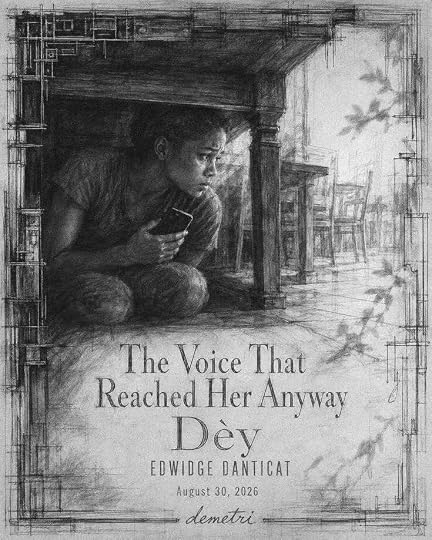
“The Voice That Reached Her Anyway” — Beneath a restaurant table, Magnolia holds a dead phone while the open paper at right carries what the device cannot: the remembered steadiness of someone she has not yet let back in.
Dead phones are meant to be useless objects, but in Edwidge Danticat’s “Dèy” one becomes a tuning fork. Magnolia Elie is hiding beneath a table in a Miami mall restaurant while gunfire cracks outside, strangers whisper passwords and final instructions to people they love, and the active-shooter catechism passes through the room: run, hide, fight. She cannot call Harrison, the partner from whom she has recently separated, or their nearly twelve-year-old daughter, Zoë. Harrison reaches her anyway, his steady voice reproduced from memory. Magnolia survives among strangers while depending on a man she will later refuse to tell what happened.
Escape is the book’s most provisional verb. Magnolia leaves Hibiscus Mall without an interview, a photograph or even her name entering the record of survivors. The shooting can remain hers if she declines to claim it, and she does. Within hours she is showing a Brickell condo and calling herself “unscathed,” while her body quietly files an objection. Floors tighten her chest. A toy gun produces panic. The mall itself becomes impassable. Bureaucracy may accept a clean exit; the nervous system keeps poorer records.
Magnolia’s life was already parceled into separate rooms before the bullets arrived. She sells Miami real estate, lives in Little Haiti, co-parents Zoë with Harrison and has asked him for space without knowing what that space is supposed to reveal. Her mother, Louise, lives in Haiti with Magnolia’s father, Daniel, and moves in and out of psychological stability. Victor, Magnolia’s half-brother and the child of Daniel’s long affair with Béatrice, is nearby. Soon Louise needs emergency surgery, armed groups tighten their hold around Croix-des-Bouquets, and the crisis Magnolia hoped to contain in Miami acquires an international address.
Elsewhere, another novel might have stayed tightly with Magnolia’s concealed trauma. “Dèy” keeps enlarging the room. The mall dead acquire names, jobs, relatives, jokes and plans they will not complete. Zoë discusses lockdown drills with the terrible fluency of a child explaining recess. Violence closes roads in Haiti and eventually pushes Magnolia’s parents toward Miami. In Little Haiti, longtime businesses watch development press closer while Magnolia earns her living selling property. These dangers occupy the same novel without pretending to be the same danger.
The distinction is easy to state and harder to maintain. A school shooting, gang rule, mental illness, romantic separation and gentrification are plainly not versions of one catastrophe. What they share are practical questions: Where can I go? Who can reach me? Who gets to remain? Magnolia’s profession sharpens the irony. She converts shelter into square footage, asking prices and commissions while discovering how little ownership can guarantee belonging. A house can be bought. Home proves less obedient to contract law.

“The Room With a Price” — Magnolia stands nearly swallowed by a Brickell condo she knows how to price, while the room’s measured emptiness asks the harder question of what makes a place inhabitable.
Ringing phones give “Dèy” another plot beneath the visible one. They die, charge, track children, carry photographs and transmit voice notes between Haiti and Miami. When Magnolia finally tells Harrison that she was inside the mall, his hurt is not merely about the withheld fact. Her silence has passed judgment on their intimacy. She needed his imagined voice beneath the table, then kept the actual Harrison outside the experience. Magnolia has begun mistaking privacy for invulnerability, and Danticat is more interested in that mistake than in any tidy sequence called recovery. Her problem is not simply that she cannot speak about the shooting; it is that silence lets her pretend the event belongs to her alone.
In the sentences themselves, abstraction keeps bumping into things. The prose is lucid, tactile and conversational: a sticky floor, a bag pulled against a chest, dirt loosened around roots, sandals lost while running for one’s life. Home has rooms. Grief has a body. Care requires somebody to carry the pot. Danticat is most persuasive when she leaves such objects alone long enough for their meanings to gather rather than fastening an explanation to them immediately.
Past objects rarely stay past. The Oasis floor resurfaces in childhood hiding places and in memories of Zoë learning to crawl. An empty condo becomes another place where Magnolia lies down and tries to breathe. One sensation slips backward and picks up another life on the way. “Dèy” sprawls through association rather than sentence length; the prose stays controlled while Magnolia’s present fills with earlier moments. This can be wonderfully cumulative. It can also make Magnolia – and occasionally the novel around her – reluctant to let any association end. Repetition is most powerful here when the reader notices the return half a beat before Magnolia explains it.
After the casualty count, biography returns. Naomi Mills, Yeriel Ramon Cruz and especially Jonathan Augustin recover work, relatives, migrations, tastes and unfinished obligations. Like Myriam J. A. Chancy’s “What Storm, What Thunder,” “Dèy” distrusts catastrophe’s talent for reducing a biography to an event, though Chancy distributes that resistance across many voices. Danticat keeps Magnolia at the center. The correction comes gradually: the dead are not important because their lives intersected hers. Their lives were already important before she entered them. That correction is small but decisive. It keeps Magnolia’s terror from becoming the scale by which every other life must be measured.
Papa complicates this widening field at home. Daniel has betrayed Louise, yet he has also spent years caring for her through episodes that consume money, patience, sleep and enormous stretches of ordinary life. Asked how he can still call that love, he describes himself as her garde fou, her guardrail. Danticat does not confuse caregiving with absolution. Betrayal and devotion can occupy the same man, which is inconvenient in exactly the way a family should be inconvenient in fiction. Love here has maintenance costs. Constancy does not erase damage; damage does not make the constancy imaginary. Danticat is good on the humiliating practicalities that survive moral disappointment: somebody still has to remember the medicine, watch the wandering, make the next call.
At first, Victor exists in Magnolia’s mind mainly as evidence against her father. Crisis in Haiti makes that position harder to maintain. Victor has been doing the work. He gets their parents to medical care, understands the roads, watches the violence and recognizes before Magnolia does that Daniel and Louise will have to leave. The son produced by an affair becomes indispensable to the supposedly intact branch of the family. Blood establishes the relationship; staying alters its value.

“Who Did the Work” — Victor helps Louise and Daniel across a threshold and toward the road, where care becomes less a declaration than the physical work of getting people where they need to go.
Danticat folds a similar revision into the book’s four sections: “RUN?,” “HIDE,” “F(L)IGHT” and “DÈY.” The first three grow out of active-shooter instructions. Even the typography distrusts their simplicity: “RUN?” questions its command, while “F(L)IGHT” discovers flight lodged inside fight. Then the vocabulary changes. Run, hide and fight tell an endangered person what to do. Dèy, the Haitian practice of collective mourning, requires other people.
Inside “HIDE,” Magnolia keeps the shooting from Harrison, but concealment does not stay hers alone. Parents withhold information in the name of protection. Old betrayals acquire euphemisms. Grief can pass for competence if one keeps working. By “F(L)IGHT,” the pun has become literal as Magnolia’s parents flee Haiti while their daughter begins facing what she has sealed away. The commands she first hears on the Oasis floor are excellent instructions for escaping bullets and miserable instructions for living afterward.
Magnolia’s secret does more work than suspense could. Harrison does not know she was there. When he finally learns, the delay has already become part of the injury between them. Jonathan’s story is withheld even longer, and that delay changes something larger than a relationship. What looked like private survival will turn out to have another person’s fingerprints on it.
In Oasis again, Magnolia tells its owners that she was there. Almost nothing happens in the conventional sense. Nobody applauds. No fear evaporates. The exchange simply allows another survivor to recognize her as one of them. Magnolia has spent much of the book protecting the shooting by keeping it exclusively hers. Here she gives up that privilege. Recognition itself is modest – a few people in a restaurant sharing knowledge of the same terrible afternoon – but modesty is the point. She permits herself to be found while still afraid.
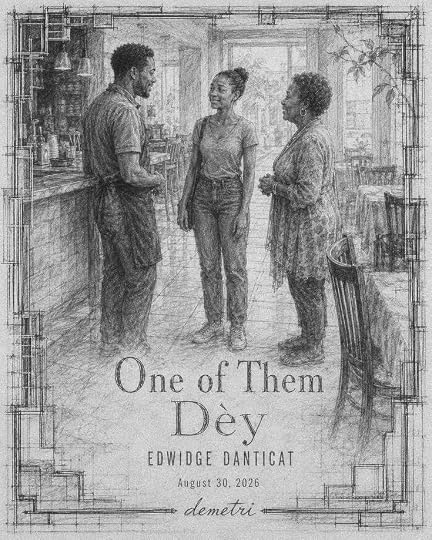
“One of Them” — Back at Oasis, Magnolia stands upright before Kaleb and Angela, surrendering the privacy of survival long enough to be recognized as one of the people who were there.
The chores arrive before the philosophy. Money has to be wired. A child has to be collected. Someone drives the dangerous road, tends the garden, retrieves the bag, cooks the meal. Tante Odile became a mother to Magnolia by doing mothering. Victor becomes more fully a son through the chores of sonship. Harrison’s steadiness is largely logistical. Even Zoë begins caring for the mother who has spent years measuring care in the opposite direction. “Dèy” is tender about these acts without prettifying them. The soup does not cook itself. Here affection is less persuasive than evidence: who came, who stayed, who brought what was needed.
Roads, classrooms and property lines keep those chores from becoming a private family morality tale. Zoë’s fluency in lockdown procedure is frightening precisely because she treats it as routine childhood knowledge. In Haiti, armed violence makes flight literal for Daniel, Louise and Victor. Little Haiti adds a quieter pressure as rising property values threaten the people and businesses that made the neighborhood worth buying into. Magnolia knows how to price a house in a city where staying put is becoming its own luxury. That gives the book’s talk of home a useful abrasion. Belonging is sentimental only until the rent rises, a road closes or somebody with more money wants the block.
One association too many is usually where “Dèy” loses some of its force. Historical explanation, shooting protocols, Haitian political context, migration routes and real-estate pressures sometimes arrive with enough exposition that Magnolia sounds less like herself than like the person most conveniently positioned to brief us. Elsewhere an image makes its point beautifully and receives another paragraph of interpretive assistance. The problem is not that Danticat sees connections everywhere. It is that she occasionally keeps explaining them after the connection is already alive.
Perhaps the ending comes closest to testing that generosity. Jonathan’s funeral, Magnolia’s birthday, replacement sandals, soup and the story of her birth converge within a narrow span. Each has been prepared. Together they briefly show the hand arranging them. A sterner version of the novel could lose one or two of these returns and still leave plenty on the table. Its warmth would survive.
Of the final returns, Jonathan’s funeral can bear the most weight because it resists the very simplification it later risks encouraging. Public speakers have turned Jonathan Augustin into a hero whose earlier life seems merely to have been waiting for its publicly useful death. His friend Wagner restores the longer route – Haiti, Brazil, Chile, migration north, work, friendship, money sent home. Then the story changes again. While the shooter was changing weapons, Jonathan charged and tackled him, delaying him long enough for others to escape and for armed responders to arrive. The stranger Magnolia has been mourning helped create the minutes in which she remained alive. Heroism could swallow his biography all over again. Danticat knows it. The funeral therefore performs two opposite acts at once: it names the deed that helped save strangers and refuses to let that deed become the only sentence left in Jonathan’s life.
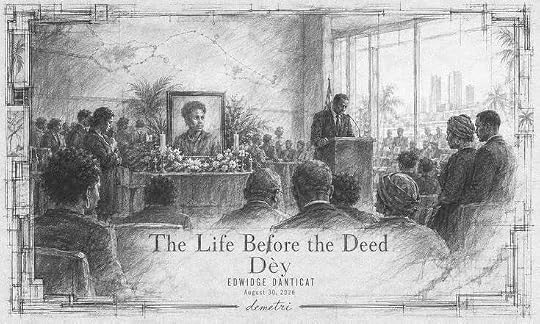
“The Life Before the Deed” — At Jonathan Augustin’s funeral, public ceremony frames a man as a hero while broken routes and gathered mourners insist that his life began long before the act for which strangers will remember him.
Until Jonathan’s funeral, Magnolia can still imagine her survival as something that happened principally to her. She ran. Oasis was barricaded. Police arrived. Luck, God, chance – choose the accounting. Jonathan changes the ledger. Her escape is suddenly indebted, social, embarrassingly plural. Survival has coauthors. Somebody she did not know fought for minutes she eventually got to keep.
Louise makes that lesson intimate rather than heroic. Magnolia fears becoming her mother, and her separation from Harrison partly grows from a desire to locate a self uncontaminated by anybody else’s needs. “Dèy” offers neither isolation nor self-erasure. Magnolia has to remain herself without turning absence into a method of self-protection. When she climbs into bed between Louise and Tante Odile rather than listening from outside their intimacy, she does not vanish into the family. She chooses to be among them.
On Magnolia’s thirty-third birthday, after Jonathan’s funeral, the house is full. Zoë replaces the sandals her mother lost fleeing the mall. Harrison says he is already home. Soup arrives as an offering. Then Daniel and Louise retell Magnolia’s birth: she came out not breathing, while Louise called to her in panic, asking whether her daughter was still there. Years later the same question finds her again. The family surrounding Magnolia has not become simple in the meantime. Betrayal, illness, exile and uncertainty are all still at the table.
Still, for all its occasional over-explanation, “Dèy” earns 84/100, or 4/5 stars. Its best scenes trust people and objects to carry more than its weakest explanatory passages believe they can. It begins with the brutally practical question of how not to die. It ends with something quieter. Beneath the magnolia blossoms, Louise calls across the distance between mother and daughter, illness and memory, birth and aftermath: is Magnolia there? The answer offers no cure, no sealed reconciliation, no promise that danger has spent its force. “Mwen la,” Magnolia says. I am. Presence is not a declaration made into an empty room. Somebody asked first.
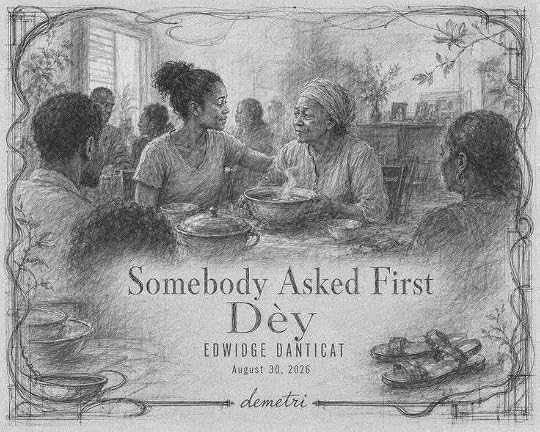
“Somebody Asked First” — At the family table, Magnolia and Louise face one another across soup, steam, and the ordinary objects of care; presence becomes possible because somebody asks whether she is there.
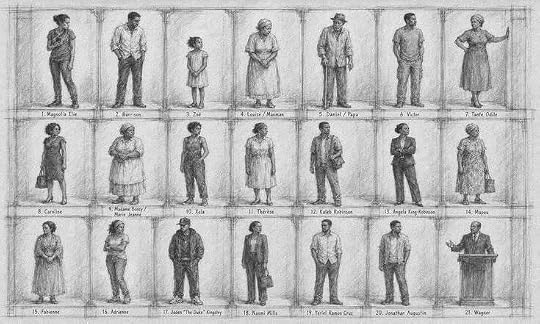
Full-Body All-Character Charcoal Study

Important-Items Charcoal Study

Cover-Derived Proportional Value Ledger

Hand-Lettering + Border Architecture Study
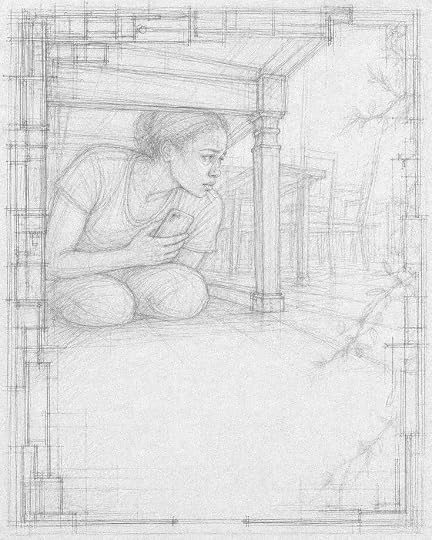
First Underdrawing

First Charcoal Massing Study

Empty-Room Perspective Study
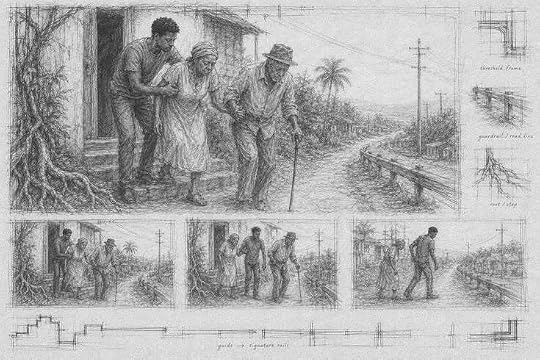
Caregiving Spatial Study
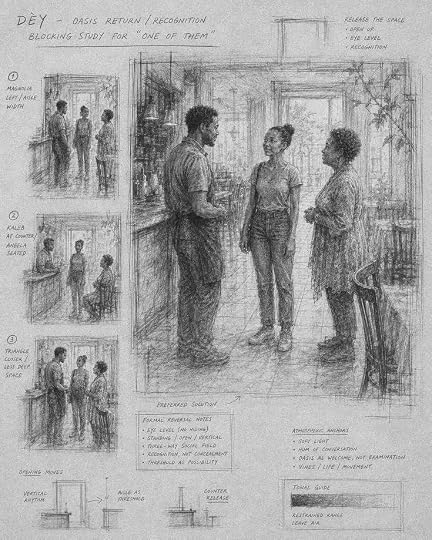
Recognition Blocking Study
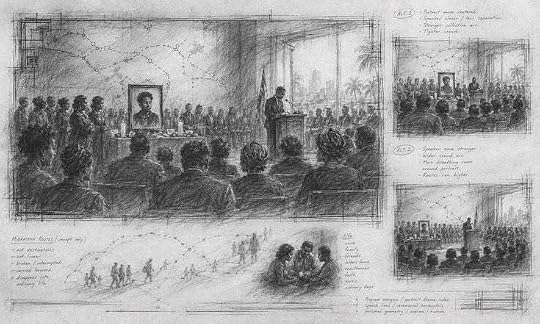
Funeral Composition Study
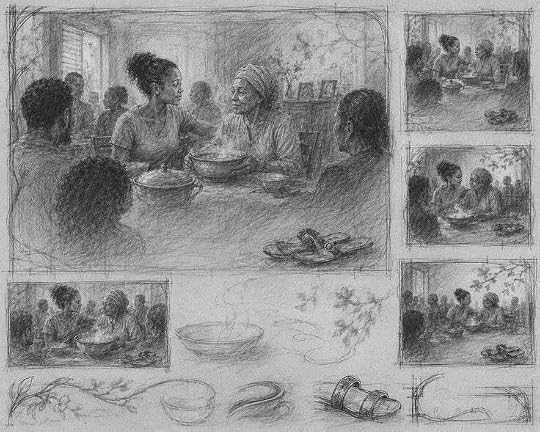
Final-Chapter Symbol-Rhythm Study

Series Rhythm / Negative-Space / Redundancy Matrix
All charcoal illustrations by Demetris Papadimitropoulos.
Charcoal drawings are done on 140lb vellum and then scanned into the computer using an Epson scanner. From there, they are finalized in Procreate. No AI was used in writing this review — all art and opinions are my own.
Edwidge Danticat’s “Dèy” on the Administrative Difficulties of Surviving
By Demetris Papadimitropoulos | August 30th, 2026
“The Voice That Reached Her Anyway” — Beneath a restaurant table, Magnolia holds a dead phone while the open paper at right carries what the device cannot: the remembered steadiness of someone she has not yet let back in.
Dead phones are meant to be useless objects, but in Edwidge Danticat’s “Dèy” one becomes a tuning fork. Magnolia Elie is hiding beneath a table in a Miami mall restaurant while gunfire cracks outside, strangers whisper passwords and final instructions to people they love, and the active-shooter catechism passes through the room: run, hide, fight. She cannot call Harrison, the partner from whom she has recently separated, or their nearly twelve-year-old daughter, Zoë. Harrison reaches her anyway, his steady voice reproduced from memory. Magnolia survives among strangers while depending on a man she will later refuse to tell what happened.
Escape is the book’s most provisional verb. Magnolia leaves Hibiscus Mall without an interview, a photograph or even her name entering the record of survivors. The shooting can remain hers if she declines to claim it, and she does. Within hours she is showing a Brickell condo and calling herself “unscathed,” while her body quietly files an objection. Floors tighten her chest. A toy gun produces panic. The mall itself becomes impassable. Bureaucracy may accept a clean exit; the nervous system keeps poorer records.
Magnolia’s life was already parceled into separate rooms before the bullets arrived. She sells Miami real estate, lives in Little Haiti, co-parents Zoë with Harrison and has asked him for space without knowing what that space is supposed to reveal. Her mother, Louise, lives in Haiti with Magnolia’s father, Daniel, and moves in and out of psychological stability. Victor, Magnolia’s half-brother and the child of Daniel’s long affair with Béatrice, is nearby. Soon Louise needs emergency surgery, armed groups tighten their hold around Croix-des-Bouquets, and the crisis Magnolia hoped to contain in Miami acquires an international address.
Elsewhere, another novel might have stayed tightly with Magnolia’s concealed trauma. “Dèy” keeps enlarging the room. The mall dead acquire names, jobs, relatives, jokes and plans they will not complete. Zoë discusses lockdown drills with the terrible fluency of a child explaining recess. Violence closes roads in Haiti and eventually pushes Magnolia’s parents toward Miami. In Little Haiti, longtime businesses watch development press closer while Magnolia earns her living selling property. These dangers occupy the same novel without pretending to be the same danger.
The distinction is easy to state and harder to maintain. A school shooting, gang rule, mental illness, romantic separation and gentrification are plainly not versions of one catastrophe. What they share are practical questions: Where can I go? Who can reach me? Who gets to remain? Magnolia’s profession sharpens the irony. She converts shelter into square footage, asking prices and commissions while discovering how little ownership can guarantee belonging. A house can be bought. Home proves less obedient to contract law.
“The Room With a Price” — Magnolia stands nearly swallowed by a Brickell condo she knows how to price, while the room’s measured emptiness asks the harder question of what makes a place inhabitable.
Ringing phones give “Dèy” another plot beneath the visible one. They die, charge, track children, carry photographs and transmit voice notes between Haiti and Miami. When Magnolia finally tells Harrison that she was inside the mall, his hurt is not merely about the withheld fact. Her silence has passed judgment on their intimacy. She needed his imagined voice beneath the table, then kept the actual Harrison outside the experience. Magnolia has begun mistaking privacy for invulnerability, and Danticat is more interested in that mistake than in any tidy sequence called recovery. Her problem is not simply that she cannot speak about the shooting; it is that silence lets her pretend the event belongs to her alone.
In the sentences themselves, abstraction keeps bumping into things. The prose is lucid, tactile and conversational: a sticky floor, a bag pulled against a chest, dirt loosened around roots, sandals lost while running for one’s life. Home has rooms. Grief has a body. Care requires somebody to carry the pot. Danticat is most persuasive when she leaves such objects alone long enough for their meanings to gather rather than fastening an explanation to them immediately.
Past objects rarely stay past. The Oasis floor resurfaces in childhood hiding places and in memories of Zoë learning to crawl. An empty condo becomes another place where Magnolia lies down and tries to breathe. One sensation slips backward and picks up another life on the way. “Dèy” sprawls through association rather than sentence length; the prose stays controlled while Magnolia’s present fills with earlier moments. This can be wonderfully cumulative. It can also make Magnolia – and occasionally the novel around her – reluctant to let any association end. Repetition is most powerful here when the reader notices the return half a beat before Magnolia explains it.
After the casualty count, biography returns. Naomi Mills, Yeriel Ramon Cruz and especially Jonathan Augustin recover work, relatives, migrations, tastes and unfinished obligations. Like Myriam J. A. Chancy’s “What Storm, What Thunder,” “Dèy” distrusts catastrophe’s talent for reducing a biography to an event, though Chancy distributes that resistance across many voices. Danticat keeps Magnolia at the center. The correction comes gradually: the dead are not important because their lives intersected hers. Their lives were already important before she entered them. That correction is small but decisive. It keeps Magnolia’s terror from becoming the scale by which every other life must be measured.
Papa complicates this widening field at home. Daniel has betrayed Louise, yet he has also spent years caring for her through episodes that consume money, patience, sleep and enormous stretches of ordinary life. Asked how he can still call that love, he describes himself as her garde fou, her guardrail. Danticat does not confuse caregiving with absolution. Betrayal and devotion can occupy the same man, which is inconvenient in exactly the way a family should be inconvenient in fiction. Love here has maintenance costs. Constancy does not erase damage; damage does not make the constancy imaginary. Danticat is good on the humiliating practicalities that survive moral disappointment: somebody still has to remember the medicine, watch the wandering, make the next call.
At first, Victor exists in Magnolia’s mind mainly as evidence against her father. Crisis in Haiti makes that position harder to maintain. Victor has been doing the work. He gets their parents to medical care, understands the roads, watches the violence and recognizes before Magnolia does that Daniel and Louise will have to leave. The son produced by an affair becomes indispensable to the supposedly intact branch of the family. Blood establishes the relationship; staying alters its value.
“Who Did the Work” — Victor helps Louise and Daniel across a threshold and toward the road, where care becomes less a declaration than the physical work of getting people where they need to go.
Danticat folds a similar revision into the book’s four sections: “RUN?,” “HIDE,” “F(L)IGHT” and “DÈY.” The first three grow out of active-shooter instructions. Even the typography distrusts their simplicity: “RUN?” questions its command, while “F(L)IGHT” discovers flight lodged inside fight. Then the vocabulary changes. Run, hide and fight tell an endangered person what to do. Dèy, the Haitian practice of collective mourning, requires other people.
Inside “HIDE,” Magnolia keeps the shooting from Harrison, but concealment does not stay hers alone. Parents withhold information in the name of protection. Old betrayals acquire euphemisms. Grief can pass for competence if one keeps working. By “F(L)IGHT,” the pun has become literal as Magnolia’s parents flee Haiti while their daughter begins facing what she has sealed away. The commands she first hears on the Oasis floor are excellent instructions for escaping bullets and miserable instructions for living afterward.
Magnolia’s secret does more work than suspense could. Harrison does not know she was there. When he finally learns, the delay has already become part of the injury between them. Jonathan’s story is withheld even longer, and that delay changes something larger than a relationship. What looked like private survival will turn out to have another person’s fingerprints on it.
In Oasis again, Magnolia tells its owners that she was there. Almost nothing happens in the conventional sense. Nobody applauds. No fear evaporates. The exchange simply allows another survivor to recognize her as one of them. Magnolia has spent much of the book protecting the shooting by keeping it exclusively hers. Here she gives up that privilege. Recognition itself is modest – a few people in a restaurant sharing knowledge of the same terrible afternoon – but modesty is the point. She permits herself to be found while still afraid.
“One of Them” — Back at Oasis, Magnolia stands upright before Kaleb and Angela, surrendering the privacy of survival long enough to be recognized as one of the people who were there.
The chores arrive before the philosophy. Money has to be wired. A child has to be collected. Someone drives the dangerous road, tends the garden, retrieves the bag, cooks the meal. Tante Odile became a mother to Magnolia by doing mothering. Victor becomes more fully a son through the chores of sonship. Harrison’s steadiness is largely logistical. Even Zoë begins caring for the mother who has spent years measuring care in the opposite direction. “Dèy” is tender about these acts without prettifying them. The soup does not cook itself. Here affection is less persuasive than evidence: who came, who stayed, who brought what was needed.
Roads, classrooms and property lines keep those chores from becoming a private family morality tale. Zoë’s fluency in lockdown procedure is frightening precisely because she treats it as routine childhood knowledge. In Haiti, armed violence makes flight literal for Daniel, Louise and Victor. Little Haiti adds a quieter pressure as rising property values threaten the people and businesses that made the neighborhood worth buying into. Magnolia knows how to price a house in a city where staying put is becoming its own luxury. That gives the book’s talk of home a useful abrasion. Belonging is sentimental only until the rent rises, a road closes or somebody with more money wants the block.
One association too many is usually where “Dèy” loses some of its force. Historical explanation, shooting protocols, Haitian political context, migration routes and real-estate pressures sometimes arrive with enough exposition that Magnolia sounds less like herself than like the person most conveniently positioned to brief us. Elsewhere an image makes its point beautifully and receives another paragraph of interpretive assistance. The problem is not that Danticat sees connections everywhere. It is that she occasionally keeps explaining them after the connection is already alive.
Perhaps the ending comes closest to testing that generosity. Jonathan’s funeral, Magnolia’s birthday, replacement sandals, soup and the story of her birth converge within a narrow span. Each has been prepared. Together they briefly show the hand arranging them. A sterner version of the novel could lose one or two of these returns and still leave plenty on the table. Its warmth would survive.
Of the final returns, Jonathan’s funeral can bear the most weight because it resists the very simplification it later risks encouraging. Public speakers have turned Jonathan Augustin into a hero whose earlier life seems merely to have been waiting for its publicly useful death. His friend Wagner restores the longer route – Haiti, Brazil, Chile, migration north, work, friendship, money sent home. Then the story changes again. While the shooter was changing weapons, Jonathan charged and tackled him, delaying him long enough for others to escape and for armed responders to arrive. The stranger Magnolia has been mourning helped create the minutes in which she remained alive. Heroism could swallow his biography all over again. Danticat knows it. The funeral therefore performs two opposite acts at once: it names the deed that helped save strangers and refuses to let that deed become the only sentence left in Jonathan’s life.
“The Life Before the Deed” — At Jonathan Augustin’s funeral, public ceremony frames a man as a hero while broken routes and gathered mourners insist that his life began long before the act for which strangers will remember him.
Until Jonathan’s funeral, Magnolia can still imagine her survival as something that happened principally to her. She ran. Oasis was barricaded. Police arrived. Luck, God, chance – choose the accounting. Jonathan changes the ledger. Her escape is suddenly indebted, social, embarrassingly plural. Survival has coauthors. Somebody she did not know fought for minutes she eventually got to keep.
Louise makes that lesson intimate rather than heroic. Magnolia fears becoming her mother, and her separation from Harrison partly grows from a desire to locate a self uncontaminated by anybody else’s needs. “Dèy” offers neither isolation nor self-erasure. Magnolia has to remain herself without turning absence into a method of self-protection. When she climbs into bed between Louise and Tante Odile rather than listening from outside their intimacy, she does not vanish into the family. She chooses to be among them.
On Magnolia’s thirty-third birthday, after Jonathan’s funeral, the house is full. Zoë replaces the sandals her mother lost fleeing the mall. Harrison says he is already home. Soup arrives as an offering. Then Daniel and Louise retell Magnolia’s birth: she came out not breathing, while Louise called to her in panic, asking whether her daughter was still there. Years later the same question finds her again. The family surrounding Magnolia has not become simple in the meantime. Betrayal, illness, exile and uncertainty are all still at the table.
Still, for all its occasional over-explanation, “Dèy” earns 84/100, or 4/5 stars. Its best scenes trust people and objects to carry more than its weakest explanatory passages believe they can. It begins with the brutally practical question of how not to die. It ends with something quieter. Beneath the magnolia blossoms, Louise calls across the distance between mother and daughter, illness and memory, birth and aftermath: is Magnolia there? The answer offers no cure, no sealed reconciliation, no promise that danger has spent its force. “Mwen la,” Magnolia says. I am. Presence is not a declaration made into an empty room. Somebody asked first.
“Somebody Asked First” — At the family table, Magnolia and Louise face one another across soup, steam, and the ordinary objects of care; presence becomes possible because somebody asks whether she is there.
Full-Body All-Character Charcoal Study
Important-Items Charcoal Study
Cover-Derived Proportional Value Ledger
Hand-Lettering + Border Architecture Study
First Underdrawing
First Charcoal Massing Study
Empty-Room Perspective Study
Caregiving Spatial Study
Recognition Blocking Study
Funeral Composition Study
Final-Chapter Symbol-Rhythm Study
Series Rhythm / Negative-Space / Redundancy Matrix
All charcoal illustrations by Demetris Papadimitropoulos.
Charcoal drawings are done on 140lb vellum and then scanned into the computer using an Epson scanner. From there, they are finalized in Procreate. No AI was used in writing this review — all art and opinions are my own.

October 7, 2026
The physical setting is Miami, but the heart & soul is Haiti.

September 9, 2026
4.5 Stars. Great book with a complex main character and complex themes. See my full review on instagram @robertsonsreadingrecs.

August 28, 2026
Dèy is a thoughtful and beautifully observed novel about trauma, family, grief and the complicated idea of home. Magnolia, a Haitian American real estate agent living in Miami, survives a shooting at a shopping mall while buying a birthday present for her ten-year-old daughter, Zoë. She tells no one what happened, instead carrying the experience quietly while continuing with her everyday life.
From there, Danticat moves between Miami, Brooklyn and Haiti, gradually revealing Magnolia’s family history and the difficulties faced by her parents and younger brother in an increasingly dangerous Haiti. Her relationship with Zoë, her estranged partner Harrison and her mother all add different dimensions to the story.
I particularly enjoyed the way Danticat brings together the personal and the political without losing sight of Magnolia herself. There is a strong sense of Haitian culture and family throughout, with food, music, language and celebrations providing warmth alongside the themes of mourning and loss.
The title, Dèy, means mourning in Haitian Creole, and the book is really interested in what happens after the immediate danger has passed: how we live with what has happened, how we remember those who have been lost and how family and community can help us carry grief.
A quiet, thoughtful book with plenty to reflect on, and another strong exploration of Haitian identity and the ties between people and places from Edwidge Danticat.
From there, Danticat moves between Miami, Brooklyn and Haiti, gradually revealing Magnolia’s family history and the difficulties faced by her parents and younger brother in an increasingly dangerous Haiti. Her relationship with Zoë, her estranged partner Harrison and her mother all add different dimensions to the story.
I particularly enjoyed the way Danticat brings together the personal and the political without losing sight of Magnolia herself. There is a strong sense of Haitian culture and family throughout, with food, music, language and celebrations providing warmth alongside the themes of mourning and loss.
The title, Dèy, means mourning in Haitian Creole, and the book is really interested in what happens after the immediate danger has passed: how we live with what has happened, how we remember those who have been lost and how family and community can help us carry grief.
A quiet, thoughtful book with plenty to reflect on, and another strong exploration of Haitian identity and the ties between people and places from Edwidge Danticat.

August 4, 2026
Thank you NetGalley for this ARC.
Sometimes a book doesn’t need to be loud to leave an impression.
As a Haitian American, reading Dèy by Edwidge Danticat felt especially meaningful. She has always had such a beautiful way with words, and once again her storytelling shines. Magnolia’s journey through grief—in all its complicated, messy forms—felt honest and deeply human. Watching her navigate so much loss and trauma made for an emotional read.
My only wish? I wanted more of Magnolia and Harrison. I would’ve loved to better understand what truly went wrong between them and spend more time with what reconciliation looked like on the page.
Overall, this is a thoughtful, moving novel that reminds you why Edwidge Danticat is such a gifted storyteller.
Sometimes a book doesn’t need to be loud to leave an impression.
As a Haitian American, reading Dèy by Edwidge Danticat felt especially meaningful. She has always had such a beautiful way with words, and once again her storytelling shines. Magnolia’s journey through grief—in all its complicated, messy forms—felt honest and deeply human. Watching her navigate so much loss and trauma made for an emotional read.
My only wish? I wanted more of Magnolia and Harrison. I would’ve loved to better understand what truly went wrong between them and spend more time with what reconciliation looked like on the page.
Overall, this is a thoughtful, moving novel that reminds you why Edwidge Danticat is such a gifted storyteller.
This entire review has been hidden because of spoilers.

September 7, 2026
Dèy is quiet, but not gentle. Danticat takes grief, migration, motherhood, Haiti, Miami, family, and the very inconvenient fact that life keeps happening after catastrophe, and fits all of it into a remarkably compact novel.
There’s something about her restraint that reminded me of Jhumpa Lahiri, with a little of Yaa Gyasi’s preoccupation with what families carry across places and generations. But Danticat feels entirely her own—less interested in explaining everything than in letting the emotional weight accumulate.
I have been neglecting Edwidge Danticat all these years, which now needs to be corrected. Must read more of her work.
Displaying 1 - 30 of 191 reviews