

What do you think?

Gender Rituals: Creating a Sacred Space for Your Body, Your Gender, and Your Becoming
Rituals and practices for reclaiming your gender journey, nurturing trans joy, and coming home to your innate, embodied sacredness
Drawing from his lived experience as a trans person, his training as a gender doula, and years of leading ritual and body-based healing work, Eli Lawliet offers tools for both personal transformation and collective survival—so you can live your gender journey wholly and unapologetically
Gender Rituals is a radically inclusive guide to honoring and navigating your gender journey—and reconnecting to your body as an ally.
Created by gender doula Eli Lawliet, PhD—the pioneer of gender doula work and a trusted guide to trans, non-binary, and gender-expansive people worldwide—this book offers gentle yet fierce practices to help you reconnect with your body, honor the milestones that matter to you, and cultivate trans joy…no matter where you are on your gender journey.
Whether you’re releasing an old name, claiming a new one, or celebrating the transformations of HRT, Lawliet shows how to imbue your gender-affirming with meaning and ritual. Lawliet also
Why this work is for you—regardless of your relationship to gender, how you identify, and whether you’re new to spiritual or ritual practice
There’s no such thing as “not trans enough”—and how to experience your gender journey as profound, affirming, and valuable, whether you have a “destination” or not
Foundational skills for ritual and energetic work, like cleansing, grounding, attuning, and shielding against transphobia and harm
How to access the wisdom of your transcestors and community
How to support identity-aligned choices
In a world that tries to define you, erase you, or make you small, Gender Rituals helps you reclaim your gender journey as sacred, powerful, and fully your own—an act of healing, resistance, and joy.
Drawing from his lived experience as a trans person, his training as a gender doula, and years of leading ritual and body-based healing work, Eli Lawliet offers tools for both personal transformation and collective survival—so you can live your gender journey wholly and unapologetically
Gender Rituals is a radically inclusive guide to honoring and navigating your gender journey—and reconnecting to your body as an ally.
Created by gender doula Eli Lawliet, PhD—the pioneer of gender doula work and a trusted guide to trans, non-binary, and gender-expansive people worldwide—this book offers gentle yet fierce practices to help you reconnect with your body, honor the milestones that matter to you, and cultivate trans joy…no matter where you are on your gender journey.
Whether you’re releasing an old name, claiming a new one, or celebrating the transformations of HRT, Lawliet shows how to imbue your gender-affirming with meaning and ritual. Lawliet also
Why this work is for you—regardless of your relationship to gender, how you identify, and whether you’re new to spiritual or ritual practice
There’s no such thing as “not trans enough”—and how to experience your gender journey as profound, affirming, and valuable, whether you have a “destination” or not
Foundational skills for ritual and energetic work, like cleansing, grounding, attuning, and shielding against transphobia and harm
How to access the wisdom of your transcestors and community
How to support identity-aligned choices
In a world that tries to define you, erase you, or make you small, Gender Rituals helps you reclaim your gender journey as sacred, powerful, and fully your own—an act of healing, resistance, and joy.
- GenresQueerNonfiction
288 pages, Paperback
Published August 25, 2026
About the author
Eli Lawliet PhD
1 book1 followerEli Lawliet, Ph.D., (he/him) is the dreamer and weaver of The Gender Doula and the author of Gender Rituals. In addition to a decade of experience researching trans healthcare, law, policy, and history, he has formal training as a full spectrum doula, breathwork facilitator, and tarot reader, as well as many years of surviving the world of poverty wages and retail work. The broad scope of his experience directly informs the equally broad spectrum of his work as The Gender Doula. Eli has been seeing clients since January of 2020 and has worked with hundreds of trans folks nationally and internationally in sessions, classes, and workshops. Though he was born in Oklahoma and raised in Missouri, Eli currently lives in Los Angeles (Gabrieliño-Tongva, Chumash, & Kizh land).
Ratings & Reviews
Friends & Following
Create a free account to discover what your friends think of this book!
Community Reviews
Displaying 1 - 12 of 12 reviews

Review of advance copy received from NetGalley
Who Gets to Decide What a Transformation Means?
Eli Lawliet’s “Gender Rituals” Returns Names, Bodies, Hormones, Surgery, and Spiritual Practice to the Person Living Through Them.
By Demetris Papadimitropoulos | August 10, 2026
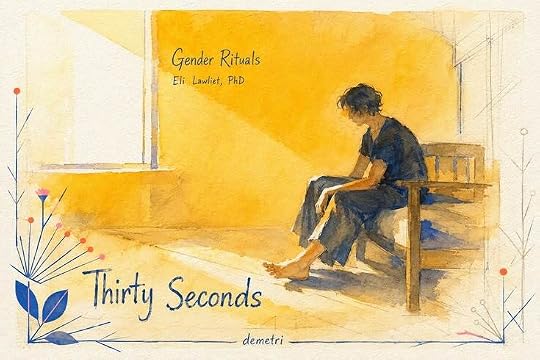
“Thirty Seconds” – Drawn from Eli Lawliet’s “Gender Rituals,” this saffron-lit interior reduces transformation to its quietest beginning: one body, one small movement, and enough undisturbed time for attention to arrive before anyone else decides what that attention should mean.
During one of the smallest exercises in Eli Lawliet’s “Gender Rituals: Creating a Sacred Space for Your Body, Your Gender, and Your Becoming,” the reader is asked to wiggle their toes for thirty seconds. Notice movement. Notice sensation. If toes are inaccessible, choose fingers, facial muscles, some other patch of bodily territory where contact does not immediately become conflict. It is an almost comic instruction in a book stocked with candles, altars, divination, hormone rituals, surgery blessings, and relationships with the dead. Yet those thirty seconds tell me more about Lawliet’s method than any of the grander apparatus. A person estranged from a body does not necessarily need to be ordered into loving it. First they need enough quiet to notice that it is there.
Eli Lawliet, a gender doula writing from his own trans experience and an animist spiritual practice, begins from another absence. American life has ceremonies for some thresholds and surprisingly little language for others. A first dose of hormones may arrive in a pharmacy bag. A form can record a new name; it cannot know what the old one carried. Hair falls to a salon floor. Surgery becomes an appointment, a consent form, a recovery schedule. The events happen. Their meanings are left to improvise. Lawliet wants ritual to occupy that gap, giving a change enough form that it can be noticed, witnessed, grieved, welcomed.
Much of “Gender Rituals” is devoted to supplying those forms. Its opening gathers roughly twenty people on a Pacific beach to release names, pronouns, and former understandings of themselves. Participants write in chalk on stones, remember what those identities carried them through, then return the stones to the water before calling in what comes next. Some throw them; some let the tide take them. Later, haircuts, clothing, hormones, baths, scars, names, and medications acquire their own ceremonial weight. Lawliet’s magic is often this plain: an ordinary thing, handled deliberately, is allowed to mean more than its use.

“The Stones” – Along the Pacific edge of “Gender Rituals,” chalked stones, separated bodies, and the incoming tide turn release into something less absolute than erasure – an old name or understanding can be thanked, carried to the water, and relinquished without pretending it never helped someone survive.
Early on, however, the book spends five chapters before gender becomes the pressure organizing its ritual system. Part One teaches timing, customization, cleansing, grounding, shielding, altars, intuition, sigils, divination, and record keeping. Readers already familiar with contemporary magical or wellness traditions may feel the train has checked the tickets and explained emergency procedure twice before leaving. Lawliet’s cautions about appropriation and his accommodations for disability, neurodivergence, money, space, and safety are substantive. But he has a habit of anticipating the reader’s discomfort before the reader has quite had time to feel it.
That caution shapes the prose too. Lawliet writes in a warm, conversational second person, with the cadence of a facilitator who would rather repeat an instruction than let discomfort masquerade as failure. A ritual can be shortened, skipped, repeated, or performed alone. A book about bodily autonomy has no business becoming bossy about candles, and Lawliet rarely does. Still, he often states a point, illustrates it, anticipates resistance, reassures, then circles back. The voice can resemble an excellent spotter who keeps a hand near the bar after you have shown that you can lift it.
Ritual becomes most persuasive when Lawliet lets objects do some of the thinking. Chalk loosening from stone in seawater says more about release than another declaration can. Transphobic residue imagined as grease on a stovetop gives cleansing a physical logic. A phrase practiced before surgery becomes something the mouth can still find when fear narrows language. The body becomes a teammate rather than a defective object. Lawliet is not a stylist of compression. His better gift is to turn abstraction into action: wash it, move it, thank it, cut it loose, set it on a table and come back tomorrow.
In Part Two, that gift begins repaying the long preparation. The sequence is not arbitrary: body, expression, identity, transphobic injury, hormone therapy, surgery, transcestors. Bodily attention comes first, then expression and self-naming, then the social world’s resistance. Medical transition raises the stakes; surgery tests the fantasy of certainty; ancestors widen the solitary self into lineage. By the time surgery arrives, the body has already been practiced as a source of information rather than merely a problem to solve. Lawliet tells readers they may skip around. The deeper argument benefits from not doing so.
Precisely where many self-help books reach for body love, Lawliet slows down. He does not ask a dysphoric, dissociated, traumatized, or simply wary person to leap from estrangement into adoration because an affirmation card says Tuesday is the day. The movement is connection, allyship, trust, love, pleasure. Thirty seconds of toes may lead to imagining the body as a collaborator. Later exercises ask what bodily “yes” and “no” feel like. Only after communication becomes possible does Lawliet approach love. The body is not made sacred by declaration; it becomes something with which one can negotiate.
At heart, those negotiations make the book more interesting than its spiritual furniture. Desire is not obligation. Fear is not refusal. Uncertainty is not proof that a choice is wrong. Bodily sensation is not infallible either, and Lawliet is best when he does not pretend otherwise. His account of beginning testosterone while unable to claim maleness refuses the tidy version of transition in which the self discovers a hidden answer and simply catches up. His body seemed to want something his existing story could not yet authorize. Hormones did not uncover a finished identity waiting backstage. They changed the conditions under which he could understand himself.
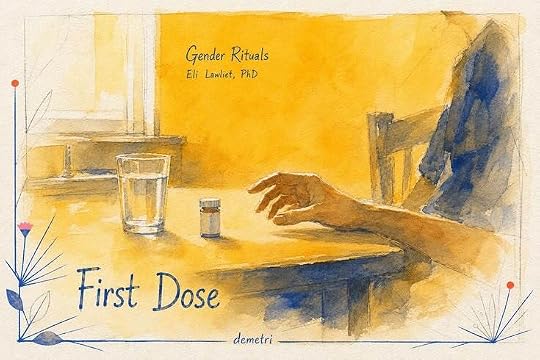
“First Dose” – A hand pauses beside an ordinary medication object in “First Dose,” where the smallest gap on the table becomes the threshold: medicine can alter a body, but the meaning of beginning still belongs to the person whose hand must eventually cross the space.
Pressure puts that ethic under its hardest test in the chapter on surgery and regret. Lawliet knows regret has been made politically radioactive. In hostile discourse, its existence is used to discredit gender-affirming care; in defensive affirmative discourse, admitting fear can feel like volunteering evidence for the prosecution. He declines both roles. Some people regret gender-affirming procedures, he says; he has worked with them. People also regret marriages, careers, degrees, moves, and other consequential choices without society suspending agency until prophecy becomes available. A wanted surgery may still terrify. Consent does not become purer by pretending the future can be known.
A book this affirming might easily have made brightness another obligation. Lawliet usually resists that temptation. Gender-affirming clothing can reveal one desired silhouette while making another source of dysphoria newly obvious. Hormones can produce unexpected emotional intensity or a disorienting lack of it. A transphobic encounter can linger after the offending person has vanished. A new name can require gratitude toward an old one rather than its ceremonial execution. Joy matters here, but it is not asked to clean the room before grief, boredom, fear, or ambivalence are allowed inside.
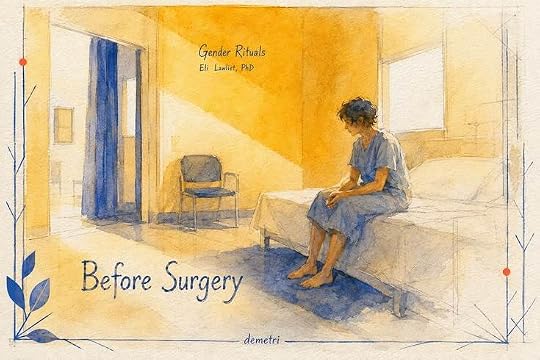
“Before Surgery” – Held inside cooler cobalt architecture and a room that seems more certain than the future, “Before Surgery” gives Lawliet’s hardest argument its visual form: fear can sit beside desire without becoming refusal, and a consequential choice need not arrive with prophecy attached.
Doubt becomes more useful than certainty until Lawliet begins explaining the metaphysics behind the practices. He is explicit about his animist spirituality. He works with astrology and divination, speaks to spirits and transcestors, and regards transness itself as a portal to sacred knowledge. He also tells readers they need not share those beliefs. The difficulty is grammatical as much as philosophical: the prose can use the same calm declarative register for spiritual experience, therapeutic metaphor, client observation, historical claim, and assertions about how unseen forces operate. “Energy” may describe a felt state on one page and an external spiritual force on another.
I do not think the answer is for Lawliet to believe less. A book this spiritually committed would be duller if he handled his cosmology like contraband. The problem is that different sentences ask for different kinds of assent, and the prose does not always mark the change. “This practice helped me hear myself” is not the same proposition as “this is what these forces are doing.” A secular reader can translate a shield into visualization, cleansing into sensory reset, an ancestor altar into historical remembrance. Translation, however, is not agreement.
Meaning is where the rituals become harder to dismiss, even for someone who leaves the metaphysics behind. A doctor can prescribe hormones but cannot decide what the first dose means. A government can recognize a name but cannot consecrate it. A surgeon can alter tissue but cannot determine what is being welcomed, mourned, feared, or released. A stranger can misgender someone without earning permanent jurisdiction over that person’s relationship to their body. Lawliet’s rituals repeatedly return that interpretive work to the person living the event. This is less glamorous than magic, and to my mind more radical.
If private ritual has a political limit, Lawliet mostly knows where it is. He wrote portions of “Gender Rituals” amid intense hostility toward trans lives, and Chapter 9 is explicit about the cumulative effects of misgendering, rhetoric, media exposure, and fear. A shower cannot repeal a law. A protection ritual cannot make a workplace safe. Energetic boundaries cannot manufacture medical access. But after a hostile encounter, a shower can mark the point at which another person’s mistake stops narrating the evening. The book occasionally approaches the self-help temptation to answer public injury with private practice; it is better when it stays at the scale of one person reclaiming an hour.
[image error]
“After the Encounter” – In the quiet bathroom of “After the Encounter,” water cannot repair the public world outside the frame, but it can mark the smaller moment when another person’s misrecognition stops being granted the right to narrate the rest of the evening.
Tolerance and recognition are not the same thing. People often demonstrate enlightened acceptance of transition by refusing to make a fuss. Sometimes a fuss, properly designed, is exactly what the moment requires. Not spectacle or interrogation, not the compulsory inspiration in which a trans person must become a symbol before dinner. Simply acknowledgment. Something happened. Someone crossed a threshold. Even wanted change can contain mourning. Even ordinary medication can carry history. Ritual, in Lawliet’s hands, gives that history a body, an object, and a little time.
Repetition is both the instrument of this method and its most persistent drag. Lawliet distrusts the idea that transformation occurs through one grand gesture, preferring tiny practices performed often enough to become relationships. The prose follows that principle too faithfully. Its central assurances – trust yourself, adjust the ritual, proceed according to capacity – recur until their force thins. One wishes the editing had trusted repetition as a ritual principle without making it so fully compositional. “Gender Rituals” could lose meaningful length without losing generosity.
Over time, though, repeated practices change jobs, and that is where the structure earns its keep. Cleansing begins as ritual hygiene and later becomes recovery after transphobic exposure. Grounding starts as spiritual technique and becomes a way to separate bodily information from panic. The body moves from estranged territory to ally, then to source of consent, participant in HRT, partner in surgical change, and finally a defense against other people’s projections. Community begins as an optional setting and becomes witness, protection, lineage, futurity. The same tools return, but the stakes around them have altered.
Put beside neighboring books, Lawliet’s combination sharpens. “A Queer Dharma” by Jacoby Ballard also asks how embodied spiritual practice can address queer and trans life without pretending oppression exists only inside the practitioner’s mind. “My New Gender Workbook” by Kate Bornstein likewise makes the reader work on their own categories rather than merely absorb theory. Lawliet is less formally mischievous than Bornstein and more self-composed in his spiritual system than Ballard. His unusual move is to make ritual answerable to gendered particulars: the first injection, the new garment, the discarded pronoun, fear before an operating room, the wish to be witnessed when “that’s fine” is supportive but still too small.
One of the strangest and most revealing developments comes late, with transcestors. Lawliet uses the term for trans and gender-expansive predecessors while acknowledging that contemporary labels cannot simply be pasted backward onto lives lived under different categories. His spirituality goes further, treating transcestors as presences to address, petition, and thank. Skeptical readers may stop at historical lineage; Lawliet keeps walking into relationship. What saves the section from becoming ancestor-themed décor is an ethical demand. Venerating Marsha P. Johnson, in his account, cannot be separated from caring about the marginalized people with whom Johnson made common cause. If the dead become companions, they may also become inconvenient company.

“The Door Left Open” – The final watercolor turns solitude into the possibility of relation – one living figure, one empty chair, one unfinished doorway, and a slightly warmer pulse of pink within the returning saffron light suggest the transcestor work of “Gender Rituals” without deciding whether the company in the room is memory, history, spirit, or all three at once.
Useful, searching, and occasionally overconfident, “Gender Rituals” lands for me at 81/100, or 4/5 stars. The ritual primer runs long; the prose often says twice what one concrete image has already made clear; the spiritual confidence occasionally outruns the distinctions a wide audience needs. But its better chapters give haircuts, names, hormones, misgendering, surgery, pleasure, and fear a shared ceremonial vocabulary without pretending they all feel the same. By the conclusion, Lawliet’s phrase “trans audacity” pushes that vocabulary outward: if the world was wrong about the limits of one’s own becoming, perhaps some of its other limits deserve suspicion too.
Lawliet’s quietest sacred act may be less mystical than the apparatus suggests. It is not necessarily the candle, altar, card, bath, stone returned to the sea, or voice addressed to a transcestor. It is the decision to give an experience enough attention that its interpretation need not be handed to whoever happens to be watching. Lawliet occasionally tells readers too confidently what the unseen world means. His best rituals do not supply answers. They arrange the conditions for listening: a little room, a body given back its time, a door left open long enough for an answer to arrive.
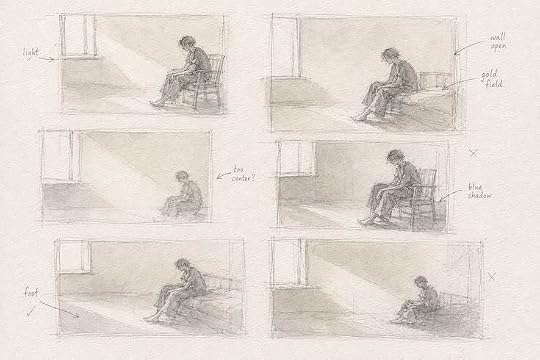
Compositional Thumbnail Sheet
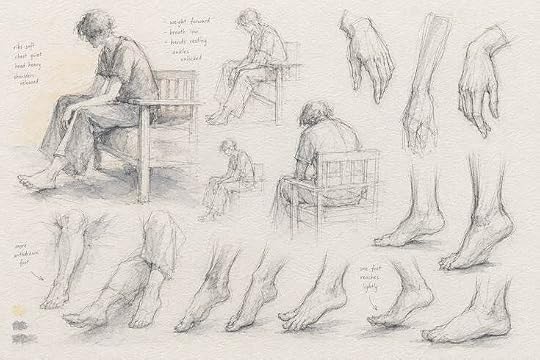
Character Anatomical / Gesture Study
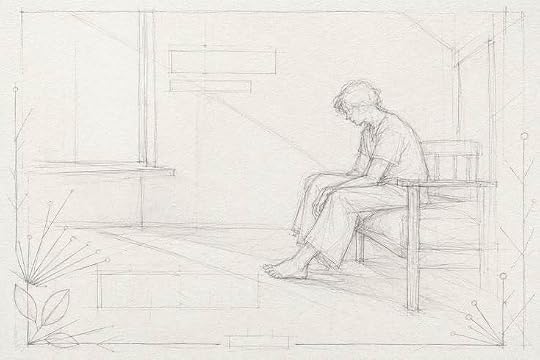
Faint Pencil Underdrawing
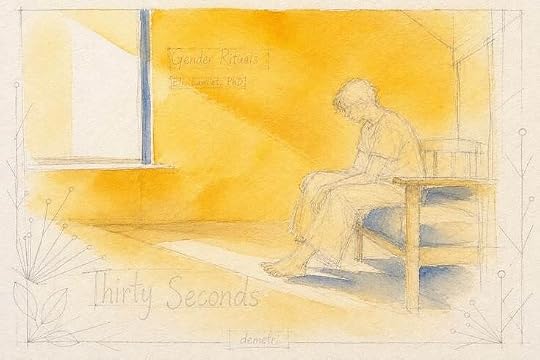
Pencil + First Saffron Wash

Light-and-Value Architecture Study
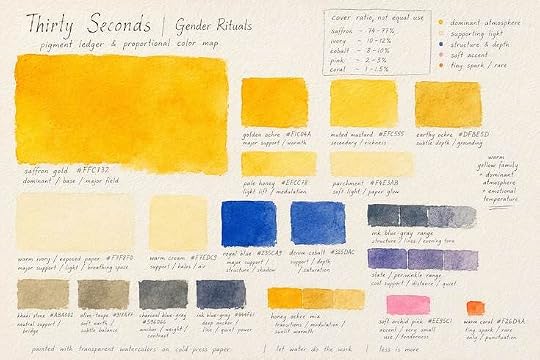
Proportional Color Swatch / Pigment Ledger

Watercolor Border Details Study
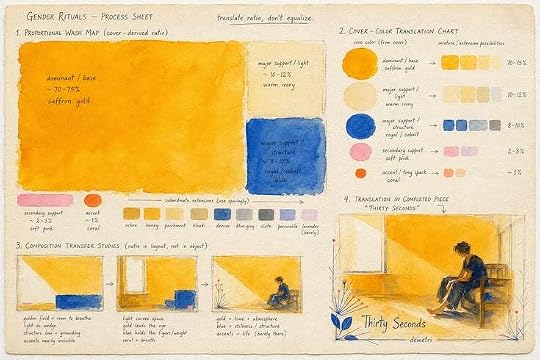
Cover-Color Proportional Wash Map / Translation Chart
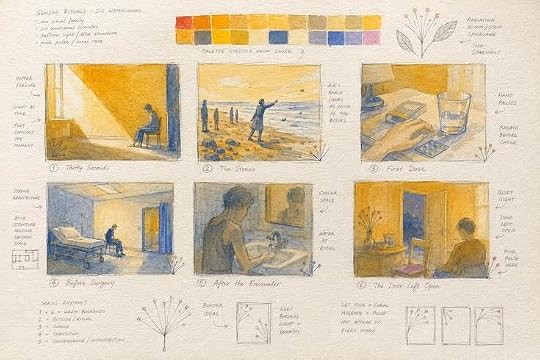
Six-Work Series Planning Sheet
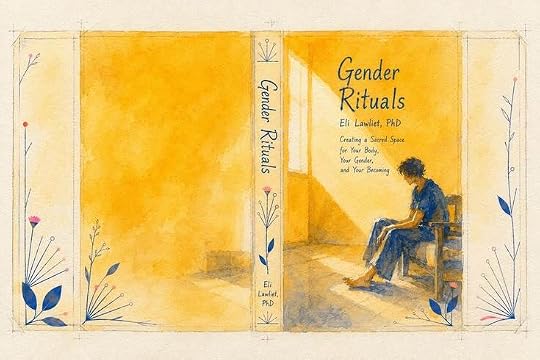
Proposed Alternative Full Dust Jacket with Flaps
All watercolor illustrations by Demetris Papadimitropoulos.
Watercolors are done on 140lb vellum and then scanned into the computer using an Epson scanner. From there, they are finalized in Procreate. All art and opinions are my own.
Eli Lawliet’s “Gender Rituals” Returns Names, Bodies, Hormones, Surgery, and Spiritual Practice to the Person Living Through Them.
By Demetris Papadimitropoulos | August 10, 2026
“Thirty Seconds” – Drawn from Eli Lawliet’s “Gender Rituals,” this saffron-lit interior reduces transformation to its quietest beginning: one body, one small movement, and enough undisturbed time for attention to arrive before anyone else decides what that attention should mean.
During one of the smallest exercises in Eli Lawliet’s “Gender Rituals: Creating a Sacred Space for Your Body, Your Gender, and Your Becoming,” the reader is asked to wiggle their toes for thirty seconds. Notice movement. Notice sensation. If toes are inaccessible, choose fingers, facial muscles, some other patch of bodily territory where contact does not immediately become conflict. It is an almost comic instruction in a book stocked with candles, altars, divination, hormone rituals, surgery blessings, and relationships with the dead. Yet those thirty seconds tell me more about Lawliet’s method than any of the grander apparatus. A person estranged from a body does not necessarily need to be ordered into loving it. First they need enough quiet to notice that it is there.
Eli Lawliet, a gender doula writing from his own trans experience and an animist spiritual practice, begins from another absence. American life has ceremonies for some thresholds and surprisingly little language for others. A first dose of hormones may arrive in a pharmacy bag. A form can record a new name; it cannot know what the old one carried. Hair falls to a salon floor. Surgery becomes an appointment, a consent form, a recovery schedule. The events happen. Their meanings are left to improvise. Lawliet wants ritual to occupy that gap, giving a change enough form that it can be noticed, witnessed, grieved, welcomed.
Much of “Gender Rituals” is devoted to supplying those forms. Its opening gathers roughly twenty people on a Pacific beach to release names, pronouns, and former understandings of themselves. Participants write in chalk on stones, remember what those identities carried them through, then return the stones to the water before calling in what comes next. Some throw them; some let the tide take them. Later, haircuts, clothing, hormones, baths, scars, names, and medications acquire their own ceremonial weight. Lawliet’s magic is often this plain: an ordinary thing, handled deliberately, is allowed to mean more than its use.
“The Stones” – Along the Pacific edge of “Gender Rituals,” chalked stones, separated bodies, and the incoming tide turn release into something less absolute than erasure – an old name or understanding can be thanked, carried to the water, and relinquished without pretending it never helped someone survive.
Early on, however, the book spends five chapters before gender becomes the pressure organizing its ritual system. Part One teaches timing, customization, cleansing, grounding, shielding, altars, intuition, sigils, divination, and record keeping. Readers already familiar with contemporary magical or wellness traditions may feel the train has checked the tickets and explained emergency procedure twice before leaving. Lawliet’s cautions about appropriation and his accommodations for disability, neurodivergence, money, space, and safety are substantive. But he has a habit of anticipating the reader’s discomfort before the reader has quite had time to feel it.
That caution shapes the prose too. Lawliet writes in a warm, conversational second person, with the cadence of a facilitator who would rather repeat an instruction than let discomfort masquerade as failure. A ritual can be shortened, skipped, repeated, or performed alone. A book about bodily autonomy has no business becoming bossy about candles, and Lawliet rarely does. Still, he often states a point, illustrates it, anticipates resistance, reassures, then circles back. The voice can resemble an excellent spotter who keeps a hand near the bar after you have shown that you can lift it.
Ritual becomes most persuasive when Lawliet lets objects do some of the thinking. Chalk loosening from stone in seawater says more about release than another declaration can. Transphobic residue imagined as grease on a stovetop gives cleansing a physical logic. A phrase practiced before surgery becomes something the mouth can still find when fear narrows language. The body becomes a teammate rather than a defective object. Lawliet is not a stylist of compression. His better gift is to turn abstraction into action: wash it, move it, thank it, cut it loose, set it on a table and come back tomorrow.
In Part Two, that gift begins repaying the long preparation. The sequence is not arbitrary: body, expression, identity, transphobic injury, hormone therapy, surgery, transcestors. Bodily attention comes first, then expression and self-naming, then the social world’s resistance. Medical transition raises the stakes; surgery tests the fantasy of certainty; ancestors widen the solitary self into lineage. By the time surgery arrives, the body has already been practiced as a source of information rather than merely a problem to solve. Lawliet tells readers they may skip around. The deeper argument benefits from not doing so.
Precisely where many self-help books reach for body love, Lawliet slows down. He does not ask a dysphoric, dissociated, traumatized, or simply wary person to leap from estrangement into adoration because an affirmation card says Tuesday is the day. The movement is connection, allyship, trust, love, pleasure. Thirty seconds of toes may lead to imagining the body as a collaborator. Later exercises ask what bodily “yes” and “no” feel like. Only after communication becomes possible does Lawliet approach love. The body is not made sacred by declaration; it becomes something with which one can negotiate.
At heart, those negotiations make the book more interesting than its spiritual furniture. Desire is not obligation. Fear is not refusal. Uncertainty is not proof that a choice is wrong. Bodily sensation is not infallible either, and Lawliet is best when he does not pretend otherwise. His account of beginning testosterone while unable to claim maleness refuses the tidy version of transition in which the self discovers a hidden answer and simply catches up. His body seemed to want something his existing story could not yet authorize. Hormones did not uncover a finished identity waiting backstage. They changed the conditions under which he could understand himself.
“First Dose” – A hand pauses beside an ordinary medication object in “First Dose,” where the smallest gap on the table becomes the threshold: medicine can alter a body, but the meaning of beginning still belongs to the person whose hand must eventually cross the space.
Pressure puts that ethic under its hardest test in the chapter on surgery and regret. Lawliet knows regret has been made politically radioactive. In hostile discourse, its existence is used to discredit gender-affirming care; in defensive affirmative discourse, admitting fear can feel like volunteering evidence for the prosecution. He declines both roles. Some people regret gender-affirming procedures, he says; he has worked with them. People also regret marriages, careers, degrees, moves, and other consequential choices without society suspending agency until prophecy becomes available. A wanted surgery may still terrify. Consent does not become purer by pretending the future can be known.
A book this affirming might easily have made brightness another obligation. Lawliet usually resists that temptation. Gender-affirming clothing can reveal one desired silhouette while making another source of dysphoria newly obvious. Hormones can produce unexpected emotional intensity or a disorienting lack of it. A transphobic encounter can linger after the offending person has vanished. A new name can require gratitude toward an old one rather than its ceremonial execution. Joy matters here, but it is not asked to clean the room before grief, boredom, fear, or ambivalence are allowed inside.
“Before Surgery” – Held inside cooler cobalt architecture and a room that seems more certain than the future, “Before Surgery” gives Lawliet’s hardest argument its visual form: fear can sit beside desire without becoming refusal, and a consequential choice need not arrive with prophecy attached.
Doubt becomes more useful than certainty until Lawliet begins explaining the metaphysics behind the practices. He is explicit about his animist spirituality. He works with astrology and divination, speaks to spirits and transcestors, and regards transness itself as a portal to sacred knowledge. He also tells readers they need not share those beliefs. The difficulty is grammatical as much as philosophical: the prose can use the same calm declarative register for spiritual experience, therapeutic metaphor, client observation, historical claim, and assertions about how unseen forces operate. “Energy” may describe a felt state on one page and an external spiritual force on another.
I do not think the answer is for Lawliet to believe less. A book this spiritually committed would be duller if he handled his cosmology like contraband. The problem is that different sentences ask for different kinds of assent, and the prose does not always mark the change. “This practice helped me hear myself” is not the same proposition as “this is what these forces are doing.” A secular reader can translate a shield into visualization, cleansing into sensory reset, an ancestor altar into historical remembrance. Translation, however, is not agreement.
Meaning is where the rituals become harder to dismiss, even for someone who leaves the metaphysics behind. A doctor can prescribe hormones but cannot decide what the first dose means. A government can recognize a name but cannot consecrate it. A surgeon can alter tissue but cannot determine what is being welcomed, mourned, feared, or released. A stranger can misgender someone without earning permanent jurisdiction over that person’s relationship to their body. Lawliet’s rituals repeatedly return that interpretive work to the person living the event. This is less glamorous than magic, and to my mind more radical.
If private ritual has a political limit, Lawliet mostly knows where it is. He wrote portions of “Gender Rituals” amid intense hostility toward trans lives, and Chapter 9 is explicit about the cumulative effects of misgendering, rhetoric, media exposure, and fear. A shower cannot repeal a law. A protection ritual cannot make a workplace safe. Energetic boundaries cannot manufacture medical access. But after a hostile encounter, a shower can mark the point at which another person’s mistake stops narrating the evening. The book occasionally approaches the self-help temptation to answer public injury with private practice; it is better when it stays at the scale of one person reclaiming an hour.
[image error]
“After the Encounter” – In the quiet bathroom of “After the Encounter,” water cannot repair the public world outside the frame, but it can mark the smaller moment when another person’s misrecognition stops being granted the right to narrate the rest of the evening.
Tolerance and recognition are not the same thing. People often demonstrate enlightened acceptance of transition by refusing to make a fuss. Sometimes a fuss, properly designed, is exactly what the moment requires. Not spectacle or interrogation, not the compulsory inspiration in which a trans person must become a symbol before dinner. Simply acknowledgment. Something happened. Someone crossed a threshold. Even wanted change can contain mourning. Even ordinary medication can carry history. Ritual, in Lawliet’s hands, gives that history a body, an object, and a little time.
Repetition is both the instrument of this method and its most persistent drag. Lawliet distrusts the idea that transformation occurs through one grand gesture, preferring tiny practices performed often enough to become relationships. The prose follows that principle too faithfully. Its central assurances – trust yourself, adjust the ritual, proceed according to capacity – recur until their force thins. One wishes the editing had trusted repetition as a ritual principle without making it so fully compositional. “Gender Rituals” could lose meaningful length without losing generosity.
Over time, though, repeated practices change jobs, and that is where the structure earns its keep. Cleansing begins as ritual hygiene and later becomes recovery after transphobic exposure. Grounding starts as spiritual technique and becomes a way to separate bodily information from panic. The body moves from estranged territory to ally, then to source of consent, participant in HRT, partner in surgical change, and finally a defense against other people’s projections. Community begins as an optional setting and becomes witness, protection, lineage, futurity. The same tools return, but the stakes around them have altered.
Put beside neighboring books, Lawliet’s combination sharpens. “A Queer Dharma” by Jacoby Ballard also asks how embodied spiritual practice can address queer and trans life without pretending oppression exists only inside the practitioner’s mind. “My New Gender Workbook” by Kate Bornstein likewise makes the reader work on their own categories rather than merely absorb theory. Lawliet is less formally mischievous than Bornstein and more self-composed in his spiritual system than Ballard. His unusual move is to make ritual answerable to gendered particulars: the first injection, the new garment, the discarded pronoun, fear before an operating room, the wish to be witnessed when “that’s fine” is supportive but still too small.
One of the strangest and most revealing developments comes late, with transcestors. Lawliet uses the term for trans and gender-expansive predecessors while acknowledging that contemporary labels cannot simply be pasted backward onto lives lived under different categories. His spirituality goes further, treating transcestors as presences to address, petition, and thank. Skeptical readers may stop at historical lineage; Lawliet keeps walking into relationship. What saves the section from becoming ancestor-themed décor is an ethical demand. Venerating Marsha P. Johnson, in his account, cannot be separated from caring about the marginalized people with whom Johnson made common cause. If the dead become companions, they may also become inconvenient company.
“The Door Left Open” – The final watercolor turns solitude into the possibility of relation – one living figure, one empty chair, one unfinished doorway, and a slightly warmer pulse of pink within the returning saffron light suggest the transcestor work of “Gender Rituals” without deciding whether the company in the room is memory, history, spirit, or all three at once.
Useful, searching, and occasionally overconfident, “Gender Rituals” lands for me at 81/100, or 4/5 stars. The ritual primer runs long; the prose often says twice what one concrete image has already made clear; the spiritual confidence occasionally outruns the distinctions a wide audience needs. But its better chapters give haircuts, names, hormones, misgendering, surgery, pleasure, and fear a shared ceremonial vocabulary without pretending they all feel the same. By the conclusion, Lawliet’s phrase “trans audacity” pushes that vocabulary outward: if the world was wrong about the limits of one’s own becoming, perhaps some of its other limits deserve suspicion too.
Lawliet’s quietest sacred act may be less mystical than the apparatus suggests. It is not necessarily the candle, altar, card, bath, stone returned to the sea, or voice addressed to a transcestor. It is the decision to give an experience enough attention that its interpretation need not be handed to whoever happens to be watching. Lawliet occasionally tells readers too confidently what the unseen world means. His best rituals do not supply answers. They arrange the conditions for listening: a little room, a body given back its time, a door left open long enough for an answer to arrive.
Compositional Thumbnail Sheet
Character Anatomical / Gesture Study
Faint Pencil Underdrawing
Pencil + First Saffron Wash
Light-and-Value Architecture Study
Proportional Color Swatch / Pigment Ledger
Watercolor Border Details Study
Cover-Color Proportional Wash Map / Translation Chart
Six-Work Series Planning Sheet
Proposed Alternative Full Dust Jacket with Flaps
All watercolor illustrations by Demetris Papadimitropoulos.
Watercolors are done on 140lb vellum and then scanned into the computer using an Epson scanner. From there, they are finalized in Procreate. All art and opinions are my own.

August 16, 2026
This advanced reader’s copy is courtesy of NetGalley.
Thank you NetGalley and North Atlantic Books for this advanced reader’s copy of Eli Lawliet’s book Gender Rituals: Creating a Sacred Space for Your Body, Your Gender, and Your Becoming in exchange for an honest review. My words are my own.
One of the hardest things about this book is not having a physical copy to annotate, underline, write in the margins, take notes in and truly absorb. This is so packed with knowledge and practical wisdom. It is a highly relevant text that explores how ritual is a powerful way to affirm your gender identity and body. Lawliet has comprehensively formatted this work into smaller segments which allows effortless access for all levels of knowledge. For example, the book opens with a section called “What Is Ritual?” which would be useful for someone new to any kind of repetitive form of affirmation, either spiritually or verbally. While the author explains why his concept is unique to gender identity, you can easily approach the book from your specific lived experience.
I deeply appreciate how this text differs from the more removed nature of typical academic texts; it is much more accessible to a broad spectrum of readers. The author does a brilliant job of explaining how this is not just a book about trans-ness or religiosity; its focus is all-encompassing humanity. He states: “regardless of how you identify, regardless of your spiritual practice or lack thereof, regardless of your relationship to or history with gender, this book has something for you… because you are a human, your body is made of the stuff of this earth, you’re connected to thousands of gender-expansive people across the entirety of human history, and because you, dear reader, have a relationship with gender”. While Lawliet emphasizes that none of us are outside the lived experience of gender identity, he gathers his entire readership within the human experience, not only in this statement, but throughout the entirety of his book.
The premise that this book has something for everyone is absolute. I would also say this book offers ways to help people evolve. For instance, misgendering individuals is unfortunately a common occurrence, however Lawliet offers a tangible means by which to both change and heal this. He gives practical rituals for people who have transitioned, people who have been misidentified, or people who err in this way. He teaches affirmative blessings for bodies that experience this pain, as well as rituals to heal a regularly misgendered body. Additionally, rather than a reprisal of individuals who struggle with gender correctness, these rituals can help cultivate better awareness of gender identification.
Other sections are just as multi-applicable. The chapter on “Rituals for Surgery” I found helpful to apply when assisting my trans friends going through gender affirming operations. However, as with the introduction, these rituals can be translated to surgeries related to the body that are not specific to trans people. These concepts would be helpful for individuals facing other physical and gender altering surgeries, for example, mastectomies. I applied these principles when adjusting to a new visible neurosurgical implant and found them incredibly healthy.
This book is a congealing of practical rituals and mental affirmations to celebrate and enhance your relationship with your body - to heal, love and acknowledge your inner self. As long as the reader doesn’t approach this with the concept that it only applies to trans people, everyone can find ways in which this book will benefit their lives. I would highly recommend this text for the purposes of education about trans identities, individual gender rituals, and overall self affirmation. So often when we consider self-care it involves forms of capitalism or bodily improvement (i.e. purchasing items, undergoing procedures, weight loss). I found the primary motivation in this text to be affirming your true self in its most genuine form; that is the type of radical self love that I think any reader could benefit from.
Thank you NetGalley and North Atlantic Books for this advanced reader’s copy of Eli Lawliet’s book Gender Rituals: Creating a Sacred Space for Your Body, Your Gender, and Your Becoming in exchange for an honest review. My words are my own.
One of the hardest things about this book is not having a physical copy to annotate, underline, write in the margins, take notes in and truly absorb. This is so packed with knowledge and practical wisdom. It is a highly relevant text that explores how ritual is a powerful way to affirm your gender identity and body. Lawliet has comprehensively formatted this work into smaller segments which allows effortless access for all levels of knowledge. For example, the book opens with a section called “What Is Ritual?” which would be useful for someone new to any kind of repetitive form of affirmation, either spiritually or verbally. While the author explains why his concept is unique to gender identity, you can easily approach the book from your specific lived experience.
I deeply appreciate how this text differs from the more removed nature of typical academic texts; it is much more accessible to a broad spectrum of readers. The author does a brilliant job of explaining how this is not just a book about trans-ness or religiosity; its focus is all-encompassing humanity. He states: “regardless of how you identify, regardless of your spiritual practice or lack thereof, regardless of your relationship to or history with gender, this book has something for you… because you are a human, your body is made of the stuff of this earth, you’re connected to thousands of gender-expansive people across the entirety of human history, and because you, dear reader, have a relationship with gender”. While Lawliet emphasizes that none of us are outside the lived experience of gender identity, he gathers his entire readership within the human experience, not only in this statement, but throughout the entirety of his book.
The premise that this book has something for everyone is absolute. I would also say this book offers ways to help people evolve. For instance, misgendering individuals is unfortunately a common occurrence, however Lawliet offers a tangible means by which to both change and heal this. He gives practical rituals for people who have transitioned, people who have been misidentified, or people who err in this way. He teaches affirmative blessings for bodies that experience this pain, as well as rituals to heal a regularly misgendered body. Additionally, rather than a reprisal of individuals who struggle with gender correctness, these rituals can help cultivate better awareness of gender identification.
Other sections are just as multi-applicable. The chapter on “Rituals for Surgery” I found helpful to apply when assisting my trans friends going through gender affirming operations. However, as with the introduction, these rituals can be translated to surgeries related to the body that are not specific to trans people. These concepts would be helpful for individuals facing other physical and gender altering surgeries, for example, mastectomies. I applied these principles when adjusting to a new visible neurosurgical implant and found them incredibly healthy.
This book is a congealing of practical rituals and mental affirmations to celebrate and enhance your relationship with your body - to heal, love and acknowledge your inner self. As long as the reader doesn’t approach this with the concept that it only applies to trans people, everyone can find ways in which this book will benefit their lives. I would highly recommend this text for the purposes of education about trans identities, individual gender rituals, and overall self affirmation. So often when we consider self-care it involves forms of capitalism or bodily improvement (i.e. purchasing items, undergoing procedures, weight loss). I found the primary motivation in this text to be affirming your true self in its most genuine form; that is the type of radical self love that I think any reader could benefit from.

Review of advance copy received from NetGalley
5/5 Stars!
Thank you to NetGalley and North Atlantic Books for a digital ARC in exchange for an honest review!
Gender Rituals by Eli Lawliet was a phenomenal read. As someone who has been a part of alternative spirituality circles for many years, it’s hard to find books that really stand out to me anymore. But Lawliet does exactly that in an extremely intelligent, grounded, and compassionate approach to ritual work. This book not only fills a gap in the literature as a book primarily for a trans audience, but does such an excellent job explaining ritual itself that I think it is essential reading for anyone interested in spiritual practices related to animism, witchcraft, and paganism.
The book is broken down into four main sections: an introduction to ritual, a section on energetic hygiene, a section on gender rituals, and a section on ancestor work. The introduction to ritual itself contains a beautiful explanation as to why ritual is important and the impact of the lack of ritual in our current culture. It’s a section that does an excellent job setting the tone for the rest of the book.
The section on energetic hygiene consists of cleansing, grounding, and shielding. This is a section that could have felt very repetitive considering how foundational these practices are in the spiritual communities that intersect with this book. However, there is a care to Lawliet’s writing where he does such a good job at clearly explaining the mechanics and purpose of a practice that it manages to feel both refreshing and rewarding to read.
The bulk of the book is dedicated to gender rituals. These rituals cover a wide variety of experiences and particularly focus on common experiences in the trans and genderqueer community. There is a lot of ground covered in this section and even if a reader does not resonate with each ritual presented to them, the way that Lawliet presents information also provides the reader with tools to create their own rituals to fit their needs.
The final section of the book is dedicated to working with the ancestors, specifically the transcestors, a deeply queer understanding of ancestor work that encourages readers to connect within and beyond their blood relatives. It’s a very good introduction to ancestor work and also does a good job at providing a framework for ancestor work for people who might be coming from a background with family trauma.
All together Gender Rituals was a joy to read. I was constantly struck by the deep care the author took in creating this book. I’ve been consistently recommending it to people since I read it and look forward to putting it in the hands of readers for years to come.
Thank you to NetGalley and North Atlantic Books for a digital ARC in exchange for an honest review!
Gender Rituals by Eli Lawliet was a phenomenal read. As someone who has been a part of alternative spirituality circles for many years, it’s hard to find books that really stand out to me anymore. But Lawliet does exactly that in an extremely intelligent, grounded, and compassionate approach to ritual work. This book not only fills a gap in the literature as a book primarily for a trans audience, but does such an excellent job explaining ritual itself that I think it is essential reading for anyone interested in spiritual practices related to animism, witchcraft, and paganism.
The book is broken down into four main sections: an introduction to ritual, a section on energetic hygiene, a section on gender rituals, and a section on ancestor work. The introduction to ritual itself contains a beautiful explanation as to why ritual is important and the impact of the lack of ritual in our current culture. It’s a section that does an excellent job setting the tone for the rest of the book.
The section on energetic hygiene consists of cleansing, grounding, and shielding. This is a section that could have felt very repetitive considering how foundational these practices are in the spiritual communities that intersect with this book. However, there is a care to Lawliet’s writing where he does such a good job at clearly explaining the mechanics and purpose of a practice that it manages to feel both refreshing and rewarding to read.
The bulk of the book is dedicated to gender rituals. These rituals cover a wide variety of experiences and particularly focus on common experiences in the trans and genderqueer community. There is a lot of ground covered in this section and even if a reader does not resonate with each ritual presented to them, the way that Lawliet presents information also provides the reader with tools to create their own rituals to fit their needs.
The final section of the book is dedicated to working with the ancestors, specifically the transcestors, a deeply queer understanding of ancestor work that encourages readers to connect within and beyond their blood relatives. It’s a very good introduction to ancestor work and also does a good job at providing a framework for ancestor work for people who might be coming from a background with family trauma.
All together Gender Rituals was a joy to read. I was constantly struck by the deep care the author took in creating this book. I’ve been consistently recommending it to people since I read it and look forward to putting it in the hands of readers for years to come.
Review of advance copy received from NetGalley
Thank you to NetGalley and North Atlantic Books for giving me the chance to read this ARC! Gender Rituals is probably one of the most impactful non-fiction self-help/spirituality books I have had the pleasure to read. The author takes the time to thoughtfully set you up to understand the purpose, order, and resources that are provided within. I really liked the way that it goes through some of the basics of energetic hygiene and ritual before really diving into some trans-specific rituals and processes. It's rare that you find a book on the topic of ritual that isn't overly religious or cisnormative so this was a real gift.
I found myself taking notes on the chapters, expanding my definitions of gender affirmation, and being excited to work on myself and my relationships with my transness. I have never really considered mixing my queer identity with my spiritual identity but now that I have, I firmly believe there is a market and need for this kind of work. I genuinely can't wait until this book comes out so I can get my hands on a physical copy to reference and annotate.
I found myself taking notes on the chapters, expanding my definitions of gender affirmation, and being excited to work on myself and my relationships with my transness. I have never really considered mixing my queer identity with my spiritual identity but now that I have, I firmly believe there is a market and need for this kind of work. I genuinely can't wait until this book comes out so I can get my hands on a physical copy to reference and annotate.

Review of advance copy received from NetGalley
Thank you to NetGalley and the publishers for an advanced copy in exchange for an honest review. This was such a lovely educational read, not just for trans people but for anyone who wants to feel closer to their gender. I loved the pacing and the introductory part of the book, where the author explains how one's gender is an inherent part of our existence and how something as simple as wearing makeup is also a gender ritual! Through the course of the book, I was able to learn a lot about the importance of any ritual and how they impact us and help us ground ourselves and make us feel one with our bodies. I absolutely agree with the author's words that 'if you found this book, it was meant for you.' Absolute 100% recommended to anyone who looking for a good educational/self help book, irrespective of how you identify!!

Review of advance copy received from Netgalley
I enjoyed this book. It was so absolutely affirming. The pacing is gentle, and it assumes belonging immediately, like you found the book, and it found you because you needed it. I appreciate how neurodivergent friendly it was, and it has good examples for practical activities and basically tutorials for specific rituals, which is very informative and helpful. I particularly enjoyed the part on which is talked about cultural misappropriation on spitirual spaces, its a very important topic and not talked about nearly enough. I also appreciated the book recommendations and the beautiful book design. It was a nice read.
Thank you, Netgalley and North Atlantic Books, for the eARC. This was an unbiased and honest opinion.
Thank you, Netgalley and North Atlantic Books, for the eARC. This was an unbiased and honest opinion.
Review of advance copy received from NetGalley
This is a very important book that made me think more thoughtfully about my gender and the rituals I enact. It is a book that makes a case for thoughtfulness and intentionality. It felt very validating, in a world where ritual can sometimes feel frivolous (even though it isn’t) – a valuable book to help reclaim the importance of ritual, including ritual for cleansing after bad experiences. I think people of any gender identity would benefit from this (and certainly anyone who has felt disconnected with their body) but certainly gender nonminority individuals.
Thank you to Netgalley, the author, and the publisher for this ARC!
Thank you to Netgalley, the author, and the publisher for this ARC!

September 21, 2026
Gender Rituals offers a thoughtful and deeply intentional approach to the gender journey, bringing together ritual, embodiment, identity, and community. Eli Lawliet draws from lived experience and gender doula work to create practices that encourage readers to honor meaningful moments of change and cultivate a stronger relationship with their bodies. The emphasis on trans joy and the idea that there is no single way to experience a gender journey gives the book an inclusive and affirming foundation. Its combination of personal transformation, ritual practice, and collective connection gives this work a distinctive place within contemporary queer nonfiction.
September 22, 2026
Gender Rituals offers a thoughtful and deeply intentional way of looking at the gender journey. I appreciated how it treats the body not as something to overcome, but as something that can become an ally through reflection, ritual, and care.
The emphasis on milestones, identity, embodiment, and trans joy gives the book a meaningful sense of purpose. The practices also make the subject feel personal rather than purely theoretical.
What stayed with me most is the idea of making space for becoming on your own terms. It feels affirming, reflective, and especially valuable for readers seeking a more intentional relationship with their identity and body.
The emphasis on milestones, identity, embodiment, and trans joy gives the book a meaningful sense of purpose. The practices also make the subject feel personal rather than purely theoretical.
What stayed with me most is the idea of making space for becoming on your own terms. It feels affirming, reflective, and especially valuable for readers seeking a more intentional relationship with their identity and body.

August 26, 2026
This book is about gender rituals for folks who are non-binary, trans or gender fluid. I picked it up because I love rituals and indeed there is a lot in here about how to time rituals, when to use them, how to customize them etc. So I got a lot out of it even though I’m not the target audience. At the end, there’s a long long list of specific rituals you can do. This book is going to be meaningful to a lot of people.

Review of advance copy received from Netgalley
This is a really thoughtful book, helping people harness the power of rituals to bring the sacred dimension of life into our life transitions. The writing is clear and organized, which lets the ideas shine through. The author helps people think about the power of rituals in a way that makes them accessible to everyone, not just "experts."

July 23, 2026
3.5 out of 5
lots of good and affirming info/practices. will definitely be picking up a physical copy once released.
lots of good and affirming info/practices. will definitely be picking up a physical copy once released.
Displaying 1 - 12 of 12 reviews