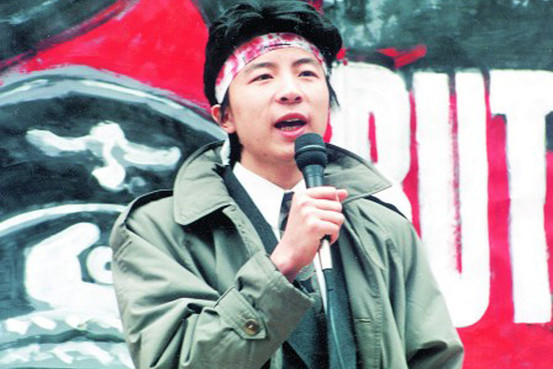
One of the student leaders of the demonstrations in Tiananmen Square describes growing up in China, his rise to leadership in the student movement, the Tiananmen massacre, and his escape to the U.S.
photo from a Wall Street Journal article 20 years later: http://online.wsj.com/article/SB12439... which along with this Guardian article - http://www.guardian.co.uk/world/2009/... - I'm waiting to read until finishing the book. This is so much perspective added to the little I remember from when all this happened. --------- 2/13/2011 The ending was overwhelming and it's hard to explain how this affected my feelings when, shortly after, I went out to get some dinner, walking southwestern China's streets and thinking about it's people's lives, and the lives caught up (in multiple ways) in or by its governance. Seeing the faces around me and wondering what they knew of 1989 in Beijing.
The writing is not on the level of high literature but it is overall a well-written account and most definitely high tension, especially when Shen starts giving day by day accounts of what was happening in his part of the movement. Like reading an account of the Titanic's sinking (sorry, did I give it away?), you can know the ending, and still find yourself crying out to the participants, to someone, somehow, to change things, to alter what must, what will, what did happen. Would it be different today?
"Almost a revolution" is a great literature work done by Shen Tong. Where Shen Tong offers us a rare look at a bold and daring new generation of Chinese citizens who tried to protest the restraints imposed by their country's government. This massacre has been a forgotten chapter in China's history. The government has tried every means to erase this from history. But, with "Almost a revolution" one comes to know each and every detail explaining the need and importance of this revolution. This can be considered as a benchmark in Mr. Shen Tong's life, shaping up his interest in social work and giving back to society. Shen's firsthand account gives a better and clear vision of the entire incident. I would suggest reading this book as it not just give us insight in a really meaningful massacre but also makes us understand need to raise our voice against the oppression of our government.
Idealism meets reality in this narrative of a tragedy told from the perspective of a leader of the Tiananmen Student Movement. Shen Tong through his simple use of language provides the reader with a great depth of understanding about not only the Tiananmen incident but also the background leading up to it.
I personally have read many books on the history of China. Despite this background, I found Shen Tong provided me with a different, personal perspective concerning Communism and the CCP in China, a perspective I have not encountered before. Here, I found a voice for what could have been, a voice of one of many who believed that the Chinese people deserved a better system.
Inspiring close-up look at the revolutionary people's movement that took place in China and, specifically, Beijing and Tiananmen Square leading up to June 4, 1989.
This book was fantastic. I couldn't put it down. I was especially struck by the relationship Shen had with his father, a loyal communist. As a recent mother, this angle offered me a lot of thought.
This work was written in a hurry, and it shows it. As a result of that circumstance, it may not be as polished or replete with references as some readers might like--but I believe it is very valuable. Shen Tong was active in the student movement leading up to and through the Tian An Men incident (May and June 1989). What emerges from Shen Tong's narrative is the somewhat haphazard nature of the student movement: who is in charge? What are we doing? What are our objectives? Is the party listening to us (or even hearing us)? These questions do not always have clear answers as Shen Tong runs through events. What is clear, however, is the sincerity of the demonstrators, and their high hopes that China can progress. It's useful to compare the timeline in this work with the observations from "Prisoner of the State" (Simon & Schuster, 2009), which contains or tries to present the view of events from the perspective of then-Premier Zhao Ziyang. For students of contemporary China, knowledge of these works is essential. Enjoy.
The author of this book works with my father and gave it to him as a gift. I found it very inspirational and interesting since I knew very little about Tiananmen Square and the massacres that occurred there.
incredible personal account of the chinese student revolution that led up to the tienamen square demonstrations in the 1980s. great insight into the politics of china and the development of activism and democracy there.
4.5 although I feel like I can't really rate this book. Read it for my modern China class and it was a fascinating and heartbreaking read. I would definitely recommend to anyone who wants a deeper understanding of the events leading to the tiananmen sq massacre