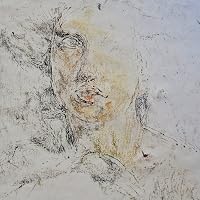
How much should we sacrifice for the life that we want? All his life, C had been dimly conscious of feeling as though he were seeking something from the world, digging through the sod and the soil for something. He did not necessarily want it for himself, he just needed it to exist.
He stood motionless, as his staring eyes reflected the expanse of stained glass in front of him. He had heard about this place, although he could not remember where. It was a theatre, in which patrons could join the actors and live little, ready-made lives, vignettes of reality. In short, it was a place to live vicariously, a place to be somebody else.
Alexander's debut novel, Venus In Chains is a surrealist exploration into meaning and desire, and the lengths to which one should go to find them.
Venus in Chains is a novel that is sincere, raw and delicate. It asks you to simply be and re-evaluate what matters, this is imposed on the reader quietly and imperceptibly but settles and remains with you long after finishing the book. The style is uniquely the author's and the personality of the protagonist, C, bleeds through every aspect of the book.
Nothing prepares you for the strange discomfort the novel creates. For most of it, the reader observes the surroundings alongside C, often nothing seems to be happening, and yet everything is. The novel is set across a mere few days and the events occur only in a few hundred pages, but by the end, it feels as though you have lived an entire lifetime.
The writing is textured, detail is built strata upon strata in thin eloquent layers, never feeling excessive, it is breathless, alluring, pleading, and slyly self-deprecating. The author writes paragraphs and sentences in ways I would have never dared to try, seamlessly incorporating so many circling messages, themes and connotations that come back and haunt your mind vaguely as you progress through the text. The writing style almost collapses the boundary between the reader’s and C’s memories in a unique way. Countless parallels are laid down through the book, as you read past they seem to fade but strangely re-emerge in a manner akin to flashback memories.
At first, C appears vaguely arrogant, assigning himself seemingly unjust self-importance. As you progress, the distance to C unnoticeably erodes, the reader begins to morph, slowly inhabiting, not just observing, the world as C does. Every perspective and aspect of the story, from paragraph arrangement to word choice is curated with an almost obsessive amount of care; the text feels warmly intimate, yet guarded, mirroring the character. The refinement resulted in a story uniquely the author's. By the novel’s conclusion, the reader does not merely comprehend C as a character, but inhabits him, achieving an intimacy that is both profoundly sincere and remarkably sustained.
The story appeals to the most raw of human emotion, in a cruel and simultaneously tender manner. What remains in the end is an overwhelming sense of loss: the loss of wonder, of a part of yourself - indistinct, persistent nauseating loss. The strange ending seems to have no alternative, and everything that occurred feels inevitable and constant. You feel at peace, only because there is no other choice, nor do you desire there to be simply because of how meticulously the book is orchestrated.
Venus in Chains, is a novel told from the perspective of a character whose personality permeates through every aspect, it is deeply intimate and almost religious in a way. The unique character of the book asks for the reader to be able to give into a certain sadness, but never demands the reader to understand every part of it fully. In my opinion everyone will be able to obtain something from reading it, be that an appreciation of its plenteous description of the surrounding world or a deeply resonating experience of human connection.
Venus in Chains. Wow! I didn’t expect to be so immediately pulled into its world, but from the first pages it felt immersive and quietly arresting, the kind of book that asks you to slow down and really sit with it.
Alexander Halford’s writing feels both deliberate and intuitive, as though each image has been carefully placed yet allowed to breathe. The prose doesn’t just describe scenes—it creates an atmosphere you move through. There’s a dreamlike quality to the narrative, but it never feels distant or cold; instead, it remains grounded in emotion, vulnerability, and a very real sense of longing.
What stood out most to me was the precision of the language. Small details carry surprising weight, and certain passages stayed with me long after I finished reading them. This is a book that rewards attention and revisiting; meanings shift slightly the more you reflect on them, and there’s always something new to notice.
I’ll admit that I haven’t read a great deal of surrealist literature before, but this book felt like an invitation rather than a challenge. It opened a door I didn’t realize I wanted to walk through, and it left me genuinely curious to explore more works in a similar vein. If this novel is any indication of what the genre can offer, I’m eager to keep going.
A friend gave me this book for Christmas. As somebody who generally reads historical fiction, with a low tolerance for 'weirdness', I truly expected to hate it. To my surprise, I loved it. Venus In Chains is definitely very weird, but not gratuitously so, rather, the surrealism gave me enough space to explore the emotional context of the book, letting me focus more on how I felt than on keeping track of plot-points. The novel is very rich with symbolism, and towards the end a slew of concepts, phrases, and even individual words reveal themselves to be deeply connected, resulting in a profound and moving ending from which I am still reeling. In spite of that, I felt as though there was still more in the book, so I decided to re-read it. It was even better on the second reading, and I found connections and themes that I had missed the first time around. Fascinating.
Venus in Chains is a chaotic and overwhelmingly warm yet sad novel told through the eyes of its main character, C. English is not my first language, so I often stopped to translate parts of the book, but I genuinely enjoyed doing this and learned a lot of new vocabulary along the way. The scenes move smoothly and feel carefully woven together, you barely notice the transitions and feel the care that has been put into the writing. The writing is velvety, flowing, and deeply absorbing. It took me some time to read and understand the novel, but it was worth it, and I want to read it again to fully appreciate its beauty.
A vibrant and deeply creative debut, Halford draws in his reader through visions of surrealism and beautiful, vivid imagery to perfectly illustrate the internal turmoil of his main character. Venus in Chains explores themes of grief and longing set against a backdrop of otherworldly imagery. I found this read deeply relatable and thought-provoking, particularly in how it captures the tangle of emotions after heartbreak and the mind's way of shutting down memories in an act of self-preservation. Along the way, it offers a striking look at the human struggle to let go, making it a truly memorable and hauntingly beautiful debut.
This book is a rare gem, so beautifully written that its impact lingers long after the final page. Every sentence feels intentional and every word carefully chosen, creating imagery so vivid you can almost step right into the scenes, yet never overshadowing the emotional depth that runs through the story. Each page is layered with meaning, making the narrative both relatable and profoundly moving, inviting reflection and leaving a lasting impression that goes far beyond a casual read.
Venus in Chain is so beautifully written and easy to sink into. The descriptions pull you right into the story, making you feel like you’re there, living each moment as it unfolds. The writing is emotional and almost dream-like, with a soft sadness running through the book. It’s thoughtful and moving, and it stays with you long after you finish reading. I would definitely recommend this book!
“Venus In Chains” is breathtaking in a way that caught me completely off-guard.
Alexander Halford writes with a painter’s eye and a philosopher’s heart. The imagery is so vivid that you don’t simply read it—you step into it. Every page feels like slipping into a surreal dreamscape where emotion and symbolism are entwined, and yet it all feels deeply, achingly human.
The attention to detail is exquisite and masterful! The style is also very unique. There are passages I reread just for the pleasure of how they’re constructed. It’s a book I keep coming back to. There is always something new to discover, something you didn’t notice before.
This is a story for anyone who leans toward the philosophical, who finds beauty in introspection and micro detail and who is intrigued by surrealism. It gently asks you to consider what matters, the lives we lead, and perhaps longing we don’t always know how to name. It lingers long after you close the book.
Poetic, profoundly moving, and relatable in its humanity. “Venus In Chains” is the kind of book that doesn’t just sit passively in your mind, it settles there — in the most beautifully and haunting way.