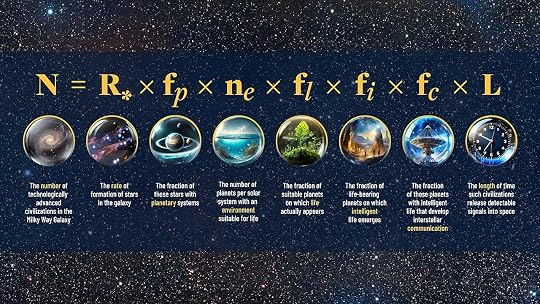
Cloudy with a Chance of Starships takes readers on an irreverent expedition through the marvelous world of astrobiology, using as a guide the most important equation in science since E=mc2. With an irresistible blend of wit, insight, and the latest cutting-edge research, Seven Rasmussen looks at the thrilling possibilities of life in the cosmos through the lens of the Drake equation, a seven-variable mathematical expression that calculates the number of civilizations in our galaxy that humans could potentially contact.
First proposed in 1961 by astrobiologist and SETI scientist Frank Drake, the equation begins with simple and well-known numbers such as the rate of star formation in the Milky Way and the fraction of stars with planetary systems. It then wades into thornier topics such as the number of planets with environments suitable for life, the fraction of suitable planets on which life appears, and the likelihood of intelligent life emerging on a planet and becoming technological. It concludes with the truly unknowable average lifetime of a civilization. While we will never resolve all its variables, the Drake equation offers an invaluable road map to the questions and challenges that lie before us in our quest for alien life.
Cloudy with a Chance of Starships guides readers from the basics of astronomy to the very frontiers of planetary science, along the way covering subjects such as the Big Bang, the formation of solar systems, the origins and evolution of life, and the fascinating methods used by astrobiologists today. This extraordinary book shares a tantalizing vision of the dawning era of space exploration and invites enthusiasts of all ages to join in the discovery.
This was both entertaining and educational/informative - I learned new things. Rasmussen gives an interdisciplinary overview of cosmology, astrobiology, astronomy, the search for alien life, and the possibility of intelligent life in the universe, using the Drake Equation as a guide.
An easy read, that pretty much goes through everything about the possibility of finding intelligent life in another solar system. Using the Drake equation as the guide, Rasmussen explains the many problems, questions, and unknowns about life in the universe and the possibility of humans encountering such.
Rasmussen presents the many problems and factors in simplified language with a friendly voice, making it easy for most people to understand. I think that in doing so, she missed out on some of steps in logical arguments, and I found it hard to make some of the jumps her telling made. There are a few errors in the text, such as LUCA presented as "Last Common Universal Ancestor", when is should be "Last Universal Common Ancestor".
Overall, this is a good introductory book if one is interested in extraterrestrial intelligent life, either searching for or expecting visits from. A good start for anyone new to this topic, or anyone interested in looking at the full problem space of life in the universe and the possible development of intelligence.
I am not usually a nonfiction reader. Science was not my strong suit when I was in school. I like to read for fun, I like to read mostly fiction, I like the things I read to be full of story and be fun to read.
I had a TREMENDOUS time reading "Cloudy with a Chance of Starships!" I really was being told a story the whole time, in language that is accessible to non-STEM people, and it was so FUNNY and charming the whole time! Rasmussen is excellent in the craft of writing, she delivers banger line after banger line, and it feels like every other page I was sharing snippets with my friends in the group chat, because I needed them to also read it too.
A couple of my favorites:
" . . . at least 1,000 F, there were volcanoes everywhere, and it was constantly getting blasted by all kinds of comets and asteroids slinging around the solar system. Now, we've all been in our Hadaen era: hot, messy, questionably hydrated, poorly constrained by zircon petrochronology. But were Earth's chaotic college days scorching enough to rid it of water, or was there enough buried inside to mantle to produce our oceans?"
and
"Astronomers use a clever, mathy tool called 'cross-correlation' to see if the leftover planet spectrum looks like the best-guess spectrum their computer spit out. Cross-correlation just means 'we slid one plot over another plot to see where they lined up the best.' It's very helpful for seeing a signal in a noisy data set. If there is a match, they get to say they found such-and-such molecules (usually water or carbon monoxide) in the atmosphere of the planet. It's a very exciting day: Everyone gets to tell their baffled relatives that they learned something brand new about the universe, and no one has to think about writing a grant to use the telescope again for a whole week.*
(*Ha-ha! A joke! Most of astronomy is writing requests to use the telescope and very little of it is getting to use the telescope.)"
and "The neutron star's weirdness is second only to the other possible outcome of a supernova: a black hole. When a star's core is too massive for even neutron pressure to support it, it simply ghosts out of spacetime, and not even the most well-crafted late-night text message can bring it back."
YOU SEE WHAT I MEAN??? It's all so clever, and funny, and understandable, and I'm learning things about astrophysics and astrobiology and astronomy and physics and research and all kinds of stuff, and I'm having a blast, and it's such a fun read. It makes me want to know more about the universe.
Rasmussen knows what she's doing as a doctor (PhD) and as a researcher. She's bringing the super complicated stuff to us, the masses, in a way that's a good time for everyone. I heard she has a second book in the works and I am SO EXCITED to read that one too whenever it'll come out!!!