Jump to ratings and reviews
Rate this book

Arjun: Without a Doubt

Rate this book
Explore Mahabharata in the voices & through the eyes of Arjun & Draupadi.
Note - Draupadi's narrative is denoted by *** symbol.

I knew there was nothing poetic about death.
I knew not that the most horrific battles are fought off the battlefield.

Arjun: The idealist in a non-ideal world; the warrior whose deadliest opponent was his conscience.
History forgot his voice, but misquoted his silence.

My self-esteem originates from me and ends in me.
Why does your honor depend on me? Find your own.

Draupadi: The untamed tigress, the fragrant flame, the unbridled spirit.

Power does not justify sin. Power is not virtue.
Virtue is that which lasts in spite of power.

Krishn : The enigma whose unique ideology churned the battlefield into a quest for Truth.

The Missile …The Trajectory … The Vision.
The trio that makes for the core of The Mahabharata.

This is their saga.
Insightful, visceral and candid
.

Find ‘other’ famous Arjuns; compare Arjun vis-a-vis Achilles and Alexander; Explore Myths of Mahabharata.

All this and much more in ‘Arjun: Without A Doubt’.

306 pages, Paperback

First published January 1, 2015

28 people are currently reading
806 people want to read

About the author

Shinde Sweety

3 books107 followers
The heart can be dissected, the brain can be spliced open, but I love to unravel the mind and emotions.
Age: Wisdom tooth? Check. Silver-grey streaks? Check.
Marital status: Was a footloose bachelorette, until Chiku (my naughty bitch) lassoed a leash around my ankle and adopted me as her single Mom :)

Genres I dig: Mystery, Thriller, short stories, Historical fiction

Hobbies to perk me up: Swimming, Sanskrit, sketching, yoga, daydreaming, music

Genres I penned till date: Mythology (Arjun- without a doubt),
Medical Drama (Rage of Maggots)

My upcoming projects: Mytho dystopia, Thriller murder mystery and so on

Instagram: sweetyshinde_author

Ratings & Reviews

What do you think?
Rate this book

Friends & Following

Create a free account to discover what your friends think of this book!

Community Reviews

5 stars
141 (50%)
4 stars
85 (30%)
3 stars
35 (12%)
2 stars
9 (3%)
1 star
8 (2%)
Displaying 1 - 30 of 105 reviews
Profile Image for Archit.
826 reviews3,200 followers
October 23, 2016
One Chapter of it and I'm wondering out aloud "This book is arresting to the eye!"

An adventurous and thought provoking retelling.
Wait! It's not retelling, to me, it's an era in itself!

To know your enemy, you have to be your enemy.

I absolutely adored this book!

Arjun, what can I say about the way he is portrayed in this work! It has shown him as a person every man would want to be and why not! His patience, honesty and glory are to win mind and hearts.
He was not my favorite character in Indian Mythology, he still is not.
But seeing Arjun's inner fears, walking in his shoes and skin, having each second in battlefield, fighting with relatives and his own demons, I'm definitely moved!

Draupadi, other name of strength, sacrifices, determination and perseverance , had my respect already, but this book has increased it immensely. Her inspirational, painful, compelling and heart shaking voyage, will not leave my mind for the rest of my life.

Unlike other mythology books, that glorify Krishna's work and even though the story is centered on someone else, Krishna comes and takes all the credit! Nopes, not in this one! Kudos for it!

To everyone, who are not interested in seeing battles and wars, this turns out to be a treasure.

Right from the preface, the author warns you, through her writing, that this book is going to be - Merciless!

I liked how she stood up for what she believed in, asked questions which no normal person would've asked and gave a unique perspective of Mahabharat.

She defended Arjun and Draupadi, as Panna Dhay defended Maharana Pratap and as Rama saved Sugreev's life fiercely and majestically. She didn't leave one string loose.
Surgically going through the layers and bringing out to you a fully blossomed story.

During the read, I got that the pith of these all pages stung together was "To Make the reader feel - Invincible." .

And invincible I felt.

Can't help illustrating the magnanimity of Mahabharat with the following verses from a TV show :

Janmayi gayi yagyan se, (She was born from Fire)
Ati sundar naam Draupadi (A beautiful name, Draupadi)
Pratishodh pita ne thaana, (Her father took oath of a revenge)
uska parinaam Draupadi. (And the result was Draupadi!)

Pati patni juye me hara, (Husband lost her wife in a gamble)
Jaise koi vastu ho naari, (Like woman is an object)
Aadarneeyo ki sabha me, (In assembly of respected people)
Apamaanit hui bichaari. (Helpless, she was insulted.)
Naari ki yahi kahani (This is the story of woman)


Draupadi has conquered sky and mountains. And the portrayal of her in it, will certainly overcome the reader's mind.

Verdict : special, special mark in this genre .
Profile Image for Viju.
332 reviews85 followers
July 22, 2016
(The author Sweety Shinde provided me with a review copy.)

When Dr. Sweety Shinde, the author of Arjun: Without A Doubt, mentioned to me about the book on Mahabharata centred around Arjun that she was coming out with, I was majorly skeptical of the choice of the title character, especially considering that I do not consider Arjuna as the most exciting character in the epic. This was also further attested by the fact that a book on Arjuna that I had read earlier showed him in too plain a light. And I was happy to be proven wrong on two accounts. One, a book on Arjuna can be written. Two, Arjuna is definitely not the non-exciting character that I made him out to be with all the various interpretations of Mahabharata that I have read so far.

My love for Mahabharata is very well-evident from the number of interpretations of Mahabharata I have in my book collection. I have managed to locate ‘most’ of them and gotten to lay hands on at least half of them. So when the author sent me this review copy of this book, I was more than happy to read it and add it to my collection.

A lot of the happenings in the book is something that is known to everyone who has read one form of Mahabharata or the other. The main distinguishing factor of this book from the other books is that, yes, it does have Arjun as the title character, but it also has a novel way of moving the narrative with two narrators. Arjun along with Draupadi are the two narrators and this choice of narrators is something that I would definitely like to commend Sweety for. With a lot of focus thrown on just the two of them, who seem centric to the epic, Sweety manages to retell the happenings of Mahabharata with great ease. There is not much focus on any of the characters apart from Krishna (and Kunti, in the very end) and each of the characters are uses as plot elements very effectively.

Sweet manages to give a voice to Arjun, something that I haven’t seen in other works and ensures that he is shown as a human being prone to jealousy among other flaws. He sure is the wonderful warrior and Casanova, but Sweety manages to portray him in much better light that what he is usually shown. Draupadi! Where do I even begin. The author’s love for Draupadi’s character, which is very well evident in the post-script notes she makes at the end of the book, manages to show Draupadi as mostly never shown before. What helped was the fact that she got her own voice, much like in Palace of Illusions, except that her voice in this was stronger and louder. She is shown as this woman who craves for the attention of the warrior who won her and makes not effort to hide her disgust/unhappiness when she was forced to share husbands all life.

Sweety’s narrative, as mentioned earlier, is very effective with the usage of two narrators and there’s seldom any redundancy in terms of the narration between the two characters. This is of great benefit to the reader, since this makes it a fast-paced read which is well within 300 pages. In terms of writing, Sweety definitely has her language prowess among her strengths.

Sweety also manages to squeeze in a 20 pages analysis of the epic, much like in Yuganta, and this makes me curious to see what Sweety’s next book is going to be like. I would love to see her write a piece of fiction with characters she has developed and see how she gives life to them.

Arjun: Without A Doubt, without a doubt, is a read that Mahabharata fans to undertake.

(Feb 22 2015)
Profile Image for Bookish Indulgenges with b00k r3vi3ws.
1,617 reviews256 followers
February 17, 2017
Arjun: Without A Doubt is one of the latest to join the bandwagon of Mythological story being retold. This time around we get a glimpse into the Epic Mahabharata from Arjun and Draupadi’s perspective.

Having said that, I really have no need to summarize the story as almost everyone knows it already. Instead, let me tell you about what I thought of it as a book and my take on the way the Epic has been narrated. The first thing that attracts attention is the fact that the author has chosen to tell the story from Arjun’s point of view. Arjun is probably the most popular and most beloved of all the Pandavas and as such it can be difficult to narrate the story. However, the author has done a good job of it and anybody who adores Arjun will love reading this book. On the other hand, we also get a glimpse of Draupadi’s perspective on everything as the story unfolds – I was enchanted by the scene of her Swayamvar. This book also gives us a glimpse into Draupadi’s mind about her polygamous status and the Vastraharan episode. The author’s language and narrative style is very interesting and inviting. She has her own style with the language she uses as well as her narrative. The language is not ‘flowery’ yet it has a nice feel to it while the narrative is very descriptive. I was engrossed in the pages as they simply flew by.

Now it is time for the things that I did not like as much… Without giving out many spoilers, I have to say that I did not always agree with some of the author’s interpretations and justification for some of Arjun’s actions. I understand that the author wanted to show Arjun, her protagonist, in a good light… but to imply that Arjun was almost never at fault or always had the right reasons for his actions is just not done. Also, to put Arjun on the right side, the author has given some of the other characters a darker shade than necessary. And while I am not saying that none of the others were at fault, I just wish we had seen the grey areas of Arjun’s life to make him more real.

Overall, this made for an interesting read that I did enjoy to the fullest while reading it. It might make you rethink on some of the events of Mahabharata and also see some of the characters in a new light.
Profile Image for Jyoti Arora.
Author 12 books68 followers
March 9, 2015
Before I begin my review of this book, I’d like to thank author Sweety Shinde for sending me a copy of her book to read. This is the first mythological novel that I have read. I never thought that I would feel any interest in reading a novel about stories that I already knew so well. But Sweety’s book proved me wrong! Even if it tells a well-known tale, it still holds many surprises. And author’s notes exploring popular myths at the end were added delight.
Arjun: Without A Doubt tells the story of Epic Mahabharata from Arjun and Draupadi’s perspective. The ancient epic has been presented in terms of love story of these two tall figures, with Krishna acting as friend, guide, and philosopher to both.
The language of this book is elevated, without being difficult. The language brings alive the emotions of the characters. You’ll find several one liners or deep and insightful quotes in this book that you’ll consider worth remembering and quoting. Some Examples:
“Peace is the first casualty in every ambition. It comes at the price of conflict for every warrior. “
“Religion is nothing but a series of conveniently placed loopholes”
“Goodness is an asset - but if you allow it to be exploited, it is a liability”
“Truth is a kaleidoscope, it alters with perspective. “
As for story and plot, well, there can be no doubt that it tells a great tale. The story of Mahabharata is so complex and so vast. Limiting it within 280 pages is no easy task. The story moves along at a fast pace. Many a times I did have difficulty in understanding the events as lot has been left unsaid in the book to save space.
What I liked best about this book’s characterization is how easily it makes readers accept the epic heroes as humans. However, it was a bit uncomfortable to accept the darker shades of the characters of Yudhishthir, Kunti, Bhishm Pitamah etc. as they have been portrayed in this book.
But anyway, a book is told as per the perspective of its author. I may not agree to all that I read, but I’ll still say that it was a gripping, engrossing and thoroughly enjoyable book. And it did dispel many illusions and cleared up many doubts and questions. There’s much in our epics that we might feel is wrong and unjust. But we are made to accept it and even admire it as having been necessitated by some dharma. Sweety focuses light on much of this and dares to call the wrong as wrong.
After reading this book, I'm sincerely thinking of reading the Mahabharata and find out exactly what it says. And what can be a greater victory for a book than that it makes the reader to want to seek out the real truth and question the old and popularly accepted knowledge?
Profile Image for Maniparna Sengupta majumder.
46 reviews4 followers
March 19, 2015
Mahabharata, the greatest epic of India, has intrigued the readers and writers from the time immemorial. It is said in the Book of Beginning of The Mahabharata, “Poets have told it before, poets are telling it now, other poets shall tell this history on earth in the future.” And, so true are the words. Thousands of books have been written taking cue from this epic and, still it has retained all its charm. I always believe that whatever is in Mahabharata, is found elsewhere. But what is not there, is nowhere else. Whenever I manage to get some time, I read and re-read the great epic and, every time I feel amazed!

So, it’s quite natural that Dr. Sweety Shinde’s debut novel Arjun: Without A Doubt considerably piqued my interest. A cursory glance at the beautiful cover and you’ll understand that it’s not only about Arjun, but also about Lord Krishna and, Draupadi. The symbolization has been done artistically; the arrow representing Arjun, the peacock plume signifying Krishna, the blue lotus and, flames portraying the quintessence of Draupadi.


Dr. Sweety Shinde has depicted this very fact in her book, the interconnection of Arjun, Krishna, and Draupadi. They act, behave, feel like human beings in her book, making the characters alive. And, while doing this, I won’t say that she has deviated much from the mythological history or the other way around.

Arjun: The Hero
The first person narrative has produced a dramatic effect throughout the story. Contradiction and conviction, love and passion, enmity and togetherness…. everything has been delineated through dialogues.

The moment Arjun looked at Draupadi at the Swyambara, he thought,”She seemed like an idea, a Muse, a Divine weapon. Like Vajra- Indra’s thunderbolt.” Perhaps he fell in love with her at the very moment. And Draupadi, she mused,”My toe curled in delight. I wished I could run my fingers through his voice….my mind flew to an image of crumpled silk sheets.” These amorous musings, from both sides, prepared the foundation of Arjuna’s exile after he was captivated in the hands of destiny to “share” his wife with his brothers!

In this saga of Arjun, he has been portrayed as a real epic hero; devoid of any moral flaccidity in his character. The author has justified his every single action. The inaction of Arjun, when Draupadi was dragged to the court to face the most outrageous humiliation from her in-laws, has been justified by saying that he was in a stupor; perhaps he was thinking of those series of events as figments of his dark imagination.

Arjun truly was a character who had been immensely loved and praised by Lord Krishna who was the sole Creator and, everyone else was just his marionettes. His emotions, grievance, and grief have been put in words so meticulously that the reader is bound to feel a strange attachment with Arjun.

The Dark Lotus: Draupadi
The character of Draupadi has changed its shades according to the milieu. But, she has never been portrayed as a damsel in distress waiting for her man in shining armour to rescue her. Her characterization in Arjun: Without A Doubt will make you re-think of the story. Draupadi was, undoubtedly, the strongest ever female character of ancient India, but, she also had her own share of vices, skillfully enshrouded by her pulchritudinous appearance and various impeccable qualities.

Yudhisthir

The character of the apocryphal Dharmaraja has been severely stained. The readers may or may not sing in unison with Sweety’s portrayal of Yudhisthir but, they’re sure to ponder over her points and, as I’ve said in the beginning, I consider this as an achievement.
Language and Style
Sweety has a style of her own. She can create a gossamer through her words. The book starts as, “I lay sprawled by the lake, my fingers floated lazily along its edge. I ruffled the surface once in a while and gazed at the ripples- perfectly symmetrical ripples emanating from the epicenter.” The readers at once lose themselves in the magic of words. The charm of reading enhances when the exuberant bubbles of words rise headily upwards.

What Didn’t Work For Me
The role of Krishna as the savior of Draupadi, while Dusshashon was trying to unrobe her, has been mysteriously left out. In order to accentuate the uniqueness of Draupadi, the role of Arjun’s other wives have been belittled. (Draupadi, especially, always envied the Naga Princess, Uloopi, to whom Arjun lost his virginity)
The characters of Drona, Karna, and Pitamah Bhishma have not been properly emphasized in order to establish the supremacy of Arjun. Especially Radheya ( Karna) has been hugely lambasted just to make Arjun a hero, without a doubt.
The story jump cuts from one scene to another. Someone who is not well-versed with The Mahabharata may find it difficult to catch up with all the loose ends.

My Verdict

However, I’m not going to belabor my readers by making this review a long one. This is, essentially, Arjun’s story and, the author has every right to substantiate her claim to Arjun’s innocuous fame. She has done that impeccably and, even if you’re not in love with the Third Pandava, you’re sure to feel for him after reading the book.

Many times it has happened that Arjun’s story finally has deviated from its purpose and has become someone else’s (read Karna’s). One of the examples is Saga of a Pandava Warrior Prince: Arjuna by Anuja Chadramouli. But, Sweety’s Arjun: Without A Doubt essentially speaks for Arjun, because, as she said, “we live in times that vilify the heroes and glorify the villains.”

It’s not an easy task to write about something already known to most of us. It’s not easy to write about Mahabharata without its spiritual aspects. It’s not easy to establish a particular one as the hero along with adequate justification. DrSweety Shinde has done all these perfectly. I do not agree with her points in many places but, I enjoyed reading her perspectives and, I feel anyone who has an inclination to unfold the myriad layers of the great epic, will enjoy "Arjun: Without A Doubt."
https://maniparna5002.wordpress.com/

Profile Image for Swathi Shenoy.
Author 3 books32 followers
September 15, 2015
Ramayana and Mahabharatha are my all time favorite reads. No matter how many times you read them, there is always something new to learn each time. So when the author asked if I want to review it, I happily agreed. What interested me most was this book was written from the point of view of Arjun and Draupadi - two of my favorite characters from Mahabaratha. I was looking forward to read this book.

When I picked up the book, I instantly liked the language. The book is written in first person - some in Arjun's voice and the other in Draupadi's. I enjoyed it immensely. All these times, when reading this epic, I was a bystander - watching the story unfold from a corner. But reading the story in first person perspective changes it all. You feel the character's emotions and it keeps you involved in the book.

Reading this book, I started understanding the epic in a new light. I loved how the author has glorified Arjun through Draupadi's eyes and vice versa. It was a moment of joy when I read Panchali's polygamy was forced and not a choice made willingly. Though Arjun had to share his wife with his brothers, the love between Arjun and Draupadi remained the strongest till the end, which proves their love was true. I loved the bonding between Krishn and Arjun and how it is depicted throughout the book.

The language is immaculate. I liked the flow of the novels. I liked the dual point of view offered on the events. It was difficult to put the book down. The spark between Arjun and Draupadi is clearly depicted and it was fun to read about it. Arjun - Draupadi fans are in for a treat! I also liked that the author hasn't glorified Yudhishtir much. Despite his greatness, it was wrong to wager so much for the dice game and I would have been disheartened if he was glorified even after that. Mistakes are made by everyone and it becomes crime when instead of correcting them, people just accept them!

There was one thing which I didn't like. The story just picks up from where it is left off without any pretext of who the narrator of that part is. Sometimes I had to read two or three paragraphs to understand whether it was Draupadi's Point of View or Arjun's. And sometimes I had to go back and start reading again once I understood. So it was a little frustrating.

I wish there was more to read. I couldn't get over the fact that the story ended too soon, especially the Kurukshetra war. I wanted to read more about it and it was a disappointment that it ended so soon with only little description about it.

Here are a few lines that i liked from the book:
* Deserts come out of volcanoes. Oceans come out of earthquakes. Nature has its own violent way of balancing its elements. We are just trying to imitate Nature in human form. We may succeed or we may fail. But we canot live life regretting that we did not try when we could.
* No person is great in isolation. It takes many hands to shape a life. Denial would mean conceit, and conceit is not the same as self-respect.
* Religion is nothing but a series of conveniently placed loopholes.
* Passion is a feeling born to bear pain. Bear it, or let go.
* Power does not justify sin. Power is not virtue. Virtue is that which lasts inspite of power.
* Absence of questions is not proof of answers.
and the best one is the below quote which Krishn says to Arjun
* Don't underestimate your triumphs. Leave it to the enemy.

Verdict: I LOVED this book. The book is a awesome and it is highly recommended for Mahabharatha fans. Especially, if you are an Arjun fan, then this book is definitely for you! Go grab your copy now! It is totally worth it!

Profile Image for Pankaj Goyal.
269 reviews53 followers
June 16, 2015
‘Arjun: Without a Doubt’ by Sweety Shinde is a recent book, which tells the story of the Mahabharata from the perspective of Arjun or Arjuna. However, Sweety Shinde’s book not only retells the Mahabharata through the eyes of Arjun, but also through the eyes of Draupadi. While the main protagonist of this novel is Arjun (as the title suggests), the author has beautifully incorporated the voice of Draupadi also. This dual narrative makes it an interesting read.

Whenever someone writes about a mythological character, he/she carries a risk. And, the risk becomes greater if somebody has already written about the same character more recently. There is already a book on Arjun by Anuja Chandramouli, which was published on January 2013. And, therefore, we should admire the author of the book under review for venturing into a dangerous terrain and coming out victorious with such a wonderfully written book.

You would find retellings based on the Mahabharata more captivating if you don’t know much about this epic. However, what about those who have a prior knowledge of this epic? And, what should those readers expect from such modern retellings of the Mahabharata? Retellings like these should be able to add something new to their understanding of the original narrative or original character by providing alternative points of view that may have been only implicit in the original. And, this is where this book scores positive points. Sweety Shinde seems more intent on developing her main characters beyond the predictable and less on retelling the plot in all its detail. By mainly focusing either on Arjun or Draupadi, the author manages to retell the happenings of Mahabharata as well as projecting the main protagonist of this novel with ease. In other words, the author brilliantly manages to give a voice to Arjun, the hero of this book.

Though we all know Arjuna as a mighty warrior, this book allows us to see the emotional side of him also. There is no doubt that he was a great archer, but he was a human being also. This book uncovers the mask and throws light on the real man behind the clothing of a warrior. You get to know him as a son, as a brother, as a student, as a husband, as a rival, and most importantly, as a human being. You come to know his feelings when he had to share his wife among his brothers. You come to know his feelings when Yudhisthir gambled Draupadi in the court of Duryodhana. You come to know his feelings when he had to face his relatives in the war. You come to know his feelings when he lost his son Abhimanyu in the war. And, you come to know his feelings towards Karna and Eklavaya (his rivals), and Draupadi (his wife).

Certain scenes in the book are really delightful. The emotional but heated exchange between Arjun and Kunti after the death of Karna in the Great War of Kurukshetra is one such scene. The same can be said about interactions and conversations not only between Arjun and Krishna, but also between Arjun and Draupadi. The language is lyrical and helps in bringing out a certain beauty in dialogues. However, at the same time, sometimes it becomes difficult to identify the characters as definite dialogue markers are not given. Consequently you lose track and retrace your steps to clarify who is actually speaking. Yes, this a minor flaw in the book and distract your attention time to time.

Coming to the end of this long review, I belief the vilification of Karna and Yudhisthir in the book was unnecessary. I would have been certainly happier if the character of Karna would have been dealt in a different manner. I also feel that few more pages could have devoted to the war scenes. This is Arjun’s story and he played a major role in this war. But, at the same time, we should also understand that the author cannot make each and everyone happy. Isn’t it?

And, to conclude, as I have told you in one of my earlier reviews, there is neither white nor black among the characters of the Mahabharata. On the other hand, the characters of the Mahabharata represent different shades of grey and even Arjun is not an exception. And, I would ask this question, “Did the author present all shades of Arjun?” You read the book and answer this question.

A must read for the fans of Indian mythologies. I will highly recommend it.

Read full review on:
https://pgalmora.wordpress.com/2015/0...
Profile Image for A.P. Rajshekhar.
Author 3 books14 followers
March 1, 2015
Story – the two minute version

The book starts with the POV of Arjuna in the forest where the Pandavas and Kunti are living incognito after escaping from the house of lac. Then the scene shifts to Panchal where the kingdom is preparing for Swayamvar of Draupadi. Here, the readers are introduced to Krishna and Draupadi's through her own words. From there on, each event in Mahabharata is portrayed from the POV of either Arjuna or Draupadi.

What I liked

1. The relationship of Arjuna and Krishna. In any book related to Mahabharata, the first thing I look for is the portrayal of Parth-Madhav. The author has done full justification in this regard. I would dare say that this is first time an Indian author has depicted their friendship as it is in the epic.

2. Arjuna's dedication to archery. Dr. Shinde beautifully depicts the sweat and blood Arjuna had shed to become the peerless archer that he was. Majority of authors forget this aspect of Arjuna.
3. Lord Indra's pride in the victories of Arjuna and his love for Arjuna.

4. Karna's one sided rivalry with Arjuna. In the epic, Arjuna had only one rival – he himself. However, with the emergence of Karna as a tragic hero in Indian literature, this aspect of Arjuna is selectively forgotten. That is not the case with Arjuna, Without a Doubt. There is a long conversation between the three Krishnas that makes it clear that Arjuna neither considered Karna as a rival nor was intimidated by him ever.

5. The unique relationship between Arjuna and Draupadi. In the epic, most of their conversation happens through eyes, smiles and sarcastic banter. In this book, these translate to explicit conversation. And that makes understanding their relationship much easier.

What could have been better

1. Arjuna's thoughts about Khandav-dahana. This is not first time that an author has shown Arjuna as traumatized for his role in burning of Khandava forest. However, nowhere in the epic, this has been mentioned.

2. Facts about Gandiva, specifically the fact that nobody except Krishna and Arjuna could lift it. Draupadi could never have taken it to her room.

3. Reason for Arjuna's silence during dice hall incidence. I wont spoil it for anyone who has not yet read the book. However, I feel a better reason could have been found in his inner struggle between cold logic and emotions.

4. Portrayal of Subhadra. In the epic, the only person for whom Arjuna openly declares his love is Subhadra. That could have been taken into consideration.

5. Darker shades in the portrayal of other Pandavas and Kunti. I am not going into details as that could spoil many of the twists in this tale. The portrayal could have been more balanced.

Overall Rating
4 out of 5. A must read for any fan of Arjuna and Arjun-Draupadi pairing.
Profile Image for Ishan Agrawal.
942 reviews48 followers
April 15, 2016
It gave me goosebumps as soon as I heard that the novel is on epic mythological story Mahabharta and more importantly on Arjun whom I have always idolize for his sheer focus and strength of character.
Though the story is woven around our very own rich historical figures with a sense of religious sentiments and a feeling of heavenly divinity attached to them but still i strongly feel , Mahabharta is universal in its theme and anyone can relate to it. Even if we look at today's world , all the political treacheries , dethronement , rivalries going on - they all bear a stark similarity and bear its fundamental roots to Mahabharta only.
The way author has highlighted the essential virtues of various characters involved is just spot on. What really captures my attention is the fact that she has tried to bring various perspectives to a rather classical theme in her own sweet ways rather than focussing on any particular episode.
Sweety has kept Arjun and Draupadi as the central characters and shown the flow of events with their eyes. The way Arjun's depth of nature and Draupadi's psychological conflics are displayed , that brings the story in great light.
The tools of literary art being employed or in simpler terms , the language is very gripping unlike many contemporary authors today who blunders on this particular aspect. I was completely engrossed in most of the events as they unfolded.
However, any piece of writing is not without any shortcoming. Though I do agree with most of the author's interpretation shown through the protagonist Arjun's eye but all of them doesnt seem justified to me. It is , as if , author has forcefully kept Arjun on a brighter side in every incident and aspect. The analogies being drawn are sparkling enough but yeah at few instances the novel became cumbersome too as to who is talking about whom. There is not clear and evident demarcation being made everywhere.The end was a bit abrupt which put me off a bit.
There is one particular thing that I would like to highlight about this novel. Most of the stories of the present generation are blamed to be stretched unnecessarily , however here the case is just opposite . I think though the writing is well researched . still a few more pages would have done more justice to this masterpiece.
Having said that , when I started reading this novel , I dint expect it will arouse much interest within me as it was based on stories which i already know quite well. However , after completing it , I do admit that I took a great decision owing to the fact that there were so many inside stories and deeply embedded truths (read illusions) to be known.
My 3.75 stars to this and kudos to Sweety and thanks to Tushti also for sending me its review copy :-)
Profile Image for Gnanendra.
2 reviews6 followers
March 22, 2015
Actuallly,I was skeptical about reading epics, this is my 3 rd mythological novel and i had to say that i changed my opinion after reading this, mahabharatha was a magnaficent tale ,it puts forth every possible human predicament before our eyes, in the form of its characters and situations and tells us the correct way of dealing with them through the various Spiritual messages scattered all over it.. In This Book ARJUN -Without a doubt, author highlights mainly three important characters of mahabharatha namely, arjuna,draupadi and krishna...this book breaks some myths and portrays the characters in new light especially draupadi and arjuna...u'll always learn some new things every time u read mahabharatha n in this book depicts the truth behind panchali's polygamy and the bond between arjun and draupadi,..however the only problem is the confusion about who is narrating ,which made me re-read some parts again......[ Actually the author has used 3 asterisks for Draupadi and none for Arjun]......And coming to Arjuna, the legendary character is brought to life in a vivid and endearing way. This indeed is a very well researched piece of book, and I am sure that even if one knows a lot about the Hindu mythology, he would surely get to know at least something new. The author has weaved all implying incidents in a clean manner. I had quite many doubts on various incidents in Mahabharata. The author has done a splendid job in clarifying those doubts by mentioning almost everything about Arjuna.This is a delightful read with many insightful n thought provoking quotes about passion, power, triumphs and religion like...'' Heaven is a Mirage, all we have is this life and this earth''. & '' Truth is a kaleidoscope, it alters with perspective ''Religion is nothing but a series of conveniently placed loopholes” “Goodness is an asset - but if you allow it to be exploited, it is a liability” .This book after finishing changes ur opinion on many things n im happy to say that many of our present day queries/problems have got answers in this epic...the lines like'' The only time arjun falters is when he battles his own conscience n it is the only time krishna steps in to aide him '' will show authors love for the character of arjun which some may feel a bit over glorified. Finally , ARJUN was a beautifully narrated tale and it is a treat for arjun fans and as the author said it is a homage for his great character.Thank u Dr. SWEETY SHINDE.... looking forward to read ur future works. VERDICT : GO Get Ur Copy !!
9 reviews
July 7, 2020
This was the perfect book that anyone want to read and understand the things about Arjun. I don't know how much is true and twisted but but the final pages where all myths are broken with references inclining my opinion in favour of Arjun. Despite of coming from Royal family,the life Arjun lived no one could ever endure that much pain throughout their life. I guess that's what makes him dear to Krishna. Even the conversation between him and kunti or draupadi or conversation of draupadi and bheema sounds real,which lacks in TV serials on Mahabharata. Must read for Arjun fan and those who abuse him, definitely read it before saying anything.
Profile Image for Deepali Gupta.
308 reviews4 followers
September 11, 2016
this is a magnificient book, a huge read but worth all the time and efforts.
as the name suggest it is from the mahabharat, story of arjun and draupadi rewritten, how it felt being in there shoes. the story revolves around them and ofcourse almighty govind. as being a reader of mythological books. this book makes you read it. as the narration is very amazing and vivid imagery which takes you back to their time and habitat. this book gives an insight about arjuns and draupadis mind and their lives revolving around . their emotions, crossroads.. i really appreciate this new twist to the way the story has been narrated. also many facts will be relearned here. it also has various messages for us. with how to deal with life and some morals which we can put down into our lives. for any second you won't feel like no this wouldnt be his / her reply. all the characters have been portrayed brilliantly. this book adds another feather to the, addition of mahabharata. how can i not mention, this book's cover is pretty. too colourful, giving you a happy vibe. :)v ocabulary is intense and understandable. somebody who does not like to read any mythological books and still has some interest must definitely read this book. and if you do read myth books. it is definitely recommended.


i rate it an overall 4/5 :)
Profile Image for Saiswaroopa.
Author 14 books201 followers
June 20, 2016
A refreshing take on the most uncomplaining (whew!) characters of Mahabharata. Re-telling of Mahabharata from individual perspectives has been an ever-green favourite of the Indian literary segment. Arjun without a Doubt by the debutante Sweety Shinde stands out of the rest, giving a voice to the ever inspirational Arjuna while admirably balancing the macro narrative. It is not surprising that the author actually chose that perspective which refreshingly does not blame the world for his misfortunes. In a unique approach to balance the male and female (perhaps) narratives, the author chose to retell the epic through the eyes of Draupadi and Arjuna. For the full review, visit : https://saiswaroopa.com/2016/06/19/bo...
Profile Image for Ravish Mani.
Author 3 books3 followers
Read
August 10, 2015

The word Arjun reminds me of the greatest epic ever written, Mahabharata. People know Veda Vyasa as its author but his original name was Krishna Dwaipayana which means the dark child who was born on a river island. He was known as Veda Vyas because he compiled the scattered hymns into four Vedas. He was also the biological father of Dhritarashtra, Pandu and Vidura.

The epic has two characters with the same name as the author without which Mahabharata was not possible – Krishna, son of  Devaki and Krishna(a), daughter of Drupada also known as Draupadi.

Anyway, let’s come back to Arjun: Without A Doubt. He is the same Arjun of Mahabharata, friend of Krishna and beloved of Draupadi.

ABOUT AUTHOR

Dr. Sweety Shinde is a doctor by profession and holds a Doctorate in Medicine. She is currently learning Spanish & Sanskrit. She has a good grip on mythology. She dedicated almost one year in understanding Bhagwad Gita under the guidance of Shubha Vilas of Iskcon, author of Ramayana – The Game of Life series.

I found many similarities between debutante author Sweety Shinde and nowadays mythological veteran and chief consultant of Star Plus Mahabharata, Devdutt Pattanaik: both are from medical background, both are well versed in Indian as well as Western mythology and both specialize in drawing sketches.

Though Sweety has been published numerous times, Arjun: Without A Doubt is her first novel. Earlier, she was published in Medical Journals.

BOOK COVER


Click on the image to see its larger version

The way she describes the Cover Design of her book, it reminds me of one of the genius of this century, Steve Jobs, the man behind Apple Inc, who was known for his passion for design, detail and perfection.

Jay Elliot & William L. Simon, in their book The Steve Jobs Way: iLeadership for a New Generation, mentioned an incidence when Steve spent twenty minutes back & forth with the engineers about the best place within a three-square-inch section to put three words in the nth revision of the Apple iTune Music Store website designing. He believed that design was not just about what a product looked like on the surface but had to reflect the product’s essence.

Arjun: Without A Doubt is all about Arjun, Draupadi & Krishn and their relationship with each other. The same is reflected through the symbols used in Cover Design. I found a similar passion for design, detail & perfection in Sweety when I came to know that lotus & peacock feather stems entwinement and their curling about silver arrow also has a symbolic meaning. The why, what & how of Cover Design could be found here.

WHY THIS BOOK

People mostly know the tales of Mahabharata. They have watched and have been watching TV Serials based on Mahabharata. Then why this book?

The author said about herself, “The heart can be dissected, the brain can be spliced open, but I love to unravel the mind and emotions.” She did exactly the same. She tried to uncoil the minds and untangle the entangled emotions of the characters. She tried to look inside the characters to know what they were thinking at the time of taking decisions.

What would lead to share a single woman among five brothers? Under what circumstances, a woman would allow herself to be a wife of multiple husbands? How would a woman feel if she is forced to polyandry? How would a man feel if he is forced to polygamy? How would a person feel if he/she is treated as objects and are subjected to be wagered in gamble? Why would a man have to marry several women, if the women, themselves, are willing to have free sex with the man? What is the basis of marriage? Could a couple lead a happy married life without loving each other, just by doing their marital obligations honestly?

The perspective, the author came up with, is aligned with present mindset, with the ideologies prevalent in the modern society. This approach makes the plot relevant in current context, as polyandry is still practiced in some parts of Rajasthan & Haryana due to poor male:female ratio. Despite feminist revolutions, a large no. of women still have to sacrifice their happiness & dreams for family.

STORY BACKGROUND

The story begins with the marriage of Arjun with Draupadi and ends with their death, in a timeline fashion. But the way of narration reveals that the story was being retold as in flashback; when Draupadi and Arjun fell on their way to heaven but not died till that time. They saw Yudhisthir reaching heaven. It appeared to them that Yudhisthir would get entry into heaven. Then Arjun and Draupadi looked into each other’s eyes and entered into retrospection, thinking: “Did they take right decisions in life? Should they need to regret the way they lived their lives? How could Yudhisthir make entry into the heaven, despite losing his kingdom twice and his brothers & wife once in gamble, not them who sacrificed in the name of the unity of brothers?”

The novel is a love story about human love with all its feelings intact: passion, jealousy, romance, seduction, compassion and sacrifice. It is about the same love that we refer in our day to day life – in terms of giving & receiving.

Arjun is shown saying, “I must be an emotional fool to invest emotions where none were reciprocated. I did not know how else to love. It was too late to alter myself.”

Would Arjun elevate to higher divine level of love in the end? Well, to know that, you’ll have to read the novel.

PROTAGONISTS OF NOVEL

Arjun is depicted as humble, innocent, sensitive, moralist, courageous one woman man having ascetic qualities. He is projected as an ideal man in agreement with the opinion of Vivekananda on the subject. Vivekananda said “The true man is he who is strong as strength itself and yet possesses a woman’s heart.”

Draupadi is portrayed as intelligent, learned, jealous, loving, caring, courageous beautiful woman and adept in using verbal whiplashes.

Krishn is shown as a normal human being who was pretty good in strategy with excellent understanding of human psychology. Spiritualism is stripped off Krishn and he is presented as shrewd, who only focussed on end without caring much over the means. 

MAHABHARATA and GEETA INTERPRETATION

Geeta is also interpreted on worldly plane without a tint of spiritualism in it. Mahabharata and Geeta without spiritual interpretation are precarious. I must appreciate the guts of author for taking a huge risk in her debut novel.

Since the story is not narrated in Universal Omnipotent Tone but put into words through the eyes of Arjun and Draupadi in First Person, the idea of non-spiritual Krishn seems to be fine because it is portrayal of Krishn as understood by Arjun and Draupadi not as HE actually was.

Moreover, the indication that there is much in the story is given time to time by author as in this excerpt: “It was more than the loss of Kingdom. It was the crumbling of his (Krishn) dream. Magadh-Panchal-Indraprastha-Dwarka was his uninterrupted chain of power – his idea of righteous rule. Was!” But chances are that the tiny italicized ‘Was!’ could be easily overlooked and the sentence could be misinterpreted.

STYLE OF NARRATION

Author’s narration is tight, intensive, vivid, opinionated and a bit provocative. Author deviated from popular storyline at many places and came up with her own interpretation, sometimes backed up with reasoning and some other time just to glorify Arjun & Draupadi and vilify others. In fact, author dedicated a few last pages on whys and why nots of epic. Author also compared Arjun with ancient Greek heroes: Achilles and Alexander separately, apart from main story.

The strong part of the book is its intense gripping dialogues especially of Draupadi. It forces you to get involve in story and take sides. You have to either appreciate or criticize the author’s stand. You just can’t ignore and be a mute spectator of the events in the book.

EXCERPTS TO SHOW AUTHOR’s IMAGINATION AND WORDS SELECTION

I lay sprawled by the lake, my fingers floated lazily along its edge. I ruffled the surface once in a while and gazed at the ripples – perfectly symmetrical ripples emanating from an epicentre... this is how arrow should leap. My other hand reached up to trace the reassuring curves of my bow.

I stood on tiptoe to lift a sweat drop on my tongue tip. His lips seared mine, then trailed fire down my throat. Thirstily he retraced his path. ‘Spice, musk and honey’, he used to say.

SOME QUOTES FROM THE BOOK:

* Success is more difficult to handle than failure.
* A person who gets something precious with no cost to himself can never know its value.
* The interest in the chase wanes when the chase ends. Don’t reduce yourself to a mere chase.
* Goodness is an asset – but if you allow it to be exploited, it is a liability.
* Fate reserves its worst blows for those who are strong enough to bear it.

ARJUN AND MEN ARE FROM MARS WOMEN ARE FROM VENUS

John Gray, in his book Men Are from Mars, Women Are from Venus: The Classical Guide to Understanding the Opposite Sex, highlighted some points, which could enable one to understand the opposite sex in better ways. He brought to light the fact that major cause of sore-relations is: When He communicates something, She gets something else or vice versa.

John pointed out that offering unsolicited advice to a man is just like insulting him for his incapability and it is considered as a sign of caring from woman’s perspective. This conflict & confusion is reflected in the conversations of Draupadi and Yudhisthir.

Often, when a female is seeking empathy, male interprets she is asking for solutions. Female talks about problems to get close and not necessarily to get solutions. Just as a male is fulfilled through working out the intricate details of solving a problem, a female is fulfilled through talking about the details of her problems. A female under stress is not immediately concerned with finding solutions to her problems but rather seeks relief by expressing herself and being understood. If she does not feel understood then it is difficult for her to release her hurt.

This understanding of female psychology by Krishn is beautifully described in the dialogues of Krishn and Draupadi. On a cursory glance, sometimes, it appears that Krishn accepts his defeat in debate with Draupadi or keeps mum instead of offering solutions but it was his way of honouring her by listening patiently with empathy, seeking truly to understand her feelings.

Sweety's Arjun: Without A Doubt could be used as a guide of relationship. It throws light on why Arjun loved Draupadi, despite Subhadra having the qualities of ideal wife. It provides ample options to mull over why Draupadi chose to live with her husbands during the exile of 13 years, even though there was no binding for her to do so, and above all, they wagered her in gamble.

SWEETY SHINDE VS DEVDATT PATTANAIK

As like charges repel each other, so does Sweety and Devdutt. The differences could be felt from Sweety’s opinion on Star Plus Mahabharata TV Series. Sweety said “The Star Plus TV Serial was so way off the mark and so incorrect, that I gave up seeing it very early on.” Her comment on the review of Devdutt’s book, Shikhandi and Other Stories They Don't Tell You, written by Avinash Gupta, had somewhat similar opinion.
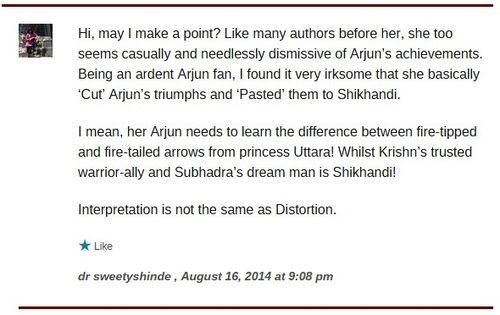


(Here needs a little clarification. The statement was posted under the comment section of Shikhandi Review Post. But author confirmed that it was made for Krishna Udayasankar’s Aryavarta Chronicles Trilogy, not Devdutt’s book.)

There are many differences in Sweety’s book Arjun: Without a Doubt and Devdutt’s book Jaya: An Illustrated Retelling of the Mahabharata not only in interpretations but simple facts also. I’d like to mention one here – the names of the seven commanding officers of the seven armies fighting on Pandava side.

According to Sweety’s Arjun, they are Drupad, Virat, Dhrishtadymn, Satyaki, Dhrishtaketu, Sahadeva (of Magadh) and Shikhandi. She cited Udyog-Parv as source.

On the other hand, in accordance with Devdutt’s Jaya, they are Arjun, Drupad, Virat, Satyaki, Dhrishtaketu, Sahadeva (of Magadh) and Vrihatkshatra & his four brothers (Rulers of Kekaya).

REALITY DISTORTION FIELD

Apart from passion for design, details & perfection, I feel, there is one more thing common between Author and Steve Jobs – Reality Distortion Field. Walter Isaacson, in Steve Jobs, mentioned Steve's reality distortion field as a confounding mélange of a charismatic rhetorical style, indomitable will, and eagerness to bend any fact to fit the purpose at hand. If reality did not comport with Steve’s will, he’d ignore it. It is said that it was dangerous to get caught in Steve’s distortion field, but it was what led him to actually be able to change reality.

Likewise, I don’t find any talk about Arjun’s failure, though there are many in Mahabharata. I also don’t find any praise for Yudhisthir or any compassionate line on him; whereas, in Mahabharata, there is an incidence in which Yudhisthir brought the lives of other four brothers, including Arjun, back from Yama disguised as Yaksha, by using his intelligence.

Instead, I find a sympathetic line for Duryodhan: “I saw the brief flicker of apology in his eyes, before he deliberately lifted his hand and patted his thigh.”

If one get caught in author’s distortion field, he’s sure gonna hate Yudhisthir more than Duryodhan.

At this instance, I’d like to quote author’s opinion on Vyasa’s Mahabharata. She said “If Mahabharata was mere literature, I’d find fault with Vyas. Since Mahabharata is history, perhaps Vyas was merely being a faithful chronicler and could not alter facts to what should-have-been.” The author emphasized on 'should-have-been' by italicizing it. It may be assumed as the extent of empathy & love of author for Arjun and Draupadi from worldly perspective.

ARJUN AND PRACTICAL WAYS TO A POWERFUL PERSONALITY

Psychotherapist Dr. George Weinberg, in his book Practical Ways To A Powerful Personality, said “Your feelings are your cues in the interpersonal world. If you want to alter a feeling or attitude, like chronic depression or rage, the first step must not be to deny its existence but to try to identify the feeling, and to describe to yourself in as much detail as possible the thoughts evoked in you by the feeling.” He further said “Try to accept the fact that you’ll hold nearly every attitude at some time, even toward the people closest to you.”

In a Draupadi-Arjun chat, Draupadi said “If it helps you to heal, I will say ‘I forgive you,’ I may even mean it. But you will have to learn to forgive yourself. I cannot help you with that.” Would Arjun able to forgive himself in the end? Well, to know the answer you’ll have to read the book.

CONCLUSION

Arjun: Without A Doubt has potential to earn a reputation of a good book for exploring & understanding human emotions in great details.

To get more out of the book, I'd like to recommend you to watch the Ted Talk of Parul Sehgal, an editor for The New York Times Book Review, before reading the book.

The author said in her book, “There was something about questions; questions opened up unfound vistas and unexplored ideas.... He (Arjun) needs to learn to distrust. Some things need to be learnt the hard way. I believe in practical demonstration.”

Did the author intentionally use the strong, opinionated, provocative narration to churn our stagnant blood? Did the author purposely censor some facts, practise favouritism and vilify other Kunti’s sons including Karn to compel us to ponder instead of believing blindly on religious matters? Is it the author’s way of preaching spiritualism practically, through introspection, instead of conventional theoretical approach?

In words of Devdutt Pattanaik,

Within infinite myths lies the Eternal Truth
Who sees it all?
Varuna has but a thousand eyes
Indra, a hundred
And I, only two

Tweet this

Profile Image for Mrinaal Prem.
Author 1 book2 followers
May 27, 2016
“Arjun- Without A Doubt” review


Imagine being told that Shoaib Akhtar was just another pretentious, over-glorified bowler who thrived on PR rather than giving out fastest balls in the world; a Brett Lee and McGraw duo who were under-achievers and useless in actual matches- not just once, but umpteen times..
Would you have ‘massive respect’ for Sachin Ramesh Tendulkar- as the greatest batsmen of all time- if his opponents were never a real challenge for him?? PR-project or not, we remember Sachin for beating-to-pulp those balls which constantly had around 140 kmph speeds! If those balls are later claimed to be just 80kmph ‘flukes’, wouldn’t that be a bigger blow to Sachin’s ‘greatness’ than to that of those ballers??

The author, Dr Shinde, seems to have overlooked this angle as she invests 306-paged effort in ‘dismantling’ each and every person who ‘dared’ to overshadow Arjun, for any reason, in the public eye- be it Bhishm and Drona (author’s Draupadi calls them pervert, and alleges that they derived voyeuristic pleasure in her disrobing), Arjun’s own eldest brother and mother (author alleges that not only Yuddhishthir desired Darupadi and blatantly lied about Kunti’s “share the gift, just like always” slip-of-tongue, but he was also a bitter, jealous and pompous sibling, not much better than Duryodhan) or be it Karna. Especially Karna.
If I have to pick out one single theme of this book, Arjun’s glorification would come a poor second to establishing Karna as the vilest villain of all time, in human history. According to author, every single positive thing about Karna, or any injustice meted out to him due to his supposed charioteer caste, is either an invention of his own and a malicious PR-campaign against Pandavas, or a folklore that has somehow crept in, in between the five millennia that separate today from the day Mahabharata happened..

Even Surya is not spared, accusing him of partiality against Arjun by ‘hurrying to set’, the day after Abhimanyu’s slaying. But, here, the author again overlooks two facts:
a) Before this event, Surya never showed too much solidarity with his son, except warning him against Indra’s plan to tricking him into donating the armor Karna inherited from Surya.
Contrast this to Indra’s taking Arjun to his heavenly city, getting him trained under the tutelage of all the mighty gods of heaven, seeking to render Karna defenseless (if, as the author claims, there was ‘nothing special’ in his armor, why did the ruler of three worlds get desperate enough to trick him into giving it up?), and, yet, refusing him his most powerful Vajra as compensation.

b) The early setting of the sun, followed by sudden resurgence was actually a life-savior to Arjun, rather than a killer, because it brought Jayadrath out in the open- something Arjun may, or may not, have achieved that very day by himself, if the situation till that point were any indication!
In my humble opinion, the solar ‘mishap’ of the day was more likely either a solar eclipse- something that neither of the camps had any control over- or an illusion by Krishna; rather than Surya stooping low!


However, when the book does manage to rise above what is, in solely my opinion, grudging mud-slinging against Karna, it is indeed a delightful read.
It captures the mindset of not only the protagonist Arjun- his fanboy-enamor towards the fabled cousin Krishna, his falling head-over-heels in love with Draupadi, his amused liking of Subhadra and his grief over deaths of Bhishma, Drona and Abhimanyu- but also of her true wife- Draupadi.
In fact, almost half of the book is written from Draupadi’s point-of-view, rather than Arjun’s. The reason could be a natural inclination of woman, to empathize more with their gender. It also allows us a woman’s perspective of casualties of war, their compassion and solidarity towards each other while cutting across camp lines, and their general take on the Vedic society and religion itself.

One commendable feat by the author is the frank acceptance of Krishna’s bias towards Pandavas- from the first page itself. The Krishna, of this book, has no qualms in accepting that his peace proposal- to both Duryodhana and Karna- were mere half-hearted(and thus lacking any true intent and effort towards success) formalities. The Krishna of this book accepts that he indirectly caused them to reject the peace-offer, thus conveniently shifting the blame of war-mongering totally on them.

The book could have had a bit clearer division of dialogues, for, at certain places, the reader loses thread of who’s-saying-what.
It could’ve shown Arjun superior to others without, subtly, demonizing others of his own ‘side’ (especially Yuddhishthira and Bhishma) or dismissing and vilifying those of the ‘other side’. While the dismissal of others’ achievements and skill (especially Karna’s) actually belittles Arjun’s own feat of vanquishing them (since “A man is only as big as the adversity he wins over”), the demonizing of others opens this unanswered question- “When the sons of other, more virtuous gods- like Bhishma (son of Ganga, the purest of all, in all the three worlds), Karna (son of the most virtuous of gods), Yuddhishthira (son of Yama- the personification of righteousness itself) and even Ashwatthama (known to be an incarnation of Rudra himself)- couldn’t remain even a little virtuous, were unable to practice even a little of what ran in their veins, how come the son of Indra- one of the greatest ‘sinners’ of all time- manage to be so morally uptight?”

However flawed her perception and interpretation might seem, from my own point-of-view, I cannot disagree with that the author has indeed researched a lot for her book and deserves an ovation for having the grit to stand against the popular perception. Because, as the real message of Mahabharata says, “there are no villains or heroes, sinners or saints. What matters is what you believe in, and how far can you go, to ensure that your thoughts matter..”
Profile Image for Aayesha Hakim.
146 reviews29 followers
June 19, 2020
Arjun: Without A Doubt tells the story of Epic Mahabharata from Arjun and Draupadi’s standpoint. I loved how the author has glorified Arjun through Draupadi's eyes and vice versa.

Mahabharatha is a book of true love and relationships. Arjun is pretty much what we expect him to be: a champion warrior. The language of this book is easy. The language brings alive the emotions of the characters.

The bond between Draupadi and Abhimanyu has been captured beautifully.

Few lines from the book are worth finding place in your personal diary/collection.

The book is a source to enlighten and refresh the minds. It's not a sparking revelation but a fine tuned version of the epic.

The book is written in such a manner, that it gets you to think deeper about your now favourite story Mahabharata, and makes you to see the book in a whole different way with how she extracts bits and pieces from the lesser known versions of the story.

Dr. Shinde Sweety's 'Arjun - Without a Doubt' reads like an easy-to-read fiction.

Full review here: https://intheclassroomoflife.blogspot...
2 reviews
June 10, 2020
Must read books for Mahabharata lovers

This book is not just another retelling of Mahabharata. It is reflecting the emotions of the greatest warrior of the Epic. We have always known Arjun as a peerless worrier but what made him a great worrier? Was everything served to him on a silver platter? No, he worked hard for that. He was one of the most unfortunate characters of Mahabharata (after Draupadi). He spent many years of his youthful age in the forest. He was asked to share his wife, he had to leave the kingdom he established and still his brother stakes him in the game of dice. He loses everything without his fault, still, we have never seen him complaining. The author has successfully portrayed his character very well. We all know the Mahabharat story but she has filled the story with emotions of Arjun and Draupadi. The author has beautifully described the reason behind his and her actions. One more thing I am very happy about is that she has not changed the story like other authors. There are many things we have neglected while reading the real Mahabharata or watching the serial but she has drawn our attention towards those things so I must say hats off to the author, great job and I'm waiting for more books from her.
123 reviews8 followers
April 14, 2015
Arjuna is a person one would want to emulate, he worked hard to gain all the power on the earth, in his times he was the most powerful and greatest archer of the world, a man who had the greatest astras such as Brahmasironamakaaastra, Paashupataastra and the Brahmaastra. We never see him misusing any of these celestial weapons, he rarely speaks about his strengths and was the man who displayed tremendous restraint most of the times. The author brings out these characteristics of Arjuna in a wonderful manner. From Draupadi Swayamvar till the war she outlines all the achievements of the Pandava Madhyama and brings out the valor and the greatness of man who had the mighty Gandiva in his hand.

The Urvasi episode, the episode at the Draupadi Swayamwar and the bond between and Arjuna and Krishna were handled really really well, as one of the narrators of the story is Arjuna himself , we get to see his emotions, his feelings and the way he would have wanted the situations to be. (Most of this must have stemmed from the authors creativity but then it was nice to read.)

While the spotlight of the book might be on Narrator 1, we ought to realize that the second and the final narrator of the book also has her own story to tell. The second narrator, *** the daughter of Panchal, the woman who was brought to this earth with a specific purpose of marrying Arjuna was made to tell us the story of Mahabharatha from her own view point. The author tries to capture the thoughts, the likes and dislikes of Draupadi and presents them to us.

As you must have got it by now we see Arjuna and Draupadi talking to us in the book. To me that is the USP of the book, we see Arjuna and Draupadi in the same situation and get to know as to how both of them felt about. You read a page and half or so that depicts Arjuna’s view point and then you see *** and the test that follows is the Draupadi’s view point of the situation. Very nice effort by the author, I liked it. Then the author takes on a lot of myths in & about Mahabharatha that are widely accepted by one and all, she takes on each one of them and tries to bring the truth to light. The myths on Karna need a special mention, she takes on them one after the other and clears the air. This is another thing that I liked in the book.

Towards the end of the book, the author makes us realize the feud between the families of Drupada and Dronacharya and also lets us know how Draupadi ends it once for all. It was portrayed well.

As we all know , Mahabharatha is an epic that has 100000 verses in it. Arjuna , Draupadi and Krishna are there for most of the book. So even when you want to pick the story that relates only to them and publish it as a book, you must do a lot research , that is visible in the book and I commend the author for that. The language used in the book is simple and the pace of the narration is good , hence one can read the book easily.

Now let me speak about the areas that I did not like in the book.

1. The author swayed away from the original story in a number of places and tried to give us the story that she has envisioned. Here she should have told the reader that it was her idea of the story and not the one in the original texts. The Draupadi Vastrapaharanam (cheer -Haran) , Kunti’s words after the Draupadi swayamvar, Khandav Dahana ( Burning of the Khandava forest) are a few instances that would serve as the case in point. There are a few more as well. Since I am very conservative in these areas I somehow am uncomfortable with that.
2. Then I did not like the portrayal of Yudhistira (Dharma Raja). In a number of places I felt that he was being criticized unfairly. (I doubt if Arjuna himself would be happy with his elder brother’s portrayal in the book. ). It is true that Arjua and Bhima have great strengths are were amongst the best warriors of their times. However, Yudhistira’s adherence to dharma is considered the most important thing in Mahabharata. The episode of Yaksha Prashnas brings that to light. Criticism of Yudhistira is uncalled for and should have been avoided.

3. The author gives us an impression that it was Arjuna whom Draupadi loved the most, there are some others who say that it was Bheema, and then some versions go on to say (this is the one that I believe in) that she loved all the Pandavas equally. The author must have made this point clear (that Draupadi’s love for Arjuna was solely her way looking at things) at some point of time. This point becomes obvious from the book when you read it but then I feel that telling that upfront would have done more good to the book. Again, this is my opinion and might not be the best thing to do. I just wanted to say this.

Conclusion

All in all a great attempt by the author. This book bursts a lot of myths and helps us know about some of the great deeds of Arjuna, it indeed celebrates the triumphs of one of the greatest heroes of Mahabharatha. Then you get to see a different version of Draupadi too. It would have been a great book had the criticism of Yudhistira been avoided. One would learn more about Arjuna and Draupadi by reading this book. Wishing more success for Dr. Sweety Shinde in the days to come.
Profile Image for Rajni Sahota.
64 reviews3 followers
March 14, 2018
The biggest epic of all time Mahabharata shown from the 3 main sides of Krishna , Arjun and Draupadi and there quest and how Kurukshetra happened serious loved this side of of Mahabharata
2 reviews
Read
July 30, 2016
There is no doubt about the fact that most of the stories we hear or see in India are actually inspired in some way or the other by the two great epics - Ramayana and Mahabharata. Within these two great epics also, there have been myriad interpretations of narratives and analyses of the characters. What really intrigues me about these two epics is that you pick any character - and there are so many layers - that the character is never purely good or bad. As a matter of fact, this is more evident in the Mahabharata.

When I read the blurb of Arjun Without A Doubt by Dr Sweety Shinde, I knew this was a book that I just had to read...I am sharing the blurb with you:
"'I knew there was nothing poetic about death. I knew not that the most horrific battles are fought off the battlefield.'
Arjun: The idealist in a non-ideal world, the warrior whose deadliest opponent was his conscience. History forgot his voice, but misquoted his silence.

'My self esteem originates from me and ends in me. Why does your honor depend on me? Find your own.'
Draupadi: The untamed tigress, the fragrant flame, the unbridled spirit.

'Power does not justify sin. Power is not virtue. Virtue is that which lasts in spite of power.'
Krishn: The enigma whose unique ideology churned the battlefield into a quest for truth.

The Missile... The Trajectory... The Vision...
The trio that makes for the core of the Mahabharata.

This is their saga. Insightful, visceral and candid."

Arjun is the hero of the Mahabharata – he won Draupadi’s hand in the Swayamvar, he killed many of the Kaurava army, felled Karna and Bhishma. He also features prominently in the Bhagvad Gita, with Arjun’s hesitation in killing his own family serving as the reason for Lord Krishn expounding about the laws of the world which are relevant even today. This flawed but heroic character sits at the centre of Dr. Shinde Sweety‘s book Arjun: Without A Doubt along with the other pivotal characters in a book that aims to unravel the aura around the best known Pandava brother. And not just Arjun, this is also the story of Draupadi - who also bore the cross of the responsibility of the war that was heaped on her.

Arjun Without A Doubt is a look into the injustices meted out to Arjun - who won Draupadi in the war for himself; and also Draupadi, who led a polygamous existence that was not her choice. Krishn, then becomes the guide and best friend of these two characters who negotiate through the duties of dharma that were imposed upon them. The intersection of these three characters is beautifully depicted on the cover as well. The symbolization has been done artistically; the arrow representing Arjun, the peacock plume signifying Krishna, the blue lotus and, flames portraying the quintessence of Draupadi.

The first person narrative has produced a dramatic effect throughout the story. Contradiction and conviction, love and passion, enmity and togetherness…. everything has been delineated through dialogues.The love story of Arjun and Draupadi - their trials and tribulations form the core of the narrative. The story starts with Draupadi's swayamvar, the foundation of the most miserable yet beautiful love story of the history. This book is a saga of their constant triumph over the evils, both external and internal. Arjun is described as the idealist by the author and Draupadi is the support that lets him fulfill those lofty ideals. Krishn, the eternal enigma, is their chaperone - guiding them through the maze of their lives.

This the love story of Arjun and Draupadi that was showered with exiles and separation but nurtured with unmeasured passion and fire. The story starts with Draupadi's swayamvar, the foundation of the most miserable yet beautiful love story of the history. This book is a saga of their constant triumph over the evils, both external and internal.

This fresh and unconventional portrayal of the epic is very relevant also to the problems faced by the successors of Draupadi - the modern women of today who seek empowerment and release from the shackles of their roles as envisaged by a patriarchal society. Note this extract from the book - something that Krishn says to Draupadi - "Once, there was a cub whose foot was tied to the tree trunk to prevent him from wandering off. Years passed, the cub grew up, the tree withered and the chain was chopped off. But the cub refused to believe it was free! Sometimes, the idea of bondage is stronger than the chains."

This is the perfect book for lovers of the epic stories!
Profile Image for Saral.
19 reviews
March 10, 2015
The author’s look at Arjun holds deep intimacy, at Krishna holds a searching question mark and at Draupadi holds worship.

Firstly Draupadi’s words are marked by *** while Arjun’s words are unmarked, as i confirmed with author. There, and now getting back to what I LOVED.

1] The first person narration makes Arjun’s ups & downs a personal experience. ARJUN the man behind the warrior is discovered with fresh eyes as one falls in love with him.

As a son (his emotional trauma when Kunti says those ugly words and the heartwarming scene when Indra gets jealous of the tears of mortals)

as a husband (he struggles to and cannot ever forget Draupadi, his funny first night with Ulupi and the fact that Subhadra also has to obey 1 year rule. So is that why Abhimanyu was their only child…?)

as emotional (when khandav dahan memory haunts him at dyut sabha and the way he treats the Gandiva bow as a living being)

as human (the cute scene with his nephews ‘They seemed to be born directly from wombs of Yudhishtir and Bheem, untouched by her’, his joy at learning archery as well as dance -‘both required timing and tempo, restraint and rhythm’

as warrior (how he built his concentration using the insults of kaurava cousins, his calm confidence ‘I would rather evoke envy than pity’, his severe discipline & grit reflected in his ‘I demand perfection of myself.’

his emotions for Yudhishthir & Kunti change from respect to anger to pity as he discovers that ‘Elders are just flawed people who happen to be born earlier’ , quite a SHOCKING new angle.

2]DRAUPADI’s role in keeping alive Arjun’s legacy, how she inspires Arjun into turning Savyasachi via eklavya’s story, how she guesses Arjun’s feelings on battlefield by seeing his arrows is totally a new way of looking at this couple’s strong bond.

She is mischievous and witty (Her main asset was her brother, mine was Me). Also she is steely (If they cannot use seniority as a sword, they cannot use it as a shield), mature (I wish there was a weapon that could raze evil souls or erase evil from souls) and truly Krishna’s ‘bravest soldier’. Atishay saksham varnan kele aahe.

3] KRISHN is not a god here. But his wisdom (Morals, rules and ethics are always the first casualty in war) and his foresight are clear (Maharaj is dangerous – but not to the enemy). His helplessness at Dwarka’s divided opinions, his silent tears at abhimanyu’s death, his deep attachment to arjun contrasting his own advice of detachment. Such scenes just make him very loveable, very HUMAN.

4) On KURUKSHETRA, Arjun & draupadi’s emotions are poles apart and yet to the author’s credit, both views are equally convincing. Draupadi sees Drona’s betrayal but Arjun feels drona’s grief over ‘grandson’ Abhimanyu. Same way Arjun’s respect and Draupadi’s disgust for bhishma are both true.

5) Draupadi-Bheem and Arjun-Kunti dialogues are shocking, but again make you think. Many truths about Karna also get uncovered like he was Drona’s student and his defeat at Draupadi’s swayamvar. Shikhandi’s battle for Draupadi does seem more logical than for amba’s revenge. I had to pause and reread many times to digest facts from ‘Myths’ chapter but there are references to show the research behind it.

6) FAVORITE scenes include draupadi-arjun’s first happy walk and their final sober walk together, their reunion after 8 years, krishn-draupadi talk before& after Subhadra, arjun-draupadi’s conversations which cover romance, archery, astras,Drona and their tug of love over krishna.

I CoMPLAIN. 1) Draupadi’s vastraharan is not shown at all, which we are so used to reading. But even without it, one can feel all of the horror and pain felt by Draupadi. 2) action scenes are brief, but maybe they reflect Arjun’s reluctance at war.

Overall the book asks tough, uncomfortable questions and it gives believable answers. It makes you rethink popular beliefs & myths with logic and references. It has humor, memorable quotes, bitter facts, tender moments and dramatic conversations. Definitely recommended.
Profile Image for Abhyudaya Shrivastava.
Author 10 books27 followers
April 9, 2015
This is an amazingly written book. When I started reading it, I was mildly surprised by the brilliant quality of writing. I have seen people write books once they have attained a career goal because they see it as something they always wanted to do. In this case however, it is utterly baffling how good Dr Sweety actually is. And this novel is not just something she needed to get done with, it is born out of love. The love of story-telling, the love of Mahabharata, the love of mythology AND history.

Not only does the language weaves perfect pictures in the novel, the writing and the thought behind it reflects a certain maturity of thought that is rare to find these days. The author has turned the ancient epic into a format easily comprehensible to a modern day reader while keeping it equally entertaining. The first person accounts of the protagonists - Arjun and Draupadi make them come across as real and human. Even the divinity of Krishn is not the focal point of this mytho-drama. He is portrayed just as a key- character in this story. The author takes her hand and reaches inside the guts of 'Mahabharata- the epic' and turns it inside out to make it- 'Mahabharata- the story'. She has imbibed the values and philosophy behind it, has taken a stand instead of reading it passively and has presented her view boldly in this book.


I am usually against preachy books with lots of monologues but I am all praises for this one because it is not preachy. It is thoughtful writing with brilliant execution. The author doesn't force her thoughts down your throat, she reasons with you, goads you into thinking on a higher plane and then just presents what appears plausible.


The Arjun and Draupadi monologues are separated by squiggly lines and are marked to avoid confusion. Personally, I think the publishers need to find a more graceful way to do that. The cover art is visually pleasing. I would have loved it if there were symbolic representations or changes in font to denote that the narrator is changing. I hope this gets taken care of in the subsequent editions. Particularly for myself, I didn't feel any ambiguity while reading. It was a masterful work and I will cherish it in my personal library.


Now, with the above description, one shouldn't assume that there is no room for improvement here. No book is perfect. This book might not appeal to those who are looking for accurate/ alternate historical accounts because it does take its liberties in describing mystical events just like its parent epic- Mahabharata. Nothing new or shocking here in terms of story line. It is just the perspective which is unique. Also, the language gets too poetic at times but then the book never claims to be hard-hitting real-life journalism from Kurukshetra battlefield. It just gets assumed in the mind of the reader as the accounts begin to get realistic. And then the assumption is shaken at certain points.

Nevertheless, it remains a book to be read and then re-read.


Take a bow, doc. (bow... Arjun... get it?) You nailed it!
3 reviews1 follower
April 14, 2015
Ever since I've known "Mahabharata" my two favorite people from the epic have been Arjun and Draupadi, both individually and as a couple. Many times I've been asked "why Arjun?" (many people believe that Arjun just got everything on a platter and was so much more fortunate than their so called "inspirational" "tragic" ideal hero)I have tried in vain to explain Arjun's qualities and struggles to them but to no avail. Now if anyone asks me this question I'll just show them this book and ask them to read it or at least the "exploring myths" part of it and say "this is why". This is one of the best books I've ever read on Mahabharata and The best P.O.V book I've read on it. Though the characterization of Yudhishthir, Kunti, Karna and some others may be unpalatable for some people, I find it quite close to how I imagine these people but I do not agree with her portrayal of Subhadra. Coming to the three Krishnas who are at the center of the book-
Arjun: You can't help but fall in love with him or at least feel for him. This Arjun is quite close to how I imagine the epic Arjuna was. The author, Dr. Shinde has done complete justice to the real Partha and her love for Arjuna is evident throughout the book. Though I think there could've been more dimensions to Arjun and would've liked a better explanation for his silence in the catastrophic game of dice,overall Dr.Shinde has done a commendable job in unraveling the emotions of this mighty hero of Mahabharata and I'll always be grateful to her for it.
Draupadi: I have one word for Dr.Shinde's Krishnaa "perfect". This is exactly how I imagine Draupadi. She is feisty, headstrong, stubborn yet gentle, loving and emotional. Her love and weakness for Arjun, her divine bond with Krishna, her bond with Abhimanyu and her sons,everything is beautifully explained. If I had not yet been completely in love with Draupadi this novel would certainly have made me fall in love with this feisty heroine of the greatest epic. Kudos to Dr. Shinde for it!
Krishn:He's not a God here. Though we don't get his POV the logic behind most of his decisions is explained (especially the peace making and the very "controversial" offer after it). Dr.Shinde has turned the enigmatic God into a very real and believable person and has done an amazing Job at it.
Apart from these three another thing that I absolutely loved in this book was the language which is poetic yet simple and simply delightful.The book was an incredible experience and it was great to see the epic through the eyes of two of my favorite people from the epic. Though there is a lot of literature on Mahabharata little of it is based on Arjun which surprises me( maybe it is so because Arjun, according to me is the real protagonist of the actual Mahabharata). I want to thank Dr.Shinde for providing this masterpiece which is something to cherish for every ArDi ( Arjuna and Draupadi) fan. A must read for every Arjuna and ArDi fan!
Profile Image for Arunita.
23 reviews1 follower
February 18, 2015
First of all congratulations to Dr. Shinde for breaking a popular tendency of modern authors- a tendency to vilify heroes and deify villains.Even if we agree(which I do) that all the characters of Mahabharat had some grey shades in them plenty of authors are hellbent to whitewash some particular characters with shades of grey bordering on black.
One thing I was thinking many times while & after reading the book is that Dr. Shinde has one skill that makes conversation part of a story enjoyable – how to apply different shades and types of sense of humor on different characters so that it doesn’t feel like one person(author) is speaking through them.Different people have different kinds of sense of humor-mischievous, fiery, witty or deadpan.In her novel Dr. Shinde beautifully portrayed three protagonists having three distinct humor as they speak – mischievous(Krishn),Fiery(Draupadi) & Witty but calm(Arjun).Her writing has an easygoing flow & none can say even after thousands of years the storyline she has chosen is not as equally gripping as it was.
Before reading I expected the book to be Arjun’s POV but not in first person.B’coz personally I feel first person POV,especially if its of a legendary personality,has some weakness.If he/she is inside out honest about her achievements,the reader will think him/her to be a braggart.If they are potrayed as humble enough types then reader won’t have a proper view.BUT…Sweety Shinde showed Arjun’s glory though Panchali’s eyes and vice versa.Smart move!
And after reading a lot of Panchali centred books,I have to say here I like that Panchali’s feelings are not illogically and ridiculously centred on ‘someone’ who was one of her tormentors.
Two complaints I have against the author---
Firstly,I wished it to be a longer read, wanted to see more of the battle scenes in her wonderful way of narrating since its Arjun’s diary and those 18 days was most striking parts of his life.A bit more bonding between Krishn and Parth could have been shown during those days coz friends that slay together…
Secondly,Panchali is potrayed as regal,intelligent,brave as she was but her jealousy towards her co-wives(Especially Subhadra) felt a bit too intense for a woman of Panchali’s dignity.Author ment to show Parth & Panchali to be madly in love which is okay but I believe Subhadra also had her own place in Arjun’s heart as per the epic.She was not neglected by him and a woman who brought up a hero like Abhimanyu without her husband’s support,who carries Krishn’s blood in her vein was more of a woman of subsatance just going by Genetics.She can not be just a dumb beauty just bullied by Panchali.
Its been a wonderful read & waiting for more books from Dr. Shinde(hopefully she will write more and after such a nice start she has a long way to go).
Profile Image for Shekhar Ruparelia.
58 reviews50 followers
July 8, 2015
(A slightly longer and more personal review of this book appears on my blog at https://adventuresofatraveller.wordpr... Please do have a look at that too. Thanks!)

“Arjun: Without A Doubt” picks up the Mahabharat tale with Draupadi wondering who exactly this Arjun is. Of course, she has heard of Pandu’s illustrious son, the man who defeated her father, Drupad, in battle as gurudakshina for his guru, Dronacharya. But she has never set her sights on him. And her father tells her Arjun is the most deserving husband for her. Even Krishn is all praise for him. She wonders if Arjun, and his family, have survived the burning palace and whether he will be able to win her hand at the swayamvar her father is organising.

Thus, once more, begins this grand old tale. The book is written from the points of view of Arjun and Draupadi, each of them taking up the narration in alternate chapters. Arjun is pretty much what we expect him to be: a champion warrior. His dedication to his craft is commendable. We get a glimpse of the hardships he had to undertake to achieve what he did. We realise that it wasn’t always a walk in the park for him.

And yet, he is more than just a soldier who is very good at lifting up a bow and shooting arrows. He dearly loves Draupadi and is heartbroken every time he has to leave her behind. He also has his moments of doubts about the nature of his duty towards his family, especially towards his eldest brother Yudhisthir. As war approaches, we can see these doubts surfacing, which eventually leads Krishna to answer his queries about why the war must be fought. Arjun’s shockingly rude and direct dialogue with Kunti when she mourns Karna’s death shows how much he has changed from when we met him at the beginning: indeed, Arjun is without any doubts now.

But it is for Draupadi’s voice for which you should read this book. From the moment when Kunti says that Draupadi must be shared by the five Pandava brothers is when we start seeing her being served injustice. And what makes this even more insulting is that Draupadi comes across right away as a strong, independent woman. What stopped her, I asked myself, from walking away from the Pandavas right then and there?

And yet, there are a couple of glitches. The construction of paragraphs is at times confusing: I lost track at a couple of places and had to retrace my steps in order to clarify whose speech it is that I was reading.

Yet, this is a minor flaw in a book which is effective in it’s larger purpose of drawing our attention to various aspects of the Mahabharat.

In conclusion, if you’re a Mahabharat fan, I would highly recommend you read this book.

(Disclaimer: The author sent me a copy of “Arjun: Without A Doubt” to review.)
Profile Image for Jayant Swamy.
Author 2 books16 followers
April 12, 2015
Deep and dramatic

The Mahabharatha has traditionally been a plot-oriented epic with a multitude of main characters. It is for the first time that I am seeing it through the eyes of Arjun. Equal time and importance has been given to portraying the character of the eminent Draupadi, who provides the perfect foil for Arjun, performing the role of an antagonist and ally. The characters of Arjun and Draupadi continue to haunt me long after I completed reading the novel wherein lies the real victory of the author - getting into the skin of the historic characters and employing her creative intelligence to etch their trials and tribulations within the framework of the unalterable incidents from the epic.

While my tryst with the Mahabharatha started several decades ago, the five Pandavas somehow functioned as a collective protagonist and I had viewed Arjun as just one of the lead characters (akin to one of the heroes in the multi-starrer Hindi films popular in the 70's and 80-'s!. This novel made me realize that he is the most under-revered hero from Hindu mythology, as the author effectively intertwines the courage of a valiant warrior with the fragility of his emotional relationships - with Krishna and with Draupadi - traversing the gamut, from tranquility to trauma. The depth of understanding displayed by the author and her ability to impactfully dramatize the complex cast of characters of this complicated epic is truly commendable.

The novel is written in first person from a dual point of view - Arjun and Draupadi - a Herculean achievement which can get tenuous at times. Staying with each point of view a little longer in a chunk rather than crossing over to the other character too soon would have made for an even more effective read, as would a variation in the tone to identify the two points of view with greater ease. The permutations of interactions and conversations between Arjun, Draupadi and Krishna are a treat to consume and a major highlight of the book. (The dialog tags could have been a tad more prominent though, the conversations would have been even more enjoyable if I did not have to figure out who was saying what at times, but this is a minor distraction)

While the plot driven epic had always made excuses for the follies of Yudishtir, the epitome of Dharma, reading this novel through the eyes of Arjun and Draupadi - gave me my biggest Aha insight - that this was but a crutch to cover up his character weaknesses, since he represented the 'good side' of the epic! And full credit goes to the author for demystifying this myth without being judgmental.

The novel is a must read for all those who have any connection or exposure however limited, to the Mahabharatha.
Profile Image for Rajdipsinh Zala.
1 review1 follower
April 3, 2015
First of all, thanks a lot Dr.Shinde for breaking recent proclivity of glorifying villains & vilifying heroes.I fully agreed with sentence in preface of the book that; "The Central theme can never belong to anyone else but the Hero".

Arjun,Draupadi & Krishn : The Missile,The Trajectory & The Vision.Dr.Shinde beautifully portrayed about this concept.

Specific chapters which I found more interesting are;
-The Fish & Two Baits(Marvelous narration of Draupadi's swayamvar with ornaments of words)
-The Defeated Victors(Draupadi's Agony & Arjun's Chagrin)
-A Friend Regained(Draupadi & Krishn's mysterious prediction on Yudhisthira's behavior)
-Savyasachi & His Fragrant Flame(Draupadi's pivotal role in Arjuna's ambidexterity, using Eklavya's story as a turning point)
-Hastinapur Disrobed(Arjuna's bravery,idealism,humanity & his reluctance)
-The Finality of Doom(Finality of doom in karn's eyes)
-An Exquisite Torture(Arjun's unexpected & tough questions directed to Mata Kunti.They highlight his transition to calm,assured confidence & make the reader Rethink many existing beliefs)
-Whys and Why Notes:Exploring Myths(Myths of Karna, Shikhandi, Sanjay, Shalya & Role of Krishna in lives of Bhima & Arjun are based on in-depth research and apt references.)...

Cover of the book is very attractive & that picture describe more than words about book.Dr.Shinde's style of writing is marvelous & intriguing.Such an amazing flawless writing!We find deep insightful worthy Quotes like;

"Success is more difficult to handle than failure."
"Some things in life are just not a coincidence."
"Be careful of what you wish for,you may get it."
"Destiny,however,has its own ways to balance karma."
"Pain should never be the ruling force in life."
"Goodness is an asset - but if you allow it to be exploited, it is a liability.” etc...

Dr.Shinde's aspect "This book is my homage to Arjun's greatness" is completely fulfilled by this book.The 1st person narration makes the reader live every emotion, angst, pain,joy & passion in lives of Arjun-Draupadi.

Overall, A MUST Read & BUY without a doubt!
Profile Image for Ruchi.
Author 1 book4 followers
February 25, 2015
Book review : Arjun without a doubt.

Arjun : without a doubt. Truly awesome book by Dr Sweety Shinde.

When I first came across the title, I was not sure I wanted to read another of Gita- Mahabharata thing.
But somehow the book's cover and FB page made me give it a try and I am glad I did.

No, it is not a twisted version of Mahabharata. It is a saga of Arjun the great warrior, who never got the due credit for his greatness and Draupadi who has always been misunderstood through ages.
The narrative is gripping and as the story unfolds the reader is thirsty for me. Like the author words it ' If learning was a river I was forever unquenchably thirsty'....so is the reader thirsty for more coz it ends too soon.
What I liked best was trying to understand Draupadi's feeling when she was forced into polyandry, her love for Arjun and her strength and feelings when she was disrobed.

The book has lovely quotes, and few of my favourite are
1. Parents should come with a warning sign that they are not perfect; elders are just flawed people who happen to be born earlier.
2. Tears are infinitely more precious than blood. Blood spurts from the body, tears stream from the soul.
3. If motherhood transformed a woman into a goddess, then why should the act responsible for this transformation be a sin.
4. But the best is always a state of flux, it is a constant endeavour; not a one time title.
5. Virtue is that which lasts inspite of power.
6. No person is great in isolation. It takes many hands to shape life. Denial would mean conceit and conceit is not the same as self respect.

Overall, Definitely a Must read!
Profile Image for Janvi Santwani.
620 reviews43 followers
November 25, 2023
Arjun: Without A Doubt' is a mesmerizing expedition through the Mahabharata's lesser-explored nuances. The book portrays Arjun as the quintessential idealist grappling with the complexities of a flawed world. Sweety brilliantly captures Arjun's internal strife, showcasing his inner battles that overshadow the epic battles fought on the battlefield. His quest for righteousness amid moral ambiguities speaks volumes about the human condition, transcending time and echoing relevance in today's world.

✍️Draupadi emerges as an embodiment of resilience and unwavering virtue. Sweety beautifully delineates Draupadi's unwavering strength, emphasizing her defiance against societal norms that equate power with virtue. The portrayal of her unyielding spirit in the face of adversity resonates powerfully, redefining conventional perceptions of strength and grace.Krishn, the enigmatic philosopher, elevates the narrative to philosophical heights.

✍️Sweety intricately weaves Krishn's unique ideology, transforming the battlefield into a canvas for a profound quest for truth. His guidance shapes the moral compasses of Arjun and Draupadi, adding depth to their characters and the epic tale.

✍️ 'Arjun: Without A Doubt' by Dr. Shinde Sweety is a masterful retelling that peels back the layers of the Mahabharata's iconic trio—Arjun, Draupadi, and Krishn—offering profound insights into morality, virtue, and the human struggle.
1 review1 follower
October 7, 2015
At last!! I have been waiting to read a story from Arjuna's point of view for a long time . Arjun : Without a Doubt was a real treat for me. I finished reading the book (Well, the kindle version) in one night. Sweet Shinde has done an amazing job portraying the other side of Arjun. It clearly highlights the personal sacrifices both Arjuna and Draupadi have done for the greater good and I loved the way she portrayed Lord Krishna's relation to Arjuna and Panchali. The language is also very impressive, neither too simple nor too hard.

I would definitely recommend this to all the Mahabharata fans, especially to Arjuna fans. I can't wait to buy the proper book and add it to my "Mahabharata based Fictions" collections :)

A big thanks to Sweety Shinde for writing this and I wish her all the best !

Displaying 1 - 30 of 105 reviews

Can't find what you're looking for?

Get help and learn more about the design.