Ten-year-old Leo spends her mornings tidying the rooms of her nonna’s time-worn Italian hotel, quietly accumulating the junk and treasures left behind by guests – a pearl earring, a lock of hair. Her nights are suffused with her father’s liquor-spun tales of his childhood, mingled with stories of Greek heroes of old.
Years later, over another hot, endless Italian summer, the hotel is one of the only things in Leo’s life that has remained constant. An accident has knocked her family sideways; her brother Max is distant and Nonna has grown frail. But then she meets Dolores, an American girl who sets something alight in Leo that she didn’t know existed.
Heat-soaked, sensual and steeped in an exquisite longing, Nymph traverses the extraordinary pains, soaring pleasures and many metamorphoses it takes to finally grow up.
Sofia Montrone is a writer based in New York. Her debut novel Nymph is forthcoming from Avid Reader Press (US) and Canongate (UK). She teaches at Columbia University, where she earned her MFA.
a sun-soaked sapphic romance set over the course of two sweltering Italian summers. Leo has spent her childhood summers at her family’s hotel, cleaning rooms after checkouts and collecting treasures left behind by guests. whilst her mother is unwell, spending many days at a time in bed, she looks up to her often distant and confusing father, revelling in his attentions and hanging on his every word as he lavishes her with epic tales of Greek heroes.
fast forward nearly a decade, Leo is still tending to the hotel rooms, whilst her beloved Nonna becomes older and more frail, and the hotel shows its own signs of age. enter: Dolores, an American girl with a shaved head who has come to set Leo alight, in more ways than one.
this book oozes summer and sticky heat and sweat - it moves at a languid, almost sleepy pace, allowing us time and space to fall in love with Leo, Dolores and sun-drenched Italian summers. Montrone perfectly captures the awkward parts of girlhood; growing up and noticing changes happening in every part of you.
thank you, Canongate, for the early copy of this gorgeous debut.
Poetically written, emotional & beautiful coming of age story. Leo pulled at my heart, she was just such an easy character to love. The pacing dragged at times but overall a memorable story that absolutely pulled at my heartstrings.
Big thanks to Netgalley & the publisher for allowing me to enjoy this.
i didn't just read this book, i LIVED inside of it. montrone's lyrical-prose is beautiful, and she perfectly captured the blind adoration many of us feel towards our father in childhood. this book felt nostalgic, sunkissed, and sticky with heat. i'm gonna spend the rest of the year chasing the high this book left me with.
thank you again to Avid Reader Press for the advanced readers copy!! now i need someone to wipe my memory so i can reread it again just to feel something
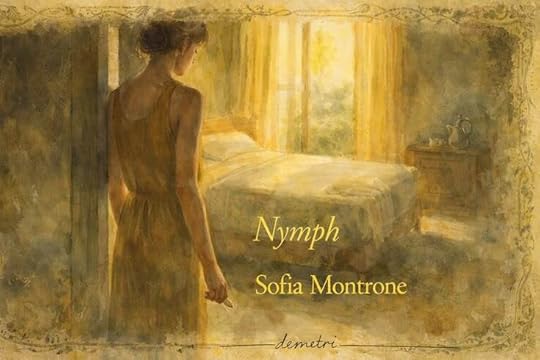
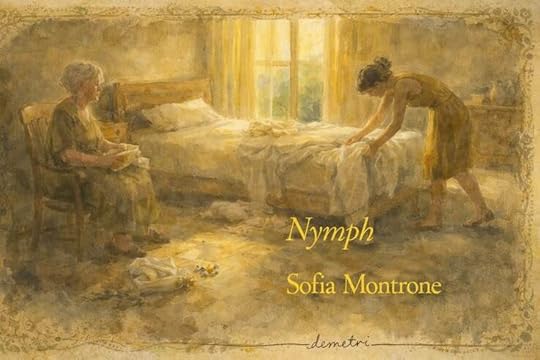
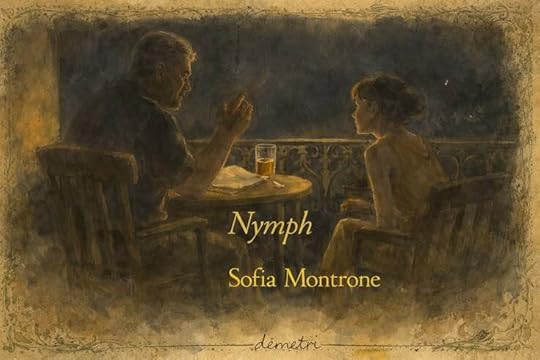
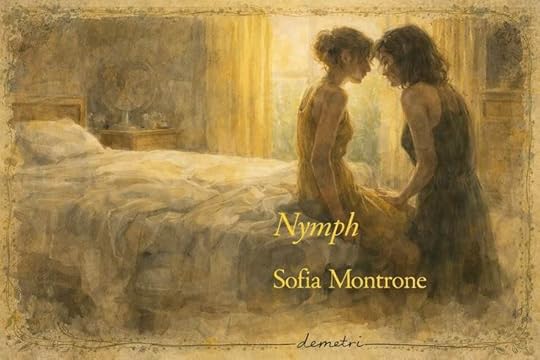
This book was beautifully written (and has such a stunning cover!), and Italian summers with sapphic love and stories were lovely and interesting topics to explore, but I just felt like it was missing something.
Welcome to Paradise. Please Ignore the Laundry. In “Nymph,” Sofia Montrone turns an Italian agriturismo into the perfect stage for first love, family myth, invisible work, and all the things beauty would prefer not to mention. By Demetris Papadimitropoulos | April 9th, 2026
Beneath the clean lines of a room restored for strangers, Leo pauses with the fragile shell of a grasshopper in hand – caught between service and witness, beauty and residue, and the impossible wish to keep what the world is always already asking her to let go.
Most novels set at beautiful hotels treat the work of keeping them beautiful as a kind of atmospheric hum. Sheets are changed, glasses vanish, ashtrays empty themselves, and the paying guest gets to experience leisure as if it were a law of nature. Sofia Montrone’s “Nymph” knows better. It begins from the premise that beauty is maintained by somebody’s hands, and that those hands, if they belong to the right girl, may develop a taste for what beauty is supposed to remove. Leo, who spends her summers at her family’s fading agriturismo in northern Italy, grows up among the traces other people leave behind – hair in a drain, blood on a towel, sweat still trapped in sheets, a pearl earring under a bureau, cigarette butts, lost trinkets, bodily embarrassments, tiny proofs that a room has been inhabited by a mortal creature rather than a fantasy of repose. The hotel is built to erase evidence. Leo lives to keep it. That is the novel’s animating contradiction, and Montrone is clever enough to know how strange, how faintly predatory, it makes her heroine.
This is one of the reasons “Nymph” turns out to be more interesting than its jacket language. The expected points of reference – “Call Me By Your Name” by André Aciman for heat and first desire, Elena Ferrante for female formation and volatility – get some of the weather right. They do not get the pipes in the walls. Montrone’s real subject is not simply summer longing, queer awakening, or an Italian season of ripening. It is what remains after people have passed through a room, a family, a life. Her novel cares less for ecstasy than for what ecstasy leaves on the sheets.
As sheets are stripped, corners squared, and the remains of other lives quietly gathered away, Leo learns that beauty is rarely innocent – it is maintained by labor, sharpened by scrutiny, and haunted by what cannot be fully removed.
Leo’s childhood summers unfold under several systems at once. There is the daily regime of labor she shares with her grandmother Nonna Tina, a hotelier of dwindling strength and still-formidable vanity, whose knees are failing long before her will does. There is the maternal absence of Violetta, Leo’s beautiful, chronically exhausted mother, who spends much of Leo’s early life half withdrawn behind headaches, sleep, and illness. There is Max, the brother who begins as companion and fellow witness, then grows into a rival keeper of family truth. And over everything there hangs Leo’s father, an American academic whose gifts for storytelling, historical analogy, and theatrical intimacy coexist with drink, instability, and the spreading weather system of his damage. He parcels out the story of Odysseus to his daughter in installments, turning myth into bedtime serial and domestic philosophy. War, return, betrayal, the failures of men, the patience of women, the child who waits for a father and inherits only his distortions – these are not merely themes laid over the book. They are part of the emotional furniture.
Half in shadow and half in performance, Leo’s father turns myth into household weather, making story feel like intimacy and inheritance at once – a source of wonder, distortion, and the first dangerous glamour of explanation.
Then, years later, comes Dolores, the American violin-maker with the shaved head, the green Bic lighter, the philosophical paperbacks, the shark tooth, and the unnerving air of someone who seems to have assembled herself on purpose. Leo falls in love with her. Or rather, because this is a novel too intelligent to confuse love with pure radiance, Leo folds Dolores into the same system by which she has always tried to master what she fears losing. She studies her, inventories her, memorizes her, hoards her as if desire might become secure once it has been properly observed. Leo has always treated the world as a field of clues. Dolores becomes the brightest clue she has ever seen.
For a first-love novel, “Nymph” keeps the bleach close. The romance is where the book gives up on neatness. Leo’s fascination with Dolores is erotic, certainly, but it is also epistemological. She wants Dolores’s body. She wants Dolores’s style, Dolores’s ease, Dolores’s self-possession, the sense that Dolores belongs to herself in a way Leo has never managed. She notices everything: the shape of the scalp, the bitten nails, the mole, the dark hairs on wet forearms, the practiced little rituals of smoking and dressing and holding a book. What gives the affair force is not merely chemistry, though Montrone is very good at chemistry. It is that Leo cannot stop treating desire as a form of evidence. She studies and hoards. She compares, projects, misreads. Love becomes another way of handling proof.
In the charged stillness of a room just returned to order, Leo and Dolores hover at the threshold where looking becomes longing, and where desire first enters the novel not as escape, but as another form of heightened attention.
This is where the novel really catches. Leo’s erotic life reveals itself as housekeeping by other means. She strips beds, lifts stains, sifts through trash, pockets abandoned objects, and restores rooms to their paying innocence. Then she does something analogous with people. She collects stories, smells, gestures, phrases, annotations, objects, afterimages. She wants to preserve before she fully understands. More precisely, she mistakes preservation for understanding. Montrone is very sharp on this error. Leo does not hoard because she is quaintly sentimental. She hoards because she wants verification. If something can be held, hidden, pocketed, catalogued, or reexamined, then perhaps it cannot wholly vanish. The pearl earring, the shell of the grasshopper, the cigarette butt touched by Dolores’s mouth, the father’s books and notes and keychains – all are enlisted into a private war against disappearance. The war is doomed, but it gives Leo a method.
The prose is one of the book’s central pleasures, though “pleasure” is too mild a word for how often it startles. Montrone’s great gift is for writing sensation without merely perfume-bombing the page. She has a tactile intelligence. Fruit splits, towels keep warmth, glass bites, drains snag hair, soap goes filmy, bodies smell of salt and sleep and labor and old perfume. Light does not merely illuminate; it beads, dulls, warps, skims, and catches. Her sentences tend to the medium and long, but they rarely sprawl. They coil. A thing is seen, then touched, and only then thought about. By the time the thought arrives, the object has come back altered by contact. Even when the prose moves toward idea, it keeps one hand on something material. Leo understands by handling things – scrubbing them, pocketing them, smelling them, worrying at their edges – and the style reproduces that method. The erotic scenes, especially, are built from texture before they are built from declaration. Desire here is not a mist or a glow. It is pressure, friction, embarrassment, surprise, appetite, the shock of another person turning suddenly solid under the hand.
Formally, the novel is braided rather than merely linear. Childhood summers, the father’s retellings of Odysseus and Telemachus, the later affair with Dolores, the father’s death by suicide, the family’s altered life afterward, and Nonna Tina’s decline all interleave. Rooms are reset. Stories are retold. Myths come back in new clothes. The recursion feels built into the place itself. An agriturismo works by staging repetition as freshness. Guests arrive believing they are the first people ever to see this view, sleep in this bed, touch this brass handle, eat this apricot. The hotel depends on the continuous laundering of history. Montrone’s structure borrows that logic and complicates it. A room can be made to look untouched, but it cannot be made unwitnessed. Likewise, a family can restage its own narratives for years – the brilliant father, the sick mother, the beautiful grandmother, the sibling pair – but the residue keeps surfacing.
The father is the novel’s greatest risk, and one of its major successes. He is charming, learned, theatrically aggrieved, funny, intermittently tender, intermittently cruel, and damaged in ways that seep through the house air. He can make the world feel charged and legible. He can also disappear into drink, fury, silence, self-pity, or story. Many novels would sentimentalize him as the doomed father of immense feeling, or flatten him into a private tyrant. Montrone does neither. She understands that charismatic damage is still damage, and that the child who loves such a man may become his best curator. Leo does not simply remember him. She labors for him. She protects him from consequence in her mind long after consequence has come.
The novel’s hinge is the car crash Leo reaches before the adults do. Her father sits bloodied behind the wheel, a bottle shattered between his knees, glass embedded in his legs, and Leo’s first instinct is not to scream but to clean. She picks shards from the car. She wipes his hands. She hides evidence. She retrieves his tooth. It is one of the best scenes in the book because it makes the novel’s governing logic terrible at last. Love becomes custodial. Terror becomes task. From there forward, grief itself becomes another room Leo tries to reset.
Her father’s eventual suicide is not treated as a melodramatic key that suddenly unlocks everything. Instead it thickens the problem the novel has already posed. Bereavement gives Leo’s appetite a new room to work in. She salvages his books, notes, annotations, myths, school-photo keychains, lies, idioms, belongings. She tries to rescue him from the humiliations of his end. Yet the novel never lets her memory become sovereign. Her brother remembers a bully, a father who frightened him, a man whose volatility made ordinary life unstable. Her mother, notably revived after his death, remembers a husband whose absence feels suspiciously like relief. The dead split according to the needs of the living, and “Nymph” is too intelligent to pretend otherwise.
Then the novel shifts its full weight onto Nonna Tina, and the book becomes sharper still. Up to this point Leo has treated labor as method, style, vocation, even eros. Age changes the terms. Urine in a nightdress, trembling hands, failing sight, the bathroom as site of shame and care – here the novel loses its softness. Leo tries to bleach dignity back onto the body. The older women know better. Privacy, the book suggests, is not only concealment but mercy. “One day you will have to let people hide things from you,” Nonna Tina tells Leo, and the line lands not just as family wisdom but as a rebuke to the novel’s own appetite for witnessing. It is one of the few contemporary first-love novels I can think of in which erotic awakening is genuinely forced to share the stage with elder care, toileting, bodily decline, and the humiliations of dependency – and to the book’s credit, these things do not feel tacked on as relevance. They are central.
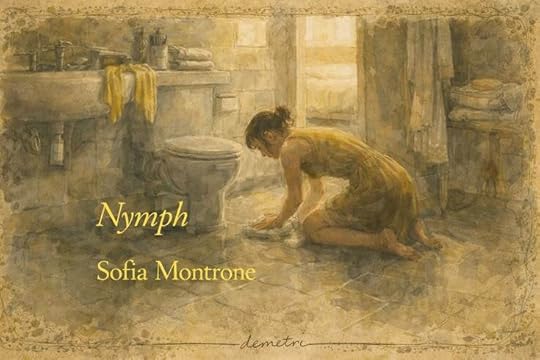
On her knees before the stubborn evidence of age, Leo discovers the harsher truth beneath the book’s summer radiance – that care can be both tenderness and trespass, and that dignity is sometimes bound up with what love must learn not to see.
That is also where “Nymph” begins to feel fully current without pawing for importance. Its relevance lies not in topical signaling but in its understanding of invisible care work, service labor, and the social arrangements that keep pleasure looking effortless. Leo changes the sheets, removes the stains, sorts the debris, clears the evidence of leisure, and in doing so becomes the book’s unofficial historian of classed intimacy. The guests arrive to feel rustic, sensual, restored. Leo and the others do the work that allows restoration to appear natural. Montrone never turns this into a speech. She lets it live in napkins hot from the wash, old men smoking after dinner, hand cream on a bedside table, and the daughter who realizes she has become the dead man’s maid.
The title, which at first risks sounding decorative, earns itself by way of the grasshopper shell Leo carries in her pocket. Here is a creature caught in becoming, softest just before the next hard skin sets. Leo is forever at that threshold. She wants to become, but she also wants not to shed. She wants change without loss, knowledge without relinquishment, desire without vulnerability, preservation without decay. The shell, the pearl, the saved cigarette, the borrowed myth – all are attempts to keep time from doing what time does.
My reservation is not with the novel’s ambition but with the degree of tidiness with which it sometimes secures its own meanings. Montrone’s motifs – stains, shells, mirrors, sweat, hair, flowers, residue, bodily ruin, textual remains – are rich and rightly insisted upon, but now and then the book feels arranged a little too neatly around the evidence it already knows how to read. A few passages arrive more as confirmation than discovery. Dolores, too, is vividly made but not entirely free of this pressure. She has a real sensibility – the violin-making, the philosophy paperbacks, the teleological bent, the practical tenderness – yet the novel occasionally likes her most as the bright surface onto which Leo’s desire and interpretive method can be projected. That does not ruin the book. It does, however, keep a few pages from surprising as hard as they might.
Even so, “Nymph” is a debut of real bite – sensuous, exacting, and less yielding than its summer heat first suggests. I’d place it at 87/100, or 4 stars on Goodreads: a novel I admire without quite surrendering to, and one I suspect will remain less as plot than as bodily afterburn. What makes it notable is not merely that it is beautifully written, though it often is, nor that it handles grief and desire with seriousness, though it does. It is that Montrone has found a formal and emotional language for the hidden work that sustains beauty, family legend, and private ruin alike. Cleaning gives the room its alibi back. Hoarding treats objects as lousy insurance against loss. Writing, at least in this book’s final movement, becomes the least dishonest option left. Leo cannot keep her father, Dolores, her grandmother’s failing body, or the old life of the hotel in place. She can only learn to write them down without pretending they were ever unmarked.
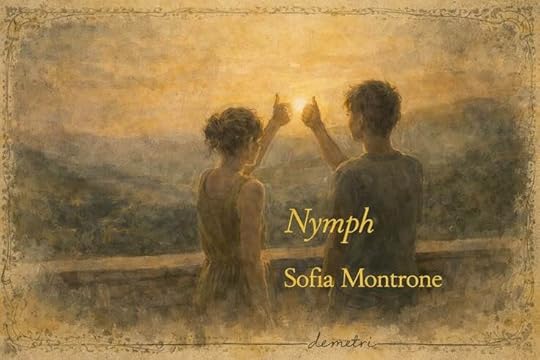
With their hands raised toward a sinking sun they cannot possibly hold in place, Leo and Max become, for an instant, the keepers of a vanishing world – joined by memory, rivalry, and the childhood faith that witness might yet delay loss.
By the end the room has been reset again, the windows untied, the brass handles polished bright. A guest steps in and notices only the sunlight. Leo notices the steam lifting off the bread, the stopped watch, the fine wreckage of a grasshopper’s shell in her pocket. Nothing is kept by being made spotless. It is kept by being looked at long enough to be described without washing clean.
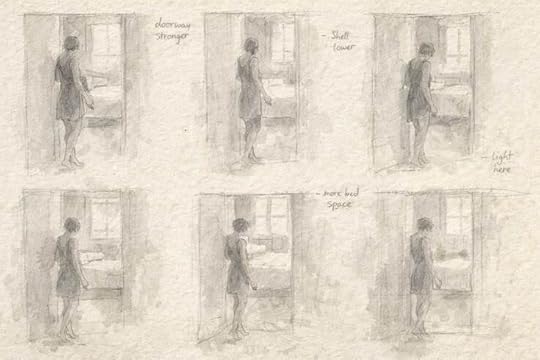
These early thumbnail studies test the painting’s central problem – how to balance room, threshold, figure, and relic so that the final image reads not as plot illustration, but as a visual argument about witness, erasure, and what remains.
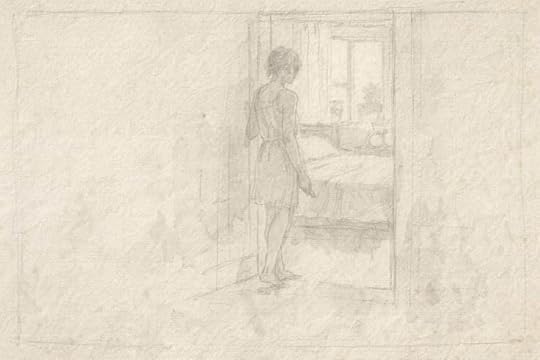
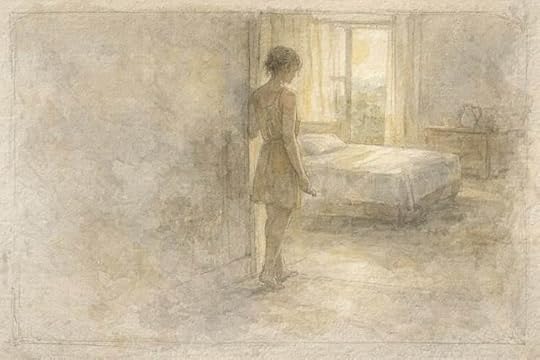
The faint underdrawing reveals the quiet architecture beneath the watercolor’s looseness, mapping the doorway, bed, window light, and Leo’s withheld posture before atmosphere is allowed to soften what structure first makes legible.
At the first-wash stage the image begins to breathe, as light, heat, and tonal pressure settle over the room and turn a simple interior into the charged emotional threshold the finished painting will eventually inhabit.
This swatch sheet shows the disciplined, cover-derived palette behind the final painting – ochres, mosses, stone neutrals, and citron accents arranged not merely for beauty, but to keep the whole visual program faithful to the book’s tarnished, sun-struck emotional world.
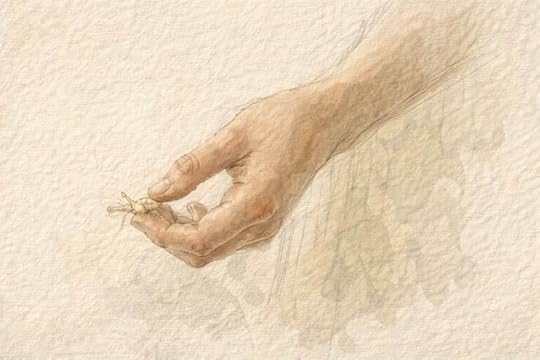
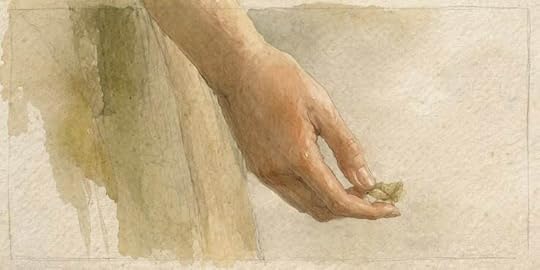
In this close study, the hand and grasshopper shell are reduced to their most fragile essentials, turning a tiny relic of metamorphosis into a tactile emblem of everything the novel wants to preserve against disappearance.
This intermediate hand study lets the shell, the wrist, and the first folds of fabric emerge together, showing how the painting’s emotional charge depends on the quiet meeting of touch, residue, and restraint.
These border studies test how the image’s margins might carry the novel’s hidden pressures – linen, ornament, shed wings, and dust – so that even the frame feels lightly haunted by what a room cannot quite erase.
All watercolor illustrations by Demetris Papadimitropoulos.
Beautiful, written from the heart. Such an original voice. I finished reading it while sitting in a salon full of people. I was so immersed that I cried. Leo and Delores warmed my heart.
I enjoyed seeing Leo’s life as she was a child and as she became a young adult. Leo’s life was nothing extraordinary in the grandest of ways, yet it was extraordinary to read her coming-of-age story. This is a five-star read, one I will preorder a hard copy of to cherish and share.
It is full of the happiest moments, the saddest and the most mundane. the most human moments, the ones we keep to ourselves. It’s full of love, loss and pain, hope and longing. I highly recommend this for readers and lovers of literary fiction that works its way into every fiber of your soul.
Thank you, Sofia, for taking the time to write such a masterpiece. Thank you, NetGalley, for providing me with this uncorrected digital copy.
Nymph follows an American girl named Leo as she comes of age against the idyllic backdrop of the Italian countryside in the way of Elio Perlman and Elena Greco.
Leo spends her summer breaks helping out at her family’s agriturismo in Italy. For her, summers are measured in World Cups, loaves of bread, poker games, lost earrings, and her father’s Homeric wisdom. These things withstand the test of time and tether her to existence apart from her home in New York City. But while days lengthen in the summer season, the passage of time refuses to slow. Over the course of two pivotal summers, eight years apart, Leo bears witness to the complex intricacies of familial and romantic love and the ways it can be both given and taken away.
Reading this book stirred a nostalgic ache in my chest. Sophia Montrone takes a reverent, timeless, and naturalistic approach to memorializing adolescence in the 2010s. She presents readers with a ‘modern’ family, thoughtfully woven together and layered with detail like a tapestry. Such a stunning debut novel!
Thank you to Avid Reader Press / Simon & Schuster and NetGalley for the arc in exchange for my honest review :)
I was enthralled by this book. The setting was deeply evocative- I loved the Italian immersion; both the good and the bad. The characters had a complexity to them that was nuanced and well rounded. The story was emotionally compelling and I enjoyed the Iliad insertions as a storytelling device. I found this entire book to be unlike anything I have read recently. I have been constantly thinking about it since I finished and I believe it will continue to stick with me. The way Sofia Montrone portrayed the feelings of youth into young adulthood and the way we view or family through different eyes at different stages was apt and well executed. This was overall an excellent novel and had a very clear and unique perspective that I appreciated. Thank you Avid Reader for this ARC! Always topnotch.
Some grief doesn’t arrive as a storm, but as stillness — the quiet feeling that time has stopped moving forward.
This book unexpectedly had me floored. What I anticipated being a high-energy, coming of age sapphic palate cleanser quickly revealed itself as a charged and tender story about time, identity and the fragile process of shedding the self grief leaves behind.
Set in rural Lombardy, it follows a small family running an agriturismo (didn’t know what this was but now will be finding one and going immediately), with a focus on the inner world of its narrator, Leo, whose life becomes shaped by accumulative grief. In the opening section, we meet Leo in her youth as a 10 year old girl. She is curious, excitable, the kind of child who, similarly to me, notices everything. She collects objects left behind by guests — forgotten trinkets, small traces of people who have passed through — keeping them as little monuments to who they once were. In a place where strangers constantly arrive and depart, these objects become her way of holding time still.
Her father occupies the centre of this early world. He tells stories about Odysseus, the wandering hero whose long journey home seems at first like a playful bedtime mythology. But gradually the stories begin to echo something closer to his own life. Like Odysseus, he becomes a man drifting through memory and time — though in his case the wandering comes through alcoholism and dementia rather than adventure.
What I found especially powerful is that the novel never lays this reality out plainly. Instead, it lets the truth surface slowly through small, almost incidental details. We notice the medication he takes — gabapentin — and realise what it might imply. We see him playing memory games with his children so that he doesn’t start forgetting. The novel trusts the reader to connect these moments, allowing the emotional weight of them to gather quietly rather than announcing itself outright. The physical landscape, sun-soaked and dripping with beauty speaks for itself.
After an eight-year time jump, the story shifts with the arrival of Dolores, an American guest who feels completely unlike anyone Leo has encountered before. Usually I would hate this as a narrative device, as I prefer to experience characters more linearly, but credit where credit is due as Montrone executes this phenomenally. It’s intentional, where Dolores is expressive, fluid, constantly experimenting with who she might be and crucially the opposite to Leo. Through her character, we learn more about the missing years of Leo, who has evidently spent it trying to “collapse time,” remaining suspended in the moment of her father’s death rather than moving beyond it.
The agriturismo itself makes this contrast even more poignant. It is a place defined by movement — people arriving, staying briefly, then continuing on with their lives. Leo has spent her childhood observing this flow, cataloguing the lives of strangers through the objects they leave behind. But while everyone else passes through, she remains rooted there, watching time move around her rather than with her. Dolores disrupts that stillness. She begins to open Leo to the possibility that identity is not fixed, that people are allowed to change.
She also gives Leo the titular name — nymph. At first it sounds almost mythic, suggesting something eternal and rooted in nature. Interesting how this is how people see Leo, and yet she gives the word entirely new meaning: a baby grasshopper. This version of the nymph must shed its skin in order to grow. The metaphor becomes quietly haunting as the novel unfolds. Leo’s grief has done the opposite of growth and I had to go back to experience moments of the grasshopper again — it has preserved her inside an earlier version of herself. Moving forward means doing something far more vulnerable: letting that old self fall away.
The prose reflects this emotional journey beautifully. The language feels soft and attentive, grounded in the rhythms of the agriturismo itself. Everything we see is filtered through Leo’s gaze — first with the bright curiosity of childhood, later with a more complicated awareness of time, loss, and the small forms of decay that accompany growing older.
By the end, the novel feels less like a dramatic narrative and more like a life quietly unfolding. What stayed with me most was its gentle suggestion that grief can freeze us in place, convincing us we will never become someone else. But becoming — like the nymph shedding its skin — is often a slow and fragile process, one that requires a surprising amount of tenderness toward the person we used to be.
I would recommend this to anyone looking for a poignant summer read - that unexpectedly, unabashedly, and unequivocally has changed my perspective on grief, time & becoming.
Thank you to #NetGalley #AvidReaderPress & Simon & Schuster for the ARC of this gorgeous debut by Sofia Montrone. You've gifted me a new author to follow closely for future releases. This novel is one for the senses -- the setting is tangible (the smells, the sights, the FEELS - both inner and outer), and the experiences.
Montrone holds nothing back finding beauty and treasure throughout her family-owned Italian agriturismo where she has spent summers of her life growing up in every way. The hotel is, itself, a character that has gone through many transformations and ages beautifully and effectively along with the characters in the novel. There are mysteries and secrets in the items (even the trash) left behind by guests and the narrator, Leo's (Leonora's), worldview and vision is that of an explorer/detective or, as readers know, a WRITER. She accompanies her very proud and seasoned Nonna Tina on the day-to-day mission of cleaning hotel rooms and we are introduced to her younger brother, Max, and her flawed parents who all change in many ways throughout the course of the novel.
I found this book brilliant in its efficient and effective use of two parts to inform the evolution of these lives (for better and worse) as well as Leo's coming of age and the decline of other characters. It is sexy, wise, and beautifully penned.
Leo's Dad begins as a larger-than-life storyteller and life of the party but there is evidence that more is there than we see. Conversely, Leo's Mom is a self-contained quiet woman prone to sickliness who spends much of her time behind closed doors (seemingly in various states of illness and/or disability). No spoilers here but these dynamics do change as the novel progresses.
Leo's Dad is a professor and obviously very well-learned with a self-proclaimed "degree" of knowing "everything" -- he tests his children so that he can retain all of his big-headed knowledge (super sweet and reminiscent of my own Dad). A parallel (and very effective!!) plot line is provided by the father who relates Homer's tales of Odysseus, Penelope, and Telemachus using this classic epic plot to accentuate aspects of the actual novel. SO GOOD!
The second part of the novel focuses much more on Leo's coming of age encounters with both a young Italian male and Delores, a fascinating, brilliant, curious, and self-assured American who is studying in Italy. Delores is an incredibly interesting character (perhaps the most interesting in the novel for me).
Can't say enough about this one and I do believe it will BLOW UP and be award-nominated once it hits the shelves in early June. The perfect time for this hot and sunny novel to land. Thank you again!!!
Set in the Northern Italian countryside, Nymph examines one girl's childhood and adolescence as she grapples with complicated family issues and finding her identity. Written with lyrical prose and introspective dialogue, this novel mixes a sapphic love story with a crushing narrative about loss.
We first meet Leo, the main character, when she is 10 years old and working at her family’s hotel over the summer. As the season unfolds, the reader learns about Leo’s strange interest in stealing the items left behind by checked-out guests and how that relates to her inner thoughts and emotions. We also meet her father, a complicated man who tells her the story of Odysseus but conflates his life with the Greek hero.
Throughout the novel, the narrative of Greek mythology follows Leo around alongside the ghost of her father and the guilt she feels surrounding his death. Alongside her grief, she continuously tries to reach out to her younger brother who grows more distant as he battles his own mental health issues.
During her last year before college, she meets Dolores, an American teenager who is studying abroad to learn about violin making. The two work alongside each other at the hotel and quickly realize that they each have feelings for one another. Feelings that Leo tries her best to hide. As their relationship blooms, Leo’s connections to her family and the people of her town start to fade.
While this novel has a poetic tone and intricate detailing of the Italian countryside and its culture, the communication between characters becomes confusing to read at times. Most of the dialogue is either not in quotes or is not attributed to a specific person which forces the reader to infer. This creates confusion and can sometimes alter the message of what each character is saying. The book starts off slow and doesn’t really gain a plot until Dolores shows up in the second part. Even then, it is a struggle to read through the intense descriptions and notions the author disperses throughout the novel.
Overall, this book is atmospheric and complex with elaborate details and reflective quotes from the author.
This coming-of-age story is broken down into two parts. The first is about Leo at age ten. She is staying at her family's multi-generational agriturismo over the course of the summer. She is surrounded by her immediate family consisting of her timid younger brother Max, depressed mom, and self-destructive, alcoholic father. This portion explores the inner workings of Leo's young mind as she assists her grandmother in maintaining the hotel during peak summer season. Leo gets brief respite when spending time with her father as he retells the story of Homer's Odyssey. It is not lost on the reader that, as her father lays out the story of Odysseus, there are strong parallels to his own life; ostensibly being absent and choosing drinking instead of being an active member of his family. There is definite underlying manipulation at play.
In this part II we have time jumped and we find Leo, now eighteen, back at the family agriturismo once again. Wherein she meets Dolores. With her buzzed head and men's clothing, Leo is immediately drawn in. Additionally, the latter portion of the significance of The Odyssey continues to carry throughout. There's more focus on Odysseus's son, Telemachus and the aftermath of his father's return. The interspersed narrative about Telemachus provides parallels to Leo's life with her father. As well has her father's relationship with his own father.
With all that being said, there is not much actual plot. There isn't anything propelling the story forward. The large majority of this book is just building atmosphere. While that usually works and is much appreciated, I feel like there was just something missing. Leo just sort of seemed bland and not fully flushed out as a character.
Thank you Netgalley and the publisher for the opportunity to read this ARC.
Leo has spent every summer working at her grandmother’s hotel in rural Italy, cleaning the recently emptied rooms and gathering small trinkets left behind by guests. As a young girl, her father regales her with stories of Odysseus, whenever he is sober enough and in a good mood. She plays with her brother by the pool, helps the employees with small tasks, worries about her sick mother; in short, it’s an idyllic yet complex childhood. As an adult, returning to the same hotel once again for the summer, she strikes up a relationship with a girl her age, who is helping out at the hotel.
A beautifully atmospheric debut, I was enraptured by the world Sofia Montrone paints with her words; I’m actually a little upset this is not a real hotel I can visit. She perfectly conveys the sensations of summer with its listless, lazy energy. I will say that while I liked the second section of the book, I really loved and preferred the first, with the memories of Leo living there as a child. They just felt so realistic and striking, and I wanted to know more about the world she inhabited and her relationship with her father.
I also really loved the side characters, the hotel workers and town locals, as they were so well written that they felt like real people, and in turn that made the setting of the hotel and town feel more real. I really enjoyed the intimate feeling this novel has with regard to Leo; I’ve always been a sucker for a good character study, and this was no different. All of that to say that I found this to be a striking and well-written debut, and I have left it eagerly awaiting summer’s return.
Thank you so much to Avid Reader Press and NetGalley for providing me with an ARC in exchange for my fair and honest opinion!
Have you ever been swallowed by desire in a foreign land?
A grandmother’s Italian villa. A fractured family trying to reconnect. A father—brilliant, drunk—telling Leo stories of Odysseus, a man trying to find his way home. She loved him. He never made it. He died by self. And everything in Leo’s life became existential.
A distant mother. A brother marked by something as ordinary—and unsettling—as preparing a chicken.
Leo is searching. Trying to make sense of herself while quietly wishing her family could be whole again.
The town pulses with World Cup soccer. Life moving forward.
Tonino wants Leo. She cannot return it.
Enter Delores. American. Temporary.
A vacation.
And like most things on vacation… ephemeral.
I struggled.
As a man in my sixties, reading about two teenage girls discovering each other, I felt outside of it. Waiting for them to kiss… it felt uncomfortable. Maybe this isn’t a read for me.
Then that line.
“Are you afraid of the dark?”
No.
“I want to see you.”
My skin stopped crawling.
I stopped seeing them.
I started seeing us.
That fragile moment when desire, grief, and identity collide—and you don’t yet have the language for any of it.
I stepped inside the demographic.
This is a coming-of-age story with weight. Not because of who it’s about—but because of what it understands.
Nymph is genuinely stunning. The writing is soft, poetic, lyrical, and full of that hazy, sunlit nostalgia that feels like stepping into someone’s memories. The Italian setting is vivid in both its beauty and its discomfort. The Greek myth elements add a quiet depth, giving the story an echo of fate, grief, and consequence that mirrors Leo’s emotional journey in a really beautiful way.
I loved seeing Leo at two points in her life, about eight years apart. The difference in how she sees the world is clear and emotional, shaped by family, loss, and the uneven process of growing up. The story spends lots of time with the people around her, and I loved how layered and human they all felt. Their relationships shift and unfold in ways that make the book feel deeply intimate, almost like you are watching an entire inner world take shape around her.
The romance adds another dimension to her growth. The arrival of someone new brings a spark of possibility, something bright and unexpected that pushes against the quiet stillness she has been living in. It captures that fragile kind of love that feels temporary yet transformative, the kind that makes you see yourself differently and imagine a future beyond the version of yourself shaped by everything you have carried.
This is not a plot-driven book. It feels more like a life unfolding, full of atmosphere, emotion, and reflection. A beautiful, contemplative coming-of-age story that lingered with me long after the final page.
Thank you to NetGalley and the publisher for the advance digital copy.
A coming of age story filled with emotion—tragedy, romance, and self-growth. Nymph is told in two parts: before and after tragedy strikes Leo’s family. At ten years old, Leo holds the universe within herself and sees it reflected in her father. By nineteen, she has lived through something that changes her irrevocably.
In both timelines, Leo is an extraordinary character—one I loved, empathized with, and deeply related to. What I cherished most was witnessing her growth and her gradual journey toward self-discovery. She endures watching a loved one spiral down a devastating path, experiences loss, confronts the aging of her beloved grandmother, and finds love in a space that is fragile and painfully temporary. Yet despite it all, Leo remains resilient, still carrying that universe within her.
I adored the writing. The summery feeling, the atmosphere, the nostalgia woven through every page. Montrone beautifully captures tender, sensitive emotions with prose that is both simple and poetic. The mother–daughter relationship that runs throughout the book is a poignant portrayal of womanhood, and of the love and vulnerability that come with it.
Another aspect I loved was how this book didn’t feel like a book; it felt like life. Things go wrong suddenly, just as they do in reality. Emotions unfold naturally, growth is uneven, and acceptance is never linear. Nymph was a truly moving and enjoyable read, and I sincerely hope to read more from this author.
3.5 stars The writing was incredible, I was transported to an Italian summer, immersed in the day to day running of a family run idyllic hotel with beautiful descriptions of the hotel, countryside, culture and food.
I enjoyed the first half more than the second. We first follow Leo, our FMC, in childhood spending her days with her brother, idolising her father and assisting her mother and grandmother in the day to day running of their hotel during the busy summer period. In the second half we follow her after a time jump and I found her voice falls quite flat and I didn't see the growth I wanted. Everyone in the family has a mental health issue albeit we don't go into specifics but all the context clues are there. There's a sapphic storyline but it's very much a subplot, Leo's relationship dynamics with differing family members take centre stage.
Overall I'm glad I read it but it won't be a new favourite. I will say I have the urge to book a summer gateway to Italy or Greece!
If you're a fan of Homer, enjoy beautiful descriptions of Italian summertime cooking and prefer stories exploring coming of age of age then this will be for you.
Thank you to NetGalley and Canongate Books for allowing me to read the ARC in exchange for an honest review!
Nymph is a coming of age novel centered on our main character Leo. We follow Leo through key parts of her life, learn her routines, understand her relationships, and watch her grow from a child to a young adult. In true litfic fashion, the meat of this story is in Leo’s relationships and how those experiences define her. I was most intrigued by her relationships with her family. I felt that the themes of grief were narrated equally beautifully and darkly.
While I was originally drawn to this story for the sapphic romance, I found myself underwhelmed by Leo’s relationship with Dolores. I wished I felt their connection stronger, and expected more from their intimacy.
I liked Leo’s quirks, and I grew to enjoy the references of Achilles throughout / as parallels to the relationships in Leo’s life.
All in all, this is a beautiful debut I would recommend for anyone interested in a literary fiction coming of age novel with deep themes of grief, aging and identity.
TW: substance use, mental health, etc.
Thank you to NetGalley and the publisher for my first eArc!
A beautifully atmospheric book that takes you through the sticky summers of Leo's childhood and near adulthood. Sofia Montrone has really used all of her best words to set the pace and the scenes, which have you stumbling alongside her characters as they navigate the subtleties of growing with grief. It's a slower book that traverses queer coming-of-age with a sense of unease and nostalgia; Leo is never sure what she is looking for, nor the immediate (in)significance of life as she experiences it. Not to say that she doesn't ruminate on it: throughout the book, her teenage mind is guided by her deconstruction of her younger self's understanding of the Iliad (with a nod to the freshman Columbia experience). This does have the effect of keeping the reader at arm's length, nothing feels experienced alongside the characters, but filtered through many reprocessed thoughts and replayed events. The writing has nonetheless built a rich world for itself through the minutely inhabited scenes, and is definitely a beautiful debut.
4.5 stars! A lush, beautifully written novel about an Italian-American girl's coming-of-age in the rustic countryside of Italy, which I read in less than 24 hours. This has beautiful prose and imagery, but it is NOT fast-paced and doesn't have a lot of plot. Perfect if you want to luxuriate in beautiful prose, but maybe hold off if you're looking for a ton of plot.
The reason I did not give a full 5 stars: I ended up liking the resolution of the relationship between Leo and her brother Max. But for most of the novel, Max doesn’t do anything and just lingers in the background; he could be cut from the first 80% of the book without making a difference. Also, there was a significant subplot about Leo’s grandma being mysteriously sick— and then it never really got resolved except in a throwaway line.
This is a very impressive debut, and I look forward to reading more from Montrone in the future!
There is much to like about this book. Atmospheric and beautifully written, interwoven with the stories our protagonist was raised on, through which she reflects on her own coming of age. The kind of book you might like to write an essay on - the allusions to greek myth, the close heat of the setting, the strange tether between mothers and daughters, sisters and brothers, fathers and the rest of their families. But I do feel like something in the writing holds the reader at a distance - I felt like I was looking at these moments in Leo's life through a haze - watching but not experiencing them with her. Because of that I found myself maybe not emotionally connecting to the story in the way I'd want to, despite it's beauty and obvious technical skill.
Thanks to the publisher and Netgalley for an early copy.
(ARC - out 06/09/26 via Avid Reader Press) I understand the comparisons between this and “Call Me by Your Name” because both are queer coming-of-age stories set in the Italian countryside and both rely so much on vibes as opposed to plot. Nymph follows Leo during two separate summers spent at her family’s agriturismo (a working farm), when she’s ten and when she’s eighteen. We see how her family changes and also witness her fall in love with an american woman. The yearning in this is so good and so is the evocative language. The descriptions of people and places and food and weather really put the reader in the novel. What a great book this would be to read by the water on a hot summer’s day.
I feel like this book is not for me despite my initial interest and comparison to Call Me By Your Name. I don't need to read about a girl sifting through the trash looking at tampons and in another scene she is cleaning excrement from under toilet seats. I get it, 10 year olds are curious but we don't need to write about everything. She spends a lot of time talking about the gross stuff left behind by guests as well as sweaty bodies which took me out of the story as a whole. I was hoping that by Part 2 I would eventually like story and the plot, but sadly I did not connect to this one.
Thank you NetGalley and Avid Reader Press | Avid Reader Press / Simon & Schuster for access to the ARC in exchange for an honest review.
I was drawn in to read Nymph by Sofia Montrone from the dreamy cover and this debut novel started off interesting enough but unfortunately fell flat for me. It centres around Leo, who works at her grandmother’s Italian agriturismo and begins a romance with an American girl, Dolores. I liked the seemingly family drama that was unfolding at the start but Leo hardly interacted with her family once she met Dolores. Leo’s longing for more in her life was evident. I really enjoyed the Italy setting and the queer coming of age for Leo. I was left wanting more especially for Leo’s relationships with her brother Max and her grandmother Nonna Tina.
Thank you to the publisher via NetGalley for my free advance review copy!
A delectable coming of age story with an amazing main character who has to deal with working for her family, a tragedy that deeply affects her, and a romance with an American. Leo is fascinating and I resonated with her so much as she experienced great tragedy and greater feelings of love as she finds who she really is. So many emotions in this book were so beautifully captured and put into words. The nostalgia of girlhood oozes from every page. I hope I get to read more from this author! I received an advance review copy for free, and I am leaving this review voluntarily.
this book is all about the writing and the atmosphere. plotwise, there's not much going on, it's mostly a snapshot of two summers in Leo's life - the first thirty percent of the book follows her at 10 years old; the remaining seventy percent follows her at 19. the writing is gorgeous and the atmosphere is excellent. I can totally understand the comp to call me by your name. 8 haven't read Elena ferrante so can't speak to that comp but if her books read like this then I'm sure to enjoy them
Beautiful coming of age story. Captures so fantastically how it feels to be a teenager with no sense of self, fully believing that every aspect of oneself is stolen or passed on from other people, and how jarring it is for others to point out that this is not the case. The tug of war between Leo's duty to her family and her desire is excruciating, and all the better for its subtlety - most of the melodrama in this book takes place entirely in Leo's head. Oh to ruminate for an entire summer over a beautiful futch
absolutely stunning writing—if you like a slower paced book that takes you back to nostalgic summers, this is for you. there’s essentially no plot, rather we’re taken through leo’s life, focusing on her relationship with others and how events shape her; however, what makes this character study impactful are the woven greek myths. at some point, we all read these stories that teach us about resilience and consequences, so with the before and after of leo’s family tragedy, this book, at its heart, is contemplative.
many thanks to the publisher for the netgalley epub!
Nymph is a beautifully written, atmospheric coming-of-age story that really lingers in the senses. Montrone captures the texture of Italian summers, the bittersweet weight of first love, and the quiet tragedies that shape who we become. Leo’s perspective is intimate and reflective, and her romance with Dolores is tender, complicated, and achingly real. At times, the pacing feels a little meandering, and some of the story’s quieter moments left me wanting more momentum, but the prose is consistently gorgeous and immersive. It’s a novel that celebrates memory, longing, and the small details that make life feel full. Overall, I was captivated, even if it didn’t hit as hard as I hoped in certain places.
Thank you to the publisher for the e-arc in exchange for my honest review.