From “the Chuck D of Palestinian hip-hop” (Los Angeles Times), a memoir of three generations of one family of Palestinians up against loss, oppression, and a shape-shifting past, present, and future, in a work of stunning originality and kinetic energy
3Gs tells the stories of a father, his son, and his son’s future daughter—Fawzi, Tamer, and Shaden Nafar—three generations of fracture and dissonance, stubborn insistence, love, hope, and the will to create. It’s also the story of a town—Lyd to the Palestinians who fled there in ’48, Lod to Jewish Israelis—built of people from elsewhere, swamped by crime and poverty, and, in the not-too-distant future, off-limits to those who call it Lyd.
Fawzi, Tamer’s father, keeps his head down as the 1948 expulsion lives in his bones. He gets by, passing as a postman though he can’t read, installing boilers, and playing in a wedding band, until an accident puts him in a wheelchair. Tamer keeps his head up and his voice loud, spitting punchlines and cries of fury, not leaving Lyd even as the violence comes for his own. He will come to a point of understanding and gentle respect for the father who, he always thought, hadn’t fought back. Shaden is the future—Lyd is in her past, but she risks returning to save its artifacts and memories to live in Palestine-in-the-Cloud, a place beyond conquest and capture.
Part oral history, part fable, part self-analysis, 3Gs defies the expectations of memoir with the emotional vastness of a multi-generational novel and the rhythmic force of rap. It is a wildly innovative work of power and pathos that introduces a master storyteller.
No One Can Find the Right Cable, but the Memory Still Survives “3Gs” is Tamer Nafar’s unruly, brilliant family archive of Lyd, where history hides in stairs, songs, graves, and cloud storage. By Demetris Papadimitropoulos | July 25th, 2026
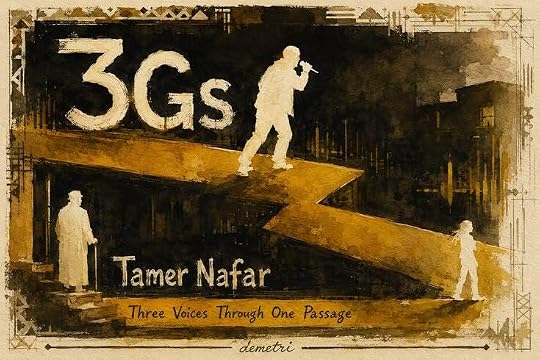
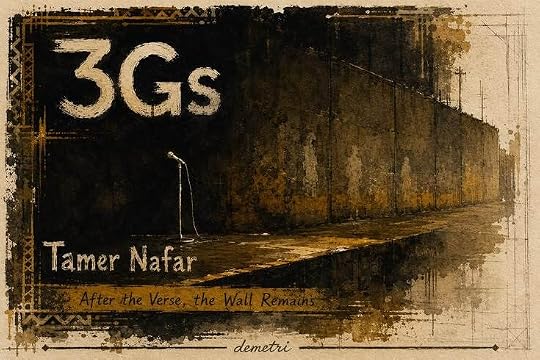
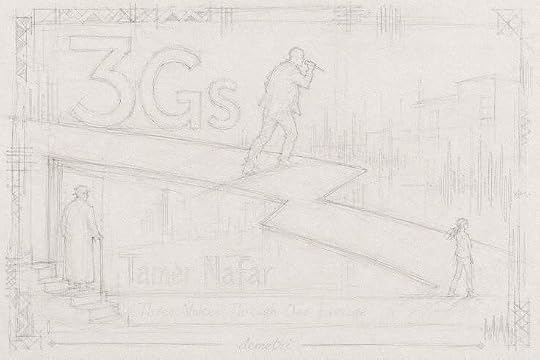
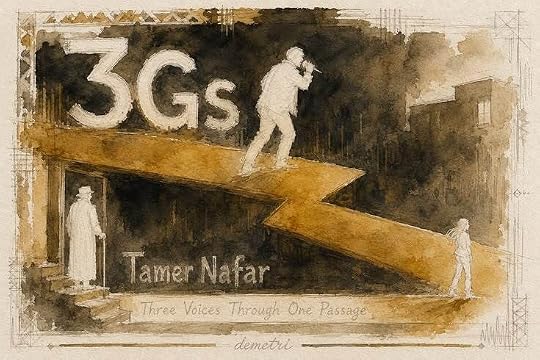
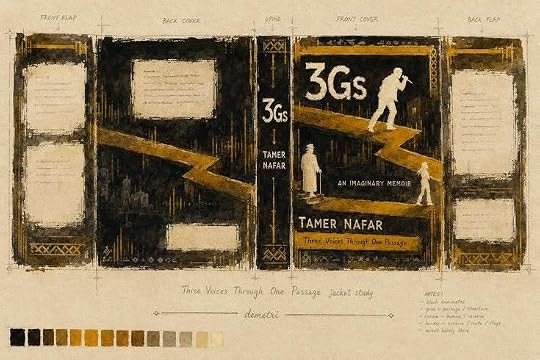
A dark-gold passage holds three pale presences in relay, translating “3Gs” into a visual argument about inheritance, voice, and memory moving through danger without ever becoming safely housed.
Displacement usually asks memoir to look backward; Tamer Nafar’s “3Gs” makes it check three directions, like someone crossing a dangerous street with a family archive under one arm. Its subtitle, “An Imaginary Memoir,” sounds at first like a contradiction, or at least a minor genre misdemeanor committed in daylight. But the book quickly makes plain memoir seem too narrow for what Nafar is trying to hold. A family history broken by expulsion, altered names, missing archives, inherited silences, neighborhood violence, disability, rap, ghosts, and a daughter who has never existed cannot be held by fact alone. “3Gs” does not use invention to dodge truth. It uses invention because truth, here, has already been scattered, renamed, and told to move along.
Even the structure works like triage. The book is divided into three generational movements: Fawzi Nafar, Tamer Nafar, and Shaden Farha. Fawzi is the father, speaking from disability, late literacy, family memory, religious return, and the haunted afterlife of Lyd. Tamer is the son, the Palestinian rapper, actor, activist, and founder of DAM, writing through fame, shame, fatherhood, fear, and the cost of becoming visible. Shaden is the fictional daughter, a future child invented so the book can test what its memories might become. She returns to a hardened Lod-Oz to scan endangered objects into the cloud. The outline is simple; the freight is not.
Memory, in “3Gs,” arrives with the dirt still on it. Fawzi’s section begins with names and injury. His name means “always winning”; Jewish friends call him Uzi; as the father of his eldest son, he becomes Abu Tamer. After a car accident leaves him in a wheelchair, he begins to learn to read and write Arabic, having previously copied Hebrew work words by memorizing their shapes. Writing, for him, begins as drawing. Language is not finish or ornament; it is the tool he reaches for when the body has stopped obeying.
Especially in Fawzi’s voice, Nafar finds the book’s most supple music. Fawzi is funny in the way people are funny when sorrow has been sitting in the room so long it has started offering commentary. He lies to an insurance therapist, inventing a story about his father abusing his mother because he senses the therapist wants a sad Arab domestic tragedy. Also, he needs the money. Then comes the turn: he confesses the lie and gives us the truer father, Jamil, a gentle, musically gifted carpenter, oud-maker, husband, and survivor. The episode is comic, morally double-jointed, and devastating. It shows how stories get shaped by a therapist’s report, an insurance check, a stereotype, and a son clever enough to know which door will pay.
The first movement keeps spooling outward without losing breath. From Fawzi’s wheelchair, it moves backward into Jamil’s childhood, a story told by “fifteen mouths,” each sibling offering a different version of how an eight-year-old boy lost his father, mother, sister, and brother in a short span of time. It moves to Yafa, where Jamil becomes a carpenter and oud-maker, marries Fatmeh, opens shops, raises children, and is driven out during the Nakba. The family flees by afloka, is stripped of savings, reaches al-Majdal, rebuilds briefly, and is forced onward to Lyd. The carpenter with no furniture becomes one of the book’s quietest indictments.
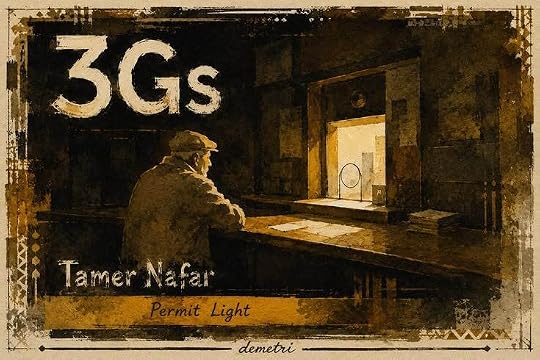
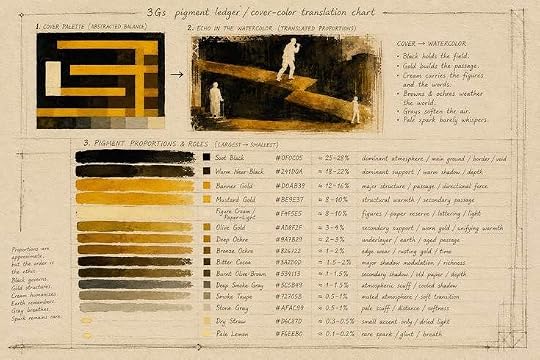
In a stark room of paper, shadow, and narrow gold illumination, inherited pressure becomes almost architectural: a figure waits inside the systems that name, sort, delay, and contain him.
Rather than treating history as a slab of explanation, Nafar lets it hide inside things. A sign outside a carpentry shop. A suitcase emptied of gold. A yellow plane remembered by a child who did not yet know the language of military technology. A branch mistaken for the severed arm of a massacred girl. A white Fender Stratocaster bought from a Yafa music shop that may stand where Jamil’s lost carpentry shop once stood. A stillborn daughter in a shroud, “like a guitar that would never talk.” The suitcase, branch, guitar, and shroud do the remembering after official wording has changed the locks.
In the middle of this, there is disco, because grief in this book has no private office. Fawzi becomes a postman who cannot read, then a boiler worker, then a musician. He discovers Western records, Arab wedding music, Oum Kulthoum, Hendrix, the Beatles, and “Shaft.” He buys a guitar, forms a band, plays chaotic weddings, navigates Arab and Jewish audiences, and watches music become money, rivalry, pleasure, politics, and escape. The comic set pieces crowd the page like relatives arriving with folding chairs. Then life yanks them back to the floor: debt, marriage, a dead baby, prayer, bankruptcy, stairs.
Perhaps the most piercing image in the book is Fawzi crawling. After the accident, the stairs to his family’s apartment become a sentence built from stairs. He crawls up and down them; his children carry his wheelchair; Nadia lives with the failure of a home that cannot accommodate him. The image returns later in Tamer’s section with crueler light. What Fawzi narrates as adaptation, Tamer remembers as humiliation, inconvenience, shame, guilt. One generation’s survival becomes the next generation’s wound.
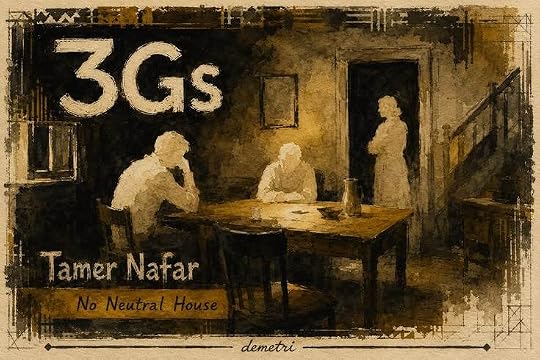
A table, a doorway, and a few unresolved figures make the domestic room feel neither refuge nor battlefield, but the intimate place where history keeps arriving late for dinner.
As the second movement opens, Tamer has applause, awards, and no usable peace. A film based on his life has succeeded at Berlin and Tribeca; Robert De Niro shakes his hand; the hood posts the photo online with pride. But his father has died, his baby has been born, his music career has stalled, and he is answering calls at a collection agency from desperate people whose cars and bank accounts may be seized. The reversal is brutal and perfectly pitched: the godfather of Arabic hip-hop reduced to saying, when callers recognize his voice, that he only wishes he were Tamer Nafar.
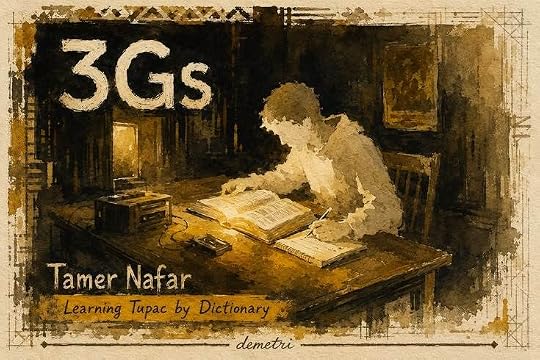
A boy studies sound into language at a small table, where the dictionary’s pale glow becomes a private ignition point for art, translation, and self-making.
Performance, for Tamer, is both rescue and camouflage. Hip-hop gives him a way to exist in Lyd, where nonexistence is the great childhood terror: not existing in school, with girls, on a soccer field, as a Palestinian citizen, as a son whose father needs to be carried. Michael Jackson first gives him spectacle; Tupac gives him recognition; rap gives him borrowed armor, volume, and permission. DAM’s political turn, the house-demolition song, the video shoot with Juliano Mer-Khamis, the bridge built over the train tracks, and the Ophir Awards performance with Mahmoud Darwish all show art moving concrete. But Nafar is too honest to let art stay clean. Visibility feeds ego as surely as courage.
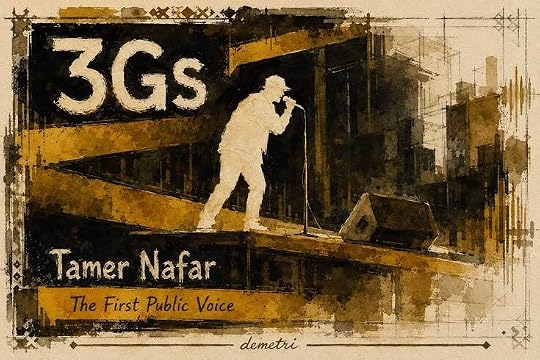
A young performer leans into the microphone as black space and gold structure gather around him, catching the charged instant when private rhythm becomes public address.
At its sharpest, Tamer’s section is a study of fear misnamed as swagger. He is profane, self-indicting, often very funny, and often appalled by himself. He remembers exploiting women, craving the attention of drug dealers, confusing danger with charisma, treating fear as a private engine. In guided psychedelic sessions, he sees his father crawling up the stairs and is forced to confront the cruelty of his younger self. Later he meets “Mr. Fear,” a figure who first speaks like an adviser and then grabs him by the throat when Tamer tries to make fear merely “part” of him. Fear insists on its full authorship. Tamer finally says, aloud, “I’m afraid.”
Done badly, such scenes could have collapsed into therapy-room tidiness. They do not, because the book keeps letting life dirty the insight. Tamer’s breakthrough is interrupted by murder: Firas, the cousin who once embodied protection, is shot eleven times. Joy and blood keep arriving together. A political victory is followed by a funeral. A stage triumph is followed by fascist harassment. A fan onstage becomes, in Tamer’s frightened body, the boy with the knife from childhood. The book understands trauma not as a single buried secret but as an alarm system that continues to misread the present because it once read the past well enough to survive it.
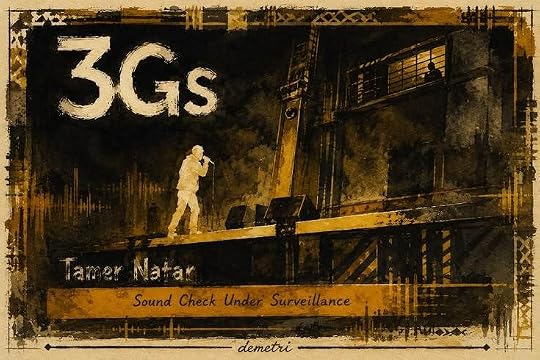
A single voice enters the stage-light while the surrounding architecture watches back, turning performance into exposure and song into a form of risk.
If Fawzi keeps memory in the mouth and Tamer drives it through the mic, Shaden ships it off-site. The third movement is the book’s largest wager. Shaden Farha, Tamer’s fictional future daughter, lives in a world where Lyd has become Lod-Oz, Haifa is colloquially Kapland, and Palestinians inside Israel have become “box contortionists,” sacrificing bones of language, memory, voice, and safety to fit inside narrowing political spaces. She rides a quantrain into Lod-Oz to scan a door knocker for ClouDinHanD.ai, her memory-storage start-up. Its slogan might sound like tech satire if it were not so sad: pack your memories before you leave.
Much of Shaden’s movement is brilliant as an idea. Her technology can scan an object’s sensory and emotional residue: a plate, a key, a door, a crack, a smell, a family trace. The premise extends the book’s deepest anxiety: if houses can be taken, names changed, graves surrounded, and archives denied, where can memory go? Shaden’s answer is not surrender to the cloud but emergency storage. Fight for the land, she argues, but save a backup. A people repeatedly forced to pack cannot be blamed for wanting better luggage.
Its execution shows more scaffolding. Shaden’s future has to introduce Lod-Oz, Kapland, Slenses, HES scanners, digital occupation, post-human consciousness, and the afterlife logic of memory storage. In scene – on the train, remembering being chased by armed settlers, standing inside Dahmash, touching the cemetery stones with her father – the section is as strong as anything in the book. When it pauses to explain its systems, one can hear the gears click. The future movement occasionally has to build its own oxygen supply, and the effort shows.
The strain shows, but it belongs to the design. Shaden is the only major figure who is fully invented, and she must carry not only a life but a possible future. Her pages are less naturally embodied than Fawzi’s because Fawzi has the density of remembered speech, family gossip, work, debt, marriage, and illness. Shaden has dread, theory, technology, and inheritance. She is not loose on the page because her world is not loose. It is coded, watched, narrowed, and armed.
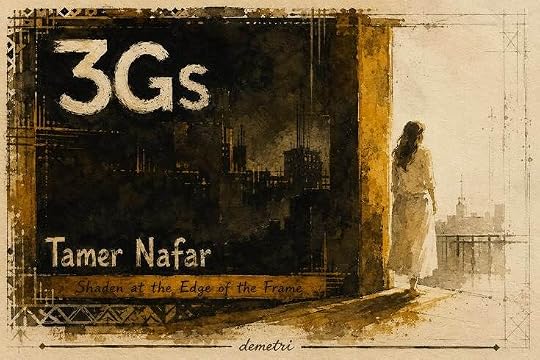
Set against a dark-gold threshold, Shaden stands partly inside the image and partly beyond it, a future-facing presence the frame cannot fully contain.
Real-world pressure enters “3Gs” the way smoke gets into clothes. Lyd / Lod is the book’s co-protagonist: mixed city, shattered city, renamed city, city of crime and memory and suspicion. The danger is not only state violence, though that is everywhere. It is also neighborhood bloodshed, debt, extortion, masculinity, civic abandonment, guns, and families left to negotiate danger without reliable protection. Nafar’s public life as a Palestinian artist inside Israel gives the second movement a charge no footnote could supply, while Shaden’s imagined world extrapolates from visible present fears: surveillance, armed civilians, memory theft, and the exhaustion of proof.
One useful ghost in the room is Mahmoud Darwish’s “Memory for Forgetfulness,” though Nafar writes under different weather. Darwish distills siege, exile, coffee, language, and homeland into lyric pressure; Nafar crowds the room with boilers, duct tape, wedding bands, gangsters, fathers, daughters, ghosts, mushrooms, and cloud servers. Ibtisam Azem’s “The Book of Disappearance” is another neighbor for the speculative question of Palestinian erasure, but Nafar’s book is less cleanly allegorical and more familial, noisy, and cussing, breathing, alive. “3Gs” does not want a marble pedestal. It wants the family house, even if the stairs are filthy and no one can find the right cable.
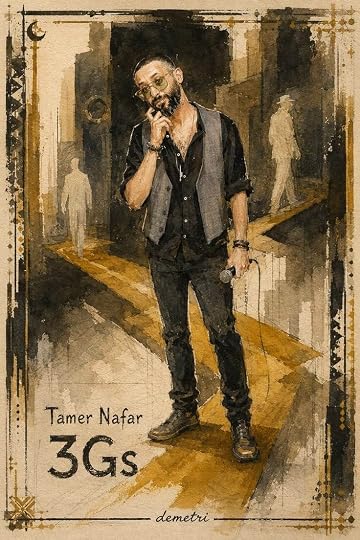
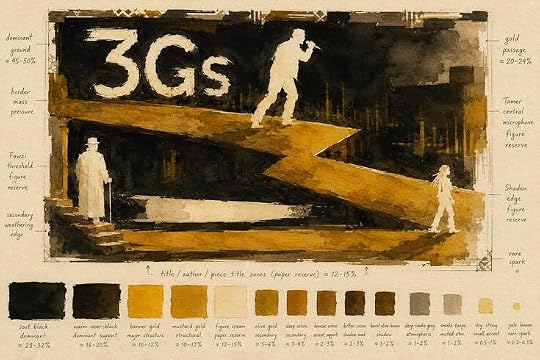
The author stands at the crossing of microphone, inherited shadow, and the gold passage of “3Gs,” rendered as both performer and unruly family archivist.
Part of what makes the book so bracing is its refusal to make suffering dignified in the expected way. Fawzi can be evasive, vain, irresponsible, devout, loving, and ridiculous. Tamer can be brave in public and ugly in private. Shaden can be visionary and severe. These people are not arranged to flatter anyone’s idea of victimhood. That is why they live. Nafar knows that oppression does not improve character as a favor to future reviewers. It may produce jokes, tenderness, cowardice, genius, cruelty, and songs that build bridges over tracks where children died.
Over and over, the book asks what can safely hold a life. A house cannot; it can be taken or made inaccessible. A body cannot; it can be crippled, chased, shot, frightened, or made to crawl. A name cannot; it can be changed from Fawzi to Uzi, Lyd to Lod, Lod to Lod-Oz. A song cannot; it can build a bridge and still fail to stop the next murder. A cloud cannot, not fully; it may preserve memory, but it cannot hug a child or stop a patrol car. And yet the book keeps making vessels, because to stop would be to accept the erasure it has spent every page resisting.
After the voice has passed through, a wall, a passage, and a faint trace remain, leaving testimony suspended between echo, endurance, and unfinished return.
Under that pressure, “3Gs” proves its nerve was not a stunt. It is not seamless. Fawzi’s movement is the most complete and surprising; Tamer’s is the most volatile; Shaden’s is the most conceptually burdened. But the unevenness belongs to a book taking real artistic risks, not to one losing control out of laziness. Its final rating: 92/100, which corresponds to 5/5 Goodreads-compatible stars under the rubric where 90 to 100 earns five stars. The score reflects a book of unusual originality, force, and voice, with a visible but worthwhile cost in its most speculative stretch.
Late in the book, cloud storage gives way to stone. Shaden and Tamer stand in the cemetery among the family dead: Jamil, Fatmeh, the stillborn daughter, Fawzi. Tamer guides Shaden’s hand across gravestones and tells her that when she cried as an infant, Fawzi recited Quran in a soft voice until she slept; later, Tamer would rap to her in that same softness. On Fawzi’s grave, she reads “raji’un,” return, and the word gathers the whole book: return to God, return to land, return through song, return through memory, return perhaps through some future vessel not yet invented.
Of course, Nafar will not let return become consolation. Patrol cars circle. Curfew approaches. Shaden wants the word etched into her brain, skin, and bones. Then danger arrives again, as it always does in this book, just when tenderness thinks it has found a little room. She tells her father they have to go. The Jews are coming. The sentence lands with terrible simplicity, but the book has already complicated it beyond slogan or shock. What remains is the hand on the grave, the father’s voice, the daughter who never existed, and a word for return trying to survive long enough to be carried elsewhere.
Still, the book’s lasting force lies in that contradiction: it knows no container is safe, and it keeps making containers anyway. The cloud does not replace the grave. The grave does not replace the song. The song does not replace the house. The house is gone, or renamed, or up too many stairs. So “3Gs” keeps moving – from mouth to mic to cloud, from joke to prayer to warning, from Lyd to Lod to whatever name comes next – carrying memory like something fragile, contraband, and alive.
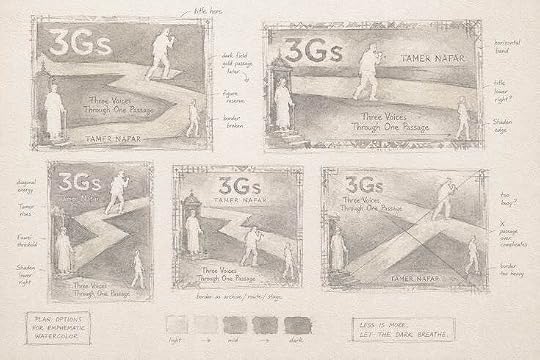
All watercolor illustrations by Demetris Papadimitropoulos. Watercolors are done on 140lb vellum and then scanned into the computer using an Epson scanner. From there, they are finalized in Procreate. All art and opinions are my own.
I received a free copy of this book through a Goodreads giveaway!
This book had the unfortunate luck of being the one I was reading when I became a lot busier. It took me like two weeks just to get through the first 15 pages, and I had to keep rereading them over and over again because it just wasn't sticking in my brain. I did really like it, though. It reminded me of a class I took with Heidi and the books we loved, like the Corpse Washer.
The book spans 3 generations, each affected by the last and each in a changing sociopolitical landscape. I think that being able to tie together the efforts of the first generation to the third was deeply satisfying, and there's a lot of commentary about geopolitical relations and settings. Particularly important during this time.
-1 star for me because the first section was a little dense to get through, but still an enjoyable novel.
Book is exactly as described and well worth reading. I also found myself looking up Nafar’s music and playing it in the background while reading, which added to the story.
It took a while for me to finish this book because I found myself rereading parts due to the generational shifts and town name changes, along with many moving parts that take place in the book. I enjoyed taking the time to get it all straight in my mind.