'Each chapter is a treasure trove' - Carole Kauffman
'You'll walk away seeing yourself not as a stranger, but as a collaborator' - Daniel H. Pink
How will you live your 100-year life?
In a world of longer lives and constant change, work is no longer a single straight path. It is a fabric we weave – with threads of mastery, friendship, calm, intimacy, adventure, cooperation, knowing, and amplification. How we strengthen and reweave these threads will shape not just our working lives, but our happiness, health, and sense of purpose across a century.
In Living the 100-Year Life, Lynda Gratton – acclaimed co-author of The 100-Year Life – offers a practical and deeply human guide to navigating this new reality. Drawing on global research, expert voices, and the stories of four fictional characters at different life stages, Gratton shows how
· Discover what each of the eight threads can make possible for you · Strengthen the threads through reflection, action, and promises to your future self · Weave a working life that is resilient, meaningful, and uniquely yours
This is not a book about extending life for its own sake. It is a book about living wisely across time – finding joy in friendships, resilience in calm, creativity in adventure, and purpose in work.
Your 100-year life is still being woven. The threads are in your hands.
What We Owe the Years We Get: The Strange Inheritance of a Life That May Last Longer Than We Expected Lynda Gratton’s “Living the 100-Year Life” begins with the years her father never had and becomes a searching argument about work, love, repair, mortality, and what the person we become will inherit from us. By Demetris Papadimitropoulos | August 18th, 2026
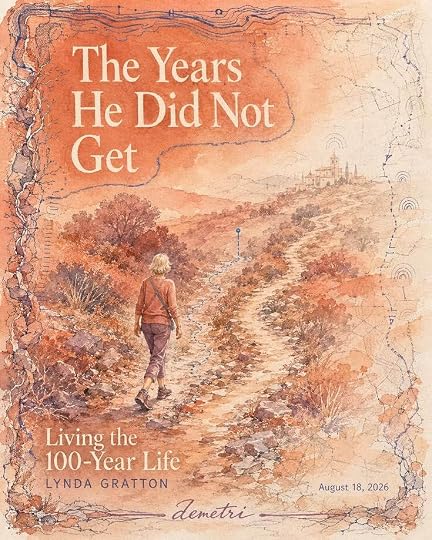
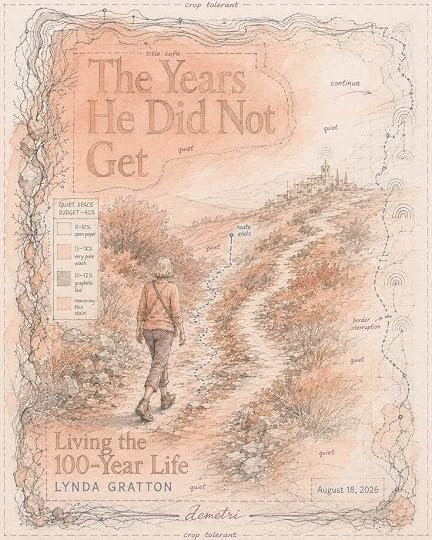
On a warm hillside in southwest France, Gratton keeps walking beside a second route that ends before hers does, turning the years her father never received into the review’s governing question: what do we owe the time that remains available to us?
Dying young is not the premise of Lynda Gratton’s “Living the 100-Year Life,” but it is the pressure that gives the book its shape. Nearing seventy, Gratton walks alone in southwest France and finds herself crying over her father, who became ill more than a decade younger than she now is. The grief is old; the arithmetic is new. He did not get the years she may yet receive. A question Gratton once approached through demography and work has become embarrassingly intimate: if time arrives that someone you loved was denied, what do you do with it?
Even Gratton’s earlier work had not quite prepared her for that version of the problem. “The 100-Year Life,” written with Andrew J. Scott, argued that longer lives would strain the familiar sequence of education, employment and retirement. Here Gratton moves from forecast to inhabitation – from the map, as she puts it, to the guidebook. Three questions keep returning: Who am I? How am I working now? What actions should I take, and what promises am I making to my future self? They give the book a practical spine while unsettling the assumption that adulthood should harden into one permanent shape.
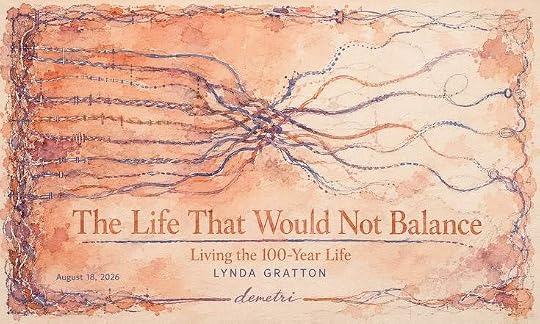
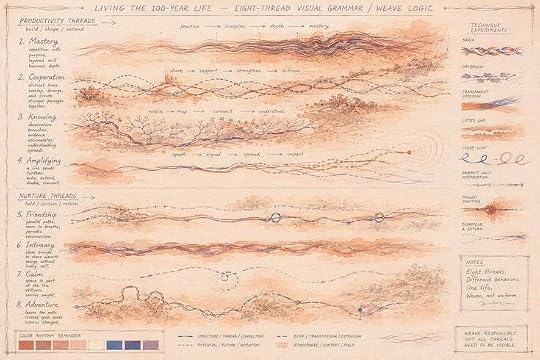
Most of Gratton’s machinery is organized around eight “threads.” Four belong to productivity: Mastery, Cooperation, Knowing and Amplifying. Four belong to nurture: Friendship, Intimacy, Calm and Adventure. It sounds, initially, like something born ready for a conference slide. Then the metaphor proves more supple than the usual language of “balance.” Balance imagines two sides holding still. A weave can tighten, sag, tear, thicken, fade, be repaired. One thread may dominate for years while another thins almost unnoticed. The model’s real usefulness lies there: a life can be temporarily lopsided without being declared a failure.
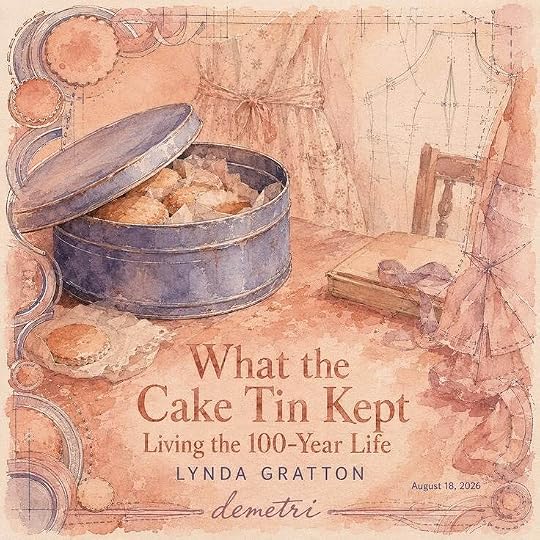
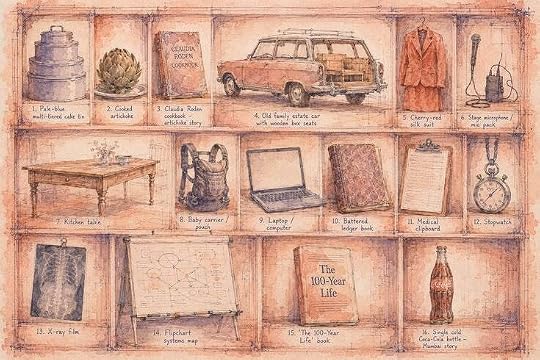
Equally important, Gratton begins with inheritance before she turns to improvement. Her mother’s pale-blue cake tin becomes one of the book’s best objects. It held cakes and biscuits, but also a mid-century theory of womanhood: what a good mother made, what a working woman concealed, what care looked like when it hardened into duty. Gratton built a career partly by refusing that domestic script, then discovered that refusal had not erased it. She still carried the guilt, the standards, the reflex to do everything. The book’s argument about social norms lands more cleanly in that cake tin than in any of its abstract formulations. A cake tin will do.
A pale-blue cake tin sits inside the warmth of domestic memory while seam lines and inherited household order gather around it, letting one ordinary object hold the rules about care, motherhood, and womanhood Gratton spent a lifetime resisting without ever entirely leaving behind.
That is where Gratton’s prose wakes up. Give her an object, a body, a place, and the book acquires grain. A teenager in Italy stares at an artichoke she cannot afford and turns appetite into a vow about independence. A cherry-red suit backstage at Radio City Music Hall catches the instant fear becomes exhilaration. A young mother tries to write at a kitchen table with an infant strapped against her, milk leaking through her clothes, exhaustion making a mockery of professional poise. Gratton does not need to tell us these scenes matter; they already do. Yet she usually does tell us, then asks what our equivalent scene might be, then offers a question or exercise. She trusts recollection. She is less willing to trust silence.
Reading straight through makes that habit both useful and tiring. The sentences are generally short to medium in length, the diction plain, the second person persistent. Gratton does not want readers admiring a sentence from across the room; she wants them carrying the idea into Wednesday. That makes the prose warm, audible and unusually easy to use. It also means almost every implication receives an escort. By the third or fourth chapter, one begins to suspect that even a loose metaphor will soon be assigned three reflection prompts and asked to make a promise to its future self.
If that sounds like a complaint about self-help machinery, it is only half one. The same machinery gives the book its portability. Gratton explicitly invites readers to enter where needed: Amplifying for technological anxiety, Calm for depletion, Friendship or Intimacy when the career is functioning and the rest of the person is not. But consecutive reading yields something the modular instructions undersell: echo. The same life changes meaning when viewed from another age. Her mother’s rules deepen once the book reaches Intimacy. Early career choices look different after Mastery. Youthful travel acquires another charge when Adventure arrives. The woman walking with her dead father at the beginning is not quite the woman who later asks who she is becoming.
Perhaps the book’s smartest move comes halfway through its central section. Gratton first gives us the recognizable vocabulary of professional life – mastery, collaboration, learning, technology – then changes the terms. Friendship follows. Then Intimacy. Then Calm. Then Adventure. The sequence quietly removes career achievement from the throne. Friendship is not networking in a cardigan. Calm is not a trick for squeezing more work out of Tuesday. Intimacy is not defended because a happy marriage improves executive performance. Adventure is not an innovation workshop in hiking boots. They matter because years worth extending need to contain something besides output. Gratton earns that expansion by first taking professional competence seriously rather than dismissing ambition as a youthful error.
Eight unequal line systems tighten, loosen, cross, and fall open across the page, translating Gratton’s central structural insight into visual form: a long life is not kept in equilibrium so much as repeatedly noticed, reweighted, and repaired.
At one end of the shelf sits Oliver Burkeman’s “Four Thousand Weeks: Time Management for Mortals,” a book that starts from scarcity. Time is brutally finite, Burkeman argues, and our attempts to master it tend to become another way of wasting it. Gratton begins from the opposite numerical problem: life may be longer than expected, so inherited schedules and identities may become inadequate. Yet the two arrive at a similar correction. More time is not automatically more life. Gratton’s particular move is to put professional capability and human sustenance inside the same design without forcing friendship, rest or love to justify themselves in office terms.
Part of Gratton’s answer to a longer life is refusing the idea that reinvention requires discovery of one secret, authentic self. Her thinking sits close to Herminia Ibarra’s “Working Identity: Unconventional Strategies for Reinventing Your Career,” where people test possible selves through side projects, temporary roles and provisional commitments. Gratton’s own career repeatedly follows that pattern. The corporate employee becomes an academic; the academic becomes a public thinker; the teacher becomes a writer she had not long imagined becoming. A hundred-year life, in this sense, does not require one identity sturdy enough to survive five decades. It requires enough give to survive becoming someone else.
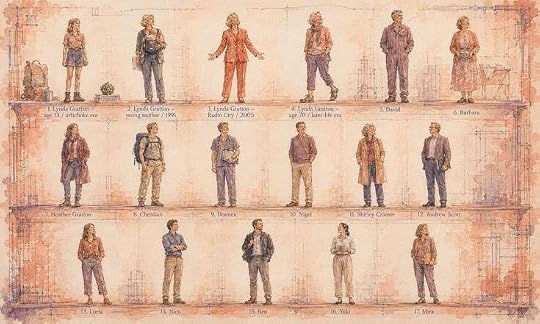
At their neatest, though, Lucia, Nico, Ben and Mira expose the difference between a framework and a person. They broaden the book beyond one comparatively privileged biography and give different ages and pressures somewhere to land, but they seldom surprise the system that invented them. Lucia drifts, Nico experiments, Ben strains under competence and care, Mira faces later-life precarity. Each arrives carrying the right illustrative burden. Gratton’s mother, father, friends, children and younger selves are less obedient. They leave residue. The invented characters clarify; the remembered people complicate. The book is better whenever complication wins.
Despite everything Gratton knows about circumstance, her prose tends to return quickly to agency. She knows lives are shaped by illness, caregiving, gender, layoffs, age, money, history and chance. Her father’s mesothelioma shows work delivering consequences decades after the job itself. Her early motherhood shows how little freedom remains when body, institution and clock all make demands at once. Yet the governing verbs are still choose, strengthen, design, promise, reweave. They are not false verbs. They are simply more evenly available on the page than in life.
In the mismatch between those stories and those verbs lies the book’s sharpest limitation. Some thread is in our hands. Some was tied before we arrived. Some belongs to employers, governments, partners, parents, bodies, bank accounts, illnesses and accidents. Gratton is too alert to deny this, but her practical apparatus can make partial authorship feel like sufficient authorship. The distinction matters because choice itself is unequally financed. A sabbatical can be renewal for one person and unemployment for another. A portfolio career can sound like freedom from one side of the paycheque and like unstable income from the other.
Much of the AI chapter will age faster than Gratton’s family stories, which is probably unavoidable. She is sensible when she treats generative systems as tools that may alter bundles of tasks rather than simply vaporize occupations, and sharper when she asks what happens to time supposedly “saved” by automation. Modern work has a marvelous ability to convert every efficiency into fresh capacity for more work, rather like winning a cake-eating contest whose prize is another cake. Gratton wants some of that reclaimed time spent on friendship, calm, intimacy or adventure. The technology specifics will date. The question of who gets the saved hour will not.
If the weave begins to feel overhandled, that is partly because Gratton has found a metaphor roomy enough to admit nearly everything. Threads strengthen, fray, knot, loosen, disappear, return and require repair. By the later chapters, scarcely a human condition has escaped textile conversion. Still, the image survives its workload because it catches what balance does not: different parts of a life can weaken at different times without condemning the whole. Gratton’s best practical question is less “How do I do everything?” than “What have I stopped tending?” Friendship can thin through scheduling. Calm can be consumed by responsiveness. Mastery can harden into expertise that no longer learns. Adventure can be postponed until the appetite for it becomes faint.
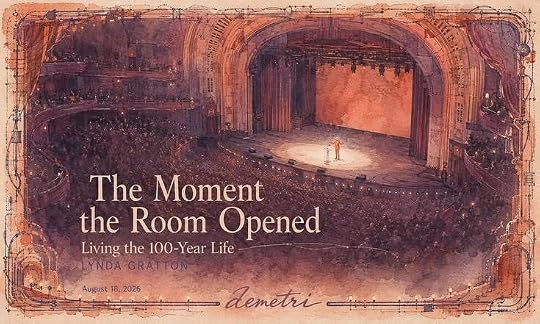
The liveliest answer to all this maintenance comes in Adventure. That chapter could easily have become permission for expensive travel wearing the nametag of personal growth. Instead, adventure can be a new project, a difficult room, an unfamiliar place – anything uncertain enough to expose a version of the self hidden by routine. Gratton remembers standing backstage at Radio City Music Hall in a cherry-red silk suit, heart pounding before thousands of people. What remains with her is the instant terror turned into exhilaration. A long life, the scene suggests, should contain moments the future self is glad the present self did not decline.
Inside the immense architecture of Radio City Music Hall, a small coral figure reaches the instant when terror turns into exhilaration, letting Adventure become more than escape or novelty: one of the ways a long life stays sufficiently alive to be worth its additional years.
Repetition, meanwhile, is built into the way the book expects to be used. Chapters often proceed through personal story, concept, expert voice, fictional case, reflection, immediate action and promises to the future self. Read selectively, the pattern is reassuring. Read straight through, it can feel as though the loom has hired a project manager. The concluding assessment, workbook, journal, website and community intensify that impression. Just as the book reaches the recognition that a long life is never lived alone, one can hear infrastructure being assembled around the revelation.
On its own terms, though, the system leaves behind more than its repetition wears away. “Living the 100-Year Life” receives 82/100 and 4/5 stars from me because Gratton changes the rank of familiar ingredients. A durable working life cannot be built from work alone; nor does it require permanent equilibrium. It requires periodic attention. “Which thread is fraying?” sounds almost quaint, yet it is useful enough to travel beyond the page. Its modesty is part of the point: diagnosis comes before reinvention, and sometimes noticing the neglected thing is the only action available. Plenty of practical nonfiction offers more elaborate systems and leaves the reader with less.
Perhaps what gives the book its largest shape is inheritance. Part One asks what family, history, personality and earlier working selves have handed us. Part Three turns the same question forward: what will the person we become inherit from decisions made now? Hal Hershfield’s “Your Future Self: How to Make Tomorrow Better Today” examines why later versions of ourselves can feel like strangers. Gratton places that problem inside a thicker world of parents, employers, skills, bodies and time. The future self is not merely a planning device. It is almost a descendant.
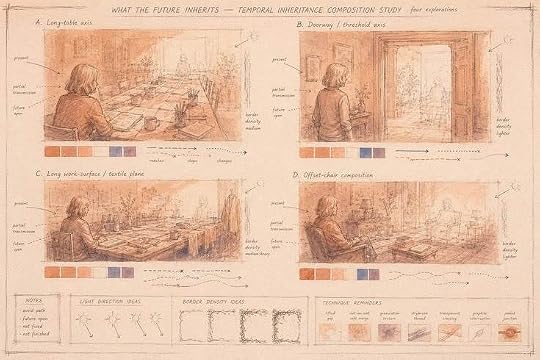
Across a long interior, present-day Gratton faces a future presence that remains only partly made, turning the book’s language of promises into temporal inheritance: what we choose now becomes material for someone we have not yet become, who will one day have to receive it.
Only near the end does the opening grief reveal how much work it has been doing. Gratton’s father is not there merely to lend sadness to a career book. His absence sets the scale. She has reached years he did not. Her mother handed her rules she has spent a lifetime revising. Friends and collaborators have died. Children have grown. Old professional selves have become material for new ones. Places first visited in youth look different when revisited later. Time does not simply accumulate. It changes the meaning of what came before.
Underneath its bright promise of longevity, then, “Living the 100-Year Life” is finally a book about mortality. Careful planning cannot guarantee a century of flourishing, and Gratton’s best pages never pretend it can. Fate interrupts. Bodies rebel. Institutions disappoint. People we love vanish from the pattern. The weave matters not because we can perfect it, but because it ends, because some breaks will remain visible, and because much of the design becomes legible only after the thread has already passed through our hands.
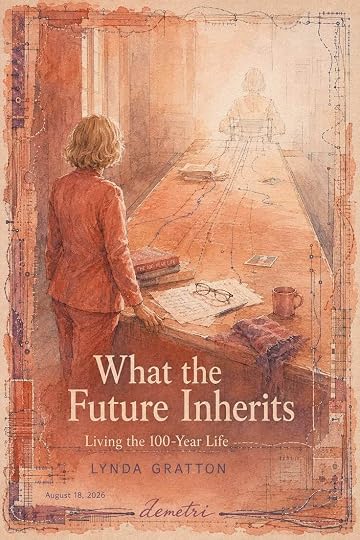
Full-Body All-Character Watercolor Study
Important-Items Watercolor Study
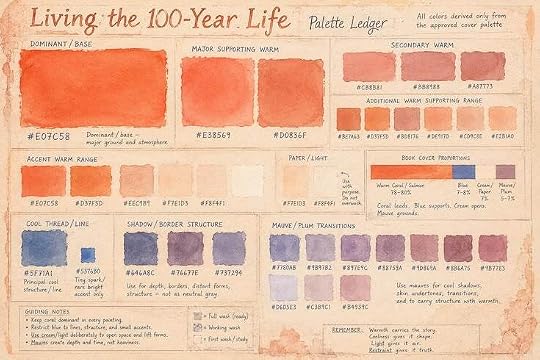
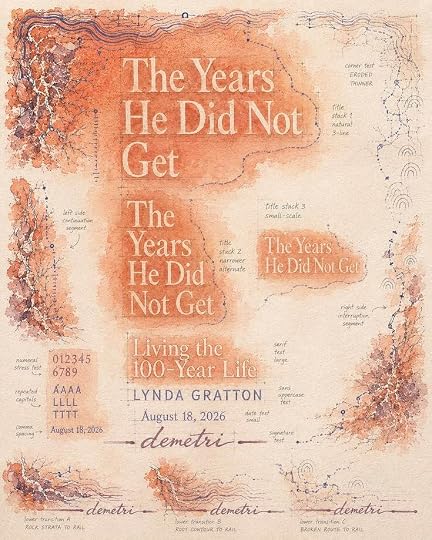
Cover-Palette Proportional Ledger
Hand-Lettering + Border Architecture Study
Negative-Space / Crop-Safety Composition Map
First Underdrawing
First-Wash Visualization
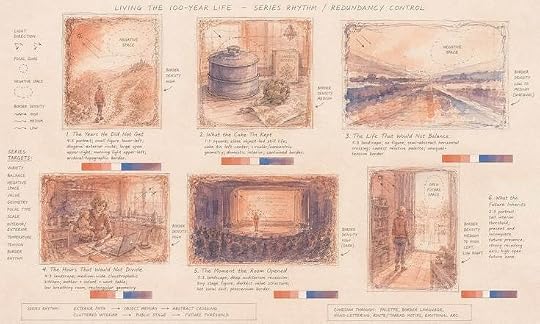
Series Rhythm / Redundancy Study
Eight-Thread Visual Grammar Study
Temporal Inheritance Composition Study
Border Architecture Matrix
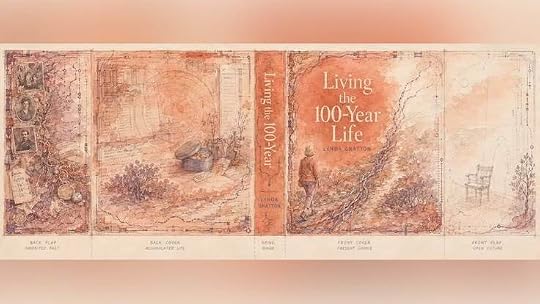
Alternate Full Dust-Jacket Study
All watercolor illustrations by Demetris Papadimitropoulos. Watercolors are done on 140lb vellum and then scanned into the computer using an Epson scanner. From there, they are finalized in Procreate. No AI was used in writing this review — all art and opinions are my own.
I was fortunate to receive an advanced reader copy of this book. For full transparency, my own research on working couples is featured in a small section of the chapter on intimacy, which gives me a particular stake in recommending it honestly.
I read Gratton's The 100-Year Life (co-authored with Andrew Scott), which made a compelling case for why longevity demands that we rethink work, money and identity. This new book is a rich companion to that argument. Less a sequel than a practical guidebook for actually doing the rethinking. Where the first book asked what needs to change, this one asks how.
Gratton maps out eight threads — mastery, cooperation, knowing, amplifying, friendship, intimacy, calm and adventure — that together weave the fabric of a meaningful life. The weaving metaphor resonated with me. It captures the idea that no single thread sustains you, and that the texture of a life comes from how they intertwine over time. That certainly rings true to my life and the lives of my friends and colleagues.
Each thread has its own chapter and is brought to life through reflection prompts, personal stories and practical exercises. I was personally most drawn to the thread of adventure. As a soon to be empty nester, its now I feel the pull to strengthen and now I know how.
Strongly recommended for anyone thinking seriously about how to shape a life that remains vital, purposeful and connected well into later decades.