As someone who loves language and makes my living from the written word, I found this book a mind-blowing revelation. Spinney does an incredible job retracing the origins of Indo-European languages back to a common ancestor, Proto-Indo-European, by examining both linguistic and archaeological evidence, and she does so in a highly readable way.
My first thought was, "Wow, anthropology and archaeology have come a LONG way since I was a history student back in the 1980s." It's amazing how much we've been able to piece together about prehistoric societies (meaning those without the written word) from genetic evidence and examination of the earliest human settlements. I was particularly struck by how much of the story of Proto-Indo-European is tied to the Ukraine, and how war there has interfered with the ability of archaeologists to study and preserve valuable sites (along with all the other miseries of war).
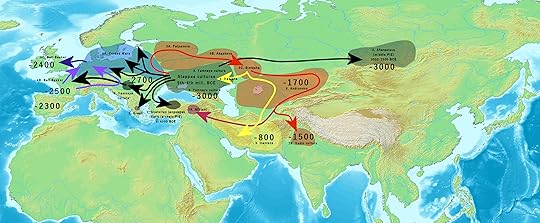
From the Caucasus, Spinney described how early societies spread across Eurasia, their languages changing and evolving as they went, but still anchored in their common origin. As Spinney puts it, "their psychic universes overlapped. From the Scottish isles to the Himalaya, there existed a chain of societies that was deeply interconnected through trade, custom, language and mythology."
One of the more awe-inspiring things, for me, is how Proto myths can be reconstructed, showing just how many echoes there are in later versions of mythology. Here, for instance, is one Proto-Indo-European creation myth:
"A primordial Man (* Manu) conjures the world from his Twin (* Yemo). After journeying through the cosmos in the company of a primordial cow, Man and Twin decide to make the world. To do this Man must sacrifice Twin and cow so that he can build it from their dismembered parts. The sky gods and goddesses help him, and once the world exists Man becomes the first priest, overseeing ritual sacrifice. The gods then create Third Man (* Trito), to whom they give cattle, but a monster serpent steals the cattle. The name of the serpent is *Ngwhi, which is a literal negation: ‘not’. Fortified by an intoxicating beverage and assisted by a god, Trito overcomes the serpent and frees the sequestered cattle. He then makes a gift of cows to Man the priest, so that the sacrifices may continue and cosmic order be restored. Trito is the first warrior, and that first cattle raid is his initiation into manhood."
Aside from the history lessons, which are fascinating in themselves, I especially enjoyed the exploration of what language *is* and how it functions beyond just a vehicle for communication. As language changes, it becomes one of the major markers of cultural identity. If you speak my language, you are like me. If not, you are an outsider.
Embedded in this idea is a feeling of mistrust around migration which is still with us today: "Migration is considered a major if not the main motor of language change, because it drives a wedge between dialects and brings them into contact with different languages."
People want to belong, and they want to distinguish between "us" and "them." Because of this, we want to believe that our language is somehow pure and unchanging, and we want to resist anything that might "infect" it with foreign influences. Spinney even says that 'barbarians' are literally those whom we cannot understand, and that the word barbarian was "probably inspired by the sound people registered when they heard an unintelligible stream of speech: bar-bar or blah-blah or rhubarb. But everyone heard blah-blah when foreigners spoke."
A similar concept lurks behind the Latin words for guest and enemy. "Hospes (host, guest) and hostis (stranger, enemy). Hospes underlies the word ‘hospitality’ while hostis is the root of ‘hostility’, via Latin loans to English. These two words seem antithetical in their meaning, but they were once linked by the concept of a stranger, that passer-by whom a good welcome might turn into a friend and a bad one into a foe." So that "the moment a newcomer opens their mouth, they reveal whether they belong to ‘us’ or ‘them’."
Stepping back and taking macro view, however, the idea of an isolated, unadulterated language is nonsensical. "There is no such thing as a pure language. Its peculiar mix of archaisms and innovations reflects the periods of calm that it has known, as well as the periods of upheaval, and the other languages that it has brushed with along the way."
Spinney also ties our obsession to cultural monolingual to the rise of the European nation states in the 18th century. "From that time on languages and dialects other than the national ones were repressed. Before that, however, Europe was as multilingual as the rest of the world, and as our species for most of its past."
Again, this is grounded in the need to distinguish between 'us' and 'them.' "Understandably, a lot of people find it unnerving to think of their languages being transformed by the arrival of new ones, or even dying. But underpinning that fear is a false impression that they have remained static in the past. Throughout humanity’s long existence, languages have have never ceased to absorb and change each other."
A few other random tidbits that I found fascinating:
One of the early poetic devices used by bards when relating oral epic stories was the refer to a hero as someone who "urinates standing up." I've been asked to define the word 'hero' many times, but that was never in my top ten list of descriptors.
The idea of the Golden Fleece may have come from the ancient people of the Balkans (in the area of Colchis, where Jason and the Argonauts go) who actually used sheepskins to pan for gold in the rivers, leaving behind glittering fleeces as evidence.
To believe in something means to put your heart into it. "*k’erd-, the root of both ‘cardio’ and ‘heart’, sometimes occurred in the context of an expression, *k’red dheh1-. Literally meaning ‘to put your heart’, this became śrad dhā-in Sanskrit (believe) and crēdō in Latin (I believe)."
Writing is magic. The Ancient Egyptians certainly believed this, but so did most early societies. And when you think about what a radical thing the written word is, this makes sense. "Imagine being shown a scratch on a mossy log and told that it’s your ‘name’. It has no head, arms or legs, yet others who see it will think only of you. When you consider all that writing made possible, from seducing and defrauding people over long distances, to keeping track of complex transactions and claiming property and kinship after your death, it’s not hard to believe that people felt reverence for it; that in their minds it could alter a person’s destiny."
All in all, a wonderful illuminating read, expanding the story of humanity more broadly than I'd ever appreciated. I'll end with this lovely Russian proverb, reminding us that history can teach and guide us, but should not make us nostalgic for some perfect golden past that never existed: "The past is a lighthouse, not a port."