This brand-new edition of 1001 Movies You Must See Before You Die covers more than a century of movie history. Every film profile is packed with details including the director and cast, a plot summary and production notes, and little-known facts relating to the film’s history.
This must-have guide chronicles the complete history of filmmaking, from silent-era sensations such as D. W. Griffith’s controversial The Birth of a Nation to recent Oscar nominees like Birdman, Boyhood and The Grand Budapest Hotel . Also described are Hollywood’s most memorable musicals, great dramas, screwball comedies, experimental “New Wave” films from 1950s and ‘60s Europe, major films noir, classic westerns, action and adventure films, and outstanding documentaries.
Steven Jay Schneider is a film critic, scholar, and producer with M.A. degrees in Philosophy from Harvard University and in Cinema Studies from New York University. He is the author and editor of numerous books on world cinema, most notably in the horror genre. They include Eurohorror, The Cinema of Wes Craven: An Auteur on Elm Street, Designing Fear: An Aesthetics of Cinematic Horror, Killing in Style: Artistic Murder in the Movies, Understanding Film Genres, and Traditions in World Cinema. He is also a consultant for film, television, and home video/DVD production companies, a curator for world horror film programs, and a staff member in development for Paramount Pictures. Among his recent titles are 501 Movie Stars and 501 Movie Directors, both available in North America from Barron's. Two additional titles from Barron's are scheduled for publication in Spring 09. They are 101 Horror Movies You Must See Before You Die and 101 Sci-Fi Movies You Must See Before You Die.
If you only ever saw movies from this 1001 list you’d be missing a whole ton of fun and you’d have to be really quite insane but still you’d have a pretty great time. Yeah, your favourite movie may well not be in here but you know what? You're just one insignificant worm and your opinions don't count. And so am I. And so is Steven jay Schneider! We are the worms!
Don’t know why I did not review this before, I have been using it for years. I’ve seen 492 of the 1001 movies listed, and lemme tell ya, it will take strong inducements like the kidnap of a close family member to make me see some of the rest of them, for instance Ben Hur (1959), Peking Opera Blues (1986), or Braveheart (1995).
This beautifully displayed and really heavy don’t drop it on your foot or it’ll be the A&E for you list whizzes from the dawn of film to a few years ago and all across the globe taking corners so fast you might get carsick. Also, should you want to be a 1001 completist, some of them are impossible to find, like Gun Crazy (1950), Butterfield 8 (1960) and The Decline of the American Empire (1986) for reasons too boring to contemplate probably. Anyhow, could anyone really like all 1001?
TWO LISTS
TEN GREAT MOVIES I TOTALLY LOVED AND WOULD NOT HAVE SEEN WITHOUT THIS BOOK TELLING ME I SHOULD
Fires Were Started The Docks of New York Au Revoir Les Enfants Dear Diary The Man With The Golden Arm The Belles of St Trinians 32 Short Films About Glenn Gould Cleo From 5 To 7 Le Trou The Double Life Of Veronique
TEN HORRIBLE MOVIES I WOULD NOT HAVE SEEN WITHOUT BEING BROWBEATEN BY THIS DREADFUL ELITIST BOOK INTIMIDATING ME
The Life And Death Of Colonel Blimp Loulou A Matter Of Life And Death Shanghai Express The Umbrellas Of Cherbourg Wings Of Desire Barry Lyndon Boudou Sauve Des Eaux The Discreet Charm Of The Bourgeoisie Faces
This list is more interesting than the first. All ten are drooled over by everyone who knows anything about movies. But somebody needs to go through these top 100 all time critics choice movies and point out that many of them are, or have become over time, sorry to say, ridiculous beyond redemption (A Matter of Life and Death, who can tolerate this agglomeration of industrial strength whimsy; The Umbrellas of Cherbourg – who can listen to this non-music mimsywibble for more than ten minutes even if Catherine Deneuve is in it) or flat out tedious (Barry Lyndon, Wings of Desire, oh my God, walk walk, talk talk or what) or the humour has become rancid (Boudou) or the staginess and campery has now become an incomprehensible barrier to a modern audience (Shanghai Express).
But heck, who’s complaining. As we nearly drown in the deluge of cultural overproduction, as blockbuster budgets reach the size of some countries’ GDP, we need some kindly people to fling us a few life preservers now and then. Swim this way! Glug!
I found this eight month read (!) nowhere near as interesting as I found 1001 TV Series You Must Watch Before You Die and 1001 Books You Must Read Before You Die, but admittedly I am no big fan of film. As usually with these books I found the films and the summaries of films released in the first 3/4 of the Twentieth Century more compelling. There is just enough in each entry to make them worth reading :) Three of my fave movies,... name that movie gif. 1. 2. As for this book, I rate it at least a Three Star, 6 out of 12, as it's a great reference book. :) 3. 2022 read
I just completed a fairly big project. The original idea of course was to see all these 1001 films but then they kept publishing updated editions, adding some new titles and throwing out some old ones. The total number of films listed in all editions is currently 1228, quite a large number. As the years rolled by it became clear to me that there were a few types of film that the gang who put this vast book together thought would be good for me instead made be feel ill, so I excused myself from those. In the end there were 293 of those. I know, sounds like a lot.
The intro calls this
an all-time, all-genre-, all-world must-see films list… if you make the effort to go and see the films discussed herein, you can be sure to die a happy moviegoer. In short, the more you see the better off you’ll be.
There are dozens of great movies listed here that I would most likely have never come across otherwise, but I do think I and you too can die contentedly having never seen The Jazz Singer (1927 – Al Jolson in blackface); The Ten Commandments (1956 – Charlton Heston as Moses); Horror of Dracula (1958 – another silly Hammer horror); The Nutty Professor (1963 – Jerry Lewis, no thanks); Salo or the 120 Days of Sodom (1974, the great Pasolini’s last film which always appears towards the top of the Most Disturbing Movies of All Time lists – coprophagy, anyone?) and so many others, all for different reasons.
(no thanks, Pier Paolo)
The editor hastens to say that one person’s Midnight Cowboy will always be another person’s Ishtar, or as I might put it, one man’s Bad Boy Bubby might be another person’s Human Caterpillar. And of course there is no way to judge in one single aesthetic between Meshes of an Afternoon (14 minute experimental short, most intriguing), Satantango (7 hours, requires patience) and Terminator 2 (my favourite action movie - requires no patience).
So they try to be inclusive and that meant not excluding popular genres like slapstick comedy, blaxploitation and
movies that are of somewhat questionable aesthetic merit (Pink Flamingos, Saturday Night Fever, Blair Witch Project), wholehearted populist appeal (Top Gun, Rain Man, Big, ET, Titanic) or dubious ethical or ideological value (Birth of a Nation, Triumph of the Will, Salo).
They throw in cult movies (El Topo, Mondo Cane), experimental stuff (Dog Star Man, Limite, Flaming Creatures), kung fu, Ealing comedies, and 25 silents from 1903 to 1924 which I decided to forgo (what a philistine).
So they are not just sticking to the time-honoured list of great auteurs. (However there are way too many Fellini pix in here.)
This may be stating the obvious but it is the best time in history to be trying to watch all these movies because there are many sites out there whose mission is to make them all available (for free). Even so, there were 37 I could never find. So maybe those will turn up later.
The end result of all this is very banal indeed – I liked or loved about two thirds of the titles, and I disliked or actively hated about one third. But as my old granny used to say, you can’t like everything. And she also said it takes all sorts to make a world. Even the sort that would make a movies like The Royal Tennenbaums, Sweet Sweetback's Baadasssss Song and The Sound of Music.
TEN GREAT MOVIES I PROBABLY WOULDN’T HAVE SEEN WITHOUT THIS BOOK
Land without Bread A Day in the Country The Cow Detour The Phenix City Story Cairo Station Chronicle of a Summer Daisies Wake in Fright Celine and Julie go Boating
حدود 10 سال پیش در یک کتابفروشی، با این اثر مواجه شدم . این کتاب مدتها ذهن من رو به خودش مشغول کرد و بالاخره ایده جذاب اون کار دستم داد. حدود 4 سال قبل، تصمیم گرفتم که مجموعه خودم رو بسازم. اولش که شروع کردم، به نظرم کار ساده و راحتی بود ولی هر چه که جلوتر رفتم، کار سختتر و سخت تر شد و چالشهای زیادی به وجود آمدند. از انتخاب فیلمها گرفته تا نحوه درست کردن فایل و پیدا کردن پوستر مناسب و کلی مشکل دیگر. در نهایت پس از بارها و بارها ویرایش، تغییر و تجدید نظر، بالاخره پس از 4 سال این مجموعه به پایان کار خود رسید و احساس کردم که دیگر آماده انتشار است. میتونین این فایل رو از طریق لینک زیر مشاهده و دانلود کنین:
هزار و یک فیلمی که باید پیش از مرگ دید، به تهیه، تنظیم و پیشنهاد صدرا خرازی. (https://t.me/Melenzzi/2640)
I will resist the temptation to argue the toss about which great movies the editors have left out, instead testing which ones have been included.
The 1001 movies are well spread out through time and reasonably diverse in origin, with the entries written by 58 wizzo reviewers, mainly critics and academics, including Kim Newman, always very readable, Jonathan Rosenbaum, David Robinson, Angela Errigo and Chris Fujiwara.
I wondered how my top ten films would fare, so here is what they have to say about them. The list is slightly modified as two of my choices Porco Rosso (2004) and Ben Stiller’s The Secret Life of Walter Mitty (2013) came out after publication (2003), so I added two substitutes. Here they are from tenth to first.
#10. George Lucas: American Graffiti (1973). A completely joyous film full of affection for a mythologically more innocent time before desegregation, the war in Vietnam and civil disobedience. It is a story of growing up, the end of school, the testing of relationships, the beginning of adulthood and the choices youngsters have to make. As Angela Errigo says, it was ‘one eventful summer’s night in 1962…often imitated, never surpassed in hilarity, penetration or technical virtuosity,’ (p568). And it has a rock and roll soundtrack of unexcelled nostalgia: "See you in September…”
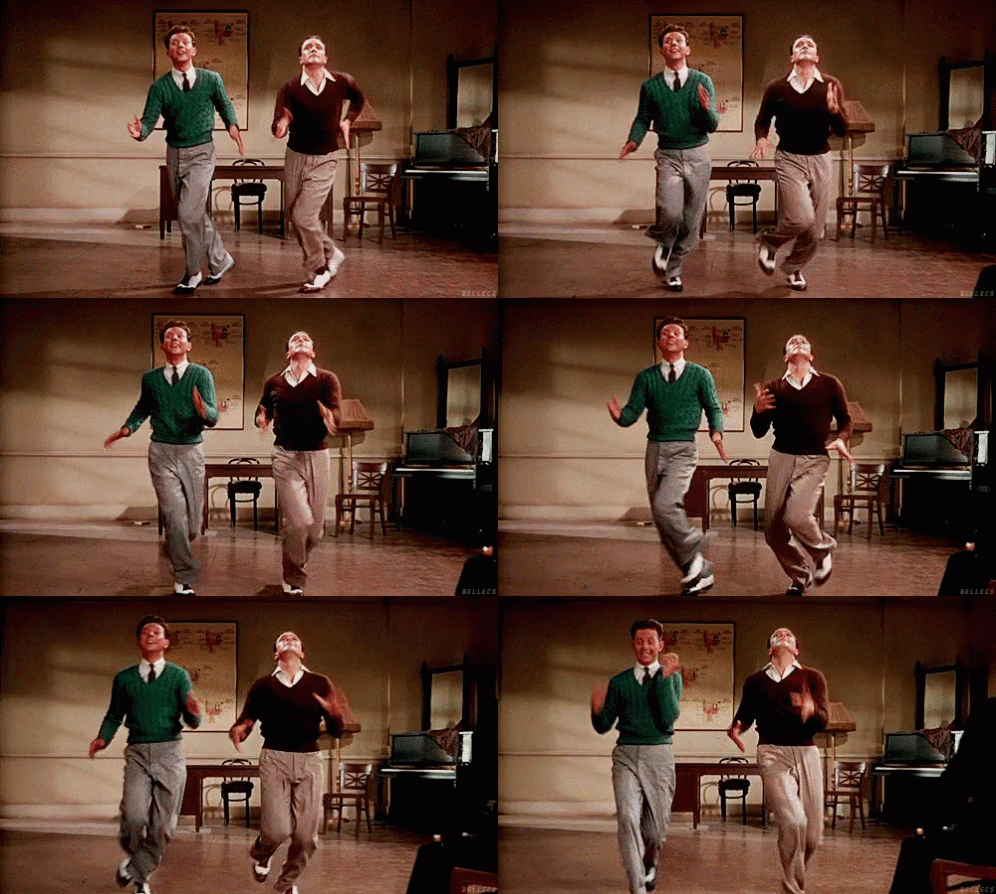
#9. Stanley Donen/Gene Kelly: Singin’ in the Rain (1952): 'the greatest of all Hollywood musicals’ (p274), the best satire of early Hollywood as cinema transforms from silence to sound with Gene Kelly in his best role, Donald O’Connor just as good, and effervescent (and very young) Debbie Reynolds, who are immeasurably aided by the beautiful Jean Hagen (‘I will sue!’) as the cunning egomaniacal silent star with the excruciating voice, Lina Lamont.
#8 Alfred Hitchcock: North by Northwest. There’s a moment when Cary Grant asks Eva Marie Saint, ironically: ‘Why are you so good to me?’ meaning the opposite, but of course she is impossible to resist. Grant is imperilled more than usually here, menaced by a crop duster and almost falling off Mount Rushmore. The film also has the incomparable James Mason at his suave oiliest and a score by the inimitable Bernard Herrmann. Why is it so good? All these ingredients with Hitchcock directing in his heyday.
#7 David Lean Lawrence of Arabia is ‘David Lean’s Oscar-grabbing masterpiece’ (p406). The first film I watched in the cinema, still standing up all these years later, a genuine epic where the landscape is just as striking as the galaxy of stars, none brighter than Peter O’Toole as Lawrence and Omar Sharif as Ali. The first notes of Maurice Jarre’s score will take you straight to the Arabian Desert.
#6 Yasujiro Ozu The Flavour of Greet Tea Over Rice (1952). A delicate marital story from the master of stillness Ozu, which I admire for its insight and observation. Not included in the compendium, one of two of my choices which miss out. But the director is well represented with Tokyo Story (1953), Floating Weeds (1959) and An Autumn Afternoon (1962) each one of which ranks high in my estimation.
#5 Zhang Yimou: Red Sorghum (1987) A muscular film of feudalism, legend and brave romance in China in the late twenties and early thirties with inspired performances from the strong–willed Gong Li and the powerful Wen Jiang as the audacious chair bearer. It is fabulous looking as well: ‘Many of Red Sorghum’s most striking features are visual: handsome ‘Scope compositions of landscapes and sorghum waving in the wind and a deft use of colour filters’. (p757)
#4 Akira Kurosawa: High and Low (1963) My chosen Kurosawa, and there’s a lot to choose from, is an unusually quiet, contemporary drama of a business man, Toshiro Mifune, faced with a fearful moral dilemma when his kidnapped son turns out to be the child of his chauffeur. Not selected for inclusion in this book but there are six Kurosawas which have been: Rashomon (1950), Ikuru (1952), Seven Samurai (1956), Throne of Blood (1965), Dersu Uzala (1974) and Ran (1980).
#3 Jean Vigo: L’Atalante (1934). Some of our best films can also be favourites and L’Atalante is one. Quite the most beautiful film about a newly married couple, a rather dour bargee and his sunny village bride walk from the church to the barge to make for Le Havre. In the view of Adrian Martin, the film is ‘the cinema’s greatest ode to heterosexual passion. One simply cannot enter its rapturous poetry without surrendering to the romantic oppositions between the sexes, comparisons rigorously installed at every possible level – spiritual, physical, erotic and emotional. It is only this thrill of absolute ‘otherness’ that can allow the agony of non-alignment between the lovers and the sublimity of their eventual fusion.’(p120) Jean Vigo made only three films before his untimely death from tuberculosis at 29, but two of them, Zero de Conduite (1933) and this one make it here.
#2 Billy Wilder: Some Like it Hot (1959) Billy Wilder boasts five entries and Some Like it Hot rewards repeated viewings. It is masterly in every way with satirical script by Wilder and IAL Diamond, principals at their peak (Monroe, Curtis and Lemmon), unremitting farce going in unexpected directions, gags aplenty, period authenticity (from 1929 Chicago following the St Valentine’s massacre to sunny Florida and a gangster convention). Some Like it Hot is as refreshing now as it ever was. As Angela Errigo suggests: ‘This legendary drag comedy is sensationally funny, fizzing from start to finish with smart situations, cleverly crafted gags, breakneck timing and terrific performances'. (p362)
And number one?
#1. Buster Keaton: The General (1926) Simply the greatest film ever made. Geoff Andrew concludes: ‘What makes The General so extraordinary is that it is superlative on every level…humour, suspense, historical reconstruction, character study, visual beauty, and technical precision…it comes as close to flawless perfection as any feature ever made, comic or otherwise.’ (p66) High praise, well merited.
The many stunts stem from the story and they are all Buster, with no trick photography. Many could have killed him. To take one example, Buster sits forlornly on the coupling rod (the horizontal bar linking the big wheels which drive the locomotive) and remains sitting as the train slowly starts, lifting him into the air, oblivious to what is happening until he realises then jumps off. In such circumstances the train wheels often spin, with a result you might imagine. Buster as the director had the driver practice until he could regularly start the locomotive moving without the wheels spinning. Heck of a risk. Take a look at Keaton’s stunt work, or a whole film, online.
The film would be great with just this but it also has Buster the master of the small gesture, the quizzical look and the brave face. He was a genius.
And there you have it; a great book full of marvellous films including eight out of my top ten. How would yours go?
PS: for the record, I have seen 504 of the 1001 films. Still time…
Since this list keeps getting updated, it's a bit of moving target, meaning that newer editions by necessity have to chop off even more older titles in order to accommodate the newer entrants. So, does this mean that movies on the older lists that haven't been forwarded to make the cut are no longer "movies you have to see before you die?" Hopefully, all of the lists are being referred to by the OCD list checkers.
I'm an insane movie nut, yet even I am not sure if you have to see any movies before you die, much less anything on these lists. For what they are, they are generally well-selected, possibly because in addition to the standard canon they have dipped into fare championed by eccentric but vital critics such as Jonathan Rosenbaum. There are commercial films on here that do not belong on this list, as they really don't need help in being seen; lists like these are only valuable if they champion the undeservedly obscure. Any list that would include puff like Beverly Hills Cop but not Sadao Yamanaka's Humanity and Paper Balloons (1937, Japan) suffers from the usual half-assedness. For every trifle on here I could cite dozens of greater films that are MIA. I'd say that any given edition of these lists is probably about 20 percent top-heavy, meaning that about that percentage of what's on them shouldn't be.
My count for the first edition of this list (2003) is 959 out of the target 1001 titles seen, which puts me of course in either the masterclass league or the nutcase league. (I have copies of all 1001 movies in my vast archive, so I can see them all whenever I choose.)
My strongest eras are the silent period through the 1960s, in which I've literally seen all but a handful of the titles. I think from 1930-1950 I've seen all but two. (I've seen more than 1001 titles from the silent movie period alone, which is not something too many living humans can claim).
By comparison, the later 2013 update finds me having seen only 918 of the 1001, and that's because my film viewing has dropped markedly over the past decade. Newer films from the 2000s are my blind spot, but thankfully the lists are not loaded down with all the crappy comic book movies that I hate.
I'm annoyed. Color me annoyed. Which is a shade close to mustard yellow.
1001 movies. ONE THOUSAND AND ONE MOVIES.
And they didn't include The Labyrinth. Or Mary Poppins. Or The Seven-Year Itch. Or a multitude of other movies that there is absolutely NO reason to leave off the list.
ESPECIALLY when I turned the page and saw the words "There's Something About Mary".
You're going to include a shitty-ass movie like that, which is not in any way funny, and you're going to leave off something as incredible as The Labyrinth?
I don't think so.
I plan to make a list of the movies I haven't seen yet from this book. But if I owned it, I'd toss it. It lost so much credibility when I realized they left out my movie.
I really like this book. It is arranged in chronological order from the 1900s to the present day. The films contained therein, are a real variety of genres and styles. There are reviews and information about many films I am familiar with, and a good few I am not. Each film is described by one of the contributors with details of the whys and wherefores it is included in the book. There are many foreign language films included in this guide including French, Russian, German, Italian, Japanese and Spanish films. A must buy for fans of cinematic history.
The book is fairly good into the 1980s, and then it totally falls apart.
Personally i would have preferred way more 1960s film, but it's one of the few books/lists anywhere to like the Czech Film 'The Ear'. Basically it got banned after it was completed in 1970, and came out in the 90s, but to deal with the subject matter of government wiretapping and state surveillance is as others have said 'it's amazing they got that far with it'. It would be like the Czech version of 'The Conversation'.
90% of the film picks are pretty fine, till somewhere in the 80s to the early 2000s where they just pad it with every trendy success and radically artsy film. Criterion Film can be trusted on making wise choices for recent cinema, Harold Bloom of Yale could be counted on picking 70s and 80s classics of Western Literature in the 1990s, but Schneider and his near half dozen henchmen, are just throwing in their pet fets, and nothing less.
If you think Passion of the Christ is as good as Blade Runner or La Notte, you got to be kidding. I almost wondered if the idea of the book was to add films appealing enough to the Gen X'ers and New-New World Cinema types, for 15% of the book, and then stitch on a fairly orthodox list of 874 classics of cinema.
it's like a novel where it's a nine out of ten, and the last 50 pages get a three out of ten.
Hearing that the new editions are pushing out the older films, basically makes me say, get the first edition and give the others the middle finger.
اشتراکات زیادی بین این لیست و لیست ۱۰۰۱ کتاب وجود داره، چون مسلما قصهی خوب بنای یک فیلم خوب هستش. راستش این رو هم کامل نخوندم و فقط لیست فیلمها رو برداشتم که ببینمشون.
I might have enjoyed this compilation more had the author made more of an effort to show some enthusiasm for the films mentioned. The writing style of this book is drier than eating Saltine crackers while drinking powdered milk in the Sahara desert. As a result, I found myself becoming frequently bored.
Also, I don't know if this was some sort of sick joke, but how is it that schlock like "Armageddon" and "There's Something About Mary" make the list of movies one must see before their death, yet great films like Charlie Chaplin's "The Great Dictator" are completely left off the list? Boring prose and trite picks for movies leave the quality and accuracy of this book something to be desired.
I love these kind of reference books on movies as it is interesting to see how my opinion differs, or is similar. Very easy to read and fun. I recommend this to all film buffs, or if you just need to expand your tastes in movies.
***I received a complimentary copy of this ebookfrom the publisher through Edelweiss. Opinions expressed in this review are entirely my own.***
I am not a huge movie person, but I wanted to see how many of these I have already seen, and I haven't seen very many. Movies just aren't my thing but these are the ones I have seen: Angels with Dirty Faces - 1938 Mr. Smith Goes to Washington - 1939 Wizard of Oz - 1939 Pinocchio - 1940 Casablanca - 1942 It's a Wonderful Life - 1946 Rear Window - 1954 Psycho - 1960 West Side Story - 1961 To Kill a Mockingbird - 1962 A Hard Day's Night - 1964 The Graduate - 1967 Cool Hand Luke - 1967 Woodstock - 1970 Willy Wonka & the Chocolate Factory - 1971 The Sting - 1973 The Exorcist - 1973 The Texas Chain Saw Massacre - 1974 Young Frankenstein - 1974 One Flew Over the Cuckoo's Nest - 1975 Rocky Horror Picture Show - 1975 Monty Python and the Holy Grail - 1975 Jaws - 1975 Carrie - 1976 Saturday Night Fever - 1977 Grease - 1978 Halloween - 1978 Apocalypse Now - 1979 Ordinary People - 1980 The Shining - 1980 E.T. - 1982 Gandhi - 1982 Breakfast Club - 1985 Ferris Bueller's Day Off - 1986 Children of a Lesser God - 1986 Fatal Attraction - 1987 Batman - 1989 Goodfellas - 1990 Dances with Wolves - 1990 Edward Scissorhands - 1990 Silence of the Lambs - 1991 Schindler's List - 1993 Forrest Gump - 1994 Lion King - 1994 Pulp Fiction - 1994 Shawshank Redemption - 1994 Braveheart - 1995 Toy Story - 1995 Casino - 1995 Se7en - 1995 Fargo - 1996 Titanic - 1997 Saving Private Ryan - 1998 Lola Rennt - 1998 Blair Witch Project - 1999 The Sixth Sense - 1999 Gladiator - 2000 Meet the Parents - 2000 The Pianist - 2002 Passion of the Christ - 2004 Downfall - 2004 Brokeback Mountain - 2005 Apocalypto - 2006 Borat - 2006 No Country for Old Men - 2007
I finished it. I would not recommend a cover-to-cover read; this book, ironically, became like a movie that had overstayed its welcome. It would be a great book for film buffs to turn into every few days and find a new movie for the evening. I'll stick to rewatching Peep Show.
Although I was unable to finish the book before I felt guilty and stopped abusing my librarian privileges to continually renew it, I found that it was an excellent book-covered "Bests" or "Greats" in every genre, time period, and country. As a serious movie buff it is often hard for any sort of movie list, even a "1001" one, to come up with stuff I haven't heard of before, but this book did just that; what's more they treated genre films respectfully and gave them their due. A friend said it was the perfect bathroom book and I tend to agree with him-not that the reviews are poorly written, but they are concise enough that you can pick it up and put it down easily and the wide range of films covered will ensure that almost anyone can find something interesting.
I'm not sure when one is allowed to mark this as read but I've read the introductions and ticked every movie I've seen so I'd say that's as close as I can get right now. From what I've seen the collection seems to be pretty solid, some of my favourite (especially newer) films are missing but as a guide for what to watch when you have no inspiration this is a wonderful source to get back to.
Sorted by specific genre at the start of the book, then laid out chronologically, and finally indexed alphabetically in the final pages, 1001 Movies You Must See Before You Die is an incredibly inclusive book. It was published in 2003, so the last movie included is 2002’s Chicago (also included as the image on the spine of the book), but Steven Jay Schneider has come out with several other editions, published in 2005, 2012, 2013, and 2015, so you can check those books out if you want a more modern list.
On each glossy page is a film still, the basic credits (writer, director, cast, Oscar nods, etc) and a few paragraphs about the plot and why it’s a must-see. The reason this 950-paged book is so great is because the contributors (over fifty people, credited in the beginning of the book) have really done their research. Foreign movies, silent movies, unknown movies, and really strange movies are included alongside blockbusters, Oscar sweeps, and classics. Granted, there are lots of movies in here that I would never want to see, but it’s a really cool list for movie buffs, and in particular, people who actively seek out obscure films.
This is a nice little (well, not exactly little) book that gives information on movies. I used it to make a list of movies I want to watch, so it was handy in that way. However, there were a couple of things I did not like about the book.
For one thing, none of the pictures were labeled. I know the pictures came from the movie being described, but it would have been nice to know who the actor was, who the character was, and maybe a little blurb about that scene.
The other thing that bothered me was that some of the descriptions were very dry. I suspect some of the movies I read about are actually quite good and worth seeing but I did not add them to my list because the description was so boring. Not good for a book claiming you must see these movies before you die.
An ok guide for films to watch, which is mostly filled with what you'd expect to see if you're watching movies.
What I did like is that it takes you chronologically from 1920s till 2010s, so that was something. Other than that and the fact that I did find a bunch of films from early 30s to late 60s that Ive never head of before ( and going to check them out ) the rest was pretty much what it is with some films that don't deserve to be over there simply because they made it to the box office.
Oh well!
I'd stay away unless you really want that cool cover. There's tons of lists all over the internet that are much better.
Virkelig imponerende indblik i film gennem de sidste hundrede år. Også ikke-vestlige film, og film der måske ikke er politisk korrekte at have med på sådan en liste - men som er vigtige for filmhistorien. Min Letterboxd er i hvertfald proppet nu.
Det ret dårlige ved bogen er så at den spoiler halvdelen af filmene, hvorfor man må læse hver anbefaling ret forsigtigt.
There are many great films on that list but also some not-really-that-good ones and I don't need to mention the fact that it's mostly centered on american cinema, so some people won't see many of their favourites but it's a decent work, compared to many other books of the series.
Of course it's no wonder when putting together a list as large as this one, one is bound to have several disagreements. It's the entire feeling of the list however that doesn't inspire me with enough trust to think Schneider actually knows what he's talking about and secondly, I'm not exactly sure that the films on this list are placed there by sound criteria. The choice that a particular movie's on there isn't always properly explained and several people on the internet cruising through Schneider's list have already complained some titles are impossible to come by, having only screened at a small festival way back in the day. It doesn't make for a particular interesting read, too. I'd much rather recommend Roger Ebert's 'The Great Movies', that isn't only explained in more detail, but better endowed with cinematic passion and written in a better fashion as well.
Again, a list of things I should do (or not do if I want to live forever?). I'm sure I haven't seen most of these. My spouse immediately fired up Netflix and began checking to see how many he could find there. Failing that, he's scouring the library. For his entertainment, I'd give the book a 5. 1900s - None. 1910s - I've seen part of one. 1920s - Two and part of a third one. 1930s - Wow - six! 1940s - Eleven, thank goodness for Disney. 1950s - Fourteen, mostly because someone here likes old Westerns. 1960s - Eighteen, I'm not doing as badly as I expected. 1970s - Whoa - thirty! (I was a teenager, can you tell?) 1980s - Thirty six, but I recall most of them from videos, not the theater. 1990s - Seventeen. We had small children and didn't see much, even on videos. 2000s - Two. Wow....Told you I don't watch many movies.
1) A star is fucking born??? Guess which version I'm talking about? Yes, it's the one where I'm hanging around with 98 other people....in the same room... during covid. But it's just to prove that the movie is shite and nothing we haven't seen before (srsly! it's like the fourth time we're seeing the same movie?)
2) Some movie credits are missing. But no worries, contributors have bios :)
3) With each update, older titles get replaced by newer. Which means movies in older versions that didn't make the cut are no longer "movies you have to see before you die"???
4) I just wanted to make this list longer, but never mind, it might get chopped later... like the classics ;)
I've flipped through this book and there's no way in heck I'll ever see all these films. Nor would I want to because I have a mind of my own. (And better taste!) But it was still fun to see what other people think everyone should see.
I'm considering this book finished because I've finished entering everything into a spreadsheet. The older sections of the list aren't so bad, but once you get into the modern era it's a very very very male list. Yeesh.
Mit diesem Buch sind lange Filmenächte vorprogrammiert. Einfach eine einzigartige Sammlung von Filmen. Mit diesem Buch wird sicher jeder Filmgeschmack mehr als nur befriedigend angesprochen.
Cinema, like other artistic mediums, has a storied history. 1001 Movies to Watch Before You Die is another book in this series and it focuses on movies. The edition I have found is from 2015 so it is slightly more recent. The editors of this project acknowledge that producing a list that is meant to cover all great movies is daunting, to say the least, even if one has 1001 spaces to fill. So a team of experts gathered together for this project and probably spent months determining what to leave out and what to leave in. Certainly, there are several movies that a list wouldn’t be the same without, but these are the ones that so many others have listed.
There are many that I would have included in such a list. Citizen Kane comes to mind but why? I have watched that movie before, but I don’t have the overall knowledge of movies to make that decision. That is where this book comes in. It gives a small synopsis of the movie, includes little bits of trivia, and discusses the people who went into its production. Take a movie that would receive a lot of raised eyebrows with the recent protests in the United States; Birth of a Nation. I have never watched this movie, but according to the essay paired with its listing in the book, I can see why they include it. The director introduced so many new techniques that make you disappointed that it had to be from such a movie. It even has historical context since it was the first movie played at the White House for President Woodrow Wilson.
The book also includes other little tidbits that you might have heard of before. It’s a Wonderful Life is a holiday classic, but it wasn’t always like that. The movie received lackluster reviews and was largely forgotten until the copyright expired and television stations showed it every year during the Christmas holidays. Take The Ten Commandments as another example; the uncredited voice of God from the Burning Bush is done by Charlton Heston. Don’t be fooled into thinking that the book only covers American Movies, however. The book goes all over the world, finding respectable entries from all sorts of genres and countries.
Some movies were left out, but this makes sense. You can always make your list of movies, and this particular list just happens to be done by experts in the field. I could even list the ones I have watched for some fun trivia. For example, did you know that I have only watched the first Toy Story movie? Shocking, I know, but I never got around to the sequels.
The movies in the book are organized chronologically. There is one major complaint I have with the design of the book. On the edge of the page, it tells you what year the movie came out and has a color-coding for the decade. The color coding is at the same level making it a bit confusing. If it were me, I think I would have had it in steps, where the first decade is at the top and the next decade is slightly lower and so on through the decades. This would make it so that you can easily get to a decade you want to find.
So in short, if you love movies this is a good book to read; if you don’t enjoy movies I don’t know why you chose this book. It is an unbeatable combination of informative and enjoyable.