We live in a world where businesses can transform overnight, and signs of change can be found long before an industry shift happens.
Most people just don't know how to see them.
After a career spent helping brands anticipate what's coming next across healthcare, technology, and other rapidly evolving sectors, I've learned that the future doesn't arrive suddenly. It arrives quietly. It shows up first in the subtle ways people talk, the small changes in what they value, and the emerging behaviors happening at the edges of culture. By the time the shift hits the mainstream, the opportunity has usually passed.
This book is your guide to spotting those early signals before anyone else. It's a practical, accessible roadmap that teaches you how to train your perception-not with more data or trend reports, but with a sharpened ability to notice what most people overlook.
Inside, you'll learn the FUTURE Framework, a clear and actionable method designed to help marketers, leaders, creators, and builders recognize what's moving beneath the
- Find Signals by paying attention to the margins where new ideas take shape - Understand Meaning to uncover what those signals reveal about changing needs - Transform Assumptions that limit imagination or reinforce outdated thinking - Unlock Patterns by connecting small signals into larger forces of momentum - Render Scenarios that map the possible directions the future may take - Execute and Embed so insights turn into action-and your organization stays ready
Whether you're guiding a team, building a brand, or simply trying to stay relevant in a world that won't slow down, this book shows you how to see around corners with confidence. You'll learn how to capture the small truths hidden in everyday behaviors, make sense of emerging shifts, and turn insight into a strategic advantage.
The future isn't far away. It's already unfolding all around you.
This book teaches you how to recognize it-and use it-long before the rest of the world catches up.
Christina Diane Warner is an award-winning marketing leader, author, and AI -native strategist who builds the systems that drive growth.
With an MBA from Duke University's Fuqua School of Business, Christina has led product marketing and go-to-market campaigns across SaaS, cybersecurity, healthcare, CPG, and e-commerce for brands including Cloudflare, Walgreens, Northwestern, SketchUp, and Northbeam. Her work has earned a Hermes Creative Platinum Award, a Digiday Future Leader Award Finalist, and two Axiom Business Book Awards.
She is the author of two books -- The Art of Healthcare Innovation and Future -- and her writing and expertise have been featured in Forbes, Fast Company, U.S. News & World report, Apple News and Thrive Global.
Today, Christina operates at the intersection of marketing strategy and applied AI, building workflows and tools that turn manual marketing processes into scalable systems.
The Future Doesn’t Arrive Loudly – It Arrives Quietly: What “FUTURE” Taught Me About Signals, Meaning, and Acting Before Everyone Else By Demetris Papadimitropoulos | February 4th, 2026
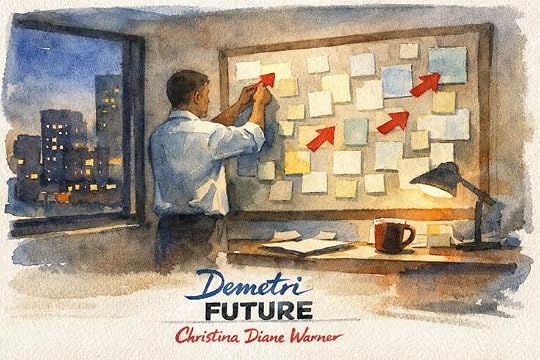
Watercolor Piece by Demetris Papadimitropoulos
There’s a particular kind of modern dread that doesn’t quite qualify as fear but behaves like it: the sense that the world has begun changing in ways you can’t quite name, and that by the time your meeting deck catches up, the story will have already moved on. “FUTURE: How Adaptive Leaders Anticipate Change, Decode Signals, and Build What Comes Next,” by Christina Diane Warner, is written for the people tasked with turning that dread into something useful – the executives, marketers, product leads, founders, and mid-level managers who have discovered that “staying ahead” has become less a posture than a physiological demand.
Warner’s premise is disarmingly simple: the future does not arrive with trumpets. It arrives quietly, first as an awkward new behavior in a niche community, a new phrase that feels too specific to be accidental, an emerging discomfort people can’t stop circling, a small workaround that begins to look like a lifestyle. The tragedy – and the opportunity – is that most organizations are built to notice only what is already obvious. And so, in Warner’s telling, foresight becomes not a gift but a practice: a set of repeatable behaviors that trains attention, builds shared language, and turns faint movement into decisions before the movement becomes a stampede.
This is, on paper, familiar territory. The business shelves are crowded with books that promise to help you see around corners; you can draw a bright line from “The Lean Startup” to “Good Strategy Bad Strategy,” from “The Signal and the Noise” to “Thinking in Bets,” from “Crossing the Chasm” back to “Diffusion of Innovations.” What distinguishes “FUTURE” is less the novelty of its ingredients than the unusual confidence with which it insists you cook dinner on a Tuesday night. Warner isn’t offering a grand theory so much as an operating system. The book’s central acronym – Find signals, Understand meaning, Transform assumptions, Unlock patterns, Render scenarios, Execute and embed – reads like a corporate training module until you begin to see what she’s actually attempting: to turn a vague aspiration (“be future-ready”) into a discipline you can calendar, document, and teach.
Warner’s tone helps. She writes with a kind of impatient warmth: direct, conversational, often funny in the way of someone who has spent enough time in conference rooms to distrust their promises. She does not court the serene authority of the academic futurist; she courts the restless intelligence of the operator. Her sentences tend to stride rather than stroll. She repeats herself often, but repetition is part of the method: a drill sergeant of perception, she wants key ideas to become reflexes.
The early chapters argue that signals begin at the edges – in subcultures, in niche communities, in the experimental corners of platforms where identity is performed and stress-tested. It’s a persuasive claim, and it lands differently in a moment when the “mainstream” has become less a place than a lag. Online micro-communities can turn a feeling into an economy before a legacy brand has even noticed the language. Warner’s attention to emotion is particularly sharp here. She insists that adoption is rarely a purely rational process; it is propelled by belonging, rebellion, frustration, desire for control, the relief of being seen. In other words, the first clues are not always in the numbers; they are in the charge behind the behavior.
That emphasis feels calibrated to the last few years of cultural whiplash. In a world where generative AI tools can redraw the creative economy overnight, where platform policies can reorganize entire livelihoods with a change log, where privacy anxieties and authenticity hunger can coexist inside the same user, leaders are forced to interpret not only what people are doing but why it suddenly matters. Warner treats that “why” as the real data. The future, she suggests, is not merely a collection of trends; it is a series of desires seeking form.
From there, “FUTURE” becomes an argument about attention. Warner introduces the reader to the idea that the brain is designed to conserve energy, to prefer the familiar path, to ignore what doesn’t fit the current model. She frames this as a leadership problem: the more successful you become, the more your mind calcifies around the patterns that earned your success. In her vocabulary, this is cognitive rigidity – the moment when expertise becomes a barrier rather than a tool. It’s a compelling diagnosis, especially now, when experience can age fast. Entire categories have been reshaped by shifts that reward the nimble and punish the complacent: streaming and the collapse of old distribution logic, remote work and the redrawing of workplace culture, the acceleration of creator economies, the reconfiguration of consumer trust amid misinformation and endless content. You can sense Warner writing with these pressures in mind, even when she keeps her examples broad.
Her most useful contribution may be the insistence that “meaning” is not automatic. Seeing a signal does not tell you what it means, just as watching a crowd run does not tell you what they’re running from. Warner proposes a practice of meaning-making that is, essentially, a way to keep teams from turning every novelty into a prophecy. She recommends logging what you notice, tagging it with its emotional pull, tracking whether it appears across domains, and resisting the temptation to mistake virality for durability. This is the book’s quiet rebuke to a culture of reactive management – the leadership style that treats every spike as destiny.
If “FUTURE” occasionally resembles a more streetwise cousin of “Thinking, Fast and Slow,” it’s because Warner is fascinated by the ways our minds rationalize what they already want to believe. She understands how an organization can convince itself that its model is the model. Her answer is a set of interrupts: curiosity, humility, a willingness to reevaluate beliefs, and, crucially, inversion – a thinking tool that asks you to flip your assumptions and see what breaks.
Inversion is one of those ideas that seems obvious until you try to do it. Most teams ask, “How do we make this work?” Warner asks, “How does this fail?” “What if the opposite is true?” “What if our strongest belief is our greatest weakness?” In a world increasingly shaped by second- and third-order consequences – the way a convenience feature reshapes labor, which reshapes trust, which reshapes behavior – inversion becomes less an exercise in pessimism than an exercise in honesty. It forces you to name the conditions that would invalidate your plan. It turns hidden arrogance into visible risk.
Here the book becomes surprisingly moral, though Warner would likely reject the term. She argues that leaders miss signals not because they are stupid but because organizations are designed to edit discomfort. Hierarchy filters truth. Information moves upward through layers that soften the message to protect the sensibilities of the powerful. By the time a signal reaches leadership, it has often become safe – and therefore late. Warner’s recommendation of “reverse mentorship,” structured relationships with younger or edge-positioned people who live closer to emerging language and behavior, is framed not as a diversity performance but as an information system. If you cannot access the raw signal, you cannot act early. If you cannot act early, you are condemned to react.
There is a tension here, and Warner mostly handles it. “Reverse mentorship” can easily become extractive, a way of buying proximity to youth without respecting it. Warner warns against systematizing the relationship into emptiness, against turning the mentor into a vending machine of “insights.” She pushes for the kind of repeated conversation that builds trust, where the point is not to harvest but to understand. In a corporate culture that often treats people as inputs, this insistence on relationship feels unusually grounded.
Once Warner moves into Part IV, she becomes more technical, though she keeps the math at the level of a whiteboard rather than a dissertation. This section – on momentum – is where “FUTURE” tries to protect readers from two temptations: chasing what is already big, and dismissing what is still small. She introduces the S-curve of adoption (emergence, acceleration, maturity, saturation) and argues that the crucial skill is spotting inflection points: the moment when the curve shifts shape. Her admonition is blunt: prioritize velocity over volume. Volume tells you where energy used to be. Velocity tells you where it’s going.
That distinction, while hardly novel, is delivered with a practical clarity that makes it usable. Warner offers proxy metrics (search volume, social mentions, creator usage, community growth) and encourages teams to track consistency rather than perfection. In a time when dashboards can become digital junk drawers, her minimalism is refreshing. She is more interested in slope than spectacle. “FUTURE” is, at heart, suspicious of anything that makes you feel certain without making you smarter.
Warner goes further, into stacking and convergence – the compounding of advances that makes early change look slow, then suddenly explosive; the blending of separate technologies and cultural forces into a new baseline. In her telling, the world is increasingly shaped by collisions: not only between tools, but between narratives. When two rising story arcs overlap, a new category meaning can form – a “whitespace” where organizations can position themselves before the market catches up. This is the part of the book that sounds most like a marketer speaking to marketers, and sometimes the examples feel a touch slogan-ready. Yet the underlying observation is sound: language often changes before budgets do, and if you can track language shifts, you can see where demand is moving even before it can be quantified.
The AI chapters arrive as both promise and warning. Warner treats large language models as perception extenders – tools that can scan vast conversational terrain, detect semantic drift, and flag early movement. But she is careful to remind readers that these systems can hallucinate, misread, and amplify bias. Her posture is not techno-utopian; it is pragmatic. Use the machine for scale, but keep a human for meaning. In an era when executives are tempted to outsource judgment to the nearest algorithm, this insistence on discernment feels like a quiet act of resistance.
Part V, on scenarios, is where Warner tries to rescue imagination from the realm of creativity theater. She argues for thinking in possibilities rather than probabilities – a useful distinction in a time when the past no longer behaves like a reliable map. Probability thinking, she suggests, keeps you tethered to what seems likely based on what has already happened. Possibility thinking opens room for low-probability, high-impact outcomes – the weird futures that break categories and reorganize habits.
Her tools here – the pivot lens, alternative pairing, scenario mapping – are familiar to anyone who has sat through a foresight workshop, but Warner’s strength is in making them feel less like an off-site and more like a practice you can run inside your existing constraints. She encourages teams to stress-test plans across divergent futures, to identify durable themes, to mark opportunity zones that persist across scenarios. The insistence is again on action: imagination is valuable only insofar as it changes what you do next.
It’s in Chapter 10, on implications, that Warner most explicitly addresses our current appetite for outrage and reaction. First-order thinking stops at the immediate effect – a tool launches, people try it, the story ends. Second-order thinking follows the chain. Warner’s point is that the real stakes live in the cascade. A new convenience changes labor. Labor changes trust. Trust changes willingness. Willingness changes adoption. Before you know it, an “innovation” has reshaped the category’s logic. She frames this as “category inversion” – the moment when the old rules no longer match what people value. Ownership becomes access. Features become experience. Utility becomes identity. The category splits; a new one forms beside it. If you can see that split forming, you can choose where to stand.
For all its frameworks, the book’s most persuasive chapters may be the last ones, where Warner insists that foresight is meaningless if it lives only in one person’s head. “FUTURE” becomes, here, an argument about organizational memory. She recommends weekly Signals Reviews – short, repeatable meetings where each person brings two signals, logs them in a shared system, and tags them as rising, steady, or fading. She proposes scanning cadences based on role: weekly for those closest to culture, monthly for leaders, quarterly for slow-moving forces like regulation and demographics. She suggests small “foresight pods” – cross-functional groups that cluster signals, map implications, propose short trials, and then hand insights to the teams responsible for building.
What Warner is doing, implicitly, is challenging the myth that strategy is a document. She is reframing strategy as a rhythm – a set of repeated behaviors that trains attention and reduces surprise. Her dashboard advice is similarly austere: leaders need to see what’s moving, how fast it’s moving, and what it might mean in the next week. If it doesn’t fit on one screen, it’s not a foresight dashboard; it’s a mausoleum.
There are weaknesses, and they are worth naming, because a review that treats a business book as scripture is not a review so much as a brochure. The neuroscience sections, while lively, lean toward pop explanation and metaphor, occasionally smoothing complexity into a story that behaves too neatly. The book’s style can be repetitive to the point of bluntness; Warner favors the hammer over the scalpel, and sometimes you wish for an example that surprises rather than reassures. The tool recommendations will also age – the market of “signal detection” platforms changes quickly, and what looks authoritative today can look quaint tomorrow. In that sense, “FUTURE” resembles “The Lean Startup” in an important way: its durable value is less in its specific references than in the habit of mind it tries to build.
Still, the book’s best argument is also its most humane: leaders are not merely thinking machines. They are nervous systems operating under pressure. Warner’s final chapter insists on emotional regulation as strategic advantage. Stress labeling, emotional rehearsal, daily reflection, weekly vision checks – these are presented not as wellness platitudes but as decision hygiene. If you cannot regulate, you cannot perceive. If you cannot perceive, you cannot act early. The advice can feel simple, even obvious, but simplicity is part of its force. In a culture that glamorizes speed and certainty, Warner is asking leaders to cultivate something quieter: attention.
Perhaps the book’s most memorable exercise, the “5-Minute Sensory Sweep,” makes this argument in miniature. Train yourself, once a day, to notice micro-movements, buried sounds, subtle shifts in temperature, the tiny irregularities your brain has learned to ignore. Warner’s point is that our lives – and our screens – have dulled our senses. We have become fluent in noise and clumsy with nuance. “FUTURE” is, in its way, an attempt to restore nuance, not as an aesthetic virtue but as a competitive edge.
There is something bracing about a book that refuses to romanticize foresight. Warner’s future is not a shimmering destiny; it’s a set of signals and pressures and desires that can be tracked, interpreted, tested, and acted upon. The book’s greatest strength is its insistence that the work is doable – not glamorous, not mystical, not reserved for the visionary founder with the genius brain, but doable by a team with a shared sheet, a weekly meeting, and the discipline to log what they see.
That practicality is also what gives “FUTURE” its relevance now. We live in an era of overlapping shocks: rapid AI acceleration, regulatory uncertainty, trust fractures, cultural polarization, supply chain fragility, shifting workplace norms, new health technologies reshaping identity and consumption, and a media environment that rewards the loudest story rather than the truest one. Against that backdrop, Warner’s message is almost quaintly radical: slow down just enough to notice what’s actually changing, and build a system that lets you act without waiting for perfect proof.
If “FUTURE” doesn’t always deliver the literary pleasure its title might promise, it does something rarer for its genre: it respects the reader’s time. It offers frameworks that can be used Monday morning, without requiring a consultant’s vocabulary or a retreat budget. It insists that the future belongs not to the loudest predictor but to the earliest perceiver – the person, and the team, willing to sit with ambiguity long enough to learn from it.
As a piece of leadership writing, it lands as a confident, often sharp, occasionally repetitive manual that treats perception as a trainable skill and strategy as a living practice. It is not perfect, but it is uncommonly actionable, and it earns its place among its comp-title peers by being less a philosophy than a set of drills. I’d rate it 80 out of 100 – a brisk, useful, and at times genuinely clarifying book whose greatest gift is not prophecy, but a method for becoming less surprised.