“I loved this book! Havelock and Sebastian are such great company, brilliant, approachable, fascinating, their relationship is real and touching and relatable. And the mystery is riveting.” ―#1 New York Times bestselling author LOUISE PENNY
Meet Havelock Harper, gentleman detective. Dapper, delightful, and decidedly queer, he's here to solve your most magical mysteries.
Everyone in England knows Havelock Harper, the celebrated consulting detective from the papers. But if any of them read his private files, they would discover secrets that must never reach the public eye―extraordinary cases, impossible crimes, and a committed love affair with his formidable companion Major Sebastian Wright.
And their next case might be the queerest yet.
Havelock and Sebastian have been summoned to investigate the murder of the Duke of Farleigh. When they arrive at the scene of the crime ― a secluded, enchanting forest ― they discover that the victim is a tree!
The trees of Farleigh have begun to write words in their bark and branches, expressing themselves for all to read. The Duke is an ancient chestnut, cruelly chopped down, and to the villagers of Farleigh, he is a beloved friend. They want justice.
Havelock and Sebastian must use all their wits and wisdom to find the murderer who has shattered the peace of Farleigh.
Oliver K. Langmead writes speculative fiction. His verse-novel, Calypso, was shortlisted for a Hugo Award, and named one of the best Science Fiction books of 2024 by Esquire Magazine and The Guardian. His previous novel, Glitterati was shortlisted for a British Fantasy Award, and named one of New Scientist’s best Science Fiction books of 2022. He is a Lecturer in Creative Writing at the University of Lancaster, and in late 2018 he was the writer in residence at the European Space Agency’s Astronaut Centre in Cologne.
I still can’t believe gay Sherlock Holmes is getting two stars from me, but I just didn’t enjoy this as much as I thought I would.
Half the reason is the second person pov. It was very distracting and I hated it. This is basically a story within a story, which would have been fine if it wasn’t 1) a novella and 2) split between second person in the present chapters and first person in the past.
The other half is that the story didn’t pull me in. We get two romances and two mysteries instead of one, and for a book under 200 pages there was too much going on for anything to be well fleshed out. I also zoned out when the reveals began. Like, what do you mean Havelock goes on a 40 minute monologue explaining the mystery? You can’t be serious!!!
I was going to give it 3 stars but seeing as I didn’t even want to go back and check what I missed is a clear enough statement as to me not liking this book or caring enough about the main mystery to know what happened.
✎ᝰ. pre-read: If Sherlock Holmes was gay :)) gorgeous cover too!
💌 Thank you to NetGalley and Macmillan Audio for the alc!
If you ever wished that Sherlock Holmes was a little more magical and much more gay, this is the book for you. Havelock and Sebastian have a Holmes/Watson dynamic, except they are also lovers. Formatted as a story within a story, we follow side characters seeking Havelock's help, and read a manuscript sent to them that follows a case involving poet trees. It's got a bit of magical realism and is incredibly cozy and charming and joyfully queer. I received a copy of this book for review from the publisher, all opinions are my own.
I didn't know what I wanted to read next so I hopped to this late October release billed as a light fantasy x queer Sherlockian mystery. And I am not disappointed that I did, because this was really nice! A night watchman begins finding flowers left around the factory where he works. His coworker encourages him to visit the great detective Havelock and his roommate/sidekick Sebastian. Havelock immediately knows the answer to the watchmen's mystery, but instead of solving it right then and there gives them an unpublished "adventure" of his own. (This feels so Sherlock Holmes it hurts and I loved it.) Here's where the fantasy comes in: the other, unpublished, mystery focuses on a land where the trees have begun growing words on their branches and trunks. Havelock and Sebastian were called in to find out who cut down the Duke, the oldest and most communicative of the trees. Is it a crime against nature? Against magic? Who in the tight-knit community would murder one of its oldest and most venerated members? And what does it have to do with the frame mystery? Maybe it has to do with the fact that Sebastian's manuscript, since it's unpublished, is much more explicit about his relationship with his "roommate" Havelock. The trees' urge to communicate helps foster the same urge for all of the men, Sebastian & Havelock and the two watchmen, to communicate their true emotions to each other. This is slow moving and contemplative but still has plenty of suspense: it's my kind of cozy. This objective review is based on a complimentary copy of the novella.
A short and sweet cozy mystery but a bit shallow. It rests really heavily on the familiarity of the Holmes/Watson dynamic without doing enough to build up its own characters. And the mystery was just the wrong side of silly/fanciful for me. I do think I will read the next installment though because I enjoy a fun historical read with a hint of romance.
Thanks to NetGalley and Macmillan Audio for the ARC. It hasn't affected the contents of my review."
I went to see John Green speak on his tour for Hollywood, Ending last Thursday, and at one point point in his talk, he said there are two types of people as you hit fifty years old: you either turn into a tree person or a bird person. I believe that I am turning into a tree person (I've read too much Tolkien, I think). So this is the perfect book for me: a murder mystery that is about the murder of a tree! (It's a magical semi-sentient tree.) Also, it's a Sherlock Holmes pastiche where our Holmes (Havelock Harper) and Watson (Major Sebastian Wright) are queer and in a long-term relationship.
There's also a really cute little frame story (which: beware is told in second person, but there is a reason for it). I rarely think a frame story is necessary, but here it mostly is! And again: very cute.
The audiobook narrator was great. Will definitely be reading on in the series, and purchasing hard copies for my shelves.
The Killing of a Chestnut Tree by Oliver Kay Langmead is a short, charming little historical mystery with a cozy atmosphere, a touch of the fantastical, and a queer spin on the classic Sherlock-and-Watson detective dynamic.
Detective Harper travels to Farley to investigate the murder of the Duke of Farley, but upon arrival, things are already considerably stranger than expected: instead of a body, there is a chestnut tree that has been chopped down. That magical element gives the mystery a whimsical quality that fits nicely with just how cozy this story is.
The mystery itself is approachable and entertaining, and I really enjoyed the characters, particularly the relationship between our two central men. The LGBTQ+ representation adds something fresh to a very traditional historical-mystery setup. This is definitely more interested in being charming than dark or gruesome.
I listened to the audiobook, which is quite short and makes this an incredibly quick read. I thought the performance was good, with a wonderfully pronounced, Margaret Thatcher-level British accent that only added to the overall atmosphere.
Ultimately, though, I found the story a little shallow. With such a short runtime, there simply wasn’t enough space for the characters, relationships, or mystery to develop as deeply as I would have liked. I enjoyed my time with it, but I wanted just a little more substance.
Still, if you’re looking for the coziest of cozy historical mysteries—especially something short, queer, whimsical, and easy to settle into—The Killing of a Chestnut Tree is a lovely little read.
⭐️⭐️⭐️ 3/5 stars
The Killing of a Chestnut Tree is expected to be published October 27, 2026. Thank you Macmillan audio!
Murder, Moustaches, and a Highly Inconvenient Chestnut Tree Oliver K. Langmead gives the Holmesian mystery greener ambitions in “The Killing of a Chestnut Tree,” where even the clues refuse to stay merely decorative By Demetris Papadimitropoulos | October 16th, 2026
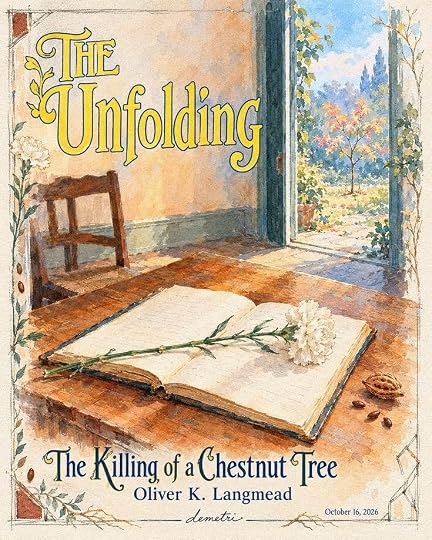
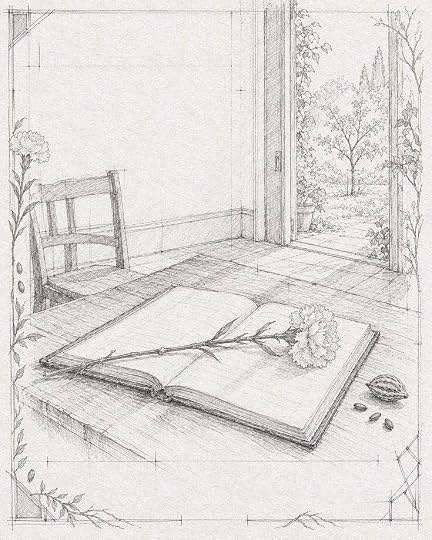
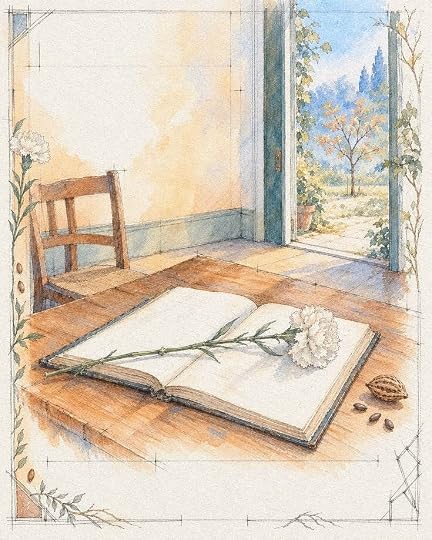
An open manuscript, a white carnation, seeds, and a garden threshold turn reading into a passage from evidence toward inheritance.
Detective fiction tends to flatter attention. Look closely enough, it promises, and the world will yield its secret. Oliver K. Langmead’s “The Killing of a Chestnut Tree” keeps that pleasure while worrying at the moral confidence beneath it. Havelock Harper notices fabrics, gait, wounds, maps, handwriting and lies; Major Sebastian Wright records the deductions. Yet the novella keeps returning to what happens after something has been seen correctly. A tree may cease to be timber and become a victim. A flower may cease to be evidence and become courtship. A friendship may reveal itself as love. And a secret, if the wrong person understands it, may become something to seize.
Emmet Parson, a night watchman at a Hackney cotton mill, receives the first lesson. He and fellow watchman Henry adore Havelock’s newspaper cases, so when unexplained white carnations begin appearing during their rounds, Emmet nervously carries the problem to 55 Gower Street. He apologizes for its smallness. Havelock will not allow it: “It’s never silly. Never.” He names the case “The Flowers of Cavendish Mill,” asks Emmet to investigate properly, then privately admits that he already knows the answer. “Sometimes,” he says, “the unfolding of the mystery is far more important than its solution.” At first it sounds like a famous detective indulging a fan. The rest of the book takes him more seriously than that.
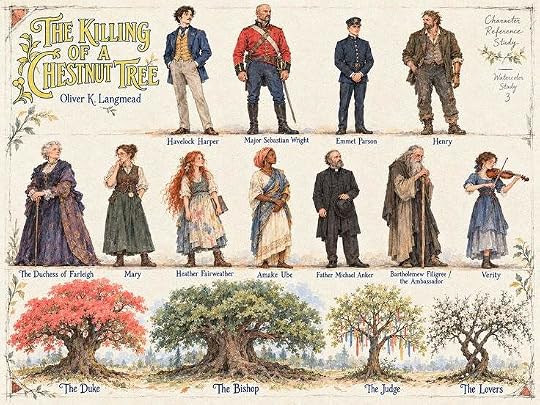
Much of the novella’s design follows from Havelock’s refusal to solve Emmet’s case for him. Instead, he sends an unpublished Sebastian Wright manuscript about a stranger investigation. The Duchess of Farleigh has summoned the pair north after the Duke is struck with an axe and crashes through a conservatory roof. The Duke turns out to be an ancient chestnut tree. Farleigh’s residents mourn him as one of their own. The village itself looks poor and neglected, though some of that decrepitude is carefully maintained camouflage. Then Havelock discovers the stranger fact: words are appearing throughout the surrounding forest, grown into bark, roots, branches and even shadow.
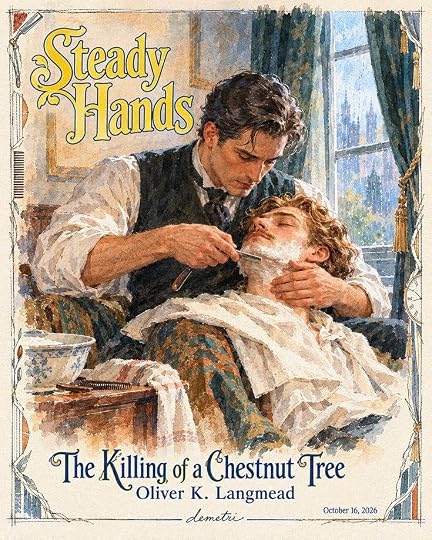
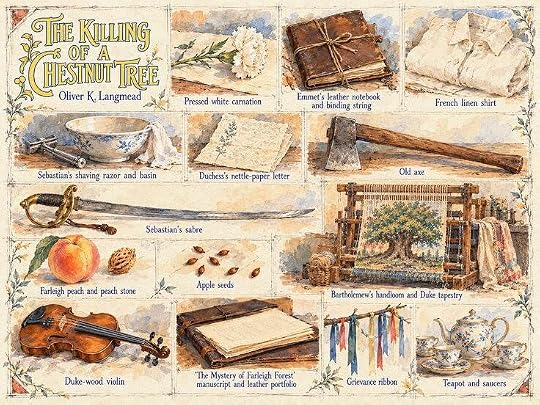
Even before the trees speak, Sebastian’s manuscript begins with a quieter failure of communication. He and Havelock have been together for roughly fifteen years, but a previous case has left them unable to regain their old candor. Sebastian shaves Havelock while worrying that tension in his hand might make the razor slip. The curtains are closed so no one can see them. A domestic ritual that once signaled ease now contains a small possibility of injury. Later, beside a pond in Farleigh, Havelock recalls having once been lost beneath the Mississippi and says of their recent estrangement, “I keep waiting for you to take my hand.” Sebastian takes both. Langmead lets the metaphor finish as touch.
Behind closed curtains, a razor held steady over a trusted face turns domestic ritual into an image of intimacy, fear, and care.
The prose suits such moments because Sebastian is a collector of physical particulars. Cloth, fruit, rain, grooming, leaves, food, furniture: he notices what things feel like before deciding what they signify. A French linen shirt can be comic characterization, class marker and gift. Pots and bowls catching water inside Farleigh House turn a leaking roof briefly musical. His sentences have a mild nineteenth-century seasoning without trying to counterfeit Victorian prose. They are companionable, observant, occasionally digressive. Langmead seldom reaches for linguistic fireworks. He does something harder to sustain over a whole novella: he gives the language the same patient temperament as the people at their best.
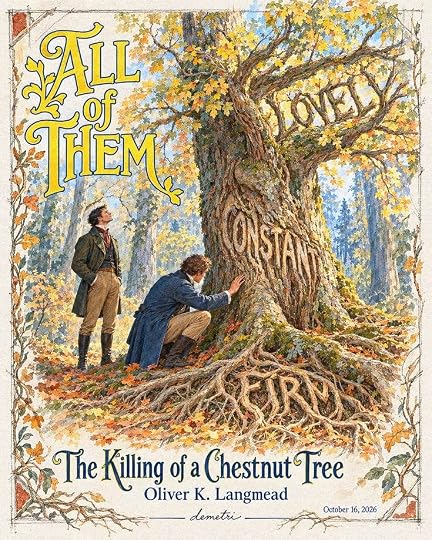
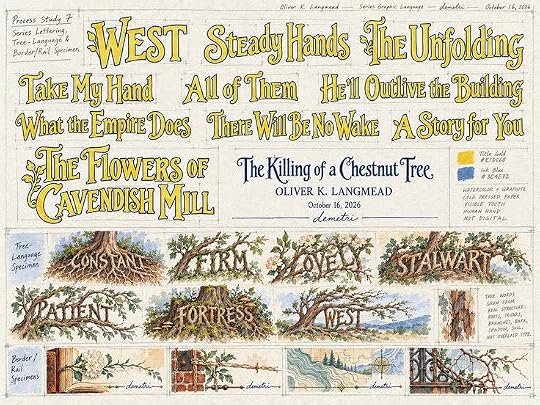
Reading the trees makes the page itself participate. Havelock asks Sebastian what he sees in a hornbeam, and ordinary paragraphic prose suddenly gives way to isolated capitals: CONSTANT. FIRM. LOVELY. The eye has to stop. What first appears to be accidental pattern becomes vocabulary as similar marks recur across roots and branches. Sebastian asks what it means and how any of it can be possible. Havelock answers, “I don’t know. But isn’t it wonderful?” Notice the order: Havelock asks Sebastian to look before he offers a theory. Much later, the capitals acquire a history. The stones of an unfinished cathedral were carved with theological and occult writings, buried, and eventually penetrated by roots. Human language disappears underground and comes back altered, alive in a form its makers never planned.
Havelock and Sebastian read CONSTANT, FIRM, and LOVELY in living wood as Farleigh’s forest crosses the line from scenery into speech.
In the interludes, another reader starts changing. Emmet and Henry consume Sebastian’s manuscript during their night shifts, and Emmet is startled less by the detective mechanics than by the private Havelock and Sebastian, far more intimate than their respectable newspaper versions. He has been taught to regard love between men as criminal and disgusting. Yet the men on the page look tender, trusting, ordinary in the most radical sense. Emmet does not instantly acquire a polished vocabulary for himself. He simply discovers that the vocabulary he inherited is no longer adequate.
Precisely there, the frame earns its keep. Emmet does something because he has read the inner story differently. The Farleigh mystery helps him solve the carnations, and Havelock and Sebastian help him reconsider feelings he had habitually classified as admiration. Henry has planted the flowers because he knows Emmet loves mysteries and wanted to give him one of his own. The result is less a revelation than a re-reading of evidence already present. An older couple’s hidden life has supplied a younger man with an example his world had refused to give him. One possible life becomes visible, and another becomes thinkable.
At Farleigh, being visible is considerably more dangerous. Schoolmistress Heather Fairweather is appalled that the Duchess has invited outsiders into the village at all. Farleigh’s apparent decline is partly theater: seem poor, remote and useless, and imperial Britain may not bother to look closely. Heather imagines what would happen if it did. The trees would be uprooted, displayed, their words cut out and framed. Havelock’s attention dignifies Emmet’s tiny mystery. Another kind of attention would turn Farleigh into inventory. “Look closely” cannot be the whole moral program.
Pressed against that problem, the book’s long romance is most convincing when it stays bodily. Havelock repeatedly admires Sebastian’s hands. Henry’s prosthetic hand makes Emmet’s early offer to sew on his missing buttons unexpectedly intimate. Bartholemew Filigree’s hands tremble after the axe work that fells the Duke. Hands shave, stitch, weave tapestries, hold lovers, plant seeds and injure trees. The recurrence never pauses to announce itself. It simply accumulates until touch has become one of the book’s measures of character: having understood another life, what will you actually do with your hands?
Across the novella, writing behaves just as materially. Newspapers, notebooks, letters, carved stones, tree words, tapestries, telegrams and private manuscripts all control who may know what. Public print makes Havelock and Sebastian safe silhouettes, detective and companion; Sebastian’s private manuscript restores the lover hidden inside the companion. The forest’s words make nonhuman experience harder to dismiss, but they also make the trees newly vulnerable to anybody who can read them. A message is never only a message here. Its medium determines its audience, and its audience may be friend, witness, collector or threat.
Detection loses some of its glamour once Havelock has gathered the facts. He is superb at establishing what happened, but he turns to Sebastian when the question becomes what ought to happen next. Sebastian is not simply the admiring chronicler who needs the detective to explain the world. He is the person Havelock trusts when deduction reaches its moral limit. The arrangement quietly revises the usual Holmesian hierarchy. Being correct about another person is not the same thing as knowing what justice requires.
In a July 2026 interview with Patricia Guy for “Publishers Weekly,” Langmead said the book grew partly from his discomfort with fantasy that grants nonhuman beings value mainly when they resemble humans or prove useful to them. He also described the desired reading experience as something like a quiet walk in the woods. That intention is plainly present in Farleigh, but the fiction introduces a difficulty more interesting than a clean fulfillment of it. The trees become impossible for humans to ignore precisely when they acquire human words. Langmead wants to loosen anthropocentric standards of value while giving his trees the most humanly legible evidence imaginable. The contradiction remains.
More revealing than resolving that contradiction is the way Farleigh sometimes organizes itself too obligingly around the novella’s ideas. The Judge bears villagers’ grievance ribbons until weather erodes them. The Lovers, two intertwined blackthorns, offer separate phrases suggesting embrace and ascent. They are attractive inventions, but one can occasionally see the conceptual furniture being arranged. Havelock eventually tells Sebastian outright that coexistence between Farleigh’s humans and talking trees gives him hope that men like them may someday be accepted as well. The thought is moving. It is also one the preceding structure had already trusted us to reach.
If the thematic pattern sometimes becomes too neat, the detective machinery has a plainer weakness. Part Three reveals that Havelock suspected Bartholemew almost from their first meeting because the old man’s limp looked exaggerated while his damaged hands suggested strenuous axe work. “The problem I faced was not the who, but the why,” he explains. That choice suits a book more interested in motive than competitive clue-solving, but it takes some spring out of the mystery. The reader has not quite been racing Havelock toward the culprit; Havelock has been waiting for enough motive to explain the culprit he already has.
The explanatory burden then becomes conspicuous. Havelock’s denouement must carry the Ruxton family history, the unfinished cathedral, buried stones, the origin of tree language, Bartholemew’s education, his attraction to imperial society, military trauma, return to Farleigh, discovery of the western beeches, the erased word WEST, the stolen axe, the false limp and the attempted framing of Father Anker. Almost all of it matters. Almost all of it arrives at once. A novella that has argued so persuasively for the pleasure of unfolding mystery briefly resembles its own set of endnotes. Langmead’s recurring weakness is not obscurity but surplus legibility: he sometimes keeps tracing after the reader can already see the line.
Recognition becomes stranger within that same speech because Havelock narrates Bartholemew’s life back to him in the second person. He tells the old man who he was, what seduced him about imperial society, what scarred him in war and how those experiences hardened into motive. The performance is humane in one respect: a culprit receives a biography instead of being reduced to a solution. It is also faintly invasive. Havelock’s talent for reading has become so complete that another man can be told the meaning of his own life. Later, Sebastian’s “you” to Emmet will mean almost the opposite.
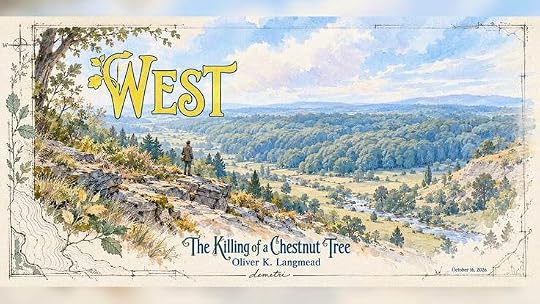
Across shale, stream, and valley, the silent beech forest occupies the horizon as distance itself becomes warning.
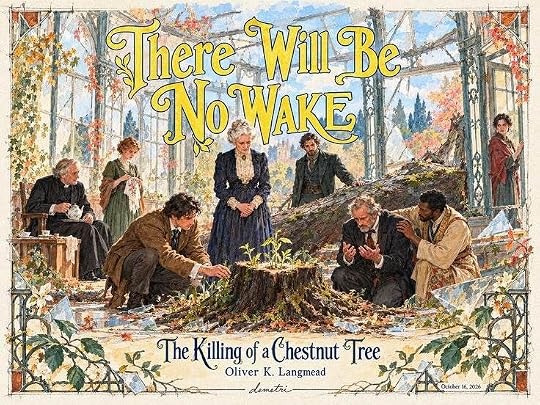
One green detail alters the whole prosecution. Havelock parts the grass at the base of the stump and finds shoots. “The Duke is not dead,” he says. “He has been felled, yes. But he lives.” Injury is not erased, nor is Bartholemew absolved; he must leave Farleigh. But punishment is redirected into responsibility, and the advancing beech forest is not burned preemptively. A problem that may take a century to mature is allowed something like a century in which to be reconsidered. The classical detective gathering has produced an answer, but not the usual pleasure of a door clicking shut behind it.
Around the Duke’s felled trunk, new shoots interrupt the logic of mourning and turn a detective revelation into the first fact of regrowth.
Placed beside Victorian botanical history, Heather’s fear looks less like modern politics smuggled into period costume. Royal Botanic Gardens, Kew now describes economic botany as an important part of British imperial expansion, including the search for, transfer and exploitation of useful plants for colonial and British industry. A miraculous productive forest would not have attracted admiration alone. Institutions existed to classify botanical value, move it elsewhere and put it to work. Farleigh protects itself through an almost comic reversal of empire’s accounting: its safest asset is its apparent worthlessness.
Outside the forest, Havelock and Sebastian’s concealment has equally concrete stakes. UK Parliament’s history of the 1885 Labouchere Amendment notes that Section 11 of the Criminal Law Amendment Act criminalized acts of “gross indecency” between men. In the novella’s approximate late-1880s setting, closed curtains and unpublished manuscripts are practical defenses, not merely melancholy symbols. Emmet and Henry eventually plan to pose as coworkers sharing lodgings, borrowing the older couple’s cover along with their example. Langmead rarely dramatizes persecution directly. More often he shows the domestic architecture built around its possibility.
Under such conditions, the novel’s kindness is not especially soft. These characters repair roofs, sew buttons, garden, gather fruit, make tea, study, write, forgive selectively and keep secrets for one another. The Empire burns forests; Bartholemew drives an axe into a beloved tree; Havelock and Sebastian carry psychological damage from another case. None of that vanishes because the book enjoys cake. Langmead’s wager is that suffering does not become more serious when ordinary pleasure is stripped away. Sometimes the counterweight to violence is simply the continued work of making a life habitable.
Late in the novella, that work begins to travel. Havelock and Sebastian return to London with fruit and a peach stone from Farleigh; a violin is made from the Duke’s fallen wood; the peach stone sprouts in their garden. Langmead dedicates “The Killing of a Chestnut Tree” to the memory of the Sycamore Gap tree. In September 2026, the National Trust reported a thick ring of new shoots growing from the real stump three years after its illegal felling. There is no need to invent a causal link between those shoots and Langmead’s ending. The proximity is affecting enough. A felled thing may remain grievously wounded without becoming past tense.
On balance, “The Killing of a Chestnut Tree” earns 87/100, translating under my Goodreads scale to 4.50/5. Its best work is done by the nested story, the seasoned tenderness of Havelock and Sebastian, the slow alteration of Emmet’s self-reading, and an ecological conceit that keeps becoming ethically less simple. Its deductions are less memorable than the uses to which those deductions are put. The long Part Three explanation genuinely costs the book some force, as does the occasional eagerness to say aloud what its own design has already communicated. Those are meaningful limits, not ceremonial reservations.
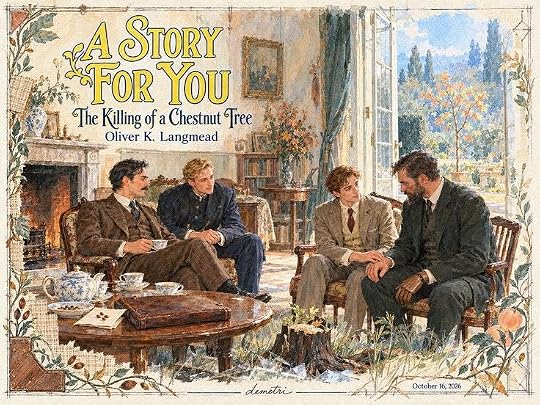
Seeds provide the last grammar. Emmet and Henry arrive at Gower Street together, and Emmet wears the French linen shirt Havelock once gave him. Sebastian initially stands beside the fireplace because that is where the public image of “the Major” belongs. After the younger men speak candidly about living together, Sebastian leaves his post and sits beside Havelock. The four go outside to inspect the peach sapling; Emmet leaves with apple seeds from Farleigh. Only afterward does Sebastian explain why Emmet’s sections have said “you”: this is not simply a story about him but “a story for you.” One hidden couple has not dragged another into the light. It has handed them something quieter: a model, a confidence, a few seeds. Whether they grow in public can wait.
Four men share the Gower Street parlour after disclosure, with manuscript, linen, touch, and the young peach tree carrying one hidden life into another.
Graphite underdrawing for “The Unfolding”
First watercolor wash over the locked “The Unfolding” underdrawing
Series lettering, tree-language, and border/rail specimen
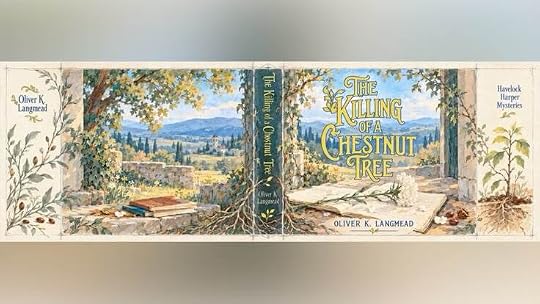
Alternate full dust-jacket watercolor with flaps
All watercolor illustrations by Demetris Papadimitropoulos. Watercolors are done on 140lb vellum and then scanned into the computer using an Epson scanner. From there, they are finalized in Procreate. No AI was used in writing this review — all art and opinions are my own.
Thank you so much to the MacMillan Audio Early Listeners Program for this ALC!
The Killing of a Chestnut Tree is a cozy “murder” mystery perfect for getting into fall. Since it is on the shorter side, I feel like it’s a great book for getting you out of a reading slump.
One thing I did not expect was the second person narration. I was like woah, I’m not doing anything but the book says I am. I thought that was an interesting stylistic choice by the author and I enjoyed seeing something new in the writing.
Sebastian is a fun narrator. I like how he inserts himself into the story, especially with phrases like, “Havelock described her to me as…” That was something else that was pleasantly surprising about this story. Who would’ve thought so many surprises would be hiding in a novella?
I also appreciated the kind of Russian nesting doll of stories effect. There are two narratives occurring simultaneously, which was a fun choice to see two different things going on.
Overall, I enjoyed this audiobook and I think I will pick up the next in the series given the opportunity.
Consulting Detective Havelock Harper and Major Sebastian Wright are known far and wide for their crime solving skills. They've solved so many that they even have a backlog to publish in the papers. When the Duke of Farleigh is killed, of course Havelock and Sebastian travel to Farleigh Forest to unwind the murder. Only, the duke isn't a person, but an ancient chestnut tree, part of a network of trees who live in community and talk to each other and to the people willing to listen.
"Be Gay, Solve Crimes" is the tagline of this cozy Sherlockian style mystery with light fantasy elements. Havelock and Sebastian are lovers, and in the frame story we meet a young man with a tendre for another man, for whom it is important to see the truth of the detective's relationship. The frame story actually provides a sweetness to the novella that I really appreciated, setting the overall tone as gentle and just a little bit whimsical. The mystery itself is a little odd, as things in a traditional Sherlockian style can be, but overall fun to unravel. I will certainly read more in this series!
The audiobook was fun to listen to, again helping to set a tone. That said if you have trouble with frame stories and some shifting timelines, I'd recommend sticking to your eyes for this one.
Thank you to Tordotcom for an ARC and MacMillan Audio for an ALC. The Killing of the Chestnut Tree is out 10/27/2026.
The nitty-gritty: Clever, charming and romantic, The Killing of a Chestnut Tree is the perfect bite-sized, feel good tale for our times.
I’ve been a fan of Oliver K. Langmead since 2015 when I read and loved Dark Star, and he continues to surprise me to this day. The Killing of a Chestnut Tree is a bit of a departure from some of his other books, but I love this new direction. This is the start to a mystery/detective series that takes place in the UK and is set in the late nineteenth century, following a detective with a distinct Sherlock Holmes flavor. But what could have been just a standard mystery is something else entirely in Langmead’s hands. The “story within a story” format is one I love, and it works remarkably well here. And bonus, The Killing of a Chestnut Tree is a delightful, feel good queer romance, and I could not stop smiling while I was reading it.
We follow Havelock Harper, a famous London detective whose cases are serialized in the Times. He’s assisted by Major Sebastian Wright, who also happens to be the narrator of the story. Their latest case takes place in a remote, forested area where the Duchess of Farleigh House has called upon Havelock to investigate the death of the Duke of Farleigh. When Havelock and Sebastian arrive, they are surprised to find out that the “Duke” is actually a large chestnut tree, and a nearby axe suggests that someone chopped the Duke down.
As the two men begin their investigation, they discover a town that has been keeping secrets from the outside world. Each person they meet brings them closer to solving the mystery, but Havelock’s keen sense of observation picks up on unease below the surface. Because the town of Farleigh is divided, and in order for everyone to come together, Havelock must uncover the reasons behind the Duke's murder.
What I’ve described above is only part of the story, and that’s what makes The Killing of a Chestnut Tree so unique. The mystery of the Duke’s felling is framed by yet another mystery, one involving two night watchmen named Emmet and Henry who, on their rounds one night, discover white flower petals strewn all over the ground (and no flower bearing plants in the vicinity that could account for the petals). Emmet is a huge fan of Havelock Harper, and so he decides to ask him to help solve the mystery. Havelock agrees, and this is where the story of the Duke enters the picture. The way Langmead weaves these two tales together is simply brilliant.
The mystery of the Duke’s “murder” is fairly complex and involves much more than just the townspeople of Farleigh and the individual who committed the crime. The history of the town plays a big part and adds a nice extra layer to the story. Havelock is a wonderful character who is not only driven by the mystery but also wants to understand the motivations of the possible suspects, and his ability to intuit the truth was remarkable and highly entertaining.
As for the romance, it isn’t the main focus, but the story wouldn’t be nearly as engaging without it. The time period makes it nearly impossible for queer people to have open relationships, so the characters struggle with their feelings quite a bit. But the romances—yes, there are two!---are so sweet and real and added the perfect, light-hearted touch.
And I have to mention the trees of Farleigh Forest, which are very important to the mystery. Langmead’s heartfelt message to save forests from destruction (like logging and construction) will resonate with many readers, and the trees have a very cool surprise that I won’t reveal here. I loved the scientific facts the author adds about trees and the ways they communicate with each other, and you will probably come to love and respect these trees as much as I did.
Everything is wrapped up nicely at the end, but Havelock and Sebastian will return! I am already excited to read their next adventure, The Chrysalis Conundrum coming out next year.
Big thanks to the author and the publisher for providing a review copy.
4.5/5 stars ------ Dearest Major Sebastian Wright,
I stumbled across your manuscript written for Mr. Emmet Parson and felt it necessary to address you directly despite us being separated by the Atlantic Ocean and nearly 140 years. Though you have long since passed, I trust that somehow my words will find their way to the right people.
The manuscript I speak of (considered a novella by today's standards) detailed two mysteries: "The Flowers of Cavendish Mill" and "The Mystery of Farleigh Forest". The former involved Mr. Parson and his partner, Henry, while the latter featured yourself and Mr. Havelock Harper.
While I understand the manuscript was never intended for my eyes, it will be celebrated the world over thanks to Mr. Oliver K. Langmead.
First, I am happy to report that the collective efforts yourself, Mr. Harper, and the inhabitants of Farleigh took were a success. Farleigh Forest remains protected and a secret for I only learned of its magic through your own recounting of your time there with Mr. Harper.
Second, I was most struck by the love and tenderness yourself and Mr. Harper shared over the years, hiding in plain sight while longing for a day when you could reach for each other without fear of retribution. That Mr. Harper so quickly understood the truth of Mr. Parson's mystery, and that your words to him, Major Wright, would grant permission for others like you to feel brave enough to move towards love... well, it is a beautiful thing.
I wish you could see how much has changed in the decades between us. While the world is still often fraught with violence and danger for those who love differently from what Empire and church might dictate, there is also much more freedom, acceptance, and agency for those like us to live and love out loud.
You and Mr. Harper kissing in Trafalgar Square or sharing affection at a royal garden party would be a common sight today. The dreams you felt were possible have come to fruition for many across the globe.
Your stories delighted me, and I'm grateful to have spent a little time in your world of speaking trees and falling flowers. I am so glad you documented them so that your adventures and your love might live on.
Very few books have captured the sense of melancholic awe of the sheer beauty of the world quite like The Killing of a Chestnut Tree by Oliver K. Langmead. Many thanks to the publisher Tor for making an eARC of this book available to me. I am quite happy to say that I adored this novella.
The Killing of a Chestnut Tree is, on its surface, a mystery tale following in the footsteps of Sir Arthur Conan Doyle, following an investigator aptly named Havelock and his trusty sidekick and teller of his stories, Sebastian. Yet, using this well-established framing, this novella uses its mystery not to investigate a bloody murder but, instead, the felling of a tree—a mundane act in a world where most of us can ‘knock on wood’ at a moment’s notice due to its sheer ubiquity in our every-day lives. From this premise, the book builds a story brimming with quiet admiration of the hidden beauty of the natural world. This book uses a fantastical premise to illuminate aspects of nature that are easy to forget, and to urge the reader to really stop and reflect on all about the world impossible for one person to recommend.
Moreover, Langmead weaves together these quiet wonder rainy, melancholic undertones: in interrogating its themes of nature and awe, the book builds a beautiful yet, at times, somber atmosphere. I don’t want to say too much more and spoil the nuance or give too much away, but the way the book intertwined is themes of the natural world with its themes about queerness and love were stunning. There is little I love more than a novella that leaves you speechless, and this one truly did. Though the pace of book is a bit slow and there were some aspects I wanted a bit more exploration or investigation of, overall, this book was simply stunning.
I am happy to recommend This Killing of the Chestnut Tree to other readers seeking deep, reflective journeys packed into a book you can finish in an evening. I am happy to have read this book and sincerely hope to see more in this series. I do recommend this book with the caveat that it is a deliberately-paced novella, and much about the characters remains unexplored—something that I know can frustrate some readers but, for me, it leaves me excited to read the next installment.
Sherlock Holmes and Watson, but make them gay—if you’re one of the people who still think they were straight.
Holmes, I mean Havelock Harper, is a famous consulting detective, and Major Sebastian Wright is his roommate, investigative partner, chronicler, and secret bed partner. Wright has published some of their cases, and the stories have become a sensation.
The Killing of a Chestnut Tree gives us a mystery inside a mystery. The framing story is written in second person, with Wright directly addressing a night watchman who has come to Harper and Wright with a mystery of his own: flowers have begun mysteriously appearing while he is at work. I’m not generally a fan of second person, and I didn’t particularly enjoy it here either, although there is a reason for the choice that becomes clear by the end.
The mystery Wright shares with the night watchman is delightfully ridiculous. Sherlock Holmes stories could occasionally get within about two hairs of magic while still insisting everything was perfectly logical. This one gets about one hair past it, and everyone simply agrees not to discuss the magic part. I decided to go along with them.
It’s cute and knowingly Holmesian, complete with the grand gathering where the brilliant detective explains exactly how everything happened. That scene did go on a little too long for such a short novella, but overall this was a fun little mystery with a sweet framing story and two sets of men finding one another in very different ways. This is listed as the first in a series, and I’d happily join Harper and Wright for another case. 3.5 stars
Thanks to Tordotcom, Oliver Langmead (author), Macmillan Audio, Edelweiss, and Libro.fm for the digital review copy and advance listening copy (narrated by Peter Wicks) of The Killing of a Chestnut Tree. Their generosity did not influence my review
Many thanks to NetGalley and Macmillan Audio for this lighthearted novella, which was a welcome change after reading some very heavy books lately.
With a definite Sherlock Holmes feel, Havelock and his sidekick Sebastian are called in to investigate a rather unusual crime: the death of the Duke in the picture-perfect Farleigh Forest. What begins as a rather strange case soon reveals more than expected about the forest and the locals that live there. Meanwhile, there’s another mystery to solve, with an anonymous person leaving flowers at the factory.
I occasionally found the switches between the two storylines a little confusing, particularly when the interludes jumped in, but there’s a delightful playfulness to the storytelling that kept me entertained with a fun conclusion to both stories.
The narration was a real highlight, with the perfect British accent bringing the characters and setting to life. I found myself greatly enjoying the relationship between Havelock and Sebastian, with the exploration of how society at the time judged their ability to interact truthfully adding a little social commentary plus a lovely romantic element to the mystery.
A cosy mystery with a historical fiction feel, a touch of whimsy and plenty of charm. This was a lovely bit of escapism and exactly the kind of lighter read I needed.
Thank you to NetGalley, MacMillian Audio, and Oliver K. Langmead for the Advanced Readers Copy of The Killing of a Chestnut Tree!
The Killing of a Chestnut Tree is a historical fiction mystery that follows two chummy and entertaining gay men that solve crimes together, this one around the felling of a tree. The narrator did a beautiful job at hooking me into the story. Due to this book being a story within a story, I struggled a bit at first to gain my bearings with where the story was. However, as it progressed, I enjoyed the way it was told and the overall picture came together. I haven’t read many books that utilize second person perspective the way this one does and it challenged me. I enjoyed the characters a lot and the way that gay love has been around and fighting for visibility for many centuries. I enjoyed the reveal at the end and how the story ended very much. Very big book if you’re a nature person and/or arborist!
I received a copy of the book from the publisher via Netgalley; any opinions are my own.
This was such an interesting and cozy novella! I wasn't expecting the framing device, but I think it really worked for this story, and I look forward to seeing how it shifts for future installments in this series. I also partially listened to the audiobook for this one, and I thought the narration was great and very much fit the characters.
The mystery was to cozy for my taste, so I did not ever care what happened to the tree. The relationship is already developed and while there is yearning I felt like I was watching their love story from a mile away with binoculars. That being said I felt very detached from both mystery and characters.
Thank you to Tor Publishing Group / Tordotcom for sending me an advance copy in exchange for an honest review!! Anyone who knows me knows I don't often dwell in the cozy mystery-romance section of the bookstore... BUT this novella has made my heart grow three sizes this day. This was a delight!
It's hard to believe that Havelock Harper makes his debut here rather than in a long series of prior novellas, since both Havelock and Sebastian feel so deeply grounded as characters already. Their relationship was heartwarming and not completely unrealistic considering "the times". I also really loved this book's perspective: super refreshing and a nice twist on the traditional Sherlockian detective story, one that I hope will become a staple of future instalments.
The mystery itself was delightfully silly, albeit a bit convoluted in its answer. Despite that and some noticeable repetition, The Killing of a Chestnut Tree put me at ease, as if I were invited into Farleigh myself to partake in the mystery and the ambience.
I hope there are a dozen more of these coming. I will happily read them all.
This was cute and fun but MAN oh man did I wish it was a full-length novel. It needed another 100 pages to really make you feel one with the story. It just felt so short and easy that it made me not really ever feel like I was IN the story.
My thanks to NetGalley and Tor Publishing Group for an advance copy of this book about a detective, his loyal companion, a lost village in England, trees that can talk, flowers, a murder, and much more.
My first Sherlock Holmes story was the The Red-Headed League. I thought the title was interesting, being a red head, I remember that much, but even now I am unsure why I would have read a book about a time of carriages and gaslight, being so young. However, I do remember liking it, along with the other stories in the collection. And wanting to read more. As many who enjoy Holmes and Watson adventures, it wasn't just the mystery, or or watching Holmes put things together, it was the characters. Even at a young age I knew these men were friends, even to the end. Holmes telling Watson to stay home, Watson putting revolver in pocket and limping along to help his friend. The worries by Watson about his friend's health, and addiction. Those moments when Holmes would disappear on a case, leaving a worried Watson to wonder what could have happened. Which is one of the many reasons I enjoyed this novel so much. Characters who care about each other, as well as a mystery that constantly left me guessing, in a story that went to many different places. The Killing of a Chestnut Tree is the first in a new series, written by Oliver K. Langmead, about a detective, his companion, a murder, a tree, a village full of secrets, and of having to keep secrets, especially about love.
The book begins with two watchman sharing stories from the newspaper about a dashing detective and his many adventures. The watchman begin to wonder if they have a mystery as flowers are being found around the factory they are protecting. One of the watchman goes to the home of Havelock Harper, consulting detective, a man famous for solving difficult cases, along with self-appointed bodyguard and roommate Major Sebastian Wright. Harper tells the watchman there is a case to be solved, and tells him that they will be in contact. Instead the watchman receives a copy of a mystery case that has never been revealed, one he shares with his fellow guard. The story goes that Harper is asked to solve a murder in a small town Farlaigh, where a Duke has been killed. The victim though is far different than what they expect. Farlaigh is a town that is happy with the way things are, for the town has a bit of mystery in itself. The trees seem to communicate, with messages in their bark. As Harper and Wright investigate, they find more than they expected a town in fear of invasion, of whispers and axes in the night. And maybe something more.
A story that kept me guessing the whole way through, with an ending that made sense, and even wondering why someone was cutting onions as I was reading. A book that crosses many genres, seemingly a bit of a fairy tale, a bit of folk horror, a bit of lost civilization. And even a romance. For a slim novel there is much going on, and I really felt invested in the characters, the story and wanting to know more. Langmead has created more than a Sherock Holmes pastiche, Langmead has written a story that takes the best of a variety of stories, mixes them up and makes something new. The writing is very good, the characters, even the smallest ones are well developed, and readers are left with a lot more at the end than expected. Hope, a very rare emotion today fills this book.
Trees, fear of colonialism, love, honor, taking care of others, and living life the way one wants. Plus a really eerie kind of mystery that I don't want to give too much away on. This is the first of a series, a series, I really can't wait to read more of. As well as anything else by Oliver K. Langmead.
Thank you NetGalley and Tordotcom of Tor Publishing for the chance to read this wonderful ARC!
All of England follows the tales of Havelock Harper in the local paper, written by his companion Major Sebastian Wright. Yet there are some cases that the public doesn't know about-such as the "Mystery of Farleigh Forest". In this one, the duo find themselves in the remote county of Farleigh at the behest of the duchess to find out who killed the duke. Yet when they arrive they discover that, not only is the victim a chestnut tree but also many trees of Farleigh grow words on their branches. Both are intriguing and perhaps connected? It's up to Havelock to find out!
Ah this is such a lovely queer Sherlock Holmes-esque story! I found it both a delight and intriguing that much like the original Holmes stories are told in Watson's point of view, Havelock's stories are told in the Major's point of view. This adds so much to the story since with the use of the first person narrative, as it introduces another character as "You" or rather the character who also follows along with the "Mystery of Farleigh Forest," given to "us" by Havelock himself, in order help "us" with a mystery of "our" own that brought us to his doorstep.
The town of Farleigh is definitely charming and mysterious, with its mysterious trees and its characters. The humans of Farleigh really add to the town, many of them have their suspicions about who could have felled the Duke. They also have a variety of views on the forest, the town, the world outside of Farliegh, each adding a bit more to the mysteries Havelock and Sebastian find there.
While this is probably the most low stakes cozy mystery I've read-after all the main victim is a tree, possibly magical, but still-it does resonate with many problems that progress and colonization have brought onto the world. This world is still very much the Victorian Empire that Sherlock Holmes investigated with it's discriminations and wars, though Havelock's world does have a bit more whimsy-thank you trees-and hope that time will overcome such things. Many of the characters ponder and fear what would happen if folks outside of Farleigh knew of the trees and their words. I found myself pondering myself if such a forest were found in our world and I must admit I have the same fears but also the same hopes that there would be those who would wonder and protect such a place.
Overall, I found this book to be so refreshing and warm-definitely a good for those that want something light but still intriguing. I hope that we are going to see more Havelock cases!
Favorite quote: "Havelock tells me that love reveals love-that seeing it in others helps you recognize it in yourself-and I have rarely known him to be mistaken about anything" (Really sweet and I feel really fits many themes found in story). Though a close second is (Havelock)" 'Oh, yes. I am to be knighted next Wednesday.' (Sebastian) 'Really?' 'Of course not. If it happens, you'll be the first to know.'
📖 Pre-Reading Thoughts Sherlock Holmes may have inspired countless detectives, but it's always interesting to see what a new writer brings to the formula. A Victorian mystery involving a talking forest certainly sounded different enough to catch my attention.
📚 Post-Reading As I thought...
Oliver K. Langmead wears his Sherlock Holmes inspiration proudly. The Killing of a Chestnut Tree has all the hallmarks of a classic Victorian detective story, from the brilliant consulting detective and loyal companion to the carefully layered mystery at its heart. Presenting the novel as a secret case file hidden within another story is a particularly enjoyable touch, adding an extra layer of intrigue before the investigation even begins.
The mystery itself is well constructed, balancing a traditional murder investigation with a delightfully unusual central premise: the trees of Farleigh Forest have begun to communicate by growing words into their bark and leaves. It's an idea that feels quietly magical rather than overwhelming, allowing the investigation to remain the focus.
It surprised me by...
How readily everyone accepts the supernatural element. Coming in with little experience of Sherlock Holmes beyond its cultural reputation, I wasn't sure whether this was in keeping with the classic stories or a deliberate choice by Langmead. Either way, once I accepted the premise myself, it became easy to settle into the mystery.
At just over novella length, the story moves at a satisfying pace and would make an excellent choice for anyone looking for a mystery they can enjoy over a couple of evenings. The ending leaves plenty of room for further adventures, and I'll certainly be interested to see where the series goes next.
👀 Who I'd Recommend It To Fans of Sherlock Holmes-inspired mysteries Readers who enjoy folklore woven into detective fiction Anyone looking for a quick autumnal read Lovers of cosy mysteries with a magical twist Music: something with gentle strings and woodwinds, or a quietly mysterious folk piece.
Vibe Check: Fallen leaves crunching beneath your boots, amber light filtering through ancient branches, bark etched with impossible words, damp earth after rain, the hush of a forest that is trying very hard to tell you something.
Tarot: Ace of Swords
Havelock uses all his faculties to see through the confusion around what's happened and who's played what part. The sparks of inspiration may be spread out throughout this story, but they come together to form a solution.
The Killing of a Chestnut Tree is one part historical cozy mystery, one part queer romance, and one part magical realism. This novella takes the bare bones of Sherlock Holmes and imparts a cozy overlay focused on relationships and the soothing magic a forest provides to unsettled souls.
The "Sherlock and Watson" duo of Havelock Harper and Major Sebastian Wright is at once close to the source material and also very different. Wright, similar to Watson, serves mostly as the narrative device by which we readers are granted the stories. This works well, but for a modern audience it may seem that Wright has no agency of his own until the end. For example, we get descriptions of a person based on what Havelock tells Major Wright, not the Major's own opinions. Havelock is much calmer and focused than Holmes. The romantic relationship between Havelock and Wright is a key component of the story and is mirrored in the two other gentlemen who begin the novella.
The magical realism comes into play with the trees. It takes a little suspension of disbelief for the answer to why the trees are "speaking," but it is a compelling part of the story. The mystery plot is well done and makes sense. There are several suspects and clues to pick up along the way. In true Sherlockian fashion, Havelock spends a good bit of the end expounding on his conclusions which seem conceivable and clear.
The prose begins in 2nd person POV. This may throw off some readers as this isn't a perspective that is often used. It does make sense as you read along and discover the reason. The rest of the book focuses on the Mystery of Farleigh Forest and adopts an easy storytelling tone. Even though this can be read like a detective story, it is very cozy in feel — even the "murder" is lessened by having the victim be a tree!
Thank you to NetGalley and Tor for the opportunity to read the eARC of this novella. I would recommend for those that want a low-stakes detective story or a relaxing read, something that will both flex your sleuthing skills while also making you smile and wish you were in a forest of word-smith trees.
The Killing of a Chestnut Tree by Oliver K. Langmead is a quick, sweet, and cozy historical read. Detective Havelock Harper is a Sherlock Holmes homage with Major Sebastian Wright as his partner in every sense of the word. They are a loving and lovely couple who work together to solve crimes, which Wright then publishes in the newspaper in serial form. In this book, they investigate the felling of a much-loved chestnut tree known as “The Duke.” What they find in the peaceful village and extraordinary forest surrounding the scene of the crime is beyond explanation, and must be protected from the wider world. How will they determine who in the hidden, pacifist village could have committed such a devastating crime? And how will their lives be changed by what they’ve discovered?
Woven through the narrative is a deep love of nature and an appreciation for the difficulties and beauties of rural life. There are the trees themselves, who communicate in the most unexpected ways. There are the villagers, who are surprisingly diverse in their backgrounds and experiences. And there is the Duchess, who is formidable in her old age, and would do anything in her power to protect the secrets of the village.
Havelock and Sebastian’s relationship is a mutually-loving and established one. While they hide from society in an era where queer love is illegal, in private they are tender and affectionate. A shorter (and somewhat confusing) story takes place alongside the main narrative, in which a young man is given the manuscript of this case and realizes that he and his work partner are more than friends. I didn’t feel that the overstory added much to the book, but it was also sweet and cute. I am curious to see how these characters interact in future books.
Overall, I gave the book three stars. It was enjoyable, but didn’t capture me the way a four- or five-star book might.
Recommended if you enjoy: Cozy mysteries Stories about English village life Short, sweet, queer reads
Thank you Macmillan Audio for providing this audiobook for review consideration via NetGalley. All opinions are my own.
Oh, this was a charming little listen. This is a great choice for a cozy story for fall.
The narration is excellent. The rich and melodic tone of voice actor Peter Wicks brings a lot to the story. He sounds like a gentleman ‘of the era’ and I felt like I had stepped into the past.
The only thing that keeps me from giving the narration a perfect score is that it was hard to distinguish Sebastian’s inner monologue from his speech, and also sometimes hard to tell different characters apart. This wasn't helped by the text lacking much to indicate who was talking.
This is a Sherlock and Watson pastiche, only this time, they're blatantly gay rather than just having gay subtext. The book is rather chaste, with the two of them having a long-standing and abiding love. It's not spicy. But Sebastian is utterly smitten with Havelock and it's all very sweet. Langmead follows the style of Arthur Conan Doyle quite closely in this, with the book delivered through the perspective of Sebastian, just as John Watson would.
The setup was interesting, with a low-stakes case in their present time mingling with the text of a manuscript about a past case. This worked well and I was interested in both plots. The main mystery was a bit of a flop, the why of it all was a little lackluster and Havelock drew conclusions the reader didn't have enough information to deduce for themselves. But the present day case was touching.
I really enjoyed this one and will be listening to or reading any future books in the series.
"It's a fine day. Why don't we enjoy the mystery?"
I listened to this little novella as an audiobook, and despite being so short, it felt a bit like it dragged on. The pacing was rather odd. I didn't do my research before reading the book, so I didn't realize there was going to be any element of romance in the book until I was 60% through the book. It was certainly vague and not discussed much until the very end. As I am personally not a fan of reading queer romance (or hardly any romance at all), I was glad that it was mercifully light and closed door.
It was very odd that the book shifted back and forth between first and second person. That was very off-putting for me.
I appreciated the magical and ecological elements of the story, but was disappointed in how the mystery was wrapped up. The detective starts explaining what happened by 70% into the novel, and the explanation is not one that the reader could have possibly come to based on what had happened in the book, so it felt long-winded and unsatisfying.
I also felt that most of characters lacked depth. Perhaps if the book were longer we would have come to understand the characters better, but in such a short time, most of the characters felt flat, and the secondary and tertiary romances in the book seemed completely unnecessary and somewhat unbelievable within the overall story.
Pretty cover, but ultimately a let down.
Thank you to Macmillan Audio for providing this ARC for review consideration via NetGalley. All opinions are my own.
Langmead somehow created the coziest murder mystery of all time.
I adored this - the lovable characters, the mystery inside the mystery, the forest, the relationships, gah! This book was charming through and through. To sum the entire book up: 🥹
Havelock & Sebastian are a fantastic pair - Havelock's ability to glean so much from so little is critical for sleuthing, and Sebastian is both a sounding board and a talented writer for reporting their findings. But beyond the 9 to 5, their love for each other is precious, even though they are finding their way after a rather disturbing case. Additionally, the choices they made during and after this case prove they have everyone's interest at heart, even strangers ❤️
"Havelock tells me that love reveals love - that seeing it in others helps you recognize it in yourself-and I have rarely known him to be mistaken about anything."
I am so glad I did not read the full bio, which I feel has some minor spoilers. No, it doesn't spoil the mystery, but I loved discovering who the Duke was (yes, yes, I know the title, but still!) and the magic of the forest as I dove in.
I am thrilled that this is a series; I can't wait for more mysteries with these two - and I hope we find out more about the previous case that threw things off course 👀
The Killing of a Chestnut Tree is a historical mystery following detective Havelock and his assistant/ lover Sebastian as they are summoned to investigate the murder of the Duke of Farleigh only to arrive and discover the victim is a tree. This is not the only mystery as the other trees of the forest have started to produce words written into their bark.
This is a quick and very experimental historical mystery that I have to at least give credit for being very out of the box and trying something different from the more traditional historical mystery. I will start with what I liked. I really enjoyed the framing narrative; The main mystery is framed as a manuscript being read with interludes throughout. These moments not in the story are all told is second person which made it feel very unique with a distinct narrative voice. I also really liked the detective duo and their dynamic a lot. It is essentially Sherlock and Watson but make them gay, what's not to like!
My issue is that the mystery was not super strong. It was definitely ambitious, but for me it was too short where we aren't given enough time investigating or getting to know the characters. I found it to feel way too rushed whin it had enough going on to be able to take a bit more time. Overall, it is a very interesting book, but not a favorite.
Thank You to NetGalley, TOR, and Macmillan for an ARC in exchange for an honest review!
Thank you to TOR/TORDOTCOM for the ARC in exchange for my honest review!
The Killing of a Chestnut Tree is a whimsical and charming novella with a wholly unique mystery afoot. Between Interludes, we follow renowned detectives, Havelock and Sebastian, as they are invited to a quiet town to solve the case of a murder. However, to their surprise, it was a felled tree known as "The Duke of Farliegh."
As they investigate the murder, they come to know the town and its people, and learn that it may have more mysteries than meet the eye. There is something unique about Farleigh Forest, a place where the trees tell just as many stories as its people do.
This book was a lovely mix of cozy and philosophical. It has the delightful charm of a historical mystery akin to How to Fake It in Society by KJ Charles, but leaves you thinking in a way that A Psalm for the Wild-Built by Becky Chambers might. It is queer joy personified, which is always very welcome in a historical setting. A perfect little mystery for those who just knew Sherlock and Watson were actually in love.
I at times felt that the Interludes took me out of the story, so I just wished that they had been expanded upon. Otherwise, a very pleasant read that made my brain feel calm. I see this is the start of a series, and I am gladly anticipating the next installment!