Jump to ratings and reviews
Rate this book

The Archives of Varok #3

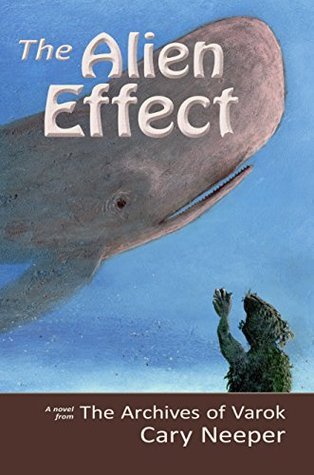
The Alien Effect

Rate this book

Raised on the Jovian moon Varok, the young woman Shawne longs to return to Earth and help her devastated home planet build a new civilization—one that can thrive for millennia. When she and her “mini alien invasion” set up a school in California, they face unexpected lessons of their own, unaware of the long-term consequences of their collision with life on Earth.


The third novel in Cary Neeper's Archives of Varok series, The Alien Effect joins the characters from Nautilus silver medalist The Webs of Varok as they explore an alternate 21st Century Earth. With two more titles coming in 2015, the five-volume Archives of Varok travels from Earth to the Oort Cloud, with several stops in-between.

282 pages, Kindle Edition

First published November 3, 2014

395 people want to read

About the author

Cary Neeper

9 books32 followers
Current Blogs
---Book reviews of critical nonfiction appear on my Goodreads blog--re many issues now critical to today's threats and choices.
--Following new information re astrobiology:
https://astronaut.com/whos-star-chips...
--Exploring work on animal sentience in our animal friends' stories and current books--How The Hen House Turns at the Los Alamos Daily Post (http://ladailypost.com) monthly.

As the author of the Archives of Varok series--set in an alternate 21st century solar system, populated with three or more intelligent (see log lines below)--my challenge has been to stay as realistic as possible in order to portray the frustrations, challenges and solutions of our current dilemmas here on Earth.

Meanwhile, the Kepler discoveries have told us that we are very likely not alone in this universe, so it’s even more important to ask who we are as human beings, a major theme in the books.

In spite of the aliens, I’m realistic about facts like the enormity of space between stars and the energy and time required to travel anywhere else. We are actually isolated out here, so we had better take care of planet Earth, as portrayed in the Archivees.

It could be that one thing I have wrong is the Archives’ time setting of 20-70 C.E. We may not have so many decades left to pull back and get it right. At the same time, the complexity of our lives is real, so that anything we do has the potential to trigger significant effects in the long run, (the theme of The Alien Effect).
See:
https://eauthorresource.wordpress.com/

Here are the brief synopses of The Archives of Varok:
The View Beyond Earth
In a 21st C. Oz (our solar system plus close neighbors) a young woman finds herself in trusting her child's instincts.
The Webs of Varok -(Nautilus Silver Medal 2013 YA Division and ForeWord Finalist for adult scifi 2012)

The Alien Effect
As the mixed family continues to untangle their story toward a secure future, it illustrates how complexity works--i.e." nothing we do is inconsequential." Who we are and what we do matter.
An Alien's QuestOur young woman raised by the mixed family reviews religious philosophy and finds Meaning close at hand.

Besides The Archives of Varok, I have written book reviews for the Christian Science Monitor, technical papers, newspaper articles, and essays; produced two musicals based on a sci-fi spoof; conducted workshops; and taught courses in sustainability and complexity at the University of New Mexico-Los Alamos. My blogs include How the Hen House Turns for the Los Alamos Daily Post (stories from 40 years with domestic birds and dogs) and Who's Out There for astronaut.com

Ratings & Reviews

What do you think?
Rate this book

Friends & Following

Create a free account to discover what your friends think of this book!

Community Reviews

5 stars
3 (23%)
4 stars
1 (7%)
3 stars
4 (30%)
2 stars
4 (30%)
1 star
1 (7%)
Displaying 1 - 8 of 8 reviews
Profile Image for Denzil Pugh.
47 reviews5 followers
December 15, 2014
The easiest way to write a Science-Fiction novel is to do away with Old Earth. Let the action take place on some planet in a distant galaxy, long ago, or even better, lets just destroy Earth completely and let man explore the stars in their ragged looking spaceships, like some nomadic band of camel riders in the foreign desert. I guess it's Romantic that way, to push the future away, for the goals that mankind has reached and surpassed are so far away from us now, we could never reach them. Or at least, that's what we realistically think.

But of course, the Science-Fiction writer's most fervent wish is to bring the message of a better Earth back to his or her reader. Than mankind can be better than what he is now, knock down the obstacles that hold him back, find his way through the unknown and progress to a Utopia that must be reachable. There are frontiers out there, if only we could get past our own failings and reach them. However, the challenge for the writer is to portray an Earth that has changed sometimes beyond what we could even imagine it being, for the better or, more often, for the worse. A world of biological or nuclear wastelands, of endless pollution, of environmental catastrophes, or of a population that has to live in a world like The Fifth Element or Corsucant from the Star Wars series.
It's hard, really it is, because a story taking place on Earth has to contend with the myriad of issues that plague our homeland. It's possible to become overwhelmed by them. And more likely than not, if you bring the hope of progress to the reader, they will find cynicism and discouragement, as it's something that, given the condition of the world currently, it would be impossible to achieve.


I say all this as a preface to a review of Cary Neeper's third book in the Chronicles of Varok series, The Alien Effect. You can read the first two reviews here (A Place Beyond Man) and here (The Webs of Varok), and you must read the first two books first before this one (unlike the second book, which is easily read without the first). It's the first criticism of the book, that a prologue might be in order, to catch a reader, even if they have read the other two, back into the groove of the novels themselves. The third book continues Neeper's quest of bringing a palatable model of steady-state economics to the attention of the world. And unlike most other scholars on the subject, she's trying to do it through the application of the system in a fictional world. And unlike most other Science-Fiction writers, she accomplishes her goal with remarkable, robust characters with a similarly developed culture. The Varoks, Ellls, and Ahlorks (Nidok's dialogue is excellent!) are great alien races, who are developed by dialogue, which is the best way to write a Science-Fiction novel. I cannot praise enough the characters that Neeper has made. As a writer, she has this aspect completely mastered.

Unlike the first two books, the plot suffers from being on Earth, with all of the complexities that must be taken into consideration when dealing with the world we live on. I found some parts, especially on the boats out in the Pacific, to be gold mines of interaction between Alien and Human, places where the general plot can be fleshed out. I would have loved to have heard the conversations between Orticon and the Captains, or Nidok and the humans aboard ship. The plot twists, the sudden storms, the traps laid by fishing vessels, they tend to just appear, in a couple of sentences. The difference between this book and the other two is that the plot in The Alien Effect is progressed by external events and directions, whereas the first book took place within a small moon-base, and The Webs of Varok took place on a small, hidden moon of Jupiter. The crises in both novels were internal, happening within the minds of the characters. In The Alien Effect, Neeper has to bring that conflict to Earth, to handle the problems and complexities of bringing the Steady-State system of Varok to our own planet.

In most Science-Fiction stories, like Neal Stephenson's Anathem, for instance, this problem of plot isn't a big deal. I love Anathem, and as long as I don't have to worry about the plot, I can read that book forever, with its philosophical conversations filling pages upon pages. But again, bringing the setting to Earth makes doing this much more complicated. The scenes with Shawne at the Economic School on Earth tends to become a background issue, one that is mentioned only as a backdrop for Shawne's moods and her attraction to visitors later in the book. The idea of population control, one that is essential for Steady-State to work, is whisked away by objections by devout religious students, who suddenly disappear, taking their argument with them. The futility of Shawne's efforts with mankind becomes evident, and I'm not so sure that we don't need more of that hope here. This combines with the diary or textbook sections that talk about the actual "Alien Effect," which show that the actualization of Shawne's dream doesn't happen for millennia, and only because of extraterrestrial influences on human evolution (without the black monolith and the usage of "Thus Spoke Zarathustra"). This part also needed some fleshing out, with maybe some of the students becoming actual characters, which would have been great, as Neeper's ability to make outstanding characters would have added to this section. Shawne and the Varoks and Ellls could have had a Plato-like discussion which would have been essential in bringing the ideas of Varok to the fictional Earth and to our own world as well.

And while I criticize the book, I would easily rate it (on the Amazon scale) as 4 stars, because I've read the other two novels, am familiar with the ideas of Steady-State Economics, and love the interactions with the characters. This is never a problem at all with any of the stories, and is usually the main criticism I have of other idea-based Science Fiction novels. To see what I mean, without taking too long to wade through an entire book made by, say, Robert Silverberg or Clifford D. Simak (both have written amazing books, by the way, so I'm not saying don't read them, but just to throw out a quick example) go watch the first Science-Fiction feature film to hit theatres, Rocketship XM, which was covered by Mystery Science Theater 3000 in the 90's. This demonstrates how characters should not be created.

So to end the review part of this, go read the first two books, then read this one, and anticipate future novels, and you'll have no problem with the shortcomings of the third book. I don't either, actually, but as a reviewer I have to maintain an honest opinion of the book as written, separate from the rest of the books in the series.
**************

Now, to the ideas presented in The Alien Effect. All you have to do is walk into a Wal-Mart to appreciate the idea of runaway materialism that is plaguing our society. Mounds upon mounds of crap. It's all it is. I've presented many times the idea of material inflation. In fact, a great example happened to me just yesterday. I broke a coffee cup. I cleaned my office at work, and, finding an old coffee cup (with Brookhaven College on it, which is where I work), I decided to take it home and wash it. Well, I dropped the bag it was in, and broke it. Instead of weeping and ruing the loss of a cup which could have easily been the only one I owned, had I lived a century ago, I just shrugged, threw it away, and looked at the dozens of other ceramic coffee cups I have sitting on my counter. We have no problem with planned obsolescence, or of the casual ruin of the things we own, as we can always go out and get more, at substantially cheaper costs. It's is amazing how many brand name, high quality clothes I find at Goodwill for a fraction of the costs of getting something new. But walk into a Walmart, and you'll see mountains of product just waiting to be bought, used, set aside, and find its way to our growing landfills. And all for the boost of dopamine that Neeper talks about in The Alien Effect. It's so true. I've seen children scream and cry "I want a TOY!!!!" and, just to get the child to shut up, they buy him or her whatever trinket they want. More than likely, the object will either be thrust back into the parent's hand as the child runs off to gaze into the Vending Machines (you know, those little rings and rubber things in mysterious bubbles, just waiting to be bought, lottery style. That's Dopamine X 2!). The child didn't want the toy, they wanted the dopamine boost, as well as the feeling of attention and love that they got when their parent bought them something. Materialism and Love are the same thing. And that's something that has changed dramatically from even a century ago, when possessions were so much more valued, coming out of world-wide depressions.

It's easy to see, then, where the dopamine boost comes into play, with materialism at the store, with collecting of action figures and other worthless objects (and I know, I still collect the State and National Park Quarters), with the episodes of Hoarders, where throwing away anything will cause temper tantrums to erupt. Entire economies are based upon the buying of trinkets that cause that momentary dopamine boost, and there are whole factories of children in China hoping to make that boost happen. How much of that same boost, then, happens when people have yet another child? Can material inflation be extended to People Inflation? Why should we care if someone on the south side of Chicago gets into a gang war and is shot dead? There's always more people where that came from. The body count on the news rarely becomes news anymore, unless the death can be used by political parties or other organizations to increase negative emotions, and therefore, donations to their coalitions. But I digress. Why should we care about people at all if there are so many of them? And this attitude is in addition to the resources that those people use day to day. In essence, most of the issues of this world, from the Environment to Crime to Disease to Politics, come down to Population Control. This, too, is a result, especially in modern times, of a desire for brain chemical boosting. In other words, the erotic pleasures of sex. And as everyone knows, Pregnancy is a by-product of sex. As long as we have a system where continued child bearing is rewarded, and self-discipline is unnecessary, we will continue to see parents of 8 children walking around Walmart trying to keep their kids from screaming by buying them whatever they think they want at the time.

What I have been consistently impressed with by Cary Neeper's ideas (and by extension, the ideas of other Steady-State Economic thinkers), is that these ideas exist outside of current political modes of thought. While ideas like Carbon-Capping and Environmental Regulations sound like ideas right out of the Democrat's playbook to extend power over businesses, the ideas themselves are neutral in political ambition. The idea is to make the world a better place to live, and to sustain the world as a healthy place to live for all the inhabitants of the world. In other words, for mankind to live in a symbiotic relationship with the world that they value. I have said many times that, while I have no desire to join modern environmentalists and go hug trees (and you can start here for some ideas I have on the subject), I am earnestly a proponent of taking care of the world we live on. The ideas that Shawne had in her classes were ones that Conservative thinkers could agree on. I especially liked the idea of regulation and oversight by local, non-centralized governments. In Neeper's America, the Nation-state is decreased to geographical regions, such as the Pacific Northwest, or Southern California. The idea of Nationalism has waned as problems on Earth became too complex and too impossible for large governments (such as our own) to provide for people's safety. A great example of that is the recent Ebola outbreak. When the Federal Government refused to block travel from West Africa to different airports in the US, individual states enacted regulations. This sort of thing is the best way to maintain optimum living quality in any given area. This is also something that every Conservative should agree with. That Conservatives (of which I happen to be one) and Liberals can work, compromise, and achieve real solutions to major problems, is something that should be very exciting for anyone working to solve the world's problems. However, this dream fall short when it is blocked by politicians hoping to keep themselves in power and comfortable by the contributions of lobbyists. In today's world, nothing will get done at all on any subject as long as the political atmosphere of Washington DC continues to fester.

Lastly, I want to address the issue of technology. In this case, I disagree with the descriptions of The Alien Effect when they find technology to be an unneeded part of establishing a proper steady-state system. There are very few ways that you can fundamentally change the ways of thinking by any culture. Religion is one way. It takes a long time, to change the religious beliefs of any one culture, especially the entire Western World. The other one is Technology. And while technology can be used to further manipulate and entrench current thinking patterns into any given culture (see Neil Postman's Techonopoly), there are examples of fundamental changes brought about by technology that are immediate and obvious. The food replicators in Star Trek, for instance, or the wormhole creators in Arthur C. Clarke and Stephen Baxter's The Light of Other Days. Both these innovations would ultimately forever change the way we think. And I think there are technological breakthroughs which are quite within our reach that would do the same. Take Clifford D. Simak's Ring Around the Sun. In it, aliens (or a further evolution of mankind) start to mysteriously create light bulbs that would last forever. In getting rid of planned obsolescence, the economy of the world is changed in an instant. Razors, cars, houses, all that never break or wear down, and all made so that anyone can afford them. It breaks down the consumer society, and leaves us with no wants in the material sense. The dopamine push is gone, and then we have to find our chemical boosts in other ways, perhaps from exercise of the development of our own minds, the progress of mankind itself. This is what Roddenberry envisioned for Earth of the 24th century.

In the end, it comes down to those Millennium that Neeper talks about at the end of . It would, in that world, take countless generations before a Steady-State world would stabilize Earth, and in our finite mode of thinking, that's too long. Heck, in our world, something that takes more than a week is too long. If we can immediately change something to make it better (from Obamacare to a struggling Football team firing their coach...etc...) then that is something that must be done quickly. It might even be a band-aid, something to cover up the underlying problem, but that's better than actually solving the problem, because it's something that can be done quickly. When the solution would take more than an election cycle, or a football season, then why bother. We want pleasure and satisfaction now, not later... that doesn't give us bliss.

Noel Paul Stookey (and I'm going to mention this for the umpteenth time) said that there's two ways for us to miss things. One is if the world goes by too fast. The other is if we go by too fast. Some people look up one day and see a tree, fully grown, and they had never noticed, while other, more fortunate people, can simply watch the rings form. It might take half our lives to see a tree grow from seed to mature towering being, but the tree will be more worth it if we do. Same thing for our own world. It might take us countless lifetimes to make our world a paradise, but it will be infinitely more worth it when we do.
Profile Image for Mary.
1,155 reviews22 followers
September 25, 2015
What would happen if an alien species came to Earth to try to help humans and animals change their lifestyle in hopes of improving the environment? Author Cary Neeper has developed an interesting fictional story around this premise in “The Alien Effect”.

While this book is one of several the author has written along this vein, I felt that the characters and their circumstances were not clearly defined at the outset of this book. As a newcomer to these stories, I can appreciate that she wants each book to be a stand-alone, yet it was challenging to figure out who was who, how they were all inter-related, and what each character looked like. I got the impression that the author's strong suit is science and theory, but not necessarily clear writing to reach the reader as effectively as she hopes. Another area of confusion was the frequent switching from one narrator to another in the story; although there were some brief notes in the text on this throughout, it still was hard to figure out who was talking sometimes. I also found some of the terminology to be above the common reader's head; unless one was already familiar with this area of study, they might be left wondering what some of the terms refer to. I strongly disagree with a great deal of the author's politics, but this is a book review, not a debate. Her viewpoint is put forward in a rather preachy way. I do not believe that government should be allowed to dictate how many children one has. I also feel that we as humans have a certain wanderlust, and to quelch that by saying we should not travel to other places, but rather stay where we are and rely only on local resources, is denying who we are.

On the plus side, I think the writer delved into some real challenges that we face as we try to balance modern living with preservation of our world for the future. She explored what it might be like if an alien race stopped by and tried to help out. What would the long term effects on our ecosystem be if non-Earth-based life paid us a visit? Surely there would be repercussions, good and bad, and she remarks upon this with brief updates that lead us over a thousand years into the future after her story takes place. I think the characters involved in the main alien family that comes to Earth are basically trying to make positive change, even if I believe their goals are naïve and misguided. I think those on the far left political spectrum would find themselves agreeing with some of what is said in this book. It just isn't a point of view I can agree with. The author has created a strange and unique symbiotic family made of humans and two other alien species, and somehow she makes it work. I think that, more than anything else about this book, would help readers relate as it seems the most human thing about the story. We constantly are adapting and doing the best we can to survive and hopefully, leave something good for our children and grandchildren as we go along each day.

The book was published in December 2014 through Penscript Publishing House. I admire the author's years of research yet respectfully disagree with her educated opinions and theories. ISBN 978-3-62222-012-0. Suggested retail price for the paperback book is $14.95. I received a free copy of this book from Goodreads.com in exchange for an honest review.
121 reviews3 followers
December 9, 2014
The theme is important: how to create sustainability when people are focused upon growth. While I enthusiastically support that, I have to say the story is not as strong as it could be. The author has created some interesting aliens but the various voices seemed a bit muddled and I had to turn to the Appendices too often, trying to keep things straight. Too much "telling" as opposed to "showing." Nice illustrations, but I kept wishing they included portraits of the characters I was reading about and trying to imagine. Still, I'll continue thinking about the issues raised and the complications humans bring to the problems facing us. Interestingly (to me, at least) as I read this, my husband and I have been discussing ways to reduce our carbon footprint and have decided to become a "no car" family once again. A tiny effect, but as the book points out, tiny effects multiply as people do what they can.
Profile Image for Belinda.
648 reviews24 followers
November 14, 2014
Great characters from a strange and unique planet that we get little glimpses of, but not an adequate overview of, move to Earth to lead an economic revolution. The characters perhaps were fleshed out better in a previous novel however as I hadn't read any previous novels in this series it took too long become comfortable with how the family unit worked even on a very general level. When the book transitioned from the voice of Shawne to other family members the distinction was hard to discern even though the changes were literally marked in the book. (aka hard to distinguish a unique voice of the character) The underlying story line is good and I did enjoy it.

ARC Copy provided by Goodreads Firstreads
Profile Image for Avaminn F'nett.
73 reviews
January 15, 2015
I won a free copy of this book on LibraryThing.

This book was a really great sci-fi story. I liked how most of the alien species were very different from humans (with the exception of 1 type) because most sci-fi aliens are too similar to humans.

I definitely want to check out this author's other sci-fi books in this same series.
Profile Image for Cassy.
110 reviews3 followers
May 4, 2015
I received this book as a Goodreads winner. I felt like I was missing something when i read this book and I couldn't fully get into it. I then realized it was part of a series. So this book really can't be fully enjoyed as a stand alone novel.
Profile Image for Jessica.
410 reviews7 followers
July 24, 2015
I tried reading this book but found it was missing something but I kept reading till it was done to see if it would get better.
Profile Image for Machelle.
714 reviews9 followers
January 12, 2015
I just could NOT get into this book. I was lost from the beginning. I did not enjoy it at all.
Displaying 1 - 8 of 8 reviews

Can't find what you're looking for?

Get help and learn more about the design.