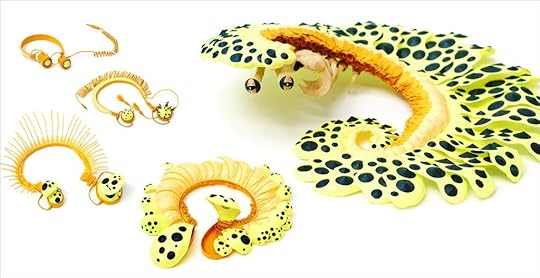
A wallet, a set of keys, a pair of glasses ― these are some of the household objects that disappear and are fantastically reconstituted in Cybèle Young’s inventive new picture book. Minimal text conveys the magic of a world where even inanimate objects are constantly undergoing a process of growth, transformation and change. An introduction describing the frustration we feel when we lose something is followed by a catalogue of misplaced objects. Each item is shown first in its original form and then, through a gatefold spread, is shown in the process of transforming into a marvelous and mysterious sea creature. At the very end of the book, we see these transformed objects in their new, watery habitat, a conclusion which will leave readers astonished by the distance they ― like the lost objects themselves ― have travelled. Some Things I’ve Lost invites readers to consider the inevitability of change and the power of the imagination. On finishing the book, children and adults alike will look more closely at everything they have previously taken for granted.
I think I missed something. I don't really get what the point of this way, and I didn't feel very interested in looking at the "transformed" items. Maybe I was in the wrong frame of mind.
I think I would have liked it better if the various items were actually remade into something, rather than revisioned as an evolution.
This seems more like an assignment for an art class than a book for kids.
I rarely, if ever, write goodreads reviews. But this book made such an impression, I have to.
As soon as I opened the first spread, I fell in love with this book. I just fell into the outpouring of creative artistry.
When I was taking college art courses, we did an exercise taking a motif from nature and expanding on it in five different ways. I took a peacock feather and emphasized or exaggerated its shape, its color pattern, its texture, and its design. This is just the beginning of what Cybele Young does here with lost objects.
Each of these lost items has grown and changed into something else similar but entirely new and this is why it cannot be found. Every item maintains its color pattern and form but changes into something incredible and beautiful. The 3-D cut paper artwork is organic and stunning.
This book stretches your mind into creative places you've forgotten. No, it's not your typical picture book for kids. This is an artistic primer for adults.
More of an art book than a storybook, each double-paged spread features the same elements. On the left side of the page, a photograph of an object that has been lost is shown on a sparse, white background. On the right side of the page, a caption that describes what the object is and it's last known location is also featured in relatively small type in a vast expanse of white. When you fold out this right side, you see a series of sculptures that show the lost object "growing" into something completely different. At the end of the book, all the sculptures come together to form an underwater scene.
This book wouldn't be a good fit for storytime at all, but would make an excellent gift book to elementary school students with an artistic eye or who enjoy looking at books that stretch their imaginations.
Are the illustrations aesthetically appealing? Yes. Definitely. But it's still kind of boring. I don't have kids and don't lead storytimes. So, maybe I am underestimating them. But this seems pretty high-concept. Honestly, I'm not sure even I really get the point. Then again, maybe kids enjoy looking at photos of abstract paper sculptures? Definitely a different kind of picture book.
This was weird. I was super excited about the fold out pages, but I don't feel like the book would really be entertaining for a child. The paper sculptures were truly awesome, but I felt like this was more of an art book than a children's book.
There is no denying that the paper sculptures are amazing, but they didn't make sense to me. Also, WAY more stuff went into them than existed in the original lost item, so there was a disconnect there.
i thought the pull out pages were cool, but I was kind of lost while reading it and didn't really understand what I was supposed to take away from the book, but it had some neat illustrations.
Explore a world of lost items that when lost change and grow and become something else. Figure one is a roller skate, laces flying that was last seen in the basement. Turn the foldout page to see it become something ethereal and unreal. The visor on the next page that was last seen on the lawn grows into something organic and living. One-by-one objects change into a landscape of imagination, becoming something far different than where they began but still having connections to the original object in form and color.
Done with almost no text except a description of the original items and where they were lost, this book is all about the incredible illustrations. Done in 3-D paper art, Young created not just the original object and the final transformation, but several stages in between where you see the clear connection between where we began and what it became. Part way through the book, readers will start to notice an underwater theme to the transformations, as we see coral, jellyfish, fish and anemones. There is a delicacy and luminous quality to the entire book, showing both the lack of permanence and the power of imagination.
Brilliant, surreal and completely amazing, this picture book is an inspiring look at creativity and imagination. Appropriate for ages 4-6.
Minimal text conveys the magic of a world where even inanimate objects are constantly undergoing a process of growth, transformation and change. An introduction describing the frustration we feel when we lose something is followed by a catalogue of misplaced objects. Each item is shown first in its original form and then, through a series of gatefold spreads, is shown in the process of transforming into a marvelous and mysterious sea creature. At the very end of the book, we see these transformed objects in their new, watery habitat, a conclusion which will leave readers astonished by the distance they, like the lost objects themselves, have traveled. Some Things I've Lost invites readers to consider the inevitability of change and the power of the imagination. On finishing the book, children and adults alike will look more closely at everything they have previously taken for granted.
Subject: Change -- Juvenile literature. Found objects (Art) -- Juvenile literature. Lost articles -- In art. Creation (Literary, artistic, etc.) -- Juvenile literature. Paper work -- Japan -- Juvenile literature. Japanese paper -- Pictorial works -- Juvenile literature. Picture books for children.
This very different book will make readers think and maybe reconsider how they regard commonplace objects in their lives or possibly how they react to losing something. While it is frustrating to lose or temporarily misplace objects, the author/illustrator wonders what might happen to them. With complicated and extraordinarily detailed paper sculptures, she unravels the twelve different objects to reveal what might be hiding inside an umbrella, a wristwatch, a lawn chair, among others, a well as telling where they were last seen. The pages fold out to show what she sees within each of those common objects. Perhaps there is more to each of them than is visible to the naked eye, and perhaps we should look more closely and more imaginatively to the world around us. This book was first published in Canada.
Outrageously beautiful. It's a book you'll come back to again & again because there is so much to see that you have to come back - like an art gallery. It's definitely one for the older kid crowd because the pages fold out and it's fragile.
Each page begins with a simple image and explanation, like an old-fashioned folding chair you would have had at a campfire or picnic and then it opens into something magical and unusual. There are layers and layers of colour and texture, all created by Young through her exquisite paperwork. It's endlessly fascinating and makes for a truly enjoyable book.
I was especially fond of the wristwatch page & am, as always, amazed that someone so talented exists in the world and chooses to lend her talents to entertaining and enlightening children.
Dreamy. Arty. Our friend Sam, who is twelve, said, "I'm pretty sure this is what happens to the stuff I lose," when we unfolded the gatefold pages of this book to see how a neglected umbrella turns into a jellyfish and a misplaced wristwatch becomes a carpet of anemones. Unbelievable paper sculptures by this Canadian artist (who is represented by Forum Gallery, in case you were thinking of picking up a little something for the children's book reviewer in your life).
What if the things you lost took on whole new shapes and forms, evolving into something completely unexpected? That's the idea Cybele Young takes and runs with in this collection of items gone missing. Everyday things evolve into mysterious and intricate creatures that hint at watery environs. Beautiful creations.
This has been produced/marketed as a children's picture book, but its lovely, clever creatures could appeal to any age. The fold-out pages will probably not do well in library books, but as a collection of post cards or wall art, these images would be lovely.
This book made me feel like the Walker Art Center's permanent collection does -- intrigued, confused, appreciative but without entirely understanding what the what or why the beans is going on. This book is sort of like that. A lost object morphs into a strange, imaginative creation. This is going to jell with young future art majors, especially those who get abstract and or modern art. For me personally, it's just not exactly my thing that resonates with me, heart and soul.
Here are amazing transformations from those ‘things’ lost like a set of keys, an umbrella or dad’s bag on the subway to eye-popping double-page paper sculptures of what “can be”. The brief text describing “what” is lost and where it was last seen amuses and tells quite a lot considering the few words used. For example, “Object: Binoculars Last Seen: Backyard--meteor shower.” It can be used as a mentor text for an art project or for a project showing change. Love book to read and see.
Oh! Wow! Fantastic! So cool! Those are the exclamations you will hear when you take a peek inside this unique picture book by Cybele Young. She creates paper sculptures of lost things and you will be amazed at what happens to those items as they morph. This book will inspire children to explore making art with paper. Tweens and Teens might enjoy a craft project based on lost items of their own. For ages 5+.
A small photograph of a lost object is shown on the left-hand page. The right-hand page lists what the thing is, and how it was lost. This page opens up to display the transformation the object has undergone to get to its final new form, something that belongs in a body of water.
It's very well done for what it is: a creative, unique, art book aimed at children. I don't know that this will become the favorite "read this to me again and again" of many kids, however.
Missing objects are presented as if they were on display in a museum included with a statement regarding the items' last known whereabouts. A pull-out flap reveals the creative alter ego of each item which comes together as an ocean diorama in the end.
Very artsy picture book. Not a read aloud book, but one that is beautiful to behold.
An artsy and unique picture book. Missing objects are presented on display with a title and last seen location.Pull out flaps reveal a creative unique identity for each object which creates an ocean in the end.
A fun book- appeals more to an older crowd. This would be a good coffee table book.
Have you ever wondered what happens to the things you've lost? Do they take on a new life somewhere? This book by paper sculptor Cybele Young will blow your mind. Key fobs take on a new existence as undersea tubular plants and umbrellas become jellyfish...explore the surprising world of lost things! Great book for inspiring an imagination as deep and boundless as the sea.
The pictures are beautiful, but I can't imagine they're very appealing to the Very Little Ones. The slightly bigger folk might have fun imagining what lurks inside everyday objects (or are the illustrations meant to show the creatures that have swallowed the lost items?), but this book is probably abstract enough to be more for adults.
Very interesting pictures that contrast the clean design. The pictures are very visually appealing and young's paper art creations are truly breathtaking. I found myself thinking, "I dont get it". While obviously the author is asking us to use our imaginations, I was disappointed with the continuity. Maybe the larger message was lost on me. Age: Preschool+ ECRR: Play