

What do you think?

Löwen.
Der vor einigen Jahren aus dem Nachlaß des Philosophen Hans Blumenberg (1920-1996) edierte Band umfaßt zweiunddreißig Betrachtungen, die Löwen beschreiben, kommentieren und ebenso erhellend wie erstaunlich und amüsant in Beziehung setzen. Die Funde reichen vom Prediger Salomo und von Euripides bis zu Thomas Mann, Odo Marquard und Oskar Lafontaine. Für die Neuausgabe schreibt Martin Meyer, langjähriger Gesprächspartner Blumenbergs, ein Nachwort.
»Das aus dem Nachlaß Hans Blumenbergs veröffentlichte Bändchen Löwen ist ein Beispiel für die Geburt der Philosophie aus der Anekdote – oder anders gewendet, die Kondensation der Philosophie in der Anekdote … Mit der intellektuellen Unerbittlichkeit des Weisen faßt Blumenberg seine Leseblüten in kleine Texte, deren Genre man noch klären müßte. Das eigentümlich Offene, das seltsam Unfaßbare, die höhere Konsequenz, mit der Blumenberg lächelnd auf die Welt schaut, kennzeichnen die Löwengeschichten. In manchen blitzt so etwas wie die Altersweisheit der chinesischen Parabel auf. Allerdings im europäischen Gewand, um nicht zu sagen im akademischen Talar.« Berliner Zeitung
»Das aus dem Nachlaß Hans Blumenbergs veröffentlichte Bändchen Löwen ist ein Beispiel für die Geburt der Philosophie aus der Anekdote – oder anders gewendet, die Kondensation der Philosophie in der Anekdote … Mit der intellektuellen Unerbittlichkeit des Weisen faßt Blumenberg seine Leseblüten in kleine Texte, deren Genre man noch klären müßte. Das eigentümlich Offene, das seltsam Unfaßbare, die höhere Konsequenz, mit der Blumenberg lächelnd auf die Welt schaut, kennzeichnen die Löwengeschichten. In manchen blitzt so etwas wie die Altersweisheit der chinesischen Parabel auf. Allerdings im europäischen Gewand, um nicht zu sagen im akademischen Talar.« Berliner Zeitung
- GenresPhilosophyGermany
Hardcover
First published January 1, 2001
About the author
Hans Blumenberg
70 books65 followersHans Blumenberg (1920-1996) was a prominent German philosopher, known for his work in intellectual history and phenomenology. He is best remembered for his development of "metaphorology," a method that investigates the role of metaphors in shaping human thought, particularly in philosophy and culture. Blumenberg's most famous works include The Legitimacy of the Modern Age (1966) and The Genesis of the Copernican World (1975), where he explored the historical and philosophical implications of metaphors and their transformative effects on human understanding.
Born in Lübeck, Germany, Blumenberg's career spanned several prestigious academic positions, including professorships at the University of Hamburg, University of Gießen, and University of Münster. His intellectual contributions deeply influenced fields such as philosophy, literary studies, and history of ideas. He was particularly concerned with how philosophical concepts were deeply intertwined with metaphors and how these shaped the intellectual trajectories of entire periods, like the Renaissance or the Enlightenment.
Blumenberg's work focused not only on philosophy but also on the philosophy of technology, language, and aesthetics, drawing from a broad range of sources, including phenomenology, historical analysis, and myth theory. His exploration of "absolute metaphors" — ideas that transcend their original metaphorical contexts and become integral to philosophical and cultural systems — marked a major contribution to postwar German thought.
Born in Lübeck, Germany, Blumenberg's career spanned several prestigious academic positions, including professorships at the University of Hamburg, University of Gießen, and University of Münster. His intellectual contributions deeply influenced fields such as philosophy, literary studies, and history of ideas. He was particularly concerned with how philosophical concepts were deeply intertwined with metaphors and how these shaped the intellectual trajectories of entire periods, like the Renaissance or the Enlightenment.
Blumenberg's work focused not only on philosophy but also on the philosophy of technology, language, and aesthetics, drawing from a broad range of sources, including phenomenology, historical analysis, and myth theory. His exploration of "absolute metaphors" — ideas that transcend their original metaphorical contexts and become integral to philosophical and cultural systems — marked a major contribution to postwar German thought.
Ratings & Reviews
Friends & Following
Create a free account to discover what your friends think of this book!
Community Reviews
Displaying 1 - 3 of 3 reviews

December 31, 2019
32 Miniaturen über den Löwen aus dem Zettelkasten von Hans Blumenberg. Ein Streifzug auf den Spuren, die Panthera leo in der Kulturgeschichte, von der Bibel bis zu Thomas Manns Tonio Kröger hinterlassen hat.
"Auch ohne naturschützerische Gebärde muß gesagt werden, daß eine Welt ohne Löwen trostlos wäre."
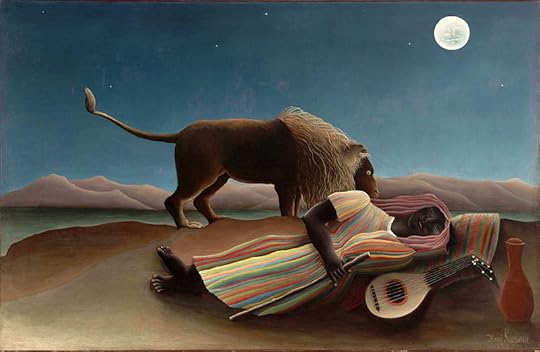
Henri Rousseau – La Bohémienne endormie
"Auch ohne naturschützerische Gebärde muß gesagt werden, daß eine Welt ohne Löwen trostlos wäre."
Henri Rousseau – La Bohémienne endormie
August 23, 2020
"Whoever is better at thinking catches more prey."
Only one other review?! C'mon, people.
Blumenberg was unfamiliar to me until I read this wonderful little collection of his essays, all having, more or less, to do with the titular king/queen of the beasts. His philosophy appears to center around the phenomenon of the metaphor and a zany idea that there is a poetical undercurrent to thought, kind of like Chomsky's Cartesian grammar thingy.
Anyway, that's all neat, but so are lions. These essays run a wide and often funny gamut. Biblical lions, actual lions, lions as poorly-represented in art, sea lions, Hitler and lions, zoos, humans as the only animal that keeps other animals, and so on.
Most are brief, never more than a few pages, all are pure, lovely genius.
Only one other review?! C'mon, people.
Blumenberg was unfamiliar to me until I read this wonderful little collection of his essays, all having, more or less, to do with the titular king/queen of the beasts. His philosophy appears to center around the phenomenon of the metaphor and a zany idea that there is a poetical undercurrent to thought, kind of like Chomsky's Cartesian grammar thingy.
Anyway, that's all neat, but so are lions. These essays run a wide and often funny gamut. Biblical lions, actual lions, lions as poorly-represented in art, sea lions, Hitler and lions, zoos, humans as the only animal that keeps other animals, and so on.
Most are brief, never more than a few pages, all are pure, lovely genius.

October 18, 2021
"As is so often the case, it is the perfectionists who, having known the disappointment of not living up to their own demands, produce the most compelling formulae of resignation as the human variant of perfection. It is their suffering that lends these formulae credibility: the passion of asking too much of oneself."
Displaying 1 - 3 of 3 reviews